Hubbry Logo
Depressor anguli oris muscleDepressor anguli oris muscleMain
Open search
Depressor anguli oris muscle
Community hub
Depressor anguli oris muscle
logo
8 pages, 0 posts
0 subscribers
Be the first to start a discussion here.
Depressor anguli oris muscle
from Wikipedia
Depressor anguli oris
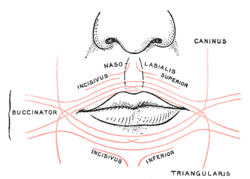
Scheme showing arrangement of fibers of Orbicularis oris (triangularis labeled at bottom right).
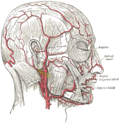
Muscles of the head, face, and neck (labeled as triangularis near chin).
Details
OriginTubercle of mandible
InsertionModiolus of mouth
ArteryFacial artery
NerveMarginal mandibular branch of the facial nerve
ActionsDepresses angle of mouth
Identifiers
Latinmusculus depressor anguli oris
TA98A04.1.03.026
TA22076
FMA46828
Anatomical terms of muscle

The depressor anguli oris muscle (triangularis muscle) is a facial muscle. It originates from the mandible and inserts into the angle of the mouth. It is associated with frowning, as it depresses the corner of the mouth.

Structure

[edit]

The depressor anguli oris arises from the lateral surface of the mandible.[1] Its fibers then converge. It is inserted by a narrow fasciculus into the angle of the mouth.[1] At its origin, it is continuous with the platysma muscle, and at its insertion with the orbicularis oris muscle and risorius muscle. Some of its fibers are directly continuous with those of the levator anguli oris muscle, and others are occasionally found crossing from the muscle of one side to that of the other; these latter fibers constitute the transverse muscle of the chin.

The depressor anguli oris muscle receives its blood supply from a branch of the facial artery.

Nerve supply

[edit]

The depressor anguli oris muscle is supplied by the marginal mandibular branch of the facial nerve.[1]

Function

[edit]

The depressor anguli oris muscle is a muscle of facial expression.[1] It depresses the corner of the mouth, which is associated with frowning.[1]

Clinical significance

[edit]

Paralysis

[edit]

Damage to the marginal mandibular branch of the facial nerve may cause paralysis of the depressor anguli oris muscle.[1] This may contribute to an asymmetrical smile.[1] This may be corrected by resecting (cutting and removing) the depressor labii inferioris muscle, which has a more significant impact on smiling.[1]

Hypoplasia/aplasia

[edit]

Underdevelopment (hypoplasia) or complete absence (aplasia) of the depressor anguli oris can occur.[2] Similarly to paralysis, individuals with these conditions will have an asymmetric smile.[medical citation needed] These conditions are rare, and develop at or before birth (congenitally).

See also

[edit]

Additional images

[edit]

References

[edit]
[edit]
Revisions and contributorsEdit on WikipediaRead on Wikipedia
from Grokipedia
The depressor anguli oris muscle (DAO), also known as the triangularis muscle, is a thin, quadrilateral muscle of facial expression situated in the lower face, arising as a superficial continuation of the platysma muscle. It originates from the oblique line on the outer surface of the mandible, typically just inferior to the mental foramen and spanning from the canine to the first premolar region. The muscle fibers converge to insert into the modiolus, a dense fibromuscular node at the angle of the mouth, blending with fibers of adjacent muscles such as the orbicularis oris and risorius. Its primary function is to depress the corner of the mouth and draw it laterally, facilitating expressions associated with frowning, sadness, or displeasure, thereby playing a key role in the dynamic modulation of the oral commissure. The DAO is innervated by the marginal mandibular branch of the facial nerve (cranial nerve VII), with occasional contributions from the lower buccal branch, ensuring coordinated lower facial movements. Blood supply is derived from branches of the facial artery, particularly the inferior labial artery. In anatomical terms, the DAO lies superficially in the cheek, overlaying deeper structures like the buccinator muscle and avoiding major neurovascular bundles in its typical course, though its proximity to the requires caution in surgical interventions. Clinically, the muscle's hyperactivity can contribute to the appearance of marionette lines or a downturned , often addressed through selective weakening via botulinum injections to enhance facial harmony and reduce signs of aging. In cases of , aberrant reinnervation of the DAO may lead to , where involuntary contraction disrupts smiling symmetry, prompting targeted therapies such as depressor anguli oris (DAO) resection or chemodenervation.

Structure

Origin

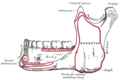
The depressor anguli oris muscle originates from the anterior portion of the oblique line of the , extending from the mental tubercle laterally to the region between the canine and teeth. This attachment site is located on the external surface of the , providing a stable bony foundation for the muscle's proximal fibers. The origin spans approximately 39 mm in width on average, with its medial border positioned about 17 mm from the and the lateral border extending toward the anterior mandibular body. The muscle fibers emerge as a thin, flat band from this mandibular origin, blending inferiorly with the to form a continuous sheet of superficial facial musculature. Historically, in the 1918 edition of , the muscle was described as arising from the oblique line of the , emphasizing its tubercular association with the lower .

Insertion

The depressor anguli oris muscle inserts primarily into the modiolus, a dense fibromuscular hub located at the angle of the mouth, where it integrates with the fibers of surrounding perioral muscles including the orbicularis oris, risorius, buccinator, and zygomaticus major. This blending allows for coordinated action in modulating the oral commissure, facilitating expressions such as frowning by pulling the corner of the mouth inferiorly and laterally. Some superficial fibers of the muscle extend beyond the modiolus to attach directly into the overlying of the skin and the adjacent near the lower lip corner, enabling a direct influence on the envelope without relying solely on the central . This peripheral insertion contributes to the muscle's role in fine-tuning lip dynamics and skin tension during facial movements. Anatomical variations include occasional transverse fibers arising from the medial aspect of the depressor anguli oris that cross the midline below the , forming the transversus menti or transverse muscle of the chin, which may blend with contralateral fibers to create a muscular sling in the submental region. This variant, observed in a minority of individuals, is considered a superficial extension of the muscle's fascicles and has implications for surgical planning in the perioral area.

Relations

The depressor anguli oris muscle lies superficial to the depressor labii inferioris, with its distal portion coursing over the lateral border of the latter muscle. It is positioned inferior to the zygomaticus major, as both muscles converge toward the modiolus at the angle of the mouth without direct overlap. Superiorly, the depressor anguli oris blends with fibers of the orbicularis oris, while laterally it interlaces with the risorius, contributing to the dense fibromuscular modiolus. Inferiorly, it is continuous with the platysma, forming a seamless transition across the lower face. The muscle follows an oblique path upward and laterally from its mandibular origin to the modiolus, passing anterior to the first mandibular molar and remaining superficial to avoid deeper adipose tissues such as the buccal fat pad.

Supply

Innervation

The depressor anguli oris muscle is primarily innervated by the marginal mandibular branch of the facial nerve (cranial nerve VII). This branch provides the main motor supply, enabling the muscle's role in depressing the angle of the mouth during facial expressions such as frowning. Occasional contributions to the innervation come from the lower buccal branch of the , as identified in cadaveric dissections where dual innervation patterns were observed in a significant portion of specimens. The supplying nerve branches enter the muscle from its deep surface near the mandibular origin, consistent with the general pattern of innervation to mimic muscles. Anatomical studies have localized the motor endplates of the depressor anguli oris to a band-shaped zone slightly inferior to the midpoint between the mandibular lower border and the modiolus, often concentrated midway along the muscle's vertical extent from the origin to the modiolus insertion. This topographic detail is crucial for targeted interventions like botulinum toxin injections, where precise placement near the endplate zone maximizes therapeutic effect.

Blood supply

The arterial supply to the depressor anguli oris muscle is primarily provided by the inferior labial branches of the , which arise near the anterior aspect of the and course superiorly along the lower lip to nourish the muscle. Secondary contributions come from the mental artery, the terminal branch of the inferior alveolar artery that emerges from the and supplies the soft tissues of the and lower lip region, including the inferior portions of the muscle. Venous drainage from the depressor anguli oris muscle occurs through anterior tributaries that converge to form the anterior facial vein, ultimately emptying into the main facial vein and draining toward the internal jugular vein. The vascular pattern of the muscle features arteries and veins that run parallel to its fibers, with perforators entering primarily from the lateral aspect near the insertion point at the modiolus to support the triangular muscle belly.

Function

Role in facial expression

The depressor anguli oris muscle plays a primary role in by pulling the corner of the downward and laterally, which contributes to the formation of a . This action is essential for conveying negative emotions such as , , or disapproval, as the downward tug on the labial commissure creates a downturned appearance characteristic of these states. In everyday communication, this muscle's contraction helps modulate the intensity of emotional displays, allowing for nuanced nonverbal signaling. The muscle functions antagonistically to the levator anguli oris, which elevates the mouth corner during positive expressions like smiling. This opposition enables the depressor anguli oris to balance and adjust smile dynamics, preventing excessive upward pull and helping to maintain facial symmetry in emotional transitions. By exerting a counterforce on the modiolus at the mouth's corner, it subtly influences the overall harmony of smiles, particularly in asymmetrical contexts. As part of the Facial Action Coding System (FACS), the depressor anguli oris corresponds to Action Unit 15 (lip corner depressor).

Biomechanical actions

The depressor anguli oris muscle exerts an inferolateral pull on the angle of the mouth, depressing the oral commissure downward and laterally to facilitate the eversion of the lower lip. The force vector of the muscle is primarily vertical, directed inferiorly with a lateral component that enhances the outward displacement of the modiolus region. During contraction, this vector opposes the superolateral pull of elevators such as the zygomaticus major, thereby modulating the overall dynamics of lower facial movements. In interaction with adjacent muscles, the depressor anguli oris synergizes with the to amplify depression of the and , particularly in coordinated actions involving inferior traction on the perioral tissues. This allows for more pronounced inferior displacement during specific lower facial maneuvers.

Clinical significance

Paralysis and weakness

Paralysis of the depressor anguli oris muscle typically results from injury to the (cranial nerve VII), particularly its marginal mandibular branch, which provides motor innervation to the muscle. Common causes include , an idiopathic , and traumatic injuries such as fractures or iatrogenic damage during surgery. In , the condition often presents as an acute affecting multiple branches, while trauma may selectively involve the marginal mandibular branch due to its superficial course near the . The leads to loss of the muscle's depressive action on the oral commissure, resulting in unopposed elevation of the mouth corner by elevators such as the zygomaticus major on the affected side. This manifests as an asymmetric smile, with the lower lip appearing elevated and the affected corner failing to descend during smiling or grimacing, contributing to noticeable . Management of depressor anguli oris paralysis focuses on restoring and function. Surgical options include selective myectomy of the contralateral normal muscle to balance hyperfunction on the unaffected side, which improves resting and dynamic without affecting the paralyzed side. For reanimation, transfer is employed to dynamically elevate and support the oral commissure, providing excursion to mimic natural smile mechanics in chronic cases. In patients with facial synkinesis following partial recovery from facial nerve paralysis (such as in Bell's palsy), aberrant reinnervation can cause inappropriate activation of the depressor anguli oris muscle during smiling, resulting in downward displacement of the oral commissure and restricted smile excursion. Selective resection or myectomy of the depressor anguli oris muscle on the affected side (also known as DAO resection, DAO myectomy, or "smile release") addresses this by weakening or excising a portion of the muscle to reduce downward pull and improve upward smile movement and symmetry. This minor outpatient procedure is performed under local anesthesia through a small intraoral incision (leaving no external scar), typically lasts less than 30 minutes, and uses dissolving stitches for closure. These interventions are typically considered after conservative measures like fail to address persistent asymmetry.

Hypertonicity and interventions

Hypertonicity of the depressor anguli oris () muscle leads to excessive downward pull on the oral commissures, contributing to the development of marionette lines and a downturned mouth appearance, which can convey a sad or aged expression. This overactivity is prominent in facial aging, where reduced skin elasticity amplifies the muscle's effects, and in orofacial , where involuntary contractions distort . Botulinum toxin type A (BoNT-A) injections are a primary intervention to relax the DAO, reducing hypertonicity and improving lower face aesthetics. Dosages typically range from 2.5 to 5 units per side, administered superficially at the base or midpoint of the marionette line, with effects onset within 1-2 weeks and lasting 3-4 months before gradual return of muscle function. In dystonic cases, doses of 4-8 units per side may be used, targeting the muscle 3-5 mm from the commissure to minimize risks like smile asymmetry. Post-2020 consensus guidelines emphasize combining BoNT-A with fillers for enhanced rejuvenation of lines, as toxin relaxation of the DAO optimizes filler placement to restore volume and elevate the oral commissures, achieving superior lift and asymmetry correction compared to monotherapy. This multimodal approach addresses both dynamic and static components, with clinical studies reporting significant aesthetic improvements in the majority of patients, including reduced line severity and improved facial harmony. For cases where non-surgical interventions provide insufficient or temporary relief, surgical options such as depressor anguli oris (DAO) resection (also known as DAO myectomy or "smile release") may be considered. This minor procedure involves partial excision or weakening of the DAO muscle to reduce its downward pull on the oral commissures. It is typically performed under local anesthesia as an outpatient procedure through a small intraoral incision, resulting in no visible external scar, with dissolving stitches and generally quick recovery. The primary indication is to improve smile symmetry in patients with facial synkinesis following facial nerve paralysis (e.g., Bell's palsy) by diminishing excessive downward traction on the affected side and facilitating a more natural upward smile. It may also offer aesthetic benefits in addressing persistent downturned mouth corners associated with hypertonicity in facial aging or other conditions.

Congenital variations

Congenital hypoplasia or aplasia of the depressor anguli oris (DAO) muscle represents a rare developmental abnormality characterized by underdevelopment or complete absence of this facial muscle, typically occurring unilaterally and leading to asymmetric crying facies from birth. In affected individuals, the normal DAO on the contralateral side pulls the mouth corner downward during crying or smiling, while the hypoplastic or absent muscle on the affected side fails to do so, resulting in an apparent elevation of that corner and a persistent "smiling" asymmetry even at rest. This condition arises due to failed embryologic migration or differentiation of mesodermal tissue forming the facial musculature during the first trimester, with the muscle's insertion at the modiolus often compromised, altering the coordinated pull on the oral commissure. The anomaly is frequently isolated but can occur as part of broader congenital syndromes, notably , where hypoplasia of facial structures, including the DAO, contributes to overall facial asymmetry. Its prevalence as an isolated finding is approximately 1 in 160 live births, but within the spectrum of congenital facial anomalies, it accounts for less than 1%, as it is overshadowed by more severe malformations like those in oculo-auriculo-vertebral spectrum disorders. Associated anomalies, reported in up to 70% of cases, may include cardiovascular defects (as in Cayler cardiofacial syndrome) or musculoskeletal issues, necessitating comprehensive screening at diagnosis. Management focuses on early intervention to address cosmetic and functional concerns, particularly in syndromic cases like hemifacial microsomia. Surgical reconstruction, typically deferred until after infancy to allow growth assessment, involves regional muscle flaps from adjacent tissues such as the depressor labii inferioris or temporalis to restore symmetry and modiolus function. In instances of associated facial nerve involvement, nerve grafts from sural or cross-facial sources may be employed to reinnervate transferred muscles, with outcomes showing improved symmetry in 80-90% of pediatric cases when performed before age 5. Nonsurgical options like botulinum toxin injection into the contralateral DAO provide temporary relief but are adjunctive to definitive reconstruction.

References

Add your contribution
Related Hubs
User Avatar
No comments yet.