Hubbry Logo
Trillion-dollar coinTrillion-dollar coinMain
Open search
Trillion-dollar coin
Community hub
Trillion-dollar coin
logo
8 pages, 0 posts
0 subscribers
Be the first to start a discussion here.
Contribute something
Trillion-dollar coin
from Wikipedia

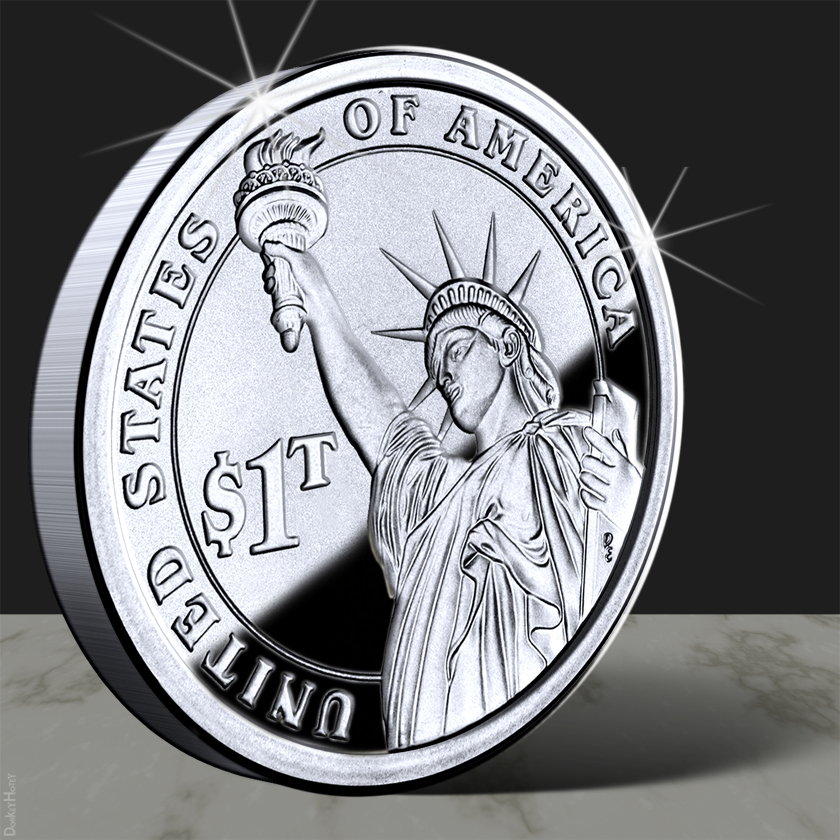
Artist's concept of a trillion-dollar coin, featuring a similar obverse design to the reverse of the presidential dollar series.

The trillion-dollar coin is a concept that emerged during the United States debt-ceiling crisis of 2011 as a proposed way to bypass any necessity for the United States Congress to raise the country's borrowing limit, through the minting of very high-value platinum coins. The concept gained more mainstream attention by late 2012 during the debates over the United States fiscal cliff negotiations and renewed debt-ceiling discussions. After reaching the headlines during the week of January 7, 2013, use of the trillion-dollar coin concept was ultimately rejected by the Federal Reserve and the Treasury.[1]

The concept of the trillion-dollar coin was reintroduced in March 2020 in the form of a congressional proposal by congresswoman Rashida Tlaib[2] during the shutdown caused by the COVID-19 pandemic in the United States. Tlaib sought to fund monthly $2,000 recurring stimulus payments until the end of the pandemic.[3]

The idea gained further traction in late 2021 with propositions by Bloomberg journalist Joe Weisenthal amongst others, amidst the United States debt-ceiling crisis of 2021.[4]

[edit]
Common obverse of American Platinum Eagle coins, a platinum commemorative United States coin that has been issued in denominations of up to $100 under the authority of 31 U.S.C. Section 5112.

The issuance of paper currency is subject to various accounting and quantity restrictions that platinum coinage is not. According to the United States Mint, coinage is accounted for as follows:[5]

Since Fiscal Year (FY) 1996, the Mint has operated under the United States Mint Public Enterprise Fund (PEF). As authorized by Public Law 104-52 (codified at 31 U.S.C. § 5136), the PEF eliminates the need for appropriations. Proceeds from the sales of circulating coins to the Federal Reserve Banks (FRB), bullion coins to authorized purchasers, and numismatic items to the public and other customers are paid into the PEF and provide the funding for Mint operations. All circulating, bullion and numismatic operating expenses and capital investments incurred for the Mint's operations and programs are paid out of the PEF. By law, all funds in the PEF are available without fiscal year limitation. Revenues determined to be in excess of the amount required by the PEF are transferred to the United States Treasury General Fund as off-budget and on-budget receipts. Off-budget receipts consist of seigniorage, the difference between the receipts from the Federal Reserve System from the sale of circulating coins at face value and the full costs of minting and distributing circulating coins. Seigniorage is deposited periodically to the General Fund where it reduces the government's need to borrow.

The concept of striking a trillion-dollar coin that would generate one trillion dollars in seigniorage, which would be off-budget, or numismatic profit, which would be on-budget, and be transferred to the Treasury, is based on the authority granted by Section 31 U.S.C. § 5112 of the United States Code for the Treasury Department to "mint and issue platinum bullion coins" in any denominations the Secretary of the Treasury may choose. Thus, if the Treasury were to mint one-trillion dollar coins, it could deposit such coins at the Federal Reserve's Treasury account instead of issuing new debt.[6][7][8][9]

31 U.S.C. 5112(k) as originally enacted by Public Law 104-208 in 1996:

The Secretary may mint and issue bullion and proof platinum coins in accordance with such specifications, designs, varieties, quantities, denominations, and inscriptions as the Secretary, in the Secretary's discretion, may prescribe from time to time.

In 2000, the word "bullion" was replaced with "platinum bullion coins".[10] According to the United States Mint: “A bullion coin is an investment-grade coin that is valued by its weight and fineness of a specific precious metal.”[11]

Platinum bullion coins can, by this statute, be minted in any denomination, whereas coins in any other specified metal are restricted to amounts of $50, $25, $10, $5 and $1.[12] The concept of minting a very high denomination coin relies on the platinum clause as a loophole for the executive branch to raise revenues without congressional oversight.

Philip N. Diehl, former director of the United States Mint and with Republican Congressman Michael Castle co-author of the platinum coin law, has said the procedure would be permitted by the statute.[7] Castle says he never intended such a use. The platinum coinage provision was eventually passed by a Republican Congress over the objections of a Democratic Treasury in 1996.[10][13][14]

Laurence Tribe, a constitutional law professor at Harvard Law School, said the legal basis of the trillion-dollar coin is sound and that the coin could not be challenged in court as no one would have standing to do so.[15]

Emergence of the concept

[edit]

The idea for the Treasury Department to mint a coin and send it to the Federal Reserve to pay off the debt was first popularized by Populist Party presidential candidate Bo Gritz in 1992. As a standard part of his stump speeches, he would hold up a five-inch example coin.[16][17] The specific concept was first introduced by Carlos Mucha, a lawyer who commented under the name "beowulf" on various blogs. "Beowulf" outlined the idea in a series of comments on Warren Mosler's blog in May 2010, noting that "Congress has already delegated to Tsy [Treasury] all the seigniorage power authority it needs to mint a $1 trillion coin".[18] Beowulf also drew attention to the concept on the blog of economist Brad Delong in July 2010[19] and in a legal analysis blogpost of his own in January 2011,[20] but it was not until July 2011 that the use of the concept as an unorthodox method of resolving the debt-ceiling crisis came to the attention of the financial press and mainstream media blogs.[21][22][23][24] At that time, the idea found some support from legal academics such as Yale Law School's Jack Balkin.[25] Once the debt ceiling crisis of the summer of 2011 was resolved, attention to the concept faded.[26]

The concept gained renewed[26][27] and more mainstream[28][29] attention by late 2012, as the debt-ceiling limit was being approached again. In early January, the economist Paul Krugman endorsed the idea[30][31][32] and asserted that opposition to the idea was coming from people unwilling to admit the truth that "money is a social contrivance".[31] His endorsement attracted considerable media attention.[33][34][35] Former Mint director Diehl was widely cited in the media debunking criticisms of the coin and its basis in law.[36][37][38][39] Congressman Jerry Nadler endorsed the idea,[40] and it was featured in the international press by January 4, 2013.[41][42]

"Beowulf" would later tell Wired magazine that the coin idea came from a December 2009 Wall Street Journal article that talked about how several people were able to generate frequent-flyer miles at no cost by ordering coins from the U.S. Mint with a credit card offering mileage rewards, then depositing the coins at a bank to pay off the credit card debt.[43] He also said that he was inspired by the 2008 book Web of Debt by Ellen Brown, which cited a former Washington official who said the government could order the minting of large coins to pay off the national debt. "Beowulf" said the trillion-dollar coin idea is more rightly attributed to a small discussion group than to an individual, adding that the group was "just in it for the lulz" (i.e., for personal amusement).[44][45]

Analysis and reaction

[edit]

Some commentators have argued that although the concept may be strictly legal, it would weaken the checks and balances system of U.S. government, even if the spending that the coin would allow was already authorized by Congress. Opinion columnist Megan McArdle wrote that "minting a $1 trillion coin neatly end-runs GOP obstructionists, but only by proving that the president himself has little respect for the institutional restraints on his office."[46] Felix Salmon, another journalist, wrote that the concept "would effectively mark the demise of the three-branch system of government, by allowing the executive branch to simply steamroller the rights and privileges of the legislative branch." Salmon said that he does not agree with what Congressional Republicans are doing, but that they have a right to do that, and that the president should not use the trillion-dollar coin option to circumvent them. He said, "Yes, the legislature is behaving like a bunch of utter morons if they think that driving the US government into default is a good idea. But it's their right to behave like a bunch of utter morons."[47]

On the other hand, many economists and business analysts endorsed the coin as a way to counter threats by congressional Republicans to force the country into default by refusing to raise the debt limit.[48][49][50][51][52] Paul Krugman said (in 2013), "So minting the coin would be undignified, but so what? At the same time, it would be economically harmless – and would both avoid catastrophic economic developments and help head off government by blackmail." He also declared the trillion-dollar coin debate to be "the most important fiscal policy debate of our lifetimes".[53]

Michael Steel, spokesperson of House Speaker John Boehner, dismissed the concept by comparing it to a Simpsons episode called "The Trouble with Trillions", which aired 13 years before the United States debt-ceiling crisis, in which Homer Simpson is on a mission in search of a missing trillion-dollar bill.[54]

On January 7, 2013, Republican congressman Greg Walden announced he would introduce a bill to close the platinum coin loophole.[55] Rep. Walden said that the intention is to "take the proposal off the table." New York representative Jerry Nadler opposed the bill and said that the idea remains a valid option.[56]

On January 12, 2013, the Treasury and Federal Reserve announced they would not mint a platinum coin,[1] and five days later, Senate Minority Whip John Cornyn (R-Texas) announced that Senate Republicans would end their threat to block an increase in the debt ceiling.[57]

In January 2023, Treasury Secretary Janet Yellen said that minting a trillion dollar coin was not on the table as a solution to the 2023 United States debt-ceiling crisis and possible U.S. default on its debt, because the Federal Reserve would be unlikely to accept it, calling it "a gimmick".[58][59] In May 2023, Paul Krugman commented: "As for claims that [Fed Chair Jerome] Powell would refuse to accept the coin, or the Supremes would block premium bonds — well, nobody knows. But my guess is that nobody wants to be the guy who destroys the world economy."[60] Premium bonds have been touted as a possible alternative to the trillion dollar coin, and an alternative to congressional action raising the debt limit.[61]

In April 2023, Bloomberg News reported that a poll of 1,212 people was conducted in March 2023 to gauge the support for the U.S. Treasury minting the $1 trillion platinum coin to pay off the country's debt obligations. The poll results showed that 14% supported the coin's minting, 37% opposed it, while 49% have no opinion or were undecided.[62]

Inflation risks

[edit]

The Federal Reserve's purchase of the trillion-dollar coin would be analogous to the securities purchases that are part of quantitative easing (QE), in both cases adding to the monetary base, which is the sum of currency in circulation and bank reserves, i.e. the liabilities of the Federal Reserve.[63][64] Commercial bank reserves would increase as the Treasury spent the proceeds from the coin's purchase by the Federal Reserve.[63] This would generate the accounting change at the Federal Reserve of moving funds from the Treasury's deposits at the Federal Reserve to commercial banks' deposits at the Federal Reserve ("bank reserves"), a transfer from one Federal Reserve liability category to another. This is no different than the normal process by which checks from the Treasury clear in the banking system. While in principle the increase in the amount of available reserves would expand the banks ability to lend by increasing the headroom under the then statutory reserve requirement and potentially lead to inflation by the mean of further expanding the money supply, that if too rapid could cause the economy to overheat and in turn further raise expectations of future inflation[64], in fact at that time banks already held excess reserves so any such impact would have likely been limited to the effects of decreased commercial interest rates (developing under the conditions of the increased capacity to lend) and the effects to which the deposits thus created became actuated (i.e. the already expanded money supply became utilized). This was not fully appreciated at the time. For example, Jaret Seiberg of the Washington Research Group stated, “the $1 trillion coin would expand the money supply by a considerable amount, which could spark serious inflation...this economic chaos could worsen the economic downturn, which would further weaken credit conditions and impose higher losses on banks.”[65]

In April 2011, a paper published by the St Louis Federal Reserve Bank said, "some believe QE will sharply increase inflation rates; however, these fears are not consistent with economic theory and empirical evidence – assuming the Federal Reserve is both willing and able to reverse QE as the recovery gains momentum." The paper added that "if the public trusts that the increase in the monetary base QE creates is only temporary, then they will not expect rapid inflation in the near future. These expectations collectively influence actual pricing behavior and, in turn, actual inflation."[64] The Federal Reserve could ensure that commercial banks do not lend out excess reserves by paying interest on their reserves at the Fed, so that the return commercial banks receive on them is greater than they could receive from alternative uses.[63][64] Finally, in the case of the coin, the Federal Reserve could also sterilize the government's spending of the coin by selling other assets from its balance sheet on a dollar-for-dollar basis, in which case the effect on the monetary base should net to zero.[63] If the debt ceiling were lifted, the Treasury could use borrowing to buy the coin back from the Federal Reserve and return it to the Mint to be melted.

Independence of the Federal Reserve

[edit]

Although the Federal Reserve had already indicated on December 12, 2012, that it wished to expand its balance sheet by another $1.02 trillion throughout 2013 via its ongoing purchases of U.S. Treasuries and government-sponsored mortgage-backed securities,[66][improper synthesis?] Greg Ip has argued that if the Fed's balance sheet were expanded for ostensibly fiscal policy reasons instead of monetary policy reasons, that could constitute an imposition on the independence of the central bank. Ip suggested that any such imposition could be avoided if the additional trillion in coinage were issued directly to the public (in more useful smaller denominations) instead of deposited with the Fed.[67] In May 2010, there was $40.4 billion in coin in circulation and about another $900 billion in banknotes.[68]

Former U.S. Mint Director Edmund C. Moy voiced doubts to TheStreet.com about whether the Federal Reserve could buy the coin, noting also that under the current system for initiating orders for coinage, the order might have to be placed by the current Fed Chair, or by one of the 12 Presidents of the regional Federal Reserve Banks. Former Director Diehl disagreed with Moy concerning a platinum bullion coin but agreed with Moy that a platinum coin would be a problem for the Fed. Diehl reiterated his view that "I certainly think [minting a trillion-dollar coin] is inferior to raising or eliminating the [debt] limit, but it's far better than defaulting and suffering the consequences of doing so."[69]

See also

[edit]

References

[edit]
[edit]
Revisions and contributorsEdit on WikipediaRead on Wikipedia
from Grokipedia
The trillion-dollar coin is a hypothetical monetary instrument proposed for minting by the as a inscribed with a of one dollars, leveraging statutory authority to enable the to obtain reserve credits from the without issuing additional debt securities. This mechanism would involve depositing the coin at the , which would credit the General Account with the nominal amount, providing to cover expenditures amid congressional constraints. The concept draws on 31 U.S.C. § 5112(k), enacted in 1996 to authorize flexible production of and proof coins for market or numismatic purposes, uniquely permitting the Secretary of the to specify denominations without the fixed values mandated for other U.S. coinage types. Originally floated in online economic discussions around 2009 and gaining traction during the 2011 debt ceiling impasse, the proposal has resurfaced in later fiscal crises, including 2013, 2021, and 2023, as a potential unilateral executive to avert default risks. Proponents, including former U.S. Mint Director Philip Diehl—who contributed to the enabling legislation—argue it aligns with the statute's plain text, offering a legal means to prioritize payments without immediate inflationary pressure if reserves are sterilized. Critics contend it distorts the law's intent for commemorative or purposes, risks eroding fiscal discipline by enabling unchecked spending, and could trigger market instability or legal challenges by effectively monetizing debt outside . Despite periodic advocacy, U.S. administrations from Obama to Biden have dismissed implementation as impractical or counterproductive, underscoring its status as an untested theoretical expedient rather than viable policy.

Statutory Authority

The statutory authority for minting platinum coins of potentially high denominations is provided by 31 U.S.C. § 5112(k), enacted as part of the Omnibus Consolidated Appropriations Act, 1996 (Pub. L. 104–208). This subsection states: "The Secretary may mint and issue bullion coins and proof coins in accordance with such specifications, designs, varieties, quantities, denominations, and inscriptions as the Secretary, in the Secretary’s discretion, may prescribe from time to time." The language explicitly vests the Secretary of the with discretion over denominations, distinguishing coins from other circulating denominations under § 5112(a)–(j), which are fixed by (e.g., dollars, quarters). A strict textual reading of § 5112(k) permits denominations unbounded by numerical limits, as the term "denominations" is not qualified and falls under the Secretary's prescriptive , potentially encompassing values like one dollars. This contrasts with and silver bullion coins under § 5112(g)–(h) and (i), where denominations are tied to metal content and weight (e.g., $50 for one-ounce eagles). However, the provision's structure limits its application to "platinum bullion coins and proof platinum coins," categories historically interpreted as investment-grade or numismatic products rather than for ends. In practice, the U.S. Mint has exercised this authority since 1997 to produce American Eagle Coins with denominations of $10, $25, $50, or $100 per troy ounce, primarily for collectors and investors, with over 16 million ounces minted cumulatively through 2023 but no instances exceeding four figures. These precedents reflect denominations aligned with metal content and market value, not arbitrary fiscal magnitudes. Legislative history indicates the subsection was added to authorize platinum issuances competitive with foreign markets and to satisfy collector demand, without reference to debt management or beyond numismatic sales. No congressional records or guidance from the provision's origin in 1996 evince intent for denominations enabling sovereign debt avoidance, underscoring a purposive gap between literal textual permission and enacted objectives.

Interpretive Debates

The primary interpretive debate surrounding the trillion-dollar coin proposal concerns the scope of authority granted by 31 U.S.C. § 5112(k), which empowers the Secretary of the to "mint and issue platinum bullion coins and proof platinum coins in accordance with such specifications, designs, varieties, quantities, and denominations as the Secretary, in the Secretary's discretion, may determine." Proponents advocate a strict textualist reading, emphasizing that the provision explicitly omits any cap on denominations and ties issuance solely to the Secretary's determination of necessity, thereby permitting high-value coins to generate —profits from the difference between and production cost—for reserves without congressional borrowing. This view posits that "demand" under the could encompass broader fiscal needs, rendering the trillion-dollar denomination a permissible exercise of delegated minting power. Critics counter with a purposivist approach, arguing that the statutory language must be understood in light of its 1996 enactment as part of efforts to authorize bullion and proof coins akin to existing and silver programs, intended for numismatic and markets rather than monetary or fiscal tools. They highlight that such coins are classified as numismatic items for sales and distribution under 31 U.S.C. §§ 5134 and 5136, underscoring a legislative focus on collectibles with intrinsic metal value, not arbitrary high-denomination instruments decoupled from material backing. This interpretation invokes the absurdity doctrine, contending that a trillion-dollar coin—feasible with minimal —would subvert congressional intent by transforming a niche provision into an unchecked executive mechanism for revenue creation. Opponents further assert that the proposal implicates , as it would enable the executive branch to evade Congress's exclusive authority under Article I to regulate coinage value, appropriate funds, and set debt limits, effectively delegating unlimited fiscal discretion without an intelligible principle to constrain the Secretary's determinations. In a series of 2013 memos, the Department of Justice's preliminarily assessed the coin's legality as viable under the statute's plain terms during debt ceiling deliberations but noted institutional risks, including potential challenges to executive overreach, without issuing a definitive endorsement. These analyses underscore tensions between textual fidelity and structural constitutional constraints, with no judicial resolution to date.

Historical Origins

Initial Conceptualization

The intellectual roots of the trillion-dollar coin proposal trace to academic and theoretical discussions in the and on —the profit governments derive from issuing currency at face value exceeding production costs—and the mechanics of sovereign creation. These conversations, often within emerging frameworks like Modern Monetary Theory (MMT), explored how monetarily sovereign entities could leverage currency issuance to fund expenditures without equivalent taxation or borrowing, constrained primarily by productive capacity rather than solvency. MMT proponents, including in his 1993 work Soft Currency Economics, argued that governments as monopoly issuers of their currency hold inherent fiscal flexibility, with representing untapped revenue potential from base money expansion. However, such discussions remained abstract, focusing on general monetary operations rather than specific mechanisms like high-denomination coins, and lacked application to U.S. circumvention. The concrete formulation of the trillion-dollar coin emerged in a May 24, 2010, blog comment by Carlos Mucha, posting under the pseudonym "Beowulf," on financier Warren Mosler's website. Mucha proposed that the U.S. Treasury mint a one-ounce platinum coin denominated at $1 trillion, invoking authority under 31 U.S.C. § 5112(k)(2)—enacted in 1996 to permit platinum commemorative and bullion coins of "any denomination"—and deposit it at the Federal Reserve to generate equivalent reserves without counting against the statutory debt ceiling. This suggestion arose in an informal thread debating fiscal policy alternatives, highlighting a perceived legal loophole in coinage statutes originally intended for numismatic purposes rather than large-scale fiscal maneuvers. At its , the idea was purely speculative and theoretical, devoid of empirical precedents, institutional backing, or practical testing. No had minted comparable high-value coins for avoidance, and the proposal circulated solely in niche online economic forums without peer-reviewed validation or endorsement from officials, , or major academic bodies. It represented an untested interpretation of existing , emphasizing seigniorage's potential scale but ignoring operational, , and market realities that would later fuel .

Popularization in Policy Discussions

The trillion-dollar coin proposal transitioned from a obscure theoretical notion, first articulated in a 2010 blog comment during discussions of U.S. monetary , to a more visible option amid the 2011 debt ceiling crisis, when it was invoked by some commentators as a potential to congressional without altering spending or revenues. This early amplification occurred primarily in policy s and among economists skeptical of fiscal constraints imposed by debt limit negotiations, though it remained marginal until subsequent debates. The concept surged in prominence during the debt ceiling standoff under President Obama, gaining endorsements from economists such as , who argued in a January 10 New York Times that minting the coin would neutralize Republican leverage for spending cuts, describing it as a "silly but harmless" tactic preferable to default risks. Similarly, Mike Konczal, a fellow, explored variations like daily platinum coin issuance in outlets like Daily Kos, positioning it as a tool to prioritize constitutional spending duties over partisan debt fights. Public engagement followed, including a petition launched in early January that amassed over 6,000 signatures urging the to mint such coins to avert default and pay national debts. Progressive-leaning publications and blogs, including New Economic Perspectives and In These Times, framed the coin as a strategic alternative to austerity-driven compromises, emphasizing its potential to insulate fiscal policy from debt ceiling brinkmanship and enable sustained government outlays without immediate revenue offsets or cuts. These outlets, often aligned with Modern Monetary Theory advocates, highlighted the idea's alignment with views that debt limits artificially constrain sovereign currency issuers, though mainstream adoption was limited by institutional resistance from the Treasury and Federal Reserve. This period marked the coin's peak visibility in policy discourse, shifting it from academic curiosity to a symbol of unilateral executive options in fiscal crises.

Operational Mechanism

Minting and Valuation Process

The minting of a trillion-dollar coin would occur at the under the direction of the Secretary of the Treasury, utilizing blanks already in inventory for programs such as the coins. The production process involves striking the blank with dies that imprint the specified designs, including the trillion-dollar denomination, as authorized by the Secretary's order pursuant to 31 U.S.C. § 5112(k), which permits coins "in accordance with such specifications, designs, varieties, [and] quantities" without prescribed limits on value. Former U.S. Mint Director Philip Diehl, who helped draft the enabling legislation, has stated that such a coin could be produced within hours using existing stock and standard minting equipment. The coin's valuation derives entirely from its as declared by the , detached from the intrinsic worth of its content, which for a typical blank weighs approximately one and holds a of under $1,000. This arbitrary denomination enables the realization of —the profit from issuing currency at exceeding production costs—approaching the full dollars, as the of minting remains negligible regardless of the engraved amount. Although U.S. Mint production of faces annual program limits under the Commemorative Coin Reform Act of 1996, such as capping distinct designs at two per year, the trillion-dollar coin falls under the separate and proof authority of § 5112(k), which imposes no explicit quantity restrictions for non-commemorative issuances and thus permits a singular high-denomination coin without conflicting with established caps. Proponents argue this exemption aligns with the statute's broad discretion, avoiding the surcharges and sales mandates applied to commemoratives.

Deposit and Accounting Effects

Upon depositing the trillion-dollar coin at the , the U.S. Treasury's General Account (TGA) would be credited with $1 trillion, representing an increase in the Treasury's reserve balances held at the without the issuance of new Treasury securities or debt obligations. This crediting process treats the coin's face value as , allowing the to accept it as an asset on its , thereby expanding both the asset side (via the coin) and the liability side (via the elevated TGA balance) by the full $1 trillion amount. This accounting adjustment enables the to authorize expenditures or redemptions up to the credited amount directly from its TGA, circumventing the need for additional borrowing that would otherwise count against the statutory . However, the mechanism does not alter the underlying , as it generates no additional revenues or spending cuts; ongoing deficits would continue to require future funding sources beyond the one-time coin deposit. In principle, the Federal Reserve could unwind the balance sheet expansion by disposing of the coin—potentially through sale or return to the —offsetting the TGA credit, though this reversal has never been tested and would depend on unestablished operational protocols.

Economic Analysis

Potential Short-Term Benefits

Minting a trillion-dollar platinum coin would enable the U.S. to deposit it at the , crediting its general account with $1 trillion in reserves and providing immediate liquidity to honor existing obligations without issuing new debt or awaiting congressional approval to raise the debt ceiling. This mechanism would avert a technical default on securities, which could otherwise disrupt payments to bondholders, Social Security recipients, Medicare providers, and federal contractors, thereby maintaining short-term financial stability during impasses. Such a step exploits the U.S. government's authority over its currency, allowing funding of authorized expenditures without precipitating abrupt tax hikes or program cuts in the near term, as the coin's value derives from statutory designation rather than backing. Proponents, including some economists, contend this preserves operational continuity for and averts market panic associated with delayed payments, offering a procedural bypass grounded in existing minting laws. The proposal surfaced amid the 2011 debt ceiling crisis on August 2, 2011, when failure to raise the limit risked default after political negotiations stalled, positioning the coin as a unilateral executive option to sustain outflows exceeding inflows. It reemerged during the October 2013 standoff, where sequestration-era similarly threatened payments, with advocates highlighting its potential to bridge the gap until legislative resolution without immediate fiscal .

Inflation and Monetary Risks

Depositing a trillion-dollar coin at the would increase the by $1 trillion, constituting an approximately 18% expansion over the base level of about $5.6 trillion prevailing in 2023. This injection of reserves, unbacked by additional goods or services, aligns with the , positing that sustained growth in exceeding real output growth drives price increases, as formalized in MV = PY where an exogenous rise in M prompts higher P absent offsetting changes in V or output Y. Empirical evidence from the post-2020 period underscores this non-neutrality: the U.S. surged by over 30% from early 2020 to 2022 amid , contributing to lagged ary pressures as partially recovered, with CPI inflation peaking at 9.1% in June 2022. Such an expansion carries risks of heightened price instability, particularly through implicit that could elevate if economic agents anticipate further fiscal-monetary coordination eroding credibility. Historical precedents illustrate the causal mechanism: in the , money supply growth exceeded 300% monthly by late 1923 to fund reparations and deficits, yielding with prices doubling every few days; Zimbabwe experienced analogous dynamics in 2007-2008, where fiscal printing propelled monthly inflation to 79.6 billion percent by November 2008. While the U.S. dollar's global reserve status dampens immediate spikes compared to these cases—affording greater absorption capacity—the relative scale remains substantial, potentially compounding existing inflationary impulses from prior base expansions. In 2023 assessments amid the debt ceiling , economists projected the coin's deployment could equate to a 3-5% one-time inflationary impulse, akin to a $3,000 tax equivalent distributed via higher prices, exacerbating the era's 4-6% CPI trends rooted in supply disruptions and prior stimulus. This risk persists even if initially sterilized by Fed actions, as historical data indicate that reserve expansions often permeate broader money aggregates over time, fueling sustained price rises when fiscal spending leverages the added .

Fiscal Policy Consequences

The minting and deposit of a trillion-dollar coin would enable the executive branch to evade the debt ceiling imposed by , effectively nullifying a key statutory check on federal borrowing and spending decisions. This circumvention removes incentives for legislative restraint, potentially exacerbating persistent deficits amid already elevated levels, where U.S. gross federal reached approximately 121% of GDP by 2023. By shifting reliance from market-based issuance—subject to congressional approval and investor scrutiny—to unilateral action, the mechanism encourages fiscal expansion without corresponding offsets, perpetuating structural imbalances rather than compelling reforms to entitlements or taxation. Fundamentally, the coin creates no net reduction in the government's real obligations; it simply transfers the accounting burden to the Federal Reserve's balance sheet, where the coin serves as an asset offsetting Treasury's liabilities without altering the underlying need to service or refinance public debt through future revenues or borrowing. This sleight-of-hand preserves the full scope of accumulated liabilities—stemming from decades of annual deficits averaging over 4% of GDP since —while delaying accountability, as the Fed's acceptance of the coin expands its holdings without corresponding economic output or productivity gains. In the longer term, market participants would likely view such a ploy as indicative of deepening fiscal gimmickry, eroding in U.S. management and prompting demands for premiums that elevate borrowing costs across the . Empirical precedents, such as post-2011 debt ceiling episodes where perceived correlated with temporary yield spikes, suggest that perceived evasions of fiscal rules amplify volatility and term premiums, as investors recalibrate for heightened default or risks absent credible commitment to restraint. This dynamic would expenses, which already surpassed $800 billion annually by 2023, further crowding out productive investments and reinforcing a cycle of debt-fueled spending over genuine measures.

Political and Institutional Reactions

Arguments in Favor

Proponents argue that minting a trillion-dollar platinum coin offers a legal mechanism to circumvent congressional debt ceiling impasses, enabling the U.S. Treasury to maintain government operations and avoid default without immediate borrowing or spending cuts. This approach leverages 31 U.S.C. § 5112(k), which authorizes the Treasury to mint platinum coins in denominations it deems appropriate, providing credits to the upon deposit without issuing new debt subject to the ceiling. Economist endorsed the idea in January 2013 amid the debt ceiling standoff, describing it as a "silly but benign" contingency preferable to risking default, which could trigger financial market disruptions. The proposal aligns with principles of Modern Monetary Theory (MMT), which posits that a currency issuer like the faces no inherent solvency risk from deficits and can create to fund expenditures, rendering the debt ceiling an unnecessary political constraint rather than a fiscal limit. MMT advocates contend that depositing the coin at the would expand the Treasury's general account, allowing to continue seamlessly while preserving congressional authority over appropriations. This mechanism, they assert, underscores the government's monetary sovereignty, potentially educating the public on the endogenous nature of without relying on taxation or bond sales as prerequisites for spending. In practice, supporters have pushed for its use in crises to fund urgent needs directly. In March 2020, Representative (D-MI) introduced the Automatic BOOST to Communities Act, proposing the minting of two $1 trillion platinum coins to finance recurring $2,000 monthly payments to households and automatic aid to local governments amid the , bypassing debt limits to ensure rapid economic stabilization. While proponents highlight its potential to avert shutdowns—such as those in and —the strategy's scalability remains empirically untested, with no historical precedent for injecting trillions via a single asset into the .

Major Criticisms

Critics argue that the trillion-dollar coin proposal functions as an accounting gimmick that circumvents on borrowing, thereby undermining fiscal restraint by allowing the executive branch to effectively monetize without addressing underlying spending excesses. This approach fails to resolve the root causes of fiscal imbalances, such as unchecked growth in programs like Social and Medicare, which drove federal deficits exceeding $1.7 trillion in 2023 alone. By enabling the to deposit a high-denomination coin at the for credit, it bypasses the limit's as a mechanism to force budgetary discipline, potentially encouraging further evasion of legislative checks on expenditure. From a right-leaning perspective, the proposal facilitates expansive without corresponding accountability, as it permits funding of deficits through rather than tax increases or cuts, effectively rewarding fiscal irresponsibility. Analysts at contend that such maneuvers sidestep the problem's core—persistent overspending—while contributors emphasize that it cannot sustainably repay accumulated from entitlement expansions and discretionary outlays, projecting instead a for repeated monetary shortcuts that erode incentives for balanced budgeting. Post-2023 analyses reinforce that the coin would merely delay fiscal reckoning without mitigating structural deficits, as evidenced by the U.S. national debt surpassing $38 trillion by October 2025 amid cumulative 2025 shortfalls reaching $1.1 trillion by April, largely attributable to entitlement obligations rather than temporary crises. This temporary workaround risks institutional distrust by signaling to markets and policymakers that debt limits lack enforceability, potentially amplifying long-term borrowing costs as investors perceive diminished commitment to . Such precedents could normalize direct monetary financing of deficits, fostering expectations of endless bypasses and weakening the causal link between spending decisions and constraints.

Federal Reserve and Treasury Positions

The U.S. Department of the has officially rejected the trillion-dollar coin as a means to address debt ceiling constraints. In early , following internal deliberations, Treasury Secretary Jacob J. Lew publicly ruled out minting such a coin, aligning with predecessor Timothy Geithner's January 2013 determination that it lacked legal viability and would distort fiscal-monetary boundaries. Similarly, in October 2021 and repeatedly in 2023, Treasury Secretary described the proposal as a "gimmick" unsuitable for serious consideration, emphasizing its potential to erode public confidence in U.S. institutions. The has maintained a stance of non-acquiescence to preserve its independence from fiscal maneuvers. Former Chair warned in 2013 that incorporating a trillion-dollar coin into the Fed's would the central bank's apolitical role and signal direct , adversely impacting . Yellen, as Fed Chair from 2014 to 2018, echoed concerns over policy normalization, and in her January 22, 2023, remarks as Secretary, affirmed that the Fed would likely refuse to credit a deposited trillion-dollar to the Treasury's account. Freedom of Information Act disclosures in 2024 from Justice Department memos confirmed high-level interagency discussions on the coin's mechanics during the 2013 crisis, involving Treasury and officials, yet these culminated in dismissal due to risks of blurring fiscal authority with monetary operations. This consistent institutional resistance prioritizes safeguarding the Fed's autonomy amid impasses.

Recent Developments

2023 Debt Ceiling Crisis

In January 2023, the reached its statutory debt limit of $31.4 trillion, prompting Treasury Secretary to notify on January 19 that extraordinary measures would be implemented to avert default, with the projected "X-date"—when cash reserves and measures would be exhausted—initially estimated between late January and early June. Amid this impasse, the trillion-dollar coin concept resurfaced in public discourse, including analyses questioning its viability as a to bypass congressional approval for raising the debt ceiling. For instance, commentators highlighted the legal basis under a 1996 law allowing the Treasury to mint platinum coins of any denomination, though skeptics argued it would undermine fiscal discipline without addressing underlying spending issues. Discussions of the coin gained traction in media outlets during the crisis, with proposals suggesting the could mint and deposit a high-value at the to credit the 's account, thereby creating fiscal space without issuing new subject to the . Internal Biden administration deliberations, as later revealed in memos, included top officials weighing the coin alongside other unilateral options like invoking the 14th Amendment, though these were not pursued in favor of bipartisan negotiations. By May 2023, as the X-date loomed closer, similar ideas were floated in economic commentary, such as minting a coin valued at the full level, but these remained speculative and faced dismissal from fiscal conservatives concerned about monetary precedent. The Treasury explicitly rejected the coin as a solution, with Yellen stating on January 22 that the Federal Reserve would likely refuse to accept it, describing the idea as a non-viable gimmick unlikely to resolve the crisis. The administration prioritized legislative talks, culminating in the Fiscal Responsibility Act of 2023, signed into law on June 3, which suspended the debt ceiling until January 1, 2025, and included spending caps to curb deficits, thereby averting default without resorting to extraordinary monetary maneuvers. This bipartisan compromise underscored a preference for negotiated fiscal restraint over untested accounting expedients like the coin, despite its periodic revival in debt limit debates.

2024-2025 Discussions

In August 2024, declassified Justice Department memos revealed that senior Obama administration officials, including then-Treasury Secretary and Attorney General , had internally discussed minting a large-denomination as a potential during the impasse, though the idea was ultimately rejected in favor of congressional action. These disclosures, obtained via Act requests, highlighted past high-level deliberations but prompted no renewed policy advocacy, with commentators noting the concept's persistent fringe status amid evolving fiscal constraints. By early 2025, the U.S. public reached the statutory limit of $36.1 trillion on January 1, triggering Treasury's use of extraordinary measures to avert default while debated extensions. In this context, trillion-dollar coin references appeared sporadically in financial blogs and speculative analyses, often framed as theoretical alternatives rather than viable options, overshadowed by broader debates on cuts and revenue enhancements. Policymakers and major institutions evinced no substantive engagement with the proposal, reflecting its marginalization as discourse prioritized statutory reforms over unconventional monetary maneuvers. By October 2025, with gross federal surpassing $38 trillion, discussions of the coin remained confined to niche online commentary, lacking endorsement from executive or legislative leaders.

Key Controversies

Critics of the trillion-dollar coin proposal contend that it violates core separation-of-powers principles enshrined in Article I of the U.S. Constitution, which vests with exclusive authority over fiscal matters, including the power "to lay and collect Taxes... to pay the Debts and provide for the common Defence and general Welfare," "to borrow on the credit of the ," and "to coin , regulate the Value thereof." By delegating coin-minting authority to the under 31 U.S.C. § 5112(k), intended routine production of circulating , not executive creation of high-value platinum coins for profit to circumvent statutory borrowing limits like the debt ceiling. Such a maneuver represents an unconstitutional end-run around 's "," allowing the executive branch to unilaterally generate funds without legislative appropriations or debt authorization, thereby inverting the constitutional framework where the legislative branch controls spending and revenue. Originalist interpretations emphasize that the coin's denomination lacks historical precedent and exceeds implied executive discretion, as the Framers designed Article I to prevent executive overreach in , drawing from colonial experiences with monarchical spending abuses. Legal scholars argue this blurs the lines between (Congress's domain) and , potentially compromising the Federal Reserve's independence by pressuring it to accept the coin as a reserve asset without congressional mandate. Proponents' reliance on statutory delegation does not override these structural limits, as executive actions cannot imply powers not expressly granted or necessary and proper under Article I, Section 8. Regarding the Fourteenth Amendment's Section 4, which states that "the validity of the public debt of the , authorized by law... shall not be questioned," opponents assert the coin scheme contravenes its original intent to ensure post-Civil War repayment of Union bonds without authorizing novel executive mechanisms to incur or validate debt outside congressional law. Ratified in to protect legislatively approved obligations from repudiation, the clause presupposes debts "authorized by law," not Treasury-invented assets deposited to evade borrowing caps, which could undermine of debt validity. No federal court has tested the coin's constitutionality, as the U.S. Treasury has never minted such an instrument despite discussions during debt-ceiling crises in 2011, 2013, 2021, and 2023. Hypothetical challenges could arise via lawsuits from individual members of claiming injury to their Article I prerogatives, or from states alleging harm from federal overreach disrupting interstate commerce or fiscal stability, though standing requirements under Article III might pose barriers. Any litigation would likely invoke the , scrutinizing executive actions with vast economic implications absent clear congressional intent.

Governance and Precedent Implications

The minting of a trillion-dollar platinum coin would establish a for the executive branch to circumvent congressional authority over federal borrowing, effectively rendering the debt ceiling mechanism obsolete as a fiscal restraint. Conservative analysts argue that this approach sidesteps the constitutional requirement for legislative approval of debt issuance under Article I, Section 8, allowing the to create arbitrary monetary value without addressing underlying spending excesses, such as the national debt's rise from $5.7 trillion in 2000 to over $16 trillion by 2012. By exploiting a 1996 law authorizing coins of unspecified denomination, the strategy would normalize unilateral executive actions in future debt crises, diminishing incentives for bipartisan negotiation and potentially encouraging repeated invocations to fund deficits indefinitely. Such a maneuver would erode institutional checks and balances, expanding executive power at the expense of Congress's role as the originator of appropriations and revenue measures. According to evaluations from right-leaning policy institutes, this gimmick undermines the debt ceiling's purpose as a periodic on unchecked spending, fostering by rather than deliberate fiscal discipline, and failing to confront long-term liabilities like Social Security's $42.2 trillion unfunded obligations. It risks compromising the Federal Reserve's independence by involving it in direct monetization of government obligations, akin to off-balance-sheet financing, which could invite further politicization of . From an international perspective, adopting this expedient would project U.S. fiscal unseriousness, potentially jeopardizing the dollar's status as the global by highlighting reliance on accounting artifices over structural reforms. Analyses contend that perceived irresponsibility in managing sovereign debt—exemplified by bypassing statutory limits—could accelerate diversification away from dollar-denominated assets by foreign holders, who already maintain over $1 in U.S. banknotes abroad, amid broader concerns over escalating deficits. This erosion of credibility might amplify global skepticism toward U.S. securities, as the coin's use signals a willingness to prioritize short-term avoidance of default over sustainable .

References

Add your contribution
Related Hubs
Contribute something
User Avatar
No comments yet.