Hubbry Logo
TrochoidTrochoidMain
Open search
Trochoid
Community hub
Trochoid
logo
8 pages, 0 posts
0 subscribers
Be the first to start a discussion here.
Trochoid
Trochoid
from Wikipedia
A cycloid (a common trochoid) generated by a rolling circle

In geometry, a trochoid (from Greek trochos 'wheel') is a roulette curve formed by a circle rolling along a line. It is the curve traced out by a point fixed to a circle (where the point may be on, inside, or outside the circle) as it rolls along a straight line.[1] If the point is on the circle, the trochoid is called common (also known as a cycloid); if the point is inside the circle, the trochoid is curtate; and if the point is outside the circle, the trochoid is prolate. The word "trochoid" was coined by Gilles de Roberval, referring to the special case of a cycloid.[2]

Basic description

[edit]
A prolate trochoid with b/a = 5/4
A curtate trochoid with b/a = 4/5

As a circle of radius a rolls without slipping along a line L, the center C moves parallel to L, and every other point P in the rotating plane rigidly attached to the circle traces the curve called the trochoid. Let CP = b. Parametric equations of the trochoid for which L is the x-axis are
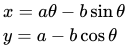
where θ is the variable angle through which the circle rolls.

Curtate, common, prolate

[edit]

If P lies inside the circle (b < a), on its circumference (b = a), or outside (b > a), the trochoid is described as being curtate ("contracted"), common, or prolate ("extended"), respectively.[3] A curtate trochoid is traced by a pedal (relative to the ground) when a normally geared bicycle is pedaled along a straight line.[4] A prolate trochoid is traced by the tip of a paddle (relative to the water's surface) when a boat is driven with constant velocity by paddle wheels; this curve contains loops. A common trochoid, also called a cycloid, has cusps at the points where P touches the line L.

General description

[edit]

A more general approach would define a trochoid as the locus of a point orbiting at a constant rate around an axis located at ,

which axis is being translated in the x-y-plane at a constant rate in either a straight line,

or a circular path (another orbit) around (the hypotrochoid/epitrochoid case),


The ratio of the rates of motion and whether the moving axis translates in a straight or circular path determines the shape of the trochoid. In the case of a straight path, one full rotation coincides with one period of a periodic (repeating) locus. In the case of a circular path for the moving axis, the locus is periodic only if the ratio of these angular motions, , is a rational number, say , where & are coprime, in which case, one period consists of orbits around the moving axis and orbits of the moving axis around the point . The special cases of the epicycloid and hypocycloid, generated by tracing the locus of a point on the perimeter of a circle of radius while it is rolled on the perimeter of a stationary circle of radius , have the following properties:

where is the radius of the orbit of the moving axis. The number of cusps given above also hold true for any epitrochoid and hypotrochoid, with "cusps" replaced by either "radial maxima" or "radial minima".

See also

[edit]

References

[edit]
[edit]
Revisions and contributorsEdit on WikipediaRead on Wikipedia
from Grokipedia
A trochoid is the locus of a point located at a distance bb from the center of a circle of radius aa as the circle rolls without slipping along a straight line, forming a type of roulette curve that combines uniform translation with circular rotation. The specific shape depends on the ratio of bb to aa: when b<ab < a, it produces a curtate cycloid with a flattened, wavy profile; when b=ab = a, it generates the classic cycloid, known for its cusps and arches; and when b>ab > a, it yields a prolate cycloid featuring loops and self-intersections. These curves are described parametrically by the equations
x=aθbsinθ,x = a\theta - b \sin \theta,
y=abcosθ,y = a - b \cos \theta,
where θ\theta is the parameter representing the rolling angle.
The study of trochoids traces back to the , with early explorations in geometric constructions, and the variant was named and analyzed by around 1599 for its applications in motion. In the , trochoids gained prominence in for optimizing gear designs, as their smooth profiles reduce friction and wear in tooth fillets generated by rack cutters. Related generalizations of curves occur when the rolling takes place around a fixed circle rather than a line: an results from external contact, producing star-like patterns such as cardioids or nephroids, while a arises from internal contact, yielding roses or ellipses. In practical applications, trochoids appear in mechanical systems like pumps, where their profiles define rotor shapes for efficient fluid displacement, and in mechanisms to ensure uniform coverage. They also inspire educational tools, such as the toy invented in the 1960s, which uses geared disks to draw intricate trochoidal patterns, making abstract accessible. Key properties include variable speed along the curve—maximum a+b|a + b| and minimum ab|a - b|—and arc lengths often involving elliptic integrals, underscoring their mathematical richness.

Definition

General Concept

A trochoid is the locus of a point fixed at a distance bb from the center of a of aa that rolls without slipping along a fixed straight line. This curve arises from the combined translational and rotational motion of the as it moves along the line, with the θ\theta determining the position of the tracing point at each instant. The key parameters governing the trochoid are the rolling circle's radius aa, the radial bb of the fixed point from the center, and the parameter θ\theta, which represents the angle through which the circle has rotated. As the circle rolls, the center translates horizontally by a aθa\theta, while the point's position relative to the center varies with the rotation. Depending on the ratio of bb to aa, the trochoid exhibits distinct visual forms, such as smooth arches when b<ab < a or loops when b>ab > a. Trochoids form a specific case within the broader class of curves, which are generated by a point attached to one curve rolling without slipping along another fixed curve.

Relation to Roulettes

A is defined as the traced by a fixed point attached to a moving as it rolls without slipping along a fixed . This construction generalizes various plane curves generated through rolling motion, encompassing a broad class of loci in classical . The generation of a relies on the prerequisite of no slipping during the rolling contact, which ensures that the motion decomposes into pure translation along the fixed curve and pure of the moving curve about its instantaneous . This condition maintains tangency and preservation between the curves, fundamental to the geometric integrity of the resulting path. Within this framework, a trochoid arises as a particular roulette where the moving curve is a circle and the fixed curve is a straight line, while epitrochoids and hypotrochoids emerge when the fixed curve is a circle. The term "roulette" itself originates from the French word roulette, meaning "small wheel," introduced by Blaise Pascal in his 1658 treatise Histoire de la Roulette, which explored the cycloid as a roulette curve.

Types

Cycloidal Trochoids

Cycloidal trochoids, also known as trochoids generated by a rolling along a straight line, are a class of curves where the path of the tracing point depends on its radial distance from the of the rolling relative to the 's . These curves arise in the context of a fixed straight line acting as the path, resulting in purely translational motion of the rolling 's without rotational variation around a curved fixed path. The common trochoid, specifically the , occurs when the tracing point lies on the of the rolling , producing a characterized by a series of cusps where the point touches the fixed line and smooth arches of equal height between them. This configuration yields a periodic with the point momentarily stationary at each cusp, creating the distinctive pointed arches. A curtate trochoid forms when the tracing point is located inside the rolling , resulting in a smoother, undulating without cusps, often described as a contracted or shortened version of the with reduced amplitude in its waves. In contrast, a prolate trochoid arises when the point is outside the , leading to a more extended with transverse loops and self-intersections, where the path crosses itself to form double points. These qualitative differences highlight how the position of the tracing point alters the 's : the balances arches and cusps, the curtate variant appears wavy and contained, and the prolate includes looping extensions that increase in complexity with greater radial distance. A special degenerate case occurs when the tracing point coincides with the center of the rolling circle, producing a straight line parallel to the fixed path, as the point simply translates without oscillation.

Circular Trochoids

Circular trochoids are generated when a circle rolls around the exterior or interior of a fixed circle, with a point attached to the rolling circle tracing the path. This setup contrasts with the straight-line rolling case by introducing curvature to the fixed path, which typically results in closed curves or star-shaped patterns when the ratio of the fixed circle's radius RR to the rolling circle's radius aa is rational. The key parameters are the radius RR of the fixed , the radius aa of the rolling , and the distance bb from the center of the rolling to the tracing point. When b=ab = a, the tracing point lies on the circumference of the rolling , reducing the curve to an or . These generalize the straight-line trochoids, where the fixed path's infinite radius limit produces open, wavelike paths. Epitrochoids arise when the rolling of radius aa moves externally around the fixed of radius RR. This configuration produces loops or petal-like extensions outward from the fixed , with the curve closing after a finite number of rotations if R/aR/a is rational. For instance, when R=aR = a and b=ab = a, the epitrochoid forms a cardioid, a heart-shaped with a single cusp. Another notable case occurs when R=2aR = 2a and b=ab = a, yielding a , a kidney-shaped featuring two cusps. Hypotrochoids, in contrast, form when the rolling circle moves internally within the fixed circle. Here, the tracing point orbits inside the fixed circle, often creating star-shaped or rosette patterns with inward-pointing cusps for rational R/aR/a. The hypocycloid subclass (b=ab = a) includes the deltoid, obtained when R=3aR = 3a, which exhibits three cusps and resembles a three-pointed star. Similarly, the astroid emerges when R=4aR = 4a, producing a four-cusped, diamond-like known for its envelope properties in classical .

Parametric Equations

Rolling on a Straight Line

The parametric equations for a trochoid generated by a point at distance bb from the center of a of aa rolling without slipping along a straight line are derived in a where the fixed line coincides with the horizontal x-axis at y=0y = 0, and the y-axis is vertical, with the circle typically positioned above the line for the standard orientation. The position of the tracing point is the vector sum of the center's location and the point's position relative to the center. The center translates horizontally along the x-axis by aθa\theta, maintaining a constant y-coordinate of aa, so its position is (aθ,a)(a\theta, a). The relative position, assuming the initial position of the tracing point is along the toward the contact point (vertical downward) and the circle rotates as it rolls to the right, is (bsinθ,bcosθ)(-b \sin \theta, -b \cos \theta). Adding these yields the parametric equations: x(θ)=aθbsinθ,x(\theta) = a\theta - b \sin \theta, y(θ)=abcosθ.y(\theta) = a - b \cos \theta. When b=ab = a, these simplify to the equations of a standard : x(θ)=a(θsinθ),y(θ)=a(1cosθ).x(\theta) = a(\theta - \sin \theta), \quad y(\theta) = a(1 - \cos \theta). For the general case, as θ\theta ranges from 0 to 2π2\pi, the curve completes one full arch, with the shape scaling based on the ratio b/ab/a: the arch is contracted for b<ab < a (curtate trochoid) and extended for b>ab > a (prolate trochoid), while the case (b=ab = a) produces the characteristic cusp-to-cusp form. Eliminating the parameter θ\theta to obtain a Cartesian equation relating xx and yy directly leads to transcendental equations involving , resulting in no simple in terms of elementary functions.

Rolling on a Fixed Circle

When a circle of radius aa rolls around the outside of a fixed circle of radius RR, the path traced by a point on the rolling circle at a distance bb from its center is an . The parametric equations for this curve are x(θ)=(R+a)cosθbcos((Ra+1)θ),y(θ)=(R+a)sinθbsin((Ra+1)θ),\begin{align*} x(\theta) &= (R + a) \cos \theta - b \cos \left( \left( \frac{R}{a} + 1 \right) \theta \right), \\ y(\theta) &= (R + a) \sin \theta - b \sin \left( \left( \frac{R}{a} + 1 \right) \theta \right), \end{align*} where θ\theta is the parameter representing the angle of rotation of the center of the rolling circle around the fixed circle. If the rolling circle instead rolls around the inside of the fixed circle, the resulting path is a , with parametric equations x(θ)=(Ra)cosθ+bcos((Ra1)θ),y(θ)=(Ra)sinθbsin((Ra1)θ).\begin{align*} x(\theta) &= (R - a) \cos \theta + b \cos \left( \left( \frac{R}{a} - 1 \right) \theta \right), \\ y(\theta) &= (R - a) \sin \theta - b \sin \left( \left( \frac{R}{a} - 1 \right) \theta \right). \end{align*} These equations assume a<Ra < R for the hypotrochoid to avoid intersection issues. The derivation of these equations follows from the position of the tracing point as the sum of the position of the rolling circle's center and the position of the point relative to that center. For the epitrochoid, the center traces a circle of radius R+aR + a with angular parameter θ\theta, so its position is ((R+a)cosθ,(R+a)sinθ)((R + a) \cos \theta, (R + a) \sin \theta). The rolling circle rotates by an additional angle ϕ=(R/a)θ\phi = -(R/a) \theta due to the gear ratio k=R/ak = R/a, leading to the relative position of the point being b(cos((k+1)θ),sin((k+1)θ))-b (\cos( (k + 1) \theta ), \sin( (k + 1) \theta )) to account for the opposite rotation direction and initial phase; combining these yields the full parametric form. A similar decomposition applies to the hypotrochoid, where the center traces a circle of radius RaR - a and the relative rotation is ϕ=(R/a)θ\phi = (R/a) \theta in the same direction, resulting in the adjusted angular multiple k1k - 1. Special cases arise when b=ab = a, the distance to the tracing point equals the rolling radius. For the epitrochoid, this produces an epicycloid, the path of a point on the circumference of the rolling circle. Similarly, b=ab = a in the hypotrochoid yields a hypocycloid. The curves exhibit periodicity when the gear ratio k=R/ak = R/a is rational, say k=p/qk = p/q in lowest terms, closing after θ\theta advances by 2πq2\pi q; otherwise, the path is dense on an annular region. In the limit as RR \to \infty, both epitrochoid and hypotrochoid equations reduce to the parametric form of a trochoid generated by rolling on a straight line, as the fixed circle approximates a line.

Properties

Geometric Characteristics

Trochoids exhibit distinctive geometric features arising from the rolling motion of a circle, including cusps, arches, and patterns of symmetry. In the case of the common cycloid, a specific type of trochoid generated by a point on the circumference of the rolling circle, cusps occur at parameter values θ = 2πn (where n is an integer), corresponding to points where the curve intersects the rolling line at y = 0 and the tangent becomes vertical. These cusps mark the instants when the tracing point contacts the base line, creating sharp points that define the curve's arch-like structure. The arches of vary by type, reflecting the position of the tracing point relative to the rolling circle of radius a. For the common cycloid, each arch rises to a height of 2a, forming smooth, rounded vaults between cusps. In curtate cycloids, where the tracing point lies inside the circle at a distance b < a from the center, the arches are reduced in height to 2b, resulting in a flatter, more elongated profile without cusps. Prolate cycloids, with the point outside the circle at b > a, produce arches extended to height 2b, often featuring self-intersecting loops that add complexity to the curve's outline. Straight-line trochoids, including cycloids, display and periodicity along the direction of rolling. These curves repeat every interval of 2πa in the x-coordinate, generating an infinite sequence of identical arches. Circular trochoids, formed by a circle rolling around a fixed of radius R, exhibit when the ratio R/a is an , resulting in star-like or rosette patterns with the corresponding number of-fold . Closure in these curves occurs after a finite number of rotations when R/a is a p/q in lowest terms, producing a bounded, non-repeating path that tiles the plane periodically; otherwise, the curve is dense and non-closing. A notable envelope property distinguishes the among trochoids: its , the locus of centers, is another congruent to the original but translated, typically shifted vertically by -2a. This self-similar underscores the cycloid's unique geometric harmony in classical curve theory.

Analytic Features

The analytic features of trochoids are derived from their parametric representations using techniques from calculus and differential geometry, yielding explicit expressions for quantities such as arc length, enclosed areas, and curvature. These properties highlight the trochoid's smooth variation except at singular points, with the cycloid serving as a canonical example where closed-form results are particularly accessible. For the cycloid, a special trochoid with generating point on the circumference (b=ab = a), the arc length LL of one complete arch (from θ=0\theta = 0 to θ=2π\theta = 2\pi) is found via the parametric arc length integral L=02π(dxdθ)2+(dydθ)2dθ.L = \int_{0}^{2\pi} \sqrt{\left( \frac{dx}{d\theta} \right)^2 + \left( \frac{dy}{d\theta} \right)^2} \, d\theta.
Add your contribution
Related Hubs
User Avatar
No comments yet.

