


Community hub
Recent from talks
Contribute something
Nothing was collected or created yet.
Tuareg languages
View on Wikipedia| Tuareg | |
|---|---|
| Geographic distribution | Sahara and Sahel |
| Ethnicity | Tuareg |
Native speakers | 2.9 million (2021–2024)[1] |
| Linguistic classification | Afro-Asiatic
|
| Subdivisions |
|
| Language codes | |
| ISO 639-2 / 5 | tmh |
| ISO 639-3 | tmh |
| Glottolog | tuar1240 |
 | |
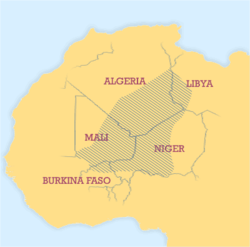
Tuareg (English: /ˈtwɑːrɛɡ/), also known as Tamasheq (English: /ˈtæməʃɛk/), Tamajaq or Tamahaq (Tifinagh: ⵜⴰⵎⴰⵌⴰⵆ), is a group of closely related Berber varieties. They are spoken by the Tuareg Berbers in large parts of Mali, Niger, Algeria, Libya, and Burkina Faso, with a few speakers, the Kinnin, in Chad.[2]
Description
[edit]The Tuareg varieties, on account of their low internal diversity and high mutual intercomprehensibility, are commonly regarded as a single language by linguists (as for instance by Karl-Gottfried Prasse). They are distinguished mainly by a few sound shifts (notably affecting the pronunciation of original z and h). The Tuareg varieties are unusually conservative in some respects; they retain two short vowels where Northern Berber languages have one or none, and have a much lower proportion of Arabic loanwords than most Berber languages.[citation needed]
The Tuareg languages are traditionally written in the indigenous Tifinagh alphabet. However, the Arabic script is commonly used in some areas (and has been since medieval times), while the Latin script is official in Mali and Niger.[citation needed]
Subclassification
[edit]- Tuareg
- Northern
- Tamahaq – language of the Kel Ahaggar, and Kel Ajjer spoken in Algeria, western Libya and in the north of Niger by around 77,000 people. Also known as Tahaggart.
- Southern
- Tamasheq – language of the Kel Adrar (also known as Adrar des Ifoghas), spoken in Mali by approximately 500,000 people.
- Air Tamajaq – language of the Kel Ayer (sometimes spelled Aïr), spoken in Niger by approximately 250,000 people.[3]
- Tawellemet – language of the Iwellemmeden, spoken in Mali and Niger by approximately 800,000 people. The term Iwellemmeden (the name of the people) is sometimes used to denote the language.
- Tamashaq language of Kal Asakan.[citation needed]
- Northern
Blench (ms, 2006) lists the following as separate languages, with dialects in parentheses:[4]
- Tawellemet (Abalagh/East, West)
- Tayiṛt (Ingal, Gofat)
- Tamesgrest (Azerori)
- Tafaghist
- Tahaggart/Ahaggar
- Ghat
Speakers of Tin Sert (Tetserret) identify as Tuareg, but the language is Tetserret, a Western Berber.
Orthography
[edit]The Tuareg languages may be written using the ancient Tifinagh (Libyco-Berber) script, the Latin script or the Arabic script. The Malian national literacy program DNAFLA has established a standard for the Latin alphabet, which is used with modifications in Prasse's Lexique and the government literacy program in Burkina, while in Niger a different system was used. There is also some variation in Tifinagh and in the Arabic script.[5]
Early uses of the Tifinagh script have been found on rock art and in various sepulchres. Among these are the 1,500 year old monumental tomb of the Tuareg matriarch Tin Hinan, where vestiges of a Tifinagh inscription have been found on one of its walls.[6]
Tifinagh usage is now restricted mainly to writing magical formulae, writing on palms when silence is required, and in letter-writing.[7] The Arabic script is mostly in use by tribes more involved in Islamic learning, and little is known about its conventions.[8]

| DNAFLA (Mali)[13] |
Niger[14] | Tifinagh | Arabic | |
|---|---|---|---|---|
| Image | Unicode | |||
| a | a | |||
| â | ||||
| ă | ă | |||
| ǝ | ǝ | |||
| b | b |  |
ⵀ | ب |
| (ḅ) | ||||
| c | ||||
| d | d |  |
ⴷ | د |
| ḍ | ḍ |  |
ⴹ | ض |
| e | e | |||
| ê | ||||
| f | f |  |
ⴼ | ف |
| g | g |  |
ⴳ | گ ݣ |
| i | i | |||
| î | ||||
| j | j |  |
ⴶ | چ |
| ǰ | ||||
| ɣ | ɣ |  |
ⵗ | غ |
| h | h |  |
ⵂ | ه |
| k | k |  |
ⴾ | ک |
| l | l |  |
ⵍ | ل |
| ḷ | ḷ | |||
| m | m |  |
ⵎ | م |
| n | n |  |
ⵏ | ن |
| ŋ | ŋ | |||
| o | o | |||
| ô | ||||
| q | q |   |
ⵆ, ⵈ | ق |
| r | r |  |
ⵔ | ر |
| s | s |  |
ⵙ | س |
| ṣ | ṣ |  |
ⵚ | ص |
| š (ʃ) | š |  |
ⵛ | ش |
| t | t |  |
ⵜ | ت |
| ṭ | ṭ |  |
ⵟ | ط |
| u | u | |||
| û | ||||
| w | w |  |
ⵓ | و |
| x | x |  |
ⵅ | خ |
| y | y |   |
ⵢ, ⵉ | ي |
| z | z |   |
ⵌ, ⵣ | ز |
| ẓ | ẓ |  |
ⵥ | ظ |
| ž (ʒ) | ǧ |  |
ⵊ | ج |
| ḥ | |
ⵆ | ح | |
| (ʕ) |  |
ⵄ | ع | |
The DNAFLA system is a somewhat morphophonemic orthography, not indicating initial vowel shortening, always writing the directional particle as < dd⟩, and not indicating all assimilations (e.g. ⟨Tămašăɣt⟩ for [tămašăq]).[15]
In Burkina Faso the emphatics are denoted by "hooked" letters, as in Fula, e.g. ⟨ɗ ƭ⟩.[16]
Phonology
[edit]Vowels
[edit]The vowel system includes five long vowels, /a, e, i, o, u/ and two short vowels, /ə, ă/ (on this page, /ă/ is used to represent IPA [æ]). Some of the vowels have more open "emphatic" allophones that occur immediately before emphatic consonants, subject to dialectal variation. These allophones include [ɛ] for /e/ and /i/ (although /i/ may be less open), [ɔ] for /o/ and /u/ (although /u/ may be less open), and [ă] for /ə/.[17] Karl Prasse argued that /e/ goes back to Proto-Berber, while /o/ is derived from /u/.[18] Comparative evidence shows that /ə/ derives from a merger of Proto-Berber */ĭ/ and */ŭ/.
Sudlow classes the "semivowels" /w, j/ with the vowels, and notes the following possible diphthongs: /əw/ (> [u]), /ăw/, /aw/, /ew/, /iw/, /ow/, /uw/, /əj/ (> [i]), /ăj/, /aj/, /ej/, /ij/, /oj/, /uj/.[19]
Consonants
[edit]| Labial | Alveolar | Palatal | Velar | Uvular | Pharyngeal | Glottal | |||
|---|---|---|---|---|---|---|---|---|---|
| plain | emphatic | ||||||||
| Nasal | m | n | ŋ[a] | ||||||
| Plosive | voiceless | t | tˤ | k | q | (ʔ) | |||
| voiced | b | d | dˤ | ɟ[note 1] | ɡ | ||||
| Fricative | voiceless | f | s | (sˤ)[b] | ʃ | x[c] | (ħ)[d] | h | |
| voiced | z | zˤ | ʒ[e] | ɣ[c] | (ʕ)[d] | ||||
| Lateral | l | (lˤ)[b] | |||||||
- ^ /ŋ/ is rare.
- ^ a b /lˤ, sˤ/ only occur in Arabic loans and /lˤ/ only in the name of Allah.
- ^ a b Sudlow (2001:26) does not specify whether these are velar or uvular.
- ^ a b /ħ, ʕ/ are only used in Arabic words in the Tanəsləmt dialect (most Tamasheq replace them with /x, ɣ/ respectively).[21]
- ^ /ʒ/ is rare in Tadɣaq.
The consonant inventory largely resembles Arabic: differentiated voicing; uvulars, pharyngeals (traditionally referred to as emphatics) /tˤ/, /lˤ/, /sˤ/, /dˤ/, /zˤ/; requiring the pharynx muscles to contract and influencing the pronunciation of the following vowel, and no voiceless bilabial plosive.[22]
The glottal stop is non-phonemic. It occurs at the beginning of vowel-initial words to fill the place of the initial consonant in the syllable structure (see below), although if the words is preceded by a word ending in a consonant, it makes a liaison instead. Phrase-final /a/ is also followed by a phonetic glottal stop.[23]
Gemination is contrastive.[24] Normally /ɣɣ/ becomes [qː], /ww/ becomes [ɡː], and /dˤdˤ/ becomes [tˤː].[24] /q/ and /tˤ/ are predominantly geminate. In addition, in Tadɣaq /ɡ/ is usually geminate, but in Tudalt singleton /ɡ/ may occur.[24]
Voicing assimilation occurs, with the first consonant taking the voicing of the second (e.g. /edˤkăr/ > [etˤkăr]).[25]
Cluster reduction turns word/morpheme-final /-ɣt, -ɣk/ into [-qː] and /-kt, -ɟt, -ɡt/ into [-kː] (e.g. /tămaʃăɣt/ > [tămaʃăq] 'Tamasheq'[note 2]).[26]
Phonotactics
[edit]Syllable structure is CV(C)(C), including glottal stops (see above).[23]
Suprasegmentals
[edit]Contrastive stress may occur in the stative aspect of verbs.[17]
Dialectal differences
[edit]Different dialects have slightly different consonant inventories. Some of these differences can be diachronically accounted for. For example, Proto-Berber *h is mostly lost in Ayer Tuareg, while it is maintained in almost every position in Mali Tuareg. The Iwellemmeden and Ahaggar Tuareg dialects are midway between these positions.[27][28] The Proto-Berber consonant *z comes out differently in different dialects, a development that is to some degree reflected in the dialect names. It is realized as h in Tamahaq (Tahaggart), as š in Tamasheq and as simple z in the Tamajaq dialects Tawallammat and Tayart. In the latter two, *z is realised as ž before palatal vowels, explaining the form Tamajaq. In Tawallammat and especially Tayart, this kind of palatalization actually does not confine itself to z. In these dialects, dentals in general are palatalized before /i/ and /j/. For example, tidət is pronounced [tidʲət] in Tayart.[29]
Other differences can easily be traced back to borrowing. For example, the Arabic pharyngeals ħ and ʻ have been borrowed along with Arabic loanwords by dialects specialized in Islamic (Maraboutic) learning. Other dialects substitute ħ and ʻ respectively with x and ɣ.
Grammar
[edit]The basic word order in Tuareg is verb–subject–object. Verbs can be grouped into 19 morphological classes; some of these classes can be defined semantically. Verbs carry information on the subject of the sentence in the form of pronominal marking. No simple adjectives exist in the Tuareg languages; adjectival concepts are expressed using a relative verb form traditionally called 'participle'. The Tuareg languages have very heavily influenced Northern Songhay languages such as Sawaq, whose speakers are culturally Tuareg but speak Songhay; this influence includes points of phonology and sometimes grammar as well as extensive loanwords.
Syntax
[edit]Tamasheq prefers VSO order; however it contains topic–comment structure (like in American Sign Language, Modern Hebrew, Japanese and Russian), allowing the emphasized concept to be placed first, be it the subject or object, the latter giving an effect somewhat like the English passive.[30] Sudlow uses the following examples, all expressing the concept "Men don't cook porridge" (e denotes Sudlow's schwa):
| meddăn wăr sekediwăn ăsink | SVO |
| wăr sekediwăn meddăn ăsink | VSO |
| ăsinkwăr ti-sekediwăn meddăn | 'Porridge, men don't cook it.' |
| wădde meddăn a isakădawăn ăsink | 'It isn't men who cook porridge.' |
| meddăn a wăren isekediw ăsink | 'Men are not those who cook porridge.' |
Again like Japanese, the "pronoun/particle 'a' is used with a following relative clause to bring a noun in a phrase to the beginning for emphasis," a structure which can be used to emphasize even objects of prepositions.[31] Sudlow's example (s denotes voiceless palato-alveolar fricative):
| essensăɣ enăle | 'I bought millet.' |
| enăle a essensăɣ | 'It was millet that I bought.' |
The indirect object marker takes the form i/y in Tudalt and e/y in Tadɣaq.[32]
Morphology
[edit]As a root-and-pattern, or templatic language, triliteral roots (three-consonant bases) are the most common in Tamasheq. Niels and Regula Christiansen use the root k-t-b (to write) to demonstrate past completed aspect conjugation:
| singular | plural | ||
|---|---|---|---|
| 1st person | ...-ăɣ | n-... | |
| 2nd person | t-...-ăd | t-...-ăm | |
| 3rd person | M | y-... | t-...-măt |
| F | t-... | ...-ăn | |
| Participle form, i.e. "who ..." |
M | y-...-ăn | ...-năt |
| F | t-...-ăt | ...-nen | |
| Person | Singular | Plural | |
|---|---|---|---|
| 1st | ektabaɣ write.1S 'I wrote' |
nektab write.1P 'We wrote' | |
| 2nd | (m) | tektabad write.2S 'You wrote' |
tektabam write.2P/M 'You wrote' |
| (f) | tektabmat write.2P/F 'You wrote' | ||
| 3rd | (m) | iktab write.3S/M 'He wrote' |
ektaban write.3P/M 'They wrote' |
| (f) | tektab write.3S/F 'She wrote' |
ektabnat write.3P/F 'They wrote' | |
The verbal correspondence with the use of aspect; Tamasheq uses four, as delineated by Sudlow:
- Perfective: complete actions
- Stative: "lasting states as the ongoing results of a completed action."
- Imperfective: future or possible actions, "often used following a verb expressing emotion, decision or thought," it can be marked with "'ad'" (shortened to "'a-'" with prepositions).
- Cursive: ongoing actions, often habitual ones.
| Verb | Perfective/simple perfect | Stative/intensive perfect | Imperfective/simple perfect | Cursive/intensive imperfect |
|---|---|---|---|---|
| z-g-r | izgăr | izgăr | ||
| 'He went out' | 'He has gone out' | |||
| b-d-d | ibdăd | ibdăd | ||
| 'He stood up' | 'He stood up (and so he is standing up)' | |||
| ekkeɣ hebu | ekkêɣ hebu | |||
| 'I went to market' | 'I am going to market' | |||
| l-m-d | ad elmedăɣ Tămasăq | lammădăɣ Tămasăq | ||
| 'I will learn Tamasheq' | 'I am learning Tamasheq' | |||
| a-dd-as asekka | ||||
| 'He will arrive (here) tomorrow' | ||||
| iwan tattănăt alemmoZ | ||||
| 'Cows eat straw' | ||||
| ăru tasăɣalăɣ siha | ||||
| 'I used to work over there' |
Commands are expressed in the imperative mood, which tends to be a form of the imperfective aspect, unless the action is to be repeated or continued, in which case the cursive aspect is preferred.[35]
Further reading
[edit]Bibliographies
[edit]- Bougchiche, Lamara. (1997) Langues et litteratures berberes des origines a nos jours. Bibliographie internationale et systematique. Paris: Ibis Press.
- Chaker, Salem, ed. (1988) Etudes touaregues. Bilan des recherches en sciences sociales. Travaux et Documents de i.R.E.M.A.M. no. 5. Aix-en-Provence: IREMAM / LAPMO.
- Leupen, A.H.A. (1978) Bibliographie des populations touaregues: Sahara et Soudan centraux. Leiden: Afrika Studiecentrum.
Dictionaries
[edit]
- Charles de Foucauld (1951–1952) Dictionnaire touareg–francais. 4 vol. Paris: Imprimerie Nationale de France. [posthumous facsimile publication (author dec. 1916); dialect of Hoggar, southern Algeria]
- Jeffrey Heath (2006) Dictionnaire tamachek–anglais–français. Paris: Karthala. [covers dialects of northern Mali]
- Motylinski, A. (1908). Grammaire, dialogues et dictionnaire touaregs. Alger: P. Fontana.
- Karl-G Prasse, Ghoubeid Alojaly and Ghabdouane Mohamed, (2003) Dictionnaire touareg–francais (Niger). 2nd edition revised; 2 vol. Copenhagen: Museum Tusculanum Press, University of Copenhagen. [1st edition 1998; covers two dialects of the northern Republic of Niger]
Grammars
[edit]- Christiansen, Niels, and Regula. "Some verb morphology features of Tadaksahak ." SIL Electronic Working Papers. 2002. SIL International. 2 December 2007 <[1]>.
- Hanoteau, A. (1896) Essai de grammaire de la langue tamachek' : renfermant les principes du langage parlé par les Imouchar' ou Touareg. Alger: A. Jourdan.
- Galand, Lionel. (1974) 'Introduction grammaticale'. In: Petites Soeurs de Jesus, Contes touaregs de l'Air (Paris: SELAF), pp. 15–41.
- Heath, Jeffrey. 2005. Grammar of Tamashek (Tuareg of Mali). (Mouton Grammar Series.) the Hague: Mouton de Gruyter.
- Kossmann, Maarten G. (2011), A Grammar of Ayer Tuareg (Niger), Berber Studies, vol. 30, Köln: Rüdiger Köppe
- Prasse, Karl G. (1973) Manuel de grammaire touaregue (tahaggart). 4 vol. Copenhagen.
Texts
[edit]- Ag Erless, Mohamed (1999) "Il n'y a qu'un soleil sur terre". Contes, proverbes et devinettes des Touaregs Kel-Adagh. Aix-en-Provence: IREMAM.
- Aghali-Zakara, Mohamed & Jeannine Drouin (1979) Traditions touarègues nigériennes. Paris: L'Harmattan.
- Albaka, Moussa & Dominique Casajus (1992) Poésies et chant touaregs de l'Ayr. Tandis qu'ils dorment tous, je dis mon chant d'amour. Paris: L'Harmattan.
- Alojaly, Ghoubeïd (1975) Ǎttarikh ən-Kəl-Dənnəg – Histoire des Kel-Denneg. Copenhagen: Akademisk Forlag.
- Casajus, Dominique (1985) Peau d'Âne et autres contes touaregs. Paris: L'Harmattan.
- Chaker, Salem & Hélène Claudot & Marceau Gast, eds. (1984) Textes touaregs en prose de Charles de Foucauld et. A. de Calassanto-Motylinski. Aix-en-Provence: Édisud.
- Chants touaregs. Recueillis et traduits par Charles de Foucauld. Paris, Albin Michel, 1997
- Foucauld, Charles de (1925) Poésies touarègues. Dialecte de l'Ahaggar. Paris: Leroux.
- Lettres au marabout. Messages touaregs au Père de Foucauld. Paris, Belin, 1999
- Heath, Jeffrey (2005) Tamashek Texts from Timbuktu and Kidal. Berber Linguistics Series. Cologne: Koeppe Verlag
- Louali-Raynal, Naïma & Nadine Decourt & Ramada Elghamis (1997) Littérature orale touarègue. Contes et proverbes. Paris: L'Harmattan.
- Mohamed, Ghabdouane & Karl-G. Prasse (1989) Poèmes touarègues de l'Ayr. 2 vol. Copenhagen: Akademisk Forlag.
- Mohamed, Ghabdouane & Karl-G. Prasse (2003) əlqissǎt ən-təməddurt-in – Le récit de ma vie. Copenhagen: Museum Tusculanum Press.
- Nicolaisen, Johannes, and Ida Nicolaisen. The Pastoral Tuareg: Ecology, Culture, and Society. Vol. 1,2. New York: Thames and Hudson, Inc, 1997. 2 vols.
- Nicolas, Francis (1944) Folklore Twareg. Poésies et Chansons de l'Azawarh. BIFAN VI, 1–4, p. 1–463.
Linguistic topics
[edit]- Cohen, David (1993) 'Racines'. In: Drouin & Roth, eds. À la croisée des études libyco-berbères. Mélanges offerts à Paulette Galand-Pernet et Lionel Galand (Paris: Geuthner), 161–175.
- Kossmann, Maarten (1999) Essai sur la phonologie du proto-berbère. Köln: Rüdiger Köppe.
- Prasse, Karl G. (1969) A propos de l'origine de h touareg (tahaggart). Copenhagen.
Notes
[edit]- ^ Sudlow (2001:26) does not make it clear whether this is a true palatal stop or something else, possibly a front velar stop or some sort of affricate.
- ^ Note that the geminate is dropped if not followed by a vowel.
References
[edit]- ^ Tuareg languages at Ethnologue (28th ed., 2025)

- ^ Monique Jay, "Quelques éléments sur les Kinnin d’Abbéché (Tchad)". Études et Documents Berbères 14 (1996), 199–212 (ISSN 0295-5245 ISBN 2-85744-972-0).
- ^ "Ethnologue report for language code: thz". Ethnologue: Languages of the World, Sixteenth edition. Retrieved August 17, 2012.
- ^ AA list, Blench, ms, 2006
- ^ Sudlow 2001, pp. 33–36.
- ^ Briggs, L. Cabot (February 1957). "A Review of the Physical Anthropology of the Sahara and Its Prehistoric Implications". Man. 56: 20–23. doi:10.2307/2793877. JSTOR 2793877.
- ^ Penchoen, Thomas G. (1973). Tamazight of the Ayt Ndhir. Los Angeles: Undena Publications. p. 3.
- ^ "Orthography in a plurigraphic society: the case of Tuareg in Niger". Archived from the original on May 3, 2008.
- ^ Sudlow 2001, pp. 28, 35–36.
- ^ Ridouane Ziri, Rachid. "Les différents systèmes d'écriture amazighe" (in French). Archived from the original on April 30, 2017. Retrieved August 19, 2012.
- ^ Bizari, Brahim. "Ecriture amazigh" (in French). Archived from the original on April 5, 2001. Retrieved August 19, 2012.
- ^ Fukui, Yusuf Yoshinori; Walett Mahmoud, Khadijatou. "Alphabets of Tamashek in Mali: Alphabetization and Tifinagh". Archived from the original on February 1, 2004. Retrieved August 18, 2012.
- ^ Osborn, Don (2002). "Base extended-Latin characters and combinations for languages of Mali". Retrieved August 18, 2012.
- ^ Enguehard, Chantal (2007). "alphabet tamajaq (arrété 214-99 de la République du Niger)" (in French). Archived from the original on March 10, 2018. Retrieved August 19, 2012.
- ^ Sudlow 2001, p. 34.
- ^ Sudlow 2001, p. 33.
- ^ a b Sudlow 2001, p. 25.
- ^ K.-G. Prasse (1990), New Light on the Origin of the Tuareg Vowels E and O, in: H. G. Mukarovsky (ed), Proceedings of the Fifth International Hamito-Semitic Congress, Vienna, I 163–170.
- ^ Sudlow 2001, pp. 25–26.
- ^ Sudlow 2001, pp. 26–28.
- ^ Sudlow 2001, p. 26-28.
- ^ Sudlow 2001, pp. 26–7.
- ^ a b Sudlow 2001, p. 27.
- ^ a b c Sudlow 2001, p. 28.
- ^ Sudlow 2001, pp. 28–29.
- ^ Sudlow 2001, p. 29.
- ^ Prasse 1969.
- ^ Kossmann 1999.
- ^ Prasse e.a. 2003:xiv
- ^ Sudlow 2001, p. 46.
- ^ Sudlow 2001, p. 48.
- ^ Sudlow 2001, p. 1.1..
- ^ Sudlow 2001, p. 118.
- ^ Christiansen & Christiansen 2002, p. 5.
- ^ Sudlow 2001, p. 57.

Bibliography
[edit]- Christiansen, Niels; Christiansen, Regula (2002). "Some verb morphology features of Tadaksahak". SIL Electronic Working Papers. Dallas: SIL International.
- Heath, Jeffrey (2005). A grammar of Tamashek (Tuareg of Mali). Walter de Gruyter. p. 745. ISBN 3-11-018484-2.
- Sudlow, David (2001). The Tamasheq of North-East Burkina Faso. Köln: Rüdiger Köppe Verlag. Archived from the original on 2010-06-07. Retrieved 2004-10-23.
External links
[edit]
Tuareg languages
View on GrokipediaOverview
Speakers and distribution
The Tuareg languages are spoken by an estimated 1.5–2 million people as of 2023, primarily members of the Tuareg ethnic group, also known as the Imazighen or Kel Tamasheq.[7] These speakers are distributed across the vast Sahara Desert and the Sahel region, encompassing Algeria, Libya, Mali, Niger, and Burkina Faso, with smaller communities in Mauritania and Chad.[8] The languages serve both nomadic pastoralist communities, who maintain traditional mobile lifestyles in remote desert areas, and sedentary populations in urban centers and agricultural settlements.[8] The languages are typically classified into three main varieties, each encompassing several dialects: northern Tamahaq (spoken in the Ahaggar and Aïr Mountains of Algeria, Libya, and Niger by around 130,000 people as of 2022); southern Tamasheq (prevalent in Mali and Burkina Faso, with approximately 900,000 speakers as of 2022); and eastern Tamajaq (found mainly in Niger and Mali, spoken by about 1 million people as of 2023, including the Tawallammat dialect with ~950,000 speakers). Usage patterns vary, with higher vitality in rural and nomadic settings compared to urban areas, where French or Arabic often predominates as lingua francas.[9]Historical context
The Tuareg languages, part of the Berber branch of the Afroasiatic language family, trace their roots to the broader Proto-Berber stage, with linguistic evidence suggesting an initial spread of Proto-Berber speakers from the Nile Valley into North Africa around 4,000–5,000 years ago.[10] This early expansion aligns with archaeological indications of pastoralist movements across the Sahara during a period of climatic favorability. The relative homogeneity among modern Berber languages, including Tuareg varieties, implies a more recent Proto-Berber consolidation around 100–200 AD, marked by language leveling possibly tied to Roman-era interactions.[11] Divergence of Tuareg from other Berber languages likely occurred 2,000–3,000 years ago, reflecting the isolation of Saharan groups amid environmental shifts toward aridity.[12] Throughout antiquity, Tuareg languages absorbed influences from interacting civilizations, incorporating Punic loanwords such as those for almond (ā-sāγīd) and reed (ā-γānīm) during Carthaginian contacts before 140 BC, which entered at the Proto-Berber level.[13] Latin agricultural terms further enriched the lexicon during Roman occupation of North Africa from the 1st century BC to the 5th century AD, evidencing economic exchanges in the region.[11] Early Arabic influences began with the 7th-century Islamic conquests, introducing religious and administrative vocabulary, while medieval scholarship in Timbuktu—a Tuareg-founded center around 1100 AD—amplified lexical borrowing through its role as a hub for Muslim learning and trans-Saharan trade, fostering deeper integration of Arabic terms into Tuareg.[14] In the 19th and 20th centuries, French colonial rule profoundly impacted Tuareg languages across the Sahara, imposing Latin-based orthographies that adapted Berber scripts for administrative and educational purposes, often prioritizing French phonetic conventions over indigenous systems like Tifinagh.[15] This period saw increased bilingualism and script standardization efforts in colonies like Algeria, Mali, and Niger, disrupting traditional oral and Tifinagh practices. Following independence in the 1960s, political tensions in Mali and Niger, including Tuareg rebellions, highlighted the cultural significance of the languages, leading to gradual inclusion in peace agreements and limited educational programs in northern regions.[16]Classification
Position in Berber family
The Tuareg languages form a distinct subgroup within the Berber branch of the Afroasiatic phylum, specifically classified as Southern Berber, alongside languages like Ghadames and Zenaga.[17] This positioning reflects their genetic ties to the broader Berber family while highlighting divergences from Northern subgroups such as Zenati (e.g., Rif and Mzab varieties) and Eastern Berber (e.g., Siwi), with which they share core lexical and morphological features but differ in subgroup-specific developments.[17] Tuareg's Southern affiliation is marked by innovations including the development and spread of pharyngealized consonants beyond Proto-Berber's original set (e.g., emphatic /ḍ/ and /ẓ/), which contrast with the more limited pharyngealization in Zenati and Eastern varieties.[17] Comparative linguistics provides evidence for Tuareg's placement through shared Proto-Berber roots with other branches, such as *asin "tooth" (cognate with Kabyle *asen and Tashelhit *asen) and *aẓru "stone" (cognate with Kabyle *aẓru and Tashelhit *aẓer), demonstrating common inheritance.[18] However, Tuareg exhibits unique innovations, including the loss of certain Proto-Berber vowels (e.g., reduction of short vowels in unstressed positions, leading to more consonantal clusters) and phonetic shifts like *z > h in some dialects (e.g., Ahaggar Tamahaq), which set it apart from the vowel-preserving patterns in Kabyle and Tashelhit.[18] These shared and divergent elements confirm Tuareg's embedded position in the Berber family tree, with conservatism in retaining ancient Afrasian loans (e.g., *a/isi "horse" from Egyptian) underscoring its deep genetic links.[18] Classification debates center on whether Tuareg constitutes a single language with dialects or multiple distinct languages, with glottochronological studies supporting the latter due to low mutual intelligibility and accumulated innovations for major internal splits (e.g., between Ahaggar Tamahaq and Mali Tamasheq).[19] This timeframe aligns with broader Berber diversification, where Tuareg's separation from Northern groups like Zenati occurred earlier, around the late 2nd millennium BCE, based on lexical retention rates.[18] Such analyses treat the five primary varieties (e.g., Ahaggar, Aïr, and Tawellemmet) as independent languages due to low mutual intelligibility and accumulated innovations.[19]Dialects and mutual intelligibility
The Tuareg languages, also known as Tamasheq varieties, are classified into several main dialects reflecting regional distributions across the Sahara. The primary division is between Northern and Southern groups. The Northern dialect, Tamahaq (also spelled Tamahaqq), is spoken primarily in southern Algeria and Libya, with key varieties including the Ahaggar (Hoggar) subdialect in the Algerian Ahaggar Mountains and the Assekrem subdialect further north.[20] The Southern dialects encompass Tamasheq, mainly in northern Mali (regions like Kidal, Gao, and Timbuktu), Tamajaq (or Tayart) in northern Niger (particularly the Aïr Mountains), and the transitional Tawellemmet, spoken in northwestern Niger and parts of eastern Mali such as Menaka.[20] These dialects form part of the Southern Berber branch within the Berber family.[19] Subdialectal variation within these main groups is marked by isoglosses in vocabulary and phonological reflexes. For instance, Tamasheq subdialects include the mainstream variety around Kidal and Tessalit, the Kal Ansar form in Timbuktu, and eastern variants in Gourma and Ansongo, distinguished by lexical items like innovations in terms for "all" (e.g., kul from Arabic loans in some eastern areas).[20] Phonological isoglosses highlight differences such as sibilant shifts: Tamasheq retains /s/ (as in tamasheq), while Tamajaq uses /z/ (tamajeq) and Tamahaq employs /h/ (tamahaq).[20] Other examples include reflexes of uvular sounds, where some varieties preserve /q/-like articulations from proto-Berber, contrasting with /ɢ/ or merged forms in others, as seen in comparative wordlists for terms like "tail" (e.g., tasbat in Aïr Tamajaq vs. tedémbut in western Awlemmiden).[19] The dialects exhibit a dialect continuum rather than discrete boundaries, with degrees of mutual intelligibility varying by geographic proximity and subgroup. Varieties within the same main dialect, such as those in the Aïr-East Awlemmiden cluster, show high mutual comprehension due to shared lexical and structural features, while cross-regional differences, like between Tamahaq and Tamasheq, reduce intelligibility owing to accumulated phonological and vocabulary divergences.[20] This continuum is shaped by the Tuareg's nomadic and transhumant lifestyle, which facilitates ongoing contact through trade routes and seasonal migrations, promoting lexical convergence in domains like commerce and herding despite political borders that have historically limited broader interactions.[20] Glottochronological analyses confirm close relatedness across the group, supporting their treatment as interconnected varieties within a single macrolanguage.[19]Phonology
Vowel system
The vowel system of Tuareg languages features a relatively simple inventory dominated by length distinctions, with five contrastive long vowels—/iː/, /eː/, /aː/, /oː/, /uː/—and two short vowels, typically /ə/ (a mid central vowel) and /a/ (or /ă/, a low central vowel). This system excludes front rounded vowels (e.g., /yː/, /øː/) and back unrounded vowels (e.g., /ɯː/, /ɤː/), aligning with broader Berber patterns but retaining more short vowel contrasts than many northern varieties.[21] Vowel length serves as a phonemic feature, particularly in verbal derivations and nominal forms, where long vowels often mark grammatical categories such as aspect or number. For example, in Malian Tamasheq, the opposition between short /a/ (realized as [æ] or a centralized variant) and long /aː/ distinguishes lexical items and morphemes, with short vowels exhibiting greater centralization in this dialect compared to northern varieties like Tamahaq. Dialectal realizations of short vowels vary, with /ə/ appearing higher and more reduced in open syllables, while /a/ remains lower but can centralize in unstressed positions.[22][23] Vowel harmony influences certain suffixes, where the vowel quality in the affix assimilates to the stem's final vowel, promoting mid vowels like /e/ and /o/ in forms such as the nominal feminine plural *-en or *-ən. This process, inherited from Proto-Berber, helps explain the limited but systematic occurrence of non-high mid vowels beyond the core /i/, /u/, /a/ set. Additionally, the schwa /ə/ frequently acts as an epenthetic vowel to resolve consonant clusters in roots or as a reduced variant of fuller vowels in weak positions, contributing to the language's prosodic flexibility without altering core phonemic contrasts.[23][21][22]Consonant inventory
The consonant inventory of Tuareg languages, as a branch of the Berber family, typically comprises around 21-27 phonemes, characterized by a lack of native bilabial stops /p/ and /b/ (which occur marginally in Arabic and French loanwords), a series of emphatic (pharyngealized) consonants, and a robust inventory of fricatives including pharyngeals and uvulars. This system reflects Proto-Berber origins, with innovations such as the development of voiced uvular /ɢ/ from /q/ in some dialects like those of Niger and Mali.[21] Stops are represented by voiceless /t, k, q/ and voiced /d, g/, alongside emphatic variants /tˤ, dˤ/ that involve pharyngealization, lowering adjacent vowels. Fricatives include pharyngeals /ħ, ʕ/, uvulars /χ, ʁ/, and sibilants /s, z, ʃ, ʒ/, with emphatic forms such as /sˤ, zˤ/. The remaining consonants consist of nasals /m, n/, liquids /l, r/ (with /r/ trilled and /ʁ/ as a uvular fricative variant), and glides /w, j/. The following table presents a representative consonant chart for Tamashek (Mali Tuareg), based on primary grammatical descriptions, with IPA symbols, orthographic equivalents where standard, and illustrative examples (transcriptions approximate surface forms). Marginal phonemes from loans are in parentheses.| Manner/Place | Bilabial | Alveolar | Emphatic Alveolar | Palato-alveolar | Velar | Uvular | Pharyngeal | Glottal |
|---|---|---|---|---|---|---|---|---|
| Stops/Affricates (voiceless) | (p) | t (t) | tˤ (ṭ) | tʃ (č) | k (k) | q (q) | ʔ (ʔ) | |
| Stops/Affricates (voiced) | (b) | d (d) | dˤ (ḍ) | dʒ (ǧ) | g (g) | (ɢ) | ||
| Fricatives (voiceless) | (f) | s (s) | sˤ (ṣ) | ʃ (š) | x (x) | χ (r) | ħ (ḥ) | h (h) |
| Fricatives (voiced) | (v) | z (z) | zˤ (ẓ) | ʒ (ž) | ʁ (ġ) | ʕ (ʿ) | ||
| Nasals | m (m) | n (n) | (ŋ) | |||||
| Laterals | l (l) | |||||||
| Taps/Trills | ɾ~r (r) | |||||||
| Glides | w (w) | j (y) |
Prosodic features and variation
The phonotactics of Tuareg languages adhere to a basic syllable structure of CV(C), where C represents a consonant and V a vowel, precluding initial consonant clusters and allowing at most one coda consonant per syllable. This structure is maintained through processes like schwa epenthesis, which inserts a short central vowel (ə) to resolve illicit consonant clusters, particularly in stem-final positions followed by suffixes or clitics. Gemination is a prevalent feature, arising frequently from the assimilation of stem-final consonants with initial stops or affricates in suffixes, as seen in verbal forms where a sequence like stem-final /d/ + suffix-initial /t/ yields /tt/ (e.g., in negative constructions such as the imperfective negative, where geminated stops reinforce the prosodic weight). Consonant length thus serves a prosodic role, contributing to syllable weight and distinguishing morphological categories without altering the core CV(C) template. Suprasegmental features in Tuareg emphasize rhythm and phrasing over lexical distinctions. Word stress typically falls on the antepenultimate syllable by default, though it can shift to the penultimate in forms influenced by ablaut or suffixation, such as feminine singular markers that attract accent rightward. Unlike some Berber relatives, Tuareg lacks lexical tone, relying instead on phrasal intonation for conveying pragmatic functions like focus or interrogation, with rising contours often marking questions and falling patterns signaling declaratives.[24] Vowel and consonant length further function prosodically, with long vowels and geminates enhancing rhythmic balance in phrases, particularly in verb stems where length contrasts signal aspectual differences (e.g., short vs. long vowels in perfective vs. imperfective forms).[25] Dialectal variations introduce notable prosodic diversity across Tuareg varieties. In Northern Tamahaq (e.g., Ahaggar dialect), the fricative /h/ is retained as a reflex of proto-Berber *z, preserving distinct syllable onsets and contributing to heavier prosodic profiles in words like azəggər > ahəggər "short" (cf. Southern forms where /h/ is lost or devoiced).[25][26] Emphatic consonants (e.g., /ṭ, ḍ, ṣ/), characterized by pharyngealization, exhibit variable spread: in Malian Tamashek, emphasis propagates rightward across adjacent vowels and consonants within the phrase, lowering F1 formants for a "dark" timbre (e.g., /aḍḍ/ "hand" affecting following /a/ > [ɑ]), whereas Algerian varieties like Tamahaq show more restricted, leftward-biased assimilation, influenced by regional Arabic contact. These differences impact overall intonation contours, with Malian dialects displaying broader emphatic harmony that extends phrasal rhythm, while Northern forms maintain sharper segmental boundaries.Orthography
Traditional and modern scripts
The traditional writing system for Tuareg languages is Tifinagh, an ancient abjad derived from the Libyco-Berber script that dates back to at least the third century BCE and was used for inscriptions across North Africa.[27] Among the Tuareg, this script persisted as a consonantal alphabet with approximately 33 basic signs, primarily employed for symbolic, funerary, and occasional practical notations such as names or short messages, reflecting its role in cultural and ritual contexts rather than widespread literacy.[28][29] The script's survival among the Tuareg distinguishes it from other Berber groups, where it largely fell into disuse after the Islamic conquests, though regional variations exist in letter forms and usage.[6] In the modern era, Tuareg languages are predominantly written using a Latin-based orthography, introduced by French colonial administrators and missionaries in the early twentieth century to facilitate administration, education, and missionary work in regions like Mali and Niger.[30] This system features variants adapted to Tuareg phonology, incorporating diacritics such as ə for the central vowel schwa (/ə/) and symbols like ħ or ʕ for pharyngeal and emphatic consonants (/ħ/, /ʕ/, /ˤ/), with Mali's official adoption formalized in 1967 and further refined in 1982.[5] Additionally, an adapted Arabic script, known as Ajami, has been employed since at least the sixteenth century, particularly for religious texts, poetry, and personal correspondence, with modifications to Arabic letters to represent Tuareg-specific sounds like pharyngeals through additional dots or contextual adaptations.[31] Contemporary usage reflects a tri-scriptal landscape, where the Latin orthography dominates formal education and official documents in countries like Mali and Niger due to its practicality and colonial legacy.[32] Tifinagh, however, experiences a revival for cultural identity and symbolism, bolstered by efforts such as the 2003 standardization by Morocco's Royal Institute of Amazigh Culture (IRCAM), which expanded the script's Unicode encoding and promoted its use in Berber-language contexts, influencing Tuareg communities through shared Berber heritage initiatives.[6] Arabic script persists in religious and literary domains, especially in Niger, where it supports Islamic scholarship and traditional poetry.[31]Standardization across regions
Standardization efforts for Tuareg orthographies vary significantly across regions, reflecting local political contexts and linguistic priorities. In Niger, the Latin script has been the primary orthography for Tuareg languages since independence, with reforms beginning in the post-colonial period and continuing through orthographic adjustments in the 1970s to accommodate phonetic features of dialects like Air Tamajeq.[33] These developments were influenced by international linguistic organizations and national education policies aimed at literacy promotion. In contrast, Mali has seen limited formal standardization of Tifinagh for Tamasheq, though cultural associations pushed for its revival in the 1990s amid post-rebellion identity movements, often alongside Latin usage in official contexts.[34] Algeria has experienced a notable revival of Tifinagh for Tuareg varieties like Tahaggart Tamahaq since the early 2000s, supported by the High Commission for Amazighity, which promotes it alongside Latin and Arabic scripts without mandating a single standard.[35] This effort gained momentum with the 2016 constitutional amendment recognizing Tamazight as an official language, enabling broader orthographic development through the Algerian Academy of Tamazight established in 2018.[35] However, political factors have historically hindered progress; in Mali, the 1960 independence era under President Modibo Keïta involved severe repression of Tuareg cultural expressions, including language use, delaying any positive recognition until peace accords in the 1990s.[16] Challenges to standardization stem from dialectal variation, which complicates uniform representation of sounds across Tuareg varieties. For instance, the voiced uvular stop /ɢ/—prominent in some dialects but absent or realized differently in others—poses difficulties in all three scripts, as Arabic lacks native symbols, Latin requires diacritics, and traditional Tifinagh offers inconsistent adaptations.[36] These phonetic disparities, combined with regional political fragmentation, have prevented a pan-Tuareg orthography, with choices often tied to identity assertion rather than practicality.[36] Recent developments include the influence of Morocco's Royal Institute of Amazigh Culture (IRCAM), established in 2001, which standardized Neo-Tifinagh in 2002–2003 based partly on Tuareg traditions to foster pan-Berber unity, impacting orthographic proposals in neighboring countries.[37] Additionally, digital support has advanced with Tifinagh's inclusion in Unicode version 4.1 in 2005, enabling fonts like Akatab for Tamahaq and Tagmukay for Tamajaq, facilitating cross-regional text processing and online resources.[38]Grammar
Morphological structure
Tuareg languages, as part of the Berber branch of Afroasiatic, employ a root-and-pattern system of morphology in which consonantal roots—predominantly triconsonantal—combine with templatic vowel patterns and affixes to derive words across lexical categories. This non-concatenative approach allows for systematic derivation, as seen in roots like ṭ-ṛ-ḍ ('walk'), where patterns such as CaCC form intensive verbs (e.g., ṭaṛṛəḍ 'walk intensively') and CaCaC yields participles (e.g., ṭaṛaḍ 'walker').[39] Biconsonantal and quadriradical roots occur less frequently but follow similar principles, with patterns adapting to root length for nouns, verbs, and adjectives. Nouns inflect for gender and number but lack inherent case marking, relying instead on prepositional phrases for grammatical relations. Masculine gender is typically unmarked or prefixed with a- (e.g., e-haen 'house'), while feminine is indicated by t- (e.g., t-e-fæ̏tel-t 'lamp'). Number distinction involves suffixes like -ən for masculine plural (e.g., i-haen-ən 'houses') or internal vowel changes and reduplication for feminine plurals (e.g., deke-tasn 'baskets'). Possession is expressed analytically through prepositions such as n ('of') followed by a possessor noun or pronoun (e.g., e-haen n nekk 'my house'), though pronominal suffixes like -nin (1sg) may attach directly in some dialects for inalienable possession.[39] Verbal morphology is highly elaborate, with verbs grouped into 19 aspectual-morphological classes defined by stem weight, vowel patterns, and prefixation, influencing tense-aspect-mood distinctions. Classes include the aorist (neutral, non-aspectual base form) and intensive (marked by gemination or reduplication for repeated or intensified action, e.g., from ḍərəb 'hit' to ḍḍərəb 'hit intensively'). Derivational prefixes derive related forms, such as m- for mediopassive participles (e.g., m-əktəb 'written thing' from k-t-b). Conjugation in the imperfective aspect prefixes subject agreement markers to the root, as illustrated below for the verb ḍərəb ('hit') in Tamashek:| Person | Imperfective Form | Gloss |
|---|---|---|
| 1sg | n-ḍərəb | I hit |
| 2sg.m | t-ḍərəb | you (m) hit |
| 3sg.m | i-ḍərəb | he hits |
| 3sg.f | t-ḍərəb | she hits |
| 1pl | n-ḍərəbb-ən | we hit |