Hubbry Logo
Two MoonsTwo MoonsMain
Open search
Two Moons
Community hub
Two Moons
logo
8 pages, 0 posts
0 subscribers
Be the first to start a discussion here.
Two Moons
Two Moons
from Wikipedia

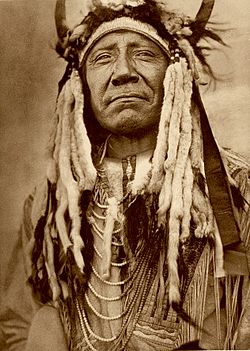
Two Moons (c. 1847–1917), or Ishaynishus (Cheyenne: Éše'he Ôhnéšesêstse),[1] was one of the Cheyenne chiefs who took part in the Battle of the Little Bighorn and other battles against the United States Army.[2]

Key Information

Life

[edit]

Two Moons was the son of Carries the Otter, an Arikara captive who married into the Cheyenne tribe. Perhaps known best for his participation in battles such as the Battle of the Rosebud against General Crook on June 17, 1876, in the Montana Territory, the Battle of Little Big Horn on June 25, 1876 and what would prove to be his last battle, the Battle of Wolf Mountain on January 8, 1877. Two Moons' defeat at Wolf Mountain by General Nelson A. Miles led inevitably to the surrender of his Cheyenne band to Miles at Fort Keogh in April 1877.[3]

After the surrender of his Cheyenne band, Two Moons enlisted as an Indian Scout under General Miles. As a result of Two Moons' pleasant personality, the friendliness that he showed towards the whites, as well as his ability to get along with the military, General Miles appointed him head Chief of the Cheyenne Northern Reservation. As head Chief, Two Moons played a crucial role in the surrender of Chief Little Cow's Cheyenne band at Fort Keogh.[4]

Northern Cheyenne Reservation

[edit]
Two Moons was one of the models for the Buffalo nickel.

Two Moons traveled on multiple occasions to Washington, D.C., to discuss and fight for the future of the Northern Cheyenne people and to better the conditions that existed on the reservation. In 1914, Two Moons met with President Woodrow Wilson to discuss these matters.

Two Moons was one of the three models, along with Iron Tail, selected for James Fraser's famous Buffalo Nickel.[5]

Death

[edit]

Two Moons died in 1917 at his home in Montana at the age of 70. Two Moons' grave lies alongside U.S. Route 212, west of Busby, Montana.[6]

See also

[edit]

References

[edit]
Revisions and contributorsEdit on WikipediaRead on Wikipedia
from Grokipedia
Two Moons (1847–1917), known in the Cheyenne language as Éše'he Ôhnéšesêstse or Ishaynishus, was a Northern Cheyenne war chief who led warriors in resistance against United States military campaigns during the Great Sioux War of 1876–1877. His most notable action came at the Battle of the Little Bighorn on June 25, 1876, where he commanded Cheyenne fighters allied with Lakota and Arapaho forces in the defeat of Lieutenant Colonel George Armstrong Custer's immediate command, rallying his men with calls to stand and fight amid the chaos. Born to Carries the Otter, an Arikara captive adopted into the Cheyenne, Two Moons participated in earlier clashes such as the Battle of the Rosebud before the Little Bighorn engagement. Following the collapse of Plains Indian resistance, he guided a group of Cheyenne to surrender in 1877 and later settled on the Northern Cheyenne Indian Reservation in Montana, where he advocated for land rights and improved conditions, including delegations to Washington, D.C. In his later years, Two Moons served as one of the models for the Native American profile on the obverse of the Buffalo nickel, minted from 1913 to 1938.

Early Life and Background

Birth and Family Origins

Two Moons, whose Cheyenne name was Éše'he Ôhnéšesêstse, was born circa in the territory that would become . His exact birth date and location remain uncertain due to the nomadic lifestyle of the Cheyenne and limited written records from the period. He was the son of Carries the Otter, a member of the Arikara tribe captured by the Cheyenne and integrated into their society through adoption and marriage to a Cheyenne woman. This inter-tribal adoption was common among , reflecting alliances and absorptions of captives into kinship networks. Historical accounts indicate his mother was Cheyenne, though her name is not recorded in surviving sources. Two Moons had at least one brother, White Shield, who fought alongside him in early conflicts and saved his life during the in 1876. Another sibling, White Elk, is mentioned in Cheyenne oral traditions as part of the family. The family belonged to the Northern Cheyenne band, which roamed the northern , engaging in buffalo hunting and intertribal warfare prior to increased U.S. encroachment.

Formative Years and Tribal Role

Two Moons was born around 1847 in the traditional territory of the Northern Cheyenne, likely along the Powder River or in present-day or , though the exact location remains undocumented in historical records. His father, known as Carries the Otter, was originally from the tribe and had been captured by the , subsequently adopting their customs and marrying into the tribe, which integrated him fully into Cheyenne society. This mixed heritage reflected the fluid alliances and adoptions common among Plains tribes during the mid-19th century, as the expanded their influence through warfare and with neighboring groups. During his youth, Two Moons grew up amid the nomadic lifestyle of the , who relied on buffalo hunting, seasonal migrations, and raids against rivals such as and Pawnee to sustain their bands. Cheyenne society emphasized warrior prowess and adherence to military societies, which provided structure for young men through rituals, discipline, and combat roles; Two Moons likely participated in these from adolescence, honing skills in horsemanship, , and lance warfare essential for tribal defense and procurement of resources. By his early twenties, he had emerged as a respected fighter within the tribe, contributing to inter-tribal conflicts that shaped Cheyenne territorial claims on the northern Plains before the intensification of U.S. pressures in the . In his tribal role, Two Moons served as one of the officers in the Fox warrior society, a key Cheyenne responsible for policing camps, leading raids, and enforcing council decisions during times of war. This position marked his ascent among the band's leadership, where influence was earned through demonstrated courage and success in battle rather than heredity alone, aligning with Cheyenne merit-based traditions. As tensions escalated with U.S. expansion following the 1851 Treaty of Fort Laramie, which confined Cheyenne lands but was increasingly violated by settlers and miners, Two Moons' role evolved toward coordinating resistance, foreshadowing his command in major engagements like the in 1876.

Warrior Career in the Great Sioux War

Battle of the Rosebud

The Battle of the Rosebud occurred on June 17, 1876, along the upper Rosebud Creek in what is now , as part of the Great Sioux War of 1876. Brigadier General commanded a U.S. Army column consisting of approximately 1,051 cavalry troopers, 200 infantry, and 262 and scouts, advancing northward from to subdue non-treaty Lakota and Northern bands. The Native American force, estimated at 1,500 to 2,500 warriors primarily from Oglala Lakota, Miniconjou Lakota, and Northern tribes, launched a surprise attack led by , with contingents including warriors under Two Moons. Two Moons, a prominent Northern Cheyenne war chief, participated actively in the engagement, directing Cheyenne fighters in assaults against Crook's lines. Cheyenne accounts, such as that from Two Moons' nephew Young Two Moon, describe coordinated charges by Cheyenne and warriors, including notable actions by individuals like and White Shield, who charged into enemy positions to disrupt the soldiers. The fighting unfolded over six to eight hours, with Native forces employing mobility and repeated flanking maneuvers to outmatch the more static U.S. formations, despite Crook's and support. U.S. forces suffered 28 killed and 56 wounded, while Native casualties were reported as low as 13 killed, reflecting the effectiveness of their tactics in avoiding decisive engagement. Although Crook claimed a by holding the field, the battle compelled his southward to Goose Creek, depleting supplies and preventing reinforcement of other commands, thereby contributing to the subsequent Native at the Little Bighorn. For Two Moons and the , the Rosebud represented a strategic delaying action that preserved their village's security and demonstrated the viability of unified resistance against federal military incursions.

Battle of the Little Bighorn

Two Moons, a Northern war chief, led warriors in the defense of the Lakota and village during the on June 25, 1876, along the in southeastern . The engagement pitted an estimated 1,500 to 2,000 Native warriors against the U.S. 7th Cavalry's approximately 700 men, divided into battalions under Major , Lt. Col. George A. Custer, and Captain . As Custer's battalion of roughly 210 men advanced toward the village's northern end, Two Moons mounted his horse and rallied fleeing Cheyenne families and fighters, proclaiming, "I am Two Moons, your chief. Don’t run away. Stay here and fight. You have horses and guns. Use them." Cheyenne warriors under Two Moons and other leaders, including Lame White Man, charged to intercept Custer's forces, attacking from the south and east while contingents engaged from other directions. After Lame White Man fell early in the clash against Custer's command, Two Moons assumed leadership of the Cheyenne fighters, directing them in encirclement tactics that forced the soldiers into defensive positions on a ridge. The combat involved rapid rifle fire, with Two Moons describing Cheyenne volleys sounding like "pop-pop-pop" as warriors closed in for hand-to-hand fighting, overrunning isolated groups of cavalrymen. This phase culminated in the complete destruction of Custer's , with all 210 officers and troopers killed. Cheyenne casualties in the overall battle numbered at least seven warriors killed, including Lame White Man, with Two Moons reporting minimal losses compared to the soldiers due to superior numbers and terrain knowledge. The following day, Two Moons joined and leaders to survey the Custer battlefield, using sticks to tally the dead, which he estimated at around 388, though archaeological and historical records confirm 210 fatalities in that sector. His helped secure the village from further immediate threat, allowing the combined forces to disperse before reinforcements arrived.

Surrender and Transition to Cooperation

Involvement in the Northern Cheyenne Exodus

Following his surrender to U.S. forces at Fort Keogh in October 1877 with around 300 Northern Cheyenne followers, Two Moons remained at the post, cooperating with the U.S. Army as a scout and emerging leader among the friendly bands encamped there alongside White Bull's group. This positioned him outside the main body of forcibly relocated to after the Great Sioux War, including the bands under and Dull Knife, who initiated on September 9, 1878, by breaking out of the Agency with about 350 people to return north to their traditional homelands. As bands evaded pursuit through , , and territories amid winter hardships and skirmishes, Two Moons contributed to the U.S. military's response in early by serving as a scout under William P. , who sought to locate Little Wolf's splinter group of roughly 150 survivors. scouts from Two Moons' band, leveraging kinship ties and assurances of protection at Fort Keogh—where Two Moons' people demonstrated peaceful adaptation—helped persuade Little Wolf to capitulate without further combat on March 25, , near the . This negotiation, informed by Two Moons' established alliances with General , allowed Little Wolf's followers to join the Fort Keogh encampment rather than face return south, averting additional bloodshed for that faction and contributing to the eventual formation of a Northern reservation in 1884. Two Moons had no direct role in Dull Knife's band, which rejected similar overtures, split off in October 1878, and suffered devastating losses during a January 1879 breakout attempt from , , where over 60 Cheyenne, mostly women and children, were killed by troops. His involvement underscored a divide among Northern Cheyenne leaders: cooperation via and diplomacy versus resistance, with Two Moons prioritizing band survival through alliance with federal authorities amid overwhelming U.S. military superiority. This stance later fueled tensions with upon integration, as traditionalists viewed Two Moons' scouts as aiding capture efforts.

Surrender at Fort Keogh and Initial Alliances

Following the U.S. Army's victory at the on January 8, 1877, Two Moons led his Northern Cheyenne band to surrender to Colonel at Fort Keogh, located in eastern Montana Territory, in April 1877. This surrender involved approximately 300 Cheyenne warriors and their families, marking a pivotal shift from resistance during the Great Sioux War to cooperation with federal forces. Unlike many Northern Cheyenne groups relocated to Indian Territory in present-day Oklahoma, Two Moons' band was permitted to remain near Fort Keogh under Miles' command, avoiding the harsh conditions that prompted the of 1878–1879. In exchange, Two Moons and select warriors enlisted as U.S. Army scouts, forging an initial alliance that leveraged their local knowledge against remaining hostile tribes. This arrangement began with service in the later in 1877, where Cheyenne scouts under Miles pursued ’s band. Two Moons played a key role in extending these alliances by facilitating the surrender of additional Cheyenne groups to Fort Keogh, including Chief Little Cow's band, through negotiations that relayed U.S. terms and encouraged peaceful integration. In March 1879, as part of the post-Exodus reconciliation, Two Moons was among six Cheyenne leaders who met with Little Wolf’s arriving followers, aiding their surrender to Miles and contributing to the establishment of a semi-permanent presence at the fort that preceded the Northern Cheyenne Reservation. These early cooperative efforts solidified Two Moons' position as a bridge between Cheyenne traditionalists and U.S. military objectives, prioritizing survival amid diminishing resources and ongoing conflicts.

Service as U.S. Army Scout and Tribal Leadership

Military Campaigns under

Following the defeat of his band at the on January 8, 1877, Two Moons led approximately 300 Northern Cheyenne in surrendering to General at Fort Keogh, , on April 14, 1877. In the ensuing months, Two Moons and many warriors from his group enlisted as U.S. Army scouts under Miles' command at the fort, transitioning from adversaries to allies in ongoing frontier operations. This enlistment reflected a pragmatic strategy amid post-Great Sioux War pressures, where Cheyenne knowledge of terrain and enemy tactics proved invaluable for U.S. forces pursuing non-surrendered bands. The Northern Cheyenne scouts, numbering up to several hundred at peak strength from Fort Keogh, participated in reconnaissance, tracking, and skirmishes against residual hostile groups and other nomadic tribes resisting confinement to reservations during the late . Their contributions supported Miles' winter and pursuit campaigns in and Dakota Territories, aiding in the capture or dispersal of holdouts following the 1876-1877 conflicts, though specific engagements directly led by Two Moons remain undocumented in primary accounts. These efforts included intelligence gathering on movements north of the and joint actions that minimized U.S. casualties while pressuring enemies into submission. The scouts' effectiveness elevated Miles' profile as a commander, with their successes—such as facilitating rapid responses to raiding parties—crediting Cheyenne auxiliaries for key tactical advantages in subduing regional threats. In exchange for this service, Miles endorsed the Northern Cheyenne's claims to ancestral lands along the Tongue River, arguing their loyalty merited exemption from forced relocation to ; this advocacy culminated in the federal allocation of approximately 444,000 acres for the Tongue River Reservation by in 1884, formalized under Two Moons' leadership. Two Moons' role as a scout chief underscored the alliance's mutual benefits, blending military utility with territorial bargaining.

Leadership on the Northern Cheyenne Reservation

Following his surrender at Fort Keogh in 1877 and subsequent service as a U.S. Army scout, Two Moons settled with his band on the Tongue River area in southeastern , which became the basis for the Northern Cheyenne Reservation established by on March 19, 1884. General , acknowledging Two Moons' military cooperation and influence, appointed him as head chief of the Northern Cheyenne on the reservation, a role that positioned him to mediate between tribal members and federal authorities. As head chief, Two Moons played a pivotal role in consolidating the fragmented Northern Cheyenne population by facilitating the surrender and integration of other bands, including that of Little Cow in the early , thereby strengthening tribal unity amid ongoing pressures from U.S. policies. His leadership emphasized securing the promised northern homeland, drawing on oral traditions of alliances forged with Miles to advocate for territorial rights against relocation threats to . This pragmatic approach, rooted in prior scouting campaigns, helped stabilize the reservation's approximately 444,000 acres, over 99% tribally owned, while navigating allotment pressures under the of 1887. Two Moons' governance focused on preserving autonomy and cultural practices, such as traditional ceremonies, amid economic challenges from limited and reliance on government rations until the early . He represented the in councils, including interactions with agents at Lame Deer, and his efforts contributed to the reservation's endurance as a sovereign entity. Two Moons resided and died on the reservation on August 4, 1917, near present-day Lame Deer, where a commemorates his legacy as a turned tribal steward.

Later Years, Death, and Historical Assessment

Final Contributions and Reservation Governance

Following the establishment of the Northern Cheyenne Reservation on the Tongue River in in 1884, Two Moons emerged as a pivotal figure in its early governance, having been appointed head chief by General upon the surrender of his band at Fort Keogh in April 1877. In this capacity, he facilitated the integration of other Cheyenne groups onto the reservation lands, including the band of Chief Little Cow, whose surrender he negotiated in 1878, thereby consolidating tribal presence and averting further fragmentation or forced relocation to the Crow Reservation or . His strategic alliance with Miles, forged through service as an Army scout, underscored a pragmatic approach to securing territorial rights, as the general's influence helped preserve the band's claim to the Tongue River area against federal pressures for removal. As head chief, Two Moons served as a primary spokesman for the Northern Cheyenne in interactions with U.S. officials, advocating for and amid the tribe's transition to reservation life. He participated in key s, such as the 1889 meeting at Lame Deer with Miles, where he represented Cheyenne interests in and agency operations. His leadership emphasized adaptation to federal policies while resisting erosions of tribal , including oversight of initial settlement efforts in 1882 that introduced limited under supervision to supplement hunting and gathering. By the 1890s, Two Moons had become part of a new cadre of chiefs who prioritized over traditional warfare, helping to stabilize internal band relations and mediate disputes with neighboring tribes and settlers. In his later years, Two Moons intensified advocacy for improved reservation conditions, making multiple trips to Washington, D.C., to petition federal authorities on issues such as inadequate rations, healthcare, and land security. A documented visit occurred in 1888, during which he conferred with officials alongside other chiefs like . These efforts extended to high-level engagements, including a 1913 meeting with the American Indian Citizenship Expedition to address persistent socioeconomic challenges, and a 1914 audience with President to press for enhanced tribal support. Through such diplomacy, Two Moons contributed to incremental federal recognitions of Northern Cheyenne needs, though outcomes were limited by broader assimilationist policies like the of 1887, which he navigated to mitigate allotment's disruptive effects on communal lands. His tenure as head chief thus bridged military cooperation and civilian governance, fostering resilience in tribal structures amid encroachments.

Death and Burial

Two Moons died in 1917 at approximately age 70 on the in southeastern . His remains were interred at a gravesite now situated alongside , approximately one-quarter mile south of Russell Lane and west of Busby in Big Horn County. A historical marker at the site, erected by Indian trader W.R. Moncure, commemorates his military role with the inscription: "Here lie the remains of Two Moons, Chief of the Indians who Led his men against General Custer In the Battle of Little Big Horn June 25, 1876." The isolated location of the grave reflects traditional practices adapted to reservation-era circumstances, though specific details of the burial rites are not documented in available records.

Legacy and Historical Debates

Two Moons' legacy endures as a symbol of Northern Cheyenne resilience and strategic adaptation amid U.S. territorial expansion. Renowned for his combat leadership at the on June 25–26, 1876, where he assumed command of Cheyenne forces after the death of Lame White Man, he provided detailed eyewitness narratives emphasizing the chaos of gunfire and smoke that obscured visibility during the engagement. His subsequent service as a U.S. Army scout under Colonel from 1877 onward, including participation in campaigns against the , enabled the surrender of remaining hostile Cheyenne bands and secured rations and protection for his followers, facilitating their relocation to the Northern Cheyenne Reservation established on November 26, 1884. As principal chief of the reservation from the 1880s until his death, Two Moons prioritized tribal governance and welfare, leading delegations to , to petition for improved land allotments and resources amid ongoing encroachments by settlers and ranchers. A monument commemorating his life stands near Busby, Montana, reflecting his role in preserving Cheyenne cultural continuity through pragmatic diplomacy rather than prolonged warfare. In numismatic history, Two Moons served as one of three models—in addition to and Big Tree—for the composite Native American profile on the , designed by James Earle Fraser and minted from 1913 to 1938, symbolizing a broader ideal of indigenous nobility. Historical debates surrounding Two Moons center on the reliability of his battle accounts and the implications of his alliances. Cheyenne warrior , in recollections recorded in 1913, described Two Moons' public narration of the Little Bighorn as boastful and factually erroneous, particularly regarding troop movements and personal exploits, though fellow participants refrained from rebuttal to maintain unity. Such discrepancies highlight challenges in reconciling oral histories among participants, with Two Moons' version emphasizing Cheyenne agency in the victory while potentially exaggerating individual heroism. Additionally, his decision to surrender and scout for the U.S. —contrasting with the resistance led by chiefs like Dull Knife during the of 1878–1879—has prompted assessments of whether his actions represented capitulation or calculated preservation of tribal sovereignty, as his band avoided the severe hardships faced by more defiant groups. These interpretations underscore tensions between martial tradition and survival imperatives in late 19th-century Plains Indian leadership.

References

Add your contribution
Related Hubs
User Avatar
No comments yet.