Hubbry Logo
George CrookGeorge CrookMain
Open search
George Crook
Community hub
George Crook
logo
8 pages, 0 posts
0 subscribers
Be the first to start a discussion here.
George Crook
George Crook
from Wikipedia

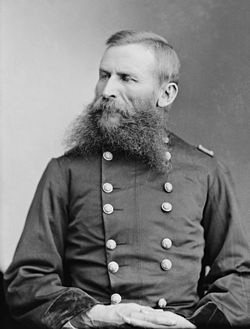
George R. Crook (September 8, 1828 – March 21, 1890)[1][2][3] was a career United States Army officer who served in the American Civil War and the Indian Wars. He is best known for commanding U.S. forces in the 1886 campaign that led to the defeat of the Apache leader Geronimo. As a result, the Apache nicknamed Crook Nantan Lupan, which means "Chief Wolf."[4]

Key Information

Early life and military career

[edit]

Crook was born to Thomas and Elizabeth Matthews Crook on a farm near Taylorsville, Ohio. Nominated to the United States Military Academy by Congressman Robert Schenck, he graduated in 1852, ranking near the bottom of his class.

He was assigned to the 4th U.S. infantry as brevet second lieutenant, serving in California, 1852–61. He served in Oregon and northern California, alternately protecting or fighting against several Native American tribes. He commanded the Pitt River Expedition of 1857 and, in one of several engagements, was severely wounded by an Indian arrow. He established a fort in Northeast California that was later named in his honor; and later, Fort Ter-Waw in what is now Klamath Glen, California.[5]

During his years of service in California and Oregon, Crook extended his prowess in hunting and wilderness skills, often accompanying and learning from Indians whose languages he learned. These wilderness skills led one of his aides to liken him to Daniel Boone, and more importantly, provided a strong foundation for his abilities to understand, navigate and use Civil War landscapes to Union advantage.[5]

Crook was promoted to first lieutenant in 1856, and to captain in 1860. He was ordered east and in 1861, with the beginning of the American Civil War, was made colonel of the 36th Ohio Volunteer Infantry.[6]

He married Mary Tapscott Dailey of Virginia.

Civil War

[edit]

Early service

[edit]
Gen. George Crook

When the Civil War broke out, Crook accepted a commission as Colonel of the 36th Ohio Infantry and led it on duty in western Virginia. He was in command of the 3rd Brigade in the District of the Kanawha where he was wounded in a small fight at Lewisburg.[7] Crook returned to command his regiment during the Northern Virginia Campaign. He and his regiment were part of John Pope's headquarters escort at the Second Battle of Bull Run.

After the Union Army's defeat at Second Bull Run, Crook and his regiment were attached to the Kanawha Division at the start of the Maryland Campaign. On September 12 Crook's brigade commander, Augustus Moor, was captured and Crook assumed command of the 2nd Brigade, Kanawha Division which had been attached to the IX Corps. Crook led his brigade at the Battle of South Mountain and near Burnside's Bridge at the Battle of Antietam. He was promoted to the rank of brigadier general on September 7, 1862. During these early battles he developed a lifelong friendship with one of his subordinates, Col. Rutherford B. Hayes of the 23rd Ohio Infantry.

Following Antietam, General Crook assumed command of the Kanawha Division. His division was detached from the IX Corps for duty in the Department of the Ohio. Before long Crook was assigned to command an infantry brigade in the Army of the Cumberland. This brigade became the 3rd Brigade, 4th Division, XIV Corps, which he led at the Battle of Hoover's Gap. In July he assumed command of the 2nd Division, Cavalry Corps in the Army of the Cumberland. He fought at the Battle of Chickamauga and was in pursuit of Joseph Wheeler during the Chattanooga campaign.

In February 1864, Crook returned to command the Kanawha Division, which was now officially designated the 3rd Division of the Department of West Virginia.

Southwest Virginia

[edit]

To open the spring campaign of 1864, Lieutenant General Ulysses S. Grant ordered a Union advance on all fronts, minor as well as major. Grant sent for Brigadier General Crook, in winter quarters at Charleston, West Virginia, and ordered him to attack the Virginia and Tennessee Railroad, Richmond's primary link to Knoxville and the southwest, and to destroy the Confederate salt works at Saltville, Virginia.

The 35-year-old Crook reported to army headquarters where the commanding general explained the mission in person. Grant instructed Crook to march his force, the Kanawha Division, against the railroad at Dublin, Virginia, 140 miles (230 km) south of Charleston. At Dublin he would put the railroad out of business and destroy Confederate military property. He was then to destroy the railroad bridge over New River, a few miles to the east. When these actions were accomplished, along with the destruction of the salt works, Crook was to march east and join forces with Major General Franz Sigel, who meanwhile was to be driving south up the Shenandoah Valley.

After long dreary months of garrison duty, the men were ready for action. Crook did not reveal the nature or objective of their mission, but everyone sensed that something important was brewing. "All things point to early action", the commander of the second brigade, Colonel Rutherford B. Hayes, noted in his diary.

On April 29, 1864, the Kanawha Division marched out of Charleston and headed south. Crook sent a force under Brigadier General William W. Averell westward towards Saltville, then pushed on towards Dublin with nine infantry regiments, seven cavalry regiments, and 15 artillery pieces, a force of about 6,500 men organized into three brigades. The West Virginia countryside was beautiful that spring, but the mountainous terrain made the march a difficult undertaking. The way was narrow and steep, and spring rains slowed the march as tramping feet churned the roads into mud. In places, Crook's engineers had to build bridges across wash-outs before the army could advance.

The column reached Fayette on May 2, and then passed through Raleigh Court House and Princeton. On the night of May 8, the division camped at Shannon's Bridge, Virginia, 10 miles (16 km) north of Dublin.

The Confederates at Dublin soon learned the enemy was approaching. Their commander, Colonel John McCausland, prepared to evacuate his 1100 men, but before transportation could arrive, a courier from Brigadier General Albert G. Jenkins informed McCausland that the two of them were ordered by General John C. Breckinridge to stop Crook's advance. The combined forces of Jenkins and McCausland amounted to 2,400 men. Jenkins, the senior officer, took command.

Breaking camp on the morning of May 9, Crook moved his men south to the top of a spur of Cloyd's Mountain. Before the Union troops lay a precipitous, densely wooded slope with a meadow about 400 yards wide at the bottom. On the other side of the meadow, the land rose in another spur of the mountain, and there Jenkins' rebels waited behind hastily erected fortifications.

Crook dispatched the third brigade under Colonel Carr B. White to work its way through the woods and deliver a flank attack on the rebel right. At 11 am, he sent Hayes' first brigade and Colonel Horatio G. Sickel's second brigade down the slope to the edge of the meadow, where they were to launch a frontal assault on the Confederates as soon as they heard the sound of White's guns.

The slope before them was so steep that the officers had to dismount and descend on foot. Crook stationed himself with Hayes' brigade, which was to lead the assault. After a long, anxious wait, Hayes at last heard cannon fire off to his left and led his men at a slow double time out onto the meadow and into the rebels' musketry and artillery fire, which Crook called "galling". Their pace quickened as they neared the other side, but just before the up-slope they came to a waist-deep creek. The barrier caused little delay and the Yankee infantry stormed up the hill and engaged the rebel defenders at close range.

The only man to have trouble with the creek was General Crook. Dismounted, he still wore his high riding boots, and as he stepped into the stream, the boots filled with water and bogged him down. Nearby soldiers grabbed their commander's arms and hauled him to the other side.

Vicious hand-to-hand fighting erupted as the Yankees reached the crude rebel defenses. The Southerners gave way, tried to re-form, then broke and retreated up and over the hill towards Dublin.

The Yankees rounded up rebel prisoners by the hundreds and seized General Jenkins, who had fallen wounded. At this point the discipline of the Union men wavered, and there was no organized pursuit of the fleeing enemy. General Crook was unable to provide leadership as the excitement and exertion had sent him into a faint.

Colonel Hayes kept his head and organized a force of about 500 men from the soldiers milling about the site of their victory. With his improvised command, he set off, closely pressing the rebels.

While the fight at Cloyd's Mountain was going on, a train pulled into the Dublin station and disgorged 500 fresh troops of General John Hunt Morgan's cavalry, which had just diverted Averell away from Saltville. The fresh troops hastened towards the battlefield, where they soon met their compatriots retreating from Cloyd's Mountain. The reinforcements halted the rout, but Colonel Hayes, although ignorant of the strength of the force now before him, immediately ordered his men to "yell like devils" and rush the enemy. Within a few minutes General Crook arrived with the rest of the division, and the defenders broke and ran.

Cloyd's Mountain cost the Union army 688 casualties, while the rebels suffered 538 casualties.

Unopposed, Crook moved his command into Dublin, where he laid waste to the railroad and the military stores. He then sent a party eastward to tear up the tracks and burn the ties. The next morning the main body set out for their next objective, the New River bridge, a key point on the railroad, a few miles to the east.

The Confederates, now commanded by Colonel McCausland, waited on the east side of the New River to defend the bridge. Crook pulled up on the west bank, and a long, ineffective artillery duel ensued. Seeing that there was little danger from the rebel cannon, Crook ordered the bridge destroyed, and both sides watched in awe as the structure collapsed magnificently into the river. McCausland, without the resources to oppose the Yankees any further, withdrew his battered command to the east.

General Crook, supplies running low in a country not suited for major foraging, now entertained second thoughts about his orders to push on east and join Sigel in the Shenandoah Valley. At Dublin he had intercepted an unconfirmed report that General Robert E. Lee had beaten Grant badly in the Wilderness, which led him to consider whether the Confederate commander might not soon move against Crook with a vastly superior force.

Having accomplished the major part of his mission, destruction of the Virginia and Tennessee Railroad, Crook turned his men north and after another hard march, reached the Union base at Meadow Bluff, West Virginia.

Shenandoah Valley

[edit]

That July Crook assumed command of a small force called the Army of the Kanawha. Crook was defeated at the Second Battle of Kernstown. Nevertheless, he was appointed as a replacement for David Hunter in command of the Department of West Virginia the following day. However Crook did not assume command until August 9.[8] Along with the title of his department Crook added "Army of West Virginia." Crook's army was soon absorbed into Philip H. Sheridan's Army of the Shenandoah and for all practical purposes functioned as a corps in that unit. Although Crook's force kept its official designation as the Army of West Virginia,[9] it was often referred to as the VIII Corps.[10] The official VIII Corps of the Union Army was led by Lew Wallace during this time and its troops were on duty in Maryland and Northern Virginia.[11]

Crook led his corps in the Valley Campaigns of 1864 at the battles of Opequon (Third Winchester), Fisher's Hill, and Cedar Creek. On October 21, 1864, he was promoted to major general of volunteers.

In February 1865 General Crook was captured by Confederate raiders at Cumberland, Maryland, and held as a prisoner of war in Richmond until exchanged a month later. He very briefly returned to command the Department of West Virginia until he took command of a cavalry division in the Army of the Potomac during the Appomattox Campaign. Crook first went into action with his division at the battle of Dinwiddie Court House. He later took a prominent role in the battles of Five Forks, Amelia Springs, Sayler's Creek and Appomattox Court House.

Indian Wars

[edit]

At the end of the Civil War, George Crook received a brevet as major general in the regular army, but reverted to the permanent rank of major. Only days later, he was promoted to lieutenant colonel, serving with the 23rd Infantry on frontier duty in the Pacific Northwest. In 1867, he was appointed head of the Department of the Columbia.

Snake War

[edit]

Crook successfully campaigned against the Snake Indians in the 1864–68 Snake War, where he won nationwide recognition. Crook had fought Indians in Oregon before the Civil War. He was assigned to the Pacific Northwest to use new tactics in this war, which had been waged for several years. Crook arrived in Boise to take command on December 11, 1866. The general noticed that the Northern Paiute used the fall, winter and spring seasons to gather food, so he adopted the tactic recommended by a predecessor George B. Currey to attack during the winter.[12] Crook had his cavalry approach the Paiute on foot in attack at their winter camp. As the soldiers drew them in, Crook had them remount; they defeated the Paiute and recovered some stolen livestock.[13]

Crook used Indian scouts as troops as well as to spot enemy encampments. While campaigning in Eastern Oregon during the winter of 1867, Crook's scouts located a Paiute village near the eastern edge of Steens Mountain. After covering all the escape routes, Crook ordered the charge on the village while intending to view the raid from afar, but his horse got spooked and galloped ahead of Crook's forces toward the village. Caught in the crossfire, Crook's horse carried the general through the village without being wounded. The army caused heavy casualties for the Paiute in the Battle of Tearass Plain.[14] Crook later defeated a mixed band of Paiute, Pit River, and Modoc at the Battle of Infernal Caverns in Fall River Mills, California.

Yavapai War

[edit]
George Crook during the Tonto Basin Campaign.

President Ulysses S. Grant next placed Crook in command of the Arizona Territory. Crook's use of Apache scouts during his Tonto Basin Campaign of the Yavapai War brought him much success in forcing the Yavapai and Tonto Apache onto reservations. Crook's victories during the Yavapai War included the Battle of Salt River Canyon, also known as the Skeleton Cave Massacre, and the Battle of Turret Peak.

General Crook Trail marker located where in 1871 Crook established a military supply road that connected Forts Whipple, Verde, and Apache. The marker is near the Fort Verde Administration Building in Camp Verde, Arizona.

In 1873, Crook was appointed brigadier general in the regular army, a promotion that passed over and angered several full colonels next in line.

Great Sioux War

[edit]

From 1875 to 1882 and again from 1886 to 1888, Crook was head of the Department of the Platte, with headquarters at Fort Omaha in North Omaha, Nebraska.

Battle of the Rosebud

[edit]

On 28 May 1876, Crook assumed direct command of the Bighorn and Yellowstone Expedition at Fort Fetterman. Crook had gathered a strong force from his Department of the Platte. Leaving Fort Fetterman on 29 May, the 1,051-man column consisted of 15 companies from the 2d and 3d Cavalry, 5 companies from the 4th and 9th Infantry, 250 mules, and 106 wagons. On 14 June, the column was joined by 261 Shoshone and Crow allies. Based on intelligence reports, Crook ordered his entire force to prepare for a quick march. Each man was to carry only 1 blanket, 100 rounds of ammunition, and 4 days' rations. The wagon train would be left at Goose Creek, and the infantry would be mounted on the pack mules.

On 17 June, Crook's column set out at 0600, marching northward along the south fork of Rosebud Creek. The Crow and Shoshone scouts were particularly apprehensive. Although the column had not yet encountered any sign of Indians, the scouts seemed to sense their presence. The soldiers, particularly the mule-riding infantry, seemed fatigued from the early start and the previous day's 35-mile (56 km) march. Accordingly, Crook stopped to rest his men and animals at 0800. Although he was deep in hostile territory, Crook made no special dispositions for defense. His troops halted in their marching order. The Cavalry battalions led the column, followed by the battalion of mule-borne foot soldiers, and a provisional company of civilian miners and packers brought up the rear.

The Crow and Shoshone scouts remained alert while the soldiers rested. Several minutes later, the soldiers heard the sound of intermittent gunfire coming from the bluffs to the north. As the intensity of fire increased, a scout rushed into the camp shouting, "Lakota, Lakota!", the Battle of the Rosebud had begun. By 0830, the Sioux and Cheyenne had engaged Crook's Indian allies on the high ground north of the main force. Greatly outnumbered, the Crow and Shoshone scouts fell back toward the camp, their fighting withdrawal gave Crook enough time to deploy his forces. The soldiers rapid fire drove off the attackers but used up much of their ammunition which was meant to last the entire campaign. Low on ammunition and with numerous wounded, General Crook decided to return to Fort Fetterman.

Historians debate whether the killing of the five companies of the 7th Cavalry Regiment under the command of George Armstrong Custer at the Battle of the Little Bighorn could've been prevented, had Crook not retreated but instead pressed his advantage.

Battle of Slim Buttes

[edit]
Crazy Horse and his band of Oglala Lakota on their way from Camp Sheridan to surrender to General Crook at Red Cloud Agency near Camp Robinson, Nebraska, May 6, 1877.

After the disaster at the Little Bighorn, the U.S. Congress authorized funds to reinforce the Big Horn and Yellowstone Expedition.[15] Determined to demonstrate the willingness and capability of the U.S. Army to pursue and punish the Sioux, Crook took to the field. After briefly linking up with General Alfred Terry, military commander of the Dakota Territory, Crook embarked on what came to be known as the grueling and poorly provisioned Horsemeat March, upon which the soldiers were reduced to eating their horses and mules. A party dispatched to Deadwood for supplies came across the village of American Horse on September 9, 1876. The well-stocked village was attacked and looted in the Battle of Slim Buttes. Crazy Horse led a counter-attack against Crook the next day, but was repulsed by Crook's superior numbers.

Standing Bear v. Crook

[edit]

In 1879, Crook spoke on behalf of the Ponca tribe and Native American rights during the trial of Standing Bear v. Crook. The federal judge affirmed that Standing Bear had some of the rights of U.S. citizens.

That same year his home at Fort Omaha, now called the General Crook House and considered part of North Omaha, was completed.

Geronimo's War

[edit]
"Scene in Geronimo's camp, the Apache outlaw. Taken before the surrender to Gen. Crook, March 27, 1886, in the Sierra Madre mountains of Mexico, escaped March 30, 1886."

Crook was made head of the Department of Arizona and successfully forced some members of the Apache to surrender, but Geronimo continually evaded capture. As a mark of respect, the Apache nicknamed Crook Nantan Lupan, which means "Chief Wolf". In March, 1886, Crook received word that Geronimo would meet him in Cañon de los Embudos, in the Sierra Madre Mountains about 86 miles (138 km) from Fort Bowie. During the three days of negotiations, photographer C. S. Fly took about 15 exposures of the Apache on 8 by 10 inches (200 by 250 mm) glass negatives.[16] One of the pictures of Geronimo with two of his sons standing alongside was made at Geronimo's request. Fly's images are the only existing photographs of Geronimo's surrender. His photos of Geronimo and the other free Apaches, taken on March 25 and 26, are the only known photographs taken of an American Indian while still at war with the United States.[17]

"Geronimo poses with members of his tribe and General George Crook's staff during peace negotiations on March 27, 1886."

Geronimo, camped on the Mexican side of the border, agreed to Crook's surrender terms. That night, a soldier who sold them whiskey said that his band would be murdered as soon as they crossed the border. Geronimo and 25 of his followers slipped away during the night; their escape cost Crook his command.[16]

Nelson A. Miles replaced Crook in 1886 in command of the Arizona Territory and brought an end to the Apache Wars. He captured Geronimo and the Chiricahua Apache band, and detained the Chiricahua scouts, who had served the U.S. Army, transporting them all as prisoners-of-war to a prison in Florida. (Crook was reportedly furious that the scouts, who had faithfully served the Army, were imprisoned along with the hostile warriors. He sent numerous telegrams protesting their arrest to Washington. They, along with most of Geronimo's band, were forced to spend the next 26 years in captivity at the fort in Florida before they were finally released.) [18]

After years of campaigning in the Indian Wars, Crook won steady promotion back up the ranks to the permanent grade of Major General. President Grover Cleveland placed him in command of the Military Division of the Missouri in 1888.

Later life

[edit]

Crook served in Omaha again as the Commander of the Department of the Platte from 1886 to 1888. While he was there, his portrait was painted by artist Herbert A. Collins.[19]

Crook was a Veteran Companion of the Ohio Commandery of the Military Order of the Loyal Legion of the United States and was assigned insignia number 6512.

Crook was a charter member of the Illinois Society of the Sons of the American Revolution. He was elected as its first president on February 21, 1890 and died one month later.

Crook spent his last years speaking out against the unjust treatment of his former Indian adversaries. He died suddenly in Chicago in 1890 while serving as commander of the Military Division of the Missouri. Crook was originally buried in Oakland, Maryland. In 1890, Crook's remains were transported to Arlington National Cemetery, where he was reinterred on November 11.[20]

Red Cloud, a war chief of the Oglala Lakota (Sioux), said of Crook, "He, at least, never lied to us. His words gave us hope."[21]

Legacy

[edit]
Bronze of Gen. Crook at Fort Omaha.

His good friend and Union Army subordinate, future President Rutherford B. Hayes, named one of his sons George Crook Hayes (1864–1866), in honor of his commanding officer. The little boy died before his second birthday of scarlet fever.

Crook Counties in Wyoming and Oregon were named for him, as was the town of Crook, Colorado.

"Crook City," an unincorporated place in the Black Hills of South Dakota, was named for his 1876 camp there. Nearby and between Deadwood and Sturgis, South Dakota is Crook Mountain, named for him. Crook City Road passes through there from Whitewood heading toward Deadwood.

Crook Peak in Lake County, Oregon, elevation 7,834 feet (2,388 m),[22] in the Warner Mountains is named after him. It is near where the general set up Camp Warner (1867–1874) in a campaign to subdue the Paiute Indians.

Crook Mountain in Chelan County, Washington, elevation 6,930 feet (2,110 m),[23] a peak in the North Cascades, was named for him.

Cañon Pintado Historic District, 10 miles (16 km) south of Rangely, Colorado, has numerous ancient Fremont culture (0–1300 CE) and Ute petroglyphs, first seen by Europeans in the mid-18th century. One group of carvings, believed to be Ute after adoption of the horse in the 1600s, has several horses, which locals call "Crook's Brand Site". They claim the horses carry the general's brand.

Forest Road 300 in the Coconino National Forest is named the "General Crook Trail." It is a section of the trail which his troops blazed from Fort Verde to Fort Whipple, and on to Fort Apache through central Arizona.

Numerous military references honor him: Fort Crook (1857–1869) was an Army post near Fall River Mills, California, used during the Indian Wars. Later during the Civil War, it was used for the defense of San Francisco. It was named for then Lt. Crook by Captain John W. T. Gardiner, 1st Dragoons, as Crook was recovering there from an injury. California State Historical Marker 355 marks the site in Shasta County.

Fort Crook (1891–1946) was an Army Depot in Bellevue, Nebraska, first used as a dispatch point for Indian conflicts on the Great Plains. Later it served as airfield for the 61st Balloon Company of the Army Air Corps. It was named for Brig. Gen. Crook due to his many successful Indian campaigns in the west. The site formerly known as Fort Crook is now part of Offutt AFB, Nebraska.

3rd Brigade Combat Team, 1st Cavalry Division is nicknamed "Greywolf" in his honor, in a variation of his Apache nickname meaning "Chief Wolf".

The General Crook House at Fort Omaha in Omaha, Nebraska is named in his honor, as he was the only Commander of the Department of the Platte to live there. At Fort Huachuca, Crook House on Old Post is named after him as well. The Crook Walk in Arlington National Cemetery is near General Crook's gravesite.

[edit]

See also

[edit]

Notes

[edit]

Further reading

[edit]
[edit]
Revisions and contributorsEdit on WikipediaRead on Wikipedia
from Grokipedia
George R. Crook (September 8, 1828 – March 21, 1890) was a career United States Army officer who rose to the rank of major general through distinguished service as a Union commander during the American Civil War and as a department leader in the post-war Indian Wars of the American West. Crook graduated from the at West Point in 1852, ranking 38th in a class of 43, and was commissioned as a in the 4th U.S. Infantry, serving in prior to the Civil War. During the war, he commanded the 36th Ohio Infantry as colonel from 1861, earning promotion to in 1862 and leading forces at battles including South Mountain, Antietam, Chickamauga, Cloyd's Mountain, and key engagements in the Campaign such as Third Winchester, Fisher's Hill, and Cedar Creek. He achieved major general rank in 1864, was briefly captured by Confederate forces in 1865 but exchanged, and concluded the war commanding a cavalry division through Appomattox. In the Indian Wars, Crook commanded the Department of the Platte and led expeditions against the and in 1876, including the Powder River Campaign that disrupted hostile villages and culminated in the , where his mounted force engaged superior numbers but inflicted attrition on the tribes. Later, as commander of the Department of from 1882, he pioneered the aggressive use of and mule-pack mobility to pursue raiders into Mexico's Sierra Madre, securing the return of Apache bands to reservations in 1883 through a combination of combat and negotiation. His tenure ended controversially in 1886 when he was relieved of command after advocating continued pursuit of with scouts rather than withdrawal, reflecting tensions between his field tactics and Washington directives; he subsequently supported Native American legal rights, aiding Ponca chief Standing Bear's case affirming tribal personhood under U.S. law. Crook's approach emphasized practical realism in frontier warfare, prioritizing scout intelligence and logistical adaptation over conventional reliance, which contributed to temporary pacification in territories despite recurring outbreaks.

Early Life and Education

Childhood and Family Background

George Crook was born on September 8, 1828, on a farm along the east bank of the Miami River near Taylorsville in , to Thomas Crook and Elizabeth Matthews Crook. His father, Thomas (1788–1875), had been born in , , as the son of Joseph Crook and Catharine, and relocated to where he established a farming life in Wayne Township, an area formerly part of Miami County. Elizabeth Matthews Crook, Thomas's , shared in the family's agrarian pursuits, reflecting the modest circumstances of early 19th-century frontier settlers from Maryland stock. Crook grew up in this rural Ohio environment as part of a large family, with at least nine siblings including older ones such as Elizabeth (1813–1844), John (1814–1850), Maria (1815–1884), and Oliver, as well as a younger brother, Walter. The family's Ohio roots traced to broader Crook lineages that had migrated westward from and earlier English origins, though specific details on ancestral professions beyond farming remain sparse in records. This upbringing on the farm provided Crook with early exposure to physical labor and the rigors of pioneer life in the expanding American Midwest.

United States Military Academy

Crook received an appointment to the at West Point from and entered as a cadet in 1848. The academy's rigorous four-year emphasized , , ordnance, philosophy, and , along with physical training and drill. He graduated on July 1, 1852, ranking 38th out of 43 cadets in his class, a position reflecting below-average academic standing. Upon graduation, Crook was commissioned as a brevet in the 4th U.S. Infantry.

Pre-Civil War Army Service

Upon graduating from the on July 1, 1852, Crook was brevetted as a in the 4th U.S. Infantry Regiment. He initially served a brief duty at Fort Columbus, New York, before transferring to frontier assignments on the , arriving at Benicia Barracks, California, later that year. Crook's early service involved postings at remote outposts amid tensions with Native American tribes in and the . From 1853 to 1857, he was stationed primarily at Fort Jones, , with additional time at Fort Humboldt in 1853. He received promotion to full on July 7, 1853, and to on March 11, 1856, while continuing duty in the 4th Infantry. In 1855, he escorted a topographical survey party through hostile territory, gaining initial exposure to irregular frontier operations. Crook participated in several expeditions against Native American resistance groups. In 1856, he joined the Rogue River Expedition in , where his role was limited to escorting bands of cooperating tribes to reservations amid the broader . The following year, as a commanding Company D, 4th Infantry, he led the Pitt River Expedition into territory, engaging in skirmishes on June 10, July 2, and July 26, 1857; during the initial clash, he sustained a severe wound to the hip that required months of recovery. In 1858, Crook served on the Yakima Expedition from , , contributing to efforts to subdue tribal forces during the . He subsequently established and commanded Fort Ter-Waw, , from 1857 to 1860, focusing on pacification and outpost maintenance until the onset of the Civil War.

American Civil War Service

Western Virginia and Early Commands

Crook received his commission as colonel of the 36th Ohio Volunteer Infantry on September 12, 1861, and immediately led the regiment to western to join Union efforts to control the strategically vital Kanawha Valley against Confederate incursions. As a captain prior to the war, Crook's volunteer command focused on offensive operations to disrupt enemy supply lines and secure Unionist strongholds in the mountainous region, where terrain favored defensive Confederate positions. In early 1862, Crook assumed command of the 3rd Brigade, District of the Kanawha, conducting raids such as one from Charleston toward the Central Railroad near Covington to interdict Confederate reinforcements and logistics. This brigade, comprising primarily volunteer regiments, emphasized rapid maneuvers suited to the rugged Appalachian landscape, reflecting Crook's prewar experience in frontier scouting and engineering. The brigade's most notable early action occurred at the Battle of Lewisburg on May 23, 1862, where Crook's approximately 1,400 troops, encamped in the town, repulsed a dawn assault by 2,200 Confederates under Henry R. Heth. Despite the numerical disadvantage, Crook's forces held their ground through coordinated volleys and countercharges, inflicting 38 killed and 66 wounded on the attackers while capturing nearly 100 prisoners, four artillery pieces, small arms, and ammunition wagons; Union losses totaled 17 killed and 53 wounded, with Crook himself sustaining a wound to the foot. The victory secured Lewisburg for Union control, boosted morale in the region, and compelled Heth's retreat, though it did not decisively alter broader Confederate hold on parts of western . Crook recovered from his wound and resumed command, contributing to ongoing Kanawha District operations until his promotion to brigadier general of volunteers on September 7, 1862. He then took charge of the 2nd Brigade, Kanawha Division—still operating in western under Brigadier General Jacob D. Cox—preparing for detachment to reinforce federal armies in amid mounting Confederate threats under . This assignment highlighted Crook's emerging reputation for tactical aggression and adaptability in irregular , though his early commands yielded limited strategic gains against persistent Confederate partisans.

Major Eastern Theater Battles

In August 1862, Colonel George Crook's brigade from the Kanawha Division, consisting primarily of regiments including the 36th Infantry which he had commanded since its , was attached to Major General Burnside's IX Corps in the under Major General John Pope. During the Second Battle of Bull Run on August 29–30, 1862, Crook's brigade arrived late in the campaign but participated in the fighting, contributing to the Union defense against Confederate assaults and helping to stabilize the line amid the overall Union defeat. Following the retreat toward Washington, elements of IX Corps, including Crook's brigade, engaged Confederate forces at the Battle of Chantilly on September 1, 1862, covering the withdrawal of Pope's army in heavy fighting against Stonewall Jackson's corps, though Crook's specific actions were part of the broader corps effort under Brigadier General Jesse Reno. In the subsequent Maryland Campaign, Crook, promoted to brigadier general on September 7, 1862, led his in the attack on Fox's Gap at the on September 14, 1862. His and Eliakim Scammon's adjacent brigades assaulted Confederate positions held by Samuel Garland's brigade, achieving initial success that resulted in Garland's death and helped Union forces pierce the Confederate line along South Mountain, facilitating the advance toward Sharpsburg. Crook's troops captured key terrain despite fierce resistance, suffering casualties including wounded officers, but their efforts were pivotal in the Union victory that compelled Robert E. Lee's withdrawal. At the on September 17, 1862, Crook's brigade supported IX Corps' delayed assault on the Confederate right flank near . Positioned in reserve initially, his units reinforced the crossing efforts after heavy Union losses, helping to secure the bridgehead and threaten Lee's army's escape route, though the overall IX Corps advance was slow and costly, with Crook's command enduring artillery fire and skirmishing. His leadership at Antietam earned him a brevet promotion to in the for gallantry.

Shenandoah Valley Campaign

In August 1864, Union Lieutenant General appointed Major General to command the newly formed Army of the Shenandoah, incorporating Brigadier General George Crook's Army of (VIII Corps) alongside the VI and XIX Corps, with orders to drive Confederate Lieutenant General Jubal A. Early from the , destroy its agricultural resources, and prevent further raids on the North. Crook's force, primarily composed of troops from , , , and , numbered around 10,000-12,000 effectives at the campaign's outset and played a pivotal role in flanking maneuvers due to its familiarity with mountainous terrain. On September 19, 1864, at the Third Battle of Winchester (also known as Opequon), Crook's VIII Corps anchored the Union right flank and executed a critical charge across Redbud Run against Confederate positions, breaking through and contributing to the rout of Early's army, which suffered approximately 3,600 casualties compared to Union losses of about 5,000. Three days later, on September 22, Crook led a daring flank march over rugged foothills to the Confederate left at Fisher's Hill, surprising and enveloping Early's lines in a rout that captured 15 flags and over 300 prisoners while inflicting heavy losses, with Early's force retreating southward without effective resistance. This victory allowed Sheridan to burn much of the Valley's mills, barns, and crops, severely disrupting Confederate supply lines. The campaign's climax occurred on October 19, 1864, at the , where Crook's corps, positioned south of the Union line near Middletown, was surprised by Early's pre-dawn attack, leading to a disorganized retreat that exposed the army's flank and enabled Confederate forces to overrun camps and artillery, capturing over 1,000 prisoners and 18 guns initially. Despite the early collapse—attributed in part to Crook's failure to post adequate pickets— timely arrival rallied the troops for a that recaptured lost ground and inflicted about 2,000 Confederate casualties against 5,600 Union losses, effectively ending major Confederate resistance in the Valley. Crook's performance drew postwar criticism for the rout, though contemporaries noted his corps' prior successes in aggressive maneuvers.

Capture, Exchange, and Final Operations

On the night of February 21, 1865, Confederate Lieutenant Jesse McNeill led approximately 64 Rangers in a raid on , where they captured Union Major General George Crook and Benjamin F. Kelly from their beds in the Revere House hotel. The raiders, part of the 18th , evaded Union pickets and guards to seize the generals without firing a shot, then escorted them southward through Union lines to , covering over 100 miles in harsh winter conditions. Crook was imprisoned at , a former warehouse converted to hold Union officers, where conditions included overcrowding and limited rations typical of Confederate prisons in the war's final months. Crook remained a prisoner for nearly a month until his exchange on March 20, 1865, facilitated by Union Ulysses S. Grant's direct intervention to secure high-value officers for the ongoing campaign against . The exchange occurred amid broader prisoner swaps under the 1862 Cartel agreement, though by early 1865 such operations were strained by the Confederacy's deteriorating logistics and Grant's refusal to halt offensives for humanitarian pauses. Upon release, Crook rejoined Union forces weakened by his absence but bolstered by the impending collapse of Confederate resistance in . Following his exchange, Crook assumed command of the 2nd Division of the Cavalry Corps in the under , participating in the from late March to April 9, 1865. His division screened Sheridan's movements during the pursuit of Lee's after the fall of Petersburg, engaging in skirmishes and maneuvers that cut off Confederate supply lines and forced Lee's retreat westward. Crook's troops contributed to the encirclement at Appomattox Court House, where Lee's surrender of 28,000 men effectively ended major combat operations in the Eastern Theater. This brief but pivotal command underscored Crook's adaptability, transitioning from captivity to frontline leadership in the war's decisive finale.

Postwar Western Commands

Department of the Columbia and Snake War

Following the , George Crook, then a commanding the 23rd , was assigned to the District of Boise within the Department of the Columbia in late 1866 to combat escalating raids by Snake Indian bands—primarily Northern Paiute, Bannock, and —on emigrants, miners, and settlements in , , and adjacent territories during the ongoing (1864–1868). These hostilities stemmed from resource competition intensified by gold rushes and emigrant trails, with tribes employing guerrilla tactics in rugged terrain to disrupt U.S. expansion. Crook assumed command at in December 1866, replacing Major L. H. Marshall after his unsuccessful expeditions and an ambush by Paiutes, and immediately initiated aggressive operations to restore order. Crook's approach emphasized mobility, surprise, and relentless pursuit, adapting pre-Civil War techniques from his service—such as with mule trains using aparejo packsaddles for supply in mountains—to larger-scale against dispersed bands. He integrated Indian scouts from allied Warm Springs and Boise tribes not merely as guides but as combat auxiliaries for tracking and , enabling dawn raids on rancherias (villages). In a December 1866–January 1867 winter campaign along the Road near Owyhee Ferry, his forces surprised a large Paiute band, killing 60 warriors and capturing 30 prisoners, exploiting seasonal vulnerabilities when tribes clustered for survival. This effort expanded into a broader winter offensive (1866–1867) that inflicted over 300 Indian fatalities and captured more than 200, primarily women and children, with minimal U.S. losses, demoralizing raiders and forcing many to flee or submit. Pursuit continued through spring and summer 1867, with Crook's detachments chasing hostiles near Camps Warner, C. F. Smith, and Harney in , disrupting their food sources and safe havens. A notable engagement occurred at Infernal Caverns in the Pit River lava beds of on September 27–28, 1867, where troops assaulted fortified positions, killing approximately 15 Indians but suffering 8 soldiers killed and 12 wounded in close-quarters fighting. By spring 1868, Crook defeated Paiute Chief Egan in a decisive skirmish, further eroding resistance among war-weary bands. Demanding rather than negotiated annuities, he coordinated logistics across outposts to exhaust guerrilla capabilities, subduing Paiute, Bannock, and Shoshone threats from the to and borders. The war concluded with peace terms at Camp Warner in late May 1868 between Crook and Snake chief Weowa (Wewawewa), offering U.S. protection in exchange for cessation of hostilities but no formal reservation or ongoing aid, which were disseminated by September 1868 to end major fighting. Crook's operations, praised by General for their energy and skill, effectively pacified the region by mid-1868, securing mining and settlement routes while testing and refining mobile warfare doctrines for future campaigns; he retained command of the Department of the Columbia until 1870.

Arizona Territory and Yavapai-Apache Campaigns

In June 1871, George Crook was appointed commander of the Department of Arizona, tasked with suppressing raids by Yavapai and Tonto Apache bands that had intensified following the Camp Grant Massacre earlier that year. He arrived in Tucson on June 19, 1871, and quickly assessed the challenges of guerrilla warfare in the rugged terrain of central Arizona Territory. Crook's approach diverged from prior efforts by emphasizing mobility and local knowledge, recruiting Apache scouts who provided intelligence and tracking expertise, and equipping forces with mule pack trains to replace slow wagons, enabling operations deep into mountainous strongholds. The Tonto Basin Campaign commenced in November 1872, with Crook deploying elements of the 1st and 5th Cavalry regiments alongside infantry from the 23rd Infantry into the heart of Yavapai-Apache territory. A pivotal early engagement occurred at the Battle of Salt River Canyon on December 28, 1872, where troops under Lieutenant Colonel A. W. Evans routed a Yavapai force, killing around 60 warriors while suffering minimal losses of one wounded. Crook's winter offensive persisted through harsh conditions, systematically destroying rancherias and supply caches to erode the bands' capacity for sustained resistance. This methodical attrition culminated in the Battle of Turret Peak on March 27, 1873, where scouts and cavalry overwhelmed a defensive position, killing 11 defenders and capturing others, further pressuring holdouts to submit. By April 1873, the campaign had fractured organized opposition, prompting widespread surrenders among and groups totaling over 1,000 individuals who were subsequently relocated to reservations including San Carlos and Fort Verde. Crook's integration of up to 200 proved decisive, leveraging inter-tribal rivalries and offering incentives like bounties for key renegades, which accelerated intelligence gathering and combat effectiveness. Though some resistance lingered into 1874, the operations effectively pacified central , reducing raids and enabling settler expansion, albeit at the cost of forced displacements and cultural disruption for the Yavapai-Apache. Crook departed the department in March 1875, leaving a legacy of tactical adaptation in warfare.

Great Sioux War Participation

Strategic Preparations and Sioux Hostilities Context

In the aftermath of the 1868 Treaty of Fort Laramie, which ceded the to the Lakota as part of their and prohibited white settlement without consent, tensions escalated following the 1874 Black Hills Expedition led by , which confirmed substantial gold deposits and prompted an influx of unauthorized miners into the region. The government sought to purchase the through negotiations in 1875, but Lakota leaders, including and , rejected offers, viewing the land as sacred and non-negotiable under treaty terms. In response, the Department of the Interior issued an ultimatum on November 14, 1875, requiring all non-treaty Lakota and Northern bands to report to designated agencies by January 31, 1876, or face military action as hostiles; many bands, including those under , disregarded the order to continue traditional buffalo hunts amid declining herds. This non-compliance, coupled with reports of raids on agency supplies and white settlements, prompted General to authorize offensive operations in late 1875, framing the conflict as necessary to enforce treaty obligations and protect frontier expansion. As commander of the Department of the Platte since May 1875, headquartered in , George Crook positioned his forces to address growing Sioux threats originating from the , where non-agency bands gathered in large, mobile villages that evaded agency control. Crook's preparations emphasized logistical adaptability and , drawing on his prior experience in irregular warfare; he advocated for light, mobile columns reliant on pack mules rather than cumbersome wagon trains to match Sioux mobility, while prioritizing the recruitment of allied Indian scouts for and combat support. By early 1876, Crook concentrated approximately 1,000 troops—including elements of the 2nd and 3rd Cavalry regiments, the 4th, 9th, and 14th Infantry regiments, and a battery of artillery—at Fort Fetterman, Wyoming, supplemented by around 260 and warriors as auxiliaries, who harbored longstanding enmities against the Lakota and provided critical tracking expertise. Sheridan's overarching strategy coordinated three converging columns to encircle and subdue and hostiles in their Powder River-Yellowstone hunting grounds: Crook advancing northward from Fort Fetterman, Brigadier General Alfred Terry's command from in , and Colonel John Gibbon's Column from Fort Ellis. Crook's column departed Fort Fetterman on May 29, 1876, with orders to strike winter-starved villages early in the season before they could consolidate, aiming to destroy food supplies and force submission; this approach reflected Crook's doctrine of relentless pursuit to disrupt enemy , contrasting with more static agency-defense tactics employed elsewhere. Initial engagements, such as Colonel Joseph Reynolds' March 17, 1876, raid on a Cheyenne village near River, tested these preparations but highlighted vulnerabilities in coordination and scout , as fleeing warriors escaped with minimal losses. Crook's emphasis on empirical —gleaning from scouts and prior campaigns—underpinned his preparations, though the vast terrain and Sioux numerical superiority in the field posed inherent challenges to centralized planning.

Battle of the Rosebud

On June 17, 1876, Brigadier General George Crook's Bighorn and Yellowstone Expedition column, comprising approximately 1,050 U.S. soldiers from the 2nd and 3rd Cavalry regiments and the 4th and 9th Infantry, supplemented by 260 Crow and Shoshone warriors under chiefs Plenty Coups and Washakie, advanced northward along the Rosebud Creek in Montana Territory following a trail to a large Lakota village discovered by scouts. The force included a wagon train burdened with supplies and ammunition, which limited mobility after prior engagements like the March action at Powder River. Around 8 a.m., Crow scouts encountered an estimated 1,000 to 1,500 Lakota Sioux and Northern Cheyenne warriors, primarily Oglala under Crazy Horse, with Cheyenne leaders including Two Moons, launching a coordinated ambush from ridges and ravines overlooking the creek valley. Crook responded by forming a defensive square with and wagons to repel repeated mounted charges, while directing cavalry under captains like Anson Mills to pursue and flank the attackers; allied and scouts engaged aggressively but suffered losses in exposed skirmishes. The Native warriors employed fluid, , leveraging superior knowledge of the terrain to harass from cover, expend arrows and bullets in volleys, and withdraw before sustaining heavy counterfire, thereby pinning Crook's command without committing to close combat. In his official report dated June 23, Crook described repulsing the assault after six hours of intermittent fighting, claiming to have "whipped" the enemy and held the field, though eyewitness accounts from embedded journalists like John F. Finerty noted the intense pressure and disarray among the supply train. U.S. losses totaled 28 killed and 56 wounded—figures corroborated by scouts like Frank Grouard, exceeding Crook's initial tally of 9 killed and 21 wounded—while allied Native casualties included at least 8 killed; Native American deaths are estimated at 10 to 13 based on later reconciliations of warrior accounts, with ammunition shortages prompting their withdrawal to consolidate for impending threats. Crook, facing critically low munitions and fatigued troops unable to press pursuit, ordered a retreat southward to Goose Creek camp on June 18, abandoning the offensive thrust toward a planned convergence with columns under Generals Alfred Terry and John Gibbon. This tactical standoff, interpreted by Crook as a victory but strategically a Native success in blunting the U.S. advance, depleted his resources and precluded support eight days later at the Little Bighorn, where concentrated Sioux and Cheyenne forces overwhelmed George Custer's detached command.

Pursuit, Battle of Slim Buttes, and War Conclusion

Following the on June 25–26, 1876, General George Crook received confirmation of the defeat on July 15 and initiated a renewed pursuit of the Lakota and Northern forces, despite his command's exhaustion from the earlier Rosebud engagement and limited supplies. His column, numbering approximately 2,000 troops including , cavalry, and scouts, advanced northward in late August amid severe shortages, leading to the grueling "Horsemeat March" where soldiers resorted to slaughtering and consuming pack mules and horses to avert starvation. By early September, the force reached the Grand River valley in , where reconnaissance revealed encampments. On September 9, 1876, Captain Anson Mills led an advance detachment of about 150 cavalrymen from the 3rd Cavalry who discovered and assaulted a Minneconjou Lakota village at Slim Buttes, comprising roughly 30–40 tipis under Chief . The surprise attack scattered the occupants, allowing U.S. forces to capture the village, seize supplies including dried meat and robes, and take prisoners; American Horse was mortally wounded during the fighting and died the following day after seeking medical aid from Crook's surgeons. Crook's main body arrived later that day, reinforcing the position amid sporadic counterattacks by reinforcements under , which were repelled. U.S. casualties totaled 3 killed and 18 wounded, primarily from the initial assault, while Lakota losses included at least 10 killed and an unknown number wounded, with 23 captured. This engagement marked the U.S. Army's first offensive success against the since Little Bighorn, boosting morale and providing critical provisions that sustained Crook's campaign. The Slim Buttes victory demonstrated the vulnerability of noncombatant villages, prompting Lakota dispersal and contributing to the erosion of unified resistance through the harsh 1876–1877 winter. Crook's persistent operations, combined with parallel efforts by columns under Generals Nelson Miles and Ranald Mackenzie, exerted unrelenting pressure via scorched-earth tactics and blockades, exacerbating famine and internal divisions among the Sioux. These factors culminated in the surrender of Crazy Horse and approximately 1,000 followers on May 6, 1877, at the Red Cloud Agency in Nebraska Territory, under terms negotiated through intermediaries like Spotted Tail and facilitated by Crook's command structure. This capitulation, following the earlier submissions of other bands, effectively concluded major hostilities in the Great Sioux War, confining remaining non-treaty Lakota to reservations despite ongoing skirmishes.

Standing Bear v. Crook and Ponca Relocation

In 1877, the Ponca tribe, numbering approximately 700 members, faced forced relocation from their treaty-reserved lands along the Niobrara River in Nebraska to Indian Territory in present-day Oklahoma, despite a 1868 treaty affirming their right to remain in Nebraska. The U.S. Department of the Interior, under pressure to consolidate tribes and free up land for white settlers, cited unratified agreements and administrative decisions to justify the move, ignoring Ponca protests and the tribe's history of peaceful relations with the government. The journey southward exposed the Poncas to severe hardships, including disease, malnutrition, and harsh weather; over 150 died during transit or shortly after arrival on the unsuitable, malaria-ridden Quapaw lands. By late 1878, Chief , seeking to bury his dying son near ancestral grounds and reclaim their homeland, led a group of about 30 followers northward from without permission. Upon reaching and gaining temporary refuge with the Omaha tribe, the group was tracked and arrested on orders from Interior Secretary , who directed General George Crook, commander of the Department of the Platte, to return them to as "agency Indians" under federal control. Crook, stationed at Fort Omaha, complied by detaining the Poncas at the barracks but expressed personal sympathy for their plight, viewing the relocation as unjust and detrimental to their survival. He delayed enforcement where possible and later cooperated with local advocates, including journalist Thomas Henry Tibbles and attorneys John L. Webster and A.J. Poppleton, who filed a writ of on Standing Bear's behalf. The resulting case, Standing Bear v. Crook, was heard in the U.S. District Court for the District of Nebraska in Omaha on April 30–May 2, 1879, before Judge Elmer S. Dundy. Crook was named defendant solely as the military officer holding the prisoners, not as an aggressor; government prosecutors argued that Native Americans lacked individual rights under , deriving authority only from tribal status. Standing Bear testified through an interpreter, declaring his intent to dissolve tribal ties and live as a citizen, while Crook provided testimony supporting the Poncas' claims of mistreatment and the lack of legal basis for indefinite confinement. On May 12, 1879, Dundy ruled in Standing Bear's favor, holding that "an Indian is a within the meaning of the laws of the " entitled to habeas corpus protections under the , and that no statute authorized the forced return absent criminal charges. The decision invalidated the detention, freeing Standing Bear's group to remain in , though it did not broadly halt Ponca relocation policies or grant full citizenship. Subsequent appeals by the government were dropped amid public outcry, and Crook's restrained enforcement helped underscore the case's focus on administrative overreach rather than military aggression. The ruling marked a narrow legal affirming Native American , challenging prior doctrines treating tribes as wards without individual recourse.

Advocacy for Indian Reservations and Treaty Enforcement

Crook advocated for the establishment and military administration of Indian reservations as a mechanism for Native American acculturation and self-sufficiency, arguing that once tribes were confined to reservations, strict control was necessary to protect them from external exploitation and to foster adoption of agriculture and governance structures modeled on white society. He implemented these principles in Arizona Territory, where, by 1883, he unified oversight of multiple reservations, enforced prohibitions on disruptive practices such as tiswin brewing and spousal abuse, and established indigenous police forces and juries to maintain order without reliance on white troops, achieving stability within a year. Under his management, the White Mountain Reservation produced substantial agricultural yields, including 2,500,000 pounds of corn and 180,000 pounds of beans in 1883, demonstrating the viability of reservation-based farming for economic independence. In enforcing treaty obligations and promises, Crook repeatedly criticized federal corruption and inadequate provisioning that violated compacts with tribes, asserting that fulfilling commitments to provide and protection would avert hostilities at lower cost, as encapsulated in his view: "It costs less to feed Indians than to fight them." He pressed the U.S. to honor assurances to conquered tribes, particularly in his later career, while negotiating returns of raiding parties—such as the Apaches in 1883—to Arizona reservations following cross-border pursuits, thereby stabilizing compliance with reservation policies. A prominent instance of his advocacy occurred with the Ponca tribe, whose forced relocation from their Niobrara River lands in 1877 contravened prior agreements; Crook, tasked with their arrest in March 1879 under orders from Interior Secretary Carl Schurz, expressed sympathy for their plight and supported the habeas corpus challenge in Standing Bear v. Crook (decided May 12, 1879), which affirmed Native Americans' personhood under U.S. law. Appointed to the Ponca Commission in December 1880, he endorsed their repatriation to original territories, contributed to public campaigns highlighting government cruelties via correspondence with journalists like Thomas H. Tibbles, and backed the March 3, 1881, congressional appropriation of $165,000 for Ponca relief and resettlement, emphasizing protections for their rights and property to enable agricultural integration. Through such efforts, Crook positioned military oversight as a counter to civilian bureaucratic failures in upholding treaty-derived reservations.

Apache Wars and Final Campaigns

Geronimo Pursuit and Tactical Innovations

In May 1885, and approximately 150 followers broke out from the San Carlos Reservation, initiating a new phase of raiding across and into . General George Crook, commanding the Department of , responded by organizing pursuit columns that emphasized mobility and intelligence over conventional massed infantry tactics. On June 11, 1885, Crook dispatched two columns into to track the hostiles, relying primarily on for offensive operations while stationing regular troops along the border for defense. This division of labor marked a tactical innovation, leveraging the scouts' terrain knowledge and cultural affinity to outmaneuver 's guerrilla bands in the Sierra Madre Mountains. Crook's use of Apache scouts, recruited from reservation tribes such as the White Mountain and San Carlos , formed the core of his strategy, with units organized into battalions under leaders like Captain Emmet Crawford and Lieutenant Charles Gatewood. These scouts, numbering up to 193 in earlier phases and continuing effectively in 1885-1886, conducted , skirmishes, and even negotiations, enabling the location of hidden rancherias and applying sustained pressure that demoralized the insurgents. Departing from standard U.S. Army practices that favored regular in rigid formations, Crook granted scouts significant autonomy, treating them as equals in pay and role, which enhanced their motivation and effectiveness against kin-based raiding parties. This approach proved superior for countering Apache , as scouts could match the hostiles' speed and stealth, leading to captures like those of Chihuahua and his followers in 1883 campaigns that set precedents for 1885 pursuits. Logistical innovations centered on mule pack trains, replacing cumbersome wagon trains with units carrying 200-250 pounds per animal, allowing columns to traverse rugged at 15 miles per day in mountains and sustain operations without fixed depots. Crook insisted on healthy s equipped with custom saddles, enabling self-sufficient expeditions covering hundreds of miles, such as the 675-mile practice marches that honed endurance. These mobile units facilitated deep incursions into , where traditional supply lines would fail, and supported relentless chases, including a 48-hour pursuit in early 1886 that cornered Geronimo's band. Challenges arose from Mexican interference, such as the January 1886 attack on Crawford's camp, and Geronimo's evasion tactics, but the system's flexibility maintained pressure across 80,000 square miles. The culmination occurred on March 27, 1886, at Cañon de los Embudos in , where scouts located 's reduced band of about 40. After a brief skirmish and negotiations from a cliffside, Geronimo surrendered to Crook, citing exhaustion from the scouts' persistent tracking and the hardships of flight. This outcome validated Crook's integrated scout-mule system, which forced the Apaches into negotiations by denying them sanctuary and supplies, though Geronimo's subsequent escape on March 30 highlighted vulnerabilities in post-surrender security. Overall, these tactics represented a shift toward methods suited to , influencing later U.S. Army adaptations.

Resignation and Aftermath

Following Geronimo's surrender to Crook on March 27, 1886, at Cañon de los Embudos in , the Apache leader and a small band escaped custody on May 17, influenced by Chiricahua dissatisfaction with U.S. relocation terms and access to alcohol from traders. Crook had negotiated terms allowing cooperative to remain on reservations in , but Washington officials, overriding his recommendations, mandated exile to Fort Marion in for all , including scouts, eroding trust and prolonging hostilities. In a letter to General dated April 1, 1886, Crook protested the policy's interference, arguing it undermined his field authority and extended the conflict unnecessarily; he requested relief from command of the Department of Arizona. Sheridan approved the request promptly, and Crook was relieved on April 1, 1886, with Brigadier General assuming command. Miles intensified operations with larger forces, pursuing across rugged terrain until the Apache's final surrender on September 4, 1886, near Skeleton Canyon, , ending the campaign but at higher cost in resources and lives compared to Crook's scout-reliant mobility. Crook, transferred to command the Department of the Platte in , from 1886 to 1888, focused on administrative duties amid reduced frontier threats, implementing supply efficiencies and maintaining order among Plains tribes. Promoted to on , 1888—the first West Pointer to achieve permanent rank without Civil War brevet—he then led the Division of the Missouri, headquartered in , overseeing vast territories while advocating for enforcement and against punitive relocations of Apache allies. Crook's post-relief efforts included congressional testimony criticizing the exile of loyal to , which he deemed unjust and counterproductive to pacification, and pushing for their return to —a policy delayed until after his death. He died suddenly of on March 21, 1890, at age 61 in , while still in command; his passing marked the end of a career noted for pragmatic frontier warfare but strained by bureaucratic clashes over Indian policy.

Military Leadership and Reforms

Use of Indian Scouts and Mobility Tactics

Crook extensively employed Native American scouts, recognizing their superior tracking abilities, knowledge of terrain, and cultural insights as essential for countering the guerrilla tactics of hostile tribes. He integrated these scouts into his forces, paying them equivalently to regular soldiers and granting them autonomy in operations, which fostered trust and effectiveness uncommon among other commanders. This approach was rooted in Crook's assessment that "it took an to find an Apache," extending to other tribes where local enmity could be leveraged for intelligence and combat support. In the , Crook relied on and scouts to enhance mobility and reconnaissance during his winter campaign launched on March 1 from Fort Fetterman, , with approximately 1,000 troops. These scouts, numbering around 300, provided critical intelligence and engaged numerically superior Lakota and Northern forces, notably at the on June 17, where their aggressive flanking attacks prevented a potential rout of Crook's column despite facing 1,500 warriors. Crook's forces utilized lightweight pack trains of mules, eschewing cumbersome wagons to maintain rapid pursuit across the , enabling sustained operations in harsh conditions like blizzards and enabling the destruction of villages such as those of in September 1876. During the , particularly his campaigns in from 1871 onward, Crook recruited White Mountain and San Carlos to pursue bands, achieving breakthroughs in the Tonto Basin winter offensive of 1872–1873 with small units guided by scouts like Sergeant William Alchesay. By 1882–1886, he expanded this to include scouts, deploying 193 under Emmet Crawford in the Sierra Madre expedition starting May 1, 1883, which facilitated cross-border pursuits into following a U.S.-Mexico agreement. Mobility was prioritized through self-contained columns reliant on mule pack trains carrying double the standard load with optimized equipment, allowing penetration into rugged mountains where traditional supply lines failed; Crook deemed scouts "more valuable than all other troops combined" for locating water sources, trails, and hideouts, leading to surrenders including Geronimo's on March 27, 1886, at Cañon de los Embudos. Crook's tactics emphasized relentless pursuit over decisive battles, blending scout-led with pack-train to match Native adversaries' agility, a departure from wagon-bound armies that often yielded initiative. This integration not only yielded tactical successes but also aimed at long-term assimilation, with scouts transitioning to reservation police roles, though it drew criticism from superiors like for perceived risks in arming potential hostiles.

Logistical Adaptations and Supply Innovations

Crook recognized the limitations of standard U.S. Army wagon trains, which were slow, road-bound, and required substantial , making them ill-suited for pursuing mobile Native American forces in rugged western terrains. He innovated by systematically adopting mobile pack trains, first refined during his Northwest campaigns against the Paiutes from to and extensively applied in the conflicts of 1872–1875 and 1882–1886. Each carried 200–250 pounds, enabling columns to advance 30 miles per day on flat ground or 15 miles in mountains, with relay systems rotating trains to sustain continuous supply lines. This approach contrasted sharply with conventional logistics, which limited operations to a 300-mile radius, while Crook's methods extended reach to over 700 miles, as demonstrated in the 1886 pursuit. In the Tonto Basin campaign of 1872–1873, mule trains supported five converging columns that penetrated strongholds, culminating in decisive engagements like the Salt Creek Cave fight on December 28, 1872 (56 warriors killed) and Turret Mountain on April 27, 1873 (47 killed), forcing approximately 2,300 and Apaches to surrender by July 1874. Crook organized trains of about 50 mules each, guided by a bell mare and managed by trained packers—preferentially honorably discharged soldiers who were literate, physically robust, and skilled in gentle animal handling—to ensure efficiency. Custom-fitted aparejos (packsaddles) boosted individual loads to 400 pounds, doubling effectiveness over earlier methods and allowing lighter, faster marches that matched Native mobility without excessive baggage. These adaptations extended to Plains campaigns, including the 1876 Powder River expedition against and , where mules provided critical mobility amid harsh winter conditions and vast distances from Fort Fetterman, , despite resupply challenges post-Rosebud that halted advances for weeks. Drawing from pre-Civil War experience with pack mules in Pacific mining regions, Crook's reforms emphasized reduced wagon dependency, forage efficiency, and relentless pursuit, proving instrumental in exhausting insurgent resources during Sierra Madre incursions and establishing reservations through sustained pressure rather than isolated strikes.

Relations with Subordinates and Civilian Authorities

Crook maintained generally positive relations with his subordinates, earning respect through shared hardships and personal leadership. During the Civil War, he formed a lifelong friendship with Colonel of the 23rd Ohio Infantry, who served under him in western Virginia and later praised Crook's command abilities. In frontier campaigns, Crook often marched on foot alongside his troops, forgoing personal comforts to endure the same deprivations, which fostered loyalty among officers and enlisted men. His , Captain John G. Bourke, described Crook's direct oversight and trust in capable subordinates during extended pursuits, such as the 1876 Sioux campaigns, where he delegated tactical execution while maintaining overall strategic control. Relations with civilian authorities were more strained, primarily due to Crook's advocacy for pragmatic Indian policies emphasizing reservations, enforcement, and subsistence support over indiscriminate violence. In 1879, as commander of the Department of the Platte, Crook openly conflicted with federal directives from the Interior Department by refusing aggressive enforcement of the relocation to , arguing it violated treaties and humane principles; this stance aligned him with reformers but led to his naming as defendant in v. Crook, highlighting tensions between military and civilian bureaucratic priorities. Settlers and territorial officials in frequently criticized Crook for perceived leniency toward captives, demanding harsher measures amid raids, while he prioritized long-term pacification through scouts and negotiations. These frictions culminated in his , 1886, resignation from the campaign after Geronimo's escape, which Crook attributed to interference from Eastern newspapers publishing sensitive details and undermining negotiations, prompting War Department reprimands amid public pressure for decisive action.

Controversies and Criticisms

Battlefield Decisions and Alleged Failures

During the , General George Crook's decisions at the on June 17 drew significant postwar scrutiny for contributing indirectly to the U.S. Army's defeat at the Little Bighorn eight days later. Crook commanded approximately 1,050 troops, including the 2nd and 3rd Cavalry Regiments, mule-mounted infantry from the 4th and 9th Infantry, and and scouts, advancing from Fort Fetterman toward the to locate and destroy hostile and villages. Encountering a force of 1,500 to 2,500 warriors under near Rosebud Creek in present-day , Crook's column faced a prolonged seven-hour engagement marked by fierce fighting across rugged terrain. His forces repelled multiple assaults but suffered disruptions when an Indian attack stampeded the pack mules, scattering ammunition and supplies critical to sustained operations. Crook's tactical response emphasized defensive positions and counterattacks, stabilizing the line after initial chaos, with reported U.S. casualties of 9 killed and 47 wounded—figures that Crook himself framed as evidence of a repulsed enemy attack. However, facing depleted ammunition, exhausted troops, and uncertain enemy strength, he opted against pursuit, ordering a withdrawal to Goose Creek (present-day Clear Creek) for resupply before retreating southward to Fort Fetterman by late June. This decision preserved his command from potential annihilation but halted his column's role in the coordinated three-pronged offensive alongside columns under Generals and , who proceeded unaware of the engagement's toll on Crook's forces. Critics, including military historians, have alleged that Crook's failure to dispatch couriers alerting to the Indians' combat readiness and redirected strength allowed the Sioux and to consolidate against the isolated 7th Cavalry under George Custer, exacerbating the Little Bighorn disaster. Earlier in the campaign, Crook's March 17 raid on a village at Powder River under Two Moon represented another contested decision, where his 1,100-man force achieved surprise but allowed the inhabitants to flee after burning tipis, yielding incomplete destruction of the target amid harsh winter conditions and logistical strains on his supply lines. While Crook touted the operation as a disruption of Indian , detractors pointed to its limited strategic impact—failing to neutralize the village's warriors or prevent their reinforcement of larger hostiles—as emblematic of overly ambitious advances without adequate or contingency for evasion. These episodes fueled broader assessments of Crook's Sioux War conduct as marked by insufficient aggression and coordination, despite his innovative use of scouts, with some analyses attributing the campaign's prolongation to such battlefield hesitations rather than inherent enemy superiority. Defenses of Crook emphasize the objective constraints: his column's 150-mile march through snow had fatigued men and animals, rendering pursuit untenable against numerically superior and mobile foes who controlled the . Yet allegations persist that overreliance on Indian scouts for led to underestimation of village sizes and dispositions, while the Rosebud withdrawal—without aggressive flanking or renewed scouting—squandered momentum from the initial contact, allowing hostiles to claim a morale-boosting that historians link to heightened at Little Bighorn. Crook's official reports minimized setbacks, asserting Indian retreat first, but contemporary accounts and later reviews highlight the strategic retreat as a defeat, tarnishing his reputation as an Indian fighter despite overall career successes.

Indian Policy Debates and Government Conflicts

Crook consistently advocated for the reservation system as a means to confine Native American tribes and facilitate their transition to sedentary , provided the federal government rigorously enforced treaties and supplied promised provisions without . He argued that inadequate rations and land reductions—such as the treaties of 1868 being undermined by subsequent appropriations failures—directly caused starvation and renewed hostilities, as tribes resorted to raiding for survival. Crook criticized the for systemic graft, where agents embezzled supplies like beef rations, reducing allocations from 95 to 15 pounds per family, thereby undermining reservation stability and efforts to maintain . He proposed oversight of reservations to supplant agents, implementing this at San Carlos in 1882–1885, where enforced order, irrigation projects yielded two million pounds of grain annually, and self-governance reduced crime without Interior Department interference. A prominent conflict arose in 1878–1879 over the tribe's forced relocation from their homeland—guaranteed by an 1868 treaty—to disease-ridden lands in , displacing 700 individuals and causing over 150 deaths en route. Crook, commanding the Department of the Platte, received orders on January 25, 1879, to arrest Ponca refugees led by Chief who had fled back north, but he sympathized with their plight, delaying enforcement and viewing the policy as unjust given the treaty violations and harsh conditions. In the resulting habeas corpus case, Standing Bear v. Crook (decided May 12, 1879), Crook served as respondent but did not contest the suit vigorously, facilitating legal representation that affirmed Native Americans' rights as "persons" under U.S. law, highlighting his opposition to coercive relocations that ignored tribal and humanitarian concerns. Crook's tenure managing Chiricahua Apaches at San Carlos further exposed tensions with the Interior Department, as he wrested control from corrupt agents in 1883–1884, using tagged passes and scouts to prevent escapes, only to face bureaucratic resistance and threats of recall from Washington. These frictions culminated in his 1886 resignation from command after Geronimo's brief surrender and escape; Crook protested the policy mandating Apache evacuation to —exposing them to tropical diseases incompatible with their physiology—and the rejection of his scout-based negotiations in favor of harsher military pursuits dictated by superiors like , whom he faulted for prioritizing extermination over sustainable pacification. This exit underscored Crook's broader critique that political interference and failure to credit field realities perpetuated inefficient, inhumane policies, as he noted in correspondence that profiteering from "Indian troubles" incentivized prolonged conflicts over resolution.

Personal Conduct and Historical Reassessments

George Crook exhibited a personal conduct marked by integrity and simplicity, traits consistently noted by contemporaries. He was described as a man who "never lied to mortal man," a quality that fostered trust among Native American leaders who dealt with him during campaigns. , who served under Crook in the Civil War and maintained a lifelong friendship, characterized him as possessing "wonderful character and gifts," emphasizing that Crook shunned popularity yet earned affection from diverse groups including soldiers, civilians, and Indians. His reticent and unassuming personality, rather than hindering his career, underscored a professional ethic focused on duty over self-promotion. In his private life, Crook married Mary Dailey on September 21, 1865, in , and the union remained childless, prompting him to form close bonds with the family of Hayes, over whom he doted affectionately. Crook adhered to a frugal lifestyle, avoiding the luxuries common among high-ranking officers; he often traveled on muleback, dressed plainly, and rejected elaborate headquarters, reflecting a commitment to egalitarian treatment of troops. No records indicate personal scandals such as , , or marital , distinguishing him from some peers in the post-Civil War . His demonstrated for Native Americans extended beyond military necessity, as he advocated for their fair treatment and opposed exploitative policies, even at professional cost. Historical reassessments of Crook have generally affirmed his reputation as an ethical commander, though interpretations vary by perspective. Military analysts praise his honesty and innovative approaches, viewing him as one of the most effective leaders in the Indian Wars despite tactical setbacks like the 1876 Sioux campaign losses. Native American accounts and sympathetic historians highlight his trustworthiness; for instance, he was respected by figures like Crazy Horse's people for fulfilling promises, and in his final years, he publicly criticized injustices against Apache prisoners, testifying on behalf of Geronimo's scouts in 1886 congressional hearings. Critics, often from advocacy-oriented narratives emphasizing indigenous suffering, have reassessed Crook as complicit in displacement and , labeling him "brutal" for pursuits like the campaign, though such portrayals overlook his employment of Indian scouts on equal pay and efforts to minimize civilian casualties. These views stem from sources like Dee Brown's Bury My Heart at Wounded Knee (1970), which prioritizes Native testimonies but has been critiqued for selective omission of intertribal conflicts and warrior raids on settlers. Empirical military histories counter that Crook's policies reduced Apache raiding through reservation systems and initiatives, achieving relative in by 1871 before policy reversals reignited conflicts. Overall, reassessments affirm Crook's legacy as a pragmatic reformer who balanced pacification with humanity, influencing modern doctrines.

Later Career, Death, and Legacy

Final Assignments and Promotions

In 1886, after being relieved of command in the Department of due to the failure of negotiations with , Crook was reassigned to lead the Department of the Platte, headquartered at Fort Omaha in , where he oversaw operations across , , parts of , and until 1888. On April 6, 1888, Crook received promotion to the permanent rank of in the Regular , recognizing his extensive service in frontier campaigns. President subsequently appointed him commander of the Division of the Missouri, a major administrative command encompassing much of the western interior, with headquarters relocated to , ; Crook retained this role until his death in 1890.

Death and Immediate Tributes

George Crook, then commanding the Division of the Missouri, died suddenly on March 21, 1890, at approximately 7:15 a.m. in his rooms at the Grand Pacific Hotel in , , from a heart attack incurred during his morning exercise routine. He was 61 years old and had been in good health prior to the incident, with no prior indications of severe cardiac issues reported. Funeral services were conducted in on March 23, 1890, with full military honors, including an escort by troops from nearby posts and attendance by high-ranking officers. His remains were then transported by train to , for private interment in the local cemetery, reflecting his personal ties to the area through family property. In 1898, his body was exhumed and reburied with greater ceremony at in . Contemporary obituaries in major newspapers hailed Crook as a "soldier hero" whose career exemplified valor in the Civil War and the Indian Wars, emphasizing his tactical innovations and humane approach to frontier conflicts. A notable immediate tribute came from Lakota chief , a former adversary, who stated upon learning of Crook's death: "He, at least, never lied to us. His words gave the people hope." This remark underscored Crook's reputation for straightforward dealings with Native American leaders, distinguishing him from other military figures in the eyes of tribal contemporaries.

Long-Term Military and Historical Evaluation

Historians assess George Crook's long-term military contributions primarily through his adaptations to during the Indian Wars, where he demonstrated superior tactical innovation compared to contemporaries reliant on conventional formations. His employment of Native American scouts, mobile pack-mule columns, and winter expeditions enabled effective pursuit of elusive and forces, resulting in key surrenders such as 2,300 Western Apaches in 1872 and Crazy Horse's band of 1,100 in 1877. These methods, honed from Civil War guerrilla experience in and the Kanawha Valley, prioritized and over firepower, yielding empirical successes in pacifying by 1873 and disrupting Northern Plains resistance despite larger enemy mobilizations. Crook's record includes notable setbacks, such as the inconclusive Powder River expedition in March 1876, where Colonel Joseph Reynolds' failure to secure captured pony herds allowed recovery, and the on June 17, 1876, a tactical standoff that forced Crook's withdrawal with 9 killed and 21 wounded, indirectly enabling the victory at Little Bighorn. These episodes highlight occasional misjudgments of enemy cohesion and scout reliability, particularly with non-hostile tribes like and , contrasting his more effective Apache scout integrations. In the Civil War, Crook's leadership in 14 engagements, including captures at Carnifex Ferry and Lewisburg in 1861, showed competence in but lacked the decisive strategic impact of Eastern theater generals, limiting his broader renown. Overall, military analysts rank Crook among the U.S. Army's premier frontier commanders for pioneering principles—adaptability, cultural awareness, and population-centric stabilization—that influenced later operations from Pershing's campaign to modern stability efforts. Biographer Paul Magid emphasizes his guerrilla expertise and humanitarian advocacy for Indian self-sufficiency, though his private demeanor obscures motivations and invites scrutiny of inflated contemporary praise from aides like John G. Bourke. Robert Utley deems him the "army’s most skilled Indian fighter," crediting humane policies amid ruthless pursuits, yet reassessments note administrative lapses and overreliance on trial-and-error absent national doctrine. Crook's legacy endures as a pragmatic realist who achieved territorial security through causal focus on mobility and alliances, transcending biases in pro-Native narratives that conflate tactical efficacy with policy ends.

References

Add your contribution
Related Hubs
User Avatar
No comments yet.