Hubbry Logo
USS MoosbruggerUSS MoosbruggerMain
Open search
USS Moosbrugger
Community hub
USS Moosbrugger
logo
8 pages, 0 posts
0 subscribers
Be the first to start a discussion here.
USS Moosbrugger
USS Moosbrugger
from Wikipedia

USS Moosbrugger
USS Moosbrugger
History
United States
NameMoosbrugger
NamesakeFrederick Moosbrugger
Ordered15 January 1974
BuilderIngalls Shipbuilding
Laid down3 November 1975
Launched23 July 1977
Acquired27 November 1978
Commissioned16 December 1978
Decommissioned15 December 2000
Stricken25 April 2006
Identification
MottoMore Than Required
Nickname(s)The Moose
FateScrapped, 2006
Badge
General characteristics
Class & typeSpruance-class destroyer
Displacement8,040 long tons (8,170 t) full load
Length
Beam55 ft (17 m)
Draft29 ft (8.8 m)
Propulsion4 × General Electric LM2500 gas turbines, 2 shafts, 80,000 shp (60 MW)
Speed32.5 knots (60.2 km/h; 37.4 mph)
Range6,000 nmi (11,000 km; 6,900 mi) at 20 knots (37 km/h; 23 mph)
Complement19 officers, 315 enlisted
Sensors &
processing systems
Electronic warfare
& decoys
Armament
Aircraft carried2 × Sikorsky SH-60 Seahawk LAMPS III helicopters
Aviation facilitiesFlight deck and enclosed hangar for up to two medium-lift helicopters

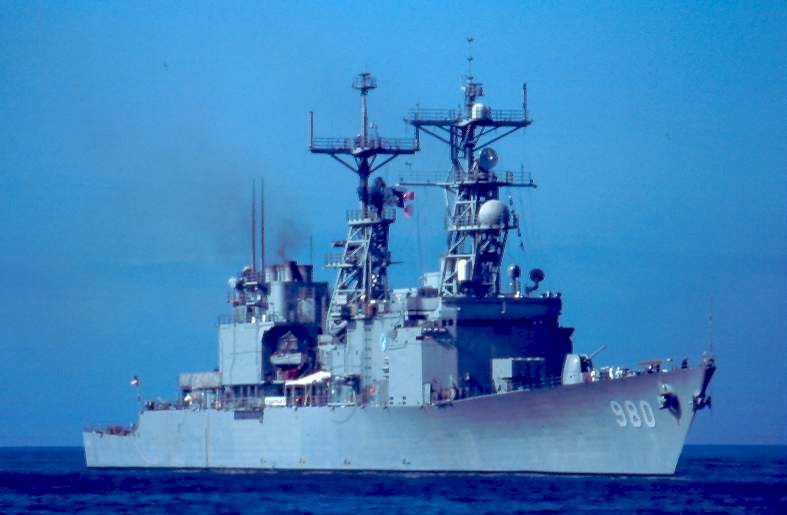
USS Moosbrugger (DD-980) was a Spruance-class destroyer built for the United States Navy by the Ingalls Shipbuilding Division of Litton Industries at Pascagoula, Mississippi. Affectionately nicknamed the "Moose" by her crews, she was named in honor of Vice Admiral Frederick Moosbrugger who is best known for his service in World War II as a highly successful commander of destroyer squadrons.

History

[edit]

USS Moosbrugger was laid down 3 November 1975, launched 23 July 1977 and commissioned 16 December 1978. She arrived at her new home port at Charleston, South Carolina just prior to Christmas 1978 becoming the first of her class at that base. She conducted shakedown operations at Fleet Training Center, Guantanamo Bay, Cuba. She visited Port-au-Prince, Haiti, and Saint Thomas, United States Virgin Islands during this time.

Following shakedown, USS Moosbrugger returned to her builders for post-commissioning refits and upgrades. While at Pascagoula, she was ordered to conduct an emergency sortie in order to avoid the worst effects of Hurricane Frederic, spending several days in the Gulf of Mexico while the storm system passed. Following her return to port, Moosbrugger supplied electrical power to portions of the shipyard to allow her refit to complete. It was in this refit that a pair of moose antlers were installed on the ship, just below the bridge windows.

USS Moosbrugger in 1982

Moosbrugger deployed to the Mediterranean Sea on 14 July 1980, acting as flagship for Commander, Destroyer Squadron 20 for the entire deployment. She conducted anti-submarine warfare (ASW) and amphibious support operations during the deployment. Port visits included Rota, Spain, Naples, Italy, Cagliari, Italy, La Spezia, Italy, Marseille, France, Benidorm, Spain, Cartagena, Spain and Palma de Mallorca. She returned from this deployment on 11 December 1980. She was the test platform for the AN/SQR 19(V) tactical towed array sonar (TACTAS) in 1982.

Moosbrugger received the Meritorious Unit Commendation (MUC) for service as set forth in the following citation:

"For meritorious service in naval operations from 13 September 1986 to 1 December 1986. During numerous ASW operations against Soviet submarines in the Mediterranean Sea, the officers and crew members of the USS Moosbrugger displayed great professional skill and exemplary tactical proficiency attaining Commander Sixth Fleet ASW objectives. USS Moosbrugger, equipped with the SQR-19 towed array sonar and MK III Light Airborne Multi-Purpose System, aggressively achieved unprecedented success in the detection, long term tracking and classification of Soviet submarines. In addition, through expert coordination of multiple ASW assets of the United States and Allied Navies, she was the key to exceptionally competent ASW operations. By her outstanding performance, USS Moosbrugger greatly enhanced national, bilateral, and NATO's ASW capabilities. USS Moosbrugger set a new standard of Mediterranean surface-ship ASW excellence that will be the bench mark for other submarine hunters. By their steadfast performance, brilliant and creative use of resources, exceptional combat readiness, and unfailing devotion to duty, the officers and enlisted personnel of USS Moosbrugger reflected great credit upon themselves and upheld the highest traditions of the United States Naval Service." Signed by the Secretary of the Navy John Lehman.

In 1989, Moosbrugger made the final Cold War deployment to the United States Sixth Fleet as the primary ASW element of the USS Theodore Roosevelt Battle Group.

1990s

[edit]

In August 1990, USS Moosbrugger was part of the initial United States response to Saddam Hussein's invasion of Kuwait. She deployed on six days notice for Operation Desert Shield to join the rapidly formed USS John F. Kennedy Battle Group. She deployed from Charleston, South Carolina and joined John F. Kennedy en route to the Red Sea via the Mediterranean Sixth Fleet. In the months of coalition build-up prior to the beginning of hostilities, the Moosbrugger performed several important tasks. She was first tasked to delay her Suez transit by several weeks in order to be the US contribution to the standing up of NATO's Standing Naval Force Mediterranean making port calls in Italy and Balearic Islands. Completing her short stay with NATO, Moosbrugger transited the Suez in early September to rejoin Kennedy and immediately took a station in the North Red Sea entrance to the Gulf of Aqaba tasked with visit, board, search, and seizure (VBSS) to support enforcement of UN Iraq Sanctions. In September and early October she stopped and boarded nearly 30 merchant ships bound for Jordan. Following a short maintenance period in Jidda, Saudi Arabia, she took onboard small contingents of U.S. Coast Guard personnel and Navy SEALS, both trained in VBSS and continued search and seizure operations until transiting back North through the Suez. Moosbrugger spent Christmas 1990 in Haifa, Israel, departing the following day back to the Suez Canal and Red Sea.

When Operation Desert Storm began in January 1991, Moosbrugger was again assigned maritime interdiction patrol at the entrance to the Gulf of Aqaba. Her assignment was to stop, board, and search merchant vessels flagged by nations sympathetic to Iraq; and to prevent any war materials found onboard from reaching Jordan and ultimately Iraq. When hostilities ceased, Moosbrugger made ports-of-call in Egypt, Crete, and Gibraltar before crossing the Atlantic for the United States. Moosbrugger was awarded the Navy Unit Commendation for service during the Persian Gulf War.

Moosbrugger performed an extensive update in Charleston shipyard which removed its forward anti-submarine missile launcher of the ASROC family and upgraded to the RUM-139 VL-ASROC vertical launching system (VLS). This allowed the ship the ability to fire Tomahawk missiles in addition to vertically launched ASROC.

Moosbrugger relocated to Mayport, Florida, on 11 March 1995, from its previous home port of Charleston, South Carolina. The Spruance-class ship was the sixth of eleven ships scheduled for relocation to Mayport as a result of the 1993 Base Realignment and Closure Commission decision.

Moosbrugger went into drydock to install women's living quarters and restrooms. She was one of the first surface warships to have women on it.[citation needed]

The yard period in Mayport Florida was also to repair extensive issues encountered during the overhaul and upgrades performed at the Earl Shipyard in Charleston just a few years prior to.

USS Moosbrugger launches a Sea Sparrow missile on 15 July 1996

Following these extensive overhaul periods, Moosbrugger deployed in 1996, along with La Moure County, John L. Hall and Narwhal, to take part in UNITAS 96, a series of combined tactical at-sea operations, amphibious operations and in-port exercises with participating South American naval forces. During that deployment, Moosbrugger spent almost two weeks in Venezuelan waters conducting anti-submarine warfare, electronic warfare and anti-air gunnery exercises in the Caribbean Sea. She then departed for Brazil for the next phase of UNITAS.

Moosbrugger deployed in 1998, along with La Moure County, Doyle and Boston, to take part in UNITAS 39–98, serving as the USCOMSOLANT flagship with COMDESRON 32 as the Operational Commander. UNITAS, Latin for unity, consists of at-sea operations, amphibious operations, riverine operations and in port exercises conducted with nine South American navies over a four-month period. The U.S. task group circumnavigated South America in a clockwise direction, returning to Naval Station Roosevelt Roads in November. The 40-year-old operation promotes a cooperative maritime strategy in the region while supporting the U.S. policy of continued engagement in South America through forward presence. The navies of Canada, United Kingdom, the Netherlands and South Africa joined the United States and South American navies for the first phase of UNITAS. This phase was led by the United States and conducted in the vicinity of Puerto Rico. The U.S. Navy's longest-running annual deployment began at Naval Station Roosevelt Roads, Puerto Rico, as seven ships from four foreign navies joined a five ship U.S. task group.

While in Puerto Rico, on 20 April 1998, Moosbrugger took part in Independent Deployer Exercise (INDEX) 98–2, off the coast of Puerto Rico. During the exercise, Moosbrugger fired two Sea Sparrows from her deck at guided target drones launched from the Atlantic Fleet Weapons Training Facility at Naval Station Roosevelt Roads. The exercise also included target drones fired from A-4 Skyhawk aircraft. Following this, the task force then headed for Venezuela on 18 July as Venezuela, Brazil, Uruguay, Argentina, Chile, Paraguay, Peru, Ecuador, and Colombia each directed, in turn, their own phase of UNITAS. Overall, U.S. forces worked with host navies from Venezuela, Brazil, Uruguay, Argentina, Paraguay, Chile, Peru, Ecuador and Colombia. The specific exercises conducted in each phase are determined by the host navy, making each phase unique. Exercises included all areas of modern naval warfare including anti-air, amphibious, anti-surface and anti-submarine warfare.

Fate

[edit]

Moosbrugger was placed in commission, in reserve on 16 October 2000 at Mayport, Florida to prepare for decommissioning. On 15 December 2000, she was decommissioned and subsequently brought to Philadelphia Naval Intermediate Ship Maintenance Facility. She was maintained there in Maintenance Category B for activation in time of national emergency until 2006, when she was towed to Brownsville, Texas, for dismantling.

Ship's crest

[edit]

The official crest of USS Moosbrugger symbolizes the dedication and courage displayed by her namesake, Vice Admiral Frederick Moosbrugger, during World War II.

The trident, an attribute of Neptune, god of the seas, represents the awesome strength and dominance of the modern destroyer. It also resembles the letter "M," an allusion to the initial letter of Moosbrugger, the ship's namesake. The ship's motto is "More than Required".

Through the heraldic fountain for water, the grappling iron (a device used for close range, early naval encounters), and the torpedo, the crest commemorates the Battle of Vella Gulf in the South Pacific during World War II. The then-Commander Moosbrugger led his ships into exceedingly close range against Japanese naval forces; took the enemy by surprise, and delivered a devastating torpedo attack, thereby annihilating the hostile force. For this action, he was awarded the Navy Cross. The gold laurel wreath is symbolic of Vice Admiral Frederick Moosbrugger's long and distinguished career.

[edit]

See also

[edit]
[edit]
Revisions and contributorsEdit on WikipediaRead on Wikipedia
from Grokipedia
USS Moosbrugger (DD-980) was a Spruance-class destroyer of the United States Navy, named in honor of Vice Admiral Frederick C. Moosbrugger, a World War II destroyer squadron commander who earned the Navy Cross for leading a flawless night surface action at the Battle of Vella Gulf in August 1943, sinking four Japanese destroyers without sustaining damage to his force. The ship was laid down on 3 November 1975 by Ingalls Shipbuilding in Pascagoula, Mississippi, launched on 23 July 1977, and commissioned on 16 December 1978, initially homeported in Charleston, South Carolina, before transferring to Mayport, Florida. Throughout her 22-year career, Moosbrugger specialized in anti-submarine warfare, conducting intensive operations against Soviet submarines in the Mediterranean Sea and earning recognition for operational excellence in ASW line operations. During Operation Desert Storm in 1991, she performed maritime interdiction patrols at the entrance to the Gulf of Aqaba, diverting suspect freighters and conducting numerous vessel identifications to enforce United Nations sanctions. Moosbrugger received multiple awards, including for damage control and engineering excellence, before being decommissioned on 15 December 2000.

Namesake and Construction

Vice Admiral Frederick Moosbrugger

Frederick C. Moosbrugger (October 9, 1900 – October 1, 1974) was a United States Navy officer who attained the rank of vice admiral, renowned for his command of destroyer squadrons during World War II's Pacific Theater, where he pioneered effective night surface tactics against Japanese forces. A 1923 graduate of the United States Naval Academy, commissioned as an ensign on June 8, 1923, Moosbrugger advanced through surface ship assignments, gaining expertise in destroyer operations that proved decisive in combat. Moosbrugger's most celebrated action occurred during the Battle of Vella Gulf on the night of August 6–7, 1943, in the Solomon Islands, where he commanded Task Group 31.2 comprising six destroyers: Nicholas (his flagship), O'Bannon, Taylor, Dyson, Claxton, and Ammen. Intercepting a Japanese "Tokyo Express" reinforcement convoy of four destroyers attempting to evacuate troops from Vella Lavella, Moosbrugger exploited superior intelligence and radar detection to achieve complete tactical surprise, closing to point-blank range under cover of darkness before launching coordinated torpedo salvos. His division sank all four enemy destroyers—Hagikaze, Arashi, Kawakaze, and the transport destroyer Mikazuki—inflicting over 1,000 tons of damage without a single American loss or hit, marking one of the U.S. Navy's most lopsided destroyer engagements and demonstrating the efficacy of aggressive night torpedo tactics over reliance on gunfire. For this "perfect victory," as termed by contemporaries, Moosbrugger received the Navy Cross, presented by Admiral William F. Halsey on September 10, 1943. His approach emphasized rapid decision-making, division cohesion, and preemptive strikes, influencing subsequent U.S. destroyer doctrine by validating radar-guided ambushes and torpedo-centric engagements in contested waters. Promoted steadily for his leadership, Moosbrugger reached captain during the war and continued to shape post-1945 as superintendent of the in , and commander of the Pacific Fleet Training Command, where he integrated wartime lessons into training regimens for and squadron operations. Retiring as a in the early , his legacy endures in prioritizing offensive maneuvers, as evidenced by the naming of USS Moosbrugger (DD-980) in his honor.

Keel Laying, Launch, and Commissioning

The keel of USS Moosbrugger (DD-980) was laid down on 3 November 1975 at Ingalls Shipbuilding's facility in , as part of the Spruance-class destroyer production line designed to enhance U.S. capabilities during the naval buildup. Ingalls, a division of , efficiently constructed multiple hulls in parallel, leveraging modular assembly techniques to meet accelerated fleet requirements amid escalating tensions with the . The ship was launched on 23 July 1977, marking a key milestone in her assembly after approximately 20 months of structural work, including installation of the hull form optimized for high-speed ASW operations. Following sea trials and outfitting with propulsion and sensor systems, Moosbrugger was commissioned into active service on 16 December 1978 at a ceremony in , her initial homeport assigned to support Atlantic Fleet operations. This timeline reflected the Navy's push for rapid commissioning of surface combatants to maintain numerical superiority over Soviet forces, with Moosbrugger joining eighteen other Spruance-class ships by late 1978. Post-commissioning, she underwent shakedown operations before transitioning to , in line with Atlantic Fleet reorganizations to optimize deployments.

Design and Capabilities

Spruance-Class Overview

The Spruance-class destroyers were developed in the late and constructed primarily during the as the U.S. Navy's premier surface escorts for carrier battle groups, with a core mission of countering the Soviet Union's expanding submarine fleet through advanced (ASW) capabilities. These ships incorporated sophisticated sonar arrays, underwater fire control systems, and provisions for helicopter operations to enable proactive detection and engagement of submerged threats in contested oceanic environments. Designed for extended blue-water patrols, the class emphasized high endurance and sustained high-speed transits, leveraging gas turbine propulsion to support fleet defense against asymmetric undersea challenges during the . Measuring 529 feet (161 m) in length at the waterline—with an overall length of 563 feet (172 m)—and featuring a beam of 55 feet (17 m), the Spruance-class vessels displaced 8,040 long tons at full load, making them the largest U.S. destroyers commissioned prior to the class. This substantial size facilitated internal volume for fuel, sensors, and potential modular upgrades, while accommodating a standard crew of 19 officers and 315 enlisted sailors optimized for prolonged operations. Drafted to 29 feet (9 m), the hull form balanced stability for ASW platforms with maneuverability in open seas. In service, the class underpinned U.S. naval superiority by delivering persistent ASW screening and volume-based firepower projection, enabling carrier groups to operate freely against Soviet naval expansions without compromising fleet mobility or response times. Their allowed integration of evolving technologies, ensuring adaptability to multi-threat scenarios while prioritizing the causal primacy of undersea domain control in great-power .

Propulsion and Performance

The USS Moosbrugger (DD-980) employed four gas turbines arranged in a (combined diesel and gas) configuration, though primarily gas turbine-driven, delivering a total of 80,000 shaft horsepower (60 MW) to two shafts. This all-gas-turbine propulsion system, a departure from steam plants in prior U.S. classes, provided rapid acceleration and responsiveness suited to demands. These turbines enabled a maximum sustained speed of 32.5 knots (60.2 km/h), allowing the ship to pursue submerged threats or evade surface engagements effectively during extended patrols. At an economical speed of 20 knots, the Moosbrugger achieved a range exceeding 6,000 nautical miles (11,000 km), facilitating transoceanic deployments with minimal refueling dependency and supporting the U.S. Navy's forward presence strategy in contested waters. The LM2500 turbines demonstrated high reliability in marine environments, with modular design allowing quick maintenance swaps and contributing to fleet-wide availability rates that sustained rigorous operational schedules. This engineering reliability underpinned the Spruance-class's capacity for high-tempo exercises, where ships like the Moosbrugger maintained generation rates above 70% amid variable sea states and fuel constraints.

Armament and Weapon Systems

The USS Moosbrugger was equipped with two Mark 45 5-inch/54-caliber dual-purpose guns, positioned one forward and one aft, designed for engagements against surface ships, shore targets, and low-flying with a range exceeding 13 nautical miles and a up to 20 rounds per minute per gun. These lightweight guns emphasized versatility in the Spruance-class's (ASW) focus while providing secondary surface and air . For subsurface threats, the destroyer featured an eight-cell Mark 16 launcher for (Anti-Submarine ROCket) missiles, which could deliver a nuclear or conventional to ranges of up to 20 kilometers, prioritizing standoff ASW capability. Complementing this were two triple Mark 32 surface-launched torpedo tubes capable of firing Mark 46 lightweight homing torpedoes, effective against submarines at shorter ranges through acoustic homing and wire guidance. Anti-surface warfare was addressed through two quadruple canister launchers accommodating eight RGM-84 missiles, added during the 1980s as a modular to enhance strike capacity against enemy shipping with and a range of approximately 70 nautical miles. Limited air defense prior to major retrofits relied on a single eight-cell Mark 29 launcher for RIM-7 point-defense missiles, infrared-guided for intercepting low-to-medium altitude threats at ranges up to 10 nautical miles, though constrained by the absence of a full area air warfare . Two 20 mm Mark 15 Phalanx Close-In Weapon Systems (CIWS) were later installed for terminal defense against anti-ship missiles and aircraft, employing radar-guided 20 mm Gatling guns with a high rate of fire. These s reflected pragmatic, incremental adaptations to evolving threats without overhauling the ship's core ASW orientation, as Moosbrugger did not receive vertical launch (VLS) integration for or advanced Standard missiles.

Sensors, Electronics, and ASW Focus

The USS Moosbrugger (DD-980), as a Spruance-class destroyer, incorporated advanced systems tailored for (ASW), with the AN/SQS-53 bow-mounted active providing high-resolution detection of submerged threats in deep-ocean conditions. This system utilized for improved reliability and performance over prior generations, enabling precise localization and of contacts at extended ranges. Augmenting the hull-mounted sonar, the ship received the AN/SQR-19 Tactical (TACTAS) in mid-1982 as the platform for its first operational prototype deployment, facilitating passive acoustic surveillance by streaming a linear array of hydrophones to capture low-frequency submarine noise signatures while minimizing self-noise interference. Together, these sensors supported the destroyer's primary ASW mission, offering complementary active and passive capabilities that enhanced detection in layered ocean environments and contributed to barrier and search operations against proliferating threats. For surface and air search, the AN/SPS-40 radar provided two-dimensional long-range tracking of airborne and surface targets, feeding data into the (CIC) for real-time fusion with inputs and weapon control systems. This integration enabled coordinated ASW responses, including cueing for deployments or launches, underscoring the ship's dedication to empirical ASW proficiency in fleet operations. The electronics suite's effectiveness was validated through rigorous at-sea evaluations, affirming its role in countering adversarial submarine capabilities during Cold War-era line duties.

Operational History

Early Service and Shakedown (1979–1985)

![USS Moosbrugger on 1 July 1983](./assets/USS_Moosbrugger_DD980DD-980 Following her commissioning on 16 December 1978 at in , USS Moosbrugger (DD-980) proceeded to shakedown training at the Fleet Training Center in Guantanamo Bay, Cuba, to verify operational readiness and crew proficiency. During this period, the ship conducted essential sea trials, including weapons systems checks and (ASW) drills, standard for newly commissioned Spruance-class destroyers to establish baseline performance. Port visits to , , and Saint Thomas, U.S. , facilitated logistical support and international engagements, enhancing the crew's experience in regional operations. After completing shakedown, Moosbrugger returned to Pascagoula for post-commissioning refits and upgrades, addressing any identified deficiencies from trials. Integrated into the Atlantic Fleet and homeported at Mayport, , the focused on ASW-centric training exercises, participating in fleet maneuvers to hone coordinated tactics against threats amid priorities. These included firing two Sea Sparrow missiles at guided target drones from the Atlantic Fleet Weapons Training Facility, demonstrating anti-air warfare capabilities during early operational evaluations. In July 1980, Moosbrugger deployed to the on 14 July, serving as flagship for Commander, Destroyer Squadron 20 throughout the mission to build interoperability with allies. Operations emphasized joint ASW patrols and fleet exercises, with port calls to , , , and the fostering diplomatic ties and logistical coordination. By 1982, the ship tested the AN/SQR-19(V) system, advancing its ASW sensor suite through experimental evaluations that informed future upgrades. These activities solidified Moosbrugger's role in Atlantic Fleet readiness, preparing for extended global commitments without major incidents.

Cold War Deployments and ASW Operations (1986–1991)

From June to December 1986, USS Moosbrugger deployed to the , where it participated in (ASW) line operations and exercises aimed at deterring Soviet naval expansion in the region. The ship conducted tracking exercises against Soviet submarines, contributing to the maintenance of in contested waters amid heightened tensions with the . For its performance from 13 September to 1 December 1986, Moosbrugger received the , recognizing exceptional ASW proficiency that set standards for surface-ship operations in the Mediterranean. In January 1989, Moosbrugger commenced another Mediterranean deployment (MED 1-89), sustaining a 70% operational tempo primarily devoted to ASW line operations, including area searches, dual-ship exercises with HMS Sirius, and specialized drills such as Diesel Hunt on 28 March. Key activities encompassed National Week 89A on 13 January and SHAREM-104 on 29 May, enhancing bilateral and ASW interoperability through joint tracking and electronic warfare integration. These efforts earned the ship the Sixth Fleet ASW "Hook'em" Award, along with battle efficiency ribbons in ASW, anti-air warfare, and related categories for the 1988–1989 cycle. Amid the 1990 , Moosbrugger deployed in August as part of the USS battle group, operating in the Mediterranean and to support Operation Desert Shield through ASW patrols and presence missions that countered potential submarine threats in vital sea lanes. The seven-and-a-half-month mission, concluding with arrival at Naval Base Charleston on 2 1991, involved 67 underway replenishments and detachment for maintenance in the Mediterranean during redeployment, underscoring the ship's role in sustaining deterrence and operational readiness into the Cold War's final phase.

Post-Cold War Activities (1992–2000)

Following the end of the Cold War, the U.S. Navy underwent significant force reductions, yet USS Moosbrugger maintained operational readiness through routine training and contingency operations in the Atlantic and Caribbean regions. Homeported in Charleston, South Carolina, until 1995, the destroyer participated in exercises such as SNFL 93, focusing on fleet proficiency amid budget constraints that limited major deployments. These activities emphasized sustained antisubmarine warfare (ASW) capabilities, even as naval priorities shifted toward littoral operations and power projection in coastal environments. On 11 March 1995, USS Moosbrugger relocated to Mayport, Florida, becoming one of the early surface combatants to integrate female crew members aboard, aligning with broader gender integration policies. The ship underwent a yard period in Mayport for maintenance and upgrades, ensuring continued ASW effectiveness through system checks and tactical drills. This period involved local operations in the , including port visits and joint exercises to adapt to post-Cold War threats like regional instability rather than open-ocean confrontations. In 1996, USS Moosbrugger deployed for UNITAS 37-96, a multinational exercise series promoting interoperability with South American navies through combined at-sea tactics, amphibious simulations, and in-port training. During this deployment, the ship spent nearly two weeks in Venezuelan waters, conducting ASW exercises, electronic warfare drills, and anti-air gunnery practice, including launches of RIM-7 Sea Sparrow missiles. The exercise highlighted the destroyer's role in hemispheric security amid fiscal pressures that reduced the overall fleet size from over 500 ships in 1990 to around 300 by 2000. USS Moosbrugger repeated this pattern in 1998 with UNITAS 39-98, serving as flagship for operations that reinforced ASW proficiency and skills in the Atlantic approaches to the . These deployments, totaling over six months at sea across the decade, underscored the ship's adaptability despite the Navy's pivot from blue-water ASW dominance to versatile, expeditionary roles. Routine upkeep in Mayport, including periodic overhauls, sustained material readiness for potential contingencies like counter-narcotics patrols or humanitarian support.

Decommissioning and Fate

Final Deployment and Retirement

The USS Moosbrugger conducted its final deployment in the summer of 2000 as part of a six-month cruise with NATO's Standing Naval Force Atlantic (STANAVFORLANT), during which it served as for Commander STANAVFORLANT. This operation marked the ship's last active duty period prior to retirement, aligning with broader U.S. Navy force structure reductions following the . Moosbrugger was decommissioned on December 15, 2000, at , , ending 22 years of service. Following decommissioning, the ship was transferred to the in , , for long-term storage and preservation in an inactive status. On April 25, 2006, Moosbrugger was officially struck from the , formalizing its removal from the U.S. Navy's active inventory. This step reflected fiscal constraints on maintaining older vessels amid modernization priorities, without immediate disposal.

Scrapping and Disposal

Following its decommissioning on December 15, 2000, USS Moosbrugger entered the inactive reserve fleet at the Naval Intermediate Ship Maintenance Facility. The vessel remained in storage until April 25, 2006, when it was stricken from the . In 2006, Moosbrugger was transferred to a commercial shipbreaking facility in , for complete dismantlement. The process involved sectioning the hull and recovering ferrous and non-ferrous metals for industrial reuse, consistent with standard U.S. Navy disposal protocols for obsolete surface combatants post-Cold War. The scrapping reflected broader fiscal imperatives in naval procurement during the early 2000s, as maintenance costs for the Spruance class—lacking vertical launch systems and advanced radar integration—exceeded those of emerging Arleigh Burke-class replacements, precluding preservation options like museum conversion. No components were retained for static display, underscoring the class's displacement by technologically superior platforms amid defense budget reallocations.

Legacy and Symbolism

Ship's Crest and Motto

The official crest of USS Moosbrugger (DD-980) symbolizes the dedication and courage exhibited by her namesake, Vice Admiral Frederick C. Moosbrugger, during World War II. At the center, a trident— an attribute of Neptune, the god of the seas—represents the formidable strength and maritime dominance of the modern destroyer, while its form evokes the initial "M" of the ship's name. Additional heraldic elements commemorate Moosbrugger's pivotal role in the Battle of Vella Gulf on 6–7 August 1943, where, as a destroyer squadron commander, he orchestrated a surprise close-range torpedo attack that annihilated a Japanese force without sustaining losses, earning him the Navy Cross. These include a heraldic fountain denoting water, a grappling iron signifying early naval close-quarters tactics, and a torpedo emblemizing the decisive strike. Encircling the design, a gold laurel wreath honors Vice Admiral Moosbrugger's extended and distinguished naval service. The ship's motto, "More Than Required," reflects a commitment to exceeding expectations in duty and performance, aligning with naval traditions of resilience and excellence embodied in the namesake's tactical precision and leadership. This served to foster , instill among the crew, and uphold official U.S. emblematic standards during the vessel's commission from 1978 to 2000.

Contributions to Naval Defense

The USS Moosbrugger, a Spruance-class destroyer optimized for (ASW), exemplified the U.S. Navy's strategic prioritization of undersea threat neutralization to sustain maritime deterrence amid Soviet naval expansion during the . By escorting carrier battle groups and conducting persistent ASW patrols, ships of this class, including Moosbrugger, directly countered the Navy's growing subsurface capabilities, preserving U.S. forward presence and the credibility of nuclear deterrence through assured sea control. This role was foundational, as Spruance-class vessels demonstrated the causal efficacy of dedicated ASW platforms in denying adversaries domain access, thereby upholding the balance of power without escalation to open conflict. Moosbrugger's demonstrated ASW proficiency, evidenced by its receipt of the U.S. Sixth Fleet's Hook'em Award for superior performance in tracking and engaging submarine contacts, validated the Spruance design's tactical value in high-stakes environments. Such outcomes reinforced the Navy's investment in advanced suites and integration, which collectively amplified fleet-wide ASW resilience against quiet, high-speed Soviet submarines like the Victor and Alfa classes. Beyond immediate deterrence, operational insights from Moosbrugger and peer ships informed iterative advancements in architecture, particularly through validation of modular systems and endurance in extended deployments. These empirical contributions shaped the transition to multi-mission platforms, with Spruance-class data on vertical launch systems and close-in efficacy directly influencing the Arleigh Burke-class's enhanced ASW and strike integration. By sustaining a cadre of experienced operators, Moosbrugger also perpetuated doctrinal continuity, enabling personnel to transfer proven ASW methodologies to newer vessels and maintain institutional deterrence posture into the post-Cold War era.

References

Add your contribution
Related Hubs
User Avatar
No comments yet.