


Community hub
Recent from talks
Contribute something
Nothing was collected or created yet.
USS Conolly
View on Wikipedia | This article needs additional citations for verification. (May 2017) |
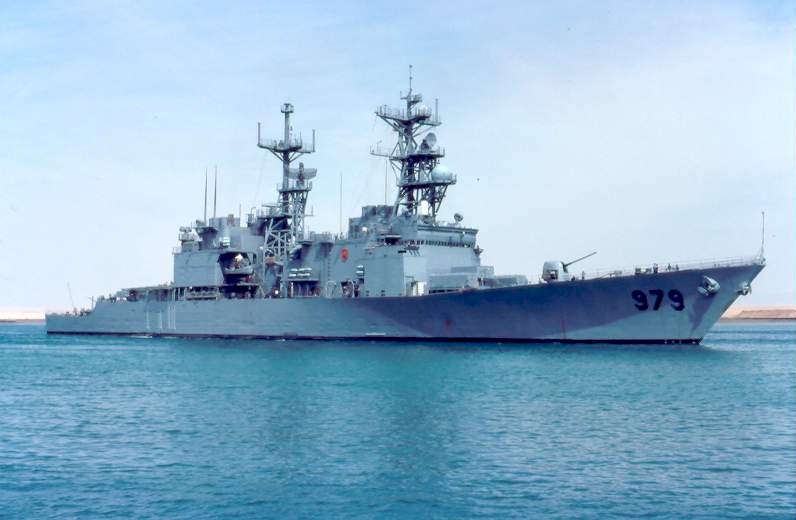
 USS Conolly transiting the Suez Canal summer 1992 | |
| History | |
|---|---|
 United States United States | |
| Name | Conolly |
| Namesake | Richard Lansing Conolly |
| Ordered | 15 January 1974 |
| Builder | Ingalls Shipbuilding |
| Laid down | 29 September 1975 |
| Launched | 3 June 1977 |
| Acquired | 25 September 1978 |
| Commissioned | 14 October 1978 |
| Decommissioned | 18 September 1998 |
| Stricken | 18 September 1998 |
| Identification |
|
| Motto | Leading The Way |
| Fate | Sunk as target, 29 April 2009 |
| Badge |  |
| General characteristics | |
| Class & type | Spruance-class destroyer |
| Displacement | 8,040 long tons (8,170 t) full load |
| Length | |
| Beam | 55 ft (17 m) |
| Draft | 29 ft (8.8 m) |
| Propulsion | 4 × General Electric LM2500 gas turbines, 2 shafts, 80,000 shp (60 MW) |
| Speed | 32.5 knots (60.2 km/h; 37.4 mph) |
| Range | 6,000 nmi (11,000 km; 6,900 mi) at 20 knots (37 km/h; 23 mph) |
| Complement | 19 officers, 315 enlisted |
| Sensors & processing systems |
|
| Electronic warfare & decoys |
|
| Armament |
|
| Aircraft carried | 2 × Sikorsky SH-60 Seahawk LAMPS III helicopters |
| Aviation facilities | Flight deck and enclosed hangar for up to two medium-lift helicopters |


USS Conolly (DD-979), named for Admiral Richard Lansing Conolly USN, was a Spruance-class destroyer built by the Ingalls Shipbuilding Division of Litton Industries at Pascagoula, Mississippi.
History
[edit]Conolly was laid down 29 September 1975, launched 19 February 1977, and commissioned 14 October 1978.
1980s
[edit]_aerial_port_bow_view_1982.jpg)
From August to December 1980, Conolly deployed as part of the Middle East Force. She deployed as part of this force again from October 1981 to February 1982. In approximately May 1982, Conolly cruised to the U.S. Virgin Islands from U.S. Naval Base Roosevelt Roads, Puerto Rico. While in the USVI, Conolly suffered a cracked bow sonar dome that required her return, under her own power, to Newport News Shipyards for repairs. While in route to Newport News, Conolly experienced a fire in one of the engineering spaces, which the ship's damage control fire fighters promptly contained. Upon arrival in Newport News, Conolly was repaired in dry docks. In September 1982, she deployed to the Mediterranean including operations off the coast of Lebanon.
In June 1983 Conolly deployed again participating in UNITAS XXIV, an annual exercise working with partner navies in South America. Conolly made multiple port visits and worked with a variety of South American navies before returning home in December of the same year. Conolly was the flagship for the cruise, with the staff of Commander, South Atlantic (COMSOLANT), Rear Admiral Clint Taylor, USN, embarked.
Due to equipment casualties in the engineering plant while on the east coast of Chile, the crew had to repair in place the pneumatic clutch-brake assemblies on the two forward gas turbine engines, the second repair having to be completed at sea en route Montevideo, Uruguay. Once in port, the damaged LM-2500 Gas Turbine Main Engine was replaced in 82 hours, using a large floating crane in the port facility.
In addition to the UNITAS cruise, Conolly left Brazil in November and sailed, initially in company with Jesse L. Brown, east to conduct a West African Training Cruise (WATC). Conolly visited Liberville, Gabon; Lagos, Nigeria; Monrovia, Liberia and finally Dakar, Senegal, before transiting west to Roosevelt Roads, PR for a refueling stop before returning to her homeport of Norfolk, VA in mid-December, 1983.
While sailing from Brazil, Conolly was required to conduct a transfer of fuel, while underway, to the Jesse L. Brown, so that ship would have sufficient fuel to make her port call in Equatorial Guinea. Conolly was the first Spruance-class vessel to complete such a task, which was not an assigned capability for the ships. Approximately 30,000 gallons were sent to the Brown using 21⁄2" fire hoses to deliver the fuel, taking about 4 hours.
In February, 1984, Conolly sailed to Portland, ME, to enter a regular overhaul (ROH) at the newly opened Bath Iron Works facility. The overhaul lasted 10 months, during which Conolly was fitted with the Tomahawk Weapons System. Also installed was the MK 15 Close in Weapons System and the Mk 23 Target Acquisition System. During the yard period, Commander Harry Maixner was relieved by Commander Gary Voorheis as Captain of the ship.
In October 1985 Conolly once again deployed as part of the Middle East Force. During this deployment "Conolly" was involved in the boarding of an American flagged ship by the Iranian Navy. She returned from this deployment in April 1986. In June 1987 she made another deployment to the Mediterranean and followed this up with two more deployments in 1989 as part of the Middle East Force, and 1992 MIF (Maritime Interception Force)during Iraq war.
1990s
[edit]Conolly spent January 1991 at Metro Machine (now General Dynamics NASSCO) in Norfolk, Virginia for a regular overhaul (ROH).[1]
_port_quarter_off_Haiti_1993.jpg)
In 1993, Conolly was deployed in support of Operation Uphold Democracy, enforcing United Nations sanctions against Haiti.
From 6 to 10 June 1994, Conolly participated in World War II commemoration activities at Cavalaire-sur-Mer, France.
That same year, Conolly deployed to the Arabian Peninsula, conducting maritime interception operations in the Red Sea in support of United Nations sanctions against Iraq. During that deployment, on 12 July 1994, Conolly came to the rescue of sixty-two crewmembers of the Panamanian-registered ferry Al Loloa following a fire on board the ferry. Conolly answered the vessel's distress call and proceeded to the scene of the fire. Sixty-one of the ferry's all Egyptian crew had already abandoned ship and were found safe in five life rafts. A survey team from Conolly boarded the Al Loloa and found the fire out of control. Before returning to Conolly, the survey team found the missing crewmember unharmed.
As part of a reorganization announced in July 1995 of the U.S. Atlantic Fleet's surface combatant ships into six core battle groups, nine destroyer squadrons and a new Western Hemisphere Group, Conolly's homeport was changed from Norfolk, Virginia, to Mayport, Florida, with the shift to occur in 1996–1997.
Conolly deployed with the USS George Washington carrier battle group, on 26 January 1996 for a regularly scheduled deployment. The previous December, the battle group and ARG participated in Joint Task Force Exercise 96–1, their "final examination" before deployment, and the culmination of a year of intense preparation.
While deployed, Conolly took part in the Ships Anti-Submarine Warfare Readiness Effectiveness Measuring 114 (SHAREM) Invitational Exercise 1-96 (INVITEX), held 23 – 29 February. SHAREM 114 was a U.S. 6th Fleet naval exercise conducted in the Gulf of Valencia off the east coast of Spain.
Following the completion of Operation Destined Glory 96, a NATO amphibious exercise, Conolly paid a visit to Augusta Bay, Sicily. Operation Destined Glory 96, lasted 16 days and was a NATO forces combined amphibious exercise which began 13 March and continued through 26 March. It tested forces in the air and at sea in the Central Mediterranean near Sardinia and in the Tyrrhenian Sea and also trained ashore at Capo Teulada, Sardinia. Military units from the NATO countries of Greece, Italy, Netherlands, Spain, Turkey and United States took part in the exercise which focused on undersea, surface, electronic and air warfare, and included communications and shiphandling skills.
On 11 April, Conolly was tasked with escorting USS Guam, USS Trenton and USS Portland to Liberia from the Adriatic Sea in support of JTF Assured Response. Guam, Trenton, Portland and Conolly were conducting routine training when they were directed to the coastal waters off Liberia.
Conolly also assisted in search and rescue efforts when the airplane carrying United States Commerce Department Secretary Ron Brown crashed. It participated in Operation Sharp Guard, enforcing United Nations Security Council resolutions in the former republics of Yugoslavia. While on station, Conolly queried 121 merchant vessels, ensuring no contraband cargo entered the troubled region.
.jpg)
In June 1996, Conolly took part in Exercise TAPON 96, an allied exercise held in the Alboran Sea, Gulf of Cadiz and the eastern Atlantic Ocean. Conolly conducted combined warfare exercises with the Spanish aircraft carrier Principe de Asturias, and other surface ships including the Spanish frigates Baleares, Santa Maria, Numancia, the Greek destroyer Formion, the Spanish submarine Delfín and the US submarine Grayling. Conolly participated in the nine-day exercise which emphasized procedures and tactics for effective maritime choke-point control. Conolly also completed live-firing exercises in the Central Mediterranean Sea at Avgo Nisi gun-firing range, a small island north of Crete, Greece. She then traveled toward Sicily and conducted a torpedo-firing exercise.
In March 1997, Conolly moved its homeport from Norfolk, Virginia to Mayport, Florida.
Decommissioning and disposal
[edit]Conolly was decommissioned 18 September 1998 and laid up at Philadelphia Naval Intermediate Ship Maintenance Facility. An effort to preserve her in Illinois failed after it was unable to acquire the needed funds.[2] Conolly was sunk as a target off Florida on 29 April 2009 as part of UNITAS Gold, a multinational naval exercise.[3]
Awards
[edit]- 3 × Battle Efficiency Awards for 1994, 1995 and 1996
- The National Defense Service Medal presented for service during Operation Desert Storm
- 2 × Joint Meritorious Unit Awards 1 November 1991-January 11, 1992, & 1997
- 12 × Sea Service Deployment Ribbon presented for each of her deployments
- Humanitarian Service Medal presented during UNITAS XXIV – June through December 1983
- 2 × Southwest Asia Service Medals presented for Middle East Force/North Red Sea deployments for March through September 1992, and March through September 1994.
- Kuwait Liberation Medal
- NATO Service Medal presented during Yugoslavia operations October through December 1996.
- Armed Forces Service Medal presented for Operation Joint Endeavor during Mediterranean deployment January through July 1996
- Armed Forces Expeditionary Medal presented for Middle East Force Deployment 27 April through 16 August 1989
Gallery
[edit]-
 USS Conolly and USS Iowa on 1 August 1986
 -
 USS Conolly on 1 November 1987
 -
 USS Conolly off Port-au-Prince on 31 October 1993
 -
 USS Conolly on 29 April 2009
.jpg)
_port_bow_view_at_anchor.jpg)
_underway_off_the_coast_of_Port-au-Prince_Haiti.jpg)
_sinking.jpg)
References
[edit]- ^ STG2 Arnesen (Crew Member)
- ^ USS CONOLLY Meseum and Memorial
- ^ "USS Conolly (DD-979) (+2009)". Wrecksite. Retrieved 7 November 2011.
External links
[edit]
- Naval Vessel Register entry for Conolly
- Photo gallery of USS Conolly at NavSource Naval History
- united-states-navy.com: USS Conolly
- SINKEX Report from UNITAS 50 of USS Conolly
Shipwrecks and maritime incidents in 2009 | |
|---|---|
| Shipwrecks |
|
| Other incidents |
|


USS Conolly
View on GrokipediaNamesake
Admiral Richard Lansing Conolly
Richard Lansing Conolly was born on April 26, 1892, in Waukegan, Illinois, and attended Lake Forest Academy before receiving an appointment to the United States Naval Academy, from which he graduated in the class of 1914.[6] Following commissioning as an ensign, Conolly pursued a career focused on surface warfare, serving aboard battleships such as USS Virginia, Montana, and New York, as well as destroyers including USS Smith, Foote, and Worden.[4] He earned a Master of Science in electrical engineering from Columbia University in 1922 and later commanded destroyer divisions and squadrons, including Destroyer Squadron 6, which was present during the Japanese attack on Pearl Harbor in December 1941.[6] His early expertise in destroyer operations and engineering laid the foundation for his later innovations in amphibious tactics.[4] During World War II, Conolly rose to prominence as an amphibious commander, first serving with the Amphibious Force Atlantic Fleet from March to October 1943, where he contributed to the invasions of North Africa, Sicily, and Italy by commanding landing craft and bases, emphasizing precise logistical coordination for troop landings.[6] Transitioning to the Pacific Theater, he led Assault Group 3 of the Amphibious Force Pacific Fleet, directing operations in the Gilbert and Marshall Islands in 1942, Kwajalein, Wake, and Marcus Islands in 1943–1944, the recapture of Guam in July 1944, and the Lingayen Gulf landings in January 1945.[4] Known as "Close-In Conolly" for his doctrine requiring fire support ships to operate perilously near shorelines to maximize accuracy and suppressive fire— a tactic validated by reduced casualties and successful beachheads in multiple assaults— he received three Navy Distinguished Service Medals and two Legion of Merit awards for these efforts.[6] His commands demonstrated the causal efficacy of integrated naval gunfire and amphibious logistics over dispersed or cautious approaches.[4] In the post-war period, Conolly commanded the U.S. Twelfth Fleet from September 1946 to January 1947 and served as Commander-in-Chief of U.S. Naval Forces, Eastern Atlantic and Mediterranean from 1947 to 1950, positions that positioned him to bolster NATO-aligned naval postures amid emerging Soviet naval expansion in European waters.[6] As President of the U.S. Naval War College from 1950 to 1953, he prioritized rigorous strategic education grounded in empirical analysis of amphibious and fleet operations, fostering readiness for potential conflicts with peer adversaries through advanced war gaming and doctrinal refinement rather than untested theoretical models.[4] Retiring as a full admiral in November 1953, he later served as president of Long Island University until his death.[6] Conolly died on March 1, 1962, in the crash of American Airlines Flight 1 over Jamaica Bay, New York, and was buried at Arlington National Cemetery.[4] The Spruance-class destroyer USS Conolly (DD-979), commissioned in 1978, was named in his honor to recognize his proven leadership in amphibious warfare and contributions to naval deterrence strategies that emphasized operational effectiveness and logistical realism during the Cold War era.[4]Construction and commissioning
Keel laying, launch, and builder details
The keel of USS Conolly (DD-979) was laid down on September 29, 1975, at Ingalls Shipbuilding in Pascagoula, Mississippi.[1][5] This event marked the initiation of physical construction for the vessel as the seventeenth Spruance-class destroyer under a 1970 U.S. Navy contract awarded to Litton Industries for thirty such ships, aimed at bolstering American naval surface combatants amid escalating Cold War tensions with the expanding Soviet fleet.[7][1] Ingalls, Litton's shipbuilding division, handled fabrication using modular construction techniques that accelerated assembly compared to earlier destroyer programs.[3] The ship was launched on June 3, 1977, entering the water for the first time after approximately 20 months of hull work.[5][8] At launch, Conolly measured 529 feet in length with a full-load displacement of approximately 8,040 long tons, reflecting the class's design emphasis on heavy anti-submarine warfare capabilities powered by four gas turbine engines.[2] This milestone demonstrated the efficiency of Ingalls' production line, which had already delivered over a dozen Spruance-class ships by the mid-1970s, contributing to the Navy's rapid fleet modernization to maintain maritime superiority.[1] Conolly was delivered to the U.S. Navy on September 25, 1978, following outfitting and trials, enabling her subsequent commissioning later that year.[9] The roughly three-year span from keel laying to delivery underscored the industrial capacity of American shipyards during the era's defense procurement surge, despite challenges like cost overruns on earlier Litton contracts.[10][11]Commissioning ceremony and initial crew
The USS Conolly was commissioned into service on October 14, 1978, at the Litton Ingalls Shipbuilding yard in Pascagoula, Mississippi, transitioning the Spruance-class destroyer from builder's trials to operational status under the U.S. Navy.[12] This event formalized the ship's readiness for fleet assignment, with emphasis placed on its primary anti-submarine warfare capabilities amid heightened Cold War tensions requiring rapid integration of new hulls into active squadrons. The initial crew numbered 19 officers and 315 enlisted sailors, totaling approximately 334 personnel trained to operate the vessel's advanced sonar, helicopter facilities, and propulsion systems for extended at-sea patrols.[5] Crew selection prioritized technical expertise in engineering, weapons handling, and ASW tactics, reflecting the Navy's focus on countering Soviet submarine threats without emphasis on non-operational demographics. Post-commissioning, Conolly undertook a shakedown cruise in the Atlantic, testing systems under real-world conditions including weather challenges like Hurricane David, while the crew honed proficiency in ASW exercises and damage control drills essential for forward-deployed operations.[13] This phase ensured the ship's seaworthiness and crew cohesion prior to assignment to Atlantic Fleet units, marking the completion of initial preparations for combat readiness.Design and capabilities
Class characteristics and propulsion
The USS Conolly (DD-979), as a member of the Spruance class, measured 563 feet (172 m) in overall length, with a waterline length of 529 feet (161 m), a beam of 55 feet (17 m), and a draft of 29 feet (8.8 m).[14] Its full-load displacement reached 8,040 long tons, reflecting a design optimized for extended blue-water operations rather than the lighter configurations of prior destroyer classes.[15] Propulsion was provided by four General Electric LM2500 gas turbines delivering 80,000 shaft horsepower to two shafts, enabling a maximum speed exceeding 32 knots. This COGAG (combined gas and gas) arrangement prioritized reliability and fuel efficiency for anti-submarine warfare (ASW) missions, with an endurance of approximately 6,000 nautical miles at 20 knots.[16] Crew accommodations supported 19 officers and 315 enlisted personnel, incorporating spacious berthing areas that earned the class the informal nickname "Love Boats" due to their cruiser-like habitability compared to cramped predecessors.[5] The Spruance design emphasized ASW primacy in response to Soviet submarine proliferation during the Cold War, featuring a larger hull to integrate helicopter facilities and sonar systems—doubling the displacement of the Charles F. Adams class (around 4,500 tons full load)—over traditional surface gunfire roles.[16] This shift enabled empirical advantages in detecting and engaging submerged threats at range, substantiated by post-commissioning evaluations of the class's sensor fusion and endurance in multi-threat scenarios.[17]Armament, sensors, and modernization efforts
The Conolly was equipped with two Mark 45 5-inch/54-caliber lightweight guns mounted fore and aft, capable of firing a range of projectiles for surface, air, and shore bombardment roles.[1] Antisubmarine warfare armament included a Mark 112 octuple launcher for ASROC rockets, paired with two triple Mark 32 tubes launching Mark 46 lightweight torpedoes, optimized for engaging Soviet-era high-speed submarines through standoff delivery.[1] Initial antiship capability comprised two quadruple canister launchers for eight RGM-84 Harpoon missiles, added during early service to counter surface threats in open-ocean scenarios.[18] Sensors emphasized ASW detection, featuring the AN/SQS-53 bow-mounted active/passive sonar for long-range submarine acquisition and classification, a system that provided superior performance over prior hull sonars due to its digital beamforming and variable-depth integration potential.[19] Radar suite included AN/SPS-40 for air search up to 200 nautical miles, AN/SPG-60 for missile fire control, AN/SPS-55 for surface search, and AN/SPQ-9 for gun targeting, integrated into the ship's combat information center for multisensor fusion.[18] Mid-life upgrades in the 1980s expanded multirole capacity without full vertical launch system refits, which were prioritized for other Spruance-class hulls amid fiscal constraints favoring rapid deployment over comprehensive overhauls.[20] Close-in defense was bolstered by two Mark 15 Phalanx 20 mm CIWS mounts, installed to autonomously engage sea-skimming missiles and aircraft, reflecting adaptations to evolving air threats from regional adversaries.[18] Strike capability grew via two Mark 143 armored box launchers (each four cells), accommodating eight BGM-109 Tomahawk land-attack missiles as an interim solution for Conolly and six sister ships, enabling precision shore bombardment while retaining ASROC space initially before its removal.[20] These modifications, completed by the early 1990s, shifted focus from pure ASW to balanced strike and self-defense, though limited cell count constrained magazine depth compared to VLS-equipped peers.[16] Combat data systems received incremental software updates for improved threat tracking, but hardware lags stemmed from Navy-wide prioritization of newer platforms over legacy fleet sustainment.[21]Operational history
1978–1989 deployments and exercises
Following its commissioning on 14 October 1978, USS Conolly (DD-979) undertook initial shakedown operations before embarking on its first significant deployment from August to December 1980 as part of the Middle East Force, conducting patrols in the Indian Ocean and Arabian Sea to support regional stability amid rising tensions with Iran.[22][18] The ship returned for a second Middle East Force rotation from October 1981 to February 1982, focusing on maritime surveillance and deterrence in the same theater.[22][18] In September 1982, Conolly deployed to the Mediterranean Sea, contributing to NATO's forward presence against potential Soviet naval threats through routine patrols and alliance coordination.[23] June 1983 saw the destroyer participate in UNITAS XXIV, a multinational exercise with South American navies off the continent's coasts, emphasizing hemispheric interoperability and anti-submarine warfare tactics; Conolly served as flagship for portions of the operation.[18][24] Following UNITAS, in November 1983, it joined USS Jesse L. Brown for a West African Training Cruise, engaging in bilateral exercises to build partner capacity along the continent's coast.[23] Conolly returned to the Mediterranean in June 1987 for another deployment, including live-firing exercises at the Avgo Nisi range north of Crete, honing gunnery and missile capabilities in a NATO-aligned environment.[1] By 1989, the ship conducted two Middle East Force deployments, transiting the Persian Gulf during the waning phases of the Iran-Iraq War's Tanker War, escorting commercial shipping and enforcing maritime security under rules of engagement that prioritized threat neutralization.[18] These operations logged extensive steaming hours, underscoring Conolly's role in Cold War deterrence and alliance reinforcement without reported major incidents.[22]