
Hubbry Logo
Muscle architectureMuscle architectureMain
Open search
Muscle architecture
Community hub
Muscle architecture
logo
7 pages, 0 posts
0 subscribers
Be the first to start a discussion here.
Muscle architecture
Muscle architecture
from Wikipedia

Muscle architecture is the physical arrangement of muscle fibers at the macroscopic level that determines a muscle's mechanical function. There are several different muscle architecture types including: parallel, pennate and hydrostats. Force production and gearing vary depending on the different muscle parameters such as muscle length, fiber length, pennation angle, and the physiological cross-sectional area (PCSA).[1]

Architecture types

[edit]
Some types of muscle architecture

Parallel and pennate (also known as pinnate) are two main types of muscle architecture. A third subcategory, muscular hydrostats, can also be considered. Architecture type is determined by the direction in which the muscle fibers are oriented relative to the force-generating axis. The force produced by a given muscle is proportional to the cross-sectional area, or the number of parallel sarcomeres present.[2]

Parallel

[edit]

The parallel muscle architecture is found in muscles where the fibers are parallel to the force-generating axis.[1] These muscles are often used for fast or extensive movements and can be measured by the anatomical cross-sectional area (ACSA).[3] Parallel muscles can be further defined into three main categories: strap, fusiform, or fan-shaped.

Strap

[edit]

Strap muscles are shaped like a strap or belt and have fibers that run longitudinally to the contraction direction.[4] These muscles have broad attachments compared to other muscle types and can shorten to about 40–60% of their resting length.[3][4] Strap muscles, such as the laryngeal muscles, have been thought to control the fundamental frequency used in speech production, as well as singing.[5] Another example of this muscle is the longest muscle in the human body, the sartorius.

Fusiform

[edit]

Fusiform muscles are wider and cylindrically shaped in the center and taper off at the ends. This overall shape of fusiform muscles is often referred to as a spindle. The line of action in this muscle type runs in a straight line between the attachment points which are often tendons. Due to the shape, the force produced by fusiform muscles is concentrated into a small area.[3] An example of this architecture type is the biceps brachii in humans.

Convergent

[edit]

The fibers in convergent, or triangular muscles converge at one end (typically at a tendon) and spread over a broad area at the other end in a fan-shape.[3][6] Convergent muscles, such as the pectoralis major in humans, have a weaker pull on the attachment site compared to other parallel fibers due to their broad nature. These muscles are considered versatile because of their ability to change the direction of pull depending on how the fibers are contracting.[3]

Typically, convergent muscles experience varying degrees of fiber strain. This is largely due to the different lengths and varying insertion points of the muscle fibers. Studies on ratfish have looked at the strain on these muscles that have a twisted tendon. It has been found that strain becomes uniform over the face of a convergent muscle with the presence of a twisted tendon.[7]

Pennate

[edit]

Unlike in parallel muscles, fibers in pennate muscles are at an angle to the force-generating axis (pennation angle) and usually insert into a central tendon.[3][8] Because of this structure, fewer sarcomeres can be found in series, resulting in a shorter fiber length.[2][3] This further allows for more fibers to be present in a given muscle; however, a trade-off exists between the number of fibers present and force transmission.[3][8] The force produced by pennate muscles is greater than the force produced by parallel muscles.[3] Since pennate fibers insert at an angle, the anatomical cross-sectional area cannot be used as in parallel fibered muscles. Instead, the physiological cross-sectional area (PCSA) must be used for pennate muscles. Pennate muscles can be further divided into uni-, bi- or multipennate.

Fiber angle of a pennate muscle

Unipennate

[edit]

Unipennate muscles are those where the muscle fibers are oriented at one fiber angle to the force-generating axis and are all on the same side of a tendon.[1] The pennation angle in unipennate muscles has been measured at a variety of resting length and typically varies from 0° to 30°.[1] The lateral gastrocnemius is an example of this muscle architecture.

Bipennate

[edit]

Muscles that have fibers on two sides of a tendon are considered bipennate.[1] The stapedius in the middle ear of humans, as well as the rectus femoris of the quadriceps are examples of bipennate muscles.

Multipennate

[edit]

The third type of pennate subgroup is known as the multipennate architecture. These muscles, such as the deltoid muscle in the shoulder of humans, have fibers that are oriented at multiple angles along the force-generating axis.[1]

Hydrostats

[edit]

Muscular hydrostats function independently of a hardened skeletal system. Muscular hydrostats are typically supported by a membrane of connective tissue which holds the volume constant. Retaining a constant volume enables the fibers to stabilize the muscle's structure that would otherwise require skeletal support.[9] Muscle fibers change the shape of the muscle by contracting along three general lines of action relative to the long axis: parallel, perpendicular and helical. These contractions can apply or resist compressive forces to the overall structure.[10] A balance of synchronized, compressive and resistive forces along the three lines of action, enable the muscle to move in diverse and complex ways.[10]

Contraction of helical fibers causes elongation and shortening of the hydrostat. Unilateral contraction of these muscles can cause a bending movement. Helical fibers can oriented into either left or right-handed arrangements. Contraction of orthogonal fibers causes torsion or twisting of the hydrostat.

Force generation

[edit]

Muscle architecture directly influences force production via muscle volume, fiber length, fiber type and pennation angle.

Muscle volume is determined by the cross-sectional area. Anatomical cross-sectional area is

where

  • stands for volume
  • stands for length

In muscles, a more accurate measurement of CSA is physiological CSA (PCSA) which takes into account fiber angle.
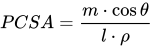
where

  • stands for muscle mass
  • stands for the fiber angle
  • stands for fiber length
  • stands for muscle density

PCSA relates the force produced by the muscle to the summation of the forces produced along the force generating axis of each muscle fiber and is largely determined by the pennation angle.[3][8]

Fiber length is also a key variable in muscle anatomy. Fiber length is the product of both the number of sarcomeres in series in the fiber and their individual lengths. As a fiber changes length, the individual sarcomeres shorten or lengthen, but the total number does not change (except on long timescales following exercise and conditioning). To standardize fiber length, length is measured at the peak of the length-tension relationship (L0), ensuring all sarcomeres are at the same length. Fiber length (at L0) does not affect force generation, much as the strength of a chain is unaffected by the length. Similarly, increased fiber cross-section or multiple fibers increase the force, like having multiple chains in parallel. Velocity is affected in the reverse manner – because sarcomeres shorten at a certain percentage per second under a certain force, fibers with more sarcomeres will have higher absolute (but not relative) velocities.[11] Muscles with short fibers will have higher PCSA per unit muscle mass, thus greater force production, while muscle with long fibers will have lower PCSA per unit muscle mass, thus lower force production. However, muscles with longer fibers will shorten at greater absolute speeds than a similar muscle with shorter fibers.[2]

The type of muscle fiber correlates to force production. Type I fibers are slow oxidative with a slow rise in force and an overall low force production. The type I fibers have a smaller fiber diameter and exhibit a slow contraction. Type IIa fibers are fast oxidative which exhibit fast contraction and a fast rise in force. These fibers have fast contraction times and maintain some, though not a great amount of their force production with repeated activity due to being moderately fatigue resistant. Type IIb fibers are fast glycolytic which also exhibit fast contraction and fast rise in force. These fibers display extremely large force production, but are easily fatigued and therefore unable to maintain force for more than a few contractions without rest.

Pennation angle

[edit]

The pennation angle is the angle between the longitudinal axis of the entire muscle and its fibers. The longitudinal axis is the force generating axis of the muscle and pennate fibers lie at an oblique angle. As tension increases in the muscle fibers, the pennation angle also increases. A greater pennation angle results in a smaller force being transmitted to the tendon.[9]

Muscle architecture affects the force-velocity relationship. Components of this relationship are fiber length, number of sarcomeres and pennation angle. In pennate muscles, for example, as the fibers shorten, the pennation angle increases as the fibers pivot which affects the amount of force generated.[2]

Architectural gear ratio

[edit]

Architectural gear ratio (AGR) relates the contractile velocity of an entire muscle to the contractile velocity of a single muscle fiber. AGR is determined by the mechanical demands of a muscle during movement. Changes in pennation angle allow for variable gearing in pennate muscles.[12] Variable pennation angle also influences whole-muscle geometry during contraction. The degree of fiber rotation determines the cross-sectional area during the course of the movement which can result in increases of the thickness or width of the muscle.[12] Pennation angle can be modified through exercise interventions.[13]

High gear ratio Low gear ratio
Contraction velocity ratio (muscle/fiber) Whole muscle ≫ muscle fiber Approximately 1:1 ratio
Force developed by whole muscle Low-force contractions High-force contractions
Velocity developed by whole muscle High-velocity contractions Low-velocity contractions
Pennation angle (fiber rotation) Increase in pennation angle Minute or no decrease in pennation angle
Cross-sectional variance Increase thickness (increase distance between aponeuroses) Decrease thickness (decrease distance between aponeuroses)

A high gear ratio occurs when the contraction velocity of the whole muscle is much greater than that of an individual muscle fiber, resulting in a gear ratio that is greater than 1. A high gear ratio will result in low force, high velocity contractions of the entire muscle. The angle of pennation will increase during contraction accompanied by an increase in thickness. Thickness is defined as the area between the aponeuroses of the muscle. A low gear ratio occurs when the contraction velocity of the whole muscle and individual fibers is approximately the same, resulting in a gear ratio of 1. Conditions resulting in a low gear ratio include high force and low velocity contraction of the whole muscle. The pennation angle typically shows little variation. The muscle thickness will decrease.

References

[edit]
Revisions and contributorsEdit on WikipediaRead on Wikipedia
from Grokipedia
Muscle architecture refers to the arrangement and orientation of muscle fibers within a , which determines its capacity for force production and . This structural property encompasses the number of fibers, their lengths, and their angles relative to the muscle's , profoundly influencing overall muscle function. In , architecture optimizes performance for specific tasks, such as generating high forces in postural muscles or enabling rapid movements in locomotor ones. Key parameters of muscle architecture include (PCSA), fiber length, and pennation angle. PCSA, calculated as (muscle volume × cos(θ)) / fiber length (where θ is the pennation angle), directly correlates with maximum isometric force, typically around 22–25 N/cm² in mammals. Longer fiber lengths enhance shortening velocity and excursion range, while shorter fibers in pennate arrangements prioritize force over speed. Pennation angle, the oblique orientation of fibers to the , affects force transmission. Skeletal muscles exhibit diverse architectural types, including parallel-fibered, pennate, and hydrostatic configurations, each tailored to functional demands. Muscle architecture is not static; it adapts to chronic loading through changes in fiber length, pennation, and PCSA, influencing clinical outcomes in rehabilitation and . For instance, immobilization can shorten fibers and increase pennation, reducing force capacity, while resistance may elongate fibers or PCSA to improve performance. Understanding these principles is essential for , , and therapeutic interventions targeting function.

Fundamentals

Definition and Overview

Muscle architecture refers to the physical arrangement of muscle fibers, organized into fascicles, relative to the muscle's and associated tendons, which fundamentally determines the muscle's capacity to generate , , and power output. This macroscopic organization encompasses the orientation, length, and packing of fibers within the muscle belly, enabling efficient transmission of contractile forces to skeletal elements for movement. Unlike microscopic structures such as sarcomeres, which govern the molecular basis of contraction, muscle architecture focuses on the gross geometric properties that scale up these cellular events to whole-muscle performance. Early foundations for understanding muscle architecture trace back to 17th-century anatomical dissections, exemplified by Vesalius's detailed illustrations of human musculature in De humani corporis fabrica, which first accurately depicted fiber arrangements and their attachments. However, a comprehensive biomechanical perspective emerged in the through quantitative analyses, propelled by innovations in imaging techniques like ultrasonography and that allowed non-invasive measurement of fiber orientations and lengths. These advancements, building on seminal work by researchers such as Richard Lieber, shifted focus from static anatomy to dynamic functional implications. Muscle architecture exhibits evolutionary adaptations across , tailored to specific locomotor demands, such as enhanced stability or rapid manipulation; for instance, pennate configurations predominate in fast-moving vertebrates to maximize force production, while hydrostatic arrangements characterize many for versatile shape changes. This diversity underscores architecture's role in optimizing mechanical output for diverse ecological niches, with examples spanning parallel-fibered, pennate, and hydrostatic types.

Key Architectural Parameters

Muscle architecture is characterized by several key geometric parameters that quantify its structure and enable predictions of biomechanical performance. These parameters include fiber length, muscle length, pennation angle, , and the fiber length-to-muscle length ratio. They are essential for modeling muscle function, as they describe how muscle fibers are arranged relative to the overall muscle unit and its . Fiber length (LfL_f), defined as the average length of individual muscle fibers or fascicles, primarily determines the muscle's maximum shortening excursion and , as longer fibers allow for greater relative displacement before reaching the limits of the sarcomere length-tension relationship. In parallel-fibered muscles, fibers typically span much of the muscle length, while in pennate configurations, they are shorter due to oblique orientation. Muscle length (LmL_m) refers to the overall length of the muscle-tendon unit measured along its primary , encompassing the muscle belly and associated tendons. This parameter provides the reference scale for relative arrangements and is crucial for understanding how muscle architecture integrates with skeletal leverage. The pennation angle (θ\theta) is the angle formed between the orientation of the muscle fibers and the muscle's principal force-generating axis, which is zero degrees in purely parallel-fibered muscles and increases in pennate arrangements to allow more fibers in parallel. Greater pennation angles enhance force capacity by increasing PCSA through shorter fibers but reduce shortening efficiency due to the oblique pull, with the transmitted force along the axis adjusted by cos(θ)\cos(\theta). Physiological cross-sectional area (PCSA) represents the effective cross-sectional area perpendicular to the muscle fibers, serving as a proxy for the number of sarcomeres in parallel and thus the muscle's maximum force-generating potential. It is calculated using the formula: PCSA=VLf\text{PCSA} = \frac{V}{L_f} where VV is the muscle , typically obtained from or . In pennate muscles, while pennation increases PCSA by allowing shorter fibers for a given , the force transmitted along the muscle's is PCSA×\text{PCSA} \times specific tension ×cos(θ)\times \cos(\theta). Higher PCSA values correlate with greater force production capacity across muscle types. These parameters are commonly measured using imaging, which allows dynamic assessment of LfL_f and θ\theta through 2D or 3D ultrasonography by visualizing fascicle traces during contraction or rest. dissection provides static measurements of volumes and lengths for PCSA estimation, often validated against imaging techniques for accuracy. Advanced methods like MRI complement these by yielding precise volume data (VV). The fiber length-to-muscle length ratio (Lf/LmL_f / L_m) quantifies the relative scaling of fibers within the muscle unit, indicating potential for versus force trade-offs, with values typically ranging from 0.3 to 0.6 in mammalian skeletal muscles. Lower ratios suggest greater involvement and gearing for speed, while higher ratios approach parallel designs for enhanced shortening.

Types of Muscle Architecture

Parallel-Fibered Muscles

Parallel-fibered muscles feature sarcomeres and myofibrils organized such that muscle fibers run parallel to the muscle's and the associated , resulting in a pennation θ ≈ 0° and a (PCSA) approximately equal to the anatomical cross-sectional area. This arrangement allows the entire fiber length to contribute directly to without angular deviation, optimizing excursion along the muscle's axis. These muscles exhibit several subtypes based on gross morphology. Strap muscles are rectangular and uniform in cross-section, providing extensive length for broad movements, as seen in the human sartorius, which spans the to enable and knee flexion with wide range. Fusiform muscles adopt a spindle shape with a thickened central belly tapering to tendons at each end, balancing length and force application, exemplified by the human biceps brachii for elbow flexion. Convergent muscles display a triangular form, with fibers originating from a broad and converging to a single , permitting variable force vectors, such as in the human for scapular stabilization and depression. The primary advantages of parallel-fibered architecture lie in its capacity for maximal fiber excursion—up to the full fiber length L_f—and elevated shortening velocity, rendering these muscles ideal for rapid movements, postural adjustments, or precise control. For example, the human rectus abdominis, a strap-like parallel-fibered muscle, supports trunk flexion through substantial range during activities like curling the torso. In arthropods, parallel-fibered leg extensors, such as the tibial extensor in locusts, facilitate explosive jumps by maximizing velocity and power output. However, this configuration yields a lower PCSA per unit volume relative to pennate arrangements, limiting maximum isometric force production. In contrast to pennate muscles, parallel-fibered types prioritize excursion and speed over force density.

Pennate Muscles

Pennate muscles are characterized by muscle fibers that insert obliquely at an (θ > 0°) onto a central or , allowing for a greater number of fibers to be packed within a given muscle volume compared to parallel-fibered arrangements. This oblique orientation, resembling the barbules of a —hence the term "pennate" derived from the Latin penna for —enables enhanced force production by increasing the (PCSA) while typically resulting in shorter fiber lengths. Such architecture is prevalent in limb muscles, where power output is prioritized over range. Pennate muscles are classified into subtypes based on the arrangement of fibers relative to the . Unipennate muscles feature fibers attaching on one side of the , as seen in the human , which facilitates finger extension. Bipennate muscles have fibers converging from both sides onto a central , exemplified by the rectus femoris in the human group, which contributes to knee extension. Multipennate muscles involve multiple layers or sets of obliquely arranged fibers, such as in the , supporting abduction through its broad, fan-like structure. Structurally, pennate muscles exhibit shorter fiber lengths (Lf) but substantially higher PCSA due to the angled packing of sarcomeres in parallel, which amplifies force-generating capacity. This configuration is common in limb muscles of vertebrates, optimizing for powerful contractions in locomotion. In humans, the gastrocnemius muscle's medial head is bipennate with a pennation of approximately 20–30°, aiding plantarflexion during activities like walking and . Similarly, in , myomeres of the axial musculature often display multipennate arrangements, where obliquely oriented fibers enhance propulsion efficiency during by concentrating force along the body axis. Adaptations in pennate architecture occur with physiological demands, such as resistance training or , where pennation angles increase to accommodate more sarcomeres in parallel within the expanded muscle volume. For instance, in vastus lateralis, over 14 weeks can elevate the pennation angle by about 35%, reflecting architectural remodeling that supports greater force output without proportional increases in overall muscle length.

Hydrostatic Muscles

Hydrostatic muscles, also known as muscular hydrostats, are self-supporting muscular structures that lack rigid skeletal elements and maintain a constant volume to enable shape changes through antagonistic muscle interactions. These organs operate on hydrostatic principles, where incompressible muscle tissue or acts as the internal medium, allowing deformations such as elongation or without external support. Key architectural features include orthogonally arranged muscle layers: longitudinal fibers that shorten the structure, circumferential (or transverse) fibers that elongate it by reducing diameter, and radial fibers that expand the cross-section. Unlike skeletal muscles with tendons, these lack attachment points, and fibers may form helical patterns in some species to facilitate torsion. The constant volume (V = constant) ensures that contraction in one compensates by expansion in others, driving all movements. Two main types exist: pure muscular hydrostats, composed entirely of densely packed muscle and without a fluid cavity, and hydrostatic skeletons, which feature a -filled compartment (e.g., ) enclosed by muscular walls. Muscular hydrostats include the human , with intrinsic muscles allowing variable deformation for manipulation during speech and swallowing, and extrinsic muscles anchoring it to the and hyoid. The trunk exemplifies this type, using layered muscles for grasping and reaching. In contrast, hydrostatic skeletons appear in the arm, where circumferential fibers enable precise bending by contracting against longitudinal antagonists, and in worms like earthworms, whose segmented body walls surround coelomic to facilitate burrowing through alternating elongation and shortening. This architecture uniquely permits elongation, shortening, , and torsion without bones, as volume conservation amplifies or displacement in soft tissues. For instance, occurs via simultaneous contraction of longitudinal muscles on one side and circumferential muscles on the other, with the uncontracted layer providing support. Such versatility supports diverse functions, from prey capture in cephalopods to locomotion in , contrasting with the more rigid arrangements in skeletal muscles.

Functional Implications

Force-Generating Capacity

The force-generating capacity of a muscle is primarily determined by its (PCSA), which represents the total cross-sectional area of all muscle fibers oriented perpendicular to the direction of force production, multiplied by the specific tension (σ) of the muscle fibers. The maximum isometric force (F_max) can be estimated as F_max = PCSA × σ, where σ typically ranges from 20 to 40 N/cm² in mammalian , reflecting the intrinsic force per unit area generated by actin-myosin interactions within the fibers. In parallel-fibered muscles, PCSA is approximately equal to muscle volume divided by muscle length (PCSA ≈ V / L_m), as fibers run the full length of the muscle, limiting the number of parallel force-generating units to the muscle's girth. In pennate muscles, PCSA is amplified by a factor of 1/cos(θ), where θ is the pennation angle, allowing for a greater number of shorter fibers packed into the same volume despite reduced fiber length (L_f), which thereby increases overall force capacity at the expense of shortening range. The pennation angle also influences force transmission to the tendon: the total tendon force is the sum of individual fiber forces resolved along the tendon axis, given by F_tendon = Σ (F_fiber × cos(θ)), such that higher θ enhances PCSA and fiber packing but reduces force efficiency since cos(θ) < 1, leading to a trade-off where only the axial component of fiber force contributes to whole-muscle output. In hydrostatic muscles, force generation differs fundamentally, relying on (P) produced within a fluid-filled compartment rather than PCSA, where P ≈ stress / area enables distributed application across the structure without centralized tendons, as muscular contraction converts longitudinal stress into radial for shape change or . Architectural parameters adapt over time; for instance, aging is associated with reduced PCSA due to and decreased pennation angles, while resistance training in hypertrophied muscles often increases θ to enhance output. These adaptations highlight a with fiber length, which inversely affects excursion potential but is optimized here for isometric maximization.

Excursion and Shortening Velocity

Muscle , or the range over which a muscle can or lengthen, is primarily determined by the length of its constituent (L_f). In parallel-fibered () muscles, the maximum shortening approximates the fiber length, allowing for substantial displacement suitable for movements requiring large . In pennate muscles, however, is reduced due to shorter fiber lengths and the of fibers toward a steeper pennation angle (θ) during contraction, which limits the effective shortening path. Hydrostatic muscles, such as the or elephant trunk, achieve variable through shape changes in a constant-volume structure via differential activation of muscle layers. Shortening velocity, particularly the maximum unloaded velocity (V_max), scales with fiber length, as longer fibers contain more in series and thus permit faster absolute shortening rates according to the force-velocity relationship described by Hill's equation. Parallel-fibered muscles typically exhibit higher velocities in fast-twitch mammalian , making them ideal for rapid movements. This velocity advantage arises because the intrinsic shortening speed per sarcomere is fiber-type dependent, but absolute muscle speed increases linearly with L_f. A key trade-off in muscle architecture involves balancing velocity and force: pennate muscles prioritize force generation through larger (PCSA) at the expense of shorter L_f, resulting in lower shortening velocities compared to parallel-fibered designs. Hydrostatic muscles mitigate this by employing antagonistic layers of longitudinal, transverse, and helical fibers, which enable controlled, multi-directional motion without rigid attachments. During dynamic contractions, pennate architecture introduces variability as fibers rotate, increasing the pennation angle (θ) and effectively altering the operating length of the fibers, which can modulate excursion and beyond static predictions. For instance, the biceps brachii, a muscle with long fibers, supports high- elbow flexion, optimizing rapid supination and flexion for tasks like throwing. In clinical contexts, muscle atrophy following injury, such as immobilization after , reduces length and overall , thereby limiting joint and complicating rehabilitation.

Architectural Gear Ratio

The architectural gear ratio (AGR) is defined as the ratio of the velocity of the muscle-tendon unit (V_mtu) to the velocity of fiber shortening (V_f), equivalent to the longitudinal strain of the muscle divided by the strain. In parallel-fibered muscles, AGR is typically 1, as shortening directly translates to muscle-tendon unit displacement. In pennate muscles, however, AGR exceeds 1 due to dynamic rotation during contraction, which amplifies muscle-tendon unit velocity relative to velocity. The mechanism underlying AGR in pennate muscles involves fiber rotation and muscle shape changes during activation. As the muscle shortens, fibers rotate such that the pennation angle (θ) increases from its resting value (θ_rest) to an active value (θ_active), allowing greater muscle-tendon unit shortening for a given length change; muscle bulging also contributes by altering effective orientation. This dynamic process can be approximated by the formula: AGRcosθrestcosθactive\text{AGR} \approx \frac{\cos \theta_{\text{rest}}}{\cos \theta_{\text{active}}} AGR is load-dependent, with higher values at low loads (e.g., up to 1.4) due to greater shape changes and lower values approaching 1 at high loads, where connective tissues like the resist bulging and limit rotation. Unlike static architectural parameters such as resting pennation angle, AGR represents an adaptive, contraction-specific feature that enables variable gearing tailored to force demands. This gearing enhances muscle power output by aligning fiber shortening velocity (near its maximum, V_max) with task-specific needs, such as rapid movements requiring high velocity at moderate forces. For example, in the human vastus lateralis during walking, AGR ranges from approximately 1.2 to 2, facilitating efficient energy transfer and matching locomotor demands without exceeding fiber velocity limits. In fast-twitch muscles, evolutionary adaptations like increased pennation promote higher AGR, optimizing performance for explosive activities. AGR is measured using to track fascicle length and angle changes during isovelocity or constant-force contractions, often with probes capturing muscle belly displacement simultaneously.

References

Add your contribution
Related Hubs
User Avatar
No comments yet.