Hubbry Logo
StrumStrumMain
Open search
Strum
Community hub
Strum
logo
8 pages, 0 posts
0 subscribers
Be the first to start a discussion here.
Strum
Strum
from Wikipedia
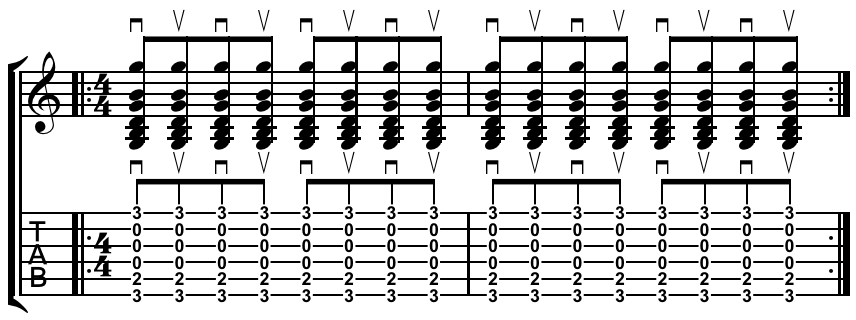
Guitar strum Play: base pattern on open G tuning. Strumming is used to create a chord. Many patterns are created through subtracting beats from this base.
Guitar strum Play: pattern created by subtracting the second and fifth (of eight) eighth notes from the base, above.
Ska stroke[1] Play: features dampened staccato upbeat downstrokes.

In music, strumming is a way of playing a stringed instrument such as a guitar, ukulele, or mandolin. A strum or stroke is a sweeping action where a finger or plectrum brushes over several strings to generate sound.[2] On most stringed instruments, strums are typically executed by a musician's designated strum hand (typically the musician's dominant hand,[3] which is often responsible for generating the majority of sound on a stringed instrument), while the remaining hand (referred to as the fret hand[4] on most instruments with a fingerboard) often supports the strum hand by altering the tones and pitches of any given strum.[5]

Strums are often contrasted with plucking, as a means of vibrating an instrument's strings. In plucking, a specific string or designated set of strings are individually targeted to vibrate, whereas in strumming, a less precise targeting is usually used. Compared to other plucking techniques, any group of strings brushed in a single sweep by a plectrum could be considered a strum due to the plectrum's less precise string group targeting (however, a plectrum might simultaneously pluck a small group of strings without being considered a strum). In contrast, a musician could utilize a technique with more precise string group targeting (such as a fingerstyle or fingerpick technique) to pluck all the strings on a stringed instrument at once and this would still be considered a pluck, not a strum.

Notation

[edit]
There are a variety of methods for writing strum notation.
Arrow notation
Letter notation
Traditional notation

Strumming patterns

[edit]

A strumming pattern or strum is a preset pattern used by a rhythm guitar.[6] For example, a pattern in common time or 4
4
consisting of alternating down and up eighth note strokes may be written:

1&2&3&4&
dudududu

Rock and pop

[edit]

The pattern most typical of rock and related styles is:

1&2&3&4&
d du udu

The final upstroke is sometimes omitted altering the strumming pattern slightly to d du ud. This pattern is often called "Old Faithful",[7] or when played on ukulele, the "Island Strum".

Examples of other strumming patterns include:[8]

Jazz and funk

[edit]

The simple four-to-a-bar rhythm is associated with jazz guitarists such as Freddie Green, although they may subtly vary the rhythm of a chord on some beats to add interest.

A simple eight-to-a-bar (8 eighth notes) rhythm is known as "straight eights" as opposed "swung eights", in which each pair are played in a rhythm that resembles the first and third notes in a triplet.

The fretting hand can also mute the strings on the fretboard to damp a chord, creating staccato and percussive effects. In reggae and ska, a few staccato "chops" are played per bar. In funk rhythm playing, the strumming hand keeps a fairly steady motion in 16th notes, while the left hand, basically holding down a jazz chord damps some of them in a syncopated pattern.

Fingerstyle strumming strokes

[edit]

Some of the many possible fingerstyle strums include

  • A slow downstroke with the thumb. This is a sforzando or emphatic way of playing a chord.
  • Light "brushing" strokes with the fingers moving together at a near-perpendicular angle to the strings. Works equally in either direction and can be alternated for a chord tremolo chord effect.
  • Upstrokes with one finger make a change from the standard downstroke strum.
  • A "pinch" with the thumb and fingers moving towards each other gives a crisp effect. It is helpful to clearly articulate the topmost and bass note in the chord, as if plucking, before "following through".
  • Rasgueado: Strumming is typically done by bunching all the right-hand fingers and then flicking them out in quick succession to get four superimposed strums. The rasgueado or "rolling" strum is particularly characteristic of flamenco.
  • Turning p-a-m-i tremolo plucking into a series of downstrokes. This is a lighter version of the classic rasgueado, which uses upstrokes.

See also

[edit]

References

[edit]
Revisions and contributorsEdit on WikipediaRead on Wikipedia
from Grokipedia
Strumming is a fundamental technique in playing stringed instruments, particularly the guitar, , and , involving the sweeping or brushing of the fingers, thumb, or a across multiple strings simultaneously to sound chords or rhythmic patterns. This method contrasts with plucking individual strings and is essential for providing rhythmic in ensemble or solo performances. The term "strum" emerged in English around as a meaning to play a stringed instrument carelessly or idly, likely derived onomatopoeically from the sound of fingers brushing the strings. By , it was also used as a to denote the act of strumming or the resulting sound. Although the word itself is relatively modern, the underlying technique has ancient roots, with evidence of similar sweeping motions on instruments like the in , where a was used to strum strings for . In , strumming is central to genres such as , , and pop, where patterns—combining downstrokes on beats and upstrokes on off-beats—create groove and drive songs forward. Effective strumming requires consistent wrist motion, synchronization with tempo, and adaptation to chord progressions, making it a key skill for guitarists. Variations include the Spanish rasgueado, a flamenco-style flourish involving rapid fanned strums, which influenced techniques.

Fundamentals

Definition and Etymology

Strumming is a involving a sweeping motion of the hand, fingers, or a across multiple strings of a chordophone, such as a guitar or , to produce a sustained, collective sound from the chord. This method contrasts with plucking, which targets individual strings to create discrete notes or arpeggios. Foundational elements include basic downstrokes, moving from the bass strings toward the treble, and upstrokes in the reverse direction. The term "strum" entered English around , probably of imitative origin and related to "thrum," which dates to the and refers to playing a stringed instrument monotonously. Its earliest recorded uses appear in contexts describing casual or rhythmic playing on stringed instruments, reflecting an onomatopoeic quality mimicking the resonant brush of strings. Historically, strumming as a technique emerged during the period in the , particularly with early forms of the guitar, which were used to provide simple strummed accompaniments for singers or small ensembles, evolving from the more plucked styles of the . By the era and into the , it developed into a core method for the modern guitar, adapting to diverse musical forms. In music, strumming serves to establish , add textural depth, and deliver support, functioning effectively in both solo performances and settings to underpin melodies or drive the overall groove.

Basic Components

A strum fundamentally involves coordinated hand positioning to generate motion across the strings of a stringed instrument. The strumming hand typically employs a loose, limber placement atop the guitar body, with the and aligned and the hand parallel to the instrument's top for optimal control. This setup allows primary involvement from the for fluid , supplemented by or upper motion for broader sweeps, while finger involvement occurs in pickless techniques where the or fingertips brush the strings. String contact is achieved through a sweeping action, often perpendicular to the strings for even excitation or angled to emphasize certain strings, ensuring the pick or digit glides lightly without excessive digging. Tempo integration ties the to the musical , where steady down-up patterns maintain a consistent aligned with the beat, while introduces off-beat accents to create groove and tension. Physically, strumming excites by displacing multiple simultaneously, propagating transverse waves that reflect at the fixed ends to form standing waves with nodes at the bridge and nut. The initial sweep imparts , determining the , which decays rapidly—often within a second—as high-frequency components dissipate through and air resistance, shifting to lower modes for a mellowing sustain. Collective string motion, coupled via the bridge, generates overtones at integer multiples of the (f_n = n * v / (2L), where v is wave speed, L is string length, and n is the ), enriching the with complex partials from interacting resonances. Instrument variations influence strum execution and sound; the standard guitar's six strings enable fuller spreads, the ukulele's four strings yield a compact, brighter chord voicings due to shorter scale length, and the banjo's five strings (often with a drum-like head) produce a sharper, percussive attack. gauge and tension critically affect clarity: heavier gauges increase tension for sustained, richer tones with reduced buzzing but demand more strumming force, while lighter gauges on ukuleles or banjos facilitate easier sweeps at the cost of quicker decay and potential muddiness in dense strums. Common errors include muting unintended strings, often from inadequate fretting-hand allowing sympathetic vibrations, and uneven pressure causing buzzing when strings contact frets incompletely during sweeps. A deathgrip on the pick exacerbates uneven force, leading to harsh or inconsistent contact, while over-digging into strings mutes lower ones unintentionally.

Techniques

Downstroke and Upstroke

In strumming, the downstroke involves sweeping the picking hand from the lower-pitched bass strings toward the higher-pitched treble strings, typically executed with a downward to generate a fuller, more accented tone that emphasizes the primary beats in a . This motion is particularly suited for accentuating beats 1 and 3 in common 4/4 time signatures, providing rhythmic weight and drive to the foundational of a piece. The upstroke, conversely, reverses this direction by moving from the treble strings back toward the bass strings, resulting in a lighter and quicker sound that contrasts the downstroke's intensity. Upstrokes are commonly placed on off-beats, such as the "and" counts between main beats, to create forward momentum and a sense of in the overall . Effective coordination between downstrokes and upstrokes relies on alternating patterns, such as D-DU-UDU (where D denotes downstroke and U upstroke), to maintain an even, flowing without interruption. For beginners, practicing these at tempos ranging from 60 to 120 beats per minute helps build consistency and speed gradually. From a biomechanical perspective, strumming incorporates rotation alongside action to distribute effort efficiently and minimize strain, while keeping fingers relaxed to avoid tension buildup in the hand and arm. exercises, starting with simple downstrokes on each beat and progressing to full alternations, are essential for developing this relaxed coordination and preventing overuse injuries.

Pick-Based Methods

Pick-based methods involve using a , or , to execute strums, providing a focused point of contact with the strings that enhances precision and tonal consistency compared to bare-hand approaches. These methods build on fundamental downstroke and upstroke motions but incorporate the pick as the primary implement for striking multiple strings simultaneously. The pick allows for greater volume projection and uniform attack across the chord, making it particularly effective for rhythmic in ensemble settings. Selection of the appropriate is crucial for optimizing strumming performance. Thickness typically ranges from 0.5 to 1.0 mm for versatility, with medium gauges (around 0.73 mm) offering a balance of flexibility for fluid strums and rigidity to prevent slippage during aggressive playing. Materials influence tone significantly; picks produce a warmer, mellower suitable for acoustic strumming due to their slight flex and , while picks deliver brighter, more articulate tones with enhanced treble response, ideal for cutting through mixes. The standard grip positions the pick between the thumb and index finger, forming a secure pinch that allows the pointed tip to protrude about half its length for controlled contact, minimizing fatigue during extended sessions. Key techniques emphasize efficient hand mechanics to achieve control and expressiveness. An anchored technique, where the heel of the hand or pinky lightly rests near the bridge for stability, provides precise control over dynamics and , particularly useful for intricate patterns requiring consistent volume. In contrast, a free-stroke approach involves a looser, floating motion originating from the , promoting fluidity and speed for sweeping, expansive strums without restricting arm swing. integrates strumming with finger-plucked notes, using the pick for bass lines or chords while the middle and ring fingers sound higher strings, enabling melodic embellishments within rhythmic frameworks. These methods offer distinct advantages, including a consistent, even attack across all that ensures balanced chord voicing, which is especially beneficial on electric guitars where amplified sustain benefits from the pick's sharp . They also facilitate louder projection without excessive hand strain, supporting high-energy performances. However, potential drawbacks include accelerated wear from the pick's harder edge scraping the windings, particularly on coated or plain during vigorous strumming, necessitating more frequent replacements. Historically, pick-based strumming gained prominence in the , evolving from early adaptations on archtop guitars to become a cornerstone of rock sections. This technique's adoption aligned with the rise of electric instruments, where the pick's ability to drive pickups effectively amplified strumming's rhythmic punch in band contexts.

Finger-Based Methods

Finger-based strumming techniques involve using , fingers, or full hand to sweep across the strings, producing an organic, intimate tone particularly suited to acoustic instruments. These methods emphasize direct contact with the strings, allowing for subtle variations in and that contribute to a warmer, more nuanced sound compared to mechanical alternatives. Proper hand positioning, with the relaxed and the hand hovering lightly over the strings near the soundhole, facilitates fluid motion in these approaches. Thumb strumming typically employs the fleshy pad of the to execute bass-heavy downward sweeps, creating a mellow, resonant tone ideal for . This technique often alternates with the index or middle finger to emphasize higher strings, providing treble clarity while maintaining rhythmic drive; for instance, in folk styles, the handles bass notes on the lower strings while fingers brush the upper ones for a balanced chordal texture. Full-hand methods, such as the , involve raking multiple fingers across the strings in a fan-like motion to achieve a percussive, rhythmic effect. In , the index, middle, ring, and sometimes pinky fingers are extended and snapped sequentially against the strings, starting from the lower ones and moving upward, which builds intensity and volume in rapid strumming patterns. This multi-finger fan stroke is a hallmark of , delivering explosive dynamics through controlled finger extension and release. These techniques offer advantages like nuanced dynamics, where varying finger pressure allows for soft to forceful strums without additional tools, and the elimination of accessories for greater portability and simplicity. However, they can lead to hand fatigue during , as sustained sweeping motions strain the and finger muscles more than rigid implements. Adaptations for often balance nail and flesh contact, where the nail provides a brighter attack on downstrokes while flesh softens upstrokes for expressive phrasing, enhancing the instrument's warm tonal palette. On , finger strumming requires a softer touch due to the smaller scale and lighter strings, with the thumb or delivering a mellow, percussive that suits the instrument's bright voice without overpowering it.

Variations for Other Instruments

Strumming techniques adapt to the unique characteristics of other stringed instruments mentioned in the article's introduction. On the , finger-based strumming is common in old-time and folk styles, often using the thumb and fingers in a "" or frailing pattern that combines downward brushes with plucks for a buoyant, rhythmic drive, though picking styles predominate in bluegrass. For the , pick-based strumming prevails, particularly in bluegrass and folk genres, employing short, choppy downstrokes (known as "chop chords") with a flat pick to produce a sharp, percussive accent on beats, often alternating with upstrokes for fuller patterns; the instrument's paired strings require precise angle control to avoid muddiness.

Patterns and Applications

General Strumming Patterns

General strumming patterns form the rhythmic foundation for guitar , emphasizing consistent and stroke sequences to support chord progressions. The simplest pattern is the quarter-note downstroke, where the pick or thumb moves downward on each beat in a 4/4 , creating a steady suitable for beginners building basic skills. This approach focuses on even dynamics across all four beats, allowing players to prioritize chord accuracy before introducing complexity. As proficiency increases, eighth-note patterns introduce upstrokes for fuller , such as the common D-DU-UDU sequence, where downstrokes (D) align with beats 1, 2, 3, and 4, and upstrokes (U) fill the "and" subdivisions between them. This pattern, executed with a or fingers, enhances groove by alternating directions, promoting smoother hand motion and tonal variation—downstrokes often hit lower strings for emphasis, while upstrokes target higher ones. For added complexity, sixteenth-note variations subdivide each beat into four parts, incorporating rapid D-U-D-U repetitions or selective skips to build speed and precision without overwhelming the core . Syncopation adds interest through off-beat accents, particularly on upstrokes, as in the pattern DU-x-UDU, where "x" denotes a brief mute or after the initial down-up, creating a bouncy, emphasized feel on the upstrokes. This technique displaces accents from downbeats, fostering a more dynamic flow. Chord integration benefits from muting strategies, such as lightly strings between changes to ensure clean transitions, or palm muting—resting the strumming hand's edge near the bridge—for percussive stops that punctuate phrases crisply. Effective practice involves starting slow with a set to quarter-note beats, gradually increasing to develop speed and evenness in 4/4 time. Adapting patterns to other signatures, like 3/4 (e.g., D-DU-D per measure), requires counting the triple pulse while maintaining stroke consistency to avoid rushing. These methods, applicable via pick or finger techniques, ensure foundational rhythms translate across various musical contexts.

Genre-Specific Variations

In rock and pop genres, strumming patterns typically revolve around steady eighth-note rhythms with a strong emphasis on downstrokes, creating a driving pulse that underpins the energetic drive of the music. The iconic "boom-chicka" pattern, featuring a percussive bass note on the downbeat followed by quick up-and-down strums on the off-beats, emerged prominently in 1950s rock 'n' roll, influencing artists like and early performers. This approach, often executed with a for consistent attack, prioritizes rhythmic momentum over complex chord voicings, allowing the guitar to with drums and bass for a full-band groove. Jazz and funk strumming diverges by incorporating syncopated upstrokes and —lightly muted strums that add percussive texture without full volume—to foster an infectious groove. In jazz comping, these elements shift accents to off-beats, enhancing swing and interaction with , as seen in Freddie Green-style quarter-note comping with subtle . extends this with syncopated straight sixteenth-note feels using and muting for tension and pocket, exemplified in grooves by artists like . Upstrokes here emphasize the '&' of beats, creating forward-leaning that defines the genre's bouncy, danceable quality. Folk and country traditions adapt strumming through alternating bass patterns, where the thumb plucks a bass note on beats 1 and 3 while fingers strum the treble strings on , producing a rolling, flow suited to acoustic . This technique, rooted in 19th-century Appalachian folk playing and traditions, evolved as a fingerstyle hybrid that mimics rolls and provides harmonic foundation without overpowering vocals. Popularized in bluegrass and early , it uses all-downstroke motions for a bright, percussive tone, as heard in works by the Carter Family and later , whose fingerstyle picking incorporated similar alternating bass elements. Similar adaptations appear in playing, where or Scruggs-style rolls incorporate strum-like sweeps for rhythmic drive in folk and bluegrass contexts. Reggae's distinctive off-beat skank strum, a sharp upstroke chop on the '&' of beats 2 and 4, leaves the downbeats open for emphasis by other instruments, drawing from 1960s Jamaican and influences tied to Rasta culture. This syncopated, percussive approach, often doubled for intensity, evokes a laid-back yet urgent vibe central to Bob Marley-era roots . In contrast, metal strumming relies on palm-muted power chords—root-fifth dyads damped by the picking hand near the bridge—for a tight, aggressive chug that builds intensity through rapid downstrokes. This technique, integral to thrash and heavy metal since the 1980s, creates a machine-gun-like , as in riffs by Metallica, prioritizing sustain control and tonal bite over melodic variation.

Notation and Representation

Symbolic Notation

In standard music notation, continuous strumming is often represented using markings, which consist of wavy lines or multiple slashes through the note stem to indicate rapid repetition of a chord or note, simulating a sustained strum effect. For rhythmic chord strums, such as those in , rhythmic slashes are employed—diagonal lines placed on the staff in place of noteheads to denote the timing and subdivision of beats without specifying individual pitches, allowing performers to interpret the chord voicing freely. Direction of strums is indicated by arrows placed above chord symbols or staff lines in lead sheets: a downward arrow (↓) signifies a downstroke from higher to lower strings, while an upward arrow (↑) denotes an upstroke in the opposite direction, providing clarity for patterned strumming in ensemble settings. Dynamic nuances in strumming are notated through standard symbols, including accents marked by a greater-than sign (>) on specific strokes to emphasize beats, and fermatas (∽) over held chords to indicate prolonged strumming beyond the written duration for expressive sustain. The evolution of these symbolic notations traces back to 18th-century figured bass practices, where numeric figures below bass lines guided improvisational harmonies, laying the groundwork for rhythmic interpretation in continuo playing. This developed into modern standards, as seen in publications like , where chord symbols paired with rhythmic slashes standardize strumming cues for comping in and small group contexts, emphasizing flexible yet structured rhythm sections. For instance, an eighth-note strumming pattern might appear as evenly spaced slashes under a chord symbol to guide steady .

Tabular and Diagrammatic Systems

Guitar tablature provides a string-focused visual representation for strumming patterns, consisting of six horizontal lines that correspond to the guitar's strings from lowest (bottom line, low E) to highest (top line, high E), with numbers placed on these lines indicating the positions to press. Vertically stacked numbers denote chords to be strummed simultaneously, while and strumming directions are often notated below the tab lines using symbols such as downward arrows or the letter "D" for downstrokes and upward arrows or "U" for upstrokes, allowing players to follow the sequence of motions without standard rhythmic notation. This format emphasizes practical execution on the instrument, making it accessible for conveying strum patterns in contexts. Chord diagrams complement tablature by illustrating strum directions on a fretboard grid, where vertical lines represent strings and horizontal lines denote frets, with dots marking finger placements for chord shapes and arrows indicating down or up strums across the relevant strings. These diagrams became widespread in beginner guitar instruction books, offering a simplified visual aid for self-learners transitioning from basic chords to rhythmic strumming. Software tools have adapted these notations for digital use, with programs like allowing users to embed strum patterns directly into files (.gp format) through rhythmic symbols for downstrokes, upstrokes, and muted strums, complete with synchronized audio playback to demonstrate the patterns. Similarly, such as supports importing and editing files, enabling the playback and modification of embedded strum notations for practice. These adaptations integrate tabular visuals with interactive audio, facilitating precise replication of patterns. Despite their practicality, tabular and diagrammatic systems have limitations in conveying dynamics, such as volume variations or articulation nuances, which standard music notation handles more effectively through symbols like crescendos or accents, often requiring supplementary audio or text for full expression. However, their instrument-specific focus makes them particularly suitable for self-taught players seeking quick, intuitive guidance on strumming without prior knowledge. These systems can be used complementarily with symbolic notation for broader rhythmic context.

References

Add your contribution
Related Hubs
User Avatar
No comments yet.