Hubbry Logo
Urinal deodorizer blockUrinal deodorizer blockMain
Open search
Urinal deodorizer block
Community hub
Urinal deodorizer block
logo
8 pages, 0 posts
0 subscribers
Be the first to start a discussion here.
Urinal deodorizer block
from Wikipedia
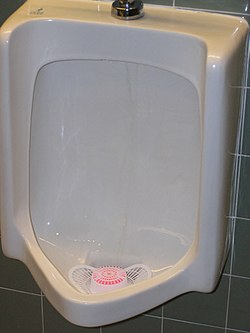
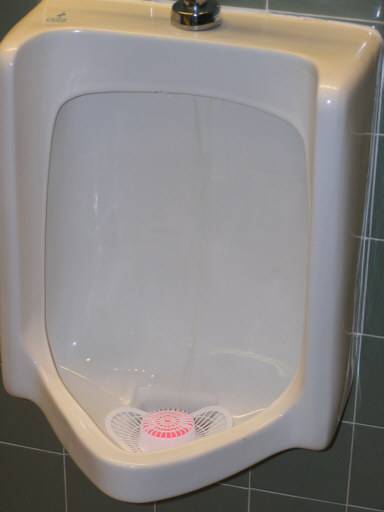
A pink deodorizer block + urinal screen in a urinal at Georgia Southern University
A Johnson Suisse waterless urinal with a block placed above the drain at City University of Hong Kong

Urinal deodorizer blocks (commonly known as urinal cakes, urinal cookies, urinal biscuits (or humorously piscuits), urinal donuts, urinal mints, toilet lollies, trough lollies, urinal pucks, toilet pucks, or urinal peons (alternately urinal pee-ons)) are small disinfectant blocks or tablets that are added to urinals. As these products originally contained para-dichlorobenzene (pDCB) they may also be called para blocks. Besides disinfecting, the purpose of these materials is to deodorize restroom urinals.[1] They are placed above the urinal drain, often in the confines of a small plastic device called a urinal screen that prevents loss down the drain when they dissolve down to a small size.

Chemistry

[edit]
Para block

The chemicals composing the block vary. The original formulations were based upon naphthalene and then later para-dichlorobenzene, both now known to be hazardous to health by inhalation. In some areas, the use of para-dichlorobenzene-based blocks has been banned; in other areas para-dichlorobenzene blocks or "para blocks" are still used.[clarification needed] Para-dichlorobenzene- and naphthalene-based blocks do not readily dissolve in water/urine, but easily sublime into the air, creating a sickly-sweet odor that has anti-microbial effects.[2]

Many urinal blocks are now para-dichlorobenzene and naphthalene free; these water-soluble alternative blocks are made from a mixture of fragrances and surfactants (normally quaternary ammonium compounds),[1] which offer some active cleaning and antibacterial efficacy. The new water-soluble blocks improve the cleaning of the pipes which helps to reduce odor. Some recent formulations also include bacterial spores which, coupled with the surfactant cleaning power, can more completely get rid of odors and blockages caused by the buildup of solids in the traps and pipes. Some manufacturers claim that these "biological blocks" can enable completely no-flush waterless urinals to be fitted.

Some urinal blocks also have enzymes added to help digest buildup within pipes.[citation needed]

Autoflush[1] and/or ice are sometimes used as alternatives.[3]

See also

[edit]

References

[edit]
Revisions and contributorsEdit on WikipediaRead on Wikipedia
from Grokipedia
A urinal deodorizer block, commonly known as a urinal cake, is a small, solid and deodorizing product placed at the bottom of a to control odors, reduce , and facilitate cleaning by gradually dissolving in contact with and flush water. Invented in the early , the concept traces back to at least , when Simon N. Kohn patented a germicidal cake composed of compressed materials intended for use in toilets and to neutralize waste odors and pathogens. Early designs evolved from simple blocks to more durable forms, with subsequent like George A. Sleight's 1922 urinal trap and deodorizing device incorporating mechanisms for sustained release of active agents. Traditionally, these blocks are primarily made of para-dichlorobenzene (pDCB), a chlorinated that sublimes at , releasing a strong fragrance while providing antimicrobial properties; concentrations often exceed 99% in commercial products, such as those from Big D Industries. Earlier formulations used , another sublimable chemical, but it has largely been phased out due to toxicity concerns. In operation, these blocks gradually dissolve, typically lasting 30 to 60 days depending on usage, releasing agents to mask odors or enzymatically break down odor-causing compounds such as derivatives (in modern variants) and to clean drains, thereby reducing clogs. Due to environmental and health risks associated with pDCB, such as potential carcinogenicity and volatility contributing to indoor , contemporary urinal deodorizer blocks frequently employ eco-friendly alternatives including water-soluble gelling agents (e.g., ), , enzymes for organic decomposition, and natural fragrances like essential oils, often bound with materials such as or for extended efficacy without harmful sublimation. These products remain a staple in commercial and public restrooms worldwide, with ongoing innovations toward greater sustainability.

History

Invention and early patents

The origins of the urinal deodorizer block trace back to anecdotal legends from the 1890s, including a popular but apocryphal tale involving John Hancock, who reportedly discovered the odor-absorbing properties of soap cakes after accidentally dropping them into urine pots. This story, though unsubstantiated, reflects early interest in simple materials for managing restroom odors during a time when indoor sanitation was evolving. Key innovations emerged through U.S. patents in the late . In 1880, J. Mallett Jr. received patent US225842A for a disinfecting device designed specifically for , featuring a case to hold deodorizing agents and prevent direct contact with waste while allowing slow dissolution. This was followed by Charles Catlin's proposal for a spherical hanging deodorizer, intended for suspension in and to release deodorizing substances gradually. A significant advancement came in 1905 with Simon N. Kohn's patent US805560A for a germicidal block, which could be affixed to or walls to combine control with cleaning as water flowed over it. These early designs focused on practical containment and release mechanisms rather than advanced chemistry. Initially, deodorizer blocks served as basic odor masks in public restrooms, coinciding with the widespread adoption of indoor in urban areas during the early , which increased the need for hygienic solutions in shared facilities. By the , they had gained traction in commercial environments such as hotels and offices, where advertisements in newspapers promoted their use for maintaining cleanliness and reducing smells in high-traffic spaces. This period marked their transition from novelty inventions to standard restroom amenities, though later decades saw a shift toward more chemical-intensive formulations.

Material evolution and regulatory changes

The earliest urinal deodorizer blocks, introduced in the early , primarily utilized as the active ingredient, leveraging its sublimation properties to release deodorizing vapors over time. These mothball-like blocks became widespread in public restrooms during the through , providing both odor control and limited effects through volatile emission. By the mid-20th century, manufacturers transitioned to para-dichlorobenzene (p-DCB) as a more stable and effective alternative, which dominated formulations until the late 20th century due to its enhanced persistence and stronger deodorizing action. This shift reflected improvements in for prolonged use in high-traffic environments, with p-DCB blocks becoming the standard in urinal maintenance products. The phasing out of began in the 1980s following toxicity assessments, including the U.S. Environmental Protection Agency's (EPA) 1986 classification of it as a possible human based on limited animal evidence of carcinogenicity via exposure. Similarly, p-DCB faced restrictions due to health concerns, such as its listing under California's Proposition 65 in 1989 as a chemical known to cause cancer, prompting regional warnings and reformulation pressures. These developments accelerated in the 1990s and 2000s, with California's Air Resources Board identifying p-DCB as a toxic air contaminant in 1993 and implementing a statewide ban on its use in solid air fresheners and / deodorizers effective December 31, 2006, to mitigate and environmental exposure risks. In response to these regulatory changes, including amendments to the Clean Water Act from onward that targeted persistent pollutants in —such as volatile organics from blocks entering systems—post-1990s innovations emphasized biodegradable alternatives. -based and formulations rose prominently in the and , using microbial enzymes to break down organic waste and surfactants for cleaning without introducing toxic volatiles, aligning with stricter standards and reducing aquatic contamination. These shifts prioritized environmental compatibility while maintaining efficacy, with enzyme blocks gaining market acceptance as non-toxic options compliant with updated discharge regulations.

Composition

Traditional chemical components

Traditional urinal deodorizer blocks primarily consist of para-dichlorobenzene (p-DCB, C₆H₄Cl₂), a crystalline solid that sublimes at , releasing vapors to mask odors in restroom environments. This compound's volatility, with a of approximately 1.3 mmHg at 20°C, enables gradual dispersion into the air without rapid dissolution. The sublimation process can be represented as: Solid p-DCBGas phase p-DCB\text{Solid p-DCB} \rightleftharpoons \text{Gas phase p-DCB} Early formulations also incorporated naphthalene (C₁₀H₈) as a secondary deodorizing agent, which similarly sublimes but was phased out due to its lower stability and higher toxicity concerns compared to p-DCB. To maintain the block's puck shape, binders such as resins or tar were mixed with the active ingredients, allowing the mixture to be pressed into durable forms. Dyes, often in blue or pink hues, were added for visual identification, while fragrances like pine or citrus oils enhanced the scent profile beyond the inherent odor of p-DCB. Key chemical properties of p-DCB, including low water solubility of about 0.08 g/L at 25°C, promote slow release primarily through sublimation rather than dissolution in , extending the block's longevity. Additionally, the volatile organic compounds emitted provide some action by disrupting bacterial activity in the environment.

Modern and alternative formulations

Contemporary urinal deodorizer blocks have transitioned to biodegradable bases, opting instead for plant-derived materials such as or compressed to ensure environmental compatibility and safe dissolution. These formulations prioritize sustainability, with products like bioenzymatic blocks using water-soluble films or gels that fully degrade without contributing to drain clogs or septic system issues. Key active ingredients in these modern blocks include enzymes, such as acid-stable proteases and bacterial cultures, which target breakdown into and water, reducing odor at the source without relying on outdated paradichlorobenzene. , often anionic types like those blended with non-ionic variants for enhanced foaming and cleaning, help remove residues, while quaternary ammonium compounds, such as didecyl dimethyl ammonium chloride, provide disinfection by disrupting microbial cell membranes. Fragrance alternatives feature essential oils, including , , or , blended with synthetic aroma chemicals for prolonged scent release, alongside natural colorants to avoid synthetic dyes where possible. Unscented variants incorporate absorbers to neutralize odors through without added perfumes. Performance is optimized with dissolution rates designed for a 30- to 60-day lifespan, equivalent to 1,000 to 2,000 flushes, and pH-neutral formulas around 7-8 to prevent pipe .

Function

Deodorization mechanism

Traditional urinal deodorizer blocks primarily rely on the sublimation of compounds like para-dichlorobenzene (p-DCB) or naphthalene to release volatile molecules into the air. These solids transition directly from a solid to a gaseous state at room temperature (16–22°C), driven by the compound's vapor pressure (e.g., 0.84 hPa for p-DCB at 20°C), producing airborne concentrations of 0.5–4.0 ppm that disperse throughout the urinal area. This process overwhelms the perception of urine-derived ammonia odors, which humans can detect at thresholds as low as 5 ppm, effectively masking rather than chemically neutralizing the smell. In contrast to simple masking, where fragrance volatiles compete with and bind to odor receptors in the , modern formulations incorporate enzymatic components to target odor sources. A key aspect of odor control involves targeting , the primary source of persistent urinal smells after evaporation, where it forms adherent crystals that metabolize into and other volatiles. Blocks release degradative agents, such as acids or enzymes, that break down these crystals, preventing their accumulation and the subsequent odor generation from bacterial action. The duration of deodorization typically lasts 4–6 weeks, influenced by factors like water flow rate, which accelerates dissolution in -soluble components and flushes away active agents, reducing overall efficacy in high-usage environments. Sublimation-based release in traditional blocks is less directly affected by water but still diminishes as the solid depletes over time.

Disinfection and cleaning action

Urinal deodorizer blocks provide disinfection primarily through antimicrobial agents such as quaternary ammonium compounds (QACs), which are cationic that disrupt bacterial cell membranes by binding to phospholipids and proteins, leading to leakage of cellular contents and cell death. These agents are effective against common urinary tract pathogens, including and , at concentrations of 10–50 ppm, with broad-spectrum activity against Gram-positive and . In modern formulations, enzymatic components enhance cleaning and indirect disinfection by targeting that supports microbial growth. Proteases hydrolyze urine-derived proteins into peptides and , while lipases break down residues, collectively degrading biofilms and organic deposits that accumulate in urinals and . This enzymatic action prevents the formation of scaling by solubilizing proteinaceous and fatty precursors to mineral buildup, thereby reducing surfaces available for bacterial and proliferation. Surfactants in these blocks, often amphoteric or non-ionic types like cocoamidopropyl betaine, contribute to by emulsifying oils, greases, and deposits, which lowers and facilitates their removal during flushing. The generation of from these improves rinse efficiency, ensuring even distribution across urinal surfaces and minimizing residue accumulation that could harbor microbes. Additionally, these blocks help prevent staining from deposits by maintaining cleaner surfaces through combined chemical and enzymatic means.

Types

Solid blocks and cakes

Solid blocks and cakes represent the foundational type of urinal deodorizer, formulated as compressed, disc-shaped products that gradually dissolve to release deodorizing agents. These blocks are characteristically round and flat, with diameters typically ranging from 3 to 4 inches and thicknesses of 0.5 to 1 inch, enabling consistent erosion over time. Many incorporate ribbed or grooved surfaces to channel water flow, ensuring efficient contact with streams for optimal performance. Placement involves positioning the block directly on the trap floor, where it intercepts the direct stream of to maximize exposure and effectiveness. Standalone versions without attachments are engineered to remain stable in this location, either sinking into the trap liquid or staying positioned based on their to avoid premature flushing away. These blocks offer key advantages in and , with individual units often priced under $0.50 in bulk quantities, making them economical for routine restroom maintenance. In low-traffic environments, they provide extended service, lasting up to 30 days or approximately 1,500 flushes while steadily emitting fragrance. Common scents include cherry for a fresh aroma or neutral options for subtler applications. Prominent examples include Big D Non-Para Urinal Toss Blocks and Urinal Deodorizer Blocks, generic compressed varieties that trace their origins to developments in the mid-20th century onward.

Screens, hangers, and liquid variants

Urinal screens consist of flexible structures embedded with deodorizing blocks, designed to trap such as paper, cigarettes, and other refuse to prevent drain clogging while releasing fragrance and cleaning agents with each flush. These screens often incorporate anti-splash features, including ridges or spikes—typically 10 to 12 in number—that direct flow downward, minimizing splatter and reducing mess on floors and walls. The embedded non-para blocks, which are water-soluble and contain enzymes, provide effective odor control and last up to 2,000 flushes or 30 to 60 days in typical use. Rim hangers for urinals feature hook-style or clip-on mechanisms that attach to the urinal's upper lip or rim, allowing or deodorizing blocks to hang without obstructing the drain. These variants utilize pressure-sensitive holders to secure the block in place, even during cleaning, and are particularly suited for high-traffic restrooms or automated urinals where drop-in options might dislodge. -based hangers dissolve gradually over 30 days, releasing deodorizers continuously without leaving residue, while clip-on offer similar longevity and are compatible with formulations for enhanced cleaning. Liquid variants of urinal deodorizers include pourable enzyme-based solutions and cartridge systems that deliver metered doses directly into the or trap, eliminating the need for solid blocks in no-clog setups. These products, often neutral and ready-to-use, break down and control odors for 1 to 3 months per application, with cartridges designed for easy replacement in wall-mounted or automatic dispensers. Enzyme liquids target urine salts, scale, and without harsh chemicals, making them ideal for waterless urinals where sealing and deodorization occur simultaneously. Innovations in this category include biodegradable urinal screens made from plant-based materials such as cornstarch-derived bioplastics, which emerged in the 2000s as eco-friendly alternatives to traditional plastic meshes and fully decompose without environmental harm. These screens maintain anti-clog and anti-splash functions while using non-toxic, water-soluble components for up to 60 days of performance. Additionally, smart dispensers equipped with IoT sensors monitor usage, detect low levels, and enable auto-refill notifications or timed releases, optimizing maintenance in commercial settings. Such advancements integrate with broader restroom management systems to reduce waste and ensure consistent deodorization.

Usage and environmental impact

Installation and maintenance practices

Installation of urinal deodorizer blocks begins with removing any existing block or accumulated debris from the trap to ensure proper placement and . Wear gloves during this process to protect against potential contaminants, as recommended in product kits designed for restroom maintenance. Next, unwrap the new block and position it centered over the drain or drop it into the bottom of the urinal, depending on the formulation; no tools are required for standard solid blocks. For screen-integrated variants, snap or place the unit flat over the drain opening to cover it completely. Compatibility is essential for effective use; select blocks suited to the urinal design, such as those for trough-style versus stall-mounted fixtures, to ensure proper fit and dissolution. Blocks are generally compatible with various urinal materials like , , or , but verify alignment with automatic flush systems if present. Maintenance involves weekly visual inspections to monitor dissolution progress, replacing the block when it has dissolved by approximately 50% or sooner if odors reemerge. Clean the area around the block using a mild to remove residue, integrating this into broader restroom routines. In high-traffic environments, such as offices or public venues, track usage closely and opt for more frequent replacements, potentially bi-weekly, to sustain performance. Best practices include rotating scents periodically to counteract olfactory , where users become desensitized to constant fragrances, thereby maintaining perceived freshness. Additionally, align block deployment with comprehensive restroom protocols, such as regular flushing and ventilation, for optimal control and cleanliness.

Health hazards and sustainable alternatives

Urinal deodorizer blocks containing paradichlorobenzene (p-DCB) pose several health risks, primarily through and dermal contact during handling and use. of high concentrations of p-DCB vapors can lead to liver damage, including increased liver weight, , , or failure, as observed in (e.g., at 600 ppm) and rare human case reports from acute exposures. The International Agency for Research on Cancer (IARC) classifies p-DCB as a Group 2B , possibly carcinogenic to humans, based on evidence of liver tumors in mice from chronic and oral exposure. Prolonged contact with p-DCB blocks can cause burning sensations, , petechiae, or swelling, particularly in sensitive individuals. As a (VOC), p-DCB contributes to , with concentrations in restrooms and homes often significantly higher than outdoor levels (up to thousands of times in some cases); the (OSHA) sets a of 75 ppm as an 8-hour time-weighted average to minimize these risks. Environmentally, traditional non-biodegradable urinal blocks, often made with synthetic polymers or p-DCB, can contribute to sewer clogs by accumulating debris and residues in drain lines, exacerbating maintenance issues in commercial systems. p-DCB itself persists in aquatic environments after flushing, with a of approximately 120 hours in model lake systems due to slow and volatilization, leading to accumulation in sediments where it may last up to two years. It exhibits moderate to aquatic life, with 96-hour LC50 values ranging from 2.85 to 33.7 mg/L for fathead minnows, posing risks to and other organisms in effluents. In response to these hazards, sustainable alternatives have gained traction, including enzyme-based blocks that use bio-active to break down organic waste without chemicals, offering 100% biodegradability and lasting up to 1,000 flushes while preventing . Products like Bio-Block exemplify this approach, relying on natural enzymes to neutralize odors at the source. Zero-chemical options, such as those formulated with for mild acidification and cleaning, provide effective deodorization without VOC emissions or aquatic toxicity, often combined with natural fragrances like citrus. Under the European Union's REACH framework, a 2012 proposal sought to restrict or ban p-DCB in consumer air fresheners and blocks due to risks, but as of 2025, it remains at the dossier preparation stage without full implementation. Adoption of green urinal deodorizers has accelerated since 2010, driven by environmental regulations and consumer demand for eco-friendly products; the broader green cleaning market has grown at a (CAGR) of 14.1% from 2024 to 2034, reaching $158.26 billion globally as of 2025 projections. Certifications like the U.S. EPA Safer Choice label endorse safer formulations, including enzymatic and acid-based alternatives, promoting their use in commercial settings for reduced health and ecological impacts.

References

Add your contribution
Related Hubs
User Avatar
No comments yet.