Hubbry Logo
VangaVangaMain
Open search
Vanga
Community hub
Vanga
logo
8 pages, 0 posts
0 subscribers
Be the first to start a discussion here.
Vanga
Vanga
from Wikipedia

Vangidae
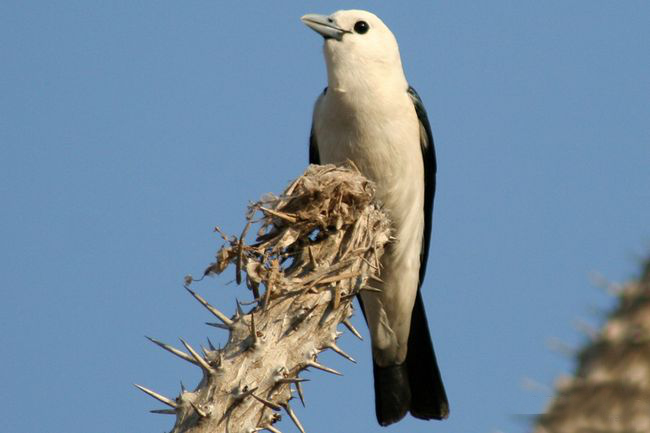
White-headed vanga (Artamella viridis)
Scientific classification Edit this classification
Kingdom: Animalia
Phylum: Chordata
Class: Aves
Order: Passeriformes
Superfamily: Malaconotoidea
Family: Vangidae
Swainson, 1831
Genera

21, see text

Synonyms

Tephrodornithidae

The family Vangidae (from vanga, Malagasy for the hook-billed vanga, Vanga curvirostris)[1] comprises a group of often shrike-like medium-sized birds distributed from Asia to Africa, including the vangas of Madagascar to which the family owes its name. Many species in this family were previously classified elsewhere in other families. Recent molecular techniques made it possible to assign these species to Vangidae, thereby solving several taxonomic enigmas. The family contains 40 species divided into 21 genera.

Taxonomy

[edit]

In addition to the small set of Malagasy species traditionally called the vangas, Vangidae includes some Asian groups: the woodshrikes (Tephrodornis), flycatcher-shrikes (Hemipus) and philentomas.[2]

Vangidae belongs to a clade of corvid birds that also includes bushshrikes (Malaconotidae), ioras (Aegithinidae) and the Australian butcherbirds, magpies and currawongs (Cracticidae) and woodswallows (Artamidae), which has been defined as the superfamily Malaconotoidea.[3] They seem closely related to some enigmatic African groups: the helmetshrikes (Prionops) and the shrike-flycatchers (Bias and Megabyas).[4]

On Madagascar, vangas were traditionally believed to be a small family of shrike-like birds. Recent research suggests that several Madagascan taxa most similar in appearance and habits (and formerly considered to be) Old World warblers, Old World flycatchers or Old World babblers may be vangas. Yamagishi et al. found in 2001 that Newtonia appeared to belong with the vangas rather than the warblers and also that Tylas was a vanga and not a bulbul.[5] It also appears that Ward's flycatcher and Crossley's babbler belong with the vangas.[6][7][8]

The phylogenetic relationships between the genera are shown below. The cladogram is based on a study by Sushma Reddy and collaborators that was published in 2012. The species in the subfamily Vanginae are endemic to Madagascar.[9]

Vangidae

Prionops – helmetshrikes (8 species)

Megabyas – African shrike-flycatcher

Bias – black-and-white shrike-flycatcher

Hemipus – flycatcher-shrikes (2 species)

Tephrodornis – woodshrikes (4 species)

Philentoma – philentomas (2 species)

Vanginae

Newtonia – newtonias (4 species)

Tylas – tylas vanga

Calicalicus – vangas (2 species)

Hypositta – nuthatch vanga

Mystacornis – Crossley's vanga

Leptopterus – Chabert vanga

Cyanolanius – blue vangas (2 species)

Vanga – hook-billed vanga

Pseudobias – Ward's flycatcher

Schetba – rufous vanga

Euryceros – helmet vanga

Xenopirostris – vangas (3 species)

Oriolia – Bernier's vanga

Falculea – sickle-billed vanga

Artamella – white-headed vanga

Description

[edit]

The vangas are an example of adaptive radiation, having evolved from a single founding population into a variety of forms adapted to various niches occupied by other bird families in other parts of the world.[10] They differ in size, colour and bill shape but are similar in skull shape and bony palate structure.[11] They are small to medium-sized birds, varying from 12 to 32 cm in length.[12] Many have strong, hooked bills similar to those of shrikes. The helmet vanga has a particularly large bill with a casque on top. Other species, such as the newtonias, have a small, thin bill. The sickle-billed vanga is notable for its long, curved bill used to probe into holes and cracks.[11]

Most vangas are largely black, brown or grey above and white below. Exceptions include the blue and white blue vanga and the blue-grey nuthatch vanga. The helmet vanga is mostly black with a rufous back. Male Bernier's vangas are entirely black while the females are brown. It is one of several species with distinct male and female plumage while in other species the sexes are identical.[12]

Most vangas have whistling calls.[12]

Distribution and habitat

[edit]

They are native to Sub-Saharan Africa and the Indomalayan realm, although most are endemic to Madagascar in a variety of forest and scrub habitats. Several species including Van Dam's vanga and sickle-billed vanga can be found in the dry deciduous forests in the west of the island. Some such as Crossley's babbler, helmet vanga and Bernier's vanga are restricted to rainforest in the east of the island. Lafresnaye's vanga and the recently discovered red-shouldered vanga occur in subarid thorn scrub in the south-west.[12]

Behaviour

[edit]
a helmet vanga feeding nestlings

Their diet can include insects, earthworms, millipedes, lizards and amphibians.[11] The blue vanga and chabert vanga occasionally eat fruit.[10] Many species feed in small groups, often in mixed-species foraging flocks. The hook-billed vanga and Lafresnaye's vanga tend to forage alone.[11] Vangas have a variety of different foraging strategies. Many species glean food as they move through the branches. The nuthatch vanga climbs up trunks and branches like a nuthatch but does not climb downwards as nuthatches do.[12] Crossley's babbler forages by walking along the forest floor amongst the leaf litter.[12] The chabert vanga and the tylas vanga often fly into the air to catch prey. The three Xenopirostris vangas use their laterally flattened bills to strip bark off trees to search for food underneath.[10]

Most species nest in pairs, building cup-shaped nests using twigs, bark, roots and leaves. The sickle-billed vanga nests in groups and builds a large nest of sticks.[11]

Status and conservation

[edit]

Some species of vanga are common such as the chabert vanga which can survive in secondary woodland and plantations of introduced trees.[12] Several other species are threatened by loss of their forest habitat. Pollen's vanga is classed as near-threatened by BirdLife International and the red-shouldered vanga, Bernier's vanga, helmet vanga and red-tailed newtonia are regarded as vulnerable. Van Dam's vanga is classed as endangered because it is restricted to a small area of north-west Madagascar where the forest is rapidly disappearing due to clearance for agriculture and uncontrolled bushfires.[13]

Species list

[edit]
Hook-billed vanga (Vanga curvirostris)
Lafresnaye's vanga (Xenopirostris xenopirostris)
Chabert vanga (Leptopterus chabert)

The family contains 21 genera and 40 species.[14]

FAMILY: VANGIDAE

References

[edit]
[edit]
Revisions and contributorsEdit on WikipediaRead on Wikipedia
from Grokipedia
Vanga is a of birds in the family Vangidae, which comprises about 40 of shrike-like, medium-sized birds distributed primarily in and the , with some in and . The genus Vanga itself contains a single , the hook-billed vanga (Vanga curvirostris), endemic to 's forests and scrublands. Named after the Malagasy word for these birds, the Vangidae family is noted for its , exhibiting diverse bill shapes adapted to various foraging niches, ranging from hooked and curved to straight and thin. These birds vary in size from 12 to 32 cm and display plumage in shades of black, grey, blue, and white, often with . The family is part of the superfamily Malaconotoidea and has undergone significant taxonomic revisions based on molecular studies.

Taxonomy and evolution

Classification history

The classification of vangas within the family Vangidae began in the early , when French ornithologist René Primevère Lesson established the family in 1831 based on the distinctive hooked bills of Malagasy species like the hook-billed vanga (Vanga curvirostris), initially placing them near shrikes (Laniidae) due to superficial similarities in bill structure and predatory habits. German ornithologist Gustav Hartlaub further contributed to early taxonomic descriptions in the 1860s, describing genera such as Tylas and reinforcing the shrike-like affinities through morphological comparisons in his works on Malagasy avifauna. Throughout the , taxonomic debates centered on the of Vangidae, with morphological analyses questioning the unity of the group and leading to reassignments of certain genera. For instance, early 20th-century studies by Pycraft (1907) proposed links to Australasian woodswallows and butcherbirds, suggesting an eastern dispersal route to , while later morphological reviews excluded genera like Newtonia (previously in ) and Tylas from Vangidae due to differences in skeletal and plumage traits, treating them as distinct lineages. These shifts highlighted ongoing uncertainties, as some species were alternately included or excluded based on limited , contributing to a fragmented understanding of vanga relationships. A pivotal advancement came in 2012 with a comprehensive molecular phylogenetic study by Reddy et al., which analyzed DNA sequences from 13 genes across all 15 recognized Malagasy vanga genera, confirming the of the core Vanginae radiation while resolving the inclusion of aberrant shrike-like corvoids from and . This work expanded Vangidae to encompass 21 genera total, reintegrating Newtonia and Tylas into the family and incorporating taxa such as helmetshrikes (Prionops) and woodshrikes (Tephrodornis), based on strong Bayesian and maximum-likelihood support for these broadened affinities. The study established the current taxonomic framework, emphasizing a unified evolutionary history originating from corvoid ancestors.

Phylogenetic relationships

The Vangidae family is positioned within the Corvida clade of the order Passeriformes, encompassing core corvoid oscines, and shares close phylogenetic affinities with families such as the cuckoo-shrikes (Campephagidae) based on molecular analyses of nuclear and mitochondrial loci. This placement reflects the family's integration into a diverse assemblage of passerines that originated in the region, with subsequent radiations across and . Molecular evidence supports a monophyletic radiation of approximately 22 vanga species endemic to Madagascar, nested within a broader Afro-Asian Vangidae group totaling around 40 species. This Malagasy clade represents a derived lineage that diverged after initial colonizations from continental Africa and Asia, as revealed by multi-locus phylogenies incorporating both mitochondrial and nuclear DNA sequences. Historically, genera such as Euryceros and Hypositta were misclassified outside the Vangidae due to morphological convergence, but molecular phylogenetic studies, particularly Reddy et al. (2012), resolved their inclusion within the family. Reddy et al. (2012) employed nuclear DNA markers alongside mtDNA to reconstruct a comprehensive phylogeny, demonstrating stepwise patterns where Malagasy vangas arose from multiple Afro-Asian ancestors, with divergence times estimated around 20–30 million years ago. These findings underscore the role of vicariance and dispersal in shaping inter-genus relationships, positioning the Malagasy radiation as a amid more basal continental lineages like the helmetshrikes (Prionops).

Adaptive radiation in Madagascar

The of the Vangidae in began with the of the island by an ancestral vanga lineage approximately 22–29 million years ago during the late , following the long-term isolation of Madagascar from other landmasses since its separation from around 88 million years ago. This event initiated a rapid diversification that produced 22 endemic species, which have evolved to occupy a wide array of ecological niches analogous to those filled by distantly related birds elsewhere, such as shrikes through aerial sallying, woodcreepers via trunk-climbing and probing, and with bark-gleaning behaviors. The radiation exemplifies classic patterns of island evolution, where the arrival of a single lineage exploits unoccupied resources in a novel environment, leading to ecomorphological divergence driven by specialized foraging strategies. Speciation rates in the Malagasy vangas were exceptionally high in the initial phases following colonization, with an explosive burst around 23 million years ago that accounted for much of the early lineage accumulation, but these rates subsequently declined dramatically toward stasis in more recent epochs. This temporal pattern, analyzed through fossil-calibrated phylogenies, indicates that the most intense diversification occurred soon after arrival, filling available niches before ecological saturation limited further splitting. A secondary peak in speciation between 10 and 5 million years ago further contributed to species richness, potentially linked to innovations in bill morphology that opened new foraging opportunities. Key drivers of this radiation include Madagascar's prolonged geographic isolation, which prevented and from continental faunas, coupled with the island's diverse habitats ranging from humid rainforests to dry spiny forests that provided varied ecological opportunities. The post-Mesozoic separation from remnants created a depauperate avifauna upon vanga arrival, allowing the to radiate without intense and adapt to multiple trophic levels through of traits suited to local conditions. This process has resulted in one of the most striking examples of avian on an oceanic island, with the Malagasy vangas demonstrating how ecological opportunity can fuel extraordinary in isolation.

Physical description

Morphology and size variation

Vangas in the family Vangidae display considerable variation in body size, ranging from small to medium-sized passerines with total lengths of 12–32 cm and weights of 15–114 g. The smallest species, the nuthatch vanga (Hypositta corallirostris), measures approximately 12–14 cm in length and weighs 13.5–14.5 g. In contrast, the largest, the sickle-billed vanga (Falculea palliata), reaches up to 32 cm in length and 114 g in weight. This size spectrum reflects the family's , with most species falling between 15–25 cm and 20–80 g, such as the hook-billed vanga (Vanga curvirostris) at 25–29 cm and 54–80 g. A hallmark of vanga morphology is the diversity in bill shapes, which vary significantly across genera despite a conserved structure. Hooked bills are characteristic of the Vanga, exemplified by the robust, curved bill of the hook-billed vanga used in its predatory habits. Sickle-shaped bills appear in Falculea, as seen in the sickle-billed vanga with its long, decurved mandible. Straight and slender bills occur in genera like Cyanolanius, where the blue vanga (Cyanolanius madagascarinus) possesses a fine, pointed bill measuring about 16–18 mm. This bill variation contributes to the family's ecomorphological distinctiveness, with over a dozen unique forms documented among the approximately 21 Malagasy species. Leg and foot structures in vangas also exhibit notable variation tied to locomotor demands. Arboreal species typically have relatively weak legs and feet suited for perching and climbing on branches, with shorter tarsi and less robust phalanges. In contrast, ground-foraging species like Crossley's babbler (Mystacornis crossleyi) feature stronger, more muscular legs and feet, including elongated toes and reinforced tarsometatarsi for such as hopping and scratching. These differences underscore the pedal morphology's role in the family's ecological diversification, with quantitative analyses showing correlated changes in bone length and muscle attachment sites across clades.

Plumage patterns and dimorphism

Vangas display a diverse array of patterns, often dominated by black, gray, or tones on the upperparts contrasted with underparts, reflecting their within Madagascar's forests. Most exhibit this bicolored scheme, with variations in gloss, streaking, or accents enhancing or signaling. For example, the Chabert's vanga (Leptopterus chabert) features glossy black upperparts with a subtle sheen and crisp underparts, creating a striking pied appearance. The vanga (Cyanolanius madagascarinus) showcases vibrant upperparts, including the head and wings, paired with immaculate underparts in adult males, while the edges of the wing coverts show dull bluish-green tinges. Another notable example is the red-shouldered vanga (Calicalicus rufocarpalis), described in 1997, where males exhibit pale reddish shoulders and rump against olive-tinged gray-brown upperparts, with brick-red lesser wing coverts adding a warm accent. Sexual dimorphism in plumage occurs in approximately 50% of vanga species, typically with males bearing brighter, more contrasting colors possibly linked to mate attraction, while females are duller for camouflage during nesting. In the Tylas vanga (Tylas eduardsii), males display brighter overall plumage, including a black head, nape, and chin, contrasting with the female's more olive-gray forecrown and upperparts. The red-tailed vanga (Calicalicus madagascariensis) exemplifies strong dimorphism, with males showing vivid rufous tail and underparts against gray upperparts, while females are browner and less saturated. Conversely, species like the Chabert's vanga exhibit minimal sexual differences, with both sexes sharing similar black-and-white patterns. In Bernier's vanga (Urathectes bernieri), dimorphism is pronounced, as males are entirely glossy black while females are uniform brown. Juveniles across the family often possess duller than adults, featuring or pale fringes on the upperparts that fade with maturation, aiding in blending with forest understory. For instance, young Chabert's vangas show white shaft streaks and tips on the black head feathers, giving a paler, mottled look, and similar streaking on the back and wings. In the red-shouldered vanga, juveniles have whitish underparts with brown-streaked upperparts and darker wing feathers. Age-related and seasonal molts are documented in several species, though details remain poorly known for the family overall; these changes refine plumage contrast and vibrancy post-breeding. The helmet vanga (Euryceros prevostii) features unique casque-like head feathers forming a stiff, helmet-shaped crest of blue-black , with minimal sexual variation but juveniles showing pale buff instead of black areas. Molts typically involve replacing worn feathers to maintain efficacy in humid habitats, as seen in the blue vanga where remiges and coverts are renewed with olive-tinged edges.

Distribution and habitat

Geographic range

The Vangidae family exhibits a core geographic range centered in , where all 15 of the endemic radiation (subfamily Vanginae) occur exclusively, representing a remarkable example of adaptive diversification within the island's forests and woodlands. These occupy diverse regions across , from lowland rainforests in the east to dry deciduous forests in the west and highlands in the central interior. Beyond , the family's distribution is scattered across Afro-Asian regions, with helmetshrikes (genus Prionops) found in , including the yellow-crested helmetshrike (Prionops alberti) restricted to montane forests in the eastern of Congo near the . In the , woodshrikes (genus Tephrodornis) inhabit scrub and open woodlands, such as the common woodshrike (Tephrodornis pondicerianus), which ranges from the through . No vanga species are recorded as vagrants outside their established native ranges, reflecting their sedentary lifestyles. Phylogenetic analyses trace the family's origins to , with ancestral dispersals to and occurring approximately 25 million years ago, followed by range expansions and contractions influenced by Pleistocene climatic fluctuations that altered forest cover and connectivity across the island. records of Malagasy avifauna from deposits support patterns of habitat-driven distributional shifts during these periods of glacial-interglacial cycles.

Habitat preferences and ecology

Vangas of the family Vangidae primarily inhabit forested environments across , with species adapted to both humid rainforests in the east and dry forests in the west. Some species, such as the Tylas vanga (Tylas eduardi), also occur in mangroves and degraded forest fragments as small as 4 hectares, while others favor scrublands and coastal woodlands. In , related taxa like helmetshrikes (Prionops spp.) occupy savannas, open woodlands, and rainforests, extending the family's ecological breadth beyond . The family exhibits a broad altitudinal range from sea level to approximately 2,000 meters, with many species concentrated in lowland and mid-elevation zones. For instance, the helmet vanga (Euryceros prevostii) is restricted to elevations below 800 meters in primary lowland rainforests of eastern , occupying the middle stratum among large trees. Microhabitat specialization is evident, as seen in the Xenopirostris vangas, which prefer dense layers in dry forests for foraging in dead wood and leaf litter. Ecologically, vangas serve as key insectivores within Madagascar's forest food webs, controlling populations through and probing behaviors. Several species incorporate fruits into their diet, potentially aiding and indirect in forest ecosystems. The family shows high sensitivity to habitat loss, with Madagascar's forests declining by over 44% from 1953 to 2010 due to , severely impacting vanga populations reliant on intact woodlands.

Behavior and life history

Foraging and diet

Vangas exhibit an omnivorous diet dominated by , primarily consisting of such as beetles, caterpillars, and orthopterans, along with spiders and other arthropods, while some supplement this with fruits, nectar, small , frogs, and occasionally bird eggs or nestlings. For instance, the hook-billed vanga (Vanga curvirostris) preys on large and small vertebrates like and frogs, often dismembering larger items before consumption. Foraging techniques vary across the family, reflecting specialized bill shapes that enable distinct methods such as , probing, and sallying, with most species active during daylight hours in forest canopies, midstories, or understories. , the most common approach, involves plucking prey from leaves, twigs, and branches; the blue vanga (Cyanolanius madagascariensis) exemplifies this by searching foliage clusters, sometimes hanging upside down to access hidden . Probing is employed by species with elongated or curved bills, such as the sickle-billed vanga (Falculea palliata), which inserts its bill into bark crevices and dead wood to extract and grubs, akin to woodpecker-like behavior. Sallying or hawking pursuits target flying ; the rufous vanga (Schetba rufa) frequently launches short aerial chases from perches. The nuthatch vanga (Hypositta corallirostris) primarily gleans prey from bark and foliage while climbing trunks and branches, occasionally probing into crevices. Many vanga forage in small groups or join mixed-species flocks to enhance detection of prey and predators, though some like the hook-billed vanga prefer solitary or paired hunting. The white-headed vanga (Leptopterus viridis) often in groups of up to six individuals, using a mix of , snatching, and probing to capture from bark and foliage. These behaviors underscore the family's , where bill morphology—detailed in physical descriptions—directly influences foraging efficiency.

Reproduction and nesting

Vangas typically breed during the rainy season in , from October to February, which aligns with increased food availability to support reproduction. This period allows pairs to time nesting with peak abundance, essential for provisioning nestlings. Most vanga exhibit social monogamy, where breeding pairs form stable bonds and share parental duties, though with helpers occurs in select . Nests are generally cup-shaped structures constructed from twigs, , rootlets, and other fibers, placed 2–5 m above ground in trees or shrubs for protection from ground predators. Clutch sizes range from 2 to 4 eggs, with an average of 2–3 across observed ; for example, Chabert's vanga (Leptopterus chabert) lays 1–3 eggs per clutch. Both parents incubate the eggs for 14–16 days, sharing duties roughly equally to maintain nest temperature. patterns may play a role in displays, signaling mate quality during pair formation. Nestlings remain in the nest for 18–25 days before fledging, during which parents deliver frequent prey to the brood. is uncommon in the but documented in like Bernier's vanga (Oriolia bernieri), where immature males assist with incubation and feeding, contributing up to 4% of incubation time and aiding in nest material delivery. In Chabert's vanga, groups of adults, including helpers, participate in feeding fledglings post-nesting, enhancing chick survival. Fledglings depend on adults for several weeks after leaving the nest, gradually becoming independent.

Vocalizations and social interactions

Vangas possess a diverse vocal that includes whistles, caws, rattles, and melodious s, serving functions such as territory defense, mate attraction, and predator alerting. For instance, the Sickle-billed Vanga (Falculea palliata) emits a characteristic loud "wa-aah" call resembling a crying , along with nasal "gaaa" contact calls and rapid "kekekeke" alarm notes. The Blue Vanga (Cyanolanius madagascariensis) produces an angry hard rattle as its primary call, often delivered from treetops, potentially functioning as a for territorial purposes. In contrast, the Hook-billed Vanga (Vanga curvirostris) delivers harsh, high-pitched whistles and raucous calls, while the Vanga (Schetba rufa) features echoing bell-like duets between paired males and females, highlighting pair-bonding communication. These vocalizations vary across but commonly include descending whistles in genera like Xenopirostris, such as the piercing "tseeang" of Van Dam's Vanga (Xenopirostris damii). Socially, most vanga species are solitary or maintain stable pairs outside the breeding season, though many participate in mixed-species flocks that enhance detection of food and threats. Gregarious exceptions include the Sickle-billed Vanga and Chabert's Vanga (Leptopterus chabert), which form flocks of 6–32 individuals and engage in . The Rufous Vanga exhibits cooperative social structure, with family groups where young males assist in breeding efforts, traveling together year-round. Communication plays a key role in these dynamics; alarm calls, such as those of the Rufous Vanga, rally mixed flocks for predators, while contact notes maintain cohesion during . is evident in territorial displays, including bill-clapping in the Hook-billed Vanga. Overall, vocal and social behaviors reflect adaptations to Madagascar's forested environments, balancing individual territory maintenance with opportunistic group interactions.

Conservation

The primary threat to vanga populations is loss driven by , where forest cover has been declining at an average annual rate of approximately 1-2% due to slash-and-burn agriculture, logging for timber and firewood, and expansion of subsistence farming. This is particularly acute for forest-dependent vangas, as their specialized s in humid and dry forests are fragmented and degraded, reducing available breeding and foraging areas. Additional pressures include hunting for , which targets a wide range of bird in , including vangas, with studies documenting exploitation of 87 avian taxa across eight years of surveys. exacerbates these issues by altering precipitation patterns, leading to drier conditions that shift suitable ranges and degrade ecosystems critical for vanga survival. use in expanding agricultural zones further threatens insectivorous vangas by diminishing prey availability, as these chemicals accumulate in food chains and affect populations. Population trends for many vanga indicate ongoing declines, with forest-restricted taxa experiencing reductions of 20-50% over three generations due to cumulative habitat pressures. For instance, Van Dam's vanga (Xenopirostris damii) has seen an estimated 23-35% decrease over the past three generations (approximately 12 years), linked to accelerated in its narrow dry forest range, though total numbers remain between 1,500 and 7,000 mature individuals. Overall, these trends underscore a broader vulnerability across the Vangidae family, with no showing stable or increasing populations amid intensifying anthropogenic impacts.

Species status assessments

The Vangidae family encompasses 40 species across 21 genera, predominantly in Madagascar with others in Africa and Asia. According to the IUCN Red List assessments as of 2025, two species are classified as Endangered: the helmet vanga (Euryceros prevostii), uplisted from Vulnerable in 2018 due to projected severe impacts from climate change on its lowland rainforest habitat, and Bernier's vanga (Oriolia bernieri), which faces ongoing habitat destruction and fragmentation from subsistence agriculture, with climate models predicting the loss of its ecological niche by 2050. Eight species are listed as Vulnerable, including Van Dam's vanga (Xenopirostris damii), downgraded from Endangered in 2025 following updated population estimates but still at risk from rapid dry forest loss exceeding 23% over three generations; Pollen's vanga (Xenopirostris polleni); and the red-shouldered vanga (Calicalicus rufocarpalis), assessed as Vulnerable since its formal description in 2017 based on its small population of 8,000–20,000 individuals confined to a fragmented area in southwestern Madagascar. The remaining species are categorized as Least Concern or Near Threatened. Recent updates to the highlight increasing pressures on vanga populations, particularly through habitat degradation. For instance, the nuthatch vanga (Hypositta corallirostris) was uplisted from Least Concern in 2016 to Near Threatened in 2025, reflecting a suspected decline of 20–29% over the past 10 years driven by forest cover loss, with projections of continued moderate declines of 15–25% over the next decade. These assessments underscore the vulnerability of Malagasy endemics, where habitat loss from and disproportionately affects range-restricted compared to their Afro-Asian counterparts, which face lower overall threat levels due to broader distributions and less intense pressures.

Conservation initiatives

Madagascar's conservation efforts for vanga species heavily rely on a network of protected areas, which encompass over 20 national parks and reserves covering approximately 10% of the island's remaining forest habitat. , the largest in the , safeguards critical habitats for species like the endangered helmet vanga (Euryceros prevostii), hosting about 50% of Madagascar's diversity, including multiple vanga taxa. Similarly, Ankarafantsika National Park, a UNESCO-recognized site and Ramsar , supports vanga populations through its dry forest ecosystems and promotes habitat integrity via regulated access. Reforestation initiatives complement these protections by restoring degraded vanga habitats, with national and international projects aiming to plant up to 60 million trees across between 2021 and 2025 to combat . The Madagascar Biodiversity Partnership, in collaboration with local communities, has already planted over 5 million native trees in key forested regions, enhancing connectivity for forest-dependent birds like various vanga species. Research and monitoring programs are essential for tracking vanga populations and informing conservation strategies. conducts regular surveys and uses camera traps to monitor elusive species, such as Pollen's vanga (Xenopirostris polleni), in fragmented eastern forests, providing data on distribution and threats. The African Bird Club's targeted projects, including those in Masoala, have updated population estimates and raised community awareness for helmet vanga conservation through field assessments and education. Community-based in areas like Ankarafantsika further supports monitoring by involving locals in bird surveys and habitat patrols, generating sustainable income while protecting vanga habitats. On the international front, funding and agreements bolster these efforts, with no vanga species currently listed under due to limited trade pressures, though broader avian protections apply. Recent initiatives include nearly $40 million from the in 2025 for climate-resilient landscapes in eastern , focusing on forest corridors to aid and habitat linkage for species like the helmet vanga. These projects, supported by organizations such as the Critical Ecosystem Partnership Fund, emphasize -based adaptation to connect protected areas and mitigate climate impacts on vanga populations.

Species diversity

Overview of genera

The family Vangidae encompasses 21 genera distributed across , , and , with the Malagasy radiation representing a classic example of adaptive diversification among birds. Of these, 15 genera are endemic to and collectively comprise 22 species, showcasing extraordinary variation in bill shapes adapted to diverse niches, from hook-like structures for extracting to stout forms for probing foliage. Notable Malagasy genera include Vanga, which is monotypic and features the hook-billed vanga (V. curvirostris) with its curved bill suited for arthropods; Calicalicus, a polytypic genus of shrike-vangas (four species) characterized by robust, hooked bills resembling those of true shrikes for capturing prey in flight; and Euryceros, encompassing two species of helmet vangas with massive, casque-like bills that facilitate specialized wood-boring behaviors. The remaining six genera occur in continental Africa and Asia, totaling approximately 18 species, and exhibit more conservative morphologies often likened to shrikes or flycatchers, with distributions ranging from savannas to forests. Examples include Prionops (eight species of helmetshrikes in ), known for their crested heads and cooperative foraging in groups, and Philentoma (two species of flycatcher-vangas in Southeast Asian forests), which display subtle and perch-gleaning habits akin to flycatchers. These Afro-Asian lineages form the basal clades of Vangidae, contrasting with the derived, hyper-diverse Malagasy assemblage that arose from a single colonization event. Vangid genera vary in species richness, with several monotypic forms such as Oriolia (Bernier's vanga, O. bernieri), a secretive understory species with a finch-like bill, highlighting isolated evolutionary endpoints, while polytypic genera like Newtonia (four species of newtonias, all Malagasy endemics) demonstrate ongoing speciation in humid forest habitats. The phylogenetic divergence among these genera spans approximately 5 to 25 million years, with the initial Malagasy crown radiation dating to the late Oligocene (around 23 million years ago) and subsequent bursts of diversification in the Miocene, driven by ecological opportunities in Madagascar's isolated biota. This temporal framework underscores the family's role as a model for studying adaptive radiations in island systems.

List of species

The family Vangidae comprises 40 species, 22 of which are endemic to , according to the IOC World Bird List (version 13.1, 2023), with the total remaining stable through subsequent updates as of 2025. This list is organized alphabetically by genus and includes each species' common name, , a brief note on its primary range, and status (as of 2023 assessments). Conservation statuses are cross-referenced from the IUCN for context, though detailed threats are addressed elsewhere.
GenusCommon NameBinomial NameRange NotesIUCN Status
ArtamellaWhite-headed VangaArtamella viridisEndemic to MadagascarLeast Concern
BiasBlack-and-white Shrike-flycatcherBias musicusSub-Saharan AfricaLeast Concern
CalicalicusRed-tailed VangaCalicalicus rufusEndemic to MadagascarNear Threatened
CalicalicusChattering VangaCalicalicus analisEndemic to MadagascarLeast Concern
CalicalicusRed-shouldered VangaCalicalicus rufocarpalisEndemic to Madagascar (described 2017)Endangered
CalicalicusAshy VangaCalicalicus leucolophusEndemic to MadagascarLeast Concern
CyanolaniusBlue VangaCyanolanius madagascarinusMadagascar and Comoros IslandsLeast Concern
EurycerosHelmet VangaEuryceros prevostiiEndemic to MadagascarVulnerable
FalculeaSickle-billed VangaFalculea palliataEndemic to MadagascarLeast Concern
HarpyhymenaeusCrossley's VangaHarpyhymenaeus crossleyiCentral Africa (Cameroon to Uganda)Least Concern
HemipusBlack-winged Flycatcher-shrikeHemipus hirundinaceusSoutheast Asia (India to Indonesia)Least Concern
HemipusBar-winged Flycatcher-shrikeHemipus picatusSoutheast Asia (Himalayas to Sumatra)Least Concern
HyposittaNuthatch VangaHypositta corallirostrisEndemic to MadagascarLeast Concern
LeptopterusChabert VangaLeptopterus chabertEndemic to MadagascarLeast Concern
MegabyasShrike-titMegabyas flammulatusNew Guinea and nearby islandsLeast Concern
NewtoniaCommon NewtoniaNewtonia brunneicaudaEndemic to MadagascarLeast Concern
NewtoniaDark NewtoniaNewtonia amphichroaEndemic to MadagascarLeast Concern
NewtoniaRed-tailed NewtoniaNewtonia fanovanaeEndemic to MadagascarVulnerable
NewtoniaArchbold's NewtoniaNewtonia archboldiEndemic to MadagascarEndangered
OrioliaBernier's VangaOriolia bernieriEndemic to MadagascarEndangered
PhilentomaRufous-winged PhilentomaPhilentoma pyrhopteraSoutheast Asia (Malaysia to Indonesia)Least Concern
PhilentomaChestnut-sided PhilentomaPhilentoma velataSoutheast Asia (Thailand to Borneo)Least Concern
PrionopsWhite HelmetshrikePrionops plumosusWest and central AfricaLeast Concern
PrionopsGabela HelmetshrikePrionops gabelaEndemic to AngolaEndangered
PrionopsGrey-crested HelmetshrikePrionops poliolophusCentral AfricaLeast Concern
PrionopsRufous-bellied HelmetshrikePrionops rufiventrisWest and central AfricaLeast Concern
PrionopsWhite-crested HelmetshrikePrionops plumatusSub-Saharan AfricaLeast Concern
PrionopsRed-billed HelmetshrikePrionops canicepsWest AfricaLeast Concern
PrionopsRetz's HelmetshrikePrionops retziiSub-Saharan AfricaLeast Concern
PrionopsYellow-crested HelmetshrikePrionops albertiCentral Africa (DRC)Vulnerable
PrionopsBlack-crested HelmetshrikePrionops cristatusEast AfricaLeast Concern
SchetbaRufous VangaSchetba rufaEndemic to MadagascarNear Threatened
TephrodornisCommon WoodshrikeTephrodornis pondicerianusIndian subcontinent to Southeast AsiaLeast Concern
TephrodornisLarge WoodshrikeTephrodornis virgatusSoutheast Asia (Myanmar to Philippines)Least Concern
TephrodornisMalabar WoodshrikeTephrodornis affinisWestern Ghats, IndiaLeast Concern
TephrodornisSulawesi WoodshrikeTephrodornis sulaensisEndemic to SulawesiLeast Concern
TylasTylas VangaTylas eduardiEndemic to MadagascarVulnerable
VangaHook-billed VangaVanga curvirostrisEndemic to MadagascarLeast Concern
XenopirostrisLafresnaye's VangaXenopirostris xenopirostrisEndemic to MadagascarVulnerable
XenopirostrisPollen's VangaXenopirostris polleniEndemic to MadagascarVulnerable
XenopirostrisVan Dam's VangaXenopirostris damiiEndemic to MadagascarEndangered

References

Add your contribution
Related Hubs
User Avatar
No comments yet.