


Community hub
Recent from talks
Contribute something
Nothing was collected or created yet.
North Jutlandic Island
View on WikipediaThe North Jutlandic Island (Danish: Nørrejyske Ø), Vendsyssel-Thy, or Jutland north of the Limfjord (Jylland nord for Limfjorden) is the northernmost part of continental Denmark and of Jutland. It is more common to refer to the three traditional districts of Vendsyssel, Hanherred, and Thy. The area has been intermittently a tied island and, during modern times, was not surrounded by water until a storm in February 1825, which severed the region from the remainder of Jutland and created a water connection between the North Sea and the western end of the Limfjord.[1] Vendsyssel-Thy retains its traditional status as a part of Jutland even though it is now an island.
Key Information


By area, it is the second-largest island of Denmark after Zealand (excluding Greenland), with a population of 294,424 on 1 January 2020.[2] 309,834 people lived on the island in 1981.
Danes rarely refer to the area as a whole, but more often to the three constituent districts or to North Jutland (which also includes an area south of the Limfjord). The adjectives nordenfjords and søndenfjords are also commonly used, meaning north and south of the fjord, respectively. The names can all be considered ad hoc creations, as a traditional name for the island is lacking.
History
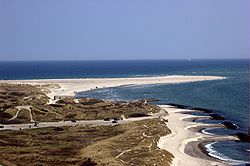
[edit]The narrow sand tombolo of Agger Tange connected North Jutland Island to the Jutland Peninsula between c. 1200 and 1825. The area became an island again due to a storm on 3 February 1825, when the North Sea broke through the Agger Tange in its far southwest, separating the area from mainland Jutland and creating the Agger Channel.[3] The current separator is the Thyborøn Channel, which was created slightly further south by a flood in 1862. The original Agger Channel filled up with sand in 1877.
The syssel was a medieval sub-division which is regarded as the oldest type of administrative unit in Denmark, having existed since before the Middle Ages. The land of the North Jutlandic Island was divided into two of these: Thysyssel (including Hanherred) and Vendsyssel.
Geography
[edit]The island is marked by very flat terrain with dry, grassy slopes and sandy coasts, especially on its north and east. The island hosts the largest sand dune in northern Europe, the Råbjerg Mile.

The North Jutlandic Island consists of these three traditional regions:
- Vendsyssel, the largest part to the east and north,
- Thy, the lesser part to the west,
- Hanherrederne, or Hanherred, is the central isthmus connecting Vendsyssel and Thy.
Since 1 January 2007, when the Danish municipal reform became effective, these areas, along with Himmerland and the islands of Mors and Læsø have constituted the North Jutland Region, the smallest of Denmark's five regions by population. Ecclesiastically, the North Jutland Islands are the main part of the Diocese of Aalborg.
In traditional terms, the westernmost part of the island, Thy, is considered part of both Northern and Western Jutland simultaneously. The term North West Jutland refers to Thy, the island Mors, and the parts of mainland Jutland bordering the western Limfjord, such as the peninsula of Salling and around the towns of Struer and Lemvig.
Key facts
[edit]- Area: 4,685 km2
- Population: 294,424 (January 1, 2020)
| Traditional district | Town | Population (2025) |
|---|---|---|
| Vendsyssel | Hjørring | 25,908 |
| Frederikshavn | 22,548 | |
| Skagen | 7,394 | |
| Brønderslev | 12,946 | |
| Sæby | 8,991 | |
| Hirtshals | 5,347 | |
| Løkken | 1,669 | |
| Nørresundby (the northern part of Aalborg, which is mainly south of the Limfjord) | 24,436 | |
| Hanherred | Fjerritslev | 3,306 |
| Brovst | 2,684 | |
| Thy | Thisted | 13,305 |
| Hanstholm | 2,050 | |
| Hurup | 2,657 |
Transport
[edit]Road
[edit]The largest motorways on the island are European route E39 and European route E45, which run from Nørresundby to Hirtshals (with a bypass around Hjørring on its east) and Frederikshavn respectively. The main east-west road across the island is national road 11 that runs non-continuously west from Aabybro to Oddesund, intermitted with parts of national roads 29 and 26.
Airport
[edit]The island has one international airport, which is Aalborg Airport. As of 5 September 2025 it offered flights to Kastrup Airport, Bornholm Airport, Oslo Gardermoen Airport, Amsterdam Airport Schiphol, Nice Côte d'Azur Airport, and various holiday destinations on the northwest and northeast Mediterranean coasts.
Rail
[edit]Nordjyllands Trafikselskab operates regional lines on the island, the longest being Aalborg-Skagen through the Vendsyssel Line and Skagen Line, along with a small off-branch to Hirtshals on the Hirtshals Line.
The Thy Line runs south from Thisted railway station to across Oddesund.
The national DSB high-speed lines do not go north of Aalborg Airport railway station, requiring transits in Aalborg or at Struer railway station to get to or from the rest of Denmark.
Boat
[edit]Hirtshals and Frederikshavn are major ferry terminals for international routes. Hirtshals has routes as of May 2025 to Larvik, Bergen (via Stavanger), Langesund, and Seyðisfjörður (via Tórshavn), while Frederikshavn has a route to Göteborg.
Connections to rest of Denmark
[edit]The island has seven fixed transport links to the mainland: Four road bridges (including national road 180 at Limfjordsbroen, national road 29 at Aggersund, and national road 11 at Oddesund Bridge), one road tunnel (European route E45 at Limfjordstunnelen), and two rail bridges. There are also two short-distance car ferry connections, one each at the west and right outlets of the Limfjord.
Ferries connects Frederikshavn to the islands of Læsø and Hirsholm.
There was technically a ferry between Frederikshavn and København, but the operators (Initially DFDS Seaways year-round, and later Gotlandsbolaget as a seasonal winter route[4]) prohibited passengers from boarding on only the stretch between the 2 cities, instead only allowing passengers who were bound for Oslo northbound, or from Oslo to either city southbound.
Culture
[edit]Sports
[edit]The most successful team internationally on the island is the women's association football team Fortuna Hjørring. They reached the final of the 2002–03 UEFA Women's Cup, and have performed well in the UEFA Women's Champions League (More often than not reaching at least the Round of 16) even after the increasing professionalisation of women's club football across Europe.
In men's football, Vendsyssel FF plays in the NordicBet Liga (National tier 2).
In men's ice hockey, Frederikshavn White Hawks plays in the national Metal Ligaen. As of May 2025, they had most recently made it to the Danish final in the 2012–13 season and have never played in the European Champions Hockey League.
Media
[edit]Radio stations based on the island include Skaga FM, Radio Nord, ANR, and Vendsyssel FM. Danish national stations and stations broadcasting from Aalborg are also available on DAB+[5] and on FM radio. Television channel selections are generally the same as in the rest of Denmark. In national systems for regional broadcasters, the island forms part of the TV2 Nord and DR P4 Nordjylland designated areas.
Amusement parks
[edit]The biggest amusement park on the island is Fårup Sommerland, located between the villages of Blokhus and Saltum. The park is open intermittently from roughly early May to mid-October, with the most frequent opening days per week being from June to August.
Climate
[edit]The climate is temperate oceanic on the Köppen climate classification. Frost is common in the winter, and snow occurs from time to time.[6]
| Climate data for Skagen (1971–2000) | |||||||||||||
|---|---|---|---|---|---|---|---|---|---|---|---|---|---|
| Month | Jan | Feb | Mar | Apr | May | Jun | Jul | Aug | Sep | Oct | Nov | Dec | Year |
| Record high °C (°F) | 10.2 (50.4) |
11.5 (52.7) |
15.7 (60.3) |
19.0 (66.2) |
23.6 (74.5) |
27.1 (80.8) |
28.2 (82.8) |
29.0 (84.2) |
22.6 (72.7) |
19.0 (66.2) |
13.2 (55.8) |
11.1 (52.0) |
29.0 (84.2) |
| Mean daily maximum °C (°F) | 3.0 (37.4) |
2.7 (36.9) |
4.6 (40.3) |
8.4 (47.1) |
13.7 (56.7) |
17.2 (63.0) |
19.5 (67.1) |
19.2 (66.6) |
15.5 (59.9) |
11.4 (52.5) |
7.3 (45.1) |
4.7 (40.5) |
10.6 (51.1) |
| Daily mean °C (°F) | 1.4 (34.5) |
1.0 (33.8) |
2.5 (36.5) |
5.6 (42.1) |
10.5 (50.9) |
14.0 (57.2) |
16.3 (61.3) |
16.2 (61.2) |
13.1 (55.6) |
9.5 (49.1) |
5.7 (42.3) |
3.1 (37.6) |
8.2 (46.8) |
| Mean daily minimum °C (°F) | −0.7 (30.7) |
−1.1 (30.0) |
0.3 (32.5) |
2.9 (37.2) |
7.5 (45.5) |
10.9 (51.6) |
13.1 (55.6) |
13.0 (55.4) |
10.4 (50.7) |
7.1 (44.8) |
3.6 (38.5) |
1.0 (33.8) |
5.7 (42.3) |
| Record low °C (°F) | −16.5 (2.3) |
−15.0 (5.0) |
−10.8 (12.6) |
−4.8 (23.4) |
−3.0 (26.6) |
3.2 (37.8) |
6.0 (42.8) |
5.5 (41.9) |
1.3 (34.3) |
−2.6 (27.3) |
−5.8 (21.6) |
−12.4 (9.7) |
−16.5 (2.3) |
| Average precipitation mm (inches) | 52.4 (2.06) |
32.1 (1.26) |
40.4 (1.59) |
33.7 (1.33) |
43.6 (1.72) |
54.6 (2.15) |
48.8 (1.92) |
61.9 (2.44) |
75.5 (2.97) |
75.6 (2.98) |
66.1 (2.60) |
58.5 (2.30) |
643.2 (25.32) |
| Average precipitation days (≥ 0.1 mm) | 16.5 | 12.3 | 13.7 | 11.2 | 11.1 | 11.8 | 10.1 | 11.8 | 14.4 | 16.0 | 16.6 | 16.7 | 162.3 |
| Average snowy days | 5.8 | 4.6 | 3.7 | 1.2 | 0.0 | 0.0 | 0.0 | 0.0 | 0.0 | 0.1 | 1.2 | 3.7 | 20.3 |
| Average relative humidity (%) | 93 | 91 | 91 | 87 | 86 | 87 | 87 | 87 | 87 | 88 | 90 | 92 | 89 |
| Mean monthly sunshine hours | 59 | 77 | 135 | 194 | 291 | 274 | 306 | 257 | 164 | 101 | 56 | 48 | 1,969 |
| Source: Danish Meteorological Institute (humidity 1978–1997)[7][8] | |||||||||||||
See also
[edit]References
[edit]- ^ "Stormfloden i 1825, Thyborøn Kanal og kystsikring" [The flood in 1825, Thyborøn Channel and coastal protection]. danmarkshistorien.dk (in Danish). Aarhus University. Retrieved 13 June 2020.
- ^ "Danmarks Statistik." Retrieved 12 May 2020.
- ^ Blangstrup, Chr., ed. (1915). "Aggerkanal". Salmonsens Konversationsleksikon (in Danish). Vol. 1 (2nd ed.). Copenhagen: J.H. Schultz Forlagsboghandel. p. 310. Retrieved April 3, 2013.
- ^ Odd Roar Lange (4 December 2024). "Varsler stor endring" (in Norwegian Bokmål). Dagbladet. Retrieved 12 June 2025.
- ^ "Radiofrekvenser i Nordjylland, Himmerland, Vendsyssel og Mors" (in Danish). Dansk Radio. Retrieved 4 September 2025.
- ^ Niels Skipper (9 December 2023). "Museerne i Hjørring ligger flot i front om at blive de bedste i Danmark" (in Danish). Nordsøposten. Retrieved 4 September 2025.
- ^ "Danish Climatological Normals 1971–2000 for selected stations" (PDF). Danish Meteorological Institute. Retrieved 17 November 2015.
- ^ "Observed Air Temperature, Humidity, Pressure, Cloud Cover and Weather in Denmark with Climatological Standard Normals, 1961–90" (PDF). Danish Meteorological Institute. Retrieved 17 November 2015.
External links
[edit] Media related to Nørrejyske Ø at Wikimedia Commons
| Baltic Sea | ||
|---|---|---|
| Sydhavsøerne | ||
| Kattegat | ||
| South Funen Archipelago | ||
| Limfjorden | ||
| Øresund | ||
| Great Belt | ||
| Little Belt | ||
| Wadden Sea | ||
| Other islands |
| |


| International | |
|---|---|
| Other | |

North Jutlandic Island
View on GrokipediaGeography
Location and boundaries
The North Jutlandic Island, also known as Vendsyssel-Thy, constitutes the northernmost portion of Denmark, extending approximately from 56°30' N to 57°45' N latitude and 8°00' E to 11°00' E longitude.[7][8] It is bounded to the north by the Skagerrak strait, to the east by the Kattegat sea, to the south by the Limfjord, and to the west by the North Sea.[9][10] This positioning places it as a distinct landmass physically separated from the main Jutland peninsula, though traditionally regarded as part of Jutland in cultural and historical contexts.[11] Administratively, the island encompasses the traditional regions of Vendsyssel in the northeast, Thy in the northwest, and Hanherred in the central area.[12] Since the Danish structural reform of 2007, which reorganized the country's regions and municipalities, it has been fully integrated into the North Denmark Region (Region Nordjylland), one of Denmark's five administrative regions.[13][14] This reform reduced the number of municipalities from 271 to 98 and established the current regional framework to enhance efficiency in public services.[13] With an area of 4,685 km², the North Jutlandic Island ranks as Denmark's second-largest island after Zealand, excluding Greenland and other territories of the Kingdom of Denmark.[10][9] Its separation from the Jutland mainland occurred historically through the Limfjord, which widened into a full waterway over time, defining its insular status despite continental origins.[11]Physical features
The North Jutlandic Island, also known as Vendsyssel-Thy, is characterized by predominantly flat terrain dominated by sandy soils, expansive dunes, and open heathlands, shaped by glacial deposits and coastal processes. This low-lying landscape rises gently in places, with the highest elevation at Knøsen, reaching 136 meters above sea level in the central Jyske Ås ridge.[15][16] Along its coasts, the island features extensive sandy beaches stretching for kilometers, interrupted by dynamic dune systems. A prominent example is Råbjerg Mile, northern Europe's largest migrating sand dune, which spans approximately 1.1 square kilometers and advances 15 to 20 meters northeastward each year due to prevailing winds.[17][18] Inland, the terrain includes shallow inlets and bays connected to the Limfjord, which separates the island from the mainland, alongside pockets of forested areas.[11] Biodiversity thrives in the island's protected natural areas, particularly National Park Thy, established in 2008 and encompassing roughly 24,400 hectares of coastal dunes, moorlands, and heath vegetation that harbor unique Atlantic-influenced ecosystems, including rare plant species and bird habitats.[19][20]Climate
The North Jutlandic Island features a temperate oceanic climate under the Köppen classification Cfb, marked by mild winters without extreme cold and cool summers rarely exceeding comfortable temperatures. This classification reflects the moderating influence of the surrounding North Sea and Kattegat, which prevent severe temperature fluctuations typical of continental interiors. Annual average temperatures, based on data from the nearby Skagen station for the period 1971–2000, stand at 8.2°C, with January averages around 1.5°C and July averages reaching 16.5°C. These conditions support a relatively stable growing season, though brief cold snaps can occur in winter.[21] Precipitation on the island averages 700–800 mm annually, distributed fairly evenly but peaking in autumn due to increased cyclonic activity over the North Atlantic. The proximity to the North Sea enhances moisture availability, leading to frequent overcast days and drizzle, particularly from October to December. Winds are a defining feature, predominantly westerly and averaging up to 10 m/s year-round, with stronger gusts common during transitional seasons; this persistent airflow contributes to the island's exposed, windswept landscape. Extreme weather events underscore this variability, such as the severe storm of February 1825, which generated winds exceeding 20 m/s and breached the Agger Tange isthmus, forming the channel that isolated the island from mainland Jutland.[21][22] In recent decades, the climate has shown signs of change, with temperatures in Denmark rising by about 1.5°C over the last 125 years and signs of accelerated warming in recent decades, consistent with broader patterns in northern Denmark driven by global anthropogenic influences.[23][23] This warming has been accompanied by an increase in storm frequency and intensity, with more powerful extratropical cyclones affecting the region, potentially exacerbating wind and precipitation extremes. Such trends align with projections for the North Sea area, where rising sea surface temperatures amplify cyclonic development.[23][23]Demographics
Population statistics
The population of the North Jutlandic Island stands at an estimated 295,375 as of 1 January 2025, marking a modest rise from 294,424 recorded in 2020. This figure reflects the island's role as Denmark's second-largest island by area, spanning 4,685 km², with a corresponding population density of 63 inhabitants per square kilometer—significantly below the national average of 137 inhabitants per square kilometer.[24] Preliminary data indicate continued modest growth through mid-2025.[25] The lower density underscores the island's predominantly rural character and expansive natural landscapes. Over the decade from 2015 to 2025, the population has grown at an average annual rate of 0.3%, fueled primarily by seasonal tourism boosting local economies and an influx of retirees seeking affordable coastal living. This trend coincides with an aging demographic profile, where 22% of residents are aged 65 or older, higher than the national figure and indicative of out-migration among younger working-age groups.[26] Ethnically, the island's residents are predominantly Danish (approximately 95%), similar to national trends, with small immigrant communities—largely workers from Poland and Romania drawn to agriculture and seasonal services. The distribution between urban and rural areas shows a 60% rural majority, concentrated in agricultural and coastal zones, while 40% reside in smaller urban centers. In historical context, the population reached a post-World War II peak of 309,834 in 1981 before experiencing a gradual decline due to economic shifts and urbanization elsewhere in Denmark, stabilizing in recent years through targeted regional development.[25]Major settlements
Hjørring serves as the largest town on the North Jutlandic Island, with a population of 25,908 in 2025. Chartered as a market town in 1243, it has long functioned as a commercial hub in the Vendsyssel region.[27] Frederikshavn, with 22,548 residents in 2025, is a vital ferry port and trade hub on the island's east coast.[28] It operates as the primary link between continental Europe and Scandinavia, handling ferry traffic to destinations including Gothenburg, Sweden, and supporting regional freight and offshore activities.[29] Thisted, home to approximately 14,000 people, acts as a cultural center in the Thy district of the island.[30] It hosts annual events like the Thy Jazz Festival and features institutions such as the Thisted Museum, fostering local arts and heritage.[31] At the northern tip, Skagen is a fishing village renowned for its unique light that inspired the 19th-century Skagen Painters, with a population of about 8,000 in 2025.[32] The town's artistic legacy is preserved in sites like Skagens Museum, alongside its ongoing fishing industry.[33] Although partially on the mainland south of the Limfjord, the Aalborg metropolitan area (population around 120,000) functions as a regional gateway for the island, with Nørresundby on the northern shore providing direct connectivity.[34] Smaller rural settlements, such as Løkken, emphasize beach tourism, drawing visitors to its expansive sandy shores and coastal activities.[35] Urban development on the island has focused on sustainable growth following the 2007 Danish municipal reforms, which consolidated local governance to support balanced expansion in key towns while preserving rural character. Approximately 40% of the island's population resides in towns exceeding 10,000 inhabitants, reflecting this emphasis on concentrated yet eco-friendly urbanization.History
Early settlement
The earliest evidence of human settlement in the North Jutlandic Island region dates to the Late Glacial period (c. 13,000–11,000 BCE), with Mesolithic hunter-gatherer sites established around 9,500 BCE along coastal areas. By the Neolithic period (c. 4,000 BCE), early farmers had joined these communities, creating more permanent settlements along the Limfjord. Excavations at these Neolithic locations have revealed shell middens containing flint tools, fish bones, and oyster remains, pointing to a subsistence economy reliant on marine resources and rudimentary agriculture.[36][37] By the Bronze Age (c. 1700–500 BCE), the landscape featured prominent burial barrows, including examples near Skagen that served as monumental graves for community leaders. These earthen mounds, often aligned with natural features, contained bronze artifacts and reflect emerging social hierarchies and ritual practices tied to ancestor veneration.[38][39] During the Viking Age (c. 800–1050 CE), the area formed part of broader North Jutland, where local Thing assemblies convened free men to resolve disputes, enact laws, and conduct governance under chieftain oversight. Runestones scattered across Vendsyssel attest to these communal structures and highlight trade links with Norway, as inscriptions commemorate merchants and voyages across the Skagerrak.[40] In the medieval era, administrative divisions emerged under the Danish syssel system, organizing the region into Thysyssel (encompassing Thy) and Vendsyssel for taxation, defense, and justice. Børglum Abbey, founded around 1150 by Premonstratensian canons, became a pivotal religious and cultural hub, overseeing monastic estates and promoting literacy amid feudal obligations.[41][42] Significant population dynamics unfolded with the Black Death's arrival in the 1340s, which caused a roughly 50% decline across Denmark, disrupting agrarian communities and accelerating labor shortages in the north. Concurrently, from the 1200s onward, the Hanseatic League's growing presence bolstered trade in commodities like fish and grain through ports in Vendsyssel and Thy, integrating the region into Baltic networks despite occasional conflicts with Danish authorities.[43][44]Formation as an island
Prior to 1825, the region now known as the North Jutlandic Island was physically connected to the mainland of Jutland by the narrow sandy isthmus of Agger Tange, which served as a barrier separating the Limfjord—an inland waterway—from the North Sea.[45] The Limfjord had functioned as a semi-enclosed inlet since the Middle Ages, following the natural closure of its western outlet around the 12th century, after which it remained isolated from direct North Sea influence for over 700 years.[22] On February 3–4, 1825, a powerful North Sea storm surge struck the western coast of Jutland, breaching the Agger Tange isthmus and creating the Agger Channel, which permanently severed the land connection and transformed the northern area into an island.[46] This event, part of a broader flood affecting coasts from the Netherlands to Denmark, caused extensive inundation, property damage, and loss of life across the region, with approximately 800 fatalities reported along the entire North Sea shoreline, though the Danish west coast experienced relatively fewer direct casualties compared to areas farther south.[46] The breach initiated a new outlet for the Limfjord, allowing tidal exchange with the North Sea and altering local hydrology and sedimentation patterns.[47] In the years following, the Agger Channel supported limited navigation but gradually silted up due to natural sediment deposition, becoming effectively closed by 1875. Meanwhile, a similar storm in 1862 breached the nearby Thyborøn area, forming the Thyborøn Channel about 5 kilometers south of the Agger site, which provided a more stable and deeper passage suitable for maritime traffic.[48] Danish authorities subsequently maintained and expanded the Thyborøn Channel for navigational purposes, including quay construction and bank stabilization, shifting shipping routes away from the deteriorating Agger passage by the mid-1860s.[46] The island's formation triggered ongoing coastal erosion along its exposed North Sea shores, with retreat rates varying from 2 to 8 meters per year in vulnerable sections of the western Jutland coast, driven by wave action, currents, and sediment transport through the new channels.[49] This erosion prompted systematic defenses starting in the early 20th century, including the construction of groins along the Thyborøn Channel banks from around 1900 and extensive sand nourishment programs by the 1940s to counteract recession and protect dunes and settlements.[48] Further reinforcements, such as embankments and breakwaters, were planned under a 1946 act to mitigate flood risks but were ultimately adjusted in favor of ongoing monitoring and adaptive measures through the mid-20th century.[48]Economy
Primary sectors
The primary sectors of the North Jutlandic Island, encompassing agriculture, fishing, and renewable energy production, form the backbone of its traditional economy, leveraging the region's fertile soils, extensive coastline, and North Sea proximity. Agriculture dominates land use, with approximately 60% of Denmark's total area dedicated to farming, a pattern reflected in the island's rural landscapes where crop cultivation and livestock rearing prevail.[50] Key agricultural activities focus on potatoes, rye, and dairy production, with the island contributing significantly to national output through specialized farms. Dairy farming is particularly prominent, positioning Denmark—and by extension the North Jutlandic region—as one of Europe's top per capita milk producers, supported by efficient herds yielding high volumes per cow. In the Thy area, organic farming has gained traction, emphasizing sustainable practices like crop rotation and reduced inputs to enhance soil health and product quality.[51][52] Fishing remains a cornerstone industry, centered on North Sea ports such as Hirtshals, where annual landings exceed 100,000 tons of demersal species including cod and herring, bolstering local processing and export chains. Since 2010, aquaculture has expanded notably, with land-based and offshore salmon farms increasing production to meet rising demand for sustainable seafood, now accounting for a growing share of Denmark's 38,000 tons of annual aquaculture output.[53][54] Forestry plays a limited role due to the island's modest forest cover, comprising about 14% of Denmark's overall land area, primarily supplying biomass for local energy and heating needs through sustainable harvesting. In parallel, the energy sector has shifted toward renewables, exemplified by offshore wind farms like Vesterhav Nord, operational since 2010 with 180 MW capacity, and the Thor wind farm (1 GW, under construction as of 2025 off the coast near Hanstholm), which together contribute significantly to Denmark's national wind power generation and support grid stability amid the country's ambitious clean energy goals.[55][56][57] Employment in these primary sectors has declined from 25% in 1990, driven by mechanization, urbanization, and diversification into services, though the sectors continue to provide essential rural livelihoods.[58]Tourism and services
The North Jutlandic Island attracts approximately 2 million visitors annually as of 2024, primarily drawn to its expansive sandy beaches and diverse natural landscapes, including dunes and coastal forests.[59] Tourism peaks during the summer months of June to August, when milder weather enhances opportunities for outdoor activities along the North Sea coast.[60] Key attractions include Skagen's historic art colony, where late-19th-century painters captured the region's unique light and seascapes, now preserved through museums like Skagens Museum that draw art enthusiasts year-round.[61] The Rubjerg Knude Lighthouse, buried under sand from 1919 until its partial excavation and relocation in 2020 to prevent collapse into the sea, has become a prominent tourist site symbolizing the area's dynamic coastal erosion.[62] Fårup Sommerland amusement park, featuring roller coasters and water attractions in a forested setting, welcomes around 500,000 visitors each year, contributing significantly to family-oriented tourism.[63] The service economy plays a vital role, with about 25% of employment concentrated in hospitality and retail sectors that support visitor needs, from accommodations to local shops.[64] Ferry ports, such as Hirtshals, facilitate trade and tourism through services like Color Line's routes to Norway, enabling seamless cross-border travel for leisure and commerce.[65] Eco-tourism has grown notably since 2010, bolstered by the establishment of National Park Thy in 2008, which promotes sustainable activities like birdwatching amid diverse habitats hosting species such as the Eurasian oystercatcher. This rise is further supported by an extensive network of cycling routes totaling over 1,000 km, including coastal paths that encourage low-impact exploration of the island's scenery.[60] Transport infrastructure, including ferries and roads, aids visitor access to these sites without delving into operational details.[66]Transport
Road network
The road network of North Jutlandic Island, also known as Vendsyssel-Thy, serves as a vital connection within Denmark's northernmost region, facilitating both local mobility and links to the mainland via the Limfjord crossings. The primary north-south artery is the European route E45, known locally as the Nordjyske Motorvej, which spans approximately 100 km across the island from the Limfjord area near Aalborg northward to Frederikshavn, providing a high-capacity motorway that supports freight and passenger traffic toward ferry ports and the Scandinavian Peninsula. Complementing this, the European route E39 traverses the island in a generally west-to-east orientation, utilizing Limfjord bridges to connect western areas like Thy to eastern Vendsyssel, enhancing cross-regional access despite the waterway's natural barrier.[67] Key infrastructure includes several bridges and a planned tunnel forming the Limfjord crossings, essential for integrating the island with central Jutland. The Aggersund Bridge, a bascule structure completed in 1942 after construction began in 1938, spans the narrow Aggersund strait near Løgstør, allowing passage for maritime traffic while carrying road vehicles on national route 29. An underwater tunnel is planned as part of the Third Limfjord Link project, expected for completion around 2031 with preparatory works advancing from 2025, featuring a 600-meter immersed tube under the southern Limfjord channel to alleviate congestion on existing routes; the combined length of Limfjord bridges currently totals about 5 km. These crossings handle significant daily volumes, with the E45 experiencing around 10,000 vehicles per day in northern sections, underscoring their role in regional connectivity.[68][67][69][70] The island's local road system comprises approximately 2,500 km of paved and unpaved routes managed by municipalities and the state, forming a dense grid that supports rural economies and tourism. A prominent example is the coastal national route 11, which hugs the North Sea shoreline from the Limfjord westward through Thy, offering scenic access to beaches and dunes while linking smaller communities like Hanstholm. This network emphasizes resilience against coastal weather, with ongoing maintenance to prevent erosion. Recent developments prioritize sustainability, including electrification initiatives from 2025 to 2030 aimed at supporting electric vehicle adoption through expanded charging infrastructure for trucks and cars along major routes. Integrated cycle paths enhance multimodal use, notably along the historic Hærvejen trail, a 450 km EuroVelo 3 route that parallels sections of the E45 and local roads, promoting eco-friendly travel across the island's varied terrain from heaths to forests. These efforts align with Denmark's national goals for green transport, briefly complementing rail options for seamless intermodal journeys.[71][72]Rail and air
The rail infrastructure on North Jutlandic Island primarily consists of the Vendsyssel Line and the Thy Line, both operated under the Danish State Railways (DSB) framework with regional services provided by partners like Arriva. The Vendsyssel Line spans approximately 81 km from Aalborg to Hjørring and onward to Frederikshavn, offering hourly passenger services along this single-track route equipped with the European Rail Traffic Management System (ERTMS) for improved safety and capacity.[73] The Thy Line, measuring 74 km between Thisted and Struer, focuses more on freight transport while supporting limited passenger operations, also upgraded with ERTMS to enhance reliability.[74] DSB and its regional operators handle rail services across these lines, contributing to Denmark's national network that saw tens of millions of passengers annually, with northern routes like Vendsyssel supporting inter-regional connectivity for local communities and tourism.[75] These rail lines account for a modest share of inter-regional travel in the region, where road and air dominate longer distances.[76] Air travel is centered at Aalborg Airport, the primary hub for North Jutlandic Island, which recorded over 1.4 million passengers in 2024, reflecting a 1.8% increase from the previous year and underscoring its role in regional connectivity. In 2025, passenger numbers continued to grow, with over 1.1 million travelers in the first ten months.[77][78] The airport offers direct flights to key destinations including Copenhagen (via SAS and Norwegian), Oslo, and London, facilitating both domestic and international travel with a strong emphasis on Scandinavian and UK routes.[79] It handles approximately 70% of domestic flights originating from northern Denmark, primarily to Copenhagen Airport, supporting business and leisure mobility.[77] Smaller regional airfields, such as Sindal Airport near Hjørring, cater mainly to charter flights, general aviation, and flight training, providing supplementary options for private and specialized air travel without scheduled commercial services.[80] Integration between rail and air is facilitated by efficient bus connections from Aalborg Airport to the central Aalborg railway station, taking about 15 minutes and aligning with hourly train departures on the Vendsyssel Line. Planned upgrades to the regional rail network, including ERTMS enhancements, aim to increase speeds to up to 140 km/h by 2028, improving overall transport efficiency and links to the airport.[81]Maritime connections
The maritime connections of North Jutlandic Island are anchored by key ports that facilitate international ferry routes and regional water transport. Hirtshals serves as a primary hub for crossings to Norway, with services to Larvik taking approximately 3 hours and 45 minutes and to Kristiansand lasting about 3 hours and 15 minutes to 4 hours, depending on the vessel type and operator.[82] The port accommodates around 2.3 million passengers annually, supporting vital links for tourism and trade. In 2024, cargo volume reached approximately 1.8 million tonnes.[83][84] Frederikshavn complements these routes with ferry services to Göteborg in Sweden, where the journey typically spans 3 hours and 15 minutes.[85] These international connections underscore the ports' role in regional mobility. Local services include ferries operating within the Limfjord, such as the Hals-Egense route, which provides shuttle crossings for passengers, vehicles, and cyclists across the fjord.[86] Fishing harbors, notably Hanstholm, offer direct access to the North Sea and rank among Denmark's largest for commercial fishing, handling over 40,000 tonnes of fish annually through its auction.[87] Infrastructure developments at Hirtshals include expansions initiated around 2020, featuring new terminals and berths to enhance capacity for larger vessels.[88] Looking ahead, trials of electric ferries in 2025 align with Denmark's sustainability goals, with new battery-powered vessels like those for regional routes demonstrating reduced emissions and paving the way for greener maritime operations in areas such as the Limfjord.[89]Culture
Local traditions
The folklore of North Jutland, particularly in the Vendsyssel region, is rich with oral traditions including Jyske rhymes and local stories collected extensively in the late 19th and early 20th centuries. These rhymes and tales, often passed down through generations in rural communities, reflect themes of daily life, nature, and supernatural elements, as documented in collections like Jyske Folkeminder by folklorist Evald Tang Kristensen during his fieldwork in Vendsyssel and surrounding areas from 1884 to 1885.[90] One prominent tradition is the Sankt Hans bonfires celebrated on June 23, blending pagan solstice rituals with Christian elements, where communities gather around fires topped with a witch figure, recite speeches, and sing Midsommervisen. In North Jutland, regional variations include beachside events in coastal areas like Skagen, emphasizing communal gatherings that historically warded off evil spirits during the longest day of the year.[91][92] Cuisine in North Jutland draws heavily from its coastal and agricultural heritage, featuring smoked fish such as herring prepared in traditional smokehouses along the North Sea and Limfjord coasts. Herring, a staple caught in local waters, is often cured and smoked to preserve its flavor, reflecting the region's fishing economy and appearing in dishes served on dense rugbrød, the hearty rye bread essential to Danish meals with its sour, fibrous texture from cracked rye grains.[93] Annual food festivals highlight these ingredients, such as the North Jutland Food Festival, held from August 21 to 31 in 2025, where local producers showcase smoked seafood, breads, and regional specialties in events that promote culinary traditions.[94] Traditional crafts in the region preserve artisanal skills tied to local materials and history, with pottery thriving in Skagen through workshops producing handmade stoneware inspired by the area's maritime environment. Skagen Potteri, operational since 1985, exemplifies this by creating functional and decorative pieces using local clays and glazes that echo Denmark's ceramic heritage.[95] The North Jutlandic dialect, a subset of Jutlandic varieties, features unique phonetics such as consistent use of the "w" sound for "v" and voiceless realizations of "v" and "j" in combinations like "hv" or "hj" at word beginnings, distinguishing it from standard Danish and contributing to the rhythmic quality of local storytelling and songs.[96][97] Social customs emphasize community bonds through forsamlingshus, multipurpose halls scattered across North Jutland that serve as venues for gatherings, meetings, and celebrations, fostering social cohesion in rural and coastal areas. Examples include Hune Forsamlingshus in Jammerbugt Municipality and Visborg Forsamlingshus in Mariagerfjord, built in the late 19th and early 20th centuries to host events from folk dances to communal meals.[98][99] Midsummer celebrations often incorporate the fishing heritage, particularly in ports like Skagen, where bonfires on the beach historically marked the solstice for fishermen returning from the sea, blending fire rituals with tales of maritime life.Sports and recreation
Organized sports play a significant role in the community life of the North Jutlandic Island, with several professional teams drawing local support and contributing to regional identity. Fortuna Hjørring, a women's football club based in Hjørring, competes in the top-tier Kvindeliga and has a storied history of success, including winning the Danish Women's Cup and league double in recent seasons.[100] The club has also qualified for the UEFA Women's Champions League on multiple occasions, showcasing North Jutlandic talent on the European stage.[101] Vendsyssel FF, the men's football team from Hjørring, currently plays in the Danish 2. Division, the third tier of the national league system, and maintains a strong fan base at Nord Energi Arena.[102] In ice hockey, the Frederikshavn White Hawks compete in the Metal Ligaen, Denmark's premier league, and have secured national championships, including in the 2018 season.[103] Outdoor recreation thrives in the island's coastal and forested landscapes, offering opportunities for water sports and golf. Klitmøller, known as "Cold Hawaii," is renowned for its world-class waves, attracting windsurfers and kitesurfers from around the globe; the area hosts events like the PWA Youth World Cup, highlighting its status as a top European spot.[104] Golf enthusiasts can enjoy around 30 courses across the region, ranging from coastal links to inland parklands, with notable examples like Himmerland Golf & Spa Resort providing challenging play amid scenic dunes and woods.[105] Amusement facilities emphasize family-oriented fun integrated with nature. Fårup Sommerland, located near Blokhus, opened in 1975 and features over 60 attractions, including eight roller coasters, a large water park, and dedicated children's areas, making it a key draw for visitors seeking thrills in a forested setting.[106] Recreational events and participation rates underscore the island's active lifestyle. The Vendsyssel Festival, held annually in various North Jutlandic venues, combines classical music with jazz performances across approximately 50 concerts, fostering cultural engagement through sports-adjacent community gatherings.[107] Organized sports participation in the region aligns closely with national trends, where approximately 50% of adults and 75% of children engage in club-based activities as of 2025.[108]Media and attractions
The media landscape in North Jutlandic Island features several regional outlets that focus on local news, culture, and events, fostering a strong sense of community identity. TV2 Nord, a prominent regional television station, has been broadcasting since 1989 and primarily covers news, weather, and stories relevant to the North Jutland region.[109] The station produces daily regional broadcasts, emphasizing content from areas like Aalborg and Skagen to connect with local audiences.[110] Radio stations also play a key role in daily life, with Radio Nordjylland (operated as DR P4 Nordjylland) reaching an audience of approximately 100,000 listeners through music, local news, and talk programs tailored to the region's listeners.[111] This public service broadcaster maintains a strong local focus, including coverage of community events and cultural discussions.[112] Print media remains influential, exemplified by the newspaper Nordjyske, which has a daily circulation of around 50,000 copies and has served North Jutland since 1767 with in-depth reporting on regional politics, economy, and lifestyle. These outlets collectively promote regional identity through coverage of local topics, such as traditional festivals and environmental issues unique to the island. Complementing traditional media, the digital presence of North Jutlandic Island includes local podcasts and tourism apps that enhance engagement with the area's history and attractions. Tourism apps offer guided trails for sites like Råbjerg Mile, Denmark's largest migrating sand dune, with interactive maps and audio tours for exploring its shifting landscapes.[113] Notable attractions draw visitors to the island's cultural and natural highlights. Skagen Museum, established to showcase art from the Skagen Painters' colony of the 1870s, attracts approximately 160,000 visitors annually with its collection of impressionist works depicting the region's light and seascapes. Børglum Abbey, featuring 12th-century ruins and historical exhibits on monastic life and medieval architecture, provides insights into the island's ecclesiastical past through guided tours and preserved artifacts.[41] Grenen beach, a dynamic sand spit at Denmark's northern tip where the North Sea and Baltic Sea meet, offers a striking natural phenomenon with crashing waves and opportunities for wildlife observation, symbolizing the island's rugged coastal beauty.[114]References
- https://en.wikivoyage.org/wiki/North_Jutland