Hubbry Logo
Venetian PoolVenetian PoolMain
Open search
Venetian Pool
Community hub
Venetian Pool
logo
8 pages, 0 posts
0 subscribers
Be the first to start a discussion here.
Venetian Pool
Venetian Pool
from Wikipedia

Venetian Pool
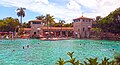
Venetian Pool in Coral Gables, Florida, June 2016
LocationCoral Gables, Florida, United States
Coordinates25°44′46″N 80°16′27″W / 25.74611°N 80.27417°W / 25.74611; -80.27417
Area4 acres (16,000 m2)
Built1924
ArchitectPhineas Paist
NRHP reference No.81000193[1]
Added to NRHPAugust 20, 1981
Kids diving off rock hill at the Venetian Pool tourist attraction in Coral Gables, Florida in the 1940s

Venetian Pool is a historic U.S. public swimming pool located in Coral Gables, Florida. Completed in 1924, it was designed by Phineas Paist with Denman Fink.[2]

History

[edit]

Venetian Pool, opened in 1924 as "Venetian Casino," was created from a 4-acre (16,000 m2) old limestone quarry, abandoned in 1921. The pool was founded by George Merrick as part of the development of Coral Gables, which was created in Mediterranean Revival style and utilized a large amount of limestone for ornamental features of the community. The remaining quarry was reconfigured by architect Phineas Paist and designed by artist Denman Fink. Named for the Mediterranean city of Venice, Italy, the pool included a Venetian style bridge and classic mooring posts.[2][3][4]

Venetian Pool has gone through several phases. A large additional island was created to allow Venetian-style gondolas to dock alongside, though the gondolas were later removed. A high diving platform was constructed above the grand waterfall and was also later torn down. Early in its history, the pool was regularly drained completely to permit the Miami Symphony to perform in it, taking advantage of the quarry's natural acoustic qualities. In 2001, to celebrate the 75th anniversary of Coral Gables, the pool was once again drained for an orchestral performance. A 1989 renovation restored many of the pool's original features.[4]

In 1981, Venetian Pool was added to the National Register of Historic Places, and is the only pool listed on the register.[2][4]

Description

[edit]

The pool occupies a shallow quarry displacing some 820,000 US gallons (3,100 m3) of fresh water daily from artesian wells, making it the largest freshwater pool in the United States.[4]

The pool ranges in depth from four feet to depths of over eight feet near the grand waterfall, with a two-foot kiddy pool near the lifeguard station; the station is atop a bridge leading out to an island with two full size palm trees on it. A grotto, where natural water-filled caves stretch back over twelve feet into the hillside, is located across the pool from the island. There is a sandy sunning area for sunbathers and a café area that is commonly used for weddings and receptions. A walking path surrounds the whole complex.

The pool received a massive historical restoration in 1989.[2] The pool had another major renovation (and was closed to the public) between September 8, 2008 and April 30, 2009.

Sustainability

[edit]

The pool has come under criticism from environmentalists due to the massive amounts of fresh water it uses daily, raising concerns that the process of completely draining the pool every night and refilling it the following day was depleting the Floridian aquifers. In 1998 a solution was devised to drain the water back into the aquifer, using natural ground filtration, thus recycling the precious natural resource, while allowing the pool to maintain its fresh, clear water.

Hours of operation

[edit]

The Venetian Pools operate from Tuesday to Sunday from February 1, 2022, to March 19, 2022. Guests can attend the pool from the hours of 10 a.m to 4:30 p.m during these dates. The Venetian Pool's operation dates and times change frequently. From March 21 to May 29 of 2022, the pools hours of operation are 11 a.m to 4:30 p.m Tuesday through Friday. On Saturday and Sunday, the Venetian Pool is open from 10 a.m to 4:30 p.m. From May 30 to August 14 of 2022, the pool is open Monday through Friday from 11 a.m to 6:30 p.m and 10 a.m to 4:30 p.m for Saturdays and Sundays. From September 6 to October 23 of 2022 the Venetian Pool will be open from Tuesday through Friday from 11 a.m to 5:30 p.m. Lastly, From October 25 to November 27 of 2022, the Venetian Pool is open from 10 a.m to 4:30 p.m Tuesday through Sunday. The Venetian Pool is closed on certain holidays, which include: New Year’s Day, Martin Luther King Day, President’s Day, Thanksgiving Day, Day after Thanksgiving, Christmas Eve, and Christmas Day.[5][6]

Admission

[edit]

Admission varies, depending on whether or not the guest is a Coral Gables resident. For residents 13 years and older, admissions prices are $6.50. Any children ranging from ages 3 to 13 have an admissions price of $5.50. Non-residential children must pay $16 and adults $21 for admission. At the venue, lawn chairs and life jackets are readily available.[7][8]

[edit]

References

[edit]
[edit]
Revisions and contributorsEdit on WikipediaRead on Wikipedia
from Grokipedia
The Venetian Pool is a historic public located in , constructed in 1924 from a former coral rock quarry that supplied for the city's early buildings. Designed in the Mediterranean Revival style by artist Denman Fink and architect Phineas Paist under the direction of city founder George Merrick, it originally opened as the "Venetian Casino" to promote in the burgeoning community. The pool holds 820,000 gallons of fresh spring water drawn daily from an underground and refilled each night, creating a serene lagoon-like environment with features including cascading waterfalls, grottos, caves, an arched bridge, and two towers. As a centerpiece of Merrick's vision for a Mediterranean-inspired "City Beautiful," the Venetian Pool was built by skilled Bahamian stonemasons who quarried and shaped the 60,000 square feet of coral rock on-site, often under challenging conditions during the era of racial segregation. In its early years, it served as a glamorous social hub, hosting orchestras like those led by Jan Garber and Paul Whiteman, lectures by figures such as William Jennings Bryan, swimming exhibitions by stars including Annette Kellerman and Johnny Weissmuller, and even a 1926 opera performance by the Miami Grand Opera Company after the pool was drained. The site was sold to the City of Coral Gables in 1927 by Merrick's Coral Gables Corporation, ensuring its preservation as a public amenity. Recognized for its architectural and cultural significance, the Venetian Pool was added to the on August 20, 1981, as one of the few swimming pools to receive this distinction. It underwent major historic restorations in 1989 and later, including the addition of water recirculation systems while maintaining original elements like loggias, porticos, and palm-shaded landscapes, as well as a centennial restoration in 2025. As of November 2025, it is undergoing final centennial renovations and scheduled to reopen later in the year, drawing locals and tourists to experience its blend of natural beauty and opulence.

History

Origins and Construction

The Venetian Pool originated as a key element in developer George Merrick's ambitious vision for Coral Gables, a planned Mediterranean Revival community in . In 1924, during the height of the land boom, Merrick founded the site as the "Venetian Casino" to serve as a luxurious public attraction, drawing tourists and prospective residents to showcase the city's aesthetic and recreational appeal. This initiative was part of Merrick's broader "City Beautiful" plan, which emphasized grand, European-inspired features to elevate Coral Gables as a premier destination. The pool was constructed by transforming a four-acre abandoned rock into a naturalistic , utilizing the site's existing to create a dramatic venue. The had previously supplied oolitic , a porous local stone, for prominent Coral Gables buildings, including the Biltmore Hotel and Merrick's family residence. Workers lined the pit with concrete and integrated native rock formations to form pools, cascades, and grottos, preserving the quarry's rugged character while adapting it for recreation. This not only resolved an industrial eyesore but also highlighted the resourceful use of local materials in the city's early development. Architect Phineas Paist, as supervising architect, and artist Denman Fink, Merrick's uncle and art director, led the design, infusing Venetian-inspired motifs such as arched bridges, loggias, and observation towers clad in and barrel tiles. Their collaboration emphasized romantic, lagoon-like elements reminiscent of , including artificial waterfalls and shaded porticos, to evoke an exotic escape. Much of the quarrying and stonework was performed by Bahamian immigrant laborers, skilled stonemasons who migrated to and played a vital role in Coral Gables' infrastructure, crafting the pool's features amid challenging conditions during the segregated labor market. The Venetian Casino opened to the public in December 1924, accommodating large crowds with its expansive 820,000-gallon capacity and facilities for , diving, and social events, quickly becoming a symbol of Coral Gables' allure amid the land boom's frenzy.

Milestones and Preservation

Following its opening amid the exuberant land boom, the Venetian Pool played a pivotal role in promoting Coral Gables as a burgeoning Mediterranean-style community, drawing visitors and fostering social cohesion through public events and leisure activities that highlighted the city's visionary development. In its early years, it served as a glamorous social hub, hosting orchestras led by Jan Garber and , lectures by , exhibitions by Annette Kellerman and , and a 1926 performance by the Miami Grand Opera Company after the pool was drained. The site was sold to the City of Coral Gables in by Merrick's Coral Gables Corporation, ensuring its preservation as a public amenity. As the boom collapsed into an economic bust by the late , exacerbated by hurricanes and over-speculation, the pool transitioned into a vital community anchor, providing affordable recreation and unity for residents facing financial hardships and the onset of the . In its early decades, the pool served multifaceted purposes beyond swimming, including as a natural amphitheater for cultural events; it was periodically drained to host orchestral performances, capitalizing on the quarry's acoustics, with a notable instance occurring in 2001 when the Symphony Orchestra staged a concert on the emptied basin to commemorate Coral Gables' 75th anniversary. On August 20, 1981, the Venetian Pool was listed on the , a designation that underscores its unique architectural and cultural significance as the only public swimming pool in the United States to receive this honor. The City of Coral Gables has actively pursued preservation initiatives to safeguard the site against urban development pressures, including ongoing restorations that balance historical integrity with modern needs, as evidenced by its inclusion in the city's Program and commitments to maintain its National Register status. In 2024, marking the pool's centennial since its 1924 debut, it was recognized as one of Coral Gables' iconic structures from that year.

Design and Features

Architectural Style

The Venetian Pool exemplifies the Mediterranean Revival architectural style, drawing direct inspiration from the historic canals and structures of , , to create an immersive, romantic environment within the subtropical setting of . This style is characterized by its use of rustic, textured materials and ornamental details that evoke ancient Mediterranean quarries and Renaissance-era aesthetics, blending seamlessly with the broader architectural vision for as a cohesive Mediterranean-themed community. Key Venetian elements are prominently incorporated, including arched stone bridges that span the water, colorful mooring posts reminiscent of those along the Grand Canal for securing gondolas, and tower-like observation structures that add vertical drama and panoramic views. The facades and walls are constructed from local oolitic —often referred to as coral rock—quarried on-site, providing a rugged, natural texture that mimics weathered Italian stone while harmonizing with the surrounding landscape and Coral Gables' signature building materials. This material choice not only ensures durability in the humid climate but also contributes to the escapist, paradise-like atmosphere intended by the designers. The architectural vision was a collaborative effort between Phineas E. Paist, who served as the supervising architect responsible for the structural elements, and Denman Fink, the art director who handled the ornamental and artistic details, resulting in a unified design that prioritizes aesthetic fantasy over strict functionality. At a scale of 60,000 square feet and with a capacity of 820,000 gallons, the pool serves as a monumental that captures the grandeur of Mediterranean heritage.

Key Attractions

The Venetian Pool's central waterfall, located on the northwest side and formed from natural coral rock, cascades into the main , creating a serene, spa-like atmosphere that enhances the swimming experience with its gentle flow and surrounding rock formations. This feature draws visitors seeking a refreshing plunge amid the pool's Mediterranean Revival-inspired design, where the water's movement provides a sensory contrast to the still depths below. Adjacent to the waterfall, the grottos feature natural coral caves carved from the quarry bedrock, offering swimmers opportunities for exploration through dimly lit underwater passages and sheltered alcoves that evoke a sense of adventure and seclusion. These cave-like structures, integrated into the irregularly shaped two-acre pool, allow for intimate interactions with the site's oolitic geology, where visitors can navigate hidden nooks while enjoying the cool, shaded interiors. At the pool's heart lies a central , originally adorned with three palm trees for a tropical ambiance, serving as a lounging spot that divides the shallow and deeper sections of the water. Connected by a Venetian-style and bridge—reminiscent of —this island links to the café area, enabling easy access for relaxation and refreshments amid the palm-shaded vista. Nearby, a walled-in sandy sunning on the east side provides a beach-like expanse for basking in the sun, blending aquatic and terrestrial leisure in a cohesive visitor experience. Complementing these elements are diving platforms hewn from natural coral rock on the northwest side, inviting adventurous leaps into the deeper , and shaded loggias with red barrel-tile roofs and Cuban tile floors, which offer respite from the sun in elegant, columned enclosures. Together, these amenities foster a multifaceted sensory engagement, from the thrill of diving and to the tranquility of shaded lounging and bridge-side strolls.

Sustainability and Operations

Water Management Practices

The Venetian Pool has a capacity of approximately 820,000 gallons and historically drew fresh spring water daily from artesian wells tapping into the underlying Biscayne Aquifer. Prior to 2025, this practice ensured the pool remained filled with naturally cool, clear water with minimal chlorination limited to 1 part per million. To maintain and , the pool was drained nightly during peak season, allowing for natural as the water percolated through the site's coral rock and before re-entering the . This geological process acted as an effective, chemical-free purification method, leveraging the porous oolitic characteristic of 's geology to remove impurities. In 1998, the pool was retrofitted with two injection wells located across the street, enabling the drained water to be pumped at high velocity back into the approximately 100 feet underground. This system addressed earlier criticisms of aquifer overuse by recycling the water sustainably, reducing freshwater withdrawal while preserving the pool's historic operational rhythm. Following the 2024-2025 , a new water recirculation pump system was installed, eliminating the need for daily draining and refilling. This upgrade maintains using the Biscayne Aquifer spring water source, reduces water loss and chemical use by 40%, and prevents issues such as . These water management practices comply with Florida's environmental regulations for aquifer protection, overseen by the South Florida Water Management District and the Department of Environmental Protection, which emphasize preventing degradation of groundwater resources through permitted injection and recharge methods. By integrating modern infrastructure with the site's natural filtration, the Venetian Pool balances its status as a landmark with contemporary sustainability goals, minimizing ecological impact on the vulnerable .

Maintenance and Upgrades

The Venetian Pool underwent a significant historical renovation in 1989, which focused on restoring many of its original architectural and landscape features, including the coral rock carvings, caves, bridges, and waterfalls, while blending new plantings with the existing environment to preserve the site's integrity as a landmark. In 1998, the pool was retrofitted with injection wells to enable sustainable water recycling, allowing drained water to be returned to the underlying for natural without visible alterations to the historic appearance. A second major renovation occurred in 2008, marking one of only two comprehensive upgrades in the pool's history up to that point, which addressed structural and operational needs to maintain functionality. In 2024-2025, as part of the centennial celebration, the pool underwent another major renovation, including overhauls to pumps, plumbing, electrical, and piping systems; installation of a new water recirculation system; and sealing with eco-friendly materials, all while preserving historic elements. The pool was closed from October 2024 and reopened in fall 2025. Subsequent enhancements integrated modern elements such as improved and features, including an for entry and free lifejackets, all while safeguarding the historic coral rock elements. Routine annual maintenance occurs during the winter closure from December to January, involving inspections and repairs to address coral rock erosion from constant water exposure and ensure compliance with public safety codes for the aging structure.

Visitor Information

Access and Admission

The Venetian Pool, located at 2701 De Soto Boulevard in , remains closed for renovations as of November 2025, with water pump and drainage upgrades tested successfully in early November; reopening is expected imminently, with no exact date announced, in time for seasonal operations and December events. When operational, the facility typically opens for the season from early spring through late fall, with hours varying by day: Tuesdays through Fridays from 11:00 a.m. to 5:30 p.m., and Saturdays and Sundays from 10:00 a.m. to 4:30 p.m. Admission is managed through an online ticketing system to guarantee entry, as the pool reaches capacity daily and stops in-person sales once full; tickets cannot be refunded or transferred, and visitors must present photo ID for resident discounts, verified via Miami-Dade property records. As of the 2025 fee schedule, admission fees differ by residency, age, and season: Coral Gables residents pay $7 for adults (13 and older) and $6 for children (3-12 years) year-round, while non-residents pay $23 for adults and $18 for children in summer (April-October, peak season including through ) or $18 for adults and $12 for children in winter (November-March, off-peak); rates for seniors (62+) are not separately specified. Entry procedures require visitors to check in at the admission office with printed or digital tickets, followed by a screening; is available in two on-site lots—one directly adjacent to the facility and another across from the De Soto Fountain entrance—with spaces filling quickly on weekends, though no specific parking fees are charged. Groups of 10 or more must make advance reservations through the online portal or by contacting the facility directly to secure availability, particularly for birthday parties or larger gatherings, which include reserved seating areas and additional setup fees starting at $250. Accessibility accommodations include ADA-compliant features such as ramps, an for pool entry, accessible , and free lifejackets provided by lifeguards upon request. Visitors must wear proper swim attire—such as lined swimsuits—without street clothes or restrictive garments in the water, and all must shower before entering the pools; service animals are permitted, but no other pets. Capacity is limited to maintain safety and , with certified lifeguards enforcing rules in deeper areas, and post-renovation health protocols continue to emphasize enhanced cleaning, no containers or alcohol, and restrictions on in the pool zones to prevent contamination. The renovations include a new water recirculation system to improve and .

Events and Activities

The Venetian Pool serves as a versatile venue for private parties, weddings, and corporate events, leveraging its picturesque grottos, waterfalls, and arched bridges to create enchanting settings for gatherings. are available from closing time until 10:00 p.m. year-round, accommodating formats such as intimate dinners, themed celebrations, and professional functions with options for reserved patios, tables, and chairs. Seasonal programs at the pool emphasize recreational and fitness opportunities, including semi-private swim lessons for children and adults taught by volunteers from the Venetian Aquatic Club using techniques—a tradition spanning over 60 years. Aqua aerobics sessions, branded as Aqua Fit, offer low-impact workouts in both shallow and deep water areas, suitable for various fitness levels and promoting cardiovascular health without joint strain. Family-oriented activities, such as outdoor movie screenings, further enhance community engagement during warmer months. Cultural events at the Venetian Pool blend history and artistry, with the site's centennial marked by guided historical tours exploring its transformation from a coral rock quarry to a Mediterranean-inspired . These commemorations included educational programs on its architectural and social legacy, drawing visitors to reflect on its role in Coral Gables' development. Orchestral performances have long been a highlight, with the pool occasionally drained to form a natural amphitheater where ensembles perform on the exposed floor, echoing early 20th-century traditions of and concerts. The Miami Symphony Orchestra has contributed to this heritage through special appearances, including a scheduled December 7, 2025, concert under the stars as the finale of Coral Gables' centennial celebrations (city founded 1925). Such events, last notably revived in 2001 for the city's 75th anniversary, underscore the pool's acoustic uniqueness and cultural draw. Community outreach initiatives include weekday field trips for school groups, providing hands-on experiences with the site's and ecology, and collaborations with local arts organizations like the Venetian Aquatic Club for volunteer-led educational swims. These programs foster inclusivity, partnering with entities such as the Miami Symphony Orchestra for broader cultural access.

References

Add your contribution
Related Hubs
User Avatar
No comments yet.