


Community hub
Recent from talks
Contribute something
Nothing was collected or created yet.
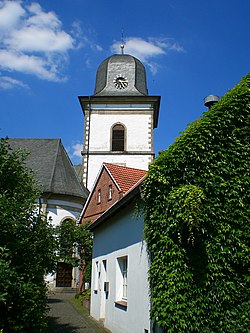
Verl (German: [fɛʁl] ⓘ) is a town in the district of Gütersloh in the state of North Rhine-Westphalia, Germany. It is approximately 15 km south of Bielefeld and 10 km east of Gütersloh.
Key Information




Geography
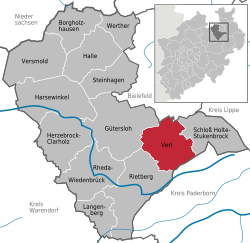
[edit]Verl is located in Ostwestfalen-Lippe in a triangle formed by Gütersloh (9.2 km), Bielefeld (15.4 km), and Paderborn (25.1 km). The administrative region for the town is Detmold. The urban area for the town is located in the large landscape area of the North German Plain, in a subarea of the Westphalian Lowland.
The rivers that cross through the town are the Dalke, Menkebach, Ellbach, Sennebach, Furlbach, and Wapelbach streams. The Ellbach is joined by the Landerbach while the Wapelbach is joined by the Rodenbach. The Sennebach drains directly into the Ems, into which all the streams that cross through Verl flow northeast/southwest from the Teutoburg Forest. To protect nearby towns from flooding, a flood basin called Wapelbecken I was established in 2011, followed by Wapelbecken II in 2023.
The town covers an area of 71.36 km². The majority of the town's area consists of agricultural land, buildings, and open spaces, together accounting for approximately 86%, followed by forest and traffic areas, accounting for approximately 8.5%. Verl is sparsely forested compared to the rest of the Gütersloh district, with a forest cover of only around 6.4%.
History
[edit]The name Verl was first mentioned in the expression 'Henricus de Verlo', which can be found in a charter from 1264.[3] The designation probably relates to the farm estate Meier zu Verl, which belonged to a group of four estates that presumably came into existence around the turn of the first millennium. Some earlier documented references to estates in this area can be dated back to the year 1188.
In 1512, a chapel was built in the farming community. This chapel was turned into a parish church in 1577 and, since then, has marked the social center for the communities of Verl, Sende and Bornholte. Count Wenzel Anton von Kaunitz-Rietberg sponsored the building of the church of St. Anna at the location of the former chapel in 1792. The construction of this classical hall church was completed in 1801.[3]

Until the establishment of the Kingdom of Westphalia in 1807 during the Napoleonic period, Verl belonged to the County of Rietberg. From 1807 on, the county was divided into two administrative districts (called cantons) -- Rietberg and Neuenkirchen—comprising the now independent municipalities of Verl, Bornholte, Sende, Liemke, and Österwiehe. After the Congress of Vienna in 1815, the districts where incorporated into the newly created district of Wiedenbrück.
On July 1, 1838, the canton administration was moved from Neuenkirchen to Verl and, in addition to the aforementioned municipalities, the village of Kaunitz was added to the newly created canton of Verl. With the introduction of a new local government code in the Kingdom of Prussia on October 31, 1841, the canton's name was changed to Amt Verl (meaning department). By this time, Verl already had 6,786 inhabitants.
During World War I, more than 350 citizens fell victim to the conflict, and the ensuing aftermath left the district in economic struggle.[4] After the Nazi seizure of power, the town square was renamed to "Hindenburg-Hitler-Platz" as part of a campaign of name changes across the country.[5] The name remained until the fall of Nazi Germany.
Another adjustment to the local government code was carried out on January 1, 1970, constituting the current city limits. Now simply called Verl, the municipality consists of five administrative units (Verl, Bornholte, Sürenheide, Sende, and Kaunitz) and belongs to the district of Gütersloh. Verl is a town as of 1 January 2010. In 2017, the town was declared "culturally significant" by the LWL-Geodaten Kultur organization.[6]
Culture
[edit]Musical festivities
[edit]In the town, the Verl Music Association hosts an annual concert every January. At the Verl Comprehensive School's Pedagogical Center, the brass band presents an annual program of marching band, polka, and samba performances, as well as films and musical hits. Since 1970, the Verl Kolping Theater has performed a play annually. Every spring, for two weeks, the school's auditorium is transformed into a small theater.
Places of interest
[edit]- St. Anna Church
- Timbered houses from the 16th century
- Flea market "Hobbymarkt" - one of the largest flea markets in Germany, every first Saturday of the month[7]
- Verl Button Museum - founded in a former print building in 2014[8]
- Village Mill - Oldest mill in the Verl municipal area, listed as an architectural monument since 1991

Sport
[edit]SC Verl, an association football club, was founded on 6 September 1924,[9] and since 1970 has consistently played in the higher echelons of amateur football. The club was promoted to the professional national third division in 2020 where it has played ever since.
In the town, twelve different homing pigeon clubs are represented as of 2006.[10]
In 2021, the town of Verl applied to be a host city for an international program as part of the 2023 Special Olympics World Summer Games in Berlin. For the occasion of the Olympics, the town was selected to host the Honduran chapter of Special Olympics International.[11] The delegation consisted of 25 people and were to stay in the city for four days total.[12]
Sister cities
[edit]Verl has sister city relationships with the following two cities:[13]
 Annaburg, Saxony-Anhalt, Germany (1990)[14]
 Delphos, Ohio, United States (1999)


The sister relationship with Annaburg was established in 1990, shortly after the Fall of the Berlin Wall. In the first few years of the relationship, Verl assisted Annaburg in finding a new administration, which would eventually help create new connections between the two cities.
The sister relationship was Delphos was founded in 1999. The town was founded in the 1800s by pastor Johannes Otto Bredeick, a native of Verl, after a period of famine had struck North Rhine-Westphalia.[15] Periodic visits and a student exchange happen between the two towns every year since the sister relationship went into effect.[13]
| Year | Pop. | ±% |
|---|---|---|
| 1849 | 7,144 | — |
| 1871 | 7,245 | +1.4% |
| 1890 | 7,633 | +5.4% |
| 1910 | 9,811 | +28.5% |
| 1930 | 12,566 | +28.1% |
| 1938 | 14,324 | +14.0% |
| 1948 | 18,432 | +28.7% |
| 1956 | 20,396 | +10.7% |
| 1969 | 26,497 | +29.9% |
| Population for Amt Verl | ||
Demographics
[edit]After the recognition of the Verl Municipality in the 1970s, parts of Amt Verl were incorporated into Schloß Holte-Stukenbrock or Bielefeld, drastically reducing its area and population size.[16] From 1975 onwards, demographic data for the town is compiled by the State Office for Information and Technology (NRW).[17]
Religion
[edit]In the town, the St. Anna Catholic Church merged with the St. Maria Immaculata of Kaunitz and the Church of St. Judas Thaddäus in 2001. As of the most recent 2022 census, 44.7% of the town's population was Roman Catholic while 17.1% were Protestant; the remaining 38.2% declared other religious affiliations or none.[18]
Verl is also a stronghold of Germany's Assyrian community, the majority of whom belong to the Syriac Orthodox Church. Several associations, such as Suryoye Verl, operate to represent the town's Assyrian community.[19] The town also has a New Apostolic Church and a Baptist house for worship.
| Year | Pop. | ±% |
|---|---|---|
| 1970 | 15,077 | — |
| 1980 | 18,799 | +24.7% |
| 1990 | 19,778 | +5.2% |
| 1995 | 21,266 | +7.5% |
| 2000 | 23,573 | +10.8% |
| 2004 | 24,403 | +3.5% |
| 2010 | 25,084 | +2.8% |
| 2015 | 25,533 | +1.8% |
| 2020 | 25,976 | +1.7% |
| 2023 | 26,201 | +0.9% |
| Population for Verl Municipality Source: [20][21] | ||
Politics
[edit]Coat of arms
[edit]In 1970, the council of the newly formed municipality of Verl decided to enact a coat of arms and banner.[22] The coat of arms of the town of Verl is divided into four areas. In the center of the coat of arms is a golden shield. The first and fourth areas of the coat of arms contain a green background with silver oak trees with two golden acorns, while the second and third contain the same imagery with opposite coloration. On the coat of arms of the District of Verl are five diamonds that represent the five municipalities belonging to Amt Verl in the Prussian Kingdom; Verl, Bornholt, Senden, Liemke, and Österwiehe.
-
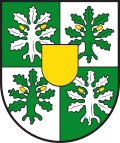 Town of Verl Coat of Arms
 -
 Town banner
 -
 Town flag
 -
 District of Verl Coat of Arms


Logo
[edit]Since 2014, the town of Verl has employed a logo to represent itself publicly.[23] The logo was chosen after a competition took place among several agencies and representatives.[24] The logo contains five multi-colored lines of differing length and the slogan "City of Verl – A Good Reason" (German: Stadt Verl – Ein guter Grund).
Economy
[edit]Until the end of the 19th century, Verl consisted of only small craft businesses, mainly engaged in wood and meat processing with some brickworks. Today, the town is host to a number of strategically important companies and their headquarters/branches including Beckhoff New Automation Technology,[25] Bertelsmann Financial Services,[26] Teckentrup,[27] Heroal,[28] and Nobilia.[29]
Verl is one of the strongest municipalities in the state of North-Rhine Westphalia financially, due to consistently high trade tax revenues. In 2018, these revenues totaled €54.5 million, and the town's budget's equity amounted to €237.8 million.[30] The town also has the second-lowest trade tax assessment of all state municipalities.[31]
Notable people
[edit]References
[edit]- ^ Die Glocke: Verls neuer Bürgermeister heißt Robin Rieksneuwöhner
- ^ "Alle politisch selbständigen Gemeinden mit ausgewählten Merkmalen am 31.12.2023" (in German). Federal Statistical Office of Germany. 28 October 2024. Retrieved 16 November 2024.
- ^ a b "Stadtgeschichte". Stadt Verl (in German). Verl. Archived from the original on 21 December 2015. Retrieved 4 June 2025.
- ^ Thöring, Von Roland. "Als der Erste Weltkrieg nach Verl kam". Neue Westfälische (in German). Retrieved 2025-06-25.
- ^ "Verl". www.lwl.org. Retrieved 2025-06-25.
- ^ "Kulturlandschaftlich bedeutsamer Stadt- und Ortskern Verl". www.lwl.org. Landschaftsverband Westfalen‑Lippe (LWL). Retrieved 2025-06-18.
- ^ "Ostwestfalenhalle | Stadt Verl". www.verl.de (in German). Retrieved 2025-07-01.
- ^ Glocke, Die (2014-09-04). "Knopfmanufaktur ist mehr als Museum". www.die-glocke.de (in German). Retrieved 2025-06-18.
- ^ Grüne, Hardy (2001). Vereinslexikon. Kassel: AGON Sportverlag ISBN 3-89784-147-9
- ^ "Brieftaubenzuchtvereine" (PDF). www.verl.de. VERL erleben!. 2006. p. 64. Archived from the original (PDF) on 2009-05-30. Retrieved 2025-06-24.
- ^ "Baden-Württemberg" (PDF). assets.berlin2023.org. March 2023. Retrieved 18 June 2025.
- ^ "Verl App: Special Olympics: Delegation aus Honduras erwartet". Verl App (in German). 25 May 2022. Retrieved 2025-06-18.
- ^ a b "Städtepartnerschaften | Stadt Verl". www.verl.de (in German). Retrieved 2025-06-04.
- ^ "Städtepartnerschaften". www.verl.de. Archived from the original on 21 December 2015. Retrieved 4 June 2025.
- ^ Meißner, Frithjof. "Ursprung und Geschichte der Partnerschaft Verl - Delphos". Amerikanetz (in German). Archived from the original on 19 September 2011. Retrieved 4 June 2025.
- ^ "Gesetz zur Neugliederung der Gemeinden und Kreise des Neugliederungsraumes Bielefeld (Bielefeld-Gesetz)" (PDF). www.bielefeld.de. 24 October 1972. Archived from the original (PDF) on 2020-03-20. Retrieved 2025-07-01.
- ^ "Federal Statistical Office Germany - GENESIS-Online". www.landesdatenbank.nrw.de. 2025-07-02. Retrieved 2025-07-01.
- ^ "Zensusdatenbank: Ergebnisse des Zensus". ergebnisse.zensus2022.de. Retrieved 2025-07-01.
- ^ "30 Jahre Assyrischer Mesopotamien Verein Gütersloh". Bethnahrin (in German). 2012-06-25. Retrieved 2025-07-01.
- ^ "Amtliche Bevölkerungszahlen" (in German). IT.NRW. 2010. Archived from the original on 28 September 2011.
- ^ "Entwicklungskonzept Fortschreibung: Verl 2020" (in German). City of Verl. December 2008. Archived from the original on 8 December 2015.
- ^ Verl, Stadt. "Stadt Verl · Das Wappen der Stadt Verl". www.verl.de (in German). Archived from the original on 2015-08-26. Retrieved 2025-06-18.
- ^ "Stadt Verl · Das Logo". www.verl.de. Archived from the original on 2015-09-17. Retrieved 2025-06-18.
- ^ THÖRING, VON ROLAND. "Elegant und stark zugleich". Neue Westfälische (in German). Retrieved 2025-06-18.
- ^ "Company". Beckhoff Automation. Hülshorstweg 20, 33415 Verl, Germany: Beckhoff Automation GmbH & Co KG. Retrieved 2025-06-22.
{{cite web}}: CS1 maint: location (link) - ^ "Locations –". arvato.com. Retrieved 2025-06-22.
- ^ "Garage doors, doors and industrial doors from Teckentrup". www.teckentrup.biz. Retrieved 2025-06-22.
- ^ "Über heroal | Familienunternehmen mit langer Tradition". www.heroal.de (in German). Retrieved 2025-06-22.
- ^ "Europe's leading kitchen manufacturer". nobilia Küchen. Retrieved 2025-06-22.
- ^ Schmidt, Barbara; Schönauer, Heribert (2019). "Haushaltsplan 2020" [Budget 2020] (PDF). verl.de (in German). Verl: Stadt Verl. Archived from the original (PDF) on 29 October 2020. Retrieved 22 June 2025.
- ^ Esken, Michael (8 October 2019). "Haushaltsrede 2020: Bürgermeister Michael Esken" (PDF). verl.de (in German). Verl. Archived from the original (PDF) on 27 October 2020. Retrieved 22 June 2025.
External links
[edit]

Towns and municipalities in Gütersloh (district) | ||
|---|---|---|
 | ||
| International | |
|---|---|
| National | |
| Geographic | |
| Other | |

Geography and environment
Location and administrative divisions
Verl lies at coordinates 51°52′59″N 8°31′00″E within the Gütersloh district of North Rhine-Westphalia, Germany. The town occupies an area of 71.36 square kilometers and holds the administrative status of a municipality (Stadt) in the Regierungsbezirk of Detmold. Positioned approximately 15 kilometers south of Bielefeld and 10 kilometers east of Gütersloh, Verl forms part of the Ostwestfalen-Lippe region.[7] The municipality encompasses the core area of Verl along with the Ortsteile of Bornholte, Kaunitz, Sende, and Sürenheide, which were integrated into the modern town structure following earlier administrative consolidations.[8] [9] Verl benefits from proximity to the Bundesautobahn 33, which facilitates connections northward to Bielefeld and southward toward Paderborn. Regional rail services operate through stations including Verl Bahnhof and Bornholte Bahnhof, linking the town to the broader Deutsche Bahn network for commuter and intercity travel.[10] [11]Physical features and climate
Verl occupies a portion of the Westphalian Lowland, a flat to gently rolling plain typical of the Westphalian region in northwestern Germany, with terrain shaped by glacial and fluvial processes resulting in low-relief landscapes dominated by arable land. Elevations within the municipality vary between approximately 80 and 105 meters above sea level, averaging 94 meters, which supports extensive agricultural use rather than rugged topography.[12] [13] Small streams and drainage channels traverse the area, facilitating irrigation and preventing waterlogging in the fertile soils, though no major rivers originate or dominate locally. Forest cover remains sparse, comprising scattered woodlands amid predominantly cultivated fields, reflecting historical land clearance for farming.[14] The local climate falls under the Köppen classification Cfb (oceanic), characterized by mild temperatures, moderate humidity, and no prolonged dry season, influenced by Atlantic westerlies moderated by the region's inland position. Average annual temperatures hover around 9-10°C, with winter lows typically above freezing (rarely below -8°C) and summer highs peaking near 23°C, though extremes can reach 30°C or lower. Precipitation averages 800-900 mm yearly, fairly evenly distributed but with a slight summer maximum, supporting consistent crop growth without irrigation dependency in most years; data from regional stations indicate about 7-10 rainy days per month on average.[15] [16] [17]History
Early origins and medieval development
The earliest evidence of human settlement in the Verl area dates to the early Middle Ages, with archaeological excavations uncovering structural remains and artifacts indicative of agricultural communities predating written records, likely from the 8th to 10th centuries. These findings, including post-built houses and pottery, point to dispersed farmsteads in a landscape suited to arable farming and pastoralism, consistent with broader patterns of Frankish colonization in Westphalia.[18][19] The first documentary reference to a specific farmstead in the region appears in 1088, recording the "Hofstelle Krax" (Crackashardt) within the Bauernschaft Varensell as part of a local land register under ecclesiastical oversight. Additional farms, such as Ebbinghaus and Liemke, are attested in 1153 in a document from the Bishop of Paderborn, Bernhard von Oesede, reflecting the gradual consolidation of manorial holdings amid feudal fragmentation. By 1189, the farm Hoinchosen is noted as property of the Cistercian monastery at Marienfeld, illustrating ties to monastic land management that shaped rural economies through tithes and labor obligations.[20] In 1237, the territories encompassing Verl's Bauernschaften—Gütersorth, Bornholte, Sende, Österwiehe, and Liemke—were integrated into the newly established Grafschaft Rietberg, a comital domain under the Counts of Rietberg, which exerted seigneurial control via mills, courts, and tribute systems. The name Verl itself emerges in 1264, referenced through the witness "Henricus de Verlo" in a charter from the Rietberg county, deriving possibly from Old High German elements denoting a "distant wood" or forested edge, apt for the area's wooded fringes. By 1312, the settlement is designated "villa Verylo," including a mill, signaling nucleation around water resources and administrative nodes under noble oversight. A Meierhof (steward's farm) is documented in 1350 parish records from Neuenkirchen, underscoring the persistence of manorial agriculture with tenant obligations to the counts.[20][21] Medieval Verl remained a peripheral rural parish without a dedicated church until the late period; ecclesiastical needs were met by nearby Paderborn diocese structures until 1512, when construction began on the St. Anna Kapelle, funded by local donations as per a surviving charter, which anchored the village core and presaged growth under Rietberg patronage. This development coincided with the transition to early modern territorial consolidation, though the region endured recurrent pressures from noble feuds and agrarian cycles, with no evidence of urban features or significant trade hubs.[22][20]Modern period through World War II
In the 19th century, Verl remained predominantly agricultural, with local economy centered on farming and small-scale milling, as evidenced by surviving structures like the old village mill on the main street. Regional industrialization in Westphalia, including textiles and early machinery in nearby Gütersloh, exerted gradual influence, but Verl's development lagged, maintaining a rural character with limited factory establishment until the early 20th century.[23][24] Population growth reflected modest urbanization; estimates place Verl's residents below 5,000 around 1900, expanding to approximately 11,000 by the late 1930s amid broader Westphalian economic pressures and infrastructure improvements like road paving.[25] The interwar period saw alignment with national trends, including the rise of National Socialism; local administration integrated Nazi structures, with Josef Lükewille serving as NS-appointed mayor, enjoying reported popularity for administrative efficiency.[26] Systematic persecution of Verl's Jewish population occurred, mirroring Reich-wide policies of exclusion and expropriation, though specific resistance records remain sparse in municipal accounts.[27] During World War II, Verl contributed to the war economy through agricultural output and potential small-scale manufacturing, but escaped major Allied bombings that targeted larger centers like Gütersloh.[28] American forces occupied the area on April 1, 1945—Easter Sunday—marking the effective end of hostilities locally, with no documented large-scale combat or destruction in Verl itself.[29] Post-liberation denazification proceedings addressed figures like Lükewille, though detailed local complicity or opposition archives highlight everyday conformity over organized resistance.[26][30]Postwar expansion and recent events
Following the end of World War II on April 1, 1945, when American forces liberated Verl, the municipality focused on integrating displaced persons and expellees, including the establishment of a Displaced Persons Assembly Center in Kaunitz that housed up to 800 Jewish forced laborers until 1949.[20] Local reconstruction drew on the broader West German Wirtschaftswunder, with the founding of Nobilia-Werke in 1945 in Kaunitz marking the start of a manufacturing surge in kitchen furniture production, which expanded to employ thousands by leveraging export markets and industrial efficiencies.[31] [32] This private-sector initiative, rather than centralized planning, drove economic recovery, as Nobilia grew into Europe's largest kitchen producer with around 4,000 employees by the 21st century.[31] Administrative changes in the late 1960s reflected population pressures from postwar influxes and industrial jobs; the Amt Verl was dissolved on December 31, 1969, leading to the formation of the enlarged Gemeinde Verl on January 1, 1970, through the merger of Verl with Bornholte, Sende, Österwiehe, and portions of Schloß Holte and Varensell.[20] This consolidation, part of North Rhine-Westphalia's municipal reforms, supported infrastructure expansion, including the 1951 construction of the Evangelical Erlöserkirche for refugee communities and the 1977 completion of a central school complex with gymnasium.[20] Germany's 1990 reunification and deeper EU integration further boosted local manufacturing exports, with firms like Nobilia benefiting from tariff reductions and supply chain access, though Verl's traditional family-owned enterprises maintained resilience amid global competition.[32] In recent decades, Verl elevated to town (Stadt) status on January 1, 2010, amid sustained growth, with a 1995 memorial plaque in Kaunitz commemorating the 1945 liberation and a 2014 biomass heating plant enhancing energy sustainability.[20] The 2010 opening of the Nord-Ost-Umgehungsstraße bypass alleviated traffic from industrial zones, while the 2015 influx of refugees prompted local integration efforts, including expanded housing and vocational training tied to manufacturing needs, reflecting community-led responses over federal mandates.[20] By 2025, these developments underscored Verl's adaptation to demographic shifts, with ongoing infrastructure priorities focusing on efficient resource use rather than expansive welfare expansions.[20]Local government and politics
Municipal structure and elections
Verl's local government follows the framework established by the North Rhine-Westphalia Municipal Code (GO NRW), which mandates a directly elected full-time mayor (Bürgermeister) and a proportional city council (Stadtrat) for decision-making on municipal affairs including budgets, land use, and public services. The council, comprising 38 members, convenes to debate and vote on policies, with the mayor presiding over sessions, representing the town externally, and overseeing administrative execution of approved measures.[33] Robin Rieksneuwöhner of the Christian Democratic Union (CDU) serves as mayor, having won a direct election on January 21, 2024, with 66.37% of valid votes against competitors including the incumbent.[34] His term aligns with the standard five-year cycle under GO NRW, focusing on priorities such as economic development and community infrastructure.[35] Local elections occur every five years, with the most recent on September 14, 2025, yielding the following council composition from 11,275 valid votes cast (55.19% turnout among roughly 21,000 eligible voters):| Party | Vote Share | Seats |
|---|---|---|
| CDU | 56.30% | 22 |
| SPD | 13.41% | 5 |
| Grüne | 13.26% | 5 |
| FWG | 11.54% | 4 |
| FDP | 5.49% | 2 |
Heraldic symbols and emblems
The coat of arms of Verl features a quartered shield with alternating green and silver fields, each containing an oak tree: silver oaks with two golden acorns on green in the first and fourth quarters, and green oaks with two golden acorns on silver in the second and third quarters, overlaid by a central golden escutcheon.[39][40] Adopted by the municipal council on 16 April 1970 and officially approved on 31 January 1973, the design symbolizes the town's name origin from "Verlo," first recorded in 1264 and interpreted as "vier loh" or four forests, with the oaks representing wooded heritage and green hues emphasizing natural identity.[39][40] This emblem derives from the 1938 coat of arms of Amt Verl, the predecessor administrative unit comprising five communities merged into modern Verl on 1 January 1970; the Amt version retained the quartered oaks but substituted a blue Wolfsangel—a heraldic charge resembling a wolf trap—for the oaks in the second and third fields, while including five green lozenges in the central escutcheon to denote the constituent parishes of Bornholte, Liemke, Österwiehe, Sende, and Verl.[40][41] The Wolfsangel, employed in the Amt arms as a traditional Westphalian symbol with roots in medieval hunting implements designed to capture wolves, appears in numerous pre-modern German heraldic contexts, such as mason's marks and regional escutcheons, predating any 20th-century ideological uses by centuries.[42][43] Upon unification, Verl's council opted for the uniform four-oak motif to unify the shared arboreal theme across former Amt parishes, omitting the Wolfsangel and lozenges to reflect the new single-entity status rather than subsumption.[40] The municipal flag, granted alongside the coat of arms on 31 January 1973, consists of three horizontal stripes in green-yellow-green proportions of 1:3:1, with the coat of arms placed toward the hoist side.[44] A vertical banner variant exists for official display. These symbols, as state-recognized insignia under German municipal law, enjoy legal protection against unauthorized reproduction to preserve official identity.[39] Distinct from the town's heraldic emblems, local club logos—such as that of SC Verl, which retains a Wolfsangel element—stem from separate traditions and do not represent municipal authority.[45]Demographics
Population statistics and trends
As of January 1, 2025, Verl had a registered population of 26,524.[46] According to the 2022 census adjusted figures from the North Rhine-Westphalia state statistical office, the population stood at 25,522 on December 31, 2022, reflecting a net increase driven primarily by migration despite a negative natural balance.[47] The town's population has expanded steadily since the early 1990s, rising from 20,451 in 1992 to 25,522 in 2022, with annual averages around 0.5-1% growth in most years.[47] This trend aligns with broader district-level patterns in Gütersloh, where net migration contributed positively, such as +5,261 across the Kreis in 2022 through 29,680 inflows versus 23,701 outflows.[46] In 2022, vital statistics recorded 237 live births and 263 deaths, yielding a natural decrease of 26 residents.[47] Migration offset this, with 2,500 in-migrants and 2,124 out-migrants for a net gain of 376.[47]| Year | Population (Dec. 31) |
|---|---|
| 1992 | 20,451 |
| 1997 | 22,813 |
| 2002 | 24,014 |
| 2007 | 24,949 |
| 2012 | 24,892 |
| 2017 | 25,356 |
| 2022 | 25,522 |
Religious and ethnic makeup
As of the 2022 census, Roman Catholics constitute the largest religious group in Verl, numbering 11,306 individuals or approximately 44.7% of the total population of 25,291, reflecting a historical predominance in this East Westphalian region. Protestants follow with 4,332 adherents, or 17.1%, while the remaining 38.2% (9,653 persons) are either unaffiliated, belong to other faiths such as Islam, or have unknown affiliation. This distribution aligns with broader trends of declining church membership in Germany, driven by secularization and formal exits from tax-linked affiliations.[48] Catholic affiliation has notably decreased, with local reports documenting 2,288 exits from the Catholic Church over the prior two decades ending in 2021, reducing the share to roughly half the population amid patterns of dechurching observed across North Rhine-Westphalia.[48] Protestant numbers have similarly contracted, though smaller in scale, consistent with national Evangelical Church statistics showing overall Christian adherence below 50% in many western German locales. Smaller religious minorities, including Muslims primarily from Turkish migrant communities, exist but lack granular local enumeration beyond the aggregated "other" category in census data. Ethnically, Verl remains overwhelmingly composed of Germans of native descent, forming the vast majority of residents. Foreign nationals account for 2,828 individuals, or 11.1% of the population of 25,522 as of December 31, 2022, up modestly from 2,438 in 2017.[47] This foreign segment includes longstanding Turkish communities originating from mid-20th-century labor migration, alongside smaller groups from Eastern Europe such as Romanians and Poles, as indicated in Kreis Gütersloh integration monitoring where Romanians represent the largest non-EU nationality regionally.[49] No substantial recent alterations in ethnic structure are evident from census or security reports, maintaining relative homogeneity compared to urban centers in North Rhine-Westphalia.[47]Economy
Industrial sectors and key employers
Verl's economy is dominated by manufacturing, particularly in mechanical engineering, automation technology, and furniture production, which together employ a significant portion of the local workforce. The town's industrial base reflects the broader East Westphalia region's strengths in precision engineering and export-oriented production, with key sectors contributing to over 19,000 social insurance-covered jobs as of recent data.[50] Mechanical engineering and automation stand out, driven by innovations in PC-based control systems and industrial machinery, while furniture manufacturing focuses on high-volume kitchen and custom cabinetry production for global markets.[50] Beckhoff Automation, headquartered in Verl, is a leading employer in the automation sector, specializing in PC-based control technology for industrial applications. The family-owned company reported 5,300 employees worldwide as of March 2025, with approximately 3,400 based in Verl and its immediate surroundings, underscoring its role as a global market leader with revenues exceeding €1.17 billion in 2024.[51] Nobilia-Werke J. Stickling GmbH & Co. KG, Europe's largest kitchen furniture manufacturer, employs 4,523 workers in Verl, producing millions of cabinets annually for export, with 2022 revenues of €1.659 billion.[52] Other notable firms include heroal, which manufactures aluminum building profiles and employs around 800 locally; Elektro Beckhoff in electrical engineering with 975 staff; and Teckentrup in doors and gates with 900 employees, all emphasizing export-driven manufacturing.[50] Hermann Bock GmbH contributes to the medical furniture niche, producing care beds at its Verl facility with about 120 employees focused on sustainable, evidence-based designs for healthcare settings.[53] These industries highlight Verl's orientation toward high-value, technology-intensive production rather than services, with major employers maintaining strong international supply chains. Agriculture persists as a minor remnant, with few remaining farms reliant on EU Common Agricultural Policy subsidies for viability amid urbanization, though specific local farm counts remain limited in public data.[54]Growth and recent developments
Beckhoff Automation, a leading automation technology firm headquartered in Verl, expanded its logistics infrastructure in 2023 by planning a relocation to a new central warehouse in the Aurea industrial park in nearby Rheda-Wiedenbrück, increasing storage and handling capacities to meet rising global demand.[55] This initiative supported the company's 16% revenue growth to €1.75 billion for the 2023 fiscal year, driven by innovations in PC-based control systems and strong order intake.[56] Such investments have bolstered local employment and supply chain efficiency, with Beckhoff's production expansions in the Verl area exceeding 50% growth since early 2020.[57] Raumplus GmbH, specializing in customized sliding doors and wardrobe systems from its Verl base, announced preparations for an in-house trade exhibition from September 20 to 28, 2025, featuring new room solutions for specialist retailers and emphasizing modular design innovations.[58] This event underscores ongoing product development and market outreach, contributing to sustained job creation in manufacturing and design sectors amid Verl's focus on high-value interior fittings. These corporate advancements have driven employment gains in Verl, countering broader German industrial pressures like elevated energy costs, which reached €67.6 per MWh for wholesale electricity in early 2024—nearly double pre-2019 levels—and prompted efficiency upgrades in local operations.[59] Municipal support through infrastructure incentives and regional logistics hubs has facilitated these adaptations, maintaining Verl's competitive edge in export-oriented automation and furniture production.[60]Culture and society
Traditions, events, and festivities
Verl hosts several annual festivities rooted in Westphalian traditions, particularly Schützenfeste organized by local shooting guilds, which emphasize marksmanship competitions, parades, and communal celebrations. The St. Hubertus Schützengilde Verl holds its Schützenfest from July 5 to 7, featuring a bird-shooting contest to crown the Schützenkönig, accompanied by music from the Musikverein Verl and family-oriented events that draw local participants and visitors.[61] Similarly, the Verler Bürgerschützen celebrate their festival from August 2 to 4, incorporating processions and traditional attire, with recent updates including enhanced safety measures for the shooting events.[62] These gatherings, dating back centuries in the region, reinforce social bonds through guild memberships that include hundreds of active members across Verl's clubs.[63] A prominent secular event is the Verler Leben Volksfest, held over the first weekend of September—typically Friday to Sunday, such as September 5–7 in recent years—which attracts thousands of attendees with amusement rides, food stalls, and live music, serving as a central harvest-season fair since at least the early 20th century.[64][65] This festival complements the earlier "Verler Tod" event but stands as the primary annual market, highlighting local crafts and agriculture in line with Ostwestfalen's rural heritage.[66] Holiday observances in Verl adhere to broader North Rhine-Westphalian customs, including Christmas markets and Easter traditions, often integrated with guild activities for community processions, though without large-scale deviations from regional norms. Local surveys and municipal reports indicate these events contribute to high resident satisfaction in social integration, with participation rates exceeding 50% among eligible adults in guild-affiliated festivities.[67]Architectural and historical sites
The St. Anna Church stands as the primary historical and architectural landmark in Verl's town center, forming the core of the Kirchringbebauung, a preserved encircling development of traditional buildings that originated with its predecessor structure from 1512.[68] [69] The current church was consecrated in 1801, reflecting neoclassical influences while maintaining elements of the earlier ecclesiastical tradition in the region.[69] Surrounding the church, the Kirchringbebauung exemplifies preserved rural architecture, including half-timbered houses and farmsteads that trace back to medieval settlement patterns in the Ostwestfalen-Lippe area.[68] The Rathaus, serving as the municipal town hall, integrates modern functionality with historical site placement in the core urban fabric.[70] Hof Johannliemke represents a notable preserved farmstead, showcasing traditional Westphalian agricultural architecture with its characteristic low buildings and courtyard layout.[71] Additional sites include the Baroque Seppeler Kapelle and the Bunte Mühle, a colorful historic mill along the Ölbach stream, both contributing to Verl's inventory of protected monuments.[72] [73] Preservation efforts in Verl align with broader North Rhine-Westphalian initiatives for monument protection, though specific state-funded restorations for these structures are documented through local heritage associations.[73]Sports and local clubs
Sportclub Verl (SC Verl), founded in 1924, is the town's primary football club and competes in the 3. Liga, Germany's third division of professional football, following promotion from the Regionalliga West in 2020.[74] The club plays its home matches at the Sportclub Arena, which has a capacity of 5,153 spectators.[75] As of October 2025, SC Verl ranks among mid-table teams in the league, with recent results including a 4-2 victory over 1. FC Saarbrücken.[76] The club's emblem incorporates the Wolfsangel, a heraldic charge derived from medieval wolf traps and ancient runic symbols historically employed in German regions to symbolize protection against wolves.[43] While the symbol gained notoriety through its adoption by certain Waffen-SS divisions during the Nazi era and subsequent neo-Nazi usage, archival evidence traces its non-ideological applications to pre-20th-century heraldry and folk traditions, independent of modern political connotations.[43] SC Verl's adoption aligns with early 20th-century regional sporting customs, predating widespread politicization, though online discussions, such as on Reddit, debate its retention amid accusations of insensitivity; proponents cite its apolitical club heritage and legal permissibility outside extremist contexts, contrasting with critics' emphasis on post-war associations.[45] German authorities restrict the Wolfsangel only in conjunction with right-wing extremist activities, not standalone heraldic or sporting uses.[45] Handball is represented by TV Verl, a multi-sport association competing in the Oberliga Westfalen, with teams including senior and junior squads; the club reported a 27-39 loss to TuS Spenge II in a recent match.[77] Turnverein von 1912 Verl organizes additional activities in handball, badminton, and gymnastics, fostering community participation across disciplines.[78] Recreational facilities support local sports, notably Freibad Verl, an outdoor aquatic center featuring a 50-meter competition pool, 10-meter diving tower, water slides, and non-swimmer areas, accommodating swimming training and events during the summer season ending in 2025.[79][80]International relations
Twin towns and partnerships
Verl maintains two formal town partnerships. The first, established in 1990, is with Annaburg in Saxony-Anhalt, Germany, focusing on cultural and communal exchanges between the municipalities.[81] The second, formalized on March 31, 1999, following a council decision on November 2, 1998, links Verl with Delphos, Ohio, United States, rooted in 19th-century emigration from the Verl region, where many Delphos residents trace ancestry to German settlers including figures like Pastor Johannes Otto Bredeick from Verl-Bornholte.[81][27][82] These agreements promote activities such as reciprocal delegations and joint events to foster mutual understanding and local ties. For the Annaburg partnership, Verl delegations visited in May 2022 during local festivities and in June 2023 for the Schloss- und Heimatfest, with plans for Annaburg representatives to attend Verl's "Verler Leben" event.[83][84] The Delphos link has involved high-level discussions, including a January 2025 meeting with the U.S. Vice Consul to explore enhanced cooperation amid 26 North Rhine-Westphalia-U.S. partnerships.[85]Notable people
Individuals born in Verl
Elmar Brok (born 14 May 1946) is a German politician affiliated with the Christian Democratic Union (CDU). He represented North Rhine-Westphalia in the European Parliament from 1980 to 2019, chairing the Committee on Foreign Affairs from 2012 to 2017 and contributing to EU foreign policy, including treaty negotiations.[86][87] Ludger Stratmann (23 July 1948 – 25 August 2021), known professionally as Doktor Stratmann, was a German cabaret artist, actor, and general practitioner. After studying medicine and practicing in Bottrop, he gained prominence in the 1980s through satirical solo programs and television appearances, blending medical humor with Ruhr region dialect sketches, performing until his death from a heart attack.[88][89]Figures associated with Verl
Hans Beckhoff established Beckhoff Automation GmbH in Verl in 1980, initially as a one-person operation focused on innovative control technology, which evolved into a cornerstone of the town's industrial landscape.[90] The company's roots trace to 1953, when Beckhoff's grandparents, Arnold and Elisabeth Beckhoff, founded an electrical installation firm in Verl, providing the foundational infrastructure for the subsequent automation enterprise.[91] Under Hans Beckhoff's leadership, the Verl-headquartered firm expanded globally, achieving €1.17 billion in worldwide sales by 2023 and employing approximately 3,400 staff in and around Verl, thereby driving local economic development through high-tech manufacturing and engineering jobs.[92] [93] The Beckhoff family continues to own and manage the company, preserving its family-oriented structure amid sustained growth, with Hans Beckhoff recognized in 2025 for his role in building a billion-euro enterprise from Verl's local base.[94] This long-term association via business establishment and operational headquarters has positioned the family as pivotal non-native influencers in Verl's transition to a modern industrial hub.[95]References
- https://commons.wikimedia.org/wiki/File:Verl_-_Bornholte_Bahnhof.jpg
- https://commons.wikimedia.org/wiki/File:Wappen_Amt_Verl.svg
- https://handwiki.org/wiki/Company:Beckhoff_Automation