Hubbry Logo
Vertical exaggerationVertical exaggerationMain
Open search
Vertical exaggeration
Community hub
Vertical exaggeration
logo
8 pages, 0 posts
0 subscribers
Be the first to start a discussion here.
Vertical exaggeration
from Wikipedia
A vertically exaggerated mountain. In reality, the terrain would appear much flatter.

Vertical exaggeration (VE) is a scale that is used in raised-relief maps, plans and technical drawings (cross section perspectives), in order to emphasize vertical features, which might be too small to identify relative to the horizontal scale.[1]

Scaling Factor

[edit]

The vertical exaggeration is given by:

where VS is the vertical scale and HS is the horizontal scale, both given as representative fractions.

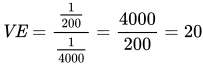
For example, if 1 centimetre (0.39 in) vertically represents 200 metres (660 ft) and 1 centimetre (0.39 in) horizontally represents 4,000 metres (13,000 ft), the vertical exaggeration, 20×, is given by:

.

Vertical exaggeration is given as a number; for example 5× means vertical measurements appear 5 times greater than horizontal measurements. A value of 1× indicates that horizontal and vertical scales are identical, and is regarded as having "no vertical exaggeration." Vertical exaggerations less than 1 are not common, but would indicate a reduction in vertical scale (or, equivalently, a horizontal exaggeration).

Criticism

[edit]
Reprojection of Maat Mons
A NASA projection of Maat Mons on Venus, with vertical exaggeration used to emphasize the mountain's height.

Some scientists[2][3] object to vertical exaggeration as a tool that makes an oblique visualization dramatic at the cost of misleading the viewer about the true appearance of the landscape.

In some cases, if the vertical exaggeration is too high, the map reader may get confused.

References

[edit]
Revisions and contributorsEdit on WikipediaRead on Wikipedia
from Grokipedia
Vertical exaggeration is a cartographic and technique that involves amplifying the vertical dimension relative to the horizontal scale in maps, topographic profiles, cross-sections, or three-dimensional models to enhance the visibility of terrain relief and elevation changes. This method addresses the challenge that Earth's surface variations are typically minimal compared to horizontal distances, making subtle features like hills or valleys difficult to perceive without . The is quantified as a , calculated by dividing the horizontal scale denominator by the vertical scale denominator (or equivalently, the real-world units of horizontal scale divided by those of vertical scale), often expressed as a multiplier such as 2:1 or 5:1, where higher values indicate greater amplification. In practice, vertical exaggeration is widely applied in topographic mapping and geographic information systems (GIS) to emphasize variations, such as in digital models (DEMs) or raised-relief maps, where it can make gentle slopes appear more pronounced for educational or analytical purposes. For instance, in constructing profiles from contour lines, an exaggeration of 2x to 10x is common to depict subtle without losing the overall horizontal accuracy essential for or . Conversely, it can also be used inversely to compress extreme vertical features, such as steep cliffs, to fit within display constraints while maintaining interpretability. This technique has roots in traditional physical relief models and has evolved with digital tools, ensuring that visualizations remain informative rather than misleading when properly labeled. Key considerations in applying vertical exaggeration include balancing visual enhancement with proportional fidelity, as excessive distortion can lead to misinterpretation of slopes or distances, particularly in fields like , , and where accurate assessment is critical. Modern software, such as or similar GIS platforms, allows dynamic adjustment of exaggeration levels to suit specific analytical needs, from environmental modeling to educational diagrams. Overall, it remains a fundamental tool in geosciences for bridging the perceptual gap between flat representations and the three-dimensional reality of landscapes.

Fundamentals

Definition

Vertical exaggeration (VE) is the deliberate of the vertical relative to the horizontal in two- or three-dimensional representations of , such as maps, profiles, or models, to enhance the of changes or features. This technique amplifies subtle topographic variations that would otherwise appear flat at a uniform scale, typically by applying a greater than 1, while preserving the horizontal proportions for accurate spatial relationships. In mapping, the horizontal scale represents the ratio of distances on the map to corresponding real-world horizontal distances, often expressed as a representative fraction like 1:50,000, where 1 unit on the map equals 50,000 units on the ground. The vertical scale, in contrast, relates map units to real-world elevations or depths, and vertical exaggeration arises when this vertical scale is adjusted independently to enlarge the relief. The general measure of VE is given by the ratio of the vertical scale (VsV_s) to the horizontal scale (HsH_s), both expressed in consistent units such as representative fractions (e.g., 1:1,000 for HsH_s and 1:200 for VsV_s, yielding VE = 5): VE=VsHs\text{VE} = \frac{V_s}{H_s} This ratio quantifies the amplification, with VE = 1 indicating no exaggeration and values exceeding 1 indicating vertical enhancement. To illustrate, consider a hypothetical with a 100-meter hill on that is otherwise nearly flat; at a uniform scale, the hill's rise would be imperceptibly shallow on a profile. Applying a 5× vertical exaggeration stretches the vertical such that the hill appears 500 meters high on the representation, making slopes and features more discernible without altering horizontal distances between points. This foundational concept of differential scaling underpins VE, distinguishing it from uniform scales that treat all dimensions equally.

Historical Development

The practice of vertical exaggeration originated in the early amid advancements in topographic and geological mapping, particularly in where geologists began employing exaggerated vertical scales in cross-sections to better visualize subtle relief and stratigraphic details that were imperceptible at true proportions. Early documented applications include Alexander von Humboldt's 1807 Tableau Physique, a geological profile of Mount Chimborazo in the , which used vertical exaggeration to depict changes and zones along transects. This approach addressed the inherent challenge of representing Earth's on flat media, where horizontal extents vastly outscale vertical ones, allowing cartographers to emphasize landforms without distorting spatial relationships excessively. In the United States, vertical exaggeration gained prominence in the late through national topographic mapping programs, including those of the U.S. Geological Survey (USGS) established in 1879, which utilized profiles and cross-sections in geologic representations to highlight terrain features for and resource assessment purposes, marking a shift from purely hachured relief depictions to more analytical profile techniques. Standardization efforts accelerated in the , particularly following the formation of the International Cartographic Association (ICA) in , which began addressing relief depiction conventions in the through commissions on thematic and topographic mapping. These initiatives addressed relief depiction conventions, emphasizing its role in balancing perceptual accuracy and visual clarity across diverse mapping scales. Pre-1950s hand-drawn profiles, reliant on manual drafting tools like plane tables and alidades, gave way post-World War II to emerging computational methods that automated exaggeration calculations. The advent of digital tools further transformed vertical exaggeration, integrating it seamlessly into geographic information systems (GIS) by the 1980s, where software enabled dynamic adjustment of vertical scales for 3D terrain modeling. This evolution reduced reliance on manual exaggeration, enabling real-time visualization in applications from environmental analysis to .

Technical Aspects

Calculation of Scaling Factor

The vertical exaggeration (VE) factor quantifies the degree to which the vertical is amplified relative to the horizontal in topographic representations such as profiles or cross-sections. It is derived from the of the vertical scale (SvS_v) to the horizontal scale (ShS_h), where scales are expressed as representative fractions or s of to actual . Specifically, Sv=vertical [distance](/page/Distance) on mapactual vertical [distance](/page/Distance)S_v = \frac{\text{vertical [distance](/page/Distance) on map}}{\text{actual vertical [distance](/page/Distance)}} and Sh=horizontal [distance](/page/Distance) on mapactual horizontal [distance](/page/Distance)S_h = \frac{\text{horizontal [distance](/page/Distance) on map}}{\text{actual horizontal [distance](/page/Distance)}}, leading to the : VE=SvSh=vertical distance on map/actual vertical distancehorizontal distance on map/actual horizontal distance\text{VE} = \frac{S_v}{S_h} = \frac{\text{vertical distance on map} / \text{actual vertical distance}}{\text{horizontal distance on map} / \text{actual horizontal distance}} This derivation ensures that VE = 1 indicates no exaggeration (isotropic scaling), while VE > 1 amplifies vertical features to enhance visibility. When scales are given in representative fraction form (e.g., horizontal scale 1:H and vertical scale 1:V, where H and V are the denominators), the formula simplifies to VE = H / V. To compute VE for a given or profile, first determine the horizontal and vertical scales in consistent units. For example, if the horizontal scale is 1:50,000 (1 unit on represents 50,000 units in reality) and the vertical scale is 1:10,000, then VE = 50,000 / 10,000 = 5, meaning vertical features appear five times steeper than they would at true scale. In practice, the vertical scale in cross-sections drawn from contour maps is often set by the contour interval and the chosen plotting interval on the graph. For instance, with a 20-meter contour interval plotted at 1 cm per interval on the vertical axis, the vertical scale becomes 1 cm = 20 m (or 1:2,000 if using cm and m). If the horizontal scale is 1:50,000 (equivalent to 1 cm = 500 m), then VE = (1/2,000) / (1/50,000) = 25, or directly 50,000 / 2,000 = 25. Adjustments for contour intervals ensure the profile fits the while maintaining proportional exaggeration; larger intervals reduce the effective vertical scale denominator, increasing VE. A worked numerical example illustrates the impact of VE on profile dimensions. Consider a terrain profile with a 200 m elevation change over a 10 km (10,000 m) horizontal distance, using a horizontal scale of 1:50,000 for the profile. The unexaggerated map horizontal length is 10,000 m / 50,000 = 0.2 m (20 cm). At true scale (VE = 1), the map vertical height would be 200 m / 50,000 = 0.004 m (0.4 cm), resulting in a nearly flat profile difficult to discern. Applying 10× VE adjusts the vertical scale to 1:5,000, yielding a map vertical height of 200 m / 5,000 = 0.04 m (4 cm), while the horizontal length remains 20 cm. Thus, the exaggerated profile has the same length but a height 10 times greater (4 cm vs. 0.4 cm), emphasizing the relief without altering horizontal proportions. The choice of VE is influenced by terrain relief, map scale, and the purpose of the representation, with lower values preferred to avoid (ideally VE ≤ 10; values >50 require explicit notation as "greatly exaggerated"). For low-relief areas like plains, higher VE (5–25×) is typically used to reveal subtle changes, while high-relief mountainous often requires little to no exaggeration (1×) to preserve realistic slopes. Foothill regions fall in between. The following table summarizes common VE guidelines based on terrain relief:
Terrain ReliefTypical VE RangeRationale
Low (e.g., plains)5–25×Amplifies minor variations for visibility in flat areas.
Moderate (e.g., )2.5–12.5×Balances detail without over-distorting transitional slopes.
High (e.g., mountains)Maintains true proportions in steep, prominent terrain.
These values are shaped by perceptual needs and map objectives, with finer adjustments for specific scales (e.g., VE ≈ 1.3 at 1:50,000 vs. 10.7 at 1:19,000,000).

Representation Methods

Vertical exaggeration is implemented through various graphical techniques in traditional to visually enhance features in two-dimensional representations. In topographic profiles, the vertical axis is stretched relative to the horizontal axis by multiplying values by a scaling factor, creating a cross-sectional view that accentuates subtle changes for better interpretability. Block diagrams extend this approach by depicting three-dimensional perspectives where the vertical dimension is similarly amplified, often using perspective projection to simulate depth while applying uniform exaggeration to maintain proportional accuracy. Hachures, as slope-shading lines, can be combined with vertical exaggeration in panoramic or non-planar views to reinforce the of steepness, where denser hachuring aligns with exaggerated elevations to mimic natural gradients. Digital methods for vertical exaggeration have evolved with geographic information systems (GIS) and software, enabling automated application to elevation datasets. In GIS platforms like , vertical exaggeration is integrated via drape functions that overlay vector or raster layers onto digital elevation models (DEMs), stretching z-values uniformly to emphasize or mitigate relief— for instance, a factor of 5x can highlight low-relief landscapes without altering horizontal scales. Raster-based exaggeration, common for gridded DEMs, involves multiplying pixel elevation values directly, preserving continuous surface data but potentially introducing in steep areas, whereas vector approaches using triangular irregular networks (TINs) allow selective scaling of discrete features for smoother 3D renders. Tools such as apply real-time vertical exaggeration to global terrain data, adjusting z-scaling dynamically for user views, while supports imported DEMs with customizable z-axis multipliers for artistic or analytical 3D visualizations. Notation standards ensure transparency in vertical exaggeration representations, preventing misinterpretation of scales. Common labeling includes phrases like "Vertical exaggeration 5x" placed near the profile or , or dual bar scales indicating vertical scale (Vs) and horizontal scale (Hs) to compute the exaggeration ratio explicitly. The U.S. Geological Survey recommends formatting as "VERTICAL EXAGGERATION X 10" with the value rounded to the nearest whole number for clarity in technical drawings. International guidelines, such as those from the International Cartographic Association's mountain working group, emphasize disclosing exaggeration factors in 3D terrain maps to align with perceptual standards and user expectations. Modern tools and software have automated vertical exaggeration since the early 2010s, streamlining implementation in open-source and proprietary environments. , for example, introduced raster terrain analysis tools post-2010 with a dedicated vertical exaggeration (Z-factor) in the Processing Toolbox, allowing users to set multipliers like 2x for hillshade or derivations directly on DEM inputs. extends this with scene-wide exaggeration controls on the Surface tab, where can be animated or layered for dynamic views, evolving from earlier manual drape adjustments. These features represent a shift from manual graphical drafting to parametric digital workflows, with plugins like 's Geoscience Section Vertical Exaggeration (introduced in June 2025) enabling post-processing stretches on vectorized profiles.

Applications

In Cartography

Vertical exaggeration is a fundamental technique in for enhancing the visibility of terrain relief on topographic maps, where subtle elevation differences might otherwise appear flat due to the compressed scale of two-dimensional representations. In the production of (USGS) quadrangle sheets, it is commonly applied in cross-sections and profiles derived from contour data, typically at factors ranging from 2x to 10x, to accentuate landforms and improve interpretability for users such as hikers and planners. This approach ensures that features like hills and valleys are discernible without distorting horizontal distances essential for accurate navigation. In contour-based exaggeration, cartographers stretch the vertical dimension relative to the horizontal one when constructing profiles from topographic , allowing the true shape of the to be conveyed more effectively on paper or digital displays. This method is integral to various types, including those employing hypsometric tints—color gradients representing bands—and shaded maps, where vertical exaggeration simulates lighting effects to foster a three-dimensional of without requiring interactive 3D models. In shaded production, for example, it amplifies depth under hypothetical sun positions, making subtle slopes more prominent for . National mapping agencies adhere to established standards and conventions for vertical exaggeration to balance visual enhancement with fidelity. The British (OS), for instance, incorporates it in longitudinal sections and profiles at factors like 2x to 4x, drawing from its datasets to support and land-use applications. Modern OS digital products, such as interactive viewers, allow adaptation of vertical exaggeration to specific map scales and user needs for improved . This variability enhances the perception of relief features, aiding tasks like route assessment where understanding subtle is crucial for and efficiency. Prominent case studies from world atlases demonstrate its practical impact. maps, renowned for their illustrative style, apply vertical exaggeration to bathymetric features, such as in the 1957 physiographic diagram of the North Atlantic with a 20:1 ratio, to vividly convey submarine topography and educate audiences on global relief. Similarly, in broader physical maps, this technique integrates with hypsometric coloring to highlight continental margins and deep-sea structures, prioritizing perceptual clarity over strict proportionality.

In Geology and Geomorphology

In , vertical exaggeration is commonly applied in stratigraphic cross-sections to accentuate structural features such as faults and folds, which may otherwise appear subdued at a 1:1 scale. These cross-sections, often constructed from data or surface mappings, employ vertical scales 10 to 100 times larger than horizontal scales to reveal subsurface complexities, particularly in sedimentary basins where thin layers or subtle displacements are critical for interpreting depositional environments and tectonic histories. For instance, in exploration mapping, exaggerated profiles help delineate traps formed by faulting or folding, allowing geologists to visualize stratigraphic thickness variations that inform decisions. In , vertical exaggeration enhances the depiction of landforms in diagrams of river valleys and glacial features, facilitating the study of and deposition patterns. By amplifying vertical dimensions, these representations make gradual slopes, incision depths, and pathways more discernible, aiding analyses of over time. A prominent example is the profiling of the Grand Canyon, where vertical exaggeration—often around 10 to 50 times—is used to illustrate the Colorado River's erosional history and the exposure of layered strata, highlighting how base-level changes have sculpted the canyon's profile. Such techniques are essential for tracing glacial landforms like U-shaped valleys, where subtle topographic relief reveals past ice flow directions and distributions. Research in has long incorporated vertical exaggeration, as seen in seminal texts like William D. Thornbury's Principles of Geomorphology (1969), which employs exaggerated scales in diagrams for slope analysis to emphasize processes like and fluvial incision. In modern contexts, seismic reflection profiles routinely use vertical exaggeration, typically 2 to 5 times, to interpret tectonic structures in sedimentary basins, though higher factors are applied for detailed fault mapping. These practices stem from the need to balance visual clarity with geometric accuracy in academic and applied studies. The primary benefit of vertical exaggeration in these fields lies in its ability to reveal subtle tectonic features, such as minor offsets or low-angle thrusts, that remain imperceptible at true scale due to the vast horizontal extents of geological structures. By compressing horizontal distances relative to vertical ones, it enhances the detection of reflection discontinuities in seismic data or fine-scale layering in cross-sections, thereby improving interpretive accuracy for processes like or basin subsidence. However, this amplification must be noted to avoid misestimating true geometries.

In Engineering and Visualization

In , vertical exaggeration is commonly applied in site plans and cross-sectional profiles to enhance the visibility of features during design and analysis phases, particularly for projects involving earthwork such as roads and . For instance, in calculations, exaggerated vertical scales help engineers assess excavation volumes and embankment requirements by making subtle elevation changes more apparent, facilitating accurate material balance and cost estimation. Software like Civil 3D supports adjustable vertical exaggeration in profile views, where factors ranging from 5x to 20x are typical for modeling, allowing users to modify the vertical scale independently of the horizontal to optimize visualization without altering underlying data. This technique is essential for projects like highway alignments, where longitudinal sections with 10:1 vertical exaggeration illustrate natural ground levels relative to proposed grading lines, aiding in the design of vertical curves and sight distances. In architectural and urban planning contexts, vertical exaggeration is used in sectional drawings to depict slope impacts on building foundations and site development, ensuring that subtle topographic variations are clearly communicated to stakeholders. For example, planning studies often employ 15x vertical exaggeration in cross-sections to highlight development limitations in sloped areas, such as erosion risks or drainage needs in residential or commercial zones. In infrastructure projects like highway alignments, this method integrates with horizontal design models at scales of 1:100, applying 5:1 vertical exaggeration to create realistic yet emphasized representations of terrain cuts and fills, which support decisions on alignment feasibility and environmental compliance. Digital visualization tools have increasingly incorporated vertical exaggeration for immersive applications in (VR) and (AR) simulations, particularly in since the , enabling real-time adjustments to enhance user perception of spatial relationships. In environments like Unity, terrain models apply vertical exaggeration factors of 5:1 or higher to , allowing architects to simulate walk-throughs of exaggerated landscapes for better evaluation of design elements such as grading and vegetation placement. These simulations support dynamic VE modifications during VR sessions, where users can scale elevations interactively to assess impacts like visibility or accessibility in proposed urban developments. Notable case studies illustrate these applications in modeling and , where vertical exaggeration aids in visualizing risks and planning resilience. Urban visualizations employ AR-based approaches to overlay dynamic water levels on 3D-printed models, helping engineers simulate inundation extents and evacuation routes in planning for resilience against events. Recent advancements as of 2025 include its use in GIS-based 3D geological modeling for site assessments and planetary mapping protocols by USGS, enhancing subsurface and extraterrestrial interpretation.

Criticisms and Alternatives

Criticisms

Vertical exaggeration (VE) in cartographic and geological representations often leads to perceptual distortions by altering the apparent steepness of slopes and landforms beyond their true proportions. For instance, applying a 5x VE to a terrain with a true slope angle of 5° results in an apparent angle of approximately 24°, calculated as ϕ=tan1(VEtanθ)\phi = \tan^{-1}(VE \cdot \tan \theta), where θ\theta is the true angle; this overestimation can mislead viewers into perceiving gentler terrains as more rugged than they are. Such distortions arise because VE amplifies vertical dimensions relative to horizontal ones, exacerbating human tendencies to underestimate shallow slopes while failing to accurately convey steeper features in three-dimensional visualizations. Scientific criticisms of VE have persisted since at least the mid-20th century, highlighting its role in promoting inaccurate geological interpretations. In a 1947 analysis, geologist H. H. Suter argued that exaggerated vertical scales in geologic sections distort structural relationships, compressing horizontal elements and misrepresenting the true geometry of formations, which can lead to erroneous assessments of basin configurations or fault systems. More recent studies confirm these issues, demonstrating that VE factors of 2–6, common in seismic cross-sections, systematically alter dip angles, curvatures, and angular relationships; for example, normal faults dipping 60° to the horizontal may appear as near-vertical strike-slip features under high VE, potentially biasing kinematic reconstructions. Empirical validation experiments show that interpreters commit significant errors when validating structures on exaggerated sections, with distortions becoming pronounced in complex, curved, or faulted terrains, underscoring the need for caution in scientific applications. These perceptual and scientific flaws raise ethical concerns in public-facing maps, where VE can inadvertently deceive audiences by exaggerating minor in contexts like environmental impact assessments, potentially influencing policy decisions or public of landscape hazards without clear disclosure. on map reading in the and further evidences reader biases, as exaggerated relief prompts overestimation of angles and variability, leading to errors in tasks such as route planning or hazard evaluation; for instance, studies on 3D visualizations reveal that unchecked VE amplifies cognitive distortions in slant , reducing the reliability of maps for non-expert users.

Mitigation Strategies

One key mitigation strategy for the distortions introduced by vertical exaggeration (VE) involves clear labeling and disclosure on maps and visualizations. According to U.S. Geological Survey (USGS) guidelines for geologic mapping, any VE applied to cross-sections or profiles must be explicitly noted, with vertical scale indicated separately from the horizontal scale to allow users to interpret true proportions. This practice, standard in USGS publications since at least the , includes displaying scale bars for both vertical (Vs) and horizontal (Hs) dimensions to prevent misinterpretation of features. To address inconsistencies in terrain visibility across varied landscapes, variable or selective VE can be employed in modern geographic information systems (GIS). This approach applies lower exaggeration factors in flat areas and higher ones in rugged terrains, balancing perceptual enhancement with geometric accuracy; for instance, in 3D visualizations of national parks, selective VE highlights subordinate features like Pu'u 'Ō'ō against dominant structures such as without uniformly distorting the entire model. User education plays a crucial role in mitigating VE's effects, particularly through training interpreters to mentally de-exaggerate profiles. In geology curricula, such as those using tools like GeoMapApp, students learn to calculate and adjust for VE to reconstruct natural scales, fostering awareness of how exaggeration alters dip angles and structural geometries. Complementing this, software like Google Earth Pro includes adjustable VE settings (ranging from 0.01 to 3.0 times), enabling users to toggle exaggeration levels dynamically for comparative analysis. Cartographic best practices further recommend limiting VE to under 10 times unless justified, as higher values excessively distort section characteristics and mislead quantitative assessments. These guidelines, echoed in labs, emphasize using no VE where possible to preserve accuracy, reserving exaggeration only for emphasizing subtle in educational or exploratory contexts.

Alternatives to Vertical Exaggeration

True-scale representations provide a direct means of depicting terrain without distorting vertical dimensions, relying on 1:1 elevation scaling or specialized projections that maintain proportional accuracy. For instance, plan oblique relief employs a parallel projection at shallow inclination angles (typically 30°–50°) to render three-dimensional terrain on flat maps, projecting features upward perpendicular to the base while preserving geographic shapes and distances at equal elevations. This technique combines elements of shaded relief and perspective views, enhancing recognizability of landforms like mountains without introducing vertical distortion, and is particularly effective for novice map readers. Advanced three-dimensional modeling techniques, such as those derived from and , enable immersive visualization at true scale by constructing full 3D surfaces from data. In tools like 3D Analyst, raster, TIN, or datasets serve as functional surfaces in an x,y,z coordinate system, representing continuously along the z-axis without mandatory vertical exaggeration, allowing accurate depiction of landscapes or subsurface features. These models support interactive exploration, such as rotating views of -derived digital models (DEMs), which reveal subtle topographic variations in their natural proportions for applications in and . NASA's (SRTM) data, for example, has been processed into global DEMs at 30 m resolution and visualized in true scale to study volcanic formations and patterns without exaggeration. Non-exaggerated enhancements further improve through optical and symbolic methods that emphasize without scaling alterations. Hillshading simulates illumination from a directional light source based on and aspect, producing images that qualitatively convey ; for example, multi-directional hillshading applied to SRTM datasets highlights structures at true scale, aiding in geomorphological analysis. Contour density adjustments and stereoscopic maps, which use paired images for via binocular viewing, offer additional layers of detail—stereoscopic pairs from aerial , for instance, reconstruct in 3D without vertical , as demonstrated in early USGS applications for resource mapping. These approaches prioritize perceptual cues over numerical scaling to balance clarity and fidelity. Emerging technologies leverage to dynamically enhance terrain visualization without fixed vertical adjustments, focusing on perceptual adaptation. Post-2020 advancements in neural rendering, such as neural adapted for multi-view , generate textured digital terrain maps by learning continuous 3D representations from 2D inputs, enabling high-fidelity reconstructions at true scale for large areas like planetary surfaces. In game engines like , AI-driven neural rendering integrates with DEMs to produce real-time, photorealistic views that adjust lighting and detail dynamically, improving user immersion in applications such as environmental simulation while avoiding exaggeration-induced distortions. These methods, building on seminal works in differentiable rendering, prioritize efficiency and accuracy for scalable terrain analysis.

References

Add your contribution
Related Hubs
User Avatar
No comments yet.