


Community hub
Recent from talks
Contribute something
Nothing was collected or created yet.
Victoria line
View on Wikipedia
| Victoria line | |
|---|---|
 | |
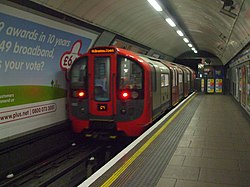
 A 2009 stock Victoria line train departs Euston | |
| Overview | |
| Termini |
|
| Stations | 16 |
| Colour on map | Light blue |
| Website | tfl |
| Service | |
| Type | Rapid transit |
| System | London Underground |
| Operator(s) | London Underground Limited |
| Depot(s) | Northumberland Park |
| Rolling stock | 2009 Stock |
| Ridership | 302.009 million (2019)[1] passenger journeys |
| History | |
| Opened | 1 September 1968 |
| Last extension | 1971 |
| Technical | |
| Line length | 21 km (13 mi) |
| Character | Deep-level |
| Track gauge | 1,435 mm (4 ft 8+1⁄2 in) standard gauge |
| Electrification | Fourth rail, 630 V DC |
| Operating speed | 80 km/h (50 mph) |
| Signalling | CBTC (Distance to Go Radio) |

The Victoria line is a London Underground line that runs between Brixton in South London, and Walthamstow Central in the east, via the West End. It is printed in light blue on the Tube map and is one of the only two lines on the network to run completely underground, the other being the Waterloo & City line.[note 1]
The line was constructed in the 1960s and was the first entirely new Underground line in London for 50 years. It was designed to reduce congestion on other lines, particularly the Piccadilly line and the Charing Cross branch of the Northern line. The first section, from Walthamstow Central to Highbury & Islington, opened in September 1968 and an extension to Warren Street followed in December. The line was completed to Victoria station in March 1969 and was opened by Queen Elizabeth II who rode a train from Green Park to Victoria. The southern extension to Brixton opened in 1971, and Pimlico (the only station in the line without an interchange) was added in 1972.
The Victoria line is operated using automatic train operation, but all trains have drivers. The 2009 Tube Stock replaced the original 1967 Tube Stock trains. The line serves 16 stations and all but Pimlico provide interchanges with other Transport for London or National Rail services. The line, the most intensively used on the Underground,[note 2] was used by 302 million passengers in 2019, making it the second-busiest tube line. With trains arriving every 100 seconds at peak times, it is one of the most frequent rapid transit lines in the world.
History
[edit]Planning
[edit]The first proposal for a railway in this area appeared in the County of London Plan, published in 1943.[2] In 1948, a working party set up by the British Transport Commission (BTC) proposed a tube railway from Victoria to Walthamstow,[3] largely based on a 1946 plan for a Croydon-to-Finsbury Park line. Its main purpose was to relieve congestion in the central area, which had been a problem since the 1930s.[4] Other benefits were linking the key railway stations at Victoria, Euston, King's Cross and St Pancras and improving connections between north-east London and the city.[5]
In early 1949, the BTC committee looked at the feasibility of building a deep-level tube to fulfil these requirements.[6] For the first time, cost–benefit analysis was used to ensure the line would be built within budget and be profitable.[7] A private bill was introduced in Parliament in 1955, describing a line from Victoria to Walthamstow (Wood Street), next to the British Rail station. Another proposal, not in the bill, supported an extension from Victoria to Fulham Broadway on the District line terminating at Edmonton instead of Walthamstow.[8][9] Proposals were made to extend the line north to South Woodford or Woodford to provide interchange with the Central line.[10] In 1961, it was decided that the line would terminate at Walthamstow (Hoe Street) station rather than Wood Street – this would cut costs by £1.4 million, and "satisfactory interchange" with British Railways was available at Hoe Street station.[11][12] Walthamstow (Hoe Street) was later renamed Walthamstow Central on 6 May 1968 in anticipation of the line's opening).[13][14] The line was planned to have cross-platform interchanges at Oxford Circus, Euston and Finsbury Park (with the Bakerloo, Northern (Bank) and Piccadilly lines respectively) and at Walthamstow Central to provide a quick and easy connection between the new line and existing services.[15]
The name "Victoria line" dates from 1955; other suggestions were "Walvic line" (Walthamstow–Victoria), "Viking line" (Victoria–King's Cross), "Mayfair line" and "West End line".[9] During the planning stages, it was known as Route C and named the Victoria line (after the station) by David McKenna, Chairman of British Transport Advertising, whose suggestion was seconded by Sir John Elliot.[9][16] The board decided that the Victoria line sounded "just right".[9]
Walthamstow–Victoria
[edit]Initial construction began in January 1960, when two test tunnels were started from Tottenham to Manor House under Seven Sisters Road. The tunnels were excavated using an experimental "drum digger" rotary shield, powered by hydraulic rams, that could cut more than 60 feet (18 m) per day. The work was completed in July 1961, with the expectation it would be used for the completed Victoria line.[17]
After the line gained parliamentary approval on 20 August 1962 with a budget of £56 million, construction began the following month.[18] The economic boom of the mid-to-late 1950s had faded leading to a rise in unemployment in London, and the government had hoped that building the Victoria line would alleviate this.[19] Work began adapting Oxford Circus station to link to the new line; a cross-platform interchange was provided with the Bakerloo line and a subway link with the Central line.[20] A steel umbrella was erected over the junction in August 1963 so that a new ticket hall could be built without disrupting existing traffic.[18] Rolling stock on the line was fitted with Automatic Train Operation (ATO), which allowed self-driving of the train based on automatic electrical signals along the track.[21] In March 1964, a £2.25 million contract was awarded to Metro-Cammell for the Victoria line fleet.[22]
That October, the Northern City Line closed between Drayton Park and Finsbury Park so that the latter station could be redesigned for a cross-platform interchange between the Victoria and Piccadilly lines. All major contracts had been awarded by 1965, and construction was on track to be completed in 1968.[23] New stations were constructed at Walthamstow Central, Blackhorse Road, Tottenham Hale and Seven Sisters.[24] The station at Blackhorse Road was built on the opposite side of the road from the mainline station (serving the Kentish Town to Barking line) and was not an interchange.[25][note 3]
The line opened from Walthamstow Central to Highbury & Islington on 1 September 1968.[27][28] There was no opening ceremony; instead the normal timetable started.[27] The first train left Walthamstow Central for Highbury & Islington at 7:32 a.m. The line proved to meet a need; more than 1,000 tickets were purchased at Highbury & Islington within its first hour of opening.[29]
The next section to Warren Street, opened on 1 December 1968, again without ceremony.[27] The line was formally opened by Queen Elizabeth II on 7 March 1969 when it had been completed to Victoria. At 11:00 a.m., the Queen made the first trip, on a 5d (2.08p) ticket, from Green Park to Victoria, where she unveiled a plaque.[30][31] In so doing, she was the first reigning monarch to ride on the Underground.[32] The line was open to the general public by 3:00 p.m. Trains from Walthamstow to Victoria took around 24 minutes.[30]
Victoria–Brixton
[edit]
The 3.5-mile (5.6 km) extension from Victoria to Brixton with stations at Vauxhall and Stockwell was approved in March 1966.[23] Preparatory work had started at Bessborough Gardens near Vauxhall Bridge Road in May 1967.[33] The contract was awarded on 4 August 1967.[23] A proposal to build Pimlico tube station received Government approval on 28 June 1968.[34][27] In July, the Duke of Edinburgh and the Prince of Wales visited tunnel workings under Vauxhall Park.[35]
The Brixton extension was bored using the older Greathead shield. Although slower, use of the tunnelling shield allowed easier digging through the gravel strata south of the Thames. It was opened on 23 July 1971 by Princess Alexandra, who made a journey from Brixton to Vauxhall.[36][37] On opening, it was the first new section of Underground to open south of the Thames since the extension of the City and South London Railway from Clapham Common to Morden in 1926.[36] The final piece of the Victoria line, Pimlico station, opened on 14 September 1972.[38]
London Transport considered extensions to Streatham, Dulwich and Crystal Palace to provide a connection to southeast London and Kent but no construction work was undertaken.[39]
Post-opening
[edit]The Kentish Town to Barking line did not close as expected and both stations at Blackhorse Road remained open. The mainline station was moved to the same side of the road as the tube station and was connected to the Victoria line on 14 December 1981 via an overbridge. The original station was then closed and demolished.[40][41]
The London Underground (Victoria) Act 1991 allowed for the construction of a 43-metre (140 ft) underground pedestrian link at Victoria station between the Victoria line platforms and the sub-surface Circle line platforms above.[42] The London Underground (Victoria Station Upgrade) Order 2009 came into force in September that year, authorising the construction of a second 1,930-square-metre (21,000 sq ft) ticket hall at Victoria.[43]
Warren Street tube station was attacked in the 21st July 2005 London bombings. There were no fatalities in this attack. After the 7 July 2005 London bombings, there was heightened security. The Metropolitan Police wrongly detained and fatally shot 27-year-old Jean Charles de Menezes once he boarded a train at Stockwell. After his death, a memorial to Menezes was placed close to Stockwell station.[44]
On 23 January 2014, during upgrade work at Victoria, construction workers accidentally penetrated the signalling room of the Victoria line and flooded it with quick-drying concrete, leading to the suspension of services south of Warren Street.[45] Services resumed the following day after sugar was used to slow the setting of the concrete and make it easier to shovel out.[46][47]
A 24-hour Night Tube service on Friday and Saturday nights, due to start in September 2015 on the entire line,[48] was delayed because of strike action.[49] The service began in August 2016, with trains running at 10-minute intervals on the whole line.[50]
Design
[edit]Every Victoria line station, apart from Pimlico and Blackhorse Road, was built as an interchange and several stations were rearranged to allow for cross-platform interchange with the line. In some stations, the Victoria line platforms were built on either side of the existing arrangement; in others, the Victoria line uses the older platforms and the existing line was diverted onto a new alignment.[51] All platforms on the line are 132.6 metres (435 ft) long.[52] The line has hump-backed stations to allow trains to store gravitational potential energy as they slow down and release it when they leave a station, providing an energy saving of 5% and allowing trains to run 9% faster.[53][54]
The stations were originally tiled in blue and grey, each decorated with tiled motifs in seating recesses for identification.[55] Some motifs were puns; the image for Brixton, for instance, was a ton of bricks.[36] During construction of the first stage of the Jubilee line in 1979, the motifs on Green Park station were replaced by others matching the design for the Jubilee line platforms.[56]
In late 2010 and 2011, platform humps were installed on all Victoria line stations except Pimlico to provide step-free access to trains.[57] The project was in accordance with the Rail Vehicle Accessibility (Non Interoperable Rail System) Regulations 2010 and the Disability Discrimination Act 1995.[58][59] The Victoria line humps resemble the Harrington Hump, a type of ramp being installed on some mainline stations, but are of a masonry construction.[60]
Service and rolling stock
[edit]
About 200 million passengers a year use the Victoria line.[61] It is the sixth-most heavily used line on the network in absolute figures, but in terms of the average number of journeys per mile it is by far the most intensively used.[62] From May 2017, trains run every 100 seconds during peak periods, providing 36 trains per hour.[63] All trains run from Brixton to Seven Sisters and some continue to Walthamstow Central.[64] During off-peak periods, the Victoria line runs 27 trains per hour between Brixton and Walthamstow Central.[65]
When the line opened, services were operated by a fleet of 39+1⁄2 eight-car trains of 1967 Tube Stock trains. In the early planning stages, an articulated type of rolling stock was considered, but not progressed because of difficulties transferring the stock to Acton Works for heavy overhauls.[66] After Acton Works closed, this no longer applies. The 2009 tube stock has a wider profile and slightly longer carriages which precludes it from running on other deep-level tube lines. The 1967 stock was supplemented by 1972 Mark I Tube Stock, transferred from the Northern line and converted to be compatible with the 1967 stock.[67]
Replacement of the 1967 rolling stock began in July 2009.[68][69] The 2009 Tube Stock fleet of 47 eight-car trains was built by Bombardier Transportation.[70] Testing the first prototypes began in 2008. The trains began to be introduced in 2009 and most were in operation by the following year. The last of the 1967 stock trains ran on 30 June 2011, after which the entire service was provided by 2009 stock.[71][72]
On opening, the line was equipped with a fixed-block Automatic Train Operation system (ATO). The train operator closed the train doors and pressed a pair of "start" buttons and, if the way ahead was clear, the ATO drives the train at a safe speed to the next station. At any point, the driver could switch to manual control if the ATO failed.[29] The system, which operated until 2012, made the Victoria line the world's first full-scale automatic railway.[note 4]
The Victoria line runs faster trains than other Underground lines because it has fewer stops, ATO running and modern design.[76][77] Train speeds can reach up to 50 miles per hour (80 km/h). A common method used by north London residents to visit the West End is to take the Northern line Bank branch, change platforms at Euston, and continue on faster Victoria line trains.[54][76] In the 2010s, the original signalling was replaced with a more modern ATO system from Westinghouse Rail Systems incorporating 'Distance to Go Radio' and more than 400 track circuits. London Underground claimed it was the world's first ATO-on-ATO upgrade.[68][70][78] The new signalling system allowed a revised timetable to be introduced in February 2013, allowing up to 33 trains per hour instead of 27.[79] In combination with new, faster trains, the line's capacity increased by 21%, equivalent to an extra 10,000 passengers per hour.[68][71] By 2019, the line was running around 36 trains per hour at peak times, with a train arriving every 100 seconds – making it one of the most frequent rapid transit lines in the world.[80]
Facilities
[edit]Step-free access
[edit].png)
When the line was built, budgetary restrictions meant that station infrastructure standards were lower than on older lines and on later extension projects.[19] Examples include narrower than usual platforms and undecorated ceilings at Walthamstow Central, Blackhorse Road and Tottenham Hale, affecting lighting levels.[81] The line was built with fewer escalators than other lines as a cost-saving measure.[82] The lack of a third escalator linking station entrances to platforms at some stations can cause severe congestion at peak times.[83] Stations have closed temporarily for safety reasons when escalators have been unserviceable.[84]
Step-free routes are available between the Victoria line and other lines at most interchanges.[85] Tottenham Hale, Finsbury Park, King's Cross St Pancras, Green Park, Victoria, Vauxhall and Brixton have step-free access from street to train.[86][85][87][88][89][90] Platform humps have been installed at all stations (except Pimlico) to provide level access to trains, improving access for customers with mobility impairments, luggage or pushchairs.[91]
Ventilation
[edit]
About 50 ventilation shafts were constructed during the construction phase.[92] Midpoint tunnel ventilation shafts remain between stations. Special "local arrangements" are in place should it be necessary to evacuate passengers from trains via Netherton Road emergency escape shaft.[93] Planning permission for a shaft at Ferry Lane, next to Tottenham Hale station, was granted on 11 January 1968, during the first phase of construction.[94]
By mid-2009, trial boreholes for a cooling system at Green Park station had been drilled and more were scheduled to be created by the end of 2009.[95] In 2010, Engineering & Technology reported that 200 litres (44 imp gal) of water per second for the cooling system was being pumped through heat-exchangers at Victoria station from the River Tyburn and into the River Thames.[96]
Between 2009 and 2014, thirteen ventilation shafts were refurbished. In the first phase were Drayton Park, Gillingham Street, Moreton Terrace, Pulross Road, Somerleyton Road and Tynemouth Road.[97] For the second phase were Cobourg Street, Dover Street, Gibson Square, Great Titchfield Street, Isledon Road, Kings Cross, Palace Street and Rita Road.[97]
By 2009, changes at Cobourg Street were in the planning stage and demolition at Moreton Terrace, Somerleyton Road and Drayton Park shafts had taken place.[95] Planning permission for Netherton Road shaft was granted on 8 September 1967.[98] On 31 March, the demolition and rebuilding of Netherton Road shaft was allowed as permitted development.[99][100]
Depot
[edit]
The depot at Northumberland Park, the service and storage area for trains, is the only part of the Victoria line above ground. Trains access the depot via a branch line in a tunnel to the north of Seven Sisters.[101]
The depot opened with the first stage of the line in September 1968. It is next to Northumberland Park railway station, on Tottenham Marshes in the London Borough of Haringey, over a mile from the Victoria line. When built, it was 900 feet (270 m) long and had working space for 22 eight-car trains.[25] As part of Transport for London's tube upgrade scheme, the depot has been expanded and upgraded to accommodate all the 2009 Tube Stock trains[102][103] and a new signalling system.[104]
Future
[edit]Tottenham Hotspur F.C. and its supporters have campaigned for a surface station next to Northumberland Park Station, adjacent to the depot to improve the stadium's transport links. The plans would require co-operation with the local council and Network Rail to minimise disruption.[105][106] It was announced by Haringey Council in its 2012 A Plan for Tottenham report that there was "potential for a Victoria Line extension to Northumberland Park".[107]
Crossrail 2, also known as the Chelsea-Hackney line, is a proposed line across central London between Victoria and King's Cross St Pancras tube station to increase capacity in Central London by 270,000 passengers per day. It is intended to relieve congestion on the Victoria line, a key line connecting several important London termini.[108][109]
Proposals have been made to extend the line one stop southwards from Brixton to Herne Hill, a significant interchange in south London providing access to Kent, Blackfriars, London Bridge and Sutton. Herne Hill would be on a large reversing loop with a single platform removing a critical capacity restriction eliminating the need for trains to reverse at Brixton and provide a more obvious route for passengers who look for the nearest tube station before any other transport options.[110][111]
Map
[edit]
Stations
[edit]Victoria line | |||||||||||||||||||||||||||||||||||||||||||||||||||||||||||||||||||||||||||||||||||||||||||||||||||||||||||||||||||||||||||||||||||||||||||||||||||||||||||||||||||||||||||||||||||||||||||||||||||||||||||||||||||||||||||||||||||||||||||||||||||||||||||||||||||||||||||||||||||||||||||||||||||||||||||||||||||||||||||||||||||||||||||||||||||||||||||||||||||||||||||||||||||||||||||||||||||||||||||||||||||||||||||||||||||||||||||||||||||||||||||||||||||||||||||
|---|---|---|---|---|---|---|---|---|---|---|---|---|---|---|---|---|---|---|---|---|---|---|---|---|---|---|---|---|---|---|---|---|---|---|---|---|---|---|---|---|---|---|---|---|---|---|---|---|---|---|---|---|---|---|---|---|---|---|---|---|---|---|---|---|---|---|---|---|---|---|---|---|---|---|---|---|---|---|---|---|---|---|---|---|---|---|---|---|---|---|---|---|---|---|---|---|---|---|---|---|---|---|---|---|---|---|---|---|---|---|---|---|---|---|---|---|---|---|---|---|---|---|---|---|---|---|---|---|---|---|---|---|---|---|---|---|---|---|---|---|---|---|---|---|---|---|---|---|---|---|---|---|---|---|---|---|---|---|---|---|---|---|---|---|---|---|---|---|---|---|---|---|---|---|---|---|---|---|---|---|---|---|---|---|---|---|---|---|---|---|---|---|---|---|---|---|---|---|---|---|---|---|---|---|---|---|---|---|---|---|---|---|---|---|---|---|---|---|---|---|---|---|---|---|---|---|---|---|---|---|---|---|---|---|---|---|---|---|---|---|---|---|---|---|---|---|---|---|---|---|---|---|---|---|---|---|---|---|---|---|---|---|---|---|---|---|---|---|---|---|---|---|---|---|---|---|---|---|---|---|---|---|---|---|---|---|---|---|---|---|---|---|---|---|---|---|---|---|---|---|---|---|---|---|---|---|---|---|---|---|---|---|---|---|---|---|---|---|---|---|---|---|---|---|---|---|---|---|---|---|---|---|---|---|---|---|---|---|---|---|---|---|---|---|---|---|---|---|---|---|---|---|---|---|---|---|---|---|---|---|---|---|---|---|---|---|---|---|---|---|---|---|---|---|---|---|---|---|---|---|---|---|---|---|---|---|---|---|---|---|---|---|---|---|---|---|---|---|---|---|---|---|---|---|---|---|---|---|---|---|---|---|---|---|---|---|---|---|---|---|---|---|---|---|---|---|---|---|---|---|---|---|---|---|---|---|---|---|---|---|---|---|---|---|---|---|---|---|---|---|---|---|---|---|---|---|---|---|---|
| |||||||||||||||||||||||||||||||||||||||||||||||||||||||||||||||||||||||||||||||||||||||||||||||||||||||||||||||||||||||||||||||||||||||||||||||||||||||||||||||||||||||||||||||||||||||||||||||||||||||||||||||||||||||||||||||||||||||||||||||||||||||||||||||||||||||||||||||||||||||||||||||||||||||||||||||||||||||||||||||||||||||||||||||||||||||||||||||||||||||||||||||||||||||||||||||||||||||||||||||||||||||||||||||||||||||||||||||||||||||||||||||||||||||||||
| |||||||||||||||||||||||||||||||||||||||||||||||||||||||||||||||||||||||||||||||||||||||||||||||||||||||||||||||||||||||||||||||||||||||||||||||||||||||||||||||||||||||||||||||||||||||||||||||||||||||||||||||||||||||||||||||||||||||||||||||||||||||||||||||||||||||||||||||||||||||||||||||||||||||||||||||||||||||||||||||||||||||||||||||||||||||||||||||||||||||||||||||||||||||||||||||||||||||||||||||||||||||||||||||||||||||||||||||||||||||||||||||||||||||||||


| Station | Image | Opened | Victoria line service began | Interchanges | Position |
|---|---|---|---|---|---|
Walthamstow Central  |
 |
26 April 1870[115][a] | 1 September 1968 | 51°34′59″N 000°01′11″W / 51.58306°N 0.01972°W | |
| Blackhorse Road |
 |
19 July 1894[40] | Suffragette line | 51°35′13″N 000°02′29″W / 51.58694°N 0.04139°W | |
Tottenham Hale   |
 |
15 September 1840[117][b] | 51°35′18″N 000°03′35″W / 51.58833°N 0.05972°W | ||
| Seven Sisters [c] |
 |
22 July 1872[119] |
Weaver line and National Rail |
51°34′56″N 000°04′31″W / 51.58222°N 0.07528°W | |
Finsbury Park  |
 |
1 July 1861[120][d] |
Piccadilly line (CPI)[25] and National Rail |
51°33′53″N 000°06′23″W / 51.56472°N 0.10639°W | |
| Highbury & Islington |
 |
26 September 1850[121] |
Mildmay line, Windrush line and National Rail (CPI)[122] |
51°32′45″N 000°06′18″W / 51.54583°N 0.10500°W | |
King's Cross St Pancras  |
 |
10 January 1863[123] | 1 December 1968 |
Circle, Hammersmith & City, Metropolitan, Northern and Piccadilly lines; National Rail and Eurostar |
51°31′49″N 000°07′27″W / 51.53028°N 0.12417°W |
| Euston |
 |
12 May 1907[124] |
Northern line (CPI with Bank branch),[30] Lioness line and National Rail |
51°31′42″N 000°07′59″W / 51.52833°N 0.13306°W | |
| Warren Street |  |
22 June 1907[124] |
Northern line |
51°31′29″N 000°08′18″W / 51.52472°N 0.13833°W | |
| Oxford Circus |  |
30 July 1900[125] | 7 March 1969 | 51°30′55″N 000°08′30″W / 51.51528°N 0.14167°W | |
| Green Park |
 |
15 December 1906[126] |
Piccadilly and Jubilee lines |
51°30′24″N 000°08′34″W / 51.50667°N 0.14278°W | |
Victoria ( Trains to Gatwick) Trains to Gatwick) |
 |
1 October 1860[127] |
Circle and District lines and National Rail |
51°29′48″N 000°08′41″W / 51.49667°N 0.14472°W | |
| Pimlico | |
14 September 1972[128] | — | 51°29′22″N 000°08′00″W / 51.48944°N 0.13333°W | |
| Vauxhall |
 |
11 July 1848[127] | 23 July 1971 |
National Rail, London River Services (St George Wharf Pier)[129] |
51°29′07″N 000°07′22″W / 51.48528°N 0.12278°W |
| Stockwell |  |
4 November 1890[130] |
Northern line (CPI)[36] |
51°28′21″N 000°07′20″W / 51.47250°N 0.12222°W | |
| Brixton |
 |
23 July 1971[131] |
National Rail (within a 100 metres (330 ft) walking distance) |
51°27′45″N 000°06′54″W / 51.46250°N 0.11500°W | |
- ^ Opened as Hoe Street, renamed when Victoria Line opened on 1 September 1968.[116]
- ^ Opened as Tottenham, renamed on 1 December 1968.[117]
- ^ Seven Sisters is the only station with more than 2 platforms. The third is a holding platform for trains that terminate their journeys from Brixton at Seven Sisters instead of at Walthamstow. The third platform allows access to the Northumberland Park depot.[118]
- ^ Opened as Seven Sisters Road (Holloway), renamed 15 November 1869.[120]
See also
[edit]
References
[edit]Notes
[edit]- ^ The exception is a branch line not used by passengers from Seven Sisters to the line's depot at Northumberland Park, position: 51°36′04″N 000°03′11″W / 51.60111°N 0.05306°W
- ^ in terms of the average number of journeys per mile
- ^ The Kentish Town-to-Barking service, serving Blackhorse Road, was proposed for closure under the Beeching cuts.[26]
- ^ Although the system was tested on the Tube on a smaller scale before that, initially on a short section of the District line; then a larger trial was carried out on the Central line between Woodford and Hainault.[73][74][75]
Citations
[edit]- ^ "London Assembly Questions to the Mayor". London Assembly. 2022. Retrieved 29 February 2024.
- ^ Day & Reed 2010, p. 143.
- ^ Horne 1988, pp. 14–15.
- ^ Wolmar 2012, p. 301.
- ^ HMSO 1959, p. 10.
- ^ Day & Reed 2010, p. 148.
- ^ Wolmar 2012, pp. 300–301.
- ^ Cooke, B.W.C., ed. (April 1955). "Proposed New London Underground". The Railway Magazine. Vol. 101, no. 648. London. pp. 279–281.
- ^ a b c d Day & Reed 2010, p. 153.
- ^ "Public Passenger Transport, London". Hansard. 18 December 1963.
- ^ "Victoria Line Change". London Transport Magazine. 15 (10): 5. January 1962.
Plans for the alignment in the Walthamstow area of the proposed Victoria tube railway line are being changed so that it ends at Hoe Street station, and not at Wood Street station as originally intended. This is because alterations to the layout of the British Railways track and overhead electrical equipment at Wood Street would too costly. Satisfactory interchange with the Eastern Region electric service to Highams Park and Chingford will be provided at Hoe Street. [...] The revision of plans will cut the capital cost of the Victoria line by about €1,400,000.
- ^ Horne, Mike (2005). The Victoria Line: An Illustrated History. Capital Transport. p. 26. ISBN 1-85414-292-5.
- ^ Horne 1988, p. 15.
- ^ Butt 1995, p. 240.
- ^ HMSO 1959, p. 13.
- ^ Klapper 1976, p. 123.
- ^ Day & Reed 2010, p. 156.
- ^ a b Day & Reed 2010, pp. 160–161.
- ^ a b Martin 2012, p. 235.
- ^ HMSO 1959, p. 36.
- ^ Day & Reed 2010, p. 160.
- ^ Day & Reed 2010, p. 161.
- ^ a b c Day & Reed 2010, p. 163.
- ^ HMSO 1959, p. 37.
- ^ a b c Day & Reed 2010, p. 167.
- ^ "Gospel Oak to Barking Renaissance". Rail Engineer. 13 September 2016. Archived from the original on 12 July 2018. Retrieved 12 September 2018.
- ^ a b c d Day & Reed 2010, p. 166.
- ^ "London's new tube starts work". Modern Railways. Vol. XXIV, no. 241. Shepperton, Middlesex: Ian Allan Ltd. October 1968. p. 532.
- ^ a b "Busy start for Victoria Line". The Times. London. 2 September 1968. p. 3. Retrieved 12 September 2018.
- ^ a b c d Day & Reed 2010, p. 168.
- ^ "Victoria Line". The Times. London. 7 March 1969. p. X. Retrieved 13 September 2018.
- ^ "150 Facts for 150 Years of the Tube". The Independent. 9 January 2013. Archived from the original on 17 August 2022. Retrieved 13 September 2018.
- ^ "Seeing Red Over A Green". The Times. London. 24 May 1967. p. 2. Retrieved 12 September 2018.
- ^ "Victoria Line Extension (Pimlico Station) (Hansard, 28 June 1968)". api.parliament.uk. Retrieved 23 April 2020.
- ^ "Picture Gallery". The Times. London. 13 July 1968. p. 3. Retrieved 12 September 2018.
- ^ a b c d Day & Reed 2010, p. 171.
- ^ "Picture Gallery". The Times. London. 24 July 1971. p. 2. Retrieved 14 April 2018.
- ^ Day & Reed 2010, p. 172.
- ^ Warman, Christopher (23 March 1973). "GLC Conservatives hope to put north Kent towns on Tube". The Times. London. p. 6. Retrieved 13 September 2018.
- ^ a b Butt 1995, p. 36.
- ^ "Barking – Gospel Oak Line User Group E-Bulletin" (PDF). 27 April 2012. p. 14. Archived (PDF) from the original on 10 October 2022. Retrieved 12 September 2018.
- ^ "London Underground (Victoria) Act 1991" (Statutory Instrument). The National Archives. 27 June 1991. Retrieved 11 June 2012.
- ^ "The London Underground (Victoria Station Upgrade) Order 2009" (Statutory Instrument). The National Archives. 28 August 2009. Retrieved 11 June 2012.
- ^ "Jury sees harrowing de Menezes film". 12 April 2012.
- ^ "Victoria Tube line part shut hit by wet concrete flood". BBC News. 23 January 2014. Retrieved 25 January 2014.
- ^ Edgar, James (24 January 2014). "Underground blunder: 'sugar used to slow concrete setting'". The Daily Telegraph. Archived from the original on 12 January 2022. Retrieved 30 July 2017.
- ^ Gray, Richard (24 January 2014). "Why sugar helped remove Victoria Line concrete flood". The Daily Telegraph. Archived from the original on 12 January 2022. Retrieved 25 January 2014.
- ^ "The Night Tube". The Future of the Tube. Transport for London. Archived from the original on 11 July 2015. Retrieved 11 July 2015.
- ^ "Night Tube begins in London, bringing 'huge boost' to capital". BBC News. 20 August 2016. Retrieved 24 August 2018.
- ^ "The Night Tube". Transport for London. Retrieved 21 August 2016.
- ^ Day & Reed 2010, pp. 167–168.
- ^ "2009 Tube Stock on Track" (PDF). London Underground Railway Society. Archived (PDF) from the original on 10 October 2022. Retrieved 12 July 2009.
- ^ MacKay, David J.C. (2008). Sustainable Energy - without the hot air (Free full text). ISBN 978-1-906860-01-1.
- ^ a b "This Northern Line Cheat Will Save You Minutes On Every Commute". Londonist. 27 May 2016. Retrieved 14 September 2018.
- ^ Day & Reed 2010, p. 169.
- ^ Day & Reed 2010, p. 180.
- ^ "Tube Update Plan — Victoria". Transport for London. Archived from the original on 26 February 2014. Retrieved 6 December 2011.
- ^ "Victoria Line Platform Humps and RVAR". Livis. Archived from the original on 11 July 2015. Retrieved 6 December 2011.
- ^ "Victoria Line Platform Humps and RVAR" (PDF). Livis. Archived from the original (PDF) on 11 July 2015. Retrieved 6 December 2011.
- ^ "Creating Step Free Access for All" (PDF). Marshalls. Archived (PDF) from the original on 11 July 2015. Retrieved 6 December 2011.
- ^ "London Underground's Victoria Line marks 50th birthday". BBC News. 1 September 2018. Retrieved 12 September 2018.
- ^ "LU Performance Data Almanac". Transport for London. Archived from the original on 3 August 2012. Retrieved 1 August 2012.
- ^ Dan Templeton (26 May 2017). "New Victoria Line timetable increases frequency". International Railway Journal. Retrieved 14 July 2017.
- ^ Feather, Clive (20 June 2017). "Victoria Line – Services". Clive's Underground Line Guides. Archived from the original on 25 October 2018. Retrieved 25 October 2018.
- ^ "Victoria line timetable". Transport for London. Retrieved 17 January 2025.
- ^ Day 1969, p. 81.
- ^ Hardy 2002, pp. 10, 12.
- ^ a b c "Tube Upgrade Plan: Victoria line". Transport for London. Archived from the original on 19 June 2011. Retrieved 19 June 2011.
- ^ "Information on Cooling the Tube – temperature monitoring". Transport for London. 3 October 2017. Retrieved 23 October 2018.
- ^ a b Waboso, David (December 2010). "Transforming the tube". Modern Railways. London. pp. 42–45.
- ^ a b "Final 1960s stock withdrawn from Victoria Line". Rail. Peterborough. 10 August 2011. p. 14.
- ^ "Londonist Ltd – Last 1967 Victoria Line Train". YouTube. 3 July 2011. Archived from the original on 11 December 2021. Retrieved 23 October 2018.
- ^ "Driverless metros poised to expand". Railway Gazette International. 1 March 2000. Archived from the original on 23 October 2012. Retrieved 25 October 2007.
These trials matured into 'attended ATO'. London's Victoria line was the first into revenue service on 1 September 1968, with Philadelphia's Lindenwold line close behind in January 1969.
- ^ "Automatic Train Operation on the Victoria Line". The Tube Professionals' Rumour Network. Retrieved 6 September 2007.
- ^ "House of Lords Hansard for 25 Feb 1998 (pt 9)". Parliamentary Debates (Hansard). House of Lords. 25 February 1998. col. 747.
- ^ a b Martin 2012, p. 236.
- ^ HMSO 1959, p. 12.
- ^ "Victoria line heads Metronet renewal". Railway Gazette. 1 August 2003. Archived from the original on 24 July 2018. Retrieved 24 August 2018.
- ^ "Victoria line customers have most intensive train service in the country" (Press release). Transport for London. 4 February 2013. Archived from the original on 14 December 2013. Retrieved 23 October 2018.
- ^ Morgan, Dick Murray, Ben (30 May 2019). "Queues slashed as Victoria line trains begin running every 100 seconds". Evening Standard. Retrieved 16 June 2024.
{{cite web}}: CS1 maint: multiple names: authors list (link) - ^ "Victoria Line". Railway Magazine. Vol. 115. 1969. p. 246.
- ^ "I'm very worried that Crossrail doesn't have enough escalators". CityMetric. 27 September 2017. Archived from the original on 14 September 2018. Retrieved 14 September 2018.
- ^ Hill, Dave (15 March 2010). "Transport for London: escalating issues". The Guardian. Retrieved 26 October 2018.
- ^ "Highbury & Islington closed for escalator repairs" (PDF). Transport for London. Archived (PDF) from the original on 10 October 2022. Retrieved 17 September 2018.
- ^ a b Standard Tube Map (PDF) (Map). Not to scale. Transport for London. February 2025. Archived (PDF) from the original on 3 March 2025. Retrieved 6 March 2025.
- ^ "Finsbury Park Tube station becomes step-free". Transport for London (Press release). 28 January 2019. Retrieved 8 March 2021.
- ^ "Step free Tube Guide" (PDF). Transport for London. April 2025. Archived (PDF) from the original on 30 April 2025.
- ^ "Avoiding stairs Tube guide" (PDF). Transport for London. May 2020. Archived from the original (PDF) on 27 November 2020.
- ^ "£36m upgrade of Vauxhall Tube station reaches half way". 18 December 2014. Archived from the original on 11 July 2015. Retrieved 11 July 2015.
- ^ "Victoria". Improvements and Projects. Transport for London. Archived from the original on 11 July 2015. Retrieved 11 July 2015.
- ^ "Victoria line". What We've Done. Transport for London. Archived from the original on 11 July 2015. Retrieved 11 July 2015.
- ^ Dunton, C. E.; Kell, J.; Morgan, H. D. (1 June 1966). "Discussion on Paper No. 6845". Victoria Line: experimentation, design, programming, and early progress. ICE Proceedings (Report). Vol. 34. Institution of Civil Engineers. p. 459. doi:10.1680/iicep.1966.8978. ISSN 1753-7789.
- ^ London Underground (28 April 2002). "Detrainment of Passengers" (PDF). Standards. Tc100 (2): 1. Archived from the original (PDF) on 25 August 2011. Retrieved 24 October 2018.
- ^ "OLD/1968/0211". Online Planning Services. Haringey Council. 11 January 1968. Archived from the original on 4 September 2015. Retrieved 1 August 2013.
Land At Ferry Lane: Construction of new fan house form Victoria Line.
- ^ a b London Underground Limited (20 May 2009). Parry, Richard (ed.). Performance Report to the Rail and Underground Panel (PDF). Managing Director's Report – London Underground (Report). Transport for London. Archived from the original (PDF) on 1 August 2013. Retrieved 12 June 2012.
- ^ Douglas, Lawrie (2 July 2010). "Air-conditioning of London Underground — reality or dream?". Engineering & Technology. 5 (10). Archived from the original on 25 October 2018. Retrieved 25 October 2018.
- ^ a b Klettner (24 January 2008). "Underground keeps its cool". Construction News. Event occurs at Andrea. Archived from the original on 20 November 2018. Retrieved 11 June 2012.
- ^ "OLD/1967/0517". Online Planning Services. Haringey Council. 8 September 1967. Archived from the original on 4 September 2015. Retrieved 1 August 2013.
Construction of new ventilation shaft and emergency staircase for Victoria Line.
- ^ Urban Environment Directorate (6 April 2004). "01/03/2009 to 31/03/2009" (PDF). HGY/2009/0151: LUL Mid-Tunnel Vent Shaft, Netherton Road N15. Planning Applications Decided (Report). Haringey Council. Archived from the original (PDF) on 25 October 2009. Retrieved 21 June 2012.
Demolition and rebuilding of existing headhouse in order to upgrade existing cooling system to Victoria Line.
- ^ "HGY/2009/0151". Online Planning Services. Haringey Council. 31 March 2009. Archived from the original on 4 September 2015. Retrieved 1 August 2013.
Demolition and rebuilding of existing headhouse in order to upgrade existing cooling system to Victoria Line.
- ^ "Visit to Northumberland Park Depot". Institution of Railway Operators. Archived from the original on 13 September 2018. Retrieved 12 September 2018.
- ^ Waboso, David (December 2010). "Transforming the tube". Modern Railways. London. pp. 43–44.
- ^ "London Underground Major Regeneration Scheme". Railway Technology. Retrieved 13 September 2018.
- ^ "Victoria Line renaissance". Rail Engineer. Retrieved 9 March 2025.
- ^ "Mayor's support for Tube extension". BBC News. 19 March 2003. Archived from the original on 25 October 2018. Retrieved 13 September 2018.
- ^ "Appendix D : Station Improvements – White Hart Lane and Northumberland Park" (PDF). Landolt & Brown. 15 August 2013. pp. 15, 18. Archived from the original on 27 October 2018. Retrieved 27 October 2018.
- ^ Strickland, Alan; Kober, Claire; Vanier, Bernice; Lipton, Stuart; Lammy, David; Fletcher-Smith, Fiona; Head, Paul; Campling, Andrew; Travers, Tony; Boylan, Brian; Girt, Matthew (26 July 2012). A Plan for Tottenham (PDF) (Report). Haringey Council. p. 19. Archived (PDF) from the original on 10 October 2022. Retrieved 2 August 2012.
potential for a Victoria Line extension to Northumberland Park
- ^ "Crossrail 2 factsheet: Victoria station – TfL Consultation" (PDF). Transport for London. Archived (PDF) from the original on 8 December 2015. Retrieved 12 September 2018.
- ^ "The proposed Crossrail 2 project would add capacity and reduce rail journey times between south west and north east London". Network Rail. Retrieved 24 October 2018.
- ^ "Unlocking Herne Hill and the Kent route to the City". London Reconnections. 9 November 2012. Retrieved 4 January 2015.
- ^ "Crossrail 2 – 2014 Consultation Analysis" (PDF). Crossrail 2. p. 143. Archived (PDF) from the original on 10 October 2022. Retrieved 24 October 2018.
- ^ "Detailled London transport map". Retrieved 2 June 2020.
- ^ "CULG - Victoria Line". Retrieved 2 June 2020.
- ^ "Step-free Tube guide - Online March 2020(a)" (PDF). Retrieved 2 June 2020.
- ^ Butt 1995, p. 121.
- ^ Pond, Chris (1975). The Chingford Line. Walthamstow: Vestry House Museum. p. 17. ISBN 0-85480-027-1.
- ^ a b Butt 1995, p. 232.
- ^ "The Secret Life of Seven Sisters". London Reconnections. 20 June 2012. Retrieved 23 October 2018.
- ^ Butt 1995, p. 209.
- ^ a b Butt 1995, p. 208.
- ^ Butt 1995, p. 128.
- ^ Day & Reed 2010, pp. 166–167.
- ^ Butt 1995, p. 134.
- ^ a b Butt 1995, p. 92.
- ^ Butt 1995, p. 179.
- ^ Butt 1995, p. 81.
- ^ a b Butt 1995, p. 238.
- ^ Butt 1995, p. 185.
- ^ "MBNA Thames Clippers Timetable" (Timetable). 21 May 2018. Archived (PDF) from the original on 14 September 2018. Retrieved 14 September 2018.
- ^ Butt 1995, p. 220.
- ^ Butt 1995, p. 45.
Sources
[edit]- Butt, R. V. J. (October 1995). The Directory of Railway Stations: details every public and private passenger station, halt, platform and stopping place, past and present (1st ed.). Sparkford: Patrick Stephens Ltd. ISBN 978-1-85260-508-7. OCLC 60251199. OL 11956311M.
- Day, John R; Reed, John (2010) [1963]. The Story of London's Underground. Capital Transport. ISBN 978-1-85414-341-9.
- Day, John R. (1969). The Story of the Victoria Line. Westminster: London Transport. 968/2719 RP/5M.
- Hardy, Brian (2002) [1976]. London Underground Rolling Stock (15th ed.). Harrow Weald: Capital Transport. ISBN 978-1-85414-263-4.
- Horne, M.A.C. (1988). The Victoria Line: A short history. London: Douglas Rose. ISBN 978-1-870354-02-8.
- Klapper, Charles (1976). London's lost railways. London: Routledge & Kegan Paul. ISBN 9780710083784. OCLC 487714609.
- Martin, Andrew (2012). Underground, Overground. Profile Books. ISBN 978-1-846-68478-4.
- Wolmar, Christian (2012) [2004]. The Subterranean Railway. Atlantic Books. ISBN 978-0-857-89069-6.
- The Victoria Line : Report by the London Travel Committee to the Minister of Transport and Civil Aviation. Her Majesty's Stationery Office. 1959.
External links
[edit]
- Official website

- "Victoria Line: Report Number One" on YouTube
- "Opening of the Victoria Line". British Pathe. Retrieved 22 January 2013.
- "BCV (Bakerloo, Central & Victoria) Upgrade". Alwaystouchout.com. 8 September 2006. Archived from the original on 20 June 2009. Retrieved 11 July 2008.
- London Transport Museum Poster Archive – images of the station tiling motifs:
- Brixton, 1981
- Stockwell, 1971
- Vauxhall, 1971
- Pimlico, 1971
- Victoria, 1981
- Green Park, 1969 (Original version)
- Green Park, 1992 (2nd version)
- Oxford Circus, 1969 (Original version)
- Oxford Circus, 1992 (2nd version)
- Warren Street, 1980
- Euston, 1968
- King's Cross St Pancras, 1984
- Highbury & Islington, 1992
- Finsbury Park, 1988
- Seven Sisters, 1969
- Tottenham Hale, 1969
- Blackhorse Road, 1969
- Walthamstow Central, 1968
| Stations | |||||
|---|---|---|---|---|---|
| Rolling stock |
| ||||
| Depot | |||||
| Abandoned plans | |||||
Victoria line
View on GrokipediaHistory
Planning and proposals
The origins of the Victoria line can be traced to post-war reconstruction plans for the London Underground in the 1940s, aimed at addressing overcrowding on existing north-south routes such as the Northern and Central lines.[1] The 1943 County of London Plan proposed new tube lines to support urban recovery and improve connectivity, but material shortages in the immediate post-war period delayed progress.[1] By 1948, the British Transport Commission had formalized a proposal for a new line from Victoria to Walthamstow Central, intended to relieve congestion in central London by providing direct interchanges at key stations like Oxford Circus and Euston.[6] In 1955, London Transport submitted a Private Bill to Parliament seeking powers to construct a deep-level tube from Walthamstow Central to Victoria, marking the first major Underground expansion proposal since the 1930s.[6] The planned route aligned north-south through northeast and central London, integrating with the existing network via cross-platform interchanges to enhance passenger flow, while avoiding high-cost areas through strategic alignments that followed favorable geology and minimized property acquisitions.[7] An experimental tunnel between Finsbury Park and Manor House, begun in January 1960, tested boring techniques and confirmed the feasibility of the route under varying soil conditions.[6] From its inception, the project incorporated innovative features, including automatic train operation (ATO), positioning the Victoria line as the world's first fully automatic passenger railway.[1] ATO was debated and selected to enable high-frequency services—up to 36 trains per hour—controlled from a central room via coded track signals, reducing staffing needs and improving reliability amid post-war labor constraints.[8] The approval process culminated in the early 1960s, with Parliament granting final powers in 1962 following years of funding negotiations.[7] The government committed £56 million in funding, viewing the line as essential infrastructure despite projected annual operating losses of £2.5–3 million, which were expected to be offset by system-wide efficiencies.[7] This secured the route from Walthamstow Central to Victoria, with provisions for a southward extension, setting the stage for construction while prioritizing cost-effective tunneling methods to navigate London's complex subsurface geology.[7]Construction: Walthamstow Central to Victoria
Construction of the Victoria line's core section from Walthamstow Central to Victoria commenced in 1962 following parliamentary approval on 20 August 1962, marking the first major deep-level tube project in central London since 1907.[6][7] The project involved excavating approximately 10.5 miles of twin running tunnels, primarily through London's London Clay, using innovative shield tunneling techniques tested in an experimental 1-mile double-tube section between Tottenham and Manor House completed in 1961.[9][7] These running tunnels measured 12 feet in internal diameter, lined with either bolted cast-iron segments or precast concrete, while station tunnels reached up to 27 feet in diameter to accommodate platforms and cross-passages.[9][10] The primary tunneling method employed the Kinnear-Moodie drum digger, a rotary shield powered by hydraulic rams and motors, which advanced through the clay at rates up to 3.5 feet per hour—establishing a world record for such machinery at the time.[9][11] This machine, with an external diameter of 14 feet for concrete-lined sections, featured a rotating toothed inner drum supported by peripheral bearings, allowing for efficient excavation while minimizing surface disruption; it was particularly suited to the soft clay conditions but required modifications to address clogging in moist areas.[9][11] Complementary Greathead-type mechanical shields were used for station excavations, and contractors like Sir Robert McAlpine & Sons and Edmund Nuttall drove key sections, including a 934-foot tunnel in just two weeks.[9] Overall, the project excavated over 500,000 cubic yards of material from the running tunnels within the first three years, with tunneling efforts largely completed by mid-1968.[9][6] Engineering challenges were significant due to the line's passage beneath densely built central London, where tunnels averaged 70 feet below ground level and navigated within inches of existing infrastructure.[12] At locations like Oxford Circus and Finsbury Park, underpinning was essential to protect overlying structures, including department stores and other Underground lines, with clearances as tight as 6-7 feet in crossover areas under Victoria station.[9] Groundwater issues arose particularly in the heterogeneous Lambeth Group soils near Euston, necessitating specialized control measures such as dewatering and grouting to prevent inflows and maintain stability during excavation.[13] Coordination with concurrent projects, including the rebuild of Victoria mainline station and integrations at interchanges like King's Cross and Euston, required precise scheduling to avoid conflicts with operational rail services and utilities.[1][9] Station developments involved extensive excavations for new deep-level platforms and escalator shafts, often linking to existing lines via cross-passages; for instance, Oxford Circus required a new ticket hall and connections to the Bakerloo line.[1] The Victoria station integration was particularly complex, aligning the new tube platforms with the ongoing mainline reconstruction while ensuring minimal disruption to one of London's busiest transport hubs.[9][1] The line opened in phases to facilitate testing and public rollout: the initial 7.5-mile section from Walthamstow Central to Highbury & Islington commenced passenger service on 1 September 1968, followed by an extension to Warren Street on 1 December 1968, and full operation to Victoria on 7 March 1969, with Queen Elizabeth II officiating the ceremony.[1][6] This phased approach allowed for automated train control trials and ensured the 11 interchange stations were operational with modern escalators and signage.[1][6]Extension to Brixton
In the 1960s, London Transport proposed extending the Victoria line southward from Victoria station to enhance connectivity for south London residents, particularly to address growing demand in areas lacking direct Underground access.[14] This extension was initially considered as far as Fulham but was revised to terminate at Brixton to support regional transport planning, including potential integration with road schemes.[14] The proposal received parliamentary approval through an act in 1966, with final government authorization granted by Transport Minister Barbara Castle on 4 August 1967.[4] Construction commenced in 1968, employing tunneling methods similar to those used for the initial Victoria line sections, including the Greathead shield for manual excavation due to the relatively short 3.5-mile (5.6 km) length.[14] Work began at sites near Bessborough Gardens in Westminster, progressing under the River Thames toward Stockwell and Brixton.[4] Significant challenges arose in densely built urban areas, especially around Stockwell, where unstable gravel layers and proximity to existing Northern line tunnels—sometimes as close as 6 feet—required careful engineering, including ground freezing techniques at Vauxhall and Pimlico to stabilize excavations.[14] The extension opened to the public on 23 July 1971, with Princess Alexandra officiating by traveling from Brixton to Vauxhall, adding stations at Vauxhall, Stockwell, and Brixton; Pimlico station followed on 14 September 1972 after additional completion work.[15] This marked the first new Underground line south of the Thames since 1926.[14] Integration with the existing Victoria line, which had opened progressively from Walthamstow Central to Victoria between 1968 and 1969, enabled through services along the full 13.25-mile route, significantly boosting capacity and reshaping service patterns to provide direct links for south London commuters to key northern and central destinations.[15] The extension improved interchange opportunities, notably at Stockwell with the Northern line, and increased overall line frequency to meet rising passenger volumes.[4]Post-opening developments
The Victoria line featured one-person operation from its opening in 1968, with the train operator handling door controls and other duties in addition to monitoring the fully automatic train operation (ATO) system, which was introduced progressively from the line's partial opening that year.[1][16] In the 1990s and 2000s, signaling upgrades were undertaken as part of broader efforts to increase capacity on the aging infrastructure, which had seen passenger numbers triple since opening. These improvements, including the introduction of a new automatic train protection system and track renewals, allowed for a peak frequency increase from 28 to 33 trains per hour by 2013, with further enhancements achieving 36 trains per hour from May 2017, reducing journey times by up to 18% and improving overall reliability.[17][18][19] The 1987 King's Cross fire, which occurred on an adjacent line but highlighted systemic risks across the Underground network, prompted widespread safety enhancements that affected the Victoria line. These included a total ban on smoking throughout all stations and trains, the phased removal of wooden escalators replaced by metal ones, mandatory fire safety training for staff, and improved emergency evacuation procedures, all implemented in the late 1980s and 1990s to prevent similar incidents.[20][21] Rolling stock transitioned from the original 1967 Tube Stock prototypes, which had served since the line's inception, to the new 2009 Tube Stock between 2010 and 2011. The 47 eight-car trains, built by Bombardier, featured air-conditioning, regenerative braking for energy efficiency, and enhanced passenger information systems, fully replacing the older fleet by June 2011 and contributing to a 21% capacity boost when combined with signaling upgrades.[22][23] Throughout the 2010s, the line experienced periodic service disruptions due to aging infrastructure and high demand, but reliability improved through targeted programs, including track and power supply renewals that reduced delays by over 30% compared to early 2000s levels. Post-COVID-19 adjustments in 2020 and 2021 involved reduced frequencies during lockdowns to align with lower ridership—dropping to as low as 5-10% of pre-pandemic levels—along with enhanced cleaning protocols using hospital-grade disinfectants on trains and stations, and gradual service ramp-ups as demand recovered to about 70% of 2019 volumes by late 2021.[24][25][26]Route and stations
Route description
The Victoria line is a deep-level underground route spanning 13.25 miles (21.3 km) in a north-south direction through east and central London, connecting Walthamstow Central in the northeast to Brixton in the south.[27] It operates entirely below ground, with an average tunnel depth of 70 feet (21 m) from surface to rail level.[12] The northern section begins at Walthamstow Central and follows a curved alignment southeast through Blackhorse Road and Tottenham Hale to Seven Sisters, before turning south to Finsbury Park, serving residential areas in northeast London while bypassing the core of Tottenham.[1] This path incorporates moderate curvatures, with no section tighter than a 400-metre radius, allowing for efficient high-speed running.[4] In the central section, the line straightens as it proceeds south from Finsbury Park via Highbury & Islington to King's Cross St Pancras, running parallel to and beneath Euston Road through Euston and Warren Street, before reaching Oxford Circus, Green Park, and Victoria.[1] This alignment facilitates direct interchanges with major rail terminals and minimizes deviations, supporting the line's design for rapid transit across key central districts. Gradients here are gentle, averaging between 1:70 and 1:100, with none exceeding 1:36 (approximately 2.8%).[12] The southern extension diverges south from Victoria through Pimlico and Vauxhall to Stockwell, where a loop configuration enables seamless linkage with the Northern line platforms, enhancing cross-platform transfers.[1] The route then continues to Brixton, featuring the line's tightest curvature at a 400-metre radius to accommodate the terminal layout.[4] Overall gradients remain consistent with the central section, ensuring smooth operations despite the southerly incline.[12]List of stations
The Victoria line serves 16 stations running northeast to southwest across London, from Walthamstow Central in the north to Brixton in the south. All stations are in Travelcard Zones 1 to 3, with interchanges available at most locations to other London Underground lines, London Overground, or National Rail services. The following table lists the stations in order from north to south, including their coordinates, opening years for Victoria line service, London borough(s), fare zones, and primary interchanges; brief notes highlight unique features or usage where relevant, such as terminals or high passenger volumes.[5][1][15]| Station | Coordinates (lat, long) | Opening year | London borough(s) | Fare zone(s) | Primary interchanges | Notes |
|---|---|---|---|---|---|---|
| Walthamstow Central | 51.583018, -0.019941 | 1968 | Waltham Forest | 3 | London Overground, Greater Anglia (National Rail) | Northern terminus |
| Blackhorse Road | 51.585777, -0.039626 | 1968 | Waltham Forest | 3 | London Overground | |
| Tottenham Hale | 51.587998, -0.060188 | 1968 | Haringey | 3 | Great Northern (National Rail) | |
| Seven Sisters | 51.583362, -0.072467 | 1968 | Haringey | 3 | London Overground, Great Northern (National Rail) | |
| Finsbury Park | 51.564635, -0.105881 | 1968 | Haringey, Islington | 2/3 | Piccadilly line, Great Northern, Thameslink (National Rail) | |
| Highbury & Islington | 51.546495, -0.104082 | 1968 | Islington | 2 | London Overground, Great Northern (National Rail) | |
| King's Cross St. Pancras | 51.530312, -0.123872 | 1968 | Camden | 1 | Circle, Hammersmith & City, Metropolitan, Northern, Piccadilly lines; Great Northern, Thameslink, Eurostar (National Rail) | Major international hub |
| Euston | 51.528664, -0.133296 | 1968 | Camden | 1 | Northern line; Avanti West Coast, London Northwestern Railway (National Rail) | |
| Warren Street | 51.52458, -0.138278 | 1968 | Camden | 1 | Northern, Jubilee lines | |
| Oxford Circus | 51.515223, -0.140836 | 1969 | Westminster | 1 | Central, Bakerloo lines | Busy shopping district interchange |
| Green Park | 51.50676, -0.142478 | 1969 | Westminster | 1 | Jubilee, Piccadilly lines | |
| Victoria | 51.496424, -0.143921 | 1969 | Westminster | 1 | Circle, District lines; Southern, Southeastern, Gatwick Express (National Rail) | Busiest station on the line and third-busiest overall on the network |
| Pimlico | 51.489553, -0.133108 | 1972 | Westminster | 1 | None | Only non-interchange station on the line |
| Vauxhall | 51.485736, -0.12383 | 1971 | Lambeth | 1/2 | South Western Railway (National Rail) | |
| Stockwell | 51.472159, -0.122846 | 1971 | Lambeth | 2 | Northern line | |
| Brixton | 51.462737, -0.114552 | 1971 | Lambeth | 2 | None | Southern terminus |