Hubbry Logo
VidyapatiVidyapatiMain
Open search
Vidyapati
Community hub
Vidyapati
logo
8 pages, 0 posts
0 subscribers
Be the first to start a discussion here.
Vidyapati
Vidyapati
from Wikipedia

Vidyapati (c. 1352–1448), also known by the sobriquet Maithil Kavi Kokil (lit.'the poet cuckoo of Maithili'), was a Maithili and Sanskrit polymath-poet-saint, playwright, composer, biographer,[2] philosopher,[3] law-theorist,[4] writer, courtier and royal priest.[5] He was a devotee of Shiva, but also wrote love songs and devotional Vaishnava songs.[6] He had knowledge of, and composed works in Sanskrit, Prakrit, Apabhramsha and Maithili.[6][7]

Key Information

Vidyapati's influence was not just restricted to Maithili and Sanskrit literature but also extended to other Eastern Indian literary traditions.[5] During Vidyapati’s time, the Prakrit-derived late Abahattha language was transitioning into early forms of Eastern Indo-Aryan languages such as Maithili. Thus, Vidyapati's influence on making these languages has been described as "analogous to that of Dante in Italy and Chaucer in England".[8]

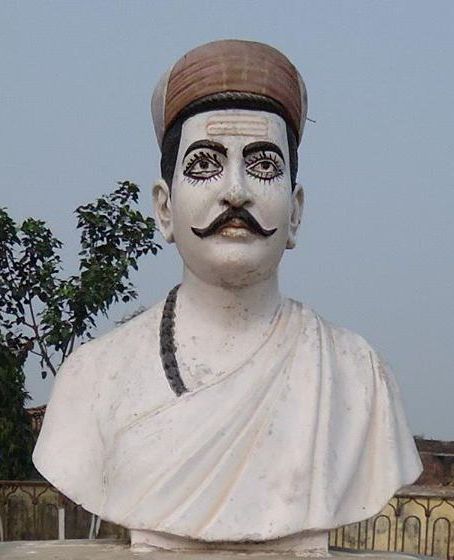
Memorial Statue of Vidyapati at the Machh Dwar entrance of the Uchchaith Bhagawati Mandir Complex

Early life

[edit]

Vidyapati was born to a Maithil Brahmin family in the village of Bisapī (now Bisfi) in the present-day Madhubani district of the Mithila region [9] of northern Bihar, India.[1][6][10] The name Vidyapati ("master of knowledge") is derived from two Sanskrit words, vidya ("knowledge") and pati ("master"). There is confusion as to his exact date of birth due to conflicting information from his own works and those of his patrons.[11]

He was the son of Gaṇapati Ṭhakkura, a Maithil Brahmin said to be a great devotee of Shiva.[10] His mother name was Hansini Devi. Vidyapati was married to Shushila.[12] He was a priest in the court of Rāya Gaṇeśvara, the reigning chief of Tirhut.[11] A number of his near ancestors were notable in their own right including his great-grandfather, Devāditya Ṭhakkura, who was a Minister of War and Peace in the court of Harisimhadeva.

Vidyapati was heavily associated with the Oiniwar dynasty of Mithila and worked in the courts of seven Kings and two Queens of this dynasty.[11] Vidyapati's first commission was by Kīrttisiṃha, who ruled Mithila from around 1370 to 1380.[10] This led to the Kīrtilatā, a long praise-poem for his patron in verse.[10] This work contains an extended passage praising the courtesans of Delhi, foreshadowing his later virtuosity in composing love poetry.[10] Though Kīrttisiṃha didn't commission any more works, Vidyapati secured a position at the court of his successor, Devasimha.[10] The prose story collection Bhūparikramaṇa was written under Devasimha's auspices.[10] Vidyapati developed a close friendship with Devasimha's heir apparent Sivasimha and started focusing on love songs.[10] He wrote some five hundred love songs, primarily between 1380 and 1406.[10] The songs he composed after that period were devotional praises of Shiva, Vishnu, Durga, and Ganga.[10]

There was a close friendship between Sivasimha, king of Mithila from 1402 to 1406, and Vidyapati.[10] As soon as Sivasimha ascended to his throne, he granted Vidyapati his home village of Bisapi, an act recorded on a copper plate.[10] On the plate, Sivasimha calls him "the new Jayadeva".[10] The poet also accompanied his king to Delhi, at the sultan's demand.[10] A story about that encounter relates how the king was held by the sultan and Vidyapati negotiated for his release by displaying his clairvoyant powers.[10] Sivasimha's favourable patronage and the courtly environment encouraged Vidyapati's experiments in love songs written in Maithili, a language everyone at court could enjoy.[10] In 1406, Sivasimha went missing in a battle with a Muslim army.[10] After this defeat, Vidyapati and the court took refuge at a king's court in Rajabanauli(also known as Banauli), in modern-day Nepal.[10] Lakhima Devi, the chief queen of Sivasimha, reigned for 12 years.[13] After that, Padmasimha became the ruler of Mithila. Vidyapati returned to serve Padmasimha and continue writing, primarily treatises on law and devotional manuals.[10]

Entry gate named Vidyapati Pravesh Dwar in the honor of the poet Vidyapati at Banauli village near Janakpur city

At about 1430 or earlier, he is known to have returned to his village, Bisapi.[10] He often visited its temple of Shiva.[10]

He is recorded as having two wives, three sons and four daughters.

Political career

[edit]

The independence of the kings Vidyapati worked for was often threatened by incursions by Muslim sultans. The Kīrttilatā makes reference to an incident where the Oiniwar King, Raja Gaṇeśvara, was killed by the Turkish commander, Malik Arsalan in 1371. By 1401, Vidyapati requested the help of the Jaunpur Sultan in overthrowing Arsalan and installing Gaṇeśvara's sons, Vīrasiṃha and Kīrttisiṃha, on the throne. With the Sultan's assistance, Arsalan was deposed and Kīrttisiṃha, the oldest son, became the ruler of Mithila.[5]

The conflicts of his time are evident in his works. In his early praise-poem Kīrttilatā, he slyly criticises his patron for his perceived deference to Muslims.[10]

Love songs

[edit]

While working under his second patron, Devasimha, and especially under his successor Sivasimha, Vidyapati started composing Maithili songs of the love of Radha and Krishna. He seems to have only composed love songs between 1380 and 1406, though he kept writing until near his death in 1448.[10] He seems to have ceased writing love songs after his patron and friend Sivasimha went missing in a battle and his court had to go into exile.[10] These songs, which would eventually number five hundred, broke with convention. They were written in vernacular Maithili as songs, not as formal poems in literary Sanskrit as was done before. Until Vidyapati, Maithili wasn't employed as a literary medium.

He applied the tradition of Sanskrit love poetry to the "simple, musical, and direct" Maithili language.[10] His inheritance from the Sanskrit tradition include its repertory of standard images to describe beauty ("eyes large and tender like a doe's") and standard settings to invoke certain moods and feelings (spring with its increasing heat as an analogy for rising passion).[10] Vidyapati also drew from the beauty of his home in Madhubani ("forest of honey"), with its mango groves, rice fields, sugar cane, and lotus ponds.[10]

In the tradition of Jayadeva's Gita Govinda, Vidyapati's songs were simultaneously praises of love-making and praises of Krishna; praise of Krishna involved praise of love-making.[10] The intensity and poetic virtuosity of the songs were integral to these songs' function as a way to directly worship god and earn spiritual merit.[10] Vidyapati's continuation of Jayadeva's program in a different language earned him the title "the new Jayadeva".[10] His work did differ from his predecessor's in two ways. His songs were independent from one another unlike the Gita Govinda, which comprises twelve cantos telling an overarching story of the couple's separation and reunion.[10] While Jayadeva wrote from Krishna's perspective, Vidyapati preferred Radha's; "her career as a young girl, her slowly awakening youth, her physical charm, her shyness, doubts and hesitations, her naive innocence, her need for love, her surrender to rapture, her utter anguish when neglected – all of these are described from a woman's point of view and with matchless tenderness."[10]

These songs frequently mention the queens of king Sivasimha, an indicator that they were meant to be enjoyed by the court.[10] At times, his poems identify Krishna with king Sivasimha and Radha with the king's chief queen, Lakhima Devi.[10] They were sung by a court singer, Jayati, who sent the songs to music.[10] They were learned by dancing girls and eventually spread out of the court.[10]

His love songs have been collected into the Padāvalī, probably not by Vidyapati himself.[8][6]

Devotional songs

[edit]

Though he wrote hundreds of love songs about the romance of Radha and Krishna, he was not a special devotee of Krishna or Vishnu.[10] Instead, he lavished attention on Shiva and Durga but also wrote songs about Vishnu and Ganga.[10] He is particularly known for his songs of the love of Shiva and Parvati and prayers for Shiva as the supreme Brahman.

A song titled All My Inhibition:

All my inhibition left me in a flash,
When he robbed me off my clothes,
But his body became my new dress.
Like a bee hovering on a lotus leaf
He was there in my night, on me![2]

Shiva and Parvati Hymns:

Vidyapati's deep devotion to Lord Shiva is evident in his compositions that explore the divine relationship between Shiva and Parvati. These works are characterised by their poetic elegance and spiritual depth, reflecting the poet's reverence for the divine couple.

Gosaunik Geet: "Jai Jai Bhairavi" :

Among Vidyapati's notable devotional songs is "Jai Jai Bhairavi," a Gosaunik Geet dedicated to Goddess Bhairavi. This composition is traditionally sung during auspicious ceremonies in the Mithila region, highlighting the poet's influence on regional devotional practices.

Influence

[edit]

Odia literature

[edit]

Vidyapati's influence reached Odisha through Bengal. The earliest composition in Brajabuli, an artificial literary language popularised by Vidyapati, is ascribed to Ramananda Raya, the governor of Godavari province of the King of Odisha, Gajapati Prataprudra Dev. He was an associate of Chaitanya Mahaprabhu. He recited his Brajabuli poems to Chaitanya Mahaprabhu, when he first met him on the bank of river Godavari at Rajahmundry, southern provincial capital of Kingdom of Odisha.[14]

Bengali literature

[edit]

Bengali Vaishnavas like Chitanya and Chandidas adopted Vidyapati's love songs about Radha and Krishna as Vaishnava hymns.[10] All major Bengali poets of the medieval period were influenced by Vidyapati. As a result, an artificial literary language, known as Brajabuli was developed in the sixteenth century. Brajabuli is basically Maithili (as prevalent during the medieval period) but its forms are modified to look like Bengali.[15] The medieval Bengali poets, Gobindadas Kabiraj, Jnandas, Balaramdas and Narottamdas composed their padas (poems) in this language. Rabindranath Tagore composed his Bhanusingha Thakurer Padabali (1884) in a mix of Western Hindi (Braj Bhasha) and archaic Bengali and named the language Brajabuli as an imitation of Vidyapati (he initially promoted these lyrics as those of a newly discovered poet, Bhanusingha). Other 19th-century figures in the Bengal Renaissance like Bankim Chandra Chatterjee have also written in Brajabuli.

Tagore was much influenced by Vidyapati. He set the poet's Bhara Badara to his own tune.[citation needed]

Legacy

[edit]
Postal stamp issued by the Government of India in recognition of Vidyapati

Vidyapati has been kept alive in popular memory over the past six centuries; he is a household name in Mithila.[6] His love songs are sung at weddings in the region.[10] Many myths have arisen about him and people continue to sing his songs.

Bidāpat Nāch

[edit]

A form of folk dance-drama street theatre, Bidāpat Nāch, where "bidāpat" is derived from "Vidyapati", is performed in Purnia district in north Bihar.[16] While several groups performed in multiple villages in that area in the 20th century, there was just one group left in one village by 2012.[6][16]

In mythology

[edit]

Vidyapati's life has been mythologised in different ways. Many of his admirers ascribe miracles to him and detail his interaction with the gods.[11] Among these stories is one which details that Shiva came down to earth to speak with Vidyapati after being impressed with his piety. This incarnation of Lord Shiva is known as Ugna. Ugna served as the servant of the poet Vidyapati.

Another story exists involving him and the Goddess Ganga.[6][11] When his death was imminent, he decided to go to the river Ganga, but was too tired to continue just a few miles away. He resolves that if his piety was pure, the river would come to him.[6] And so it happens.[6] The goddess obliges and the river rises to let him take a final dip in holy waters.[6] At some point in the past, the town where this is believed to have happened was renamed Vidyapati Nagar ("town of Vidyapati") and a Shiva temple was built there.[6]

[edit]

Pahari Sanyal played Vidyapati in the 1937 Bengali film Vidyapati, which received a lot of appreciation. The film starred Prithviraj Kapoor as King Shiva Singha of Mithila.[17] Another film, also titled Vidyapati, was made in 1964 by Prahlad Sharma, starring Bharat Bhushan and Simi Garewal in the lead roles.[3]

In December 2018, Darbhanga Airport was renamed Kavi Kokil Vidyapati Airport.[18]

Banauli Vidyapati Dih

[edit]

In the Himalayan nation of Nepal, there is a historical dih named after him at Banauli village of the Mithila region. It is known as Banauli Vidyapati Dih. The location of the historical dih has been declared as a tourist destination by the Madhech Pradesh provincial government of Nepal. It is also considered as the location of the court of King Puraditya in the Dronwara dynasty of the Raj Banauli in Mithila.[19][20]

The sacred peepal tree at the Banauli Vidyapati Dih.

Works

[edit]

Texts

[edit]
  • Maṇimañjarīnāṭikā (Sanskrit, Tirahuta script) – a conventional romantic play (nāṭikā)[6]
  • Bhūparikramaṇa ("around the world", Sanskrit, Devanagari script) – a collection of eight prose stories set in different locales[6]
  • Kīrttilatā (Avahaṭṭha, Devanagari script) – a praise-biography in verse detailing the victory of Vidyapati's patron Kirttisimha's over his rival Malik Arsalan composed in the Sanskrit genre ākhyāyikā.[6]
  • Puruṣaparīkṣā (Sanskrit, Devanagari script) – a treatise on political ethics and ideal masculinity, composed broadly in the Sanskrit kathā genre.[6]
  • Gorakṣavijaya (Sanskrit, Prakrit, and Maithili; Mithilākṣara script) – a musical play about Tantric saint Gorakṣanātha rescuing his teacher Matsyendranātha from a worldly life back to the life of a yogi[6]
  • Kīrttipatākā (Avahaṭṭha, Tirahutā script) – a partially-extant praise-biography in verse for another of Vidyapati's patrons, Sivasimha.[6]
  • Harikeli (Avahaṭṭha, Tirahutā script) – a partially-extant allegorical love play between Krishna and the Gopis, with Raya Arjuna/Jagat Simha (a cousin of Sivasimha) as protagonist.[6]
  • Likhanāvalī (Sanskrit, Devanagari script) – a manual for scribes, with model letters, business documents, and affidavits[6]
  • Śaivasarvasvasāra (Sanskrit; one manuscript in Mithilākṣara script, two in Devanagari) – describes the significance and merits of worshipping Shiva, with proscribed rituals, citing extensively from the Puranas.[6]
  • Gaṅgāvākyāvalī (Sanskrit) – a text glorifying the religious significance of Ganga, with citations from the Puranas.[6]
  • Vibhāgasāra (Sanskrit, Tirahuta script) – a dharmaśāstra focusing on property law, with citations from many Smritis.[6]
  • Dānavākyāvalī (Sanskrit, Devanagari script) – a guide to types of ritual donations and their spiritual merits[6]
  • Durgābhaktitaraṅgiṇī (Sanskrit, Devanagari script) – a guide to the proper worship of Durga, especially during Navaratri or in the month of Asvin.[6]
  • Gayāpattalaka (Sanskrit, Devanagari script) – a text about funerary rituals.[6]
  • Varṣakṛtya (Sanskrit) – a text describing the festivals that are to be observed through the year (probably the festivals that were observed in Mithila at that time).[6]
  • Padāvalī (Maithili, Tirahuta/Bangla/Devanagari scripts depending on version) – a compilation of Vidyapati's songs in praise of Krishna, likely not put together by him.[6][16]

Translations

[edit]

His works have been translated to several languages, including English.[8] Vidyapati's love songs were translated into English as part of the UNESCO Collection of Representative Works.[10]

Notes

[edit]

Bibliography

[edit]

Further reading

[edit]
[edit]
Revisions and contributorsEdit on WikipediaRead on Wikipedia
from Grokipedia
Vidyapati (c. 1350–1450 CE), also known as Maithil Kavi Kokil, was a Maithili Brahman poet and Sanskrit scholar from Mithila in medieval Bihar, distinguished for his lyrical compositions in Maithili that fused erotic human love with devotional bhakti toward Radha and Krishna. Born into a family linked to the Tirhut royal court, he served as a court poet and minister under local chieftains, producing works in multiple languages including Sanskrit treatises on law and music, Apabhraṃśa historical narratives, and Maithili pads (songs) alongside two dramas. His poetry, emphasizing shringara rasa (erotic sentiment) as a path to divine union, pioneered secular-devotional expression in Maithili literature and profoundly shaped Vaishnava traditions, with his verses adopted in kirtan practices and inspiring poets in Bengal, Assam, Orissa, and Nepal. Vidyapati's oeuvre reflects the cultural vibrancy of 15th-century Mithila amid political fragmentation, blending scholarly erudition with accessible emotional depth that ensured his enduring legacy as a bridge between classical Sanskrit poetics and regional bhakti movements.

Biography

Early Life and Origins

Vidyapati was born circa 1350 in the village of Bisapi (also spelled Bishaphi or Bisfi), situated in the Madhubani subdivision of Darbhanga district within the historic Mithila region of present-day Bihar, India. This area, centered around the cultural and linguistic traditions of Maithili speakers, formed the cradle of his intellectual and poetic development. He hailed from a distinguished lineage of Maithil Brahmanas belonging to the and adherents of the Shukla Yajurveda, with ancestral origins traceable to Oini near in . The family, identified as Bisaibaras owing to their deep ties to Bisapi, maintained a heritage of scholar-statesmen across more than five generations, positioning Vidyapati as the sixth in descent from Karmaditya, a prominent minister. His father, Ganapati Thakur—the son of Jayadatta—embodied this tradition, with the hereditary surname "Thakur" denoting possession of landed estates and administrative roles under regional rulers. Earlier forebears included the renowned Dhireshwara, a great-grandfather and author of nibandhas (legal digests), underscoring the family's scholarly prowess in and texts. Little direct evidence survives regarding Vidyapati's childhood, but he matured in a milieu enriched by courtly and Brahmanical learning, reportedly interacting from youth with Oinwara princes such as Shiva Singha. His foundational education unfolded within this familial scholarly environment, augmented by tutelage under the grammarian Hari Mishra, encompassing key Sanskrit works like the Mahabharata and Puranas. By his late teens or early twenties, around 1368, Vidyapati had already ventured into composition, as evidenced by his geographical treatise Bhuparikrama, composed during travels to sites like Naimisharanya. This precocity reflects the rigorous training typical of elite Maithil Brahmin households, where proficiency in Sanskrit poetics and rhetoric was prized.

Court Service and Political Role

Vidyapati entered service in the of Mithila around 1370 CE, initially under King Deva Singha before being recalled to serve King Shiva Singha, whose reign lasted until approximately 1406 CE. He held the position of Raja , overseeing scholarly affairs and court rituals, while also functioning as a trusted advisor and to the royal family. Over the course of more than 50 years, Vidyapati served seven kings across four generations, including Shiva Singha, Hara Singha, Narasingha, and Dhira Singha, demonstrating sustained loyalty amid regional political instability from Muslim incursions. His tenure under Shiva Singha, spanning about 36 years, marked a period of royal patronage that enabled his literary output, with the king granting him the village of Bisfi in recognition of poems such as Kirtilata and Kirtipataka. In a notable incident, Vidyapati intervened to prevent Shiva Singha's arrest by composing persuasive poetry that highlighted the king's virtues, underscoring his role as a influencer within the court. He further demonstrated administrative acumen by managing the affairs of Shiva Singha's wives during the king's exile from 1406 to 1418 CE and later acting as an elder statesman. Vidyapati's Likhanavali, a treatise compiled around 1419 CE (L.S. 299), comprises 84 model letters on , , , and socio-economic matters, revealing his direct involvement in statecraft as a or . This work details administrative structures, including fiscal divisions like grama (village), , and parigana; land revenue assessments based on ; and roles of officials such as Mahapatnika Thakkura and Gramapati, providing of feudal practices in 15th-century Mithila. Vidyapati's political influence extended to advocating conservative social hierarchies, such as among Brahmins, while his writings reflect awareness of economic challenges like rural indebtedness and slave trade transactions. Though primarily a and , his compositions like Purusapariksa praised Singha's military victories, aligning literary service with royal legitimacy in a era of Oiniwar autonomy amid broader Islamic expansions. His administrative insights in Likhanavali synthesize influences from earlier treatises like Kautilya's, offering a pragmatic view of courtly obligations without evident reformist intent.

Personal Life and Conversion to Bhakti

Vidyapati was born around 1350 into a scholarly family of the in Bisapi village, Mithila, descending from a line of scholar-statesmen and ministers noted for their cultural contributions in the region. His father was Ganapati Thakur, and his grandfather Jayadatta; the family held the title Thakur and maintained a Shaivite devotional tradition, with ancestors including figures like Karmaditya and Chandeshwar who served in administrative roles. He married twice, with his first wife bearing two sons—including the eldest, Harapati, who served as a royal seal-keeper and astrologer—and two daughters, while his second wife bore one son and two daughters, resulting in a of four sons and four daughters overall. One account identifies his first wife as Viswasadevi. Vidyapati composed songs reflecting on and life, including a genre called Nachari that depicted domestic and relational themes, though these were often stylized rather than strictly autobiographical. Raised in a Shaivite household, Vidyapati composed numerous songs devoted to and identified as a panchadevopasaka, venerating five deities without rigid sectarian boundaries, as evidenced by his assertion in the Purusapariksha that a single Almighty underlies all creation, rendering distinctions between and illusory. Despite this familial , his extensive padavali poetry centered on the erotic-devotional love of and Krishna, aligning with Vaishnava traditions and influencing later figures like Chaitanya, who incorporated these verses into practices. Scholars interpret his oeuvre as revealing an underlying Vaishnava orientation, with early works blending secular and later compositions shifting toward penitential devotion to Krishna for salvation, including copying the Bhagavata Purana during a period of following political upheaval in the Oinwara around 1406. This devotional emphasis, rather than a formal sectarian conversion, reflects a syncretic where Shaivite roots coexisted with expressions, possibly composed to sustain patronage amid diverse religious demands. He died around 1448 near the at Vidyapati Nagar.

Literary Output

Sanskrit Scholarship

Vidyapati's Sanskrit scholarship encompassed treatises on administration, , and practical , reflecting his position as a and advisor in 15th-century Mithila. His Likhanāvalī, a concise manual, delineates formats for official correspondence, legal documents, and epistles, tailored for royal use and demonstrating meticulous attention to bureaucratic precision. This work, composed around 1400–1420, underscores his expertise in prose suited to administrative needs, drawing from classical models while adapting to regional practices. Puruṣaparīkṣā, a in the Sanskrit kathā tradition, examines through stories testing male virtues such as , , and , composed circa 1420. The text critiques flawed rulers and idealizes principled manhood, blending didactic fables with moral to guide ethical conduct in . Its 15th-century composition highlights Vidyapati's integration of logic and ethical realism, prioritizing causal consequences of actions over abstract ideals. Additional Sanskrit works include Bhūparikramā, addressing royal inspections or geographical surveys, and Vibhāgasāra, likely on divisions of knowledge or administrative partitions. He further contributed Varṣakṛtya, pertaining to annual rituals or fiscal duties, and miscellaneous verses (kibiditaka) showcasing rhetorical mastery. These compositions, totaling over a dozen attributed texts, affirm his status, bridging literary elegance with pragmatic scholarship amid Mithila's scholarly tradition.

Maithili Compositions

Vidyapati's principal Maithili compositions consist of lyrical songs assembled in the Padāvalī, a collection exceeding 1,000 verses attributed to him, though approximately 800 have been traced in manuscripts. These songs, composed primarily between 1370 and 1406 CE, employ the old Maithili (or Abahaṭṭa-influenced form) and are structured as padas suitable for musical rendition in regional ragas. The Padāvalī encompasses diverse categories, including nacharī songs devoted to Shiva's life and worship, erotic depictions of love involving Krishna and the gopis, and functional verses for social rituals such as vyavahāra and joga. Beyond the Padāvalī, Vidyapati authored narrative works in old Maithili, such as Kīrtipatākā, an eulogistic poem celebrating the victory of ruler Shiva Singha, and Kīrtilatā, a historical romance blending prose and verse that chronicles aspects of the Oinwara dynasty's rule. These compositions demonstrate Vidyapati's versatility, shifting from introspective lyricism to heroic and didactic narratives, while drawing on folk traditions and contemporary cultural contexts. Their significance lies in pioneering Maithili as a vehicle for refined literature, distinct from dominant Sanskrit forms, thereby influencing subsequent poetry in northeastern India, including Bengali Brajabuli and Nepali traditions. Manuscript evidence and editorial compilations, such as those by scholars like Benipuri and N. Gupta, preserve select Padāvalī songs focusing on Shiva-Parvati's domestic life, often infused with humor and . This body of work remains performatively alive, with nacharī songs inspiring thousands of derivatives over five centuries in Mithila and .

Key Works and Manuscripts

Vidyapati's literary output spans treatises, dramas, and devotional texts; Maithili padas (lyrical songs); and Apabhramsa compositions, with manuscripts generally scarce in Mithila and better preserved in 's palm-leaf collections or specific Indian libraries. Only Purusapariksa enjoys relatively wide availability among his works, while others exist in limited, often incomplete copies; the padas survived largely through oral transmission before compilation in anthologies. The padas in Maithili, numbering over 1,000 and composed mainly from 1370 to 1406, form his most celebrated legacy, categorized into social-function songs (vyavahara, joga), Shiva-devotional pieces (nachari), and erotic depicting Krishna-gopi romance. These were gathered in collections like Padavali (edited by N. in and others) and Bhasha Geeta Sangraha (edited by Ramanath Jha in 1970), drawing from manuscripts and Mithila family songbooks; critical editions by B.B. and Subhadra Jha address attribution issues from oral variants and bhanita (signature-line) confusions. Sanskrit works highlight his scholarly range, including the moral narrative Purusapariksa (44 tales in four chapters, translated into Bengali as early as 1815); Bhuparikrama (pilgrimage route from Naimisharanya to Tirhut with eight tales, sole manuscript in Sanskrit College, Calcutta); devotional compilations like Saivasarvasvasara (on Shiva worship, incomplete copies in and ) and Durgabhakti Tarangini (on , compiled late in life); legal texts such as Vibhagasara (on , unpublished); and dramas like Goraksavijaya (in and with embedded Maithili songs, manuscript in ). Fragmentary survivals include Gayapattalaka (Gaya rites) and Varsakritya (annual festivals). In Apabhramsa (or Old Maithili), Kirtilata stands as a blending prose and verse, with published editions from error-prone manuscripts, while Kirtipataka eulogizes patron Shiva Singha's victory, known from a single dilapidated manuscript.

Poetic Themes and Innovations

Erotic and Romantic Elements

Vidyapati's Maithili padavali songs prominently incorporate shringara rasa, the aesthetic of erotic love, portraying the intense physical and emotional bonds between and Krishna with vivid, sensual imagery. Drawing from poetic traditions, he adapted elements of erotic description—such as the beauty of the beloved's form, the pangs of longing, and the ecstasy of union—into the vernacular , making them accessible and earthy for a broader audience beyond courtly elites. This innovation established a model for romantic expression in Mithila poetry, emphasizing sexual fulfillment as integral to human experience alongside spiritual dimensions. Scholars categorize Vidyapati's compositions into and non- types, with the former dominating his lyrical output and focusing on themes of attraction, flirtation, and . In these works, romantic elements manifest through detailed depictions of sambhoga (enjoyment or union), where lovers' embraces, glances, and sensory pleasures evoke raw passion, as in songs evoking Radha's adornments or Krishna's playful seductions. Conversely, viraha (separation) intensifies the romantic torment, with motifs of sleepless nights, messengers bearing tokens, and the lover's physical ache underscoring desire's psychological depth. Such portrayals blend human sensuality with symbolic devotion, though Vidyapati's unreserved sensuousness distinguishes his style from more restrained contemporaries. His poetry often employs natural metaphors—rain-lashed forests for arousal, blooming lotuses for feminine allure—to heighten romantic immediacy, reflecting a causal link between bodily urges and poetic vitality in pre-modern . While some analyses attribute this boldness to secular influences, primary attributions tie it to Vaishnava narratives, where Radha-Krishna's romance serves as for divine union, yet Vidyapati's explicitness prioritizes tangible realism over abstract philosophy. This dual layering—romantic narrative veiling deeper —has prompted debates on whether his works primarily exalt profane love or elevate it devotionally, with textual evidence favoring the former's unapologetic prominence in his corpus.

Devotional and Philosophical Dimensions

Vidyapati's Maithili padavali embodies the bhakti tradition's emphasis on personal, emotional devotion, particularly through the madhura-rasa (sweet sentiment) in depictions of Radha and Krishna's intimate bond. His roughly 195 songs illustrate the deities' lila (divine play), influenced by the Bhagavata Purana and Jayadeva's Gita Govinda, where Radha represents the devotee's soul in fervent yearning for Krishna as the supreme deity, fostering a direct, unmediated communion with the divine. This approach prioritizes lila-bhakti—devotional engagement with the gods' playful antics—as the pathway to spiritual fulfillment, transcending formal rituals in favor of heartfelt surrender. Philosophically, Vidyapati's oeuvre reflects a syncretic , positing the unity of the wherein diverse deities like and manifest as aspects of one , allowing for fluid transitions between Shaiva and Vaishnava expressions in his corpus. His integration of shringara rasa ( sentiment) with bhakti aesthetics transforms sensual imagery into for the soul's metaphysical longing, blurring distinctions between physical desire and sacred union in alignment with Vaishnavite theology's focus on experiential . Separation (viraha) and reunion (sambhoga) in Radha-Krishna narratives underscore devotion's dialectical progression toward transcendence, where erotic ecstasy symbolizes the devotee's absorption into the divine essence. In later works, themes of penitence and highlight bhakti's soteriological , portraying Krishna's grace as the sole means to amid worldly illusions, thus elevating emotional devotion over intellectual or ascetic pursuits. This philosophical undercurrent influenced regional Vaishnavite practices, bridging courtly with devotional to democratize spiritual access beyond elite scriptural knowledge.

Linguistic and Stylistic Contributions

Vidyapati elevated Maithili, the vernacular of the Mithila region, from a primarily spoken dialect to a refined literary medium, thereby democratizing poetic expression beyond the Sanskrit elite. He composed in Maithili using two stylistic registers: a sophisticated variant incorporating Tatsama (Sanskrit-derived) words for erudite audiences and a simpler Tadbhava (Prakrit-derived) form accessible to common folk, refining the language's rhythmic qualities with short vowels and liquid consonants to enhance its musical flow. His works also employed Apabhramsa (termed Abahattha), an intermediate stage between Prakrit and modern Indo-Aryan languages, particularly in historical narratives like Kirttilata, alongside Sanskrit for scholarly treatises. A key linguistic innovation was his adoption of Brajabuli, an artificial sweet dialect rooted in Maithili, which blended vernacular elements with heightened expressiveness to convey devotional and erotic themes, influencing subsequent regional literatures including Bengali Vaishnava . This approach integrated poetic conventions—such as alankaras (figures of speech like Utpreksha and Aprastutaprasamsa)—with Maithili's earthy idiom, creating vivid, nature-infused imagery that grounded abstract emotions in concrete sensory details. Stylistically, Vidyapati pioneered the fusion of poetry and music by composing over 1,000 padas (songs) tuned to local ragas, often in collaboration with musicians like Jayata for court performances, which emphasized oral transmission and emotional resonance over textual rigidity. He broke from prevailing Sanskrit-dominated conventions by favoring lyrical, independent Muktaka songs depicting discrete moods of love—often from a feminine perspective, as in Radha's longing—over narrative epics, introducing bold, unconventional similes drawn from daily life, mythology, and nature. Innovations included the Nachari form, a dance-accompanied devotional genre dedicated to Shiva, and the consistent use of bhanita (the poet's signature in the final couplet) to authenticate verses amid oral variations. These elements prioritized prasada (lucidity) and madhurya (sweetness), blending sensuous eroticism with bhakti devotion in a direct, heartfelt style that contrasted sharply with the era's formal, erudite poetry.

Historical and Scholarly Context

Debates on Chronology

Scholars generally agree that Vidyapati flourished in the late fourteenth and early fifteenth centuries CE, during the rule of the in Mithila, but precise dates for his birth and death remain uncertain due to the absence of contemporary biographical records and reliance on indirect evidence from colophons, patron references, and traditions. Traditional accounts, often repeated in secondary sources, assign him a lifespan of approximately 1352–1448 CE, implying into his mid-nineties, but this has been questioned for lacking primary corroboration and potentially deriving from hagiographic embellishments in later Maithili lore. Analysis of internal textual evidence, such as dated colophons in works like the Durga-Bhakti-Tarangini, points to Vidyapati's active composition extending to Laukika Samvat (L.S.) 330, corresponding to circa 1423–1424 CE, suggesting an earlier death around that time near the in what is now Vidyapati Nagar. This aligns with his service under multiple Oiniwar kings across four generations, including Shiva Singha (r. circa 1370–1406 CE), for whom Vidyapati composed panegyrics dated to L.S. 293 (equivalent to Saka Era 1324 or 1402 CE), positioning the poet as roughly contemporary and slightly senior to his patron. Discrepancies arise from varying interpretations of the Laukika Samvat's epoch—often pegged to 1119 CE in Mithila —which can shift absolute dates by decades if miscalibrated against or Vikrama eras. Further debate stems from Vidyapati's references to historical events and rulers, such as his allusions to Turkic incursions and local dynastic transitions, which some scholars use to anchor his career to the 1380s–1420s, while others extend it to mid-century based on undatable padas (songs) attributed posthumously or via oral transmission. For instance, cross-referencing with the reigns of successors like Hara Singha and Narasimha Thakur supports activity into the 1420s but not reliably beyond, challenging the 1448 endpoint as possibly conflated with later compilations or apocryphal biographies. These chronological variances underscore the limitations of pre-modern South Asian literary dating, where patronage ties and scribal additions often blur authorial timelines, prompting calls for more rigorous paleographic and codicological studies of extant manuscripts.

Authenticity and Attribution Issues

Scholars have long debated the authenticity of works attributed to Vidyapati, particularly his Maithili-language padavali (song collections), due to the absence of contemporary manuscripts and the oral nature of transmission in medieval Mithila. No autograph copies exist, and the earliest surviving manuscripts date from the or later, complicating direct attribution. Later anthologies, such as pada-saṃgrahas in Bengali and traditions, include hundreds of songs ascribed to Vidyapati, but these often diverge significantly from older Maithili sources, with only rare overlaps in content or phrasing. This discrepancy arises from vernacular adaptations and cultural appropriations, where poets in neighboring regions like incorporated similar bhakti themes under Vidyapati's name, leading to spurious inclusions. For instance, compilations like those edited by N. in attempt to standardize the padavali by cross-referencing variants, yet authenticity remains contested for individual songs, as stemmatic is hindered by textual fluidity and regional interpolations. Scholars such as those examining Maithili literary histories note that Bengali and appropriations have inflated the attributed corpus, sometimes prioritizing devotional utility over philological rigor. In contrast, Vidyapati's Sanskrit compositions, including treatises like Purushapariksha, enjoy firmer attribution, supported by manuscript colophons and cross-references in contemporary records from the Oiniwar dynasty court. However, even here, occasional doubts persist regarding minor works due to shared authorship conventions among court poets. Overall, modern critical editions prioritize Maithili manuscripts from Mithila proper to distinguish core authentic output—estimated at around 200-300 genuine padas—from the broader, inflated tradition exceeding 1,000 songs. These issues underscore the challenges of reconstructing medieval vernacular canons amid evolving bhakti performance practices.

Political Interpretations of His Era

Vidyapati's tenure in the courts of 15th-century Mithila coincided with the fragmentation of the and the emergence of regional powers such as the Jaunpur Sharqi sultanate, prompting interpretations of his era as one of negotiated Hindu sovereignty amid Islamic expansionism. Scholars view his works, including Kirtilata and administrative treatises like Purushapariksha, as embedding pragmatic political thought that aligned monarchical interests with and subject welfare, reflecting a strategic maintenance of through , , and intellectual administration rather than outright confrontation. For instance, Vidyapati's service under rulers like Kirti Simha (r. c. 1370–1410) and later accommodations—such as elevating Ibrahim Shah Sharqi (r. 1402–1440) in hyperbolic praise akin to divine status—illustrate a adaptation to sultanate pressures while preserving Vedic governance norms in a Brahmin-led dynasty. Pankaj Jha interprets Vidyapati's multilingual compositions as sustaining pre-sultanate imperial ideals of order and varna-based polity in vernacular forms, countering the Persian-centric historiography of that marginalizes regional Hindu polities like Mithila. This perspective posits his era not as decline but as a resilient cultural-political formation, where intellectuals, including Vidyapati as advisor across seven kings and two queens, engineered a hybrid intellectual identity blending jurisprudence with courtly realia to navigate sultanate incursions. Such analyses emphasize causal factors like the dynasty's reliance on Brahmin-Kshatriya cores and diplomatic acumen, evidenced in narratives of negotiating royal releases from sultanate captivity. Shankar Kumar Jha's political analysis frames Vidyapati as a theorist of kingship whose texts, such as Bibhagasara, prescribed character-based governance to foster loyalty and stability, mirroring the Oiniwar shift from to rule—a pragmatic ideological pivot rooted in Mithila's Vedic scholarly tradition amid external threats. Critics of sultanate-era narratives, however, caution against overemphasizing accommodation as subservience, noting Vidyapati's exaltation of indigenous rulers' martial and ethical virtues as subtle assertions of dharmic resistance. These interpretations, drawn from primary textual evidence, underscore Mithila's era under Vidyapati as a for indigenous statecraft, prioritizing empirical rulership over ideological purity.

Influence

Regional Literary Impacts

Vidyapati's padavali songs, blending erotic and devotional themes in Maithili, profoundly shaped Vaishnava poetry in , where they were adapted into the regional literary tradition by the . His works influenced Bengali poets composing in , a dialectal hybrid used for Krishna-Radha lyrics, as seen in the Vaishnava Padavali anthologies that drew directly from his sensual depictions of divine love. This impact extended through the , with (1486–1534) incorporating Vidyapati's verses into congregational performances, elevating them as models for emotional expression in . In Mithila, Vidyapati's innovations in vernacular poetics reinforced Maithili as a literary medium for courtly and folk expression, inspiring subsequent generations of local poets to explore similar romantic-devotional motifs amid the region's Shaiva-Vaishnava syncretism. His influence permeated eastward, affecting Assamese literature through shared Vaishnava networks, where Maithili songs informed the thematic and performative styles of bhakti compositions in the Ahom kingdom by the 17th century. Further south, Vidyapati's motifs reached via , contributing to early works attributed to figures like Ramananda Raya in the 16th century, though Odia historiographies often underemphasize this Maithili-Bengali lineage in favor of indigenous developments. By the modern era, his legacy persisted in Bengali revivalism, with (1861–1941) explicitly acknowledging Vidyapati's stylistic influence on his own lyrical explorations of love and . These regional transmissions underscore Vidyapati's role in fostering a shared Eastern Indian poetic idiom centered on shringara-bhakti, despite variations in linguistic adaptation and cultural emphasis.

Religious and Cultural Transmission

Vidyapati's padavali songs, which fused love poetry with Vaishnava devotion to and Krishna, served as a key medium for transmitting ideals across eastern , emphasizing personal emotional surrender over ritualistic orthodoxy. This synthesis of śṛṅgāra rasa (erotic sentiment) and spiritual longing exemplified the tradition's accessibility, influencing subsequent devotional literature by prioritizing direct experiential union with the divine. The transmission gained momentum through the Gaudiya Vaishnava movement led by (1486–1533), who regularly recited Vidyapati's verses during gatherings, entering ecstatic states that modeled their transformative power. Chaitanya's followers integrated these songs into their liturgical practices, adapting Maithili compositions into Bengali contexts and embedding them in the Pada-kalpataru anthology compiled around 1550, which preserved and disseminated Vidyapati's works alongside those of and . Culturally, Vidyapati's poetry facilitated the cross-regional flow of Mithila's aesthetic and philosophical elements into Bengali and Odia traditions, with his verses recited in temple rituals and folk performances that reinforced Vaishnava social cohesion amid Oria and Muslim political expansions in the 15th–16th centuries. Manuscripts copied in by the , such as those in the Caitanya-caritāmṛta hagiographies, underscore this oral and scribal relay, sustaining his influence in non-elite devotional circles.

Legacy

Traditional Performances and Arts

Vidyapati's padavali—lyrical poems in Maithili extolling the divine love of Radha and Krishna—have profoundly shaped expressive traditions in Indian classical dance, particularly through abhinaya (facial and gestural interpretation of emotions). These works, with their vivid depictions of nayika (heroine) sentiments ranging from longing to union, provide a rich textual basis for dancers to embody psychological nuances, as seen in performances interpreting archaic Maithili verses that challenge modern comprehension without scholarly mediation. In Bharatanatyam, choreographies set to Vidyapati's poetry emphasize the ashta nayika (eight heroines) archetype, drawing from his erotic-spiritual imagery to explore themes of separation and devotion; for instance, pieces choreographed by gurus like Sudha Raghuraman have been performed at festivals such as the Padma Vibhushan Kapila Vatsyayan Indian Classical Dance Festival in 2024. Similarly, Kathak artists incorporate his verses in abhinaya segments to evoke the poet's courtly yet devotional style, aligning with the dance form's narrative depth in conveying shringara (romantic) rasa. Manipuri dance traditions have been enriched by Vidyapati's contributions alongside other Vaishnava poets, integrating his padavali into fluid, lyrical movements that mirror the poetry's rhythmic and thematic flow. Regionally in Mithila, Vidyapati's songs form the core of folk and semi-classical vocal performances known as geet, often rendered in concerts and cultural events preserving Maithili oral traditions; exponents like have presented his 14th-century compositions in modern recitals, highlighting their endurance in community rituals and festivals. These performances underscore the poet's role in bridging elite poetics with vernacular expression, influencing ensemble singing and dance-drama forms that dramatize his narratives of cosmic love. Dedicated festivals, such as those themed around his nayikas in 2016, feature senior artists from multiple classical styles, affirming the poetry's adaptability across gharanas while maintaining fidelity to its devotional essence.

Modern Scholarship and Revivals

In the , scholars produced critical editions of Vidyapati's padas (lyrical songs), with B.B. Majumdar's exhaustive compilation, published by the Bihar Rashtrabhasha Parishad, establishing a benchmark for authenticity by drawing on . Subsequent works, such as the Padavali edition incorporating analyses by Vidya Niwas Mishra, refined textual attributions amid debates over anthological interpolations. Modern analyses, including Elaine Fisher and Deborah Delury's examination of Vidyapati's "strange afterlife," highlight challenges in transmission, where scholars often prioritize pre-modern collections over later compilations to avoid accretions. Historiographical studies have integrated Vidyapati into broader narratives of 15th-century South Asian literature, as in Yigal Bronner's A Political History of Literature: Vidyapati and the Fifteenth Century, which contextualizes his oeuvre within courtly and regional dynamics using linguistic and archival evidence. These efforts underscore Vidyapati's role in pioneering erotic-devotional lyricism, influencing subsequent Bhakti traditions, though attributions remain contested due to sparse contemporary records. Revivals of Vidyapati's poetry gained momentum in the colonial and post-independence eras through translations and adaptations. Deben Bhattacharya's 1963 English rendering of Love Songs of Vidyapati introduced his Radha-Krishna themes to global audiences, emphasizing their sensual and spiritual duality. In , drew directly from Vidyapati's lyrical style, incorporating motifs of divine love into his own compositions, which bridged medieval Maithili with modern . Contemporary scholarship, such as studies on Vaishnava musical adaptations, traces how Vidyapati's songs informed non-sectarian courtly repertoires and persist in regional performances. Sahitya Akademi's 2017 monograph further sustains interest by compiling biographical and literary assessments, affirming his enduring stylistic innovation.

Cultural Symbols and Honors

Vidyapati's legacy is commemorated through various physical monuments and memorials in Bihar, particularly in the Mithila region associated with his life and works. A notable statue, tower, and park dedicated to him were inaugurated on June 18, 2025, near Samsari Pokhar in Benipatti, Madhubani district, constructed at a cost of Rs 20 lakh to honor the poet's contributions. Another memorial statue stands at the Machh Dwar entrance of the Uchchaith Bhagawati Mandir Complex, symbolizing his devotional poetry. Vidyapati Dham in Samastipur district marks his nirvan bhoomi, serving as a site of religious and cultural significance. Annual observances further embed Vidyapati in cultural practices. Vidyapati is celebrated each year in Basaphi, his birthplace village, recognizing his poetic legacy. The Vidyapati Smriti Parv Samaroh, organized since 1954 by cultural committees, occurs on Kartik Dhawal Trayodashi, featuring tributes and performances of his works. In 2016, issued a Rs. 5 on December 26 as part of the Personality Series: , depicting Vidyapati to highlight his role as Maithili Kavi Kokil. This philatelic honor underscores his enduring influence on Maithili literature and traditions. Organizations like Mithila Sanskritik Parishad present awards such as the Vidyapati Samman to contemporary figures, perpetuating his inspirational status in literary circles.

References

Add your contribution
Related Hubs
User Avatar
No comments yet.