


.JPG/2000px-Wien_-_Staatsoper_(1).JPG)

Community hub
Vienna State Opera
View on Wikipedia
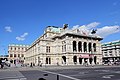
The Vienna State Opera (German: Wiener Staatsoper, IPA: [ˈviːnɐ ˈʃtaːtsˌʔoːpɐ]) is a historic opera house and opera company based in Vienna, Austria. The 1,709-seat Renaissance Revival venue was the first major building on the Vienna Ring Road. It was built from 1861 to 1869 following plans by August Sicard von Sicardsburg and Eduard van der Nüll, and designs by Josef Hlávka. The opera house was inaugurated as the "Vienna Court Opera" (Wiener Hofoper) in the presence of Emperor Franz Joseph I and Empress Elisabeth of Austria. It became known by its current name after the establishment of the First Austrian Republic in 1921. The Vienna State Opera is the successor of the old Vienna Court Opera[1] (built in 1636 inside the Hofburg). The new site was chosen and the construction paid by Emperor Franz Joseph in 1861.[2]
Key Information


.JPG)


The members of the Vienna Philharmonic are recruited from the Vienna State Opera's orchestra. The building is also the home of the Vienna State Ballet, and it hosts the annual Vienna Opera Ball during the carnival season.
History
[edit]
History of the building
[edit]Construction
[edit]The opera house was the first major building on the Vienna Ringstrasse commissioned by the Viennese "city expansion fund". Work commenced on the house in 1861 and was completed in 1869, following plans drawn up by architects August Sicard von Sicardsburg and Eduard van der Nüll. It was built in the Neo-Renaissance style by the Czech architect and contractor Josef Hlávka.


The Ministry of the Interior had commissioned a number of reports into the availability of certain building materials, with the result that stones long not seen in Vienna were used, such as Wöllersdorfer Stein, for plinths and free-standing, simply-divided buttresses, the famously hard stone from Kaisersteinbruch, whose colour was more appropriate than that of Kelheimerstein, for more lushly decorated parts. The somewhat coarser-grained Kelheimerstein (also known as Solnhof Plattenstein) was intended as the main stone to be used in the building of the opera house, but the necessary quantity was not deliverable. Breitenbrunner stone was suggested as a substitute for the Kelheimer stone, and stone from Jois was used as a cheaper alternative to the Kaiserstein. The staircases were constructed from polished Kaiserstein, while most of the rest of the interior was decorated with varieties of marble.
.jpg)
The decision was made to use dimension stone for the exterior of the building. Due to the monumental demand for stone, stone from Sóskút, widely used in Budapest, was also used. Three Viennese masonry companies were employed to supply enough masonry labour: Eduard Hauser (still in existence today), Anton Wasserburger and Moritz Pranter. The foundation stone was laid on 20 May 1863.
Public response
[edit]The building, however, was not particularly well-received by the public. For one, it lacked the grandeur of the Heinrichshof, a private residence destroyed during World War II and later replaced in 1955 by the Opernringhof. Additionally, the opera house’s construction was overshadowed by an unexpected issue: the level of the Ringstraße in front of the building was raised by a metre after construction had already commenced, the latter was likened to "a sunken treasure chest" and, in analogy to the military disaster of 1866 (the Battle of Königgrätz), was deprecatingly referred to as "the 'Königgrätz' of architecture". Eduard van der Nüll committed suicide, and barely ten weeks later Sicardsburg died from tuberculosis so neither architect saw the completion of the building. The opening premiere was Don Giovanni, by Mozart, on 25 May 1869. Emperor Franz Josef and Empress Elisabeth (Sissi) were present.
Gustav Mahler
[edit]
Gustav Mahler was one of the many conductors who have worked in Vienna. During his tenure (1897–1907), Mahler cultivated a new generation of singers, such as Anna Bahr-Mildenburg and Selma Kurz, and recruited a stage designer who replaced the lavish historical stage decors with sparse stage scenery corresponding to modernistic, Jugendstil tastes. Mahler also introduced the practice of dimming the lighting in the theatre during performances, which was initially not appreciated by the audience. However, Mahler's reforms were maintained by his successors.
WW II bombing and redesign
[edit]
Towards the end of World War II, on 12 March 1945, the opera was set alight by an American bombardment.[citation needed] The auditorium and stage were destroyed by flames, as well as almost the entire décor and props for more than 120 operas with around 150,000 costumes. The front section, which had been walled off as a precaution, however, remained intact including the foyer, with frescoes by Moritz von Schwind, the main stairways, the vestibule and the tea room. The State Opera was temporarily housed at the Theater an der Wien and at the Vienna Volksoper.
Lengthy discussion took place about whether the opera house should be restored to its original state on its original site, or whether it should be completely demolished and rebuilt, either on the same location or on a different site. Eventually the decision was made to rebuild the opera house as it had been, and the main restoration experts involved were Ernst Kolb (1948–1952) and Udo Illig (1953–1956).
The Austrian Federal Chancellor Leopold Figl made the decision in 1946 to have a functioning opera house again by 1949. An architectural competition was announced, which was won by Erich Boltenstern. The submissions had ranged from a complete restructuring of the auditorium to a replica of the original design; Boltenstern decided on a design similar to the original with some modernisation in keeping with the design of the 1950s. In order to achieve good acoustics, wood was the favoured building material, on the advice of, among others, Arturo Toscanini. In addition, the number of seats in the parterre (stalls) was reduced, and the fourth gallery, which had been fitted with columns, was restructured so as not to need columns. The façade, entrance hall and the "Schwind" foyer were restored and remain in their original style.
In the meantime, the opera company, which had at first been performing in the Volksoper, had moved rehearsals and performances to Theater an der Wien, where, on 1 May 1945, after the liberation and re-independence of Austria from the Nazis, the first performances were given. In 1947, the company went on tour to London.
Due to the appalling conditions at Theater an der Wien, the opera company leadership tried to raise significant quantities of money to speed up reconstruction of the original opera house. Many private donations were made, as well as donations of building material from the Soviets, who were very interested in the rebuilding of the opera. The mayor of Vienna had receptacles placed in many sites around Vienna for people to donate coins only. In this way, everyone in Vienna could say they had participated in the reconstruction and feel pride in considering themselves part owners.
However, in 1949, there was only a temporary roof on the Staatsoper, as construction work continued. It was not until 5 November 1955, after the Austrian State Treaty, that the Staatsoper could be reopened with a performance of Beethoven's Fidelio, conducted by Karl Böhm.[3] The American Secretary of State, John Foster Dulles, was present. The state broadcaster ORF used the occasion to make its first live broadcast, at a time when there were only c. 800 televiewers in the whole of Austria. The new auditorium had a reduced capacity of about 2,276, including 567 standing room places.[4] The ensemble, which had remained unified until the opening, crumbled in the following years, and slowly an international ensemble formed.
History of the Company After the Second World War
[edit]In 1945, the Wiener Mozart-Ensemble was formed, which put on guest performances and became known particularly for its singing and playing culture. The Austrian conductor Josef Krips was the founder and mentor, who had only survived the Nazi era (given his Jewish heritage) thanks to luck and help from colleagues. At the end of the war, Krips started the renovation of the Staatoper, and was able to implement his aesthetic principles, including the departure from the Romantic Mozart ideal with a voluminous orchestral sound. Instead, qualities more associated with chamber music were featured, as well as a clearer, lighter sound, which would later come to be known as "typically Viennese". Singers who worked with Krips during this time were Erich Kunz, Elisabeth Schwarzkopf and Wilma Lipp, among others.
As early as 1947, the Mozart-Ensemble was playing guest performances at the Royal Opera House in London, with Mozart's Don Giovanni. Richard Tauber, who had fled from the Nazis, sang Don Ottavio; three months later he died, and was remembered for singing with "half a lung" in order to fulfil his dream, many other artists became associated with the Mozart-Ensemble, for example Karl Böhm, but their role was still greatly peripheral, in a straightforward or assisting role. This was the beginning of Krips' worldwide career, which would take him to the most prominent houses in the world. Until his death in 1974, Krips was regarded as one of the most important Maestri (conductors/music directors) of the Staatsoper.
On 1 July 1998, a historical broadcast took place, as Austria undertook its first presidency of the European Union. Fidelio was broadcast live from the Vienna State Opera to the 15 capital cities of the EU.
-
 Rear of the opera house, showing the stage wings
 -
 A marble staircase between the main entrance and the first floor
 -
 One of the lobbies
 -
 Emperor's private room
 -
 The auditorium
 -
 View from the auditorium to the stage
 -
 Exterior of the building
 -
 Backstage area


Today
[edit]The company
[edit]The Vienna State Opera is closely linked to the Vienna Philharmonic, which is an incorporated society of its own, but whose members are recruited from the orchestra of the Vienna State Opera.
The Wiener Staatsoper is one of the busiest opera houses in the world producing 50 to 60 operas in a repertory system per year and ten ballet productions in more than 350 performances.[5] It is quite common to find a different opera being produced each day of a week. The Staatsoper employs over 1000 people. As of 2008, the annual operating budget of the Staatsoper was 100 million euros with slightly more than 50% as a state subsidy.
The company's 2019 production of Olga Neuwirth's opera Orlando marked the first production of an opera by a female composer in the history of the Vienna State Opera.[6]
Herbert von Karajan
[edit]
Herbert von Karajan introduced the practice of performing operas exclusively in their original language instead of being translated into German. He also strengthened the ensemble and regular principal singers and introduced the policy of predominantly engaging guest singers. He began a collaboration with La Scala in Milan, in which both productions and orchestrations were shared. This created an opening for the prominent members of the Viennese ensemble to appear in Milan, especially to perform works by Wolfgang Amadeus Mozart and Richard Strauss.
Ballet companies merge
[edit]At the beginning of the 2005–2006 season, the ballet companies of the Staatsoper and the Vienna Volksoper were merged under the direction of Gyula Harangozó, which led to a reduction in the number of performers in the resulting ensemble. This has resulted in an increase in the number of guest stars engaged to work in the ballet. The practice of combining the two ballet companies proved an artistic failure, and Harangozó left when his contract expired in 2010.
From the 2010–2011 season a new company was formed called Wiener Staatsballet, Vienna State Ballet, under the direction of former Paris Opera Ballet principal dancer Manuel Legris. Legris eliminated Harangozós's policy of presenting nothing but traditional narrative ballets with guest artists in the leading roles, concentrated on establishing a strong in-house ensemble and restored evenings of mixed bill programs, featuring works of George Balanchine, Jerome Robbins, Jiří Kylián, William Forsythe, and many contemporary choreographers, as well as a reduced schedule of the classic ballets.
140th anniversary season
[edit]2009 marked the 140th anniversary of the Vienna Opera House. To celebrate this milestone an idea designed to reach out and embrace a new audience was conceived. A giant 50 sqm screen was placed on the side of the opera house facing Kärntner Straße. In four months live broadcasts of over 60 famous operas were transmitted in this way, including performances of Madama Butterfly, The Magic Flute and Don Giovanni. This successful venture brought a new wave of operatic excitement to the many tourists and locals who experienced this cultural event. During daytime the screen displays a replica of the Opera House's façade, as it obstructs a considerable part of the building, along with information about upcoming performances.
The opera house and children
[edit]
The Vienna State Opera is particularly open to children: under Holender's direction (he has three children of his own), the opera house has become well known for its children's productions, which are performed in a tent on the roof of the Staatsoper. Recent examples include Peter Pan, Das Traumfresserchen (The Dream Gobbler), Der 35. Mai (The 35th of May), C. F. E. Horneman's Aladdin, Bastien und Bastienne and Wagners Nibelungenring für Kinder (Wagner's Ring for children). In addition to this, there is a production of The Magic Flute every year for 9- and 10-year-olds, decorated like the Opernball.
The opera house also has an opera school for boys and girls between the ages of eight and fourteen, which takes place in the afternoons after regular school. The children are introduced to music theatre and the prospect of becoming opera singers. The company recruits singers for children's roles in its productions from this opera school. Twice every season there is a special matinée performance of the opera school. In 2006, the 250th anniversary of Mozart's birth, they performed a 20-minute miniature opera Der kleine Friedrich arranged from songs of Mozart by Janko Kastelic and Claudia Toman.
"Standing room only" audience
[edit]
Eighty minutes before each performance, cheap standing room tickets are sold (€10).[4] These are popular with all age groups, and now have an almost legendary regular clientele, which is merciless in showing its displeasure with a performance loudly and unambiguously, but is even louder in voicing approval.[7][8]
Der Neue Merker
[edit]Every performance at the Vienna State Opera is reviewed by an independent company in the opera publication Der Neue Merker[9] (The New Judge) which is printed in about 2000 copies. This is unusual in that most opera magazines prefer to concentrate on new productions and premieres. There is an online version[10] parallel to the publication, which receives (as of March 2007) an average of 10,000 visitors a week, and therefore is one of the most successful German-language opera portals.
Opera ball
[edit]
For many decades, the opera house has been the venue of the Vienna Opera Ball. It is an event, which takes place annually on the last Thursday in Fasching. Those in attendance often include visitors from around the world, especially prominent names in business and politics. The opera ball receives media coverage from a range of outlets.
The opera ball in 1968 was the occasion for a protest, at which the organisation was criticised for being "elite" (due to the high prices), "conceited" (due to the opulent display of wealth for the newspapers and cameras) and "reactionary" (for upholding an allegedly outdated culture). There was violence between the demonstrators and the police.
Safety curtain
[edit]"Safety Curtain" is an exhibition series conceived by the non-profit art initiative museum in progress, which has been transforming the safety curtain of the Vienna State Opera into a temporary exhibition space for contemporary art since 1998.[11] A jury (Daniel Birnbaum and Hans-Ulrich Obrist) selects the artists whose works are attached to the safety curtain by means of magnets and are shown during the course of a season. Artists up to date: Pierre Alechinsky, Tauba Auerbach, John Baldessari, Matthew Barney, Thomas Bayrle, Tacita Dean, Cerith Wyn Evans, Dominique Gonzalez-Foerster, Richard Hamilton, David Hockney, Christine & Irene Hohenbüchler, Joan Jonas, Martha Jungwirth, Jeff Koons, Maria Lassnig, Oswald Oberhuber, Giulio Paolini, Rirkrit Tiravanija, Rosemarie Trockel, Cy Twombly, Kara Walker, Carrie Mae Weems and Franz West.[12]
Directors/General managers
[edit]In chronological order, the directors (or general managers) of the Staatsoper have been:
- Franz von Dingelstedt (1867–70)
- Johann von Herbeck (1870–75)
- Franz von Jauner (1875–80)
- Wilhelm Jahn (1881–97)
- Gustav Mahler (1897–1907)
- Felix Weingartner, Edler von Münzberg (first term, 1908–11)
- Hans Gregor (1911–18)
- Richard Strauss / Franz Schalk (1919–24)
- Franz Schalk (1924–29)
- Clemens Krauss (1929–34)
- Felix von Weingartner (second term, 1935–36)
- Erwin Kerber (1936–40)
- Heinrich Karl Strohm (1940–41)
- Lothar Müthel (1941–42)
- Karl Böhm (first term, 1943–45)
- Franz Salmhofer (1945–54)
- Karl Böhm (second term, 1954–56)
- Herbert von Karajan (1956–1964)
- Egon Hilbert (1964–68)
- Heinrich Reif-Gintl (1968–72)
- Rudolf Gamsjäger (1972–76)
- Egon Seefehlner (first term, 1976–82)
- Lorin Maazel (1982–84)
- Egon Seefehlner (second term, 1984–86)
- Claus Helmut Drese (1986–91)
- Eberhard Wächter (1991–92)
- Ioan Holender (1992–2010)
- Dominique Meyer (2010–2020)
- Bogdan Roščić (2020–present)[13]
Artistic/Music Directors
[edit]- Richard Strauss (1919–1924)
- Bruno Walter (1936–1938)
- Claudio Abbado (1986–1991)
- Seiji Ozawa (2002–2010)
- Franz Welser-Möst (2010–2014)
- Philippe Jordan (2020–present)[14][15]
Prominent artists who have appeared at the Staatsoper
[edit]Singers
[edit]- Theo Adam
- Ain Anger
- Giacomo Aragall
- Agnes Baltsa
- Polly Batic
- Gabriela Beňačková
- Ettore Bastianini
- Piotr Beczała
- Teresa Berganza
- Walter Berry
- Jussi Björling
- Franco Bonisolli
- Montserrat Caballé
- Maria Callas
- José Carreras
- Enrico Caruso
- Mimi Coertse
- Franco Corelli
- José Cura
- Oskar Czerwenka
- Giuseppe Di Stefano
- Plácido Domingo (50th jubilee in May 2017)
- Otto Edelmann
- Anny Felbermayer
- Juan Diego Flórez
- Mirella Freni
- Ferruccio Furlanetto
- Elīna Garanča
- Nicolai Gedda
- Angela Gheorghiu
- Nicolai Ghiaurov
- Tito Gobbi
- Edita Gruberová (40th jubilee in September 2008, 50th jubilee in June 2018)
- Thomas Hampson
- Hans Hotter
- Gundula Janowitz
- Maria Jeritza
- Gwyneth Jones
- Sena Jurinac
- Vesselina Kasarova
- Jonas Kaufmann
- Angelika Kirchschlager
- Alfredo Kraus
- Elisabeth Kulman
- Erich Kunz
- Selma Kurz
- Christa Ludwig (final operatic performance in Elektra, 1994)
- Éva Marton
- Anna Moffo
- Anna Netrebko
- Birgit Nilsson
- Jessye Norman
- Jarmila Novotná
- Hasmik Papian
- Luciano Pavarotti
- Alfred Piccaver
- Johannes "JJ" Pietsch
- Lucia Popp
- Hermann Prey
- Leontyne Price
- Gianni Raimondi
- Ruggero Raimondi
- Maria Reining
- Leonie Rysanek
- Matti Salminen
- Elisabeth Schwarzkopf
- Renata Scotto
- Cesare Siepi
- Giulietta Simionato
- Bo Skovhus
- Nina Stemme
- Lise Davidsen
- Michail Svetlev
- Giuseppe Taddei
- Martti Talvela
- Richard Tauber
- Renata Tebaldi
- Bryn Terfel
- Rolando Villazón
- Eberhard Wächter
- Otto Wiener
- Fritz Wunderlich
- Heinz Zednik
Conductors
[edit]- Claudio Abbado
- Kurt Adler
- Gerd Albrecht
- Ernest Ansermet
- Leonard Bernstein
- Bertrand de Billy
- Karl Böhm
- Semyon Bychkov
- Riccardo Chailly
- André Cluytens
- Colin Davis
- Victor de Sabata
- Hubert Deutsch
- Antal Doráti
- Christoph von Dohnányi
- Gustavo Dudamel
- Wilhelm Furtwängler
- John Eliot Gardiner
- Daniele Gatti
- Gianandrea Gavazzeni
- Michael Gielen
- Leopold Hager
- Daniel Harding
- Nikolaus Harnoncourt
- Paul Hindemith
- Heinrich Hollreiser`
- Philippe Jordan
- Carlos Kleiber
- Erich Kleiber
- Berislav Klobučar
- Hans Knappertsbusch
- Clemens Krauss
- Josef Krips
- Rafael Kubelík
- Jan Latham-Koenig
- Erich Leinsdorf
- Lorin Maazel
- Charles Mackerras
- Ernst Märzendorfer
- Zubin Mehta
- Dimitri Mitropoulos
- Francesco Molinari-Pradelli
- Pierre Monteux
- Rudolf Moralt
- Lovro von Matačić
- Riccardo Muti
- Andris Nelsons
- Roger Norrington
- Daniel Oren
- Antonio Pappano
- John Pritchard
- Simon Rattle
- Hugo Reichenberger
- Fritz Reiner
- Hans Richter
- Mario Rossi
- Nello Santi
- Michael Schønwandt
- Leif Segerstam
- Tullio Serafin
- Giuseppe Sinopoli
- Leonard Slatkin
- Georg Solti
- Horst Stein
- Pinchas Steinberg
- Igor Stravinsky
- Otmar Suitner
- Robert Stolz
- Richard Strauss
- Christian Thielemann
- Arturo Toscanini
- Silvio Varviso
- Marcello Viotti
- Antonino Votto
- Bruno Walter
- Felix Weingartner
- [[Alberto
Directors, set designers, and costume designers
[edit]Opera title and year of debut at the Vienna State Opera in parentheses:
- Gae Aulenti (Il viaggio a Reims, 1988)
- Boleslaw Barlog (Salome, 1972)
- Sven-Eric Bechtolf (Arabella, 2006)
- Ruth Berghaus (Fierrabras, 1990)
- Milena Canonero (Il trittico, 1979)
- Robert Carsen (Jérusalem, 1995)
- Giulio Chazalettes (Attila, 1980)
- Luciano Damiani (Don Giovanni, 1967)
- Dieter Dorn (Die Entführung aus dem Serail, 1979)
- August Everding (Tristan und Isolde, 1967)
- Piero Faggioni (Norma, 1977)
- Jürgen Flimm (Der ferne Klang, 1991)
- Götz Friedrich (Moses und Aron, 1973)
- Ezio Frigerio, (Norma, 1977)
- Josef Gielen (Madama Butterfly, 1957)
- Peter J. Hall (Le nozze di Figaro, 1991)
- Karl-Ernst Herrmann (Die Entführung aus dem Serail, 1989)
- Václav Kašlík (Idomeneo, 1971)
- Jorge Lavelli (Der Prozess, 1970)
- Alfred Kirchner (Khovanchina, 1989)
- Harry Kupfer (Die schwarze Maske, 1986)
- Lotfi Mansouri (La fanciulla del west 1978)
- Gian Carlo Menotti (La Cenerentola, 1981)
- Jonathan Miller (Le nozze di Figaro, 1991)
- Giancarlo del Monaco (La forza del destino, 1989)
- Hans Neuenfels (Le Prophète, 1998)
- Hermann Nitsch (Hérodiade, 1995)
- Adrian Noble (Alcina, 2010)
- Timothy O'Brien (Turandot, 1983)
- Tom O'Horgan (Les Troyens, 1976)
- Laurent Pelly (La fille du régiment, 2007)
- Pier Luigi Pizzi (as stage designer: La forza del destino, 1974; as director: Don Carlo, 1989)
- Jean-Pierre Ponnelle (Manon, 1971)
- David Pountney (Rienzi, 1997)
- Harold Prince (Turandot, 1983)
- Gianni Quaranta (Samson et Dalila, 1988)
- Günther Rennert (Il barbiere di Siviglia, 1966)
- Luca Ronconi (Il viaggio a Reims, 1988)
- Ken Russell (Faust, 1985)
- Filippo Sanjust (Ariadne auf Naxos, 1976)
- Johannes Schaaf (Idomeneo, 1987)
- Otto Schenk (Jenůfa, 1964)
- Yuval Sharon (Tri Sestri, 2016)
- Franca Squarciapino (Norma, 1977)
- Peter Stein (Simon Boccanegra, 2002)
- Giorgio Strehler (Simon Boccanegra, 1984)
- Josef Svoboda (Idomeneo, 1971)
- István Szabó (Il trovatore, 1993)
- Carl Toms, (Faust, 1985)
- Luchino Visconti (Falstaff, 1966)
- Antoine Vitez (Pelléas et Mélisande, 1988)
- Wieland Wagner (Lohengrin, 1965)
- Margarete Wallmann (Tosca, 1958)
- Anthony Ward (Alcina, 2010)
- Herbert Wernicke (I vespri siciliani, 1998)
- Peter Wood (Macbeth, 1981)
- Franco Zeffirelli (La bohème, 1964)
See also
[edit]
References
[edit]- ^ "The 'Sunken Chest': The Building of the Vienna Court Opera on the Ring". Die Welt der Habsburger. Retrieved 9 June 2020.
- ^ "The History of Opera in Vienna". Concert Vienna. Retrieved 9 June 2020.
- ^ Tim Smith, "Vienna State Opera 50th Anniversary Reopening Gala: An Illustrious History", p. 4, PBS. Retrieved 12 April 2013
- ^ a b "Seating plan and admission prices" (in German). Vienna State Opera. Retrieved 17 July 2013.
- ^ 2016/17 season, Vienna State Opera
- ^ "After 150 years, Vienna opera house stages first opera by a woman". The Guardian. 24 November 2019. Retrieved 24 November 2019.
- ^ "Vom Reiz der billigen Plätze" by Helmut Söring, Hamburger Abendblatt, 31 October 2006 (in German)
- ^ von Hornau, Phillipp (2012). Wien ist anders – Ist Wien anders? (in German). p. 631.
- ^ For "Merker", see Meistersinger
- ^ "Startseite". 16 February 2018.
- ^ Cf. Exhibition page "Safety Curtain", museum in progress
- ^ Kaspar Mühlemann Hartl, museum in progress; Dominique Meyer, Vienna State Opera (Ed.): CURTAIN – VORHANG. A Living Museum Space – The Vienna State Opera Safety Curtain, Vienna: Verlag für moderne Kunst 2017. ISBN 978-3-903228-11-5.
- ^ Michael Cooper (21 December 2016). "Sony Executive to Lead Vienna Opera". New York Times. Retrieved 31 July 2017.
- ^ "Philippe Jordan ab 2020 Musikdirektor der Wiener Staatsoper" (Press release). Vienna State Opera. 31 July 2017. Archived from the original on 1 August 2017. Retrieved 31 July 2017.
- ^ Michael Cooper (31 July 2017). "Philippe Jordan Will Lead the Vienna State Opera. Can He Bring Peace?". New York Times. Retrieved 31 July 2017.
External links
[edit]
- Official website (in German and English)
- Wiener Staatsoper at Google Cultural Institute
Vienna Staatsoper Directors | ||
|---|---|---|
|  | |
| International | |
|---|---|
| National | |
| Geographic | |
| Academics | |
| People | |
| Other | |

Vienna State Opera
View on GrokipediaHistorical Development
Origins and Construction (1857-1869)
In 1857, Emperor Franz Joseph I initiated the demolition of Vienna's medieval city walls to create the Ringstrasse, a grand boulevard intended to modernize the city and project Habsburg imperial prestige comparable to leading European capitals, including through monumental public buildings like a new opera house.[3][4] The emperor personally selected the site for the opera adjacent to the Kärntnertor, funding construction from his privy purse to ensure state control over the project amid the era's liberal constitutional reforms.[5] A design competition launched in July 1860 sought plans for a venue accommodating approximately 2,500 spectators suitable for opera and ballet, emphasizing functional acoustics and imperial aesthetics.[1] The winning entry came from Viennese architects August Sicard von Sicardsburg, who focused on structural engineering, and Eduard van der Nüll, responsible for exterior and decorative elements, proposing a neo-Renaissance style that integrated robust iron framing for the auditorium with ornate facades drawing from Italian palazzi to balance grandeur and practicality.[1][6] Construction began in 1861 under builder Josef Hlávka, with the cornerstone laid on May 20, 1863; the project spanned eight years and incurred costs of 6,116,647.61 guilders, reflecting meticulous site preparation on uneven terrain and innovations in load-bearing foundations to support the expansive stage machinery.[1][7] Emperor Franz Joseph influenced specifics, such as interior detailing, prioritizing durability and visual harmony over ornate excess.[1] Despite the engineers' sound choices—evident in the building's enduring structural integrity—public and press scrutiny targeted the facade's perceived stylistic inconsistencies and the structure's lower profile on one side due to topography, derogatorily termed a "sunken chest" by the emperor.[5] This backlash, compounded by van der Nüll's preexisting depression and brain tumor, precipitated his suicide on April 4, 1868; Sicardsburg followed ten weeks later from a heart attack, preventing either from witnessing completion.[5][1] The opera house opened on May 25, 1869, validating the core design's acoustic and operational efficacy born from empirical planning rather than unbridled aesthetic ambition.[1]Early Operations and Public Criticism
The Vienna Court Opera (Hofoper) opened on May 25, 1869, with a performance of Mozart's Don Giovanni in German, selected for its popularity and alignment with German-language preferences over alternatives like The Magic Flute or Armide.[1] Under the direction of Franz von Dingelstedt, the initial repertoire emphasized popular German operas by composers such as Mozart and Wagner, aiming to attract audiences transitioning from the previous Kärntnertortheater venue.[1] Public reception of the architecture was harshly negative, with critics deriding the building's lower elevation relative to the raised Ringstrasse as a "sunken box" or "sunken chest," a flaw stemming from urban planning compromises during construction that elevated surrounding streets.[5] The eclectic mix of Gothic and Renaissance elements in the neo-Renaissance design was mocked as "Zuckerbäckerei" (sugar bakery), implying overly ornate and confectionary aesthetics unfit for imperial prestige.[1] This pre-opening criticism contributed to the despair of architects Eduard van der Nüll, who committed suicide on April 4, 1868, amid depression exacerbated by health issues including a brain tumor, and August Sicard von Sicardsburg, who died shortly thereafter on October 10, 1868.[1][5] The opera's projected prestige as a cultural landmark underperformed amid this derision, with operational challenges linked to the design's visibility issues potentially deterring attendance despite capacity for 2,500 spectators.[1] Management under Dingelstedt adjusted programming to prioritize accessible German classics, fostering gradual audience buildup while relying on state subsidies from public taxes to cover the 6,116,647.61-guilder construction cost and ongoing deficits, establishing early financial dependence on imperial and later state support.[1]Gustav Mahler Directorship (1897-1907)
Gustav Mahler assumed the directorship of the Vienna Court Opera on October 8, 1897, after debuting as conductor there on May 11, 1897, with Richard Wagner's Lohengrin. His appointment followed a conversion to Catholicism on February 23, 1897, necessitated by institutional antisemitism that barred Jews from such positions despite his prior successes at opera houses in Prague, Leipzig, Budapest, and Hamburg. Immediately upon taking office, Mahler enforced stringent reforms to combat longstanding laxity, mandating precise rehearsals that prioritized composers' intentions over entrenched traditions, which he derided as "sloppiness." He dismissed underperforming musicians and singers, expanded recruitment of young talents including Anna von Mildenburg, Selma Kurz, and Erik Schmedes, and overhauled administrative practices to ensure punctuality and discipline, transforming the opera's output from routine to exemplary.[8][9][10] Mahler's repertoire emphasized Wagner's operas as integral artworks, staging the full Ring des Nibelungen cycle in 1898 and partnering with designer Alfred Roller from 1903 to pioneer minimalist sets, symbolic lighting, and unified aesthetics aligning with Wagner's Gesamtkunstwerk ideal, as in the acclaimed Tristan und Isolde production. He conducted over 600 of the nearly 3,000 performances during his decade, personally leading more than 300 in the first four seasons alone, which included 25 premieres or first performances of new works. Attempts to introduce Richard Strauss's Salome—advocated vigorously by Mahler—failed due to moral censorship by Vienna's authorities, delaying its local premiere until 1918; this battle highlighted Mahler's push for modernism against conservative resistance. These efforts empirically elevated standards, as evidenced by the opera's sustained international prestige and the technical innovations that influenced subsequent stagings.[9][11][12] Opposition intensified from bureaucratic inertia, performer disputes, and a press campaign leveraging Mahler's Jewish heritage—despite his conversion—to fuel antisemitic attacks portraying him as an outsider imposing alien modernism. Health deterioration, including a July 1907 diagnosis of congenital heart disease, compounded family grief over daughter Maria's death that month and political shifts under Minister of Culture Heinrich von Pleß. Mahler submitted his resignation on May 30, 1907, with his final Vienna performance, Beethoven's Fidelio, on October 15, 1907; a December 7, 1907, farewell letter lamented the institution's limitations on true artistry. He departed for the Metropolitan Opera in New York, leaving a legacy of rigorous excellence amid societal backlash.[9][11][13]Interwar Period and Nazi Era Influences
Following the dissolution of the Austro-Hungarian Empire in 1918, the institution formerly known as the Vienna Court Opera was redesignated the Vienna State Opera, operating under the cultural policies of Austria's First Republic.[14] Economic pressures mounted in the 1920s and intensified during the Great Depression of the 1930s, constraining budgets for Austrian theaters including the State Opera, which faced reduced funding amid widespread financial crisis affecting public institutions.[15] These strains limited production scales and programming scope, though the opera maintained a core repertoire of classical works by Mozart, Wagner, and Strauss amid Austria's unstable interwar political climate. The Anschluss on March 12, 1938, integrated Austria into Nazi Germany, prompting immediate ideological interventions at the State Opera. Nazi authorities dismissed approximately 95 employees, primarily Jewish artists, conductors, singers, and administrators, as well as those deemed politically unreliable, within weeks of the annexation.[16] This purge extended to the orchestra, where at least 13 Jewish musicians were expelled, severing longstanding talents and enforcing racial conformity that narrowed artistic diversity and enforced self-censorship in selections.[17][1] Under Nazi oversight, repertoire pivoted toward "Aryanized" content, prioritizing operas by Wagner and Richard Strauss while banning modernist compositions associated with Jewish or avant-garde figures, such as those by Arnold Schoenberg or Alban Berg, to align with regime aesthetics of heroic nationalism.[1] Conductors including Clemens Krauss, who maintained prominence despite earlier controversies, led performances emphasizing approved Germanic masters, with the inclusion of propagandistic pieces like Rudolf Wille's Königsballade to propagate National Socialist ideals.[18][1] The opera house functioned as a venue for regime prestige, hosting events attended by Adolf Hitler and other leaders, yet archival evidence reveals sporadic internal resistance, such as discreet aid to persecuted staff, though systemic complicity in purges and programming shifts predominated due to enforced loyalty oaths and surveillance.[19][20]World War II Destruction and Immediate Aftermath
On March 12, 1945, during an Allied bombing raid on Vienna, the Vienna State Opera sustained severe damage when incendiary bombs struck the building, igniting a fire that burned for 24 hours and gutted the interior.[21] The stage, auditorium, workshops, and associated decoration facilities in the Prater were completely destroyed, while only the main façade, grand staircase, and Schwind Foyer remained intact.[1] This devastation also consumed nearly all décor and props for over 120 operas, along with approximately 150,000 costumes, representing irreplaceable losses accumulated over decades of operation.[22] In the immediate aftermath, salvage and provisional measures prioritized continuity amid wartime collapse and impending Soviet liberation of Vienna. On May 24, 1945, State Secretary Julius Raab announced plans for reconstruction, reflecting pragmatic efforts to preserve cultural infrastructure despite material scarcity.[1] The company resumed operations on May 1, 1945, staging Mozart's Le nozze di Figaro at the Volksoper under Soviet occupation authorities' support, marking the first post-destruction performance by State Opera personnel.[21] By October 6, 1945, the Theater an der Wien reopened with Beethoven's Fidelio, serving as the primary provisional venue for the ensemble over the next decade and enabling a focus on core repertoire like Mozart and Beethoven to navigate Allied oversight in occupied Austria.[1] Resource shortages, including labor, materials, and funding under four-power occupation, delayed full restoration of the original site until 1955, as initial efforts contended with broader post-war devastation across Vienna, where over 20% of housing stock was ruined.[23] These constraints necessitated reliance on alternative spaces, underscoring the causal role of economic privation and geopolitical division in prolonging provisional arrangements rather than any deliberate cultural suppression.[21]Post-1945 Reconstruction and Cold War Era
Following the destruction during World War II, the Vienna State Opera underwent extensive reconstruction funded by the Austrian state, with efforts focused on restoring operability while updating facilities. The rebuilt house preserved the original facade but featured modernized stage mechanics and interior designs, including contributions from architect Clemens Holzmeister for the stage setup of the inaugural production. The opera house reopened on November 5, 1955, with a performance of Beethoven's Fidelio conducted by Karl Böhm, marking a significant cultural milestone in post-war Austria coinciding with the Austrian State Treaty that restored national sovereignty.[24][25] In the Cold War period, artistic leadership under Herbert von Karajan, who served as artistic director from 1956 to 1964, emphasized professionalization and innovative productions, elevating the institution's international profile amid Austria's neutral stance between Eastern and Western blocs. Karajan's tenure introduced director-driven approaches and repertoire diversification, including contemporary works alongside classics, fostering collaborations that enhanced technical and interpretive standards. This era saw the opera house resume near-year-round operations, with annual performances expanding to support multiple daily-changing programs, contributing to attendance growth driven by domestic subsidies and emerging tourism.[2][26] State funding remained critical for sustainability, with subsidies enabling reconstruction and operations in the resource-scarce post-war economy, while cultural exports via tours underscored Austria's soft power strategy during the ideological divides of the Cold War. By the 1970s, the opera mounted over 300 performances per season across diverse repertoire, reflecting recovery and expansion, though heavy reliance on government support—motivated partly by geopolitical aims to project neutral cultural prestige—posed ongoing fiscal vulnerabilities amid fluctuating tourism and economic pressures.[27][28]Architecture and Infrastructure
Original Design and Key Features
The Vienna State Opera's original structure, completed in 1869, exemplifies Neo-Renaissance architecture through its facade featuring layered arches, loggias with equestrian statues, and bronze elements integrated into a symmetrical composition along the Ringstrasse.[22] Architects August Sicard von Sicardsburg and Eduard van der Nüll drew on historical precedents to create a monumental yet proportionate edifice, with the exterior employing dimension stone quarried from Sóskút to ensure durability and aesthetic uniformity.[22] The auditorium employs a horseshoe-shaped plan, a configuration that promotes sound focusing by minimizing rear-wall absorption and directing reflections toward spectators, thereby enhancing auditory immersion in operatic performances compared to fully rectangular alternatives.[29] Designed for an original capacity of 2,881 places, the interior featured multi-tiered boxes, known as Logen (private boxes), divided into price groups 1–9 based on location, sightlines, and quality; the best are the Proszeniumslogen (laterally near the stage) in groups 1–2 (up to ca. €295), while affordable options in groups 7–9 (ca. €18–€51) are typically side or rear positions with potential view restrictions, with prices varying by performance category as shown in the official Saalplan.[30] These boxes were arranged to optimize sightlines and proximity to the stage, fostering the social dynamics typical of 19th-century opera attendance.[22] Key artistic elements include frescoes by Moritz von Schwind in the Schwindfoyer, symbolically illustrating pivotal scenes from opera history such as those from The Doctor and the Apothecary, underscoring the venue's dedication to musical narrative traditions.[1] The stage incorporated early hydraulic mechanisms, originally steam-powered, to facilitate scene changes and elevate production complexity, reflecting contemporaneous engineering advancements tailored for grand opera.Interior Elements Including the Safety Curtain
The safety curtain of the Vienna State Opera, referred to as the Eiserner Vorhang, functions as a fire-resistant barrier between the auditorium and stage, engineered to isolate potential conflagrations originating from combustible scenery, costumes, and gas lighting prevalent in mid-19th-century theater operations. Constructed with an iron frame during the building's completion in 1869, it addressed escalating fire hazards documented in European theaters, where open flames ignited rapid spreads, as evidenced by over 20 major incidents in the 1800s alone, including Vienna's Ringtheater fire of December 8, 1881, which claimed 384 lives due to delayed curtain deployment and inadequate compartmentalization.[22][31][32] Affixed to this structural core is a painted canvas by Rudolf Hermann Eisenmenger, completed in the late 19th century, portraying a mythological scene from Christoph Willibald Gluck's opera Orpheus and Eurydice, symbolizing artistic themes while serving practical containment. The design prioritized durability with non-flammable materials layered over the iron, enabling manual lowering via counterweights for rapid isolation, a standard innovation post-1790s English precedents but refined amid continental fire epidemics. Regular inspections and reinforcements have maintained its integrity, including post-World War II repairs after aerial bombings that gutted much of the structure yet spared full auditorium collapse owing to such compartmentalized fireproofing.[33][34][35] The auditorium's centerpiece, a 19th-century crystal chandelier weighing 3,000 kilograms and spanning seven meters in diameter, illuminates the space with historical opulence derived from Bohemian glass elements, originally gas-lit and later electrified without structural alteration. Complementing this are extensive marble applications, such as polished Kaiserstein limestone on staircases and variegated marbles cladding walls and floors, selected for aesthetic grandeur and inherent fire resistance as non-combustible stone that resisted propagation during wartime incendiary damage in March 1945, when the roof and upper levels were obliterated but core interiors endured for phased reconstruction.[33][22] These elements' longevity stems from meticulous upkeep, including chandelier hoisting for bulb replacements and marble polishing cycles, underscoring the original architects' foresight in blending functionality with permanence against era-specific perils like uncontrolled blazes.[33]Renovations, Expansions, and the 2024 Französischer Saal Opening
The Vienna State Opera underwent significant reconstruction after World War II damage, reopening on November 5, 1955, with Beethoven's Fidelio under conductor Karl Böhm, incorporating reinforced concrete elements to bolster structural integrity against future risks.[24] Between 1991 and 1994, extensive modernization of backstage infrastructure added hydraulic lifting platforms, turntables, and automated scenery systems, enhancing operational efficiency and adaptability for complex productions without altering the historic auditorium.[36] In the 2010s and early 2020s, technical upgrades focused on lighting and digital integration, replacing older HMI fixtures with compact LED-based moving heads like Claypaky Arolla Profile MPs in 2023 and Robe FORTE HCF units in 2022, which provide brighter output at lower energy consumption and enable precise, programmable effects.[37] [38] Concurrently, virtual reality tools were introduced around 2021 for collaborative stage design, allowing 3D modeling detached from physical constraints, reducing prototyping costs and material waste through iterative digital simulations.[39] To increase programming flexibility and relieve scheduling pressures on the main 1,709-seat house, the opera opened the Französischer Saal on December 7, 2024, a 250-seat auxiliary theater in the adjacent Künstlerhaus building equipped with modern acoustics and production capabilities for smaller-scale works and community outreach.[40] [41] This expansion effectively adds venue capacity without compromising the core site's preservation, supporting year-round operations amid rising demand. Sustainability enhancements, such as a rooftop photovoltaic system for on-site renewable electricity generation and LED retrofits reducing power draw, aim to lower the opera's carbon footprint while maintaining performance standards.[42]Organizational and Artistic Leadership
General Directors and Their Tenures
The general directors of the Vienna State Opera have shaped its administrative policies, financial strategies, and international profile, often navigating tensions between artistic ambitions and fiscal constraints amid consistent reliance on Austrian state subsidies comprising roughly 50-55% of operating budgets.[43][44] This dependence stems from the institution's high fixed costs for repertory operations—producing 50-60 operas annually—exacerbated by post-war reconstruction priorities and later economic pressures, where leadership decisions to boost ticket revenues have mitigated but not eliminated subsidy needs.[1]| General Director | Tenure | Key Policy and Financial Impacts |
|---|---|---|
| Franz Salmhofer | 1945–1954 | Oversaw provisional operations in alternative venues post-WWII destruction; focused on stabilizing ensemble amid reconstruction, with early subsidies prioritizing cultural continuity over expansion.[45] |
| Karl Böhm | 1954–1956 | Directed brief transitional phase during partial reopening; emphasized core Austrian repertoire to rebuild audience trust, laying groundwork for subsidy-supported infrastructure investments.[46] |
| Herbert von Karajan | 1956–1964 | Implemented rigorous artistic standards and international touring; increased operational scale, heightening subsidy demands as budgets grew to accommodate expanded productions and guest artists.[46] |
| Ioan Holender | 1992–2010 | Longest tenure in the opera's history; pursued internationalization through global co-productions and artist recruitment, achieving consistently high attendance rates that bolstered self-generated revenues while sustaining subsidy levels around 50% of the circa €100 million annual budget.[47][48] |
| Dominique Meyer | 2010–2020 | Navigated austerity-era finances, with budgets expanding to €111.7 million by 2016 amid depleted reserves; record ticket sales (€34 million in 2015/16) offset subsidy shortfalls (59.5 million euros), though warnings of insolvency highlighted over-reliance on state funding without structural cost reforms.[49][44] |
| Bogdan Roščić | 2020–present | Emphasized digital streaming initiatives for revenue diversification during COVID-19 disruptions; achieved 99.94% occupancy and €145 million budget by 2024/25, with €79 million in subsidies, through corporate-style governance and abolition of the music director role to streamline decision-making and reduce administrative overhead.[43][41][50] |