Hubbry Logo
Hermann NitschHermann NitschMain
Open search
Hermann Nitsch
Community hub
Hermann Nitsch
logo
8 pages, 0 posts
0 subscribers
Be the first to start a discussion here.
Hermann Nitsch
Hermann Nitsch
from Wikipedia

Hermann Nitsch (29 August 1938 – 18 April 2022)[1] was an Austrian contemporary artist and composer. His art encompassed wide-scale performances incorporating theater, multimedia, rituals and acted violence. He was a leading figure of Viennese Actionism.

Key Information

Life

[edit]

Born in Vienna, Nitsch received training in painting when he studied at the Wiener Graphische Lehr-und Versuchanstalt, during which time he was drawn to religious art.[2][3] He is associated with the Vienna Actionists—a loosely affiliated group of Austrian artists interested in transgressive themes and the centrality of the body in their artwork, which also includes Günter Brus, Otto Muehl, and Rudolf Schwarzkogler.[4]

Nitsch's abstract 'splatter' paintings, like his performance pieces were inspired by his neutral perspective on humanity and being human. In the 1950s, Nitsch conceived of the Orgien Mysterien Theater (which roughly translates as Theatre of Orgies and Mysteries or The Orgiastic Mystery Theater) and staged nearly 100 performances between 1962 and 1998.[4]

In 1966 he was with Yoko Ono, Gustav Metzger, Günter Brus, Otto Muehl, Wolf Vostell, Juan Hidalgo, and others, as a participant of the Destruction in Art Symposium (DIAS) in London.[5]

Art

[edit]

In 1962, together with Otto Muehl and Adolf Frohner, he performed the three-part action “The Blood Organ” in Vienna, for which a joint manifesto was published. At the beginning of the 1960s, he developed the main ideas for his Orgie Mysterien Theater. Nitsch's Orgien Mysterien Theater performances (or Aktionen, as he called them) can be considered to have been both ritualistic and existential. The scene often involved slaughters, religious sacrifices, and crucifixion, as well as blood and flesh. The performances were also accompanied by music, dancing, and active participants. In his first Orgie Mysterien Theater performance, Nitsch and his friends used animal carcasses, entrails, and blood similarly to a ritual. The cloths, bandages, and other fabrics used in these performances introduced Nitsch to the idea of making paintings.[4]

From 1971 on Nitsch organized his “Orgy-Mystery Games” at the Prinzendorf Castle area he acquired, including the high point of his life's work, the great “6-Day Game” in the summer of 1998, directed by Alfred Gulden.

In 1972, Nitsch participated in Documenta 5 in Kassel, curated by Harald Szeemann; he was also represented at Documenta 7 in 1982. In 1975, Marina Abramović took part in a Nitsch performance. In addition upon occasion Christoph Schlingensief also participated in the work of Nitsch.

Nitsch was repeatedly invited to bring his conceptions of art and ritual to the opera. In 1995, he co-directed the Vienna State Opera and created the sets and costumes for Jules Massenet's opera Hérodiade. In 2001, Nitsch was responsible for the stage design and costumes for the performance of the Gandhi opera Satyagraha by the American composer Philip Glass in the Festspielhaus St. Pölten in Lower Austria. In 2005, he created the equipment for Igor Stravinsky's Le Renard. In 2007, he directed the scenes from Goethe's Faust by Robert Schumann at the Zurich Opera House. In 2011 he was responsible for the scenic conception, design, stage design, and costumes for Saint François d’Assise by Olivier Messiaen at the Bavarian State Opera in Munich.

Nitsch's worldview was strongly influenced by mystical authors, but also by de Sade, Friedrich Nietzsche, Sigmund Freud, and Antonin Artaud, among others. In his theoretical book Orgien-Mysterien-Theater, Nitsch stated that his actions and images should first cause disgust in the audience, then catharsis. The combining of real animal carcasses and real blood with religious content such as the crucifixion and the Immaculate Conception were consciously used by Nitsch in order to bring the viewer to reflect on symbolic topoi such as blood and death that are often repressed in everyday life, which also play a central role in Christianity. Christian viewers and numerous critics perceived his actions and works as blasphemy.

In addition to his theater of orgies and mysteries, Nitsch was also active as a composer[6] and writer. His actions are noted in meticulously notated scores which, in addition to instructions and texts, also contain graphically notated pieces of music.

Because he offended not only animal rights activists, but also theologians and representatives of public morality, his work is highly controversial. Conversely, some action and performance artists, including former comrades-in-arms, distance themselves from what they consider to be the overly religious element of his work. In terms of content, his art at Prinzendorf Castle can certainly be interpreted as an attempt at a counter to Richard Wagner's Bayreuth.

From November 1988 to January 1989, the Städtische Galerie in the Lenbachhaus in Munich showed some of the artist's works as part of the solo exhibition "Nitsch - Das Bildnerische Werk".

He performed the "2-day game" campaign in summer 2004. On 19 November 2005, the 122nd action of the Orgies-Mysteries-Theater took place at Vienna's Burgtheater as part of the 50th anniversary celebrations for the reopening after World War II.

On 24 May 2007, the “Hermann Nitsch Museum” was opened in the Mistelbach Museum Center, which led to protests among parts of the Mistelbach population. In Naples on 13 September 2008, Nitsch's long-time gallery owner Peppe Morra opened a museum dedicated exclusively to Nitsch's work, the “Museo Archivio Laboratorio per le Arti Contemporanee Hermann Nitsch”, which was set up in a former power station.

In the Weinviertel, not far from his Prinzendorf Castle, Nitsch owned a vineyard. The yields from it are pressed according to traditional standards and filled into double-liter bottles. Since the 2006 vintage, the Nitsch-Doppler, whose label Hermann Nitsch artistically redesigned every year, has been presented to the public in Vienna.

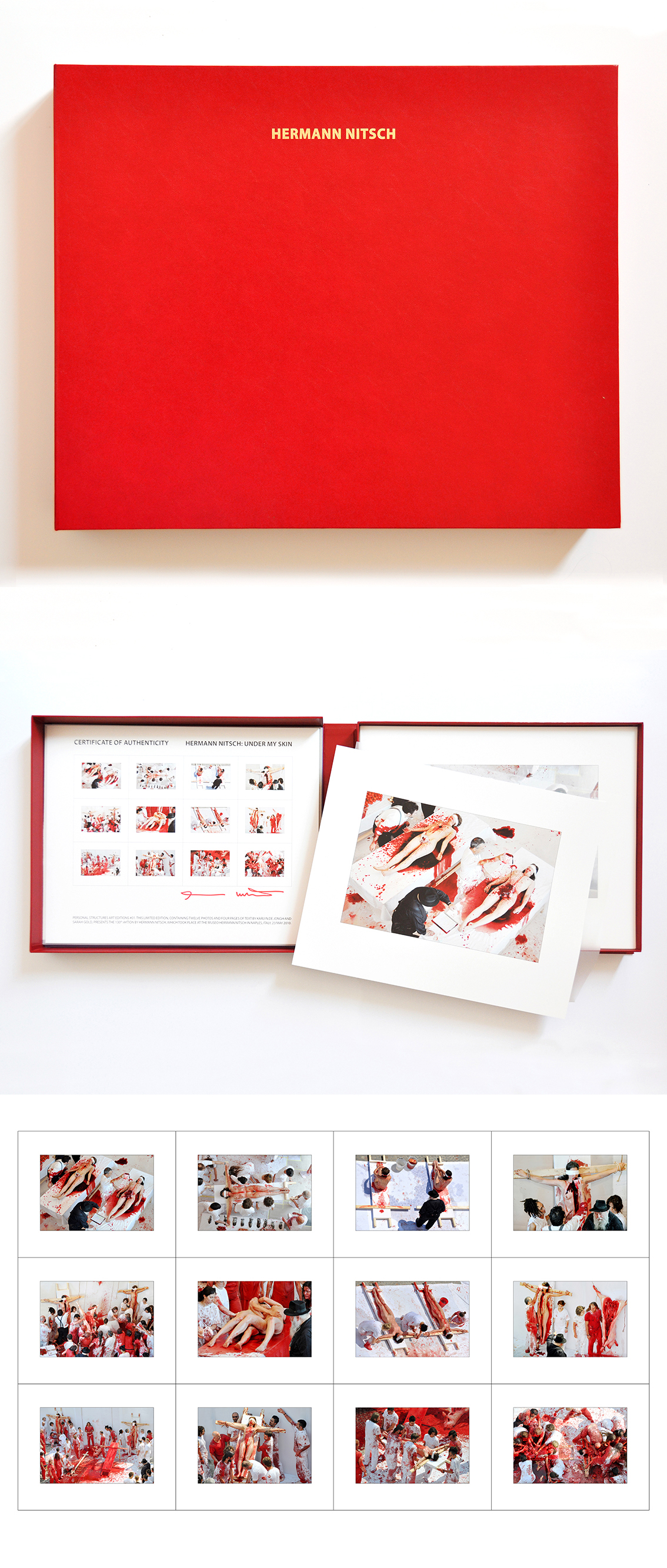
In 2010 Nitsch created a series of Limited Edition Prints, presenting his 130. Aktion at the Museo Nitsch in Napoli with the Dutch artist Rene Rietmeyer.

''UNDER MY SKIN” This book is the documentation of Personal Structures Art Projects #02. Published by European Cultural Centre.

He exhibited his works during the 2017 Venice Biennale at the European Cultural Centre.[7][8]

Most recently, in 2020, 80 current works were shown at the Museum Mistelbach in the exhibition Hermann Nitsch - New Works. After the color red, which he used earlier in his artistic work, and after the color yellow - the color of light and resurrection - Nitsch used bright colors in his late creative days. His endeavor was to bring sounds, tastes, and tactile sensations onto the canvas with his own hands. He was inspired by peonies and other flowers. His late work has an optimistic and life-affirming effect through the floral color symphonies and the transcendent lightness. [15]

Art market

[edit]

Nitsch's estate is represented by Pace Gallery (since 2022) and Galerie Kandlhofer.[9][10]

Controversy

[edit]

Because of their intense and graphic nature, often using nude performers and blood, Nitsch was subject to several court trials with charges of gross public indecency, and even sentences of three prison terms, because of his artworks. It has been suggested by critics that his work may exemplify certain peoples' fascination with, and desensitization to, violence.[2][11][12][13]

References

[edit]

Sources

[edit]
  • Stark, Ekkehard. Hermann Nitschs 'Orgien Mysterien Theater' und die "Hysterie der Griechen." Quellen und Traditionen in Wiener Atikedild seit 1900
  • Winkler, Michael. Review: Hermann Nitschs 'Orgien Mysterien Theater' und die "Hysterie der Griechen." Quellen und Traditionen in Wiener Atikedild seit 1900 by Ekkehard Stark. The German Quarterly, Vol. 61, No. 4, 60th Anniversary 1928-1988 (Autumn, 1988) pp. 590–591.
  • Romberg, Osvaldo. Redemption through Blood:pp. 8–13, 60–71
[edit]
Revisions and contributorsEdit on WikipediaRead on Wikipedia
from Grokipedia
Hermann Nitsch (August 29, 1938 – April 18, 2022) was an Austrian artist recognized as a founder of and the creator of the Orgies Mysteries Theatre, a comprehensive performance-based artwork that integrated ritualistic elements, animal dismemberment, blood, and multimedia disciplines to provoke sensory and confront human existence. Trained at Vienna's Graphische Lehr- und Versuchsanstalt from 1953 to 1958, Nitsch began developing the Orgies Mysteries Theatre in the mid-1950s as a total artwork influenced by , , and psychoanalytic ideas, evolving from textual concepts into visceral actions emphasizing orgiastic excess and symbolic sacrifice. The theater's structure featured disciplines such as (Schüttbilder produced with thrown blood and viscera), noise orchestras, scream choirs, and staged rituals involving lamb dilaceration to evoke cycles of birth, death, and rebirth, with performances documented through relics like stained fabrics. Nitsch's actions, starting with painting performances in 1960, expanded to large-scale events like the three-day play at Prinzendorf Castle in 1984 and the six-day play in 1998 involving 500 participants, alongside poured paintings exhibited at venues such as Vienna's in 1987. His interdisciplinary output extended to composition, stage design, and graphics, with dedicated museums in Mistelbach and , and international shows at institutions including the and Museum. The explicit use of animal entrails, , and in his works generated significant backlash, including protests from animal rights groups and event cancellations, as they directly challenged moral and ethical boundaries through unfiltered confrontation with bodily reality and . Despite such opposition, Nitsch maintained that these elements served an aesthetic purpose of and heightened awareness, staging ongoing performances at his acquired Prinzendorf Castle from 1971 until his death from illness in Mistelbach.

Early Life and Education

Birth and Formative Years

Hermann Nitsch was born on August 29, 1938, in Vienna, Austria. His father, Johann Nitsch, an engineer, was killed fighting for German forces in Russia during World War II, specifically in the battle for Sevastopol. His mother, Helene Nitsch (née Dostal), raised him following his father's death. Nitsch's early childhood coincided with the intensification of , during which he endured daily bombing raids in from 1943 to 1945. These wartime experiences profoundly shaped his worldview, fostering a staunch that later informed his artistic rejection of violence through ritualistic . Demonstrating early talent in , Nitsch was enrolled at the Graphische Lehr- und Versuchsanstalt, a graphic arts school, after underperforming at and being compelled to leave. He completed his studies there in 1958, earning a in . By 1957, while still training, he began working as a commercial at 's technical museum, honing skills in visual representation that preceded his pivot to experimentation.

Influences and Initial Artistic Pursuits

Nitsch trained as a graphic artist at the Graphische Lehr- und Versuchsanstalt in Vienna from 1953 to 1958, completing his apprenticeship before taking a position as a commercial graphic designer. Despite formal training in design, he pursued independent artistic endeavors, self-identifying as largely self-taught in fine arts after early expulsion from school due to disinterest, though his drawing aptitude enabled further study in painting and design. In 1956, at age 18, Nitsch began creating paintings, drawing from literary and artistic sources including Greek tragedies, the poetry of , German , French Symbolism, , , and . These influences shaped his initial abstract works, which evolved into action-based painting techniques involving splattered paint, echoing gestural abstraction by artists such as , , and . Broader philosophical inspirations included Friedrich Nietzsche's ideas on Dionysian ecstasy and , Sigmund Freud's psychoanalytic explorations of the , and Antonin Artaud's Theater of Cruelty, emphasizing visceral ritual to confront human instincts. Musical elements from and also informed his rejection of conventional theatrical forms in favor of synesthetic intensity. By 1957, these pursuits coalesced into the conception of the Orgien Mysterien Theater (Theater of Orgies and Mysteries), an ambitious framework for multimedia rituals synthesizing , , , and symbolism to enact cathartic archetypes drawn from , though initial executions remained theoretical until the early . His early actions in the late 1950s, often solitary and experimental, laid groundwork for later performative works by prioritizing bodily and material processes over representation.

Artistic Development

Emergence in Viennese Actionism

Hermann Nitsch, born on August 29, 1938, in , trained at the city's Graphische Lehr- und Versuchsanstalt during the , where he developed early interests in expressionist painting and experimental forms influenced by artists like . By 1957, Nitsch had begun conceptualizing his Orgien Mysterien Theater (Orgies Mysteries Theater, OMT), an ambitious framework for ritualistic performances integrating theater, music, and visceral elements to explore human instincts and , though initial realizations remained private or painterly. This laid groundwork for his pivot toward action-based art amid 's post-war cultural repression, where traditional outlets felt inadequate for confronting psychological taboos. Nitsch's emergence within crystallized in the early 1960s through collaborative and solo actions that emphasized bodily materiality and taboo-breaking rituals, distinguishing him alongside figures like and Günter Brus. In 1960, he produced Schüttbilder (Pour Paintings), abstract works created by pouring blood and pigments, marking a shift from static to performative process that prefigured Actionist materiality. His first major public action, the three-day Blutorgel Aktion (Blood Organ Action) in 1962, co-organized with Muehl and Adolf Frohner in Muehl's basement studio, involved ritualistic use of blood, viscera, and musical elements to simulate sacrificial rites, embodying the movement's rejection of bourgeois aesthetics in favor of raw, psychoanalytic confrontation. These early endeavors positioned Nitsch as a foundational proponent of Actionism, which arose in around 1960-1962 as a radical response to Austria's conservative scene and unresolved Nazi-era traumas, prioritizing direct bodily action over representation. By mid-decade, his actions drew legal scrutiny, including a 1965 arrest and brief imprisonment for participating in the Festival of Psycho-Physical Naturalism with , underscoring the movement's provocative edge against institutional norms. Nitsch's integration of antlered figures, white robes, and animal elements in these performances established core motifs of his OMT, influencing subsequent Actionist explorations of ecstasy and as means to transcend societal inhibitions.

Conception and Evolution of Orgien Mysterien Theater

Hermann Nitsch developed the Orgien Mysterien Theater (O.M. Theater) in the mid-1950s as a comprehensive artistic synthesis, or , intended to integrate , , theater, and elements into a large-scale festival play lasting six days, drawing on mythic archetypes to evoke cathartic experiences through . In 1956, Nitsch first articulated the core concept as a compressed summarizing conflicts from ancient myths, initially expressed through literary means but limited by verbal constraints. By 1958, Nitsch shifted emphasis from language to direct sensory engagement, incorporating substances such as , , and to stimulate ecstatic responses and bypass , marking a pivot toward bodily and material immediacy. Around , he abandoned conventional theatrical structures in favor of performative "Aktionen," which embodied the O.M. Theater's principles through staged rituals involving sacrifice, , and symbolic crucifixion, often featuring motifs of and Christ for dramaturgical . The first public Aktion under this framework occurred in 1963, following an initial painting-based action with and a lamb in 1962, establishing the format of live events that collected relics for later integration into installations. Evolution progressed through the mid-1960s with expansion into multimedia elements, including music and staged processions, while relics from performances began systematic documentation in 1968. By 1983, Nitsch resumed Aktionen using vibrant colors, diverging from earlier monochromatic works, and in the 1990s further experimented with chromatic intensity to heighten visual impact. Over decades, the O.M. Theater culminated in over 130 realized actions, with the six-day play format fully enacted at venues like Schloss Prinzendorf starting in the 2000s, such as the 100th , refining the into a cyclical celebration of existence through repeated motifs of ecstasy, , and renewal. This progression transformed the initial conception from theoretical outline to enduring performative tradition, adapting logistical and aesthetic challenges while maintaining core aims of sensory purification.

Core Works and Practices

Key Performances and Actions

Nitsch initiated the Orgien Mysterien Theater (OMT) in with painting actions that involved pouring and smearing paints, blood, and other fluids onto canvases and participants to provoke sensory and psychological intensity. These early performances drew from Viennese Actionism's emphasis on bodily extremes, escalating in the 1960s to include the of lambs, ritualistic , and auditory elements like choirs. A notable early collaboration occurred in 1962 with "The Blood Organ," a three-part ritualistic action alongside Otto Mühl and Adolf Frohner, which incorporated sacrificial motifs, bodily fluids, and crucifixion-like staging to confront taboos surrounding violence and ecstasy. That same year, Nitsch staged his first experimental OMT action in , lasting approximately 30 minutes and featuring a participant chained in a pose amid bloodshed. The 1971 acquisition of Prinzendorf Castle enabled larger-scale enactments, integrating noise orchestras and expanded participant roles in ritual processions and immersions in animal viscera. By 1984, this culminated in the "Three-Day Play" at the castle, a multi-day sequence blending , theater, and visceral props to simulate Dionysian . The OMT's conceptual apex, the "Six-Day Play"—envisioned since 1957 as a total artwork spanning six days and nights—debuted fully as the 100th Action from August 3 to 9, 1998, at Prinzendorf, involving around 500 performers in staged sacrifices, processions, and multimedia rituals across the estate grounds. This marathon performance, repeating thematic cycles of birth, death, and rebirth through blood-soaked tableaux, marked Nitsch's most ambitious realization of the OMT's aim for existential glorification via . Later actions, such as the 160th in the , adapted elements for international venues but retained core motifs of raw flesh, fluids, and communal immersion.

Paintings, Relics, and Multimedia Outputs

Nitsch's Schüttbilder (splatter or pouring paintings) originated in 1961, created by hurling pigments, initially blood, onto canvases to produce dynamic, gestural abstractions that echoed the visceral energy of his performances. These works functioned as ritual backdrops in his Orgien Mysterien Theater actions, with early examples from the 1960s featuring splattered paint, fabric, and blood, evolving to acrylic and oil media in later decades for larger formats up to 300 by 600 cm. A notable instance is the 32nd painting action from 1992 at Prinzendorf Castle, executed with oil and blood on a 270 by 1200 cm canvas. Relics derived from these performances encompass stained artifacts like cotton cloths, shirts, and wooden stretchers, which absorb blood, hot water, residues, and intestines during the ritualistic events as specified in Nitsch's scores. Post-action, these items—often repurposed stretchers as altars or tables—preserve the spontaneous traces of and , bridging the ephemeral theater with tangible objects exhibited in collections such as the Nitsch Foundation's 2017–2018 show. Nitsch extended his practice into through musical compositions designed for Orgien Mysterien Theater, including scores for monumental works like the 6-Day Play first staged in 1998, integrating dissonance and harmony to amplify sensory immersion. He also generated graphic prints from the onward, exploring the human form's structure with added paint and blood overlays by the , alongside films, photographic documentation, and drawings that record actionist events.

Philosophical and Theoretical Basis

Core Concepts and Symbolism

Nitsch's Orgien Mysterien Theater (OMT) constitutes a total artwork designed to immerse participants in the elemental cycles of human existence—birth, life, death, and rebirth—through rituals that prioritize sensory ecstasy over linguistic expression. Drawing on influences such as , Nietzsche's Dionysian aesthetics, , and , Nitsch conceptualized these actions as a "dramaturgical abreaction model" to liberate repressed instincts and foster awareness, as articulated in his theoretical writings where he described descent into the perverse as a pathway to "healing awareness." The framework rejects mimetic representation in favor of direct, lived events that compose into aesthetic rituals, aiming to dissolve ego boundaries and achieve an intensified mystic understanding via synaesthetic overload across all senses. Central to Nitsch's symbolism is , emblematic of vital , sacrificial offering, purification, and the inextricable linkage of vitality and mortality, infused with neuma (spirit) in both pagan and Christian contexts. In performances, —poured, consumed, and smeared—evokes Dionysian rites of excess and Christian Passion symbolism, serving as a medium for existential totality and the sublimation of sado-masochistic drives into perceptual harmony. Animal carcasses and entrails further symbolize primal confrontation with death, re-enacting archaic myths like totem meals or the "torn ," as seen in early actions such as the 1962 lamb , which blend destruction, , and redemption to underscore the tragic essence of creation's anarchy. These elements coalesce in the OMT's six-day structure, where compressed archetypal dramas—rooted in Oedipal conflicts and mythic catastrophes—facilitate , transforming visceral into therapeutic and self-recognition of one's "existential ." Nitsch posited as a "concentration of " yielding apprehension of total , wherein ritualistic excess bridges life-death antitheses, challenging rational order for Dionysian chaos and post-war trauma redemption.

Ritualistic Intent and Cathartic Aims

Hermann Nitsch's Orgien Mysterien Theater (OMT) functions as a ritualistic framework that re-enacts ancient sacrificial rites, incorporating elements such as the of lambs, immersion, and communal feasts to symbolize cycles of birth, death, and rebirth. These performances, structured as multi-day total artworks blending theater, music, , and action, draw on motifs from Greek tragedies, Dionysian , and to provoke regression to primal states through with raw flesh, viscera, and ecstatic noise. Nitsch intended the OMT as an aesthetic ritual to glorify human existence in its totality, embracing extremes of pleasure, agony, and mortality as a mystical affirmation of being. Influenced by Antonin Artaud's , Friedrich Nietzsche's Dionysian philosophy, and Freud's psychoanalytic concepts, Nitsch positioned the OMT as a modern equivalent to ancient mystery cults, where ritual excess serves metaphysical ends rather than religious dogma. He emphasized form's role in channeling chaotic impulses toward moral and existential insight, stating that "form has a deep metaphysical moral significance." The rituals, including sado-masochistic enactments and choral screams, aim to expose the body's hidden drives, redirecting them aesthetically to transcend societal taboos and foster a unified experience of and humanity. The aims of the OMT center on —a process akin to psychoanalytic —where participants and audiences confront and release repressed instincts through orgiastic frenzy and , culminating in emotional purification and heightened awareness. Nitsch described this as fulfilling "the need for ... brought to consciousness," enabling a rapturous state that purges neuroses and affirms life via sensory immersion in , , and communal ecstasy. He viewed the drama's essence as " therapy," where descent into the perverse yields "healing awareness," transforming confrontation with death and excess into a celebration of and love as the ultimate mystic of existence.

Controversies and Ethical Debates

Animal Sacrifice and Animal Rights Objections

Nitsch's Orgien Mysterien Theater performances frequently incorporated animal carcasses, blood, entrails, and organs to symbolize primal rituals, Dionysian ecstasy, and human confrontation with mortality and . These elements, drawn from , bulls, pigs, and other , were arranged in tableaux involving crucifixion-like poses, , and bodily immersion by performers, evoking ancient sacrificial rites without typically involving on-site live killing in later works. Animals were generally sourced from licensed abattoirs, already designated for human consumption, with remains used ritually before often being prepared as food afterward. Animal rights advocates have condemned these practices as glorifying cruelty and trivializing industrial slaughter, arguing that the artistic framing desensitizes audiences to animal suffering even when deaths occur off-site for production. Organizations like the have stated that such displays "cross the line" by aestheticizing gore from sentient beings killed prematurely or specifically timed for events. Critics, including actress , labeled Nitsch a "barbarian master of horror" for works perceived to violate ethical norms against exploiting animal bodies in spectacle. Nitsch's actions have been accused of breaching UNESCO's 1978 Universal Declaration of Animal Rights, which prohibits killing animals outside necessities like food or science. Protests peaked around specific exhibitions, such as the 2017 Dark Mofo festival in Tasmania, where plans to feature a bull carcass—slaughtered at a local abattoir—drew over 11,000 petition signatures demanding cancellation for condemning a "sentient being to a violent death" under the guise of art. The event proceeded amid demonstrations, with activists decrying it as normalizing violence against animals. Similarly, Mexico's Museo Jumex canceled a 2015 show following campaigns against Nitsch's "infamous" use of animal parts in Orgien Mysterien Theater actions. In 2019, an Italian exhibition at Mantua's Palazzo Ducale faced "mail bombing" and backlash from activists targeting the display of bloodied relics. Though Nitsch maintained his intent was to expose societal hypocrisy toward animal death—stating, "I show with my work, what we are doing against the animals"—opponents viewed the rituals as endorsing rather than critiquing exploitation. Nitsch faced multiple legal repercussions in during the and primarily for charges of gross public indecency stemming from his early Orgien Mysterien Theater performances, which involved nudity, simulated violence, and ritualistic elements perceived as obscene. He was arrested on numerous occasions and served three short terms in , with authorities temporarily banning his work as a result. One specific incident occurred in 1965, when Nitsch received a two-week sentence following his participation in the Festival of Psycho-Physical Naturalism alongside , an event that incorporated elements of his emerging actionist practices. These convictions reflected broader Austrian legal sensitivities to at the time, though Nitsch and supporters framed the trials themselves as extensions of the artistic provocation. Public outcries intensified in later decades, often centered on concerns amid Nitsch's use of carcasses, blood, and entrails in . In 2015, Mexico City's Museo Jumex canceled a planned and after public backlash over the disturbing nature of his oeuvre, which included ritualistic handling of animal remains; the decision was attributed to anticipated protests and ethical objections. Similarly, Italian activists protested his work that year, highlighting moral taboos around . High-profile figures, such as French actress , publicly denounced Nitsch as a "" for his practices involving and . A notable escalation occurred in during preparations for Nitsch's performance at Tasmania's festival, where he intended to use a freshly slaughtered bull's carcass in a "sacrificial " with 500 liters of blood. Animal rights groups, including the , the event as gratuitous , prompting a petition with over 11,000 signatures demanding its cancellation; politicians also voiced opposition, though the performance proceeded amid mixed reviews and emotional responses from attendees. These incidents underscored persistent ethical debates, with critics arguing that Nitsch's rituals crossed into unnecessary animal exploitation, while no formal legal convictions arose from the Australian event due to the use of pre-slaughtered materials compliant with regulations.

Defenses and Artistic Justifications

Nitsch conceptualized the Orgien Mysterien Theater (OMT) as a total artwork designed to provoke by immersing participants in the raw extremes of human existence, including birth, ecstasy, , and death, thereby releasing repressed psychic energies without personal endangerment. In his 1963 manifesto, he described this process as fulfilling a function for both creator and audience, transforming destructive impulses into a healing through intense and Dionysian excess, ultimately leading to emotional realization and affirmation of life. This approach rejects sanitized representations, insisting that art must confront the unfiltered totality of life—encompassing elements like and bodily fluids—to awaken and achieve a "resurrection feast of existence." The rituals of OMT draw from ancient mystery cults, Greek tragedies, and , with representing destructive fertility and Christ embodying sacrificial love, to synthesize a metaphysical framework that channels negativity into ethical synthesis and rebirth. Influenced by Nietzsche's , Freud's theories of repression, and Artaud's , Nitsch justified the inclusion of visceral elements as essential for transcending linguistic barriers and accessing primal, ecstatic states that foster profound self-awareness. He emphasized that such actions educate spectators by providing a safe conduit for experiencing life's intensities, stating in a 2022 reflection that his theater aims "to offer them the experience of pure " rather than mere horror. Regarding the use of animal carcasses and blood, Nitsch defended these as integral to authentic ritual re-enactment, mirroring historical practices like the dilaceration of lambs in Dionysian rites or Christian sacrifice, to expose and redirect humanity's innate destructive drives toward constructive insight. He argued that employing real biological materials—blood as a sensual extension of the body, meat as a symbol of consumed life—intensifies the sensory curve from orgiastic excess to meditative catharsis, compelling confrontation with mortality and consumption that modern society evades. By the mid-1990s, Nitsch shifted from live slaughter to pre-prepared relics to sustain these elements without on-site killing, maintaining that the communal artistic context honors the animal's totality in a meaningful cycle of life and death. In interviews, he rejected provocation as the intent, asserting that displaying "everything that is" without moral judgment allows audiences to process existential realities directly, fostering intensity over sanitized abstraction.

Reception and Impact

Critical Acclaim and Achievements

Hermann Nitsch received institutional recognition as a foundational figure in , with his Orgien Mysterien Theater influencing performance and multimedia art since the 1960s. Art institutions have hailed him as one of the most versatile contemporary artists, encompassing roles as action performer, painter, and . This acclaim stems from the ritualistic intensity of his works, which provoked reevaluation of and symbolism in postwar European aesthetics, despite their visceral elements. Key achievements include major retrospectives that affirm his historical significance. The Nationalgalerie in hosted the first comprehensive German survey of his oeuvre from November 30, 2006, to January 22, 2007, featuring his complete works across theater, rituals, and multimedia. A 1992 retrospective coincided with the Exposition, highlighting his global reach. Posthumously, the in New York mounted "Selected Paintings, Actions, Relics, and Musical Scores, 1962–2020" in 2023, surveying his interdisciplinary output. In , the exhibited his late paintings alongside Claude Monet's Water Lilies in late 2023, emphasizing their explosive chromatic power as a tribute. Participation in the , such as the display of his 20th Painting Action from 1987 at the 59th edition, further underscores curatorial endorsement. Market validation reflects critical esteem, with a 1961 red Schüttbild () fetching a record €600,000 at Ketterer Kunst auction in . The Nitsch Museum in , dedicated to his oeuvre, perpetuates his legacy through permanent collections and thematic shows like "The Senses and Being," employing innovative technology to explore his sensory . Since the , a surge in exhibitions worldwide has solidified his influence, often paired with live actions.

Criticisms from Traditional and Progressive Perspectives

From traditional perspectives, Nitsch's works have been condemned for and moral depravity, particularly due to their explicit , simulated violence, and ritualistic elements that evoked public outrage in during the . Performances by Nitsch and fellow Viennese Actionists resulted in arrests for violations of decency laws, with critics from conservative moral guardians decrying the art as a descent into bestiality that undermined societal standards of propriety. Religious traditionalists, especially within Austria's Catholic community, have accused Nitsch of through his recurrent use of crosses, chalices, and Eucharistic-like symbolism involving blood and animal viscera, interpreting these as profane parodies of Christian sacraments that desecrate sacred imagery. Such objections frame his Orgien Mysterien Theater as not merely provocative but actively Satanic in intent, prioritizing shock over any redemptive artistic value. Progressive criticisms, conversely, center on ethical violations against animals and perceived glorification of , with animal rights organizations repeatedly protesting Nitsch's use of slaughtered carcasses and in performances as gratuitous cruelty rather than necessary art. In April 2017, ahead of his "150.Action" at Tasmania's festival, the condemned the event's planned slaughter of a bull and use of 500 liters of as disrespectful to sentient beings, leading to public petitions and threats of disruption that highlighted tensions between and . Actress labeled Nitsch a "barbarian" for his practices, echoing broader activist demands to halt exhibitions involving animal remains. Within feminist discourse, some critiques, such as those from —a contemporary who pioneered "feminist actionism"—have targeted , including Nitsch's oeuvre, for exploiting the female body in ritualistic contexts, viewing it as reinforcing patriarchal under the guise of rather than challenging norms. These objections underscore a progressive emphasis on , questioning whether Nitsch's spectacles perpetuate systemic exploitation despite claims of phenomenological intent.

Influence on Subsequent Art Movements

Nitsch's Orgien Mysterien Theater and the broader movement, in which he was a central figure, exerted influence on later performance artists exploring themes of the body, ritual, and visceral expression. American artists such as , Mike Kelley, and have cited Nitsch and Actionism as key inspirations for their own boundary-pushing works involving bodily fluids, mock violence, and theatrical excess in the 1970s and 1980s. This impact extended to international figures like Marina Abramović, who participated in Nitsch's 50th Action performance in 1975, incorporating elements of ritualistic endurance and catharsis into her own durational pieces. Actionism's emphasis on live action over static objects also resonated with Fluxus-associated artists, including Alan Kaprow, Carolee Schneemann, Nam June Paik, and Charlotte Moorman, who adopted performative immediacy and audience provocation in the late 1960s and beyond. In contemporary , Nitsch's legacy persists through practitioners like Miles Greenberg, whose physically intense, body-centered works draw directly from Nitsch's fusion of and , as mediated through Greenberg's training under Abramović. While Actionism itself was short-lived (peaking in the ), its provocative methods contributed to the evolution of extreme performance genres, influencing a shift toward , site-specific s that prioritize and symbolic transgression in European and American art scenes from the 1970s onward.

Later Years, Death, and Legacy

Institutionalization at Prinzendorf

In 1971, Hermann Nitsch acquired Prinzendorf Castle in using inheritance from his second wife, transforming the estate into a dedicated venue for his Orgien Mysterien Theater (O.M. Theater). The castle's expansive courtyard, park, and enclosed grounds provided the scale necessary for his large-format actions, which previously faced logistical and legal constraints in urban settings. From that year onward, Nitsch staged regular O.M. Theater performances there, marking a shift from nomadic, often persecuted events to a semi-permanent base that enabled more ambitious productions involving hundreds of participants, multiple orchestras, and ritualistic elements like animal carcasses and blood. The institutional character deepened with the 1998 premiere of Nitsch's 6-Day Play, a monumental six-day at Prinzendorf involving 500 participants, three orchestras, a , and chamber ensembles, which he regarded as the pinnacle of his life's work. This event solidified the castle as Nitsch's self-described "Bayreuth"—a personal Wagnerian analog for his syncretic art form blending theater, music, and visceral symbolism. Subsequent actions continued annually or biennially, embedding Prinzendorf in the Austrian art ecosystem as a site for experiential immersion rather than mere exhibition. In 2009, the Nitsch Foundation was established in Vienna to safeguard and disseminate Nitsch's oeuvre, with Prinzendorf designated as the core venue for ongoing O.M. Theater realizations even after his death on April 18, 2022. The foundation has overseen post-mortem events, including a 2022 happening derived from Nitsch's final directives and plans for a second edition of the 6-Day Play in June 2025, ensuring the castle's role in perpetuating his ritualistic framework amid debates over its ethical implications. This structure has preserved architectural installations from dismantled performances while prioritizing live enactments over commodified relics.

Final Works and Health Decline

In his later years, Nitsch continued to engage in actions and exhibitions, producing vibrant Schüttbilder (splatter s) tied to his Orgien Mysterien Theater framework, including works from the 86th Action exhibited by the Nitsch Foundation in 2021. These s, often created during ritualistic processes involving blood and viscera, reflected a shift toward more static, large-scale canvases amid reduced physical demands of full performances. For the in 2021, Nitsch executed action s inspired by Richard Wagner's , documented in exhibitions such as " Walküre e Relitti 158. Aktion" at the Museo Nitsch in from 2022 onward, though the core actions predated his death. The 158th Aktion, performed on September 18, 2020, at the same museum, marked his final live performance, incorporating relics, , and in a 90-minute that echoed earlier Aktionen but on a scaled-back scope. Graphic works and s selected from his studio shortly before his passing were later highlighted in tributes, underscoring his persistent output until health limitations intervened. Nitsch's health deteriorated in early 2022 due to a serious illness, culminating in hospitalization. He contracted , which progressed to , leading to his on April 18, 2022, at age 83 in a in Mistelbach, . His wife, Rita Nitsch, confirmed the passing followed this acute decline, with no prior public details on chronic conditions, though advanced age had constrained his involvement in physically intensive Aktionen. Posthumous completions of planned works, such as segments of the 6-Day Play at Schloss Prinzendorf, were executed per his directives, but these did not involve his direct participation.

Posthumous Exhibitions and Performances

Following Nitsch's death on April 18, 2022, the Nitsch Foundation, under the direction of his widow Rita Nitsch, organized the continuation of his Orgien Mysterien Theater performances, beginning with the first two days of the second version of his monumental 6-Day Play on July 30–31, 2022, at Prinzendorf in , fulfilling the artist's pre-death directives for the ritualistic enactment involving sacrificial elements, music, and communal participation. Subsequent segments of this 6-Day Play second edition proceeded posthumously, including actions documented in 2023 that integrated , relic displays, and performative elements tied to his late works. Major exhibitions of Nitsch's oeuvre emerged in 2023, with in New York hosting the artist's first dedicated posthumous show from March to April, featuring selected paintings, action relics, photographs, and musical scores spanning 1962–2020, emphasizing the visceral materiality of his legacy. The Nitsch Museum in Mistelbach, , presented an annual exhibition titled Hermann Nitsch – The 6-Day Play from March 25 to November 26, 2023, incorporating artifacts and documentation from the ongoing performance series alongside paintings and installation elements. In , the mounted Hermann Nitsch: Tribute from October 11, 2023, to February 11, 2024, displaying a curated selection of late paintings and graphic works sourced directly from the artist's studio, highlighting his final creative output. Further institutional recognition continued into 2024 with an exhibition at Museum Jorn in , , from June 14 to September 22, juxtaposing Nitsch's ritualistic paintings and relics with the museum's collection to explore thematic parallels in expressive abstraction. Performances of the 6-Day Play second edition culminated in days 4–6 on June 7–9, 2025, at Schloss Prinzendorf, recreating the full cycle's climactic rituals with over 100 participants, live music, and symbolic sacrifices as scripted by Nitsch, drawing international audiences to the site he established as his artistic headquarters. These events, managed by the foundation, preserved the uncompromised intensity of his theater while adapting to logistical and legal constraints on animal elements observed in earlier iterations.

Commercial and Institutional Presence

Art Market Dynamics

Hermann Nitsch's works have sustained a robust presence in the , with 4,591 lots sold at public auction as of 2025, the majority comprising paintings from his actionist oeuvre. These sales span decades, from an early recorded transaction in 1984 for Blut und Farben des Spektrums at to recent offerings in 2025, such as an untitled print-multiple. Auction activity is concentrated in , particularly , aligning with Nitsch's roots and institutional ties there. The highest realized price stands at $726,727 for Ohne Titel (Schüttbild), a large-scale splatter painting executed in the manner of his performative rituals, sold at Ketterer Kunst in Munich on December 11, 2020. Other notable results include works at Christie's and Phillips, with Schüttbilder and relic paintings consistently commanding premiums due to their material intensity and scarcity of large formats. Recent market metrics indicate a sell-through rate of 86.4%, with average sale prices around $34,000, reflecting steady demand among collectors of post-war European art despite the niche controversy of Nitsch's themes. Following Nitsch's death on April 18, 2022, the market has maintained momentum, evidenced by his 2025 global ranking of 461 by auction turnover and continued appearances at international houses. This positions his commercial trajectory as resilient, driven by institutional validation and appeal to specialized buyers rather than broad speculative trends.

Museum Collections and Auction Records

Nitsch's works are included in the permanent collections of major institutions such as the (MoMA) in New York, the in New York, the Tate Gallery in , and the in . Dedicated museums preserving his oeuvre include the Nitsch Museum in Mistelbach, Austria, and the Museo Hermann Nitsch in , , which feature extensive displays of his paintings, performances, and related artifacts. The Essl Collection of holds one of the largest private assemblages of his pieces, amassed since the 1970s. On the auction market, Nitsch's works—primarily paintings—have appeared at public sale over 4,500 times since records began, reflecting sustained collector interest despite the provocative nature of his art. The highest price realized is 726,727 USD for Ohne Titel (Schüttbild), a large-scale painting sold at Ketterer Kunst in Munich on May 8, 2020. Other notable results include sales at Christie's and Phillips, with recent averages around 34,000 USD and sell-through rates exceeding 85% in active years. Market data indicates consistent demand for his action paintings and prints, though values fluctuate based on size, medium, and provenance from performances.

References

Add your contribution
Related Hubs
User Avatar
No comments yet.