Hubbry Logo
Voice actingVoice actingMain
Open search
Voice acting
Community hub
Voice acting
logo
8 pages, 0 posts
0 subscribers
Be the first to start a discussion here.
Voice acting
Voice acting
from Wikipedia

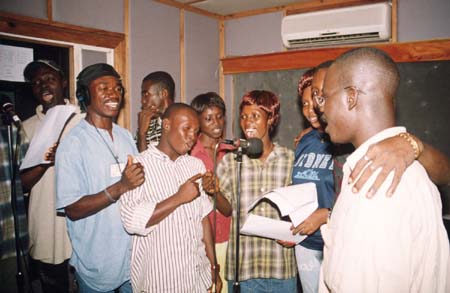
The cast of the Sierra Leonean radio soap opera Atunda Ayenda

Voice acting is the art of performing a character or providing information to an audience with one's voice. Performers are often called voice actors/actresses in addition to other names.[a] Examples of voice work include animated, off-stage, off-screen, or non-visible characters in various works such as films, dubbed foreign films, television shows, video games, animation , documentaries, commercials, audiobooks, radio dramas and comedies, amusement rides, theater productions, puppet shows, and audio games.

The role of a voice actor may involve singing, most often when playing a fictional character, although a separate performer is sometimes enlisted as the character's singing voice. A voice actor may also simultaneously undertake motion-capture acting. Non-fictional voice acting is heard through pre-recorded and automated announcements that are a part of everyday modern life in areas such as stores, elevators, waiting rooms, and public transport. Voice acting is recognized as a specialized dramatic profession in the United Kingdom, primarily due to BBC Radio's long and storied history of producing radio dramas.[1]

Types

[edit]

Character voices

[edit]

The voices for animated characters are provided by voice actors. For live-action productions, voice acting often involves reading the parts of computer programs, radio dispatchers or other characters who never actually appear on screen. With an audio drama, there is more freedom because there is no need to match a dub to the original actor or animated character. Producers and agencies are often on the lookout for many styles of voices, such as booming voices for more dramatic productions or cute, young-sounding voices for trendier markets. Some voices sound like regular, natural, everyday people; all of these voices have their place in the voiceover world, provided they are used correctly and in the right context.[2]

Narration

[edit]

In the context of voice acting, narration is the use of spoken commentary to convey a story to an audience.[3] A narrator is a personal character or a non-personal voice that the creator of the story develops to deliver information about the plot to the audience. The voice actor who plays the narrator is responsible for performing the scripted lines assigned to them. In traditional literary narratives (such as novels, short stories, and memoirs) narration is a required story element; in other types of (chiefly non-literary) narratives (such as plays, television shows, video games, and films) narration is optional.[citation needed]

Commercial

[edit]

One of the most common uses for voice acting is within commercial advertising. The voice actor is hired to voice a message associated with the advertisement. This has different sub-genres such as television, radio, film, and online advertising. The sub-genres are all different styles in their own right. For example, television commercials tend to be voiced with a narrow, flat inflection pattern (or prosody pattern) whereas radio commercials, especially local ones, tend to be voiced with a very wide inflection pattern in an almost over-the-top style. Marketers and advertisers use voice-overs in radio, TV, online adverts, and more; total advertising spend in the UK was forecast to be £21.8 billion in 2017.[citation needed] Voice-over used in commercial adverts had traditionally been the only area of voice acting where "de-breathing" was used.[4] This means artificially removing breaths from the recorded voice, and is done to stop the audience being distracted in any way from the commercial message that is being put across.[citation needed] However, removal of breaths has now become increasingly common in many other types of voice acting.[5]

Translation

[edit]

Dub localization is the practice of voice-over translation, in which voice actors alter a foreign-language film or television series. Voice-over translation is an audiovisual translation[6] technique, in which, unlike in Dub localization, actor voices are recorded over the original audio track, which can be heard in the background. This method of translation is most often used in documentaries and news reports to translate words of foreign-language interviewees.[citation needed]

Automated dialogue replacement

[edit]

Automated dialogue replacement (ADR) is the process of re-recording dialogue by the original actor after the filming process to improve audio quality or reflect dialogue changes, also known as "looping" or a "looping session".[7][8] ADR is also used to change original lines recorded on set to clarify context, improve diction or timing, or to replace an accented vocal performance. In the UK, it is also called "post-synchronization" or "post-sync".[citation needed]

Automated announcements

[edit]

Voice artists are also used to record the individual sample fragments played back by a computer in an automated announcement. At its simplest, each recording consists of a short phrase which is played back when necessary, such as the "mind the gap" announcement introduced on the London Underground in 1969, which is currently voiced by Emma Clarke. In a more complicated system, such as a speaking clock, the announcement is re-assembled from fragments such as "minutes past", "eighteen", and "p.m." For example, the word "twelve" can be used for both "Twelve O'Clock" and "Six Twelve". Automated announcements can also include on-hold messages on phone systems and location-specific announcements in tourist attractions.

AI-generated and AI-modified voices

[edit]

Since the late 2010s, software to modify and generate human voices has become more popular. In 2019, AI startup Dessa created the computer-generated voice of Joe Rogan using thousands of hours of audio from his podcast,[9] while video game developer Ubisoft used speech synthesis to give thousands of characters distinguished voices in its 2020 game Watch Dogs: Legion, and Google announced that same year their solution to generate human-like speech from text.[10]

Most voice actors and others in the entertainment industry have reacted negatively to this development due to the threat it poses to their livelihood.[11] The 2023 SAG-AFTRA strike included negotiations between the union and Hollywood studios about the regulation of AI, as well as discussions with video game studios about new terms that would protect voice actors who specialize in that field.[12][13] Although SAG-AFTRA heralded the deal it struck with AI company Replica Studios as a breakthrough due to its supposed ability to give actors more control over licensing their voice and how it may be used, the deal received backlash for its actual lack of protections from prominent voice actors such as Robin Williams, Joshua Seth, Veronica Taylor, and Shelby Young.[11] The use of AI voices in video games and animation has also been criticized in general by voice actors such as Jennifer Hale, David Hayter, Maile Flanagan, and Ned Luke.[11]

AI voices have caused concern due to the creation of believable audio deepfakes featuring celebrities or other public figures saying things they did not actually say, which could lead to a synthetic version of their voice being used against them.[14] In October 2023, during the start of the British Labour Party's conference in Liverpool, an audio deepfake of Labour leader Keir Starmer was released that falsely portrayed him verbally abusing his staffers and criticizing Liverpool.[15] That same month, an audio deepfake of Slovak politician Michal Šimečka falsely claimed to capture him discussing ways to rig the upcoming election.[16] In January 2024, voters in the New Hampshire Democratic presidential primary received phone calls featuring an AI-generated voice of U.S. President Joe Biden that tried to discourage them from voting.[17]

Voice acting by country

[edit]

United States

[edit]

In films, television, and commercials, voice actors are often recruited through voice acting agencies.

United Kingdom

[edit]

The UK banned broadcasting of the voices of people linked to violence in Northern Ireland from 1988 to 1994, but television producers circumvented this by simply having voice actors dub over synchronized footage of the people who had been banned.[18]

Japan

[edit]

Voice actor (Japanese: 声優, Hepburn: Seiyū) occupations include performing roles in anime, audio dramas, and video games; performing voice-overs for dubs of non-Japanese movies; and providing narration to documentaries and similar programs. Japan has approximately 130 voice acting schools and troupes of voice actors who usually work for a specific broadcast company or talent agency. They often attract their own appreciators and fans, who watch shows specifically to hear their favorite performer. Many Japanese voice actors frequently branch into music, often singing the opening or closing themes of shows in which they star, or become involved in non-animated side projects such as audio dramas (involving the same characters in new storylines) or image songs (songs sung in character that are not included in the anime but which further develop the character).

Brazil

[edit]

Most of the films in the theaters are dubbed in Portuguese, and most Brazilians tend to prefer watching movies in their native language.[which?] Many voice actors are also dubbing directors and translators. To become a voice actor in Brazil, one needs to be a professional actor and attend dubbing courses. Some celebrities in Brazil have also done voice acting.[citation needed]

Iran

[edit]

Voice acting in Iran is divided into three categories. Voice over Persian films, voice over Iranian animations, and dubbing of films and animations related to other countries (in non-Persian language) In the first category, due to the lack of facilities for simultaneous recording of sound while filming a film, the voice actors spoke instead of the film actors. Although this type of voice is related to years ago and now with the increase of facilities, it is possible to record the voice of the actors at the same time, but even today, sometimes the voice of the voice actors is used instead of the main actor. The tail of the voice is on Iranian animations, and like in other parts of the world, voice actors speak instead of animated characters. But most of the activities of Iranian voice actors are in the field of dubbing foreign films. In this case, the main language of the film is translated into Persian, and the dubbing director compiles the sentences according to the atmosphere of the film and the movement of the actors' mouths and other such cases, and finally the voice actors play roles instead of the actors' voices.

Voice acting in video games

[edit]

Actors often lend their voices to characters in games and some have made a career of it across many of the main game-manufacturing countries, mostly the United States, Canada, the United Kingdom, and Japan. Their names have sometimes been linked to a particular character they have voiced.

Notable video game voice actors include Maaya Sakamoto (the Japanese version of Lightning in Final Fantasy XIII),[19] Tatsuhisa Suzuki (Noctis Lucis Caelum in Final Fantasy XV), Miyu Irino (the Japanese version of Sora in the Kingdom Hearts series), David Hayter (Solid Snake and Big Boss in the Metal Gear series), Steve Downes and Jen Taylor (Master Chief and Cortana in the Halo series), Nolan North (Nathan Drake in the Uncharted series and Desmond Miles in the Assassin's Creed series), Troy Baker (Joel in The Last of Us series) and Charles Martinet (former voice actor for Mario, Luigi, Wario, and Waluigi in Nintendo's Mario franchise).[citation needed]

Other actors more linked with film or television acting have also voiced video game characters, such as Ray Liotta (Tommy Vercetti in Grand Theft Auto: Vice City and Billy Handsome in Call of Duty: Black Ops II), Michael Dorn (various characters in World of Warcraft and Gatatog Uvenk in Mass Effect 2), Kaili Vernoff (Miranda Cowan in Grand Theft Auto V and Susan Grimshaw in Red Dead Redemption 2), Ashley Johnson (Ellie in The Last of Us series), Kristen Bell (Lucy Stillman in the first three mainline entries in the Assassin's Creed franchise) and Kevin Spacey (Jonathan Irons in Call of Duty: Advanced Warfare).

Some actors from both live-action and animated works have also reprised their respective roles in video games, such as Kevin Conroy (Batman) and Mark Hamill (The Joker) in the Batman: Arkham series, Sylvester Stallone (John Rambo) in Mortal Kombat 11, various actors from the works of Walt Disney Animation Studios in Kingdom Hearts, and Mike Pollock (Doctor Eggman) in Sonic the Hedgehog.

See also

[edit]

Notes

[edit]

References

[edit]
Revisions and contributorsEdit on WikipediaRead on Wikipedia
from Grokipedia
Voice acting is the art of providing vocal performances to portray characters, narrate stories, or deliver commercial messages in media formats where the performer's physical presence is absent or obscured, such as , video games, audiobooks, and dubbed films. This discipline demands precise control over tone, inflection, pacing, and accent to convey emotion and personality solely through auditory means, distinguishing it from on-camera by emphasizing vocal technique over visual cues. The profession traces its modern origins to early 20th-century radio broadcasts and experimental sound recordings, expanding with synchronized sound in films during the late and proliferating through animated shorts and features that required distinct character voices. Pioneers like , who voiced over 400 characters including and for Warner Bros. cartoons from the 1930s onward, exemplified the field's potential for versatility, influencing generations by demonstrating how a single performer could populate entire worlds with lifelike personas. Today, voice acting supports diverse sectors, with the global and market valued at USD 4.2 billion in 2024 and forecasted to reach USD 8.6 billion by 2034 amid rising demand for localized content in streaming, gaming, and . Advancements in production have democratized access via home studios, yet the industry grapples with existential threats from , including voice cloning technologies that replicate performers' intonations from minimal samples, enabling cost reductions for producers at the expense of traditional jobs. Such tools, while improving efficiency in repetitive tasks like game localization, have sparked disputes over consent, compensation, and artistic authenticity, as seen in SAG-AFTRA's 2023-2024 negotiations permitting limited AI use under regulated terms. Despite these disruptions, actors retain advantages in nuanced emotional delivery and cultural adaptation, sustaining demand in high-stakes narrative projects.

History

Origins in Early Sound Recording

The invention of the phonograph by Thomas Edison in 1877 enabled the first reproducible recordings of human speech, initially as a novelty demonstration when Edison recited "Mary Had a Little Lamb" on a tinfoil cylinder. This device, which used a stylus to etch sound waves onto rotating cylinders, shifted from mere preservation of voices—such as Édouard-Léon Scott de Martinville's earlier 1860 phonautograph tracings of songs like "Au Clair de la Lune," which were not playable until optical scanning in 2008—to performative playback for audiences. Early commercial cylinders in the 1880s, produced by Edison's National Phonograph Company and competitors like the Graphophone (an improved wax-cylinder system developed by Alexander Graham Bell's associates in 1886), primarily captured music, speeches, and simple recitations, but lacked dedicated acting formats. By the 1890s, as cylinder production scaled—reaching millions annually through companies like —performers adapted stage techniques for audio-only formats, pioneering voice characterization through dialects, impersonations, and narrative sketches. Russell Hunting emerged as a key figure, recording from onward for the Phonograph Company with his "Michael Casey" series, where he employed an exaggerated Irish brogue and comedic timing to portray working-class vignettes, often simulating multi-character interactions by or rapid role-switching in single takes. These two-to-four-minute cylinders, such as Hunting's recitations of domestic mishaps, required vocal modulation for clarity and engagement without visual cues, emphasizing projection and over physical presence—a foundational aspect of voice acting. Similar efforts by contemporaries like Len Spencer, who specialized in ethnic dialects and comic monologues on Edison and Columbia cylinders from the mid-1890s, further developed performative voice work, including blackface minstrel-style routines and dialogues that demanded distinct vocal timbres for characters. These recordings, distributed via parlor phonographs and coin-op machines in public spaces, prioritized auditory storytelling, with artists compensating for the medium's limitations—like acoustic horns amplifying only loud, enunciated delivery—through exaggerated inflection and pacing. By 1900, such content comprised a significant portion of the cylinder market, alongside operatic arias by singers like Enrico Caruso, establishing voice performance as a viable profession distinct from live theater. This era's innovations in vocal characterization directly influenced later media, though constrained by mechanical fidelity and short durations.

Radio Broadcasting and Initial Commercialization

Radio broadcasting emerged as a pivotal medium for voice performance in the early 20th century, with the first transmission of human voice occurring on December 24, 1906, when Canadian inventor Reginald Fessenden broadcast speech, violin music, and Bible readings from Brant Rock, Massachusetts, to ships at sea, marking the initial demonstration of voice over amplitude modulation radio. This experimental broadcast laid foundational groundwork for audio entertainment, though it remained non-commercial and limited in reach. Commercial radio broadcasting commenced in the United States on November 2, 1920, when station KDKA in Pittsburgh aired live election results for the Harding-Cox presidential race, announced by staff including Leo Rosenberg, relying entirely on vocal delivery to convey events to listeners without visual aids. These early transmissions highlighted the necessity of expressive voice work, as performers adapted stage techniques to radio's audio-only format, emphasizing intonation, pacing, and sound effects to engage audiences. By the mid-1920s, radio stations proliferated, with over 500 operational in the U.S. by 1922, shifting from amateur experiments to that included , , and nascent dramatic readings. Voice performers, often drawn from theater backgrounds, began specializing in radio-specific roles, such as announcers who cultivated clear, authoritative tones to build listener trust amid competing signals and rudimentary receivers. The introduction of sponsored content accelerated this evolution; for instance, in 1922, WJZ in Newark broadcast Broadway musical excerpts and full plays performed by actors like Grace George and Herbert Hayes, demonstrating how voice alone could sustain narrative drama over airwaves. These efforts commercialized voice work by tying performances to station revenue, as broadcasters sought to attract advertisers through compelling audio content that simulated live theater experiences. Initial commercialization intensified in the late 1920s and early 1930s, as radio advertising revenue surged from negligible amounts in 1927 to over $100 million by 1930, driven by national sponsors funding serialized dramas and variety shows. Programs like the 1929 debut of "The Rise of the Goldbergs" showcased voice actors creating multifaceted characters through dialect, emotion, and timing, without physical presence, which formalized voice acting as a distinct profession requiring script interpretation and live improvisation under studio constraints. Stations employed ensembles of performers for cost efficiency, with actors often voicing multiple roles in a single broadcast, fostering techniques like rapid character differentiation via vocal modulation. This era's economic model—where shows bore sponsor names, such as "The Eveready Hour" starting in 1926—directly incentivized high-quality voice delivery to retain audiences and ad dollars, establishing radio as the first mass medium for commercial voice acting. By the 1930s, the "Golden Age" of radio saw peak investment in dramatic anthologies, solidifying voice performers' roles in a burgeoning industry valued for its intimacy and scalability.

Emergence in Animation and Film

The transition to synchronized sound in the late 1920s catalyzed the emergence of voice acting in both and live-action , transforming silent visuals into voiced narratives that demanded specialized vocal and characterization. In , ' The Jazz Singer, released on October 6, 1927, incorporated extended sequences of spoken synced to motion, with performing songs and lines recorded via the system, marking the commercial viability of "talkies" and highlighting the need for actors to adapt vocal techniques to match lip movements often captured separately. This era also birthed for foreign-language versions, as studios produced multiple audio tracks during filming or post-dubbed later; a pioneering case occurred in 1929 with the Spanish version of Río Rita, where voice performers re-recorded to fit English visuals, creating demand for skilled imitators capable of mimicking original inflections and timings. Animation leveraged sound more innovatively for character-driven storytelling, with Walt Disney's —premiered on November 18, 1928—achieving the first successful synchronization of music, effects, and dialogue in a short, where Disney supplied Mickey Mouse's high-pitched and whistles to convey mischief and emotion. Unlike silent-era reliant on exaggerated gestures, this integration elevated voices as primary conveyors of personality, proving audiences responded to auditory cues for engagement; Disney's direct involvement underscored the creator's role in pioneering vocal performance tailored to non-human forms. By the 1930s, voice acting professionalized amid expanding production scales. Disney's Snow White and the Seven Dwarfs (1937), the inaugural feature-length animated film, utilized a cast of dedicated voice specialists—including Adriana Caselotti for the title character's gentle soprano and ensemble performers like Roy Atwell (Doc) and Billy Gilbert (Sneezy)—to differentiate seven dwarfs through timbre, accent, and cadence, enhancing emotional depth in ensemble dynamics. Rival studios followed suit; Warner Bros.' Looney Tunes introduced versatile talents like Mel Blanc, whose debut in shorts such as Porky's Duck Hunt (1937) featured the manic quacks of Daffy Duck, exemplifying how a single actor could embody multiple archetypes via vocal modulation, thus streamlining production while amplifying comedic variety. These advancements, driven by technological feasibility and market demand for repeatable characters, entrenched voice acting as a distinct discipline, distinct from on-camera performance.

Expansion with Television and Post-War Media

The proliferation of television in the post-World War II era significantly broadened the scope of voice acting, transitioning many radio performers to visual media and creating demand for narration, commercials, and character voices. Experimental television broadcasting had paused during the war, but by 1946, U.S. households with sets numbered around 8,000, surging to approximately 6 million by 1950 and over 45 million by 1960 as affordability improved and networks expanded. This growth, fueled by economic recovery and consumer demand, shifted advertising budgets from radio to TV, where voice-overs provided authoritative endorsements and storytelling for products, often employing the formal, resonant delivery styles honed in radio. Voice work in television commercials became a cornerstone of the profession, with ads relying on professional announcers to convey trust and urgency amid the era's emphasis on polished enunciation and Mid-Atlantic accents. Early TV spots, typically 30-60 seconds, featured voices like those of radio veterans, supporting the free-market boom in sponsored programming where networks sold airtime directly to advertisers. extended to newsreels, documentaries, and variety shows, with actors providing off-screen commentary to bridge visual gaps or enhance dramatic effect, solidifying voice acting as essential to television's narrative structure. In animation, the shift to cost-effective limited-animation techniques enabled sustained TV production, markedly expanding voice acting opportunities. Productions, founded in 1957, launched the first primetime for television with The Ruff and Reddy Show that December, utilizing voices such as as Reddy the cat and as Ruff the dog across 156 five-minute episodes. This model prioritized vocal characterization over fluid motion, allowing prolific output; subsequent hits like (1958) and (premiering September 30, 1960, on ABC) featured ensembles including Butler, Messick, and , who voiced and Dino in the latter, drawing on his experience post-contract expiration. These series, running multiple seasons, employed reusable voice talents for dozens of characters, professionalizing ensemble voice casts and influencing global animation standards.

Digital Age and Video Games

The integration of voice acting into video games accelerated during the digital age, beginning with rudimentary in arcade titles of the early 1980s. Stratovox, released in 1980 by Sun Electronics, marked the first instance of synthesized voice elements in gaming, featuring simple spoken warnings like "Take-off" during gameplay. This was followed shortly by Berzerk from Stern Electronics, also in 1980, which used similar synthesis for robotic taunts such as "Intruder alert," demonstrating early experiments with audio to enhance immersion amid hardware limitations. Digitized human voices emerged soon after, with in 1981 incorporating sampled German phrases like "Achtung!" and "Die, Allied pig dog" to convey enemy dialogue, sampled from a single and looped for effect. These innovations relied on emerging storage, but widespread adoption was constrained by cartridge-based media's limited capacity until the mid-1990s introduction of technology, which allowed for fuller audio tracks and scripted performances. Titles like (1993) and (1995) leveraged this for extensive voice-overs in sequences, though acting quality varied due to budget constraints and non-professional talent. By the late 1990s and early 2000s, console generations like the PlayStation and enabled more sophisticated voice integration, with games such as Metal Gear Solid (1998) pioneering high-profile casts including as , setting benchmarks for dramatic delivery synced to 3D animations. Fully voiced protagonists and ensembles became standard in games, exemplified by Final Fantasy X (2001), the first in its series to feature complete voice acting for its narrative-driven characters. Performance capture techniques, combining voice with motion data, further advanced realism in titles like (2013), where actors like provided nuanced emotional range. The sector now drives significant demand for voice actors, fueled by the industry's expansion to a $221.4 billion global market in 2023, with voice work comprising a growing portion of production budgets for character-driven narratives. Modern pipelines involve studio recordings with tools like lip-sync software (e.g., in ) and remote collaboration platforms, reducing costs but raising concerns over intellectual property, as evidenced by the 2022-2023 strike addressing AI replication of performers' likenesses without consent. Despite such challenges, the sector's projected growth to $300 billion by 2026 underscores voice acting's role in immersive storytelling, with thousands of roles annually across platforms.

Techniques and Training

Fundamental Vocal Skills

Fundamental vocal skills form the technical foundation of voice acting, enabling performers to produce clear, sustainable, and expressive audio without visual support. These skills derive from principles of and , where controlled airflow from the diaphragm vibrates the vocal folds to generate sound, which is then modified by resonators and articulators for clarity and nuance. Mastery requires consistent practice to avoid strain, as improper technique can lead to vocal or nodules, with studies indicating that professional voice users experience higher rates of laryngeal without foundational training—up to 46% prevalence among performers compared to 7% in the general population. Breath support is paramount, involving to regulate air pressure for phrasing and dynamics; this technique sustains delivery over extended takes, preventing breathy interruptions that disrupt listener engagement. Voice actors train to expand ribcage capacity, achieving up to 20-30% greater than shallow chest , which supports emotional intensity without audible effort. Articulation and diction ensure consonant precision and vowel shaping, critical for intelligibility in accents or rapid speech; for instance, over-articulation exercises like tongue twisters refine and plosives, reducing error rates in tests by enhancing spectral clarity. Vocal and placement direct sound through oral, nasal, or chest cavities to achieve variation, allowing a single to differentiate characters—e.g., forward placement for youthful versus lowered for —while maintaining efficiency to sustain sessions of 4-6 hours without hoarseness. Pitch, inflection, and pacing control modulate (typically 85-255 Hz for adult males, 165-255 Hz for females) and to convey intent; actors practice scales to expand range by 1-2 octaves, enabling subtle emotional shifts that correlate with audience comprehension in auditory-only formats. Daily warm-ups, including and lip trills, prepare musculature and prevent injury, with protocols reducing post-performance fatigue by optimizing vocal fold closure efficiency.

Acting and Characterization Methods

Voice actors develop characterizations primarily through vocal modulation and psychological immersion, adapting stage and screen principles to audio contexts where visual cues are absent. Fundamental techniques begin with , wherein performers dissect dialogue for , motivations, and relational dynamics to inform vocal choices, ensuring authenticity in delivery. This is complemented by , involving the invention of personal history, quirks, and objectives to guide consistent portrayal, as inconsistent voices risk undermining narrative immersion in media like . Key vocal parameters form the mechanistic core of characterization: pitch variation alters perceived age, authority, or emotional state, with lower pitches evoking maturity or menace and higher ones suggesting youth or excitability; tempo and rhythm control pacing to reflect urgency or , as slower rates convey while rapid delivery signals agitation; timbre and texture introduce gravelly, breathy, or nasal qualities to differentiate archetypes, achieved via laryngeal adjustments and shifts in the vocal tract. Intonation patterns—rising for questioning or falling for assertion—further encode intent, while volume dynamics simulate spatial proximity or intensity. These elements causally influence listener inference of traits, rooted in evolutionary auditory cues for threat assessment and social signaling. Physical embodiment techniques enhance vocal realism, as actors adopt postures, gestures, or even props to kinesthetically influence —slouching may lower for a defeated character, while expansive movements elevate pitch for confidence. Emotional recall draws from Stanislavski-derived methods, prompting performers to access genuine affective states through sense memory, translated into prosodic shifts like for fear or steady for resolve. drills build adaptability, allowing spontaneous vocal inventions during booth sessions to refine traits under directorial feedback. Vocal range expansion, via exercises targeting head, chest, and mixed registers, enables portrayal of diverse demographics, from childlike to aged gravel, though anatomical limits constrain extreme shifts without strain. Dialect and accent integration adds cultural specificity, requiring phonetic precision to avoid caricature; for instance, modifications distinguish regional variants without compromising intelligibility. Consistency across recordings demands reference tracks and training, as vocal fatigue can erode distinctions in long sessions. Professional development emphasizes iterative recording and self-critique, often using mirrors or video to correlate facial tension with auditory output, bridging auditory and kinesthetic feedback loops. These methods, empirically validated in industry practice, prioritize causal fidelity to character logic over superficial novelty, mitigating risks of vocal damage from unsustainable extremes.

Professional Training and Development

Professional training in voice acting emphasizes practical skills acquisition through workshops, coaching, and specialized programs rather than formal university degrees, as the profession prioritizes demonstrable , script interpretation, and market readiness over academic credentials. Institutions like offer an undergraduate certificate in voice acting, focusing on preparation for entertainment industry roles through coursework in performance techniques. provides a four-course, 12-credit certificate in Voice and Speech for the , aimed at enhancing articulation and delivery for monologues and performances. However, comprehensive industry analyses indicate that a degree is not necessary for entry or success, with many professionals succeeding via targeted training alone. Specialized academies and studios deliver the bulk of instruction, often online for accessibility. Edge Studio's multi-phase training program includes coaching on commercial, narration, and character work, with nationwide instructors and options for youth and Spanish-language tracks. Voice One in offers an extensive curriculum utilizing on-site recording studios and theater spaces, suitable for beginners to advanced practitioners. Certification initiatives, such as VoiceOver LA's six-week VOLA Voice Artist Certification Program, immerse participants in voice-over fundamentals, demo production, and audition strategies. Online platforms like Global Voice Acting Academy provide membership-based coaching with ongoing feedback, covering home studio setup and genre-specific techniques. Self-evaluation of one's voice, particularly for narration, involves recording readings of neutral texts, scripts, or sample narrations using a high-quality microphone. Critical playback assessment focuses on clarity and pronunciation, pace and rhythm, tone and pitch variation, naturalness (avoiding forced or strained delivery), emotional conveyance, and overall relatability. Comparing multiple recordings over time tracks progress and identifies weaknesses. Optionally, benchmarking against professional narrators or obtaining external feedback enhances objectivity. Ongoing professional development sustains careers amid evolving media demands, including video games and audiobooks. Foundation's Voiceover Labs deliver in-person and virtual workshops exclusively for union members, emphasizing skill refinement and industry updates. The National Association of Voice Actors promotes advancement through education and inclusion initiatives, advocating for ethical standards and resource access. Practitioners frequently engage private coaching, such as through The Voice Acting Institute's tiered programs that integrate vocal training with and portfolio building. Regular masterclasses, vocal health maintenance, and demo reel updates—often produced after initial training—enable adaptation to technological shifts like AI-assisted production and remote auditions.

Categories of Voice Work

Character Voices in Animation and Fiction

Character voices in refer to the specialized performances by voice actors who embody fictional entities—such as anthropomorphic animals, mythical creatures, or stylized humans—using vocal techniques to convey personality, emotion, and narrative action without visual physicality from the performer. This form of voice acting demands exaggeration and versatility to match the heightened expressiveness of , where auditory elements drive character recognition and engagement. Unlike live-action roles, where facial expressions and support the voice, relies on phonetic clarity, pitch variation, and rhythmic timing to suggest movement and intent, often recorded in isolation prior to animating lip-sync and gestures. The practice originated with the integration of synchronized sound in animation during the late 1920s, marking a shift from silent films to voiced narratives. Walt Disney's Steamboat Willie, released on November 18, 1928, introduced Mickey Mouse with basic vocal whistles and effects by composer Carl Stalling and animator Ub Iwerks, establishing voice as integral to character development rather than mere accompaniment. By the 1930s and 1940s, studios like Warner Bros. advanced the craft through multi-character performances; Mel Blanc, starting in 1937, provided over 400 distinct voices for Looney Tunes icons including Bugs Bunny (debuting in 1940 with a Brooklyn-esque accent and sly inflection), Daffy Duck, and Porky Pig, often recording all roles in a single session to maintain consistency. This era emphasized vocal mimicry and rapid shifts between personas, influencing the "one-man show" style still prevalent in limited-animation series. Techniques for crafting character voices prioritize vocal experimentation to differentiate personas, including modulation of pitch, , and to evoke age, species, or temperament—such as gravelly lows for villains or high-pitched squeaks for comedic sidekicks. Performers employ physical in the booth, like exaggerated gestures or facial contortions, to infuse authenticity into the delivery, even if unseen by audiences; observation of real-life models, accents, and animal sounds further grounds fictional traits. patterns and pauses are calibrated for animation's pacing, ensuring lines sync with exaggerated actions, as directors guide iterations to amplify emotional arcs without on-screen cues. In fictional contexts beyond pure animation, such as audio dramas or early radio adaptations of stories, character voices adapt literary archetypes into audible forms, though remains the dominant medium for visual-auditory fusion. Challenges include sustaining originality amid demands for familiarity, as studios favor proven archetypes over novel creations, and the isolation of booth recording, which requires self-directed improvisation without scene partners or props. Professional voice actors like , who has voiced over 500 characters since the 1990s including Bubbles in (1998 debut), highlight the endurance needed for marathon sessions voicing ensembles, contrasting with celebrity cameos that prioritize star power over vocal range.

Narration and Documentary Narration

Narration in voice acting encompasses the delivery of spoken text to provide exposition, context, or over visual or auditory media, distinct from character portrayal by emphasizing clarity, authority, and rhythmic pacing to maintain audience engagement without visual embodiment. Techniques prioritize deliberate enunciation, strategic pauses for emphasis, and breath control to avoid disrupting flow, ensuring the voice supports rather than dominates the content. Professional narrators often adapt intonation to convey objectivity or subtle emotional nuance, as seen in production where consistency in tone prevents listener fatigue across extended sessions. Documentary narration, a specialized subset, applies these skills to formats, where the voice actor interprets scripts derived from research to elucidate events, data, or phenomena, fostering viewer comprehension and trust through measured delivery. This form originated in the 1930s with informational films, evolving from silent-era intertitles to voiced overlays that deepened contextual analysis, as in early British documentaries by John Grierson's unit. By the mid-20th century, it became integral to expository styles, contrasting observational modes by directly addressing audiences with factual synthesis rather than relying solely on interviews or visuals. Key techniques in documentary work include tonal to underscore seriousness—such as lowering pitch at statement ends for authority—and synchronization with footage pacing to align emphasis with on-screen revelations. Narrators select voices matching genre demands: resonant baritones for historical or scientific topics to evoke reliability, or varied for exploratory pieces to sustain intrigue. For instance, Peter Coyote's narration in Ken Burns's documentaries, starting with "The Civil War" in 1990, employs a deliberate, unhurried that parses complex timelines without . Prominent figures illustrate efficacy: has narrated over 50 natural history series since "Life on Earth" in 1979, using a calm, precise to convey empirical observations, amassing billions of viewership hours. Morgan Freeman's voice in "" (2005) and "The Story of God" (2016) leverages deep resonance for authoritative exposition, enhancing factual retention through auditory familiarity. Werner Herzog's idiosyncratic, accented delivery in films like "" (2005) introduces philosophical undertones to raw footage, prioritizing causal interpretation over neutral relay. These examples highlight how skilled amplifies evidentiary weight, with studies noting voice influences perceived source credibility in informational media.

Commercial and Advertising Voice-Overs

Commercial voice-overs consist of recorded spoken used in advertisements to convey product benefits, messaging, or calls to action across television, radio, online videos, and podcasts. These performances prioritize persuasive delivery to influence consumer behavior, often employing relatable, enthusiastic tones to foster emotional connections and drive . Unlike character-driven work, commercial reads emphasize , precise enunciation, and conversational pacing to avoid sounding overly salesy or artificial, reflecting advertisers' shift from hard-sell tactics in early radio spots to modern authenticity. The practice originated in the with radio , where voice talent narrated product pitches without visual aids, evolving into a core element of television commercials by the mid-20th century as brands leveraged audio to build familiarity and credibility. By the , increased adoption stemmed from empirical evidence of voice-overs' impact on persuasion, with studies showing that authoritative or warm vocal tones could boost ad recall by up to 20-30% compared to silent visuals alone. Iconic campaigns, such as Tony the Tiger's "They're Grrreat!" voiced by for starting in 1953, demonstrated how signature voices could become synonymous with brands, enduring for decades and contributing to market dominance. Techniques for effective commercial voice acting include vocal warm-ups to ensure clarity, hydration to maintain consistency, and to infuse reads with genuine belief in the message, as artificial enthusiasm often fails to resonate. Performers in character—briefly identifying themselves while matching the ad's tone—and deliver multiple takes varying levels to match directorial visions, with editing handling pacing and effects. High-profile actors like , whose deep, reassuring narrated Visa commercials from 2012 onward, and Jon Hamm for Mercedes-Benz ads since 2014, illustrate how celebrity voices command premium rates, often $100,000+ per campaign, due to their proven draw on audiences. The sector forms a substantial portion of the $4.4 billion global market as of 2023, fueled by digital ad growth and streaming platforms, though it faces disruption from AI-generated voices capable of mimicking at lower costs. Despite this, performers retain an edge in nuanced emotional conveyance, as evidenced by brands like sticking with operatic ' campaigns, which have run since 2009 and measurably increased inquiries through memorable phrasing. Auditions remain competitive, requiring home studios with professional microphones and ISDN/ connectivity for remote sessions, underscoring the need for self-reliant talent in a freelance-heavy field.

Dubbing, Localization, and Translation

Dubbing involves the replacement of original audio in films, television programs, or other media with new recordings in a target , performed by voice actors to synchronize with on-screen lip movements and preserve the original performance's emotional tone and timing. The process typically begins with script , followed by voice actors whose vocal qualities approximate the originals, recording sessions focused on lip-sync accuracy—often requiring takes limited to three seconds per line—and final audio mixing to integrate the dubbed track seamlessly. Voice actors must employ techniques such as precise intonation, , and modulation to match the source material's and delivery, ensuring the dubbed version feels authentic rather than mechanical. Localization extends dubbing by incorporating cultural adaptations beyond mere linguistic substitution, such as adjusting humor, idioms, or references to resonate with the target audience while selecting voice actors with regionally appropriate accents or dialects to enhance relatability. In media like video games or , localization demands voice performances that convey nuanced emotional connections, often prioritizing natural rhythm and pitch over exact phonetic matches to avoid alienating viewers. for dubbing presents distinct challenges, including condensing or expanding dialogue to fit original speech durations—typically aiming for equivalent timing with pauses aligned—and retaining emotional subtext without literal equivalence, which can distort intent if cultural contexts are overlooked. Synchronization remains a core difficulty, as voice actors must align words to visible mouth movements, sometimes necessitating script alterations or multiple retakes to achieve plausible visuals. Historically, dubbing originated in the early 1930s amid the shift to synchronized sound films, with the first notable Spanish-language dub occurring in 1929 for the Hollywood production Río Rita, marking an evolution from multilingual reshoots to efficient audio replacement. By the late 1930s, countries like Italy and Germany standardized dubbing practices, often using it for domestic films as well, which facilitated broader international distribution but required voice actors skilled in mimicking foreign performers' cadences. In contemporary practice, professional dubbing studios emphasize quality control through iterative recordings and actor feedback, with economic factors like production costs influencing decisions between dubbing and subtitling in markets favoring immersive audio experiences. Despite advancements in digital tools, human voice acting persists as essential for capturing subtle characterizations, underscoring the craft's reliance on performers' ability to bridge linguistic and performative gaps.

Post-Production Replacement and Announcements

Post-production replacement, commonly known as automated replacement (ADR), involves voice actors re-recording in a controlled studio environment after to supplant on-set audio captured during filming. This technique addresses deficiencies in production sound, such as ambient noise interference, equipment limitations, or inconsistent audio levels, ensuring higher fidelity in the final mix. Originating in the amid the transition to synchronized sound films, ADR evolved from manual looping methods—where actors repeated lines against repeated film projections—to automated systems by the mid-20th century that facilitated precise with on-screen lip movements. In ADR sessions, the original actor typically performs the replacement to preserve performance consistency, lip-syncing to projected footage while monitoring cues like mouth flaps and emotional beats through headphones. The process demands vocal precision to match , pacing, and , often requiring multiple takes per line; success rates vary, with skilled actors achieving 70-90% usable material per session, though challenges like emotional reconnection to the scene can extend recording time. Voice actors specializing in ADR may handle not only principal roles but also supplemental lines, such as crowd murmurs or off-screen dialogue, contributing to films where up to 40% of audible speech derives from post-production replacement. Announcements represent another facet of voice work, where actors provide pre-recorded messages for public address (PA) systems in venues like transportation terminals, stadiums, and institutions. These recordings prioritize intelligibility, employing neutral, authoritative tones to convey safety instructions, arrival/departure updates, or event directives, often scripted for brevity and acoustic clarity over amplified speakers. voice talent is preferred over synthetic alternatives for nuanced delivery that enhances listener compliance, as evidenced in major hubs like airports where custom announcements reduce miscommunication errors by emphasizing enunciation and pacing. Unlike ADR's performative demands, announcement work focuses on reliability, with actors auditioning for ongoing contracts to voice recurring messages across digital PA integrations.

Applications in Specific Media

Voice Acting in Animation

Voice acting in animation entails performers using vocal modulation, timing, and emotional to embody characters without visual physicality, enabling exaggerated portrayals that enhance expressiveness in films, television series, and shorts. This form distinguishes itself from live-action by prioritizing phonetic clarity for lip-sync and character-specific idiosyncrasies, often requiring actors to voice multiple roles in a single production to maintain consistency across fantastical or anthropomorphic figures. The practice synchronizes audio tracks to pre-animated visuals or, more commonly in modern workflows, precedes to guide and movement. Historically, synchronized voice in animation emerged with Walt Disney's Steamboat Willie in 1928, featuring Mickey Mouse's debut with basic sound effects and whistling, marking the shift from silent films reliant on music alone. The 1937 release of Disney's Snow White and the Seven Dwarfs represented the first feature-length animated film with fully integrated voice performances, employing actors like Adriana Caselotti for Snow White to convey nuanced emotions through voice alone. The Golden Age of American animation from the 1930s to 1960s elevated the role, with performers such as Mel Blanc voicing over 400 characters for Warner Bros. Looney Tunes, including Bugs Bunny and Daffy Duck, whose versatile characterizations influenced subsequent styles by demonstrating how vocal timbre and pacing could define iconic personalities. In production, voice recording typically occurs early, with actors delivering "scratch" tracks—provisional performances—to inform animators' timing and expressions, followed by polished sessions using large-diaphragm condenser microphones in controlled studios to capture without . Directors emphasize iterative takes to align with story beats, often directing actors to over-articulate for exaggerated styles, as seen in ensemble recordings where performers switch roles rapidly to simulate interactions. Post-recording, audio is edited for sync, with automated replacement (ADR) used sparingly for fixes, ensuring voices drive the animation's rhythm rather than merely overlaying it. Key techniques include for sustained energy in high-pitched or gravelly roles, phonetic exaggeration to facilitate animators' lip-sync, and improvisational acting to infuse spontaneity, as practiced by talents like , who voiced on since 1989 by drawing from real child behaviors for authentic rebellion. Performers must avoid vocal strain through warm-ups and hydration, countering challenges like prolonged sessions that risk fatigue or the pressure to mimic established "comp" voices, which can stifle originality in auditions. Modern examples include Tara Strong's multifaceted work across (1998–2005) and , where her range in voicing childlike yet empowered characters underscores voice acting's capacity to transcend age or species limitations.

Voice Acting in Video Games

Voice acting in video games emerged in the early 1980s with rudimentary speech synthesis, as seen in arcade titles like Stratovox (1980) and Berzerk (1980), where limited synthesized phrases provided basic auditory feedback. Digitized human speech followed soon after, with Impossible Mission (1984) on the Commodore 64 featuring sampled voice lines such as "Destroy them, Mr. Robotic." The mid-1990s marked a significant advancement with CD-ROM technology, enabling higher-quality recordings and fuller dialogue implementation in games like The Last Express (1997), one of the first Western titles with near-complete voice acting. This evolution paralleled hardware improvements, shifting from sparse, robotic audio to cinematic performances that integrated with gameplay, though early efforts often suffered from technical constraints like low storage capacity. The recording process typically involves actors auditioning via self-tapes or in-person sessions, followed by booth work where lines are delivered against temporary animations or scratch tracks. Performances must account for non-linear scripting, with actors recording hundreds of variants for branching dialogues, often without full context, to sync with motion-captured animations and lip-sync requirements. In performance capture sessions, actors like those in series combine voice with physical motion using suits and markers, allowing directors to capture nuanced emotional delivery. This method demands versatility, as actors portray diverse characters—such as voicing Joel in (2013) or as in the series—while adhering to directorial notes for consistency across takes. High-quality voice acting enhances player immersion by conveying emotional depth and personality, with studies indicating that character sounds significantly influence perceived engagement and fun in . For instance, Jennifer Hale's portrayal of in (2007–2012) allowed for player-driven narrative branches while maintaining tonal authenticity, contributing to the series' replayability. Celebrities like as Johnny Silverhand in (2020) further elevate production values, drawing from actors' established ranges to create memorable archetypes. Empirical data from industry surveys underscore vocal strain as a byproduct, with 38% of performers reporting frequent during extended sessions due to repetitive phrasing and high output demands. Challenges persist, including the high cost of full voice-over, which scales exponentially with dialogue volume and can constrain narrative flexibility by favoring linear paths over expansive player agency. Synchronization issues arise when animations precede audio, forcing actors to match pre-set timings, and poor implementation—such as mismatched accents or wooden delivery—can disrupt immersion more than silence. Indie developers often face barriers in accessing talent, relying on non-union actors or synthetic alternatives, while AAA titles benefit from budgets supporting stars but risk over-reliance on fame over fit. Despite these, voice acting remains integral, with advancements in AI-assisted tools emerging as a contentious supplement rather than replacement, given the irreplaceable nuance of human performance in evoking causal emotional responses.

Voice Acting in Live-Action Film and Television

In live-action and television, voice acting primarily involves contributions such as automated dialogue replacement (ADR), loop group performances for background audio, and narration for off-screen elements. ADR entails re-recording lines in a controlled studio environment to supplant on-set audio marred by , equipment limitations, or performance inconsistencies, ensuring clarity and synchronization with lip movements. Principal cast members usually execute their own ADR to retain vocal continuity, but professional voice actors step in for scenarios including unavailable originals (e.g., due to scheduling conflicts or ), maturing child performers, or stunt personnel whose faces are obscured. The extent of ADR varies by production scale and shooting conditions; estimates indicate it comprises 10-30% of dialogue in typical Hollywood films, rising in action-heavy or location-based projects where production sound proves inadequate. In television, ADR usage is generally more restrained owing to compressed timelines and budgets, focusing on corrective fixes rather than wholesale replacement, though it remains vital for network and streaming series with reshoots. Loop groups—ensembles of voice actors specializing in "walla" or ambient chatter—provide layered, improvised background dialogue to simulate crowd dynamics in scenes like restaurants, streets, or events, where on-set extras produce inaudible mutterings. These performers watch footage and deliver overlapping lines in sessions, enhancing immersion without overshadowing foreground action; in Hollywood, elite loop groups operate as tight-knit collectives, with seasoned members earning up to $1 million yearly from recurring studio contracts. Voice-over work in live-action supplements visuals with narration, internal thoughts, or unseen character speech, often leveraging actors' inherent vocal traits for authenticity. Examples include Ray Liotta's retrospective in Goodfellas (1990), which structures the nonlinear plot, and Morgan Freeman's poignant as the reflective Red in The Shawshank Redemption (1994). In television, such techniques appear in episodic framing devices, as in The Wonder Years (1988-1993), where adult overlays childhood visuals for thematic depth. Professional voice actors may handle these if distinct or availability demands it, particularly in documentaries or hybrid formats.

Professional Industry Dynamics

Unions, Labor Organizations, and Strikes

, formed in 2012 by the merger of the (SAG) and the American Federation of Television and Radio Artists (AFTRA), serves as the primary labor union representing voice actors in the United States across , video games, commercials, audiobooks, and other media. The union negotiates agreements with producers and studios, covering minimum wages, residuals for reuse of performances, health and pension benefits, and workplace protections such as limits on session lengths to prevent vocal strain. Membership requires adherence to union standards, including working only on union-approved projects to maintain leverage in negotiations. Voice actors have participated in several high-profile strikes, often centered on compensation for digital distribution and emerging technologies. The 2016–2017 strike, initiated on October 21, 2016, against 11 major developers including and , lasted 340 days and addressed demands for bonus pay tied to game success, improved motion-capture conditions, and transparency in . It ended with a tentative agreement in 2017 covering about 2,500 performers, though some issues like AI protections remained unresolved. More recently, SAG-AFTRA authorized a video game strike on September 24, 2023, with 98.32% member approval, following stalled talks since October 2022 over AI-generated voice replicas, wage increases amid inflation, and health/safety protocols. The strike commenced July 16, 2024, halting work for union voice and motion-capture performers on projects with non-signatory studios, impacting titles from companies like Disney and Warner Bros. Interactive. It concluded with a suspension in June 2025 after a deal providing AI consent requirements, performance capture bonuses, and augmented wages, though critics noted loopholes potentially allowing employer exploitation of synthetic voices. In the , Equity represents voice actors and has engaged in solidarity actions rather than independent strikes, issuing warnings in 2024 against companies relocating production to evade U.S. disputes and threatening over unauthorized AI use of performers' likenesses. Equity's efforts emphasize contractual safeguards for digital assets, mirroring SAG-AFTRA's focus but adapted to European labor laws that limit strike frequency. These organizations collectively aim to counter producer advantages in , where non-union or low-wage alternatives can undermine negotiated rates, though and strike participation have drawn internal debate over efficacy versus financial strain on members.

Economic Realities and Career Trajectories

Voice acting remains a highly competitive field characterized by income volatility, with the majority of practitioners earning modest incomes despite high-profile successes among a small elite. According to U.S. data for actors (encompassing voice performers), the median hourly wage stood at $23.33 as of May 2024, reflecting the prevalence of part-time or sporadic work rather than steady employment. Industry surveys indicate that over 70% of professional voice actors earn less than $50,000 annually, with 47% reporting under $10,000 in 2024, underscoring the economic precariousness for entrants and mid-career performers reliant on freelance gigs. Union-affiliated work, such as under contracts, offers structured minimums—e.g., $602.22 for an 8-week radio commercial session—but these apply only to qualifying projects and exclude residuals for non-union freelancers, who often accept lower rates to build portfolios. Career trajectories typically begin with self-investment in training, home recording setups, and audition submissions via platforms like Voices.com, where top earners submit up to 50 auditions daily to secure bookings at ratios as low as 1 job per 57 submissions. For beginners with a good demo, the time to secure the first paid job varies widely in 2026; some book within the first month of active auditioning and marketing, while others take several months or longer, due to high competition, substantial audition volumes (e.g., one actor after 89 auditions), and the effectiveness of self-promotion. Initial earnings hover between $0 and $20,000 in the first year, rising potentially to $50,000–$60,000 by year two for persistent freelancers, though full-time sustainability demands diversification into commercials, , or audiobooks amid a global and market valued at approximately $4.2 billion in 2024. Progression often hinges on securing union membership after non-union credits, enabling access to residuals and higher scales (e.g., $1,102 daily for certain ), but employment projections show minimal growth, with voice actor increasing only 8% from 2018 to 2028 amid intensifying . Long-term viability favors versatile performers who adapt to niches like video games or e-learning, yet many supplement with unrelated day jobs due to irregular workflows; union protections mitigate some risks through royalties, but non-union paths—while more accessible—yield lower per-gig compensation without benefits, perpetuating a bimodal distribution where elite voices command six figures via syndication while most face feast-or-famine cycles. This structure incentivizes early specialization and networking, though systemic barriers like audition volume and production limit upward mobility for all but the most marketable talents.

Auditioning, Casting, and Production Processes

Auditions for voice acting roles predominantly occur through remote submissions, where performers record and upload audio files of provided script sides, often from home studios equipped with professional microphones and software. A prerequisite is a professional demo reel, typically a 60-second montage of diverse voice samples showcasing accents, characters, and commercial reads, produced with coaching to highlight marketable skills. Under guidelines for union performers, producers must supply audition sides at least 48 hours prior for adults or 72 hours for minors, with scripts capped at eight pages to prevent overload, ensuring performers have adequate preparation time without compensation for the initial audition hour. In-person or callback auditions, less common post-2020 due to remote technology adoption, may involve live booth reads with slates identifying the actor's name and representation, emphasizing vocal consistency, emotional range, and script interpretation over visual elements. Casting decisions rely on casting directors or producers evaluating submissions for vocal , pacing, and character alignment, often prioritizing actors whose voices match demographic profiles such as age, gender, or regional accents specified in project breakdowns. Online platforms facilitate initial outreach, with non-union talent accessing sites for opportunities, while union jobs adhere to franchised agency rules prohibiting conflicts like agents directly casting to avoid bias. For or video games, library castings provide up to three pre-recorded samples per role to expedite selection, reducing on-site demands. Final selections factor in prior credits, agency recommendations, and sometimes callbacks for directed tests, with contracts mandating fair wages and benefits once cast, though non-union gigs dominate entry-level work. Production workflows commence with script finalization and talent briefing, transitioning to directed recording sessions in isolated booths to minimize noise, where performers deliver multiple takes under real-time guidance from directors via remote tools like Source-Connect or Zoom for audio feedback on inflection and timing. Sessions typically span 2-4 hours for commercials or promos, extending for complex with character-specific cues, followed by post-production editing to splice takes, adjust levels, and apply effects like reverb. Industry audio standards dictate 48 kHz, 24-bit files in mono for delivery, ensuring compatibility across platforms, with oversight in union productions verifying compliance with health contributions and residuals tied to usage cycles. Remote directing has become standard, enabling global collaboration but requiring stable to avoid disruptions in iterative feedback loops. Cross-regional voice acting typically involves local talent within a single recording studio for convenience, cost-effectiveness, and audio consistency, as all actors use identical equipment and environments to prevent disparities in sound quality. However, projects may utilize multiple studios across different regions to access a broader pool of voice actors. For example, Nickelodeon often employs voice actors from both Los Angeles and New York due to its studio presence in those cities. NYAV Post, with facilities in New York and Los Angeles, specializes in dual-location casting. Okratron 5000, originally Texas-based and owned by Christopher Sabat, expanded to Los Angeles in 2017 (Okratron West) during production of Dragon Ball Super, facilitating local recording for actors such as Sean Schemmel and Kyle Hebert to reprise roles without travel to Texas. The Ocean Group operates principal facilities at Ocean Studios in Vancouver and Blue Water Studios in Calgary, with Blue Water serving as a non-unionized option for cost-effective solutions; collaborations between the studios, infrequent in the early 2000s, have increased since the 2010s, particularly for video game projects requiring reprises. Examples include Brian Drummond voicing Copy Vegeta while recording in Canada, and Matthew Mercer, based in Los Angeles, voicing the recurring character Hit. Similarly, the Australian animated series Bluey featured American actors in guest roles for its third season, including Natalie Portman as the Whale Watching Narrator in the episode "Whale Watching" and Lin-Manuel Miranda as Major Tom in "Stories," without an American English dub, as producers opted to preserve the original Australian production's identity following discussions in May 2024.

Global Variations

United States

The voice acting industry in the is predominantly unionized under SAG-AFTRA, which represents performers across , video games, commercials, audiobooks, promos, trailers, and documentaries. Formed in 2012 via the merger of the (established 1933) and the American Federation of Television and Radio Artists, the union negotiates agreements that set minimum wages, residuals, and working conditions, distinguishing the U.S. sector from less regulated markets elsewhere. This structure emerged from early 20th-century efforts to counter exploitative practices in radio and film, with actors' unions gaining traction during the to secure basic protections like overtime pay and health benefits. Major production hubs concentrate in , which dominates and due to proximity to studios like and game developers in , and , a center for and broadcast voiceovers linked to Madison Avenue agencies. These locations host most in-person sessions and auditions, though advancements in home studio technology and ISDN/remote recording since the early have enabled nationwide participation, reducing geographic barriers while maintaining high competition for union-scale jobs. Unlike dubbing-heavy regions such as or , U.S. voice acting emphasizes original English content creation, supporting domestic blockbusters and exports with scalable residuals from streaming and syndication. Economically, the sector offers higher earning potential than many international counterparts, with union rates for commercials reaching $800–$2,000 per session plus usage fees, though non-union work and market saturation challenge newcomers. Membership eligibility requires prior covered employment or fi-core status, fostering a professional tier that prioritizes experienced talent amid annual auditions exceeding thousands per major project. This model sustains a robust ecosystem but faces pressures from global outsourcing and digital shifts, with U.S. actors benefiting from strong legal enforcement of contracts compared to ad-hoc arrangements in developing markets.

United Kingdom

The British Actors' Equity Association, commonly known as Equity and founded in 1930, functions as the principal for voice actors in the , representing over 50,000 members engaged in performance and , including audio recording and work. Equity's Audio Committee specifically addresses industrial concerns for voice artists, such as contracts, residuals, and production standards in radio, audiobooks, , and emerging . Unlike more specialized voice branches in American unions, Equity integrates voice acting into broader performer representation, reflecting the UK's tradition of multifaceted acting careers where voice work often complements stage, , or television roles rather than constituting a standalone profession. The voice acting industry emphasizes regional and neutral British accents, which are sought globally for their perceived sophistication and authority in commercials, corporate narration, eLearning, and international advertising, with agencies like Voquent facilitating hires for such projects. Historical roots trace to early 20th-century radio broadcasting via the , established in 1922, which pioneered scripted audio dramas and narration, evolving into modern sectors like video games—bolstered by studios such as —and stop-motion animation from firms like , known for works including Wallace & Gromit since 1989. Training typically occurs through academies or drama schools, focusing on vocal flexibility, stamina, and accent adaptability, with platforms like Spotlight providing casting opportunities and self-tapes. Post-2020, the sector has seen accelerated growth in home-based recording setups, driven by remote production demands during the , enabling freelance voice actors to access international clients while facing challenges like AI-generated content, prompting Equity to advocate against unauthorized image and voice replication as of October 2025. In contrast to the U.S., where voice acting often involves larger-scale unionized pipelines, UK practices prioritize concise, accent-driven deliveries with varied pitch for narrative depth, though economic pressures lead to variable rates starting from agency minimums around £200-£300 per session for mid-level artists. This structure fosters a competitive freelance market, with fewer full-time specialists and greater reliance on multi-accent versatility to serve both domestic plays and exported media.

Japan

Voice acting in Japan, referred to as seiyū (声優), emerged alongside in 1925 but gained prominence with the rise of animated media in the era. The profession professionalized during the 1950s boom in foreign cartoons, followed by a second surge in the 1970s driven by original productions, which popularized the term seiyū over earlier labels like "koe no haiyū" (voice actor). By the 2010s, seiyū expanded into multifaceted roles, including singing, dancing, and live events, reflecting convergence with the idol industry. Entry into the field typically involves specialized training at one of approximately 130 vocational schools, such as Announce Gakuin or Human Academy, which emphasize vocal techniques, performance, and sometimes multimedia skills like and song. Graduates audition for affiliation with talent agencies, including major ones like , , and Arts Vision, which manage careers, secure roles, and handle contracts. Auditions are competitive, with agencies scouting from school showcases or open calls, often prioritizing versatility for , video games, and foreign dubs. Economically, the industry features stark disparities: average annual gross for voice actors stands at around ¥6.26 million (approximately $41,000 USD as of 2023 exchange rates), supplemented by bonuses averaging ¥191,000. Junior seiyū may earn as little as ¥45,000 per 30-minute anime episode for mid-tier ranks, necessitating part-time work for survival, with historical reports indicating up to 80% supplementing income outside acting as of the late 2000s. Top performers, however, leverage fame through merchandise, concerts, and fan events—obligatory since around 2010—to achieve multimillion-yen earnings, underscoring a structure where prestige correlates with diversified revenue streams rather than per-role fees alone. Culturally, Japanese voice acting emphasizes exaggerated emotional delivery to convey character internals without visual cues, differing from naturalistic Western styles, and fosters intense akin to idols, with seiyū often voicing archetypes that blur performer and role identities. This leads to dedicated international fan clubs and viewership driven by specific talents, amplifying seiyū visibility beyond screens into public performances. Despite glamour, the sector faces critiques for grueling demands, including and , as voiced by practitioners highlighting unsustainable conditions amid anime's global expansion.

Other Regions

In , particularly and , voice acting is predominantly centered on foreign films, television series, and animations into local languages, with maintaining a robust industry that supports approximately 15,000 jobs, including voice actors, translators, and technicians. French dubbing emphasizes lip-sync precision and high-quality performances, often employing specialized actors who remain anonymous but are culturally recognized for iconic roles, as has been the standard since the post-World War II era to protect domestic audiences from foreign linguistic influence. In , a similar tradition prevails, with a large pool of professional voice actors—estimated to rival the number of on-screen performers—handling synchronization for Hollywood imports and domestic media, supported by studios in and agencies maintaining databases of over 700 multilingual talents. Both countries have seen pushback against AI-generated voices, with European dubbers successfully blocking unauthorized clones, such as in a 2025 case involving Sylvester Stallone's French dubber, highlighting regulatory efforts to safeguard human performers. In , voice acting thrives through dubbing for multilingual film industries, including Bollywood versions of South Indian blockbusters and foreign animations, with professionals like directing and voicing key roles in over 1,000 projects since the . The sector has expanded with the rise of streaming and gaming, though it faces criticism for inconsistent quality when non-specialist Bollywood actors dub their own films, prioritizing star power over vocal expertise. Independent voice artists increasingly handle corporate narrations, e-learning, and international dubs, with freelancers recording thousands of projects annually via home studios. China's voice acting landscape emphasizes dubbing for domestic animations (donghua), dramas, and imported content, where performers deliver exaggerated vocal styles to enhance emotional depth, as seen in cross-strait collaborations like Taiwanese Kuan Hung-sheng voicing characters in mainland hits since 1985. High demand exists in gaming and streaming, with agencies sourcing talent for Mandarin dubs that prioritize cultural resonance over literal translation. In , dubbing focuses on animations, video games, and foreign series, with Seoul-based studios like NYX handling synchronization for global exports, employing s such as Um Sang-hyun for iconic roles in localized adaptations. Latin America's voice acting is dominated by , which produces about 70% of neutral Spanish dubs for regional distribution of U.S. films and series, utilizing standardized accents to appeal across countries from to . This centralization stems from Mexico's early 20th-century infrastructure investments in , enabling efficient servicing of pan-Latin markets via studios casting diverse native talents for lip-sync and character consistency. In , voice acting operates on a freelance model with limited full-time opportunities, primarily in commercials, animations, and games, where performers often supplement income due to a smaller domestic market compared to the U.S. or . The Australian Association of Voice Actors advocates for industry standards amid AI threats, estimating potential displacement of 5,000 jobs by 2024 through cheap voice technologies. Agencies like EM Voices provide for native Aussie accents, emphasizing home-studio remote work.

Challenges and Technological Disruptions

Labor Disputes and Union Criticisms

The Screen Actors Guild-American Federation of Television and Radio Artists () has been central to labor disputes in the U.S. voice acting industry, particularly in video games, where performers sought improved compensation structures. In the 2016–2017 strike, initiated on October 21, 2016, approximately 2,500 members halted work against major publishers like and , demanding residuals for blockbuster titles, bonuses for session lengths exceeding certain hours, and enhanced safety protocols for and performance capture roles. The action lasted nearly 11 months, ending with a tentative agreement in June 2017 that included some wage hikes and transparency on casting but fell short of full residuals, prompting ratification by 38% of voting members amid internal divisions. A more protracted dispute unfolded from July 26, 2024, to June 11, 2025, when members struck video game employers over generative AI provisions, wage stagnation, and health protections, affecting roughly 2,600 performers in and motion-capture work. The union rejected multiple offers, including a final proposal in May 2025 featuring over 24% wage increases and AI consent requirements, citing inadequate safeguards against unauthorized voice replication and insufficient residuals for AI-derived content. The strike suspended after a tentative deal emphasized performer consent for digital replicas and expanded safety measures, ratified on July 9, 2025, by 95% of members, though it drew scrutiny for not fully resolving AI's long-term economic impacts on session-based pay models. Criticisms of SAG-AFTRA and similar unions extend beyond strike outcomes to structural barriers they impose on career entry and flexibility. Union membership restricts performers to contracts, limiting access to the majority of non-union gigs prevalent in commercials, audiobooks, and indie projects, which can comprise up to 80% of opportunities for emerging talent and result in reduced overall earnings during dry spells. Non-union actors, while forgoing benefits like contributions and minimum rates (e.g., $250–$500 per hour for union sessions versus variable non-union pay), benefit from broader market access, though they face risks of exploitative terms lacking or usage rights clarity. Industry observers note that high initiation fees—often exceeding $3,000 plus annual dues of 1.575% of covered earnings—deter newcomers, effectively protecting established members at the expense of workforce diversity and innovation in a freelance-heavy field. Further critiques target union handling of AI, with some performers arguing that SAG-AFTRA's "ethical" agreements, such as a January 2024 deal with Replica Studios for voice cloning, prioritize institutional partnerships over individual protections, enabling synthetic replicas without robust residuals and potentially devaluing human performance. Voices from independent actors highlight fi-core status—allowing dues-paying non-strikers to work non-union—as a exposing union militancy's rigidity, yet one that invites and limits full benefits. In development, union mandates inflate budgets by factors of 2–5 times due to mandated rates and residuals, pushing creators toward non-union or overseas talent and stunting domestic opportunities. These tensions reflect causal trade-offs: unions secure baseline safeguards through but foster insularity, as evidenced by stagnant median earnings for many members reliant on ancillary rather than bookings.

AI Integration and Job Displacement Risks

The integration of artificial intelligence (AI) into voice acting has accelerated since 2020, with tools like voice synthesis and cloning software enabling rapid generation of synthetic speech from minimal input data, such as a few minutes of recorded audio. Companies such as have deployed AI to recreate voices for and , as seen in the 2022 use of AI to synthesize a young Luke Skywalker's voice in the Disney+ series by cloning actor Mark Hamill's likeness with his consent. Similarly, platforms like and Murf AI offer commercial voice cloning for video games, advertisements, and , reducing production costs by eliminating repeated recording sessions and allowing infinite without per-use fees to actors. These technologies leverage neural networks trained on vast datasets, often including unlicensed voice samples scraped from public sources, to mimic , accent, and prosody with increasing . Job displacement risks have materialized acutely for voice actors in routine roles like commercials, audiobooks, and localization , where AI's cost efficiency—potentially under $1 per minute of generated audio versus $200–$400 for human sessions—drives adoption by studios and corporations seeking to minimize expenses. In , industry estimates from June 2024 projected that cheap AI clones could eliminate up to 5,000 voice acting jobs, particularly in corporate and radio, as broadcasters experiment with synthetic voices for 24/7 content without fatigue or scheduling constraints. European dubbing sectors face similar threats, with AI tools attempting to sync synthetic voices to lip movements, prompting calls for regulations amid fears of widespread ; a July 2025 Reuters report highlighted studios testing AI for non-union projects to bypass human performers entirely. In the U.S., a March 2025 Los Angeles Times investigation found nearly a dozen voice actors reporting reduced bookings due to AI replication, with synthetic voices infiltrating TikTok ads and virtual assistants like , eroding entry-level opportunities and forcing mid-tier talent into niche creative work. Union responses underscore the causal link between AI's economic incentives and labor market contraction, as evidenced by SAG-AFTRA's 2023 strike, which secured "historic digital replica" protections requiring performer consent, compensation, and disclosure for AI-generated likenesses in TV, film, and streaming contracts ratified in November 2023. A subsequent strike from July 2024 to June 2025 addressed AI's potential to replace stunt and voice work, culminating in an agreement mandating similar safeguards against unauthorized cloning, though critics within the union noted enforcement challenges as non-union AI tools proliferate globally. While proponents argue AI augments human actors by handling repetitive tasks—freeing them for emotionally nuanced performances—empirical trends indicate displacement dominates for commoditized voice work, with a 2025 ACM study of 15 professional voice artists revealing widespread anxiety over biometric and irreversible job erosion absent robust legal barriers. Proponents of AI integration, including some actors partnering with firms like Studios for consented clones, emphasize ethical uses like post-mortem revivals, but these remain exceptions amid broader cost-driven substitutions in games like Fortnite's generative AI characters introduced in May 2025. The replication of voice actors' performances through technologies, such as , raises profound ethical concerns centered on individual and . Without explicit, informed permission from performers, AI systems trained on their vocal data can generate synthetic speech that mimics their unique , inflection, and style, potentially leading to unauthorized commercial exploitation or misrepresentation. This practice undermines performers' control over their personal attributes, akin to theft, as voices serve as intimate extensions of one's persona in the . Central to these issues is the requirement for , which entails performers being fully aware of how their voice data will be used, stored, and potentially modified. Ethical frameworks emphasize that must be voluntary, revocable, and accompanied by fair compensation, particularly in voice acting where performers' livelihoods depend on the exclusivity of their vocal talents. For instance, unauthorized can dilute an actor's by enabling producers to generate infinite variations without ongoing payments, eroding the economic incentives that sustain professional careers. Moreover, failures in —such as breaches exposing voice —amplify risks of misuse, including non-consensual deepfakes for deceptive content. Labor organizations like have responded by negotiating agreements that mandate ethical safeguards for digital voice replicas. In January 2024, SAG-AFTRA finalized a pioneering deal with Replica Studios, allowing voice actors to license replicas of their voices for video games and other media, but only with provisions for , secure data handling, and performer oversight on each use. Similar pacts with firms like Narrativ require post-consent approval for commercial applications, ensuring actors retain veto power and receive residuals. These measures address the asymmetry where AI developers might scrape public recordings without permission, a practice critics argue violates performers' and publicity interests, though legal protections remain patchwork since voices are not uniformly copyrightable. Posthumous replication introduces additional complexities, as estates may lack mechanisms to enforce consent retroactively, potentially commercializing deceased actors' legacies without familial input. Ethical analyses highlight that such uses prioritize technological convenience over respect for human agency, fostering a causal chain where unconsented replication normalizes the of personal traits, discouraging investment in living talent. While proponents argue consented expands creative possibilities—such as resurrecting historical figures with approval—detractors contend it erodes authenticity in voice acting, where emotional nuance derives from rather than algorithmic approximation. Ongoing debates underscore the need for robust regulations to balance with performers' , preventing AI from supplanting human as the foundation of ethical production.

References

Add your contribution
Related Hubs
User Avatar
No comments yet.