


Community hub
Recent from talks
Contribute something
Nothing was collected or created yet.
Volvo B7TL
View on Wikipedia
 | This article needs additional citations for verification. (December 2009) |
| Volvo B7TL | |
|---|---|
 | |
| Overview | |
| Manufacturer | Volvo |
| Production | 1999–2007 |
| Body and chassis | |
| Doors | 1 or 2 |
| Floor type | Low floor |
| Powertrain | |
| Engine | Volvo D7C (7.3 L) |
| Power output | 215–250 hp (160–186 kW) |
| Transmission | Voith DIWA ZF Ecomat 5HP502C/6HP502C |
| Chronology | |
| Predecessor | Volvo Olympian |
| Successor | Volvo B9TL (2-Axle) |
The Volvo B7TL is a low-floor double-decker bus chassis which was launched in 1999 and replaced the 2-axle version of the Volvo Olympian (its 3-axle version was replaced by the Volvo Super Olympian). It was built as the British bus operators seemed hesitant to purchase the B7L double decker with a long rear overhang (although some have since entered service in Glasgow, Scotland as 12 m long double deckers).
The B7TL chassis was designed by the Leyland Product Developments consultancy based at the Leyland Technical Centre. It was initially built in Irvine, North Ayrshire, Scotland. In 2000, production was gradually transferred to Sweden. In mid-2004, production of the MkII version of the B7TL was started.
Like the Olympian, the B7TL features a transversely-mounted rear engine and a shorter rear overhang, but the radiator was mounted on the right side of the engine compartment. It was equipped with Volvo D7C engine and ZF or Voith gearbox. The B7TL was initially available with Alexander ALX400 and Plaxton President bodywork, later followed by East Lancs Vyking and Myllennium Vyking bodies, and also the Wright Eclipse Gemini.
Orders
[edit]United Kingdom
[edit]![[icon]](https://en.wikipedia.org/wiki/File:Wiki_letter_w_cropped.svg) | This section needs expansion. You can help by adding missing information. (December 2021) |
The Volvo B7TL was highly popular in the United Kingdom, with a large number being purchased by most of the major bus groups such as FirstGroup and Arriva. Travel West Midlands, Travel Coventry and Travel Dundee, part of the National Express Group, purchased over 320 B7TLs from 2000 to 2006, a majority of these being built with Alexander ALX400 bodies, while 112 with Wright Eclipse Gemini bodies and 102 with Plaxton President bodies were also delivered.[1][2] Translink of Northern Ireland also purchased over 150 B7TLs with Alexander ALX400 bodies for its Ulsterbus and Citybus operations between 2001 and 2006, with the first batch of 20 B7TLs delivered in 2001 marking the return of double-decker buses to Belfast for the first time since 1989.[3][4][5]
The chassis was especially popular in London, with a total of 2,014 Volvo B7TLs being built for London's bus operators, most being bodied with Alexander ALX400, Plaxton President, East Lancs Vyking or Wright Eclipse Gemini bodywork. 790 B7TLs were built for Go-Ahead Group companies London General and London Central, while 378 for Arriva London, 308 for Metroline, 278 for First London and 148 for London United were also built. Transport for London noise regulations would put an end to B7TL orders in 2006, and the type was superseded in London by both the Volvo B9TL and the later Volvo B5LH.[6]
Smaller orders from operators outside London include Lothian Buses, who ordered a total of 132 B7TLs, the first seven being delivered with Plaxton President bodywork in 2000, followed by 125 more being delivered with Wright bodies between 2005 and 2006.[7][8][9] Arriva UK Bus also ordered small quantities of B7TLs for its operations outside London, including 20 with Alexander ALX400 bodywork and 20 with Plaxton President bodywork for Arriva Yorkshire delivered between 2000 and 2001,[10][11] 49 ALX400s for Arriva Medway Towns in 2004 as part of Operation Overdrive,[12] and 30 ALX400s for Arriva Merseyside in 2006.[13]
East Yorkshire Motor Services ordered 36 B7TLs with Plaxton President bodywork from 2000 to 2003, six of these being delivered to their Manchester subsidiary Finglands Coachways, before later ordering 18 more B7TLs with Wright bodies from 2005 to 2006.[14][15] Southern Vectis ordered seven Volvo B7TLs with Plaxton President bodywork at the end of 2001.[citation needed]
The last Volvo B7TLs entered service with First Glasgow with the Wright Eclipse Gemini bodywork in April 2007. [citation needed]
Ireland
[edit]Buses built on the B7TL chassis were also popular with Irish operators Dublin Bus purchasing 648 B7TLs built with Alexander ALX400 bodywork between 2000 and 2007,[citation needed] while Bus Éireann also purchased over twenty B7TLs with East Lancs Myllennium Vyking bodies for services in Cork between 2001 and 2004.[16][better source needed]
South Africa
[edit]150 Volvo B7TLs with Marcopolo Viale bodywork were delivered to Metrobus of Johannesburg, South Africa in 2002, alongside an order for 50 Marcopolo bodied Volvo B7R single deck buses. These were the first low-floor buses to enter service in South Africa as part of a major company modernisation scheme.[17]
Gallery
[edit]-
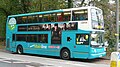 Alexander ALX400-bodied Volvo B7TL owned by Arriva Medway Towns.
 -
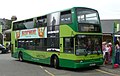
-
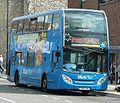 The unique Volvo B7TL/Alexander Dennis Enviro400 owned by Bluestar. All production Enviro / Volvo Buses are on the new B9TL chassis.
 -


See also
[edit]
 Media related to Volvo B7TL at Wikimedia Commons
References
[edit]- ^ "TWM orders Wrightbus deckers for Midlands, Dundee" (Press release). Ballymena: WrightGroup. 9 June 2004. Archived from the original on 11 March 2006. Retrieved 26 December 2021.
- ^ Morris, Stephen (April 2000). "Road Test: Is this the new Olympian?". Buses. No. 541. Hersham: Ian Allan Publishing. pp. 20–23. Retrieved 14 July 2024.
- ^ "Double-deckers go back on city streets". Belfast Telegraph. 26 March 2001. Retrieved 2 February 2023.
- ^ Stanczyk, Sarah (28 January 2003). "Translink Moves Public Transport into Top Gear" (Press release). Belfast: Translink. Archived from the original on 26 June 2003. Retrieved 2 February 2023.
- ^ "Translink orders 200 new buses for NI fleet". The Irish Times. 20 April 2005. Retrieved 2 February 2023.
- ^ Wharmby, Matthew (11 November 2021). The London Volvo B7TL. Pen and Sword Transport. p. 272. ISBN 978-1-52678-695-1. Retrieved 25 December 2021.
- ^ "The First President". Buses. No. 791. Stamford: Key Publishing. 21 January 2021. pp. 38–39. Retrieved 17 November 2021.
- ^ "Lothian switches to Volvo/Wrights". Bus & Coach Professional. 1 April 2005. Archived from the original on 24 March 2006. Retrieved 14 April 2022.
- ^ "Lothian orders Euro 3 and Euro 4". Bus & Coach Professional. 7 February 2006. Archived from the original on 24 March 2006. Retrieved 14 April 2022.
- ^ "Arriva hits the road with bus investment". The Northern Echo. Darlington. 27 May 1999. p. 10. ProQuest 328831312.
Arriva is investing a further £8m on 70 buses in the Yorkshire area of its operations, including 20 low-floor double deck ALX 400 buses, destined for the Leeds guided bus way project.
- ^ Day, James (12 September 2012). "Arriva's uniform bus and coach fleet". Coach & Bus Week. No. 1053. Peterborough. p. 58. Archived from the original on 23 December 2024. Retrieved 15 July 2022.
- ^ Rowlands, P. (3 September 2004). "Medway Medley". Bus & Coach Professional. No. 87. Retrieved 14 July 2022 – via TRID.
- ^ Brown, Stewart (24 March 2006). "Investing in Merseyside". Bus & Coach Professional. Archived from the original on 24 March 2006. Retrieved 14 July 2022.
- ^ Shipp, Peter (23 April 2001). "EYMS Group announces another big order for new buses" (Press release). Hull: EYMS Group. Archived from the original on 10 September 2001. Retrieved 26 December 2021.
- ^ "East Yorkshire upgrades with Wrightbus" (Press release). Ballymena: WrightGroup. 2 November 2005. Archived from the original on 11 March 2006. Retrieved 26 December 2021.
- ^ "Our Friends over the Irish Sea" (Press release). Blackburn: East Lancashire Coachbuilders. 2004. Archived from the original on 1 April 2004. Retrieved 26 December 2021.
- ^ "New double-deckers for Johannesburg". Bus & Coach Professional. January 2002. Archived from the original on 9 August 2002. Retrieved 7 December 2023.
Volvo B7TL
View on GrokipediaDevelopment
Background and Launch
The Volvo B7TL was launched in 1999 as a low-floor double-decker bus chassis, specifically developed to replace the two-axle variant of the earlier Volvo Olympian model in the UK market.[6] This introduction came amid intensifying competition for accessible urban transport solutions, with rivals such as the Dennis Trident 2 and DAF DB250 also targeting the growing demand for low-floor double-deckers to comply with emerging accessibility regulations like the UK's Disability Discrimination Act of 1995.[6][7] The chassis originated from designs by Leyland Bus engineers at the Leyland Technical Centre, later integrated into Volvo Bus operations, with initial production occurring at the Leyland plant in Irvine, Scotland.[1] This development responded to the urban transit sector's need for improved accessibility in high-density environments, where traditional stepped-entry buses were increasingly seen as inadequate for serving diverse passenger groups.[1][7] Positioned primarily for high-capacity city routes, the B7TL emphasized a fully low-floor design to facilitate easier boarding for wheelchair users, prams, and other mobility aids, aligning with broader European trends toward inclusive public transport.[6][4] The model debuted through early demonstration trials in the UK in 1999, marking Volvo's entry into the low-floor double-decker segment, before the two-axle version was succeeded by the Volvo B9TL in 2006.[8][4]Production History
The production of the Volvo B7TL commenced in 1999 at Volvo's manufacturing facility in Irvine, North Ayrshire, Scotland, marking the introduction of this low-floor double-decker chassis as a successor to the Volvo Olympian. Initial chassis assembly occurred at this site, with early examples often paired with bodywork from Walter Alexander Coachbuilders, including the popular ALX400 integral design. This Scottish production phase allowed for close collaboration with UK bodybuilders and operators, facilitating rapid market entry in the British Isles.[9] By 2000, Volvo shifted full chassis production to its primary bus manufacturing plant in Borås, Sweden, to streamline operations, leverage economies of scale, and integrate with the company's global supply chain.[10] This transition did not interrupt deliveries, as the move was gradual, but it centralized manufacturing for enhanced efficiency and quality control. The Borås facility became the hub for subsequent B7TL variants, supporting exports and diverse body integrations.[1] Overall, the B7TL was produced from 1999 to 2007, with a total output of approximately 3,163 units documented across chassis numbers 00001 to 03638, primarily serving the double-decker market. A key milestone came in mid-2004 with the launch of the MkII version, featuring refined engineering updates, though this did not prolong the model's lifecycle beyond existing orders. Production ceased in 2007, with final units completing commitments, particularly in the UK where over 2,000 B7TLs had been delivered by 2006 to major operators. By the end, the chassis had established a strong presence, with the majority bodied for British and Irish fleets.[11]Design and Specifications
Chassis Features
The Volvo B7TL chassis measures 10.1 to 10.7 meters in length, 2.55 meters in width, with bodied vehicles typically 4.2 meters in height, and a standard 2-axle wheelbase of 5.2 meters to support double-decker bodywork.[3][12][13] Its low-floor design facilitates accessibility, achieved through air suspension and a straight staircase configuration that minimizes entry steps.[3][14] The floor height at the front door is 320 mm, enabling wheelchair access and compliance with urban transit standards.[15] Door configurations include single-door or dual-door setups (front and rear), optimized for high-frequency urban operations with rapid passenger flow.[3] The suspension system features independent front suspension paired with air bellows at the rear for improved ride quality and stability under load.[12] Braking is provided by standard disc brakes equipped with anti-lock braking system (ABS) for enhanced safety in congested environments.[16] With a gross vehicle weight (GVW) of 18 tonnes, the chassis supports passenger capacities of 80 to 90 persons, varying by bodywork and seating layout.[17] The rear-mounted engine contributes to balanced weight distribution, aiding maneuverability in city settings.[3]Powertrain
The Volvo B7TL featured a rear-mounted, transversely installed Volvo D7C inline-6 diesel engine with a displacement of 7.3 liters, designed for efficient urban and intercity bus operations.[4] This engine delivered power outputs ranging from 215 to 250 hp (160 to 186 kW) at 2,200 rpm, with corresponding torque figures of 900 to 1,000 Nm, providing adequate low-end pull for heavy double-deck configurations.[4][18] The fuel system employed common-rail direct injection, enhancing fuel atomization and combustion efficiency while supporting the rear-engine layout for improved weight distribution and passenger space.[19] Transmission options included the ZF Ecomat 5HP502C 5-speed automatic or the 6HP502C 6-speed automatic for smoother shifting and better fuel economy in varied traffic conditions, alongside the Voith DIWA D864.3E 4-speed automatic, which was favored for its durability in high-mileage fleets.[4][20] Early models complied with Euro 3 emission standards, while later variants met Euro 4 requirements through updated engine tuning and exhaust aftertreatment, with no hybrid powertrain options produced.[4][21] In terms of performance, the B7TL achieved top speeds of 80 to 90 km/h, limited by gearing and regulatory factors for bus safety, and demonstrated urban fuel economy of 25 to 30 L/100 km under typical loaded service conditions.[22] This configuration integrated seamlessly with the chassis for reliable power delivery, contributing to the model's popularity in dense urban networks.[4]Bodywork and Variants
Primary Body Styles
The primary body styles for the Volvo B7TL chassis were low-floor double-decker designs from leading British bodybuilders, optimized for urban transit with full-length low floors, double-deck layouts typically featuring 2+2 seating on the upper level, and overall lengths aligning with the chassis at around 10.6–10.8 m to maximize passenger capacity while maintaining maneuverability.[3] These bodies emphasized accessibility, reliability, and integration with the B7TL's rear-mounted engine for smooth performance in city environments.[3] The Alexander ALX400, manufactured by Alexander Dennis, emerged as the most common bodywork for the B7TL from 1999 to 2006, renowned for its robust construction and versatility in seating configurations accommodating 70–80 passengers, such as the typical H47/31D layout for high-capacity routes.[3] Orders in 2005 highlighted its popularity, with examples providing 76 seated passengers plus space for 15 standees, underscoring its role in major fleet expansions.[3] The Plaxton President, an integral body produced from 2000 to 2005, featured distinctive curved windscreens for improved driver visibility and aerodynamics, paired with luxurious interiors including enhanced upholstery and climate control suited for express and interurban services.[12] Its design prioritized comfort for longer journeys, integrating seamlessly with the B7TL chassis to deliver a premium travel experience while maintaining the standard double-decker proportions.[12] Introduced in 2001 by Wrightbus, the Eclipse Gemini body adopted a streamlined, aerodynamic profile with integral LED destination displays in later iterations, focusing on low-emission compatibility through efficient paneling and modular elements that supported faster assembly and customization.[23] This design allowed for quick production adaptations to meet varying operator needs, contributing to its adoption on B7TL chassis until around 2006.[23] East Lancashire Coachbuilders offered the Vyking and Myllennium Vyking variants from 2001 to 2006, notable for their lightweight aluminum framing that reduced overall vehicle weight and improved fuel efficiency on the B7TL platform. The Myllennium Vyking, in particular, provided a modern aesthetic with curved lines and optional open-top configurations for sightseeing, while the Vyking emphasized structural integrity for demanding urban duties, both retaining the core low-floor and double-deck features.MkII Updates
The MkII variant of the Volvo B7TL was developed to comply with the impending Euro IV emission standards for heavy-duty engines, which applied to new engine types from October 2005 and all new registrations from 2006.[24] This revision incorporated the Volvo D7C engine, a 7.3-litre inline-six diesel unit compliant with Euro 4 norms, delivering 250 hp and 1,050 Nm of torque for enhanced performance and drivability. The updates also included improved electronics, such as multiplex wiring systems, facilitating easier diagnostics and maintenance through centralized control modules. Body adaptations in the MkII featured revised mounting points to support newer integral body designs, including trials with the Alexander Dennis Enviro400 double-decker bodywork introduced in 2005, allowing for better integration with low-emission urban fleet requirements.[25] Minor material adjustments contributed to slight weight reductions, improving overall efficiency without compromising structural integrity. These changes built on the original double-decker body styles like the Wright Eclipse Gemini and Alexander ALX400. Production of the MkII continued until 2007, after which Volvo transitioned to the B9TL chassis with its larger displacement engine. Performance refinements in the MkII included a standard torque output of 1,050 Nm across operating ranges, paired with enhanced noise insulation materials in the engine bay and cab for reduced cabin intrusion during urban operations.[4]Operators
United Kingdom
The Volvo B7TL saw significant adoption in the United Kingdom, where over 2,000 units were delivered between 2000 and 2006, primarily serving London and provincial urban networks.[5] This marked a substantial portion of the UK's low-floor double-decker market, with the chassis proving particularly suited to high-capacity city routes under privatized operations. The Go-Ahead Group operated the largest fleet, with nearly 800 units across its subsidiaries, including London General and London Central.[5] Key operators included Arriva London, which received substantial orders for its fleet, alongside FirstGroup subsidiaries such as First Leeds and First Manchester, and Stagecoach in Manchester.[5] Translink's Ulsterbus division also procured over 150 B7TLs, mainly for Northern Ireland services but with adaptations for cross-border operations.[26] A notable order came from London's post-2000 contracts for low-floor double-deckers, totaling more than 1,000 units across operators to meet Transport for London specifications.[5] Deliveries concluded with the final new units entering service with First Glasgow in April 2007, bodied by Wrightbus.[27] The B7TL remained in widespread use on urban routes throughout the UK until progressive withdrawals began in the late 2010s, with the last London examples retired by July 2021.[5] Post-retirement, many vehicles were preserved in heritage collections or exported for continued service abroad, reflecting their durability in demanding environments. Regional variations included Ulsterbus examples adapted for Irish border services, featuring distinctive corporate liveries such as the magenta and white scheme for cross-border reliability.[26] The Alexander ALX400 bodywork prevailed among UK operators for its compatibility with the chassis.[5]Ireland
Dublin Bus, Ireland's largest urban bus operator, acquired over 600 Volvo B7TL chassis between 2000 and 2007, all fitted with Alexander ALX400 double-decker bodies to replace its aging step-entrance fleet and establish a low-floor standard for improved passenger accessibility.[28][29] These vehicles, including batches of 100 units ordered in 2005 and 100 in 2006, were manufactured with chassis produced at Volvo Buses' plant in Ireland and bodies in Scotland, emphasizing right-hand drive configuration suited to Irish roads. The B7TLs became integral to high-frequency services such as routes 41 and 46, connecting central Dublin to suburbs like Swords Manor and Phoenix Park, supporting daily commuter demands in the capital.[30] Bus Éireann, the national bus company, introduced 25 B7TL units between 2002 and 2004, bodied with East Lancs Myllennium Vyking double-deckers for regional operations in Cork and Limerick. These buses, featuring the standard right-hand drive and low-floor design, focused on accessibility enhancements for rural-urban connections, such as Park & Ride services and intercity links.[31] By 2020, many Irish B7TLs had been withdrawn from mainline service amid fleet modernization, with examples from Dublin Bus transferred to private operators like Go-Ahead Ireland for school duties or exported to UK independents.[32][33] Surviving units continued in secondary roles as of 2025, underscoring the chassis's durability in Ireland's varied operational environments.[34]South Africa
In 2002, Johannesburg's Metrobus placed an order for 150 Volvo B7TL double-decker buses as part of a larger procurement of 200 city buses, with deliveries commencing that year through Volvo Bus South Africa Pty Ltd.[35] These vehicles were fitted with Marcopolo Viale double-decker bodywork, designed for high-capacity urban service and featuring low-floor access with air suspension for easier boarding. This order represented Volvo's initial major foray into supplying double-decker chassis for the African market, configured in right-hand drive to suit South African road conventions and adhering to local metric standards for components and signage.[36] The B7TL fleet was integrated into Metrobus operations, serving as a key component of Johannesburg's public transport network on busy inner-city and suburban routes. Following the launch of the Rea Vaya bus rapid transit (BRT) system in 2009, many of these buses were adapted for use within the BRT corridors, contributing to high-volume passenger flows along dedicated lanes and trunk lines. Their deployment helped address peak-hour demands in the metropolitan area, with the double-decker design enabling up to 80-90 passengers per vehicle in mixed traffic conditions. As of 2021, the B7TL units formed a significant portion of Metrobus's aging fleet, comprising around 150 double-deckers amid a total of over 500 buses, many exceeding 15 years in service. Approximately 111 remained operational as of 2024, supported by ongoing parts procurement and retrofits for emissions compliance.[37] In October 2025, Metrobus introduced 34 new Volvo buses to replace older units, leading to further B7TL withdrawals. A small number continue in secondary roles, such as training or peak relief, underscoring their durability in subtropical urban environments.[38]References
- https://commons.wikimedia.org/wiki/File:2003_Volvo_B7TL-Transbus_ALX400.jpg
- https://commons.wikimedia.org/wiki/File:2003_Volvo_B7TL-Transbus_ALX400_-_54699096267.jpg