Recent from talks
All channels
Be the first to start a discussion here.
Welcome to the community hub built to collect knowledge and have discussions related to Volvo B9R.
Nothing was collected or created yet.
Volvo B9R
View on Wikipediafrom Wikipedia
| Volvo B9R | |
|---|---|
| Overview | |
| Manufacturer | Volvo |
| Body and chassis | |
| Floor type | Step entrance |
| Powertrain | |
| Engine | Volvo D9A/D9B 9.0L rear-mounted I-6 |
| Transmission | 6-speed manual I-Shift automated |
| Dimensions | |
| Kerb weight | 19,000 kg (42,000 lb) maximum GVW |
The Volvo B9R is a rear-engined coach chassis built by Volvo. It can be built with bodies up to 13 m (42 ft 8 in) long and a maximum gross weight of 19,000 kg (42,000 lb).
The B9R is equipped with a rear-mounted Volvo 9.0-litre 6-cylinder diesel engine under the floor, producing 380 bhp (283 kW; 385 PS) and torque of 1,700 N⋅m (1,254 lb⋅ft).[1]
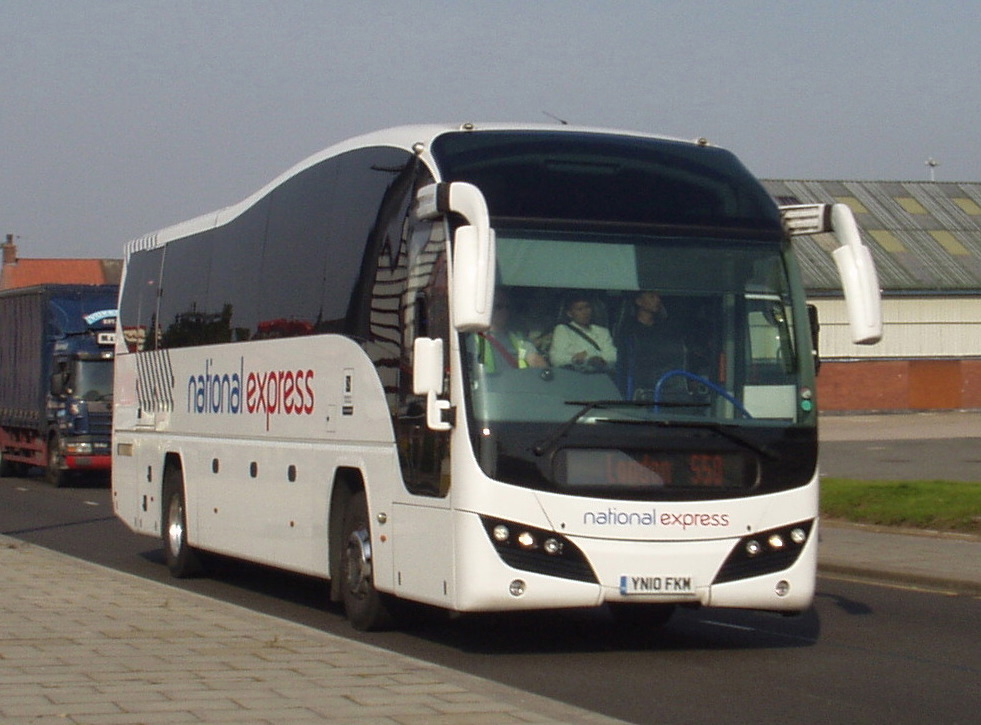
The Plaxton Panther is built on the B9R chassis and provides 53 seats.[2] The Sunsundegui bodywork provides a 55-seat arrangement.[3]
See also
[edit]References
[edit]- ^ "Volvo B9R Brochure" (PDF). Archived from the original (PDF) on 10 October 2015.
- ^ "Solus Coaches takes two Volvo B9R Panthers". Transport Engineer. 8 November 2011. Retrieved 4 November 2023.
- ^ "Straight out ontour for Volvo B9R at Cropley Coaches". 20 May 2011. Archived from the original on 2 May 2012.
External links
[edit]Volvo B9R
View on Grokipediafrom Grokipedia
Overview
Introduction
The Volvo B9R is a two-axle, rear-mounted engine chassis designed for luxury coaches and intercity buses, providing a platform for high-comfort passenger transport.[1] Manufactured by Volvo Buses, a division of the Volvo Group, the model entered production in 2006 as part of the company's coach chassis lineup.[1] Key capabilities of the B9R include support for coach bodies up to 13 meters in length and a maximum gross vehicle weight of 19,000 kg, with a step-entrance floor height optimized for elevated passenger seating.[2] It features a 9-liter diesel engine delivering 340 or 380 horsepower, enabling efficient performance for medium-distance routes.[2] Common integrations include bodies like the Plaxton Panther, which enhance its suitability for premium touring services. Initially export-oriented, the B9R targeted both emerging and developed markets, such as Mexico, Spain, Brazil, and India, where demand for reliable, mid-size coach solutions was growing.[1][6] Positioned as a mid-size alternative to the larger B11R (with 15-meter capability) and the smaller B7R, it balances capacity and maneuverability for diverse operator needs.[8]Design Philosophy
The Volvo B9R's design philosophy emphasizes balancing engine power with fuel efficiency, utilizing a 9-liter D9B diesel engine that delivers 340 or 380 horsepower while optimizing consumption for long-distance operations. This approach prioritizes mid-range torque—up to 1,700 Nm—to ensure smooth highway cruising without excessive fuel use, making it suitable for tourist and express coach services.[1] A core principle is the modular chassis design, which facilitates seamless integration with various coach bodies by body builders, allowing customization for different market needs. The rear-mounted engine layout further enhances this adaptability by maximizing interior passenger space and providing ample luggage capacity of 7-9 cubic meters, depending on the configuration.[1] Safety integration forms another foundational element, with standard features such as a reinforced chassis frame, electronic brake system (EBS), and disc brakes on all wheels to enhance stability and collision protection. These elements align with Volvo's overarching commitment to reliability in coach applications.[1][9] Accessibility is addressed through step-entrance configurations with wide doorways and evenly spaced treads, improving passenger boarding without reducing the necessary ride height for highway performance. The development goals included achieving Euro 4 emissions compliance as early as 2006 via selective catalytic reduction (SCR) technology, ensuring environmental standards while keeping costs viable for international operators.[1][10]Development and Production
Historical Background
The Volvo B9R coach chassis evolved from the B7R predecessor, which utilized a 7-liter engine, to address the rising demand for higher-power platforms in the burgeoning tourist and intercity coach sectors after 2000.[5] This shift responded to market needs for enhanced performance while retaining the lightweight versatility of the B7R design.[5] Conceptual work on the B9R commenced in the early 2000s, with prototype testing centered on achieving compliance with Euro 4 emissions requirements set to take effect in 2005 for new vehicle types.[1] The chassis incorporated a new 9-liter D9B engine to meet these standards, marking a significant upgrade from prior Euro 3-compliant models.[1] Global regulatory pressures, including the progression from Euro 3 to Euro 4 norms, shaped the B9R's development, alongside the requirement for a durable export-oriented chassis capable of supporting diverse body configurations in international markets.[1] This focus ensured the model could handle stricter environmental mandates while providing reliability for long-haul operations abroad.[1] Production of the B9R ceased around 2013, when it was succeeded by the Euro 6-compliant B8R chassis featuring smaller-displacement engines. Assembly of the B9R took place mainly at Volvo Buses' Curitiba facility in Brazil to serve Latin American demand, and at the Bangalore plant in India for regional Asian supply.[6][11] These sites were selected to optimize logistics and adapt production to local specifications.[11]Introduction and Market Launches
The Volvo B9R, a rear-engine coach chassis designed for intercity and tourist applications, made its European debut at the IAA Commercial Vehicle Show in Hannover on September 21, 2006, where it was showcased in collaboration with Spanish bodybuilder Sunsundegui as the B9R Elegance model.[1] Initial sales began shortly thereafter, with the chassis first offered in Mexico and a small number of units sold in Spain, featuring the Sideral 2000 body in lengths of 12.2 meters or 13 meters to accommodate up to 55 or 59 passengers, respectively.[1] This launch positioned the B9R as a lightweight, reliable option compliant with Euro 4 emissions standards, expanding Volvo's coach range into segments emphasizing fuel efficiency and passenger comfort.[1] In 2007, Volvo expanded the B9R's availability to South America, officially launching the chassis in Brazil on August 21, with production commencing at the company's Curitiba plant to meet regional demands for intercity and tourist services.[6] Tailored variants included a 9-liter D9B engine in 4x2 configuration, offering power outputs of 340 hp (1,600 Nm torque) or 380 hp (1,700 Nm torque), along with standard features like the EBS-5 electronic brake system, disc brakes, and ABS to enhance safety and efficiency on Brazilian highways.[6] These adaptations addressed local operator priorities for availability, low fuel consumption, and advanced electronics such as the BEA2 architecture and optional retarder.[6] The B9R entered the Indian market in October 2008 as the Volvo 9400 B9R multi-axle coach, launched at the Volvo Bus Technologies plant near Bangalore, marking India's first such vehicle and Volvo's strategic entry into the premium intercity segment with global-standard technology.[11] Measuring 13.7 meters long with capacity for 53 passengers, it featured a 9-liter Euro III engine producing 340 hp, a 6-speed ZF gearbox, and eight air bellows for improved ride quality, priced at approximately Rs. 85 lakh ex-factory.[11] Initial orders totaled 20 units, with six delivered to operators like Kesineni Travels and Neeta Travels; Volvo projected sales of 450 units for 2008—a 120% increase over prior years—and aimed to reach 1,000 units annually by 2010 through expanded production capacity.[11] Subsequent adoption occurred in other regions, including Australia where the B9R was distributed by CMV Truck & Bus for coach applications up to 12.6 meters in length.[12] In New Zealand, the B9TL double-decker variant used the same D9B engine as the B9R and was adapted for high-capacity city operations to comply with local regulations. European uptake remained limited beyond initial Spanish sales, with sporadic use in markets like the UK featuring Plaxton bodywork, though the model saw greater success in emerging economies.[1]Technical Specifications
Engine and Emissions
The Volvo B9R features a rear-mounted Volvo D9B inline-six diesel engine with a displacement of 9.4 liters.[13][1] The engine employs a turbocharged and intercooled design with electronically controlled common-rail direct injection, four valves per cylinder, and an overhead camshaft for efficient fuel delivery and combustion.[4] It delivers power outputs of 340 hp (253 kW) at 1,900 rpm or 380 hp (283 kW) at 1,900 rpm, paired with peak torque ratings of 1,632–1,700 Nm at 1,200 rpm or 1,740 Nm at 1,200 rpm, providing a broad torque curve typically spanning 1,000–1,400 rpm for strong low-end performance in highway and urban driving.[1][4] Emissions control is achieved primarily through selective catalytic reduction (SCR) with AdBlue urea injection, enabling compliance with Euro 4 standards upon the model's 2006 launch.[1][2] Later variants were upgradable to Euro 5 and Euro 6 levels via enhanced SCR systems and updated engine management, while Indian-market models met Bharat Stage IV (BS-IV) norms through similar adaptations, including a 40-liter AdBlue tank (expandable to 60 liters).[14][4] These technologies reduce nitrogen oxides (NOx) by up to 90% and particulate matter significantly compared to prior Euro 3 engines, contributing to lower overall environmental impact without compromising drivability.[2] Fuel efficiency for the B9R typically ranges from 3 to 4 km per liter under highway conditions, supported by the engine's optimized combustion and integration with automated transmissions for reduced consumption.[15] The standard fuel tank capacity is 300 liters, with options for dual 150-liter tanks or larger 400-liter setups to extend range for long-haul operations.[13][2] The engine's robust construction allows for extended maintenance intervals, including oil changes up to 40,000 km when using Volvo-approved VDS-3 synthetic oils, minimizing downtime and operational costs through features like maintenance-free universal joints and long-life wheel bearings.[2] The Volvo EMS2 electronic management system further aids reliability by monitoring key parameters such as coolant levels, oil pressure, and fuel quality during startup diagnostics.[4]Chassis and Suspension
The Volvo B9R features a ladder-frame steel chassis construction designed for durability and flexibility in coach body integration, utilizing high-strength steel sections to support loads while maintaining a lightweight profile. This two-axle (4x2) configuration incorporates a rear-engine overhung design, where the engine is mounted behind the rear axle to optimize weight distribution and passenger space. The chassis supports wheelbase options ranging from 4,800 mm to 6,900 mm, allowing for overall vehicle lengths up to 13 meters, with a kerb weight typically between 12,000 kg and 13,000 kg.[2][4][16] The gross vehicle weight (GVW) is rated at a maximum of 18,000 to 19,000 kg, depending on regional regulations and configuration, with axle load capacities of 7,500 kg on the front axle and 12,000 kg on the rear to ensure balanced handling under full load. Suspension is provided by air bellows on all axles, featuring Volvo's electronically controlled suspension (VES) system for automatic leveling and ride height adjustment, which enhances stability and comfort on varied road surfaces. Anti-roll bars are standard on both axles, complemented by double-acting hydraulic shock absorbers, contributing to improved ride quality and reduced body roll during cornering.[1][2] The braking system employs dual-circuit full-air brakes with electronic braking system (EBS) integration, including anti-lock braking system (ABS) for optimal control and safety. All wheels are equipped with disc brakes, providing consistent stopping power, while an optional Volvo retarder offers supplementary braking assistance to reduce wear on service brakes during prolonged descents. Safety features include rollover protection structures integrated into the chassis frame and electronic stability program (ESP) compatibility, which monitors and mitigates skidding or tipping risks.[9][4]Transmission Options
The Volvo B9R is equipped with transmission options consisting of a standard 6-speed manual gearbox supplied by ZF, or an optional 12-speed Volvo I-Shift automated manual transmission, which enhances driver comfort and operational efficiency without the availability of automatic torque converter variants.[1] The I-Shift system features advanced shifting logic tailored for bus applications, providing smooth gear changes and reduced driver fatigue during long-haul operations.[17] The drivetrain employs a rear-wheel drive configuration with the longitudinal engine placement at the rear, optimizing weight distribution and maneuverability for coach use, and includes an optional differential lock to improve traction on slippery or uneven surfaces by ensuring power distribution to both rear wheels.[18] Gear ratios, combined with available rear axle ratios of 2.85:1, 3.08:1, 3.36:1, or 3.70:1, are designed to support efficient cruising speeds between 80 and 100 km/h, with the vehicle's top speed electronically governed at 130 km/h for safety and regulatory compliance.[4] Key efficiency enhancements in the I-Shift include hill-start aid, which maintains brake pressure briefly after releasing the pedal to prevent rollback on inclines, and the eco-roll function, which disengages the driveline on downhill sections to allow momentum-driven travel, collectively achieving fuel savings of up to 5% in typical highway conditions.[19] These features contribute to lower operational costs while maintaining performance. In regional markets, the manual transmission remains standard in cost-sensitive areas such as India to prioritize affordability, whereas the I-Shift is more commonly specified in Europe and Brazil for its productivity benefits in demanding intercity routes.[6] The transmission integrates directly with the D9 engine via a robust coupling system, supported by dedicated cooling provisions to manage heat during prolonged high-load scenarios, ensuring reliable power delivery without compromising the engine's torque handling capabilities.[20]Body Configurations
Coach Body Integrations
The Volvo B9R chassis has been integrated with bodies from several prominent coach builders, enabling versatile applications in intercity and touring services. In the UK and Ireland, Plaxton has been a key partner, producing the Panther model on the B9R platform, which typically accommodates 53 seats in a 12.8-meter configuration designed for executive travel.[21] In Europe, Sunsundegui offers the Sideral 2000 body, supporting up to 55 passengers in a 12.2-meter layout with an emphasis on elegant design and passenger comfort.[1] VDL, through its Berkhof and Jonckheere divisions, has provided body options for the B9R in continental Europe, facilitating adaptations for regional tour operators.[5] In India, the B9R is commonly bodied as the Volvo 9400, a multi-axle coach tailored for long-distance routes with local manufacturing integrations.[22] Integration features of the B9R chassis support seamless body installations, including pre-wired harnesses for HVAC systems, interior lighting, and audiovisual entertainment to simplify assembly and ensure reliability.[23] Standardized mounting points on the chassis allow for both low-entry and high-floor body designs, accommodating accessibility needs or elevated seating preferences in coach applications.[5] These elements, combined with Volvo's body builder manuals, enable efficient customization while maintaining structural integrity and safety standards.[23] Seating layouts on the B9R typically range from 45 to 55 seats in 12- to 13-meter configurations, balancing capacity with space for aisles and amenities.[1] Luxury variants often incorporate reclining seats with adjustable headrests and footrests, alongside options for onboard toilets positioned at the center for convenience during extended journeys.[5] Customization extends to modular body panels that adapt to regional preferences, such as enhanced air-conditioning systems for tropical climates to ensure passenger comfort in high-humidity environments.[24] These panels allow for aesthetic variations, including localized graphics or materials, without compromising the chassis's core performance. Notable examples include Solus Coaches in the UK, which deployed Volvo B9R chassis with Plaxton Panther bodies for versatile executive services.[25] Similarly, Cropley Coaches utilized B9R integrations with Sunsundegui Sideral bodies for European tour operations, featuring 55-seat layouts and demountable toilets to support flexible itineraries.[26]Dimensional Variants
The Volvo B9R chassis is offered in multiple length configurations to accommodate diverse coach body requirements, with the standard variant measuring 12.2 meters overall and extended options up to 13 meters, including three-axle tag axle models in select markets.[1][2] These lengths enable adaptations for intercity and regional routes, balancing maneuverability with passenger space. Corresponding wheelbase variants range from 6,200 mm for standard coaches to 6,900 mm for extended bodies to optimize overhang distribution and stability.[4] In coach configurations, these support passenger capacities of 45 to 59 seats, with underfloor luggage compartments providing 7 to 10 cubic meters of storage for baggage and equipment.[27][1] Weight configurations are tailored to operational demands, with an 18-tonne gross vehicle weight rating suited for lighter urban routes and a 19-tonne option for heavier intercity loads; the chassis has also been adapted as the B9TL double-deck variant for high-capacity service in New Zealand.[2] The design maintains a kerb-to-kerb turning radius of 12 to 13 meters and 270 mm ground clearance, ensuring accessibility in varied environments.[13][28] Fuel tank options range from 300 to 400 liters, scalable based on route length and refueling infrastructure to support extended operations without compromising the chassis's weight efficiency.[2]| Variant | Length (m) | Wheelbase (mm) | GVW (tonnes) | Luggage (m³) |
|---|---|---|---|---|
| Standard | 12.2 | ~6,200 | 18 | 7-10 |
| Extended | 13 | ~6,900 | 19 | 7-10 |
