


Community hub
Recent from talks
Contribute something
Nothing was collected or created yet.
Vortex lattice method
View on Wikipedia
The Vortex lattice method, (VLM), is a numerical method used in computational fluid dynamics, mainly in the early stages of aircraft design and in aerodynamic education at university level. The VLM models the lifting surfaces, such as a wing, of an aircraft as an infinitely thin sheet of discrete vortices to compute lift and induced drag. The influence of the thickness and viscosity is neglected.
VLMs can compute the flow around a wing with rudimentary geometrical definition. For a rectangular wing it is enough to know the span and chord. On the other side of the spectrum, they can describe the flow around a fairly complex aircraft geometry (with multiple lifting surfaces with taper, kinks, twist, camber, trailing edge control surfaces and many other geometric features).
By simulating the flow field, one can extract the pressure distribution or as in the case of the VLM, the force distribution, around the simulated body. This knowledge is then used to compute the aerodynamic coefficients and their derivatives that are important for assessing the aircraft's handling qualities in the conceptual design phase. With an initial estimate of the pressure distribution on the wing, the structural designers can start designing the load-bearing parts of the wings, fin and tailplane and other lifting surfaces. Additionally, while the VLM cannot compute the viscous drag, the induced drag stemming from the production of lift can be estimated. Hence as the drag must be balanced with the thrust in the cruise configuration, the propulsion group can also get important data from the VLM simulation.
Historical background
[edit]John DeYoung provides a background history of the VLM in the NASA Langley workshop documentation SP-405.[1]
The VLM is the extension of Prandtl's lifting-line theory,[2] where the wing of an aircraft is modeled as an infinite number of Horseshoe vortices. The name was coined by V.M. Falkner in his Aeronautical Research Council paper of 1946.[3] The method has since then been developed and refined further by W.P. Jones, H. Schlichting, G.N. Ward and others.
Although the computations needed can be carried out by hand, the VLM benefited from the advent of computers for the large amounts of computations that are required.
Instead of only one horseshoe vortex per wing, as in the Lifting-line theory, the VLM utilizes a lattice of horseshoe vortices, as described by Falkner in his first paper on this subject in 1943.[4] The number of vortices used vary with the required pressure distribution resolution, and with required accuracy in the computed aerodynamic coefficients. A typical number of vortices would be around 100 for an entire aircraft wing; an Aeronautical Research Council report by Falkner published in 1949 mentions the use of an "84-vortex lattice before the standardisation of the 126-lattice" (p. 4).[5]
The method is comprehensibly described in all major aerodynamic textbooks, such as Katz & Plotkin,[6] Anderson,[7] Bertin & Smith[8] Houghton & Carpenter[9] or Drela,[10]
Theory
[edit]The vortex lattice method is built on the theory of ideal flow, also known as Potential flow. Ideal flow is a simplification of the real flow experienced in nature, however for many engineering applications this simplified representation has all of the properties that are important from the engineering point of view. This method neglects all viscous effects. Turbulence, dissipation and boundary layers are not resolved at all. However, lift induced drag can be assessed and, taking special care, some stall phenomena can be modelled.
Assumptions
[edit]The following assumptions are made regarding the problem in the vortex lattice method:
- The flow field is incompressible, inviscid and irrotational. However, small-disturbance subsonic compressible flow can be modeled if the general 3D Prandtl-Glauert transformation is incorporated into the method.
- The lifting surfaces are thin. The influence of thickness on aerodynamic forces are neglected.
- The angle of attack and the angle of sideslip are both small, small angle approximation.
Method
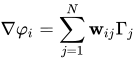
[edit]By the above assumptions the flowfield is Conservative vector field, which means that there exists a perturbation velocity potential such that the total velocity vector is given by


and that satisfies Laplace's equation.
Laplace's equation is a second order linear equation, and being so it is subject to the principle of superposition. Which means that if and are two solutions of the linear differential equation, then the linear combination is also a solution for any values of the constants and . As Anderson[7] put it "A complicated flow pattern for an irrotational, incompressible flow can be synthesized by adding together a number of elementary flows, which are also irrotational and incompressible.”. Such elementary flows are the point source or sink, the doublet and the vortex line, each being a solution of Laplace's equation. These may be superposed in many ways to create the formation of line sources, vortex sheets and so on. In the Vortex Lattice method, each such elementary flow is the velocity field of a horseshoe vortex with some strength .


Aircraft model
[edit]All the lifting surfaces of an aircraft are divided into some number of quadrilateral panels, and a horseshoe vortex and a collocation point (or control point) are placed on each panel. The transverse segment of the vortex is at the 1/4 chord position of the panel, while the collocation point is at the 3/4 chord position. The vortex strength is to be determined. A normal vector is also placed at each collocation point, set normal to the camber surface of the actual lifting surface.

For a problem with panels, the perturbation velocity at collocation point is given by summing the contributions of all the horseshoe vortices in terms of an Aerodynamic Influence Coefficient (AIC) matrix .


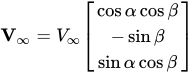
The freestream velocity vector is given in terms of the freestream speed and the angles of attack and sideslip, .


A Neumann boundary condition is applied at each collocation point, which prescribes that the normal velocity across the camber surface is zero. Alternate implementations may also use the Dirichlet boundary condition directly on the velocity potential.
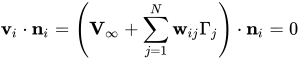
This is also known as the flow tangency condition. By evaluating the dot products above the following system of equations results. The new normalwash AIC matrix is , and the right hand side is formed by the freestream speed and the two aerodynamic angles

![{\displaystyle b_{i}=V_{\infty }[-\cos \alpha \cos \beta ,\sin \beta ,-\sin \alpha \cos \beta ]\cdot \mathbf {n} _{i}}](https://wikimedia.org/api/rest_v1/media/math/render/svg/58508b9e9844c958588a385dbc19b8d664946b24)
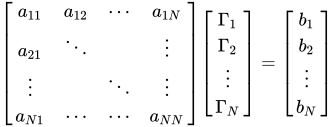
This system of equations is solved for all the vortex strengths . The total force vector and total moment vector about the origin are then computed by summing the contributions of all the forces on all the individual horseshoe vortices, with being the fluid density.




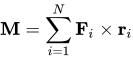
Here, is the vortex's transverse segment vector, and is the perturbation velocity at this segment's center location (not at the collocation point).


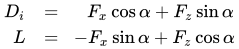
The lift and induced drag are obtained from the components of the total force vector . For the case of zero sideslip these are given by

Extension to the Dynamic Case
[edit]The preliminary design of airplanes requires unsteady aerodynamic models, usually written in the frequency domain for aeroelastic analyses. Commonly used is the Doublet Lattice Method, where the wing system is subdivided into panels. Each panel has a line of doublets of acceleration potential in the first-quarter line, similarly of what is usually done in the Vortex Lattice Method. Each panel has a load point where the lifting force is assumed applied and a control point where the aeroelastic boundary condition is enforced. The Doublet Lattice Method evaluated at frequency zero is usually obtained with a Vortex Lattice formulation
References
[edit]- ^ NASA, Vortex-lattice utilization. NASA SP-405, NASA-Langley, Washington, 1976.
- ^ Prandtl. L, Applications of modern hydrodynamics to aeronautics, NACA-TR-116, NASA, 1923.
- ^ Falkner. V.M., The Accuracy of Calculations Based on Vortex Lattice Theory, Rep. No. 9621, British A.R.C., 1946.
- ^ Falkner. V.M., The Calculations of Aerodynamic Loading on Surfaces of any Shape, R&M 1910, British A.R.C., 1943.
- ^ Falkner. V.M., A Comparison of Two Methods of Calculating Wing Loading with Allowance for Compressibility, R&M 2685, British A.R.C., 1949.
- ^ J. Katz, A. Plotkin, Low-Speed Aerodynamics, 2nd ed., Cambridge University Press, Cambridge, 2001.
- ^ a b J.D. Anderson Jr, Fundamentals of aerodynamics, 2nd ed., McGraw-Hill Inc, 1991.
- ^ J.J. Bertin, M.L. Smith, Aerodynamics for Engineers, 3rd ed., Prentice Hall, New Jersey, 1998.
- ^ E.L. Houghton, P.W. Carpenter, Aerodynamics for Engineering Students, 4th ed., Edward Arnold, London, 1993.
- ^ M. Drela, Flight Vehicle Aerodynamics, MIT Press, Cambridge, MA, 2014.
External links
[edit]Sources
[edit]- NASA, Vortex-lattice utilization. NASA SP-405, NASA-Langley, Washington, 1976.
- Prandtl. L, Applications of modern hydrodynamics to aeronautics, NACA-TR-116, NASA, 1923.
- Falkner. V.M., The Accuracy of Calculations Based on Vortex Lattice Theory, Rep. No. 9621, British A.R.C., 1946.
- J. Katz, A. Plotkin, Low-Speed Aerodynamics, 2nd ed., Cambridge University Press, Cambridge, 2001.
- J.D. Anderson Jr, Fundamentals of aerodynamics, 2nd ed., McGraw-Hill Inc, 1991.
- J.J. Bertin, M.L. Smith, Aerodynamics for Engineers, 3rd ed., Prentice Hall, New Jersey, 1998.
- E.L. Houghton, P.W. Carpenter, Aerodynamics for Engineering Students, 4th ed., Edward Arnold, London, 1993.
- Lamar, J. E., Herbert, H. E., Production version of the extended NASA-Langley vortex lattice FORTRAN computer program. Volume 1: User's guide, NASA-TM-83303, NASA, 1982
- Lamar, J. E., Herbert, H. E., Production version of the extended NASA-Langley vortex lattice FORTRAN computer program. Volume 2: Source code, NASA-TM-83304, NASA, 1982
- Melin, Thomas, A Vortex Lattice MATLAB Implementation for Linear Aerodynamic Wing Applications, Royal Institute of Technology (KTH), Sweden, December, 2000
- M. Drela, Flight Vehicle Aerodynamics, MIT Press, Cambridge, MA, 2014.
Vortex lattice method
View on GrokipediaIntroduction
Overview
The vortex lattice method (VLM) is a numerical approach within potential flow theory used to predict aerodynamic forces and moments on lifting surfaces, such as wings and control surfaces, by discretizing the geometry into a lattice of discrete vortex elements.[2] These elements, typically modeled as horseshoe or ring vortices, represent the bound vorticity on the surface and the trailing wake, allowing for the computation of pressure distributions and resultant loads.[5] VLM approximates inviscid, incompressible flow fields by applying the Biot-Savart law to determine the velocity induced by each vortex filament at specified control points, enforcing boundary conditions like no normal flow through the surface.[2] Developed in the mid-20th century, VLM emerged as a computational extension of earlier analytical techniques, serving as an intermediary between Prandtl's lifting-line theory from the early 1900s and the more comprehensive simulations of full computational fluid dynamics (CFD) that became feasible later.[2] Pioneering formulations appeared in the 1940s and gained traction in the 1960s with digital computing advancements, enabling practical solutions for complex three-dimensional configurations.[2] In preliminary aircraft design, VLM is primarily employed to estimate key aerodynamic parameters, including lift curves, induced drag polar, and stability derivatives, providing rapid insights for configuration optimization without the high computational cost of viscous flow solvers.[6] This method supports evaluations of planar and non-planar lifting systems, such as wings with high-lift devices, aiding in the assessment of performance trade-offs during conceptual phases.[5]Applications
The vortex lattice method (VLM) is widely employed in aircraft design for optimizing wing configurations, particularly in determining planform shapes and twist distributions to minimize induced drag. By modeling the wing as a lattice of discrete vortices, VLM enables rapid prediction of lift and drag distributions, allowing engineers to iterate on designs efficiently during preliminary phases. For instance, applications include adjusting wing twist to achieve elliptical lift loading, which theoretically reduces induced drag by up to 15-20% compared to unoptimized rectangular wings, as demonstrated in early NASA implementations for transonic aircraft.[2][7] In rotorcraft, such as helicopter blades, VLM is applied to predict unsteady aerodynamic loads and blade-vortex interactions, providing insights into airloading and performance under dynamic conditions. The method simulates the wake as trailing vortex sheets, facilitating analysis of hover and forward flight efficiency. For wind turbine design, VLM aids in forecasting blade loading and power output by resolving three-dimensional flow effects on rotor blades, including tip losses and wake interactions, which is crucial for optimizing swept or twisted blade geometries in offshore installations.[8][9][10] VLM plays a key role in the preliminary sizing of unmanned aerial vehicles (UAVs) and sailplanes, where its computational speed supports quick iterations on configurations before resorting to more resource-intensive computational fluid dynamics (CFD) simulations. For UAVs, it estimates aerodynamic coefficients for various mission profiles, enabling trade studies on wing area and aspect ratio to meet endurance requirements. In sailplane design, VLM helps evaluate high-lift-to-drag ratios for thermal soaring, often integrated into tools that model low-Reynolds-number flows typical of gliders.[7][11][12] VLM is frequently integrated with panel methods for comprehensive full-aircraft analysis, where it supplies lift distribution data essential for stability and control assessments, such as computing aerodynamic derivatives for flight dynamics models. This combination extends VLM's inviscid flow approximation to include non-lifting surfaces, improving predictions of overall vehicle trim and handling qualities without excessive computational cost.[13][14] Notable examples include NASA's application of VLM variants in the early aerodynamic design of the space shuttle orbiter, where it informed wing-body interference effects and stability margins during subsonic re-entry phases. In modern contexts, open-source tools like XFLR5 leverage VLM for hobbyist glider analysis, allowing users to optimize radio-controlled models for enhanced performance in low-speed flight.[2][15][16]Historical Development
Origins
The vortex lattice method (VLM) traces its conceptual roots to foundational principles in fluid dynamics established in the mid-19th century. Hermann von Helmholtz's 1858 theorems on vortex motion provided key precursors by demonstrating that vortex lines in an inviscid fluid remain connected and move with the fluid, laying the groundwork for modeling circulation in aerodynamic flows.[1] These ideas were later extended to lifting surfaces through Ludwig Prandtl's lifting-line theory in 1918, which idealized a finite wing as a bound vortex filament along the span with trailing vortices to account for induced drag and downwash effects.[17] Prandtl's approach marked a shift from two-dimensional airfoil theory to three-dimensional wing analysis, influencing subsequent discrete vortex representations.[1] The method was formalized as "Vortex-Lattice Theory" by V.M. Falkner in 1943, who applied horseshoe vortices to predict surface loadings on wings.[17] During World War II, advancements accelerated due to demands for propeller and wing performance predictions, with researchers at NACA (predecessor to NASA) exploring vortex lattices for finite wings; a key milestone was Robert T. Jones's 1940s contributions at NACA, where he applied vortex lattice concepts to compute lift distributions and aerodynamic derivatives for arbitrary planforms.[17] These efforts emphasized horseshoe vortex arrangements to simulate bound and trailing vorticity on wing surfaces.[1] Post-war developments refined these models for complex geometries, notably Helmut Multhopp's 1950 method for swept wings, which employed a vortex lattice with the 1/4-chord control point rule to predict lift and pressure distributions under subsonic conditions.[2] This approach extended Prandtl's theory to non-planar and swept configurations, proving effective for early aircraft design during the jet age.[1] By the 1960s, the advent of digital computers facilitated the transition from analytical solutions to numerical implementations, enabling iterative solving of vortex influence coefficients for practical engineering applications while preserving the inviscid, potential flow assumptions of earlier theories.[17]Key Advancements
In the 1970s, the vortex lattice method advanced through the creation of robust computational codes that combined it with panel methods for more comprehensive aircraft modeling. A key contribution was the Vortex-Lattice FORTRAN program developed by Margason and Lamar, which computed subsonic aerodynamic characteristics of complex planforms by discretizing wings into horseshoe vortex lattices.[18] Building on this foundation, Maskew's VSAERO code integrated vortex lattices for lifting surfaces with source panels for non-lifting components like fuselages, enabling nonlinear aerodynamic predictions for arbitrary subsonic configurations and marking a shift toward full-aircraft analysis.[19] During the 1980s and 1990s, VLM saw broader integration into computer-aided design environments, supporting rapid iterative prototyping in early aircraft design phases by automating aerodynamic evaluations within CAD workflows. Concurrently, extensions to rotary-wing applications emerged, with Yeo's research applying unsteady vortex lattice formulations to helicopter rotors, capturing blade-vortex interactions and performance metrics to inform rotorcraft optimization.[20] The 2000s brought open-source VLM implementations that enhanced accessibility for research and education. Tornado, a MATLAB-based tool developed by Melin at KTH Royal Institute of Technology, streamlined vortex lattice simulations for conceptual aircraft design, emphasizing user-friendly geometry definition and stability analysis. Complementing this, MIT's Athena Vortex Lattice (AVL) code by Drela extended the method to flight-dynamics modeling of rigid aircraft, incorporating unsteady effects and stability derivatives for configurations with multiple lifting surfaces.[21] Post-2010 developments have focused on computational efficiency and hybrid approaches. Coupling VLM with machine learning has enabled faster surrogate models for aerodynamic optimization, as in physics-infused neural networks predicting VTOL performance while preserving potential flow assumptions.[22] GPU acceleration has further scaled VLM for large lattices, with implementations leveraging fast multipole methods to reduce solution times for unsteady simulations by orders of magnitude.[23] These advancements have shaped regulatory practices, with FAA and EASA guidelines endorsing VLM-based tools for low-speed certification tasks, such as preliminary stability assessments in unmanned aircraft systems.[24]Theoretical Foundations
Core Assumptions
The vortex lattice method (VLM) relies on several fundamental assumptions derived from potential flow theory to simplify the analysis of aerodynamic forces on lifting surfaces. These assumptions enable the discretization of the flow field into vortex elements while maintaining computational efficiency, but they impose limitations on the method's applicability.[2][1] A primary assumption is that the flow is inviscid, meaning viscosity and its associated effects, such as boundary layers and flow separation due to friction, are neglected. This is justified for flows at high Reynolds numbers where viscous effects are confined to thin layers near the surface, allowing the bulk flow to be approximated as potential flow governed by Laplace's equation. However, this omission can lead to inaccuracies in predicting drag components influenced by viscosity or in low-Reynolds-number regimes.[2][1][25] The method further assumes incompressible flow, with constant fluid density throughout the domain. This holds well for subsonic speeds below approximately Mach 0.3, where density variations are minimal, simplifying the governing equations to the incompressible form of the potential flow equations. At higher Mach numbers, compressibility effects become significant, requiring extensions beyond the basic VLM framework.[2][1][25] Another key assumption is the small perturbation approximation, which linearizes the potential flow equations around a uniform freestream by assuming small disturbances, such as low angles of attack (typically α << 1 radian) and small camber or thickness relative to the chord. This allows the use of linear boundary conditions and superposition of elementary solutions, making the problem tractable but restricting accuracy for high-angle-of-attack flows where nonlinear effects dominate.[2][1][25] The slender body approximation posits that geometric variations along the body are gradual, enabling the representation of lifting surfaces as thin vortex sheets without significant thickness contributions to lift. This is valid for elongated configurations like wings with high aspect ratios, where spanwise loading can be effectively modeled, but it breaks down for blunt or highly three-dimensional bodies.[2][1] Finally, the irrotational wake assumption models the trailing wake as a free vortex sheet that is irrotational except along its discrete vortex filaments, enforcing the Kutta condition at the trailing edge to ensure finite velocities. The wake is typically aligned with the freestream and convected downstream without strength decay, which accurately captures induced effects in attached flows but may not represent rolled-up or curved wakes in more complex scenarios.[2][1][25]Mathematical Basis
The vortex lattice method (VLM) is founded on the principles of inviscid, incompressible, and irrotational flow, where the velocity field is expressed as the gradient of a scalar velocity potential , such that . This potential satisfies Laplace's equation throughout the flow field exterior to the body, ensuring the flow remains divergence-free and curl-free away from singularities.[1] To model the lifting surfaces, the flow is represented using a distribution of vortex filaments, whose induced velocities are computed via the Biot-Savart law. The velocity at a point due to an infinitesimal vortex filament segment of strength is given by where is the vector from the filament element to the evaluation point, and . In VLM, this is integrated along bound vortex elements on the wing and trailing vortex sheets in the wake to obtain the total induced velocity field.[1] The core boundary condition enforces impermeability on the wing surface, requiring the normal component of the total velocity (freestream plus induced) to match the local surface slope. For a thin wing in linearized theory, this condition at a collocation point on the mean camberline is where is the induced normal velocity, is the freestream speed, is the camber function, and is the angle of attack. Discretizing the wing into panels replaces the continuous vortex distribution with discrete horseshoe vortices of unknown strengths , leading to a system of linear equations where is the influence coefficient representing the normal velocity at control point induced by a unit-strength vortex on element , computed by integrating the Biot-Savart law over the horseshoe geometry.[26] Once the vortex strengths are solved from the system , where incorporates the freestream and geometric contributions, aerodynamic forces are obtained using the Kutta-Joukowski theorem. The lift per unit span on a bound vortex segment is , with the total force on each element given by , integrated over the lattice to yield sectional and overall loads.[27]Numerical Implementation
Discretization Process
In the vortex lattice method (VLM), the discretization process begins by approximating continuous lifting surfaces, such as wings, with a finite number of discrete elements to model the vorticity distribution. The surface is divided into a lattice of panels, where each panel is represented by a horseshoe vortex filament consisting of a bound vortex segment spanning the panel and two trailing vortex segments extending into the wake. This horseshoe configuration satisfies the Kutta condition at the trailing edge and allows the method to capture the essential aerodynamic behavior of inviscid, incompressible flow over thin surfaces.[2] The bound vortex of each horseshoe is typically placed along the quarter-chord line of the panel to represent the circulation on the lifting surface, while the trailing vortices emanate from the endpoints of the bound segment and convect downstream, forming a wake sheet that models the induced downwash. Panels are commonly flat quadrilateral elements for planar or mildly cambered wings, though triangular panels may be used for more complex geometries to better fit irregular shapes. Collocation points, where the no-penetration boundary condition is enforced, are located at the three-quarter-chord position of each panel, often using a cosine distribution for improved resolution near the leading edge.[2][28] Lattice density is determined by the number of panels arranged chordwise and spanwise, striking a balance between computational efficiency and accuracy; for instance, a typical wing might employ 20 chordwise by 10 spanwise panels, though finer grids such as 16x16 have been used for delta wings to achieve convergence within 5% of experimental lift coefficients. Coarser lattices, like 4 chordwise by 10 spanwise, suffice for preliminary designs of multi-element configurations. The choice depends on the wing's aspect ratio and sweep, with denser spacing near tips or roots to resolve tip vortices.[2][29] The wake, formed by the trailing vortex sheet, is aligned either parallel to the freestream or with the local flow direction at the trailing edge to promote numerical stability and convergence; in advanced implementations, the sheet may be rolled up iteratively to account for vortex interactions, reducing the effective span of the wake and improving predictions of induced drag by up to 10% compared to unrolled models. This alignment ensures that the wake vorticity convects without crossing the surface, maintaining physical realism.[2][28] Geometry input for discretization often starts with parametric representations such as Non-Uniform Rational B-Splines (NURBS) or cubic splines defining the surface contours, which are then converted into planar facets or panels by interpolating section profiles and subdividing based on specified lattice density. This faceting process accommodates twisted, cambered, or swept surfaces while preserving the overall planform accuracy essential for load distribution calculations.[2][30]Solution Procedure
The solution procedure in the vortex lattice method (VLM) commences with the assembly of the aerodynamic influence matrix , a square matrix whose elements quantify the normal velocity induced at control point by a unit-strength horseshoe vortex filament associated with panel .[31] This matrix is constructed by summing the contributions from the Biot-Savart law applied to each segment of the bound vortex (along the quarter-chord line) and the trailing wake vortices for all panels, ensuring the no-penetration boundary condition is enforced across the discretized lifting surface.[1] The computation accounts for the geometric positions of control points, typically located at the three-quarter-chord midpoint of each panel, relative to the vortex segments.[31] The right-hand side vector is then defined to incorporate the freestream conditions and surface geometry effects. Its components represent the negative of the normal component of the freestream velocity at control point , modified by the local angle of attack and the slope of the mean camber line , yielding for a planar approximation.[1] This vector enforces the flow tangency condition, balancing the induced velocities against the imposed freestream and camber influences. With the system formulated as , where is the vector of unknown vortex strengths, the equations are solved for . For systems with fewer than a few hundred panels, direct methods such as Gaussian elimination provide exact solutions, while larger configurations employ iterative techniques like the Generalized Minimal Residual (GMRES) method to handle the dense matrix efficiently and achieve convergence.[31] The wake geometry, modeled as trailing vortex sheets, is iteratively relaxed in some implementations to satisfy the Kutta condition at trailing edges.[1] Post-processing derives the physical quantities from the solved . The circulation distribution is obtained by interpolating across panels, enabling integration to compute sectional and total lift via the Kutta-Joukowski theorem. Pressure differences are calculated using the steady Bernoulli equation applied across the surface, given by , where is the fluid density, the freestream speed, the circulation jump, and the local chord length; this yields the pressure coefficient .[31] Forces and moments follow from integrating these pressures over the surface area. Solution accuracy is verified through convergence criteria, such as residual norms , combined with grid refinement studies that progressively increase panel density to confirm grid-independent results.[32]Modeling Complex Geometries
Lifting Surfaces
In the vortex lattice method (VLM), lifting surfaces such as wings are modeled by projecting the planform onto a lattice of discrete horseshoe vortices, which capture the bound vorticity along the surface and trailing vorticity in the wake. This approach accommodates geometric features like dihedral and sweep by aligning the bound vortex segments with the local quarter-chord line of each panel, allowing for non-planar configurations where the dihedral angle influences the spanwise load distribution and induced velocities. For instance, dihedral modifies the effective angle of attack across the span, while sweep affects the outboard loading, with aft sweep typically increasing the spanwise lift variation compared to unswept wings.[1][2] Camber effects on lifting surfaces are incorporated in VLM either through adjustments to the vortex strengths that mimic the mean camber line or by using source doublets superimposed on the vortex lattice to represent thickness and camber without altering the primary lifting mechanism. In practice, for cambered airfoils like the NACA 230 series integrated into a wing planform, the method optimizes local surface elevations to minimize induced drag while satisfying the boundary condition on the mean surface. This enables accurate prediction of lift increments due to camber, particularly for rectangular or tapered wings with aspect ratios around 5.[1][2] The Kutta condition at the trailing edge is automatically enforced in VLM through the continuous shedding of vorticity into the wake, modeled as a free vortex sheet aligned with the local flow direction, which ensures smooth flow departure and eliminates finite trailing-edge forces. This wake relaxation process iteratively adjusts the trailing vortex positions to maintain zero net force on the wake segments, providing a natural resolution for the singularity at sharp edges.[1][2] For multi-wing configurations, VLM treats interference between surfaces like wings, tails, and canards by embedding all lifting elements into a single global lattice, where the induced velocities from one surface's wake affect the boundary conditions on others. This captures downwash effects, such as a forward canard inducing downwash that reduces lift on the main wing depending on spacing, or tail interference altering stability derivatives in wing-tail setups. The method requires careful alignment of vortex filaments to avoid singularities at control points.[1][2] Rotor blades and propellers are analyzed in VLM using a quasi-steady approximation, where the rotating blades are discretized into vortex lattices and advanced azimuthally in discrete steps (e.g., 5° increments per time step) to simulate the cyclic loading over one revolution. This azimuthal stepping updates the wake geometry to account for blade passage, enabling prediction of thrust and torque variations with advance ratio, particularly for propellers at angles of attack up to 40°.[33] Validation of VLM for lifting surfaces often involves comparison to experimental lift curve slope (C_L-α) data, demonstrating good agreement within 5% for low-speed flows. Similar accuracy is observed for swept wings like the F-15 configuration, where the neutral point is captured within 1% of measured values.[1]Non-Lifting Components
Non-lifting components, such as fuselages and nacelles, are incorporated into the vortex lattice method (VLM) through source distributions that enforce the impermeability boundary condition on body surfaces without generating lift. These sources model the volume displacement and blockage effects of the bodies, allowing the potential flow to satisfy the no-penetration requirement. In hybrid approaches combining VLM with source panel methods, sources are distributed over the surfaces of non-lifting bodies, typically using quadrilateral panels or lattices to represent the geometry accurately. This integration augments the vortex lattice on lifting surfaces, enabling the analysis of mutual aerodynamic influences in a unified potential flow framework.[2] For fuselages, slender body theory provides an efficient approximation by representing the body as a line source along its axis, which captures axial interference and volume-induced perturbations on the surrounding flow. The line source strength is determined to match the body's cross-sectional area variation, adding interference velocities to the VLM solution for wings. This VLM-slender body theory (VLM-SBT) hybrid is particularly suited for elongated bodies where higher-fidelity paneling would increase computational cost excessively, while still accounting for key effects like upwash modifications at the wing root. More detailed modeling employs distributed source panels or cylindrical grids conforming to the fuselage shape, using cosine spacing for radial and axial discretizations to improve resolution near junctions.[2] Nacelles and pylons are modeled using cylindrical source distributions or ring sources to represent their blockage and streamline curvature effects on the external flow. These sources are placed along the nacelle axis or as annular rings to simulate the volume, with strengths adjusted iteratively to align with local flow tangency conditions. In full aircraft configurations, the non-lifting sources are combined with the vortex lattice on lifting surfaces, forming an augmented linear system solved simultaneously for all singularity strengths. This captures interference drag and lift modifications, such as fuselage upwash on wings or nacelle-induced downwash, through the influence coefficients in the discretized potential equation. The boundary condition for sources is given by , where is the induced velocity and the surface normal, ensuring impermeability.[2] Applications include analyses of transport aircraft like the KC-135, where source panels on the fuselage and tip fins were used alongside wing vortices to predict spanwise lift distributions and interference effects, showing good agreement with experimental data for subsonic flows. Similarly, in fighter configurations such as the F-4E, combined wing-fuselage-nacelle modeling via sources and vortices evaluated control surface effectiveness and jet wake interactions, demonstrating the method's utility for preliminary design of complex geometries. These examples highlight VLM's role in quantifying non-lifting contributions to overall aerodynamics, such as increased induced drag from body interference.[2]Extensions and Limitations
Unsteady and Dynamic Cases
The unsteady vortex lattice method (UVLM) extends the steady-state VLM to time-varying flows by incorporating time-dependent boundary conditions and wake evolution, enabling predictions of aerodynamic loads during maneuvers, gust encounters, or structural vibrations.[34] This adaptation relies on the quasi-steady approximation, where the flow is solved at discrete time steps assuming instantaneous equilibrium except for wake convection, which is modeled as a force-free trailing vortex sheet convected downstream with the local velocity.[34] At each time step, the wake geometry is updated by shedding new vortex elements from the trailing edge and convecting existing ones, capturing the roll-up and distortion of the wake due to mutual induction and vehicle motion.[34] Dynamic stall modeling in UVLM addresses limitations of the inviscid assumption by augmenting the potential flow solution with semi-empirical corrections for separated flows, particularly at high angles of attack during rapid maneuvers.[35] Key additions include wake unsteadiness effects that model the lag in vortex shedding, improving load predictions for pitching airfoils or wings.[34] These enhancements allow UVLM to approximate hysteresis in lift and moment coefficients, though full viscous separation requires hybrid approaches with empirical stall models.[35] Flutter analysis using UVLM involves linearizing the unsteady aerodynamic equations around a steady trim condition to form a state-space representation, from which an eigenvalue problem is solved to identify aeroelastic stability modes and flutter speeds.[34] The linearized system captures the coupling between structural modes and aerodynamic lag states, such as those from wake convection, enabling assessment of divergence or flutter boundaries for flexible wings or control surfaces.[36] This approach has been applied to configurations like high-altitude long-endurance aircraft, revealing mode coalescence leading to instability at reduced flutter speeds compared to rigid-body assumptions.[34] Gust response in UVLM is simulated by imposing harmonic or transient velocity perturbations on the freestream, propagating through the time-marching solver to compute incremental loads on flexible structures.[34] For linear gusts, the state-space formulation allows efficient frequency-domain analysis, while nonlinear simulations handle discrete gust shapes like the "1-cos" profile, predicting peak loads and structural deflections.[37] These methods highlight the role of wake dynamics in amplifying or damping responses, with applications to gust alleviation systems on transport aircraft.[34] Representative applications include UVLM simulations of fighter aircraft, such as aeroelastic analysis on parametric F-16 wings with stores, where time-domain solutions predict unsteady loads by resolving wake interactions with external bodies.[38] For rotary-wing vehicles, UVLM models helicopter rotors in forward flight by treating blades as rotating lifting surfaces with convected wakes, capturing blade-vortex interactions and airload variations across the azimuth, as demonstrated in analyses of rotor performance and noise.Modern Variations and Constraints
Modern variations of the vortex lattice method (VLM) have addressed some of its classical limitations by incorporating corrections for compressibility and viscous effects. One prominent enhancement involves applying the Prandtl-Glauert transformation to account for compressible flow effects in subsonic regimes, scaling the geometry and velocities to approximate the influence of density variations without fully resolving the compressible Euler equations. This correction is particularly effective for Mach numbers below 0.7, enabling VLM predictions to extend beyond the incompressible assumption while maintaining computational efficiency. For instance, nonlinear VLM formulations integrate this transformation alongside regularization techniques to improve accuracy in design optimization tasks. To incorporate viscous influences, contemporary VLM implementations couple the potential flow solution with integral boundary layer methods, which estimate shear stress and displacement thickness along the surface to modify the effective camber and angle of attack. This hybrid approach captures skin friction drag and mild separation effects more realistically than inviscid VLM alone, often using two-dimensional Reynolds-Averaged Navier-Stokes (RANS) sectional data interpolated onto the lattice panels via alpha-coupling schemes. Such viscous extensions have been applied to transport aircraft configurations, demonstrating improved lift and drag predictions in preliminary design phases. Recent advancements as of 2025 include hybrid nonlinear unsteady VLM with vortex particle methods (VPM) for detailed rotor wake modeling and UVLM-based simulations for wind turbines and farms.[39][40] Further advancements include hybrid methodologies that combine VLM with RANS solvers for transonic flows, where the low-fidelity VLM provides an initial global flow field, and localized RANS computations refine viscous and shock-dominated regions on critical sections like wings and fuselages. This coupling, often termed VLM-2.5D RANS, leverages the speed of VLM for overall configuration analysis while using RANS for accurate transonic airfoil polars, reducing total computational time compared to full three-dimensional RANS simulations. Applications in high-lift and high-speed wing optimization highlight its utility in multidisciplinary design, achieving convergence in minutes rather than hours.[41] In recent years, machine learning surrogates have emerged as a powerful variation to accelerate VLM-based optimization, training neural networks on ensembles of VLM simulations to predict aerodynamic coefficients and pressure distributions for unexplored geometries. These data-driven models enable real-time evaluation in design loops, such as surrogate-enhanced multi-fidelity frameworks for robust wing optimization, where low-fidelity VLM data informs high-fidelity corrections with minimal additional computations. Post-2020 research has demonstrated their efficacy in wing optimization and transonic airfoil analysis, reducing optimization iterations by orders of magnitude while preserving key flow physics.[42] Despite these enhancements, VLM retains inherent constraints rooted in its potential flow assumptions. The method breaks down at high angles of attack near stall, as it cannot model flow separation or trailing-edge vortex shedding, leading to overpredicted lift and inaccurate post-stall behavior. Compressibility effects become significant above Mach 0.3, where shock waves and density gradients violate the incompressible premise, necessitating corrections that may not fully capture transonic interactions. Similarly, separated flows, such as those in vortex-dominated wakes or bluff bodies, remain poorly represented due to the absence of vorticity diffusion and boundary layer detachment mechanisms.[43][1] Computationally, standard VLM scales as O(n²) with the number of panels n, arising from the dense influence coefficient matrix in the linear system solution, which limits its applicability to very high-fidelity meshes without acceleration techniques like fast multipole methods. Compared to full computational fluid dynamics (CFD) approaches, VLM offers superior speed—often 100-1000 times faster for preliminary analyses—but at the cost of reduced accuracy in viscous or nonlinear regimes, making it ideal for conceptual design rather than detailed validation. Relative to inviscid Euler methods, VLM is simpler and less resource-intensive, providing comparable lift estimates for attached subsonic flows while avoiding the need for grid generation around complex geometries.[44][45] Looking ahead, post-2020 research directions emphasize AI-accelerated VLM variants for real-time aerodynamic design, integrating graph neural networks and reinforcement learning to surrogate not only steady but also unsteady responses, enabling interactive optimization in virtual reality environments or flight simulators. These efforts aim to bridge VLM's speed with CFD-level fidelity through transfer learning from high-fidelity datasets, promising transformative impacts on rapid prototyping and adaptive control systems, including applications to iced tailplanes.[46][47]References
- https://ntrs.[nasa](/page/NASA).gov/api/citations/19760021075/downloads/19760021075.pdf