Recent from talks
Contribute something
Nothing was collected or created yet.
Design optimization
View on WikipediaDesign optimization is an engineering design methodology using a mathematical formulation of a design problem to support selection of the optimal design among many alternatives. Design optimization involves the following stages: [1] [2]
- Variables: Describe the design alternatives
- Objective: Elected functional combination of variables (to be maximized or minimized)
- Constraints: Combination of Variables expressed as equalities or inequalities that must be satisfied for any acceptable design alternative
- Feasibility: Values for set of variables that satisfies all constraints and minimizes/maximizes Objective.
Design optimization problem
[edit]The formal mathematical (standard form) statement of the design optimization problem is [3]
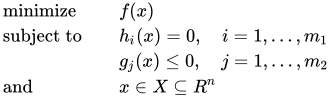
where
- is a vector of n real-valued design variables
- is the objective function
- are equality constraints
- are inequality constraints
- is a set constraint that includes additional restrictions on besides those implied by the equality and inequality constraints.
The problem formulation stated above is a convention called the negative null form, since all constraint function are expressed as equalities and negative inequalities with zero on the right-hand side. This convention is used so that numerical algorithms developed to solve design optimization problems can assume a standard expression of the mathematical problem.
We can introduce the vector-valued functions
to rewrite the above statement in the compact expression
We call the set or system of (functional) constraints and the set constraint.
Application
[edit]Design optimization applies the methods of mathematical optimization to design problem formulations and it is sometimes used interchangeably with the term engineering optimization. When the objective function f is a vector rather than a scalar, the problem becomes a multi-objective optimization one. If the design optimization problem has more than one mathematical solutions the methods of global optimization are used to identified the global optimum.
Optimization Checklist [2]
- Problem Identification
- Initial Problem Statement
- Analysis Models
- Optimal Design Model
- Model Transformation
- Local Iterative Techniques
- Global Verification
- Final Review
A detailed and rigorous description of the stages and practical applications with examples can be found in the book Principles of Optimal Design.
Practical design optimization problems are typically solved numerically and many optimization software exist in academic and commercial forms.[4] There are several domain-specific applications of design optimization posing their own specific challenges in formulating and solving the resulting problems; these include, shape optimization, wing-shape optimization, topology optimization, architectural design optimization, power optimization. Several books, articles and journal publications are listed below for reference.
One modern application of design optimization is structural design optimization (SDO) is in building and construction sector. SDO emphasizes automating and optimizing structural designs and dimensions to satisfy a variety of performance objectives. These advancements aim to optimize the configuration and dimensions of structures to optimize augmenting strength, minimize material usage, reduce costs, enhance energy efficiency, improve sustainability, and optimize several other performance criteria. Concurrently, structural design automation endeavors to streamline the design process, mitigate human errors, and enhance productivity through computer-based tools and optimization algorithms. Prominent practices and technologies in this domain include the parametric design, generative design, building information modelling (BIM) technology, machine learning (ML), and artificial intelligence (AI), as well as integrating finite element analysis (FEA) with simulation tools.[5]
Journals
[edit]- Journal of Engineering for Industry
- Journal of Mechanical Design
- Journal of Mechanisms, Transmissions, and Automation in Design
- Design Science
- Engineering Optimization
- Journal of Engineering Design
- Computer-Aided Design
- Journal of Optimization Theory and Applications
- Structural and Multidisciplinary Optimization
- Journal of Product Innovation Management
- International Journal of Research in Marketing
See also
[edit]- Design Decisions Wiki (DDWiki) : Established by the Design Decisions Laboratory at Carnegie Mellon University in 2006 as a central resource for sharing information and tools to analyze and support decision-making
References
[edit]- ^ Martins, Joaquim R. R. A.; Ning, Andrew (2021-10-01). Engineering Design Optimization (PDF). Cambridge University Press. ISBN 978-1108833417.
- ^ a b Papalambros, Panos Y.; Wilde, Douglass J. (2017-01-31). Principles of Optimal Design: Modeling and Computation. Cambridge University Press. ISBN 9781316867457.
- ^ Boyd, Stephen; Boyd, Stephen P.; California), Stephen (Stanford University Boyd; Vandenberghe, Lieven; Angeles), Lieven (University of California Vandenberghe, Los (2004-03-08). Convex Optimization (PDF). Cambridge University Press. ISBN 9780521833783.
{{cite book}}: CS1 maint: multiple names: authors list (link) - ^ Messac, Achille (2015-03-19). Optimization in Practice with MATLAB®: For Engineering Students and Professionals. Cambridge University Press. ISBN 9781316381373.
- ^ Towards BIM-Based Sustainable Structural Design Optimization: A Systematic Review and Industry Perspective. Sustainability 2023, 15, 15117. https://doi.org/10.3390/su152015117
Further reading
[edit]- Rutherford., Aris, ([2016], ©1961). The optimal design of chemical reactors : a study in dynamic programming. Saint Louis: Academic Press/Elsevier Science. ISBN 9781483221434. OCLC 952932441
- Jerome., Bracken, ([1968]). Selected applications of nonlinear programming. McCormick, Garth P.,. New York,: Wiley. ISBN 0471094404. OCLC 174465
- L., Fox, Richard ([1971]). Optimization methods for engineering design. Reading, Mass.,: Addison-Wesley Pub. Co. ISBN 0201020785. OCLC 150744
- Johnson, Ray C. Mechanical Design Synthesis With Optimization Applications. New York: Van Nostrand Reinhold Co, 1971.
- 1905-, Zener, Clarence, ([1971]). Engineering design by geometric programming. New York,: Wiley-Interscience. ISBN 0471982008. OCLC 197022
- H., Mickle, Marlin ([1972]). Optimization in systems engineering. Sze, T. W., 1921-2017,. Scranton,: Intext Educational Publishers. ISBN 0700224076. OCLC 340906.
- Optimization and design; [papers]. Avriel, M.,, Rijckaert, M. J.,, Wilde, Douglass J.,, NATO Science Committee., Katholieke Universiteit te Leuven (1970- ). Englewood Cliffs, N.J.,: Prentice-Hall. [1973]. ISBN 0136380158. OCLC 618414.
- J., Wilde, Douglass (1978). Globally optimal design. New York: Wiley. ISBN 0471038989. OCLC 3707693.
- J., Haug, Edward (1979). Applied optimal design : mechanical and structural systems. Arora, Jasbir S.,. New York: Wiley. ISBN 047104170X. OCLC 4775674.
- Uri., Kirsch, (1981). Optimum structural design : concepts, methods, and applications. New York: McGraw-Hill. ISBN 0070348448. OCLC 6735289.
- Uri., Kirsch, (1993). Structural optimization : fundamentals and applications. Berlin: Springer-Verlag. ISBN 3540559191. OCLC 27676129.
- Structural optimization : recent developments and applications. Lev, Ovadia E., American Society of Civil Engineers. Structural Division., American Society of Civil Engineers. Structural Division. Committee on Electronic Computation. Committee on Optimization. New York, N.Y.: ASCE. 1981. ISBN 0872622819. OCLC 8182361.
- Foundations of structural optimization : a unified approach. Morris, A. J. Chichester [West Sussex]: Wiley. 1982. ISBN 0471102008. OCLC 8031383.
- N., Siddall, James (1982). Optimal engineering design : principles and applications. New York: M. Dekker. ISBN 0824716337. OCLC 8389250.
- 1944-, Ravindran, A., (2006). Engineering optimization : methods and applications. Reklaitis, G. V., 1942-, Ragsdell, K. M. (2nd ed.). Hoboken, N.J.: John Wiley & Sons. ISBN 0471558141. OCLC 61463772.
- N.,, Vanderplaats, Garret (1984). Numerical optimization techniques for engineering design : with applications. New York: McGraw-Hill. ISBN 0070669643. OCLC 9785595.
- T., Haftka, Raphael (1990). Elements of Structural Optimization. Gürdal, Zafer., Kamat, Manohar P. (Second rev. edition ed.). Dordrecht: Springer Netherlands. ISBN 9789401578622. OCLC 851381183.
- S., Arora, Jasbir (2011). Introduction to optimum design (3rd ed.). Boston, MA: Academic Press. ISBN 9780123813756. OCLC 760173076.
- S.,, Janna, William. Design of fluid thermal systems (SI edition ; fourth edition ed.). Stamford, Connecticut. ISBN 9781285859651. OCLC 881509017.
- Structural optimization : status and promise. Kamat, Manohar P. Washington, DC: American Institute of Aeronautics and Astronautics. 1993. ISBN 156347056X. OCLC 27918651.
- Mathematical programming for industrial engineers. Avriel, M., Golany, B. New York: Marcel Dekker. 1996. ISBN 0824796209. OCLC 34474279.
- Hans., Eschenauer, (1997). Applied structural mechanics : fundamentals of elasticity, load-bearing structures, structural optimization : including exercises. Olhoff, Niels., Schnell, W. Berlin: Springer. ISBN 3540612327. OCLC 35184040.
- 1956-, Belegundu, Ashok D., (2011). Optimization concepts and applications in engineering. Chandrupatla, Tirupathi R., 1944- (2nd ed.). New York: Cambridge University Press. ISBN 9781139037808. OCLC 746750296.
- Okechi., Onwubiko, Chinyere (2000). Introduction to engineering design optimization. Upper Saddle River, NJ: Prentice-Hall. ISBN 0201476738. OCLC 41368373.
- Optimization in action : proceedings of the Conference on Optimization in Action held at the University of Bristol in January 1975. Dixon, L. C. W. (Laurence Charles Ward), 1935-, Institute of Mathematics and Its Applications. London: Academic Press. 1976. ISBN 0122185501. OCLC 2715969.
- P., Williams, H. (2013). Model building in mathematical programming (5th ed.). Chichester, West Sussex: Wiley. ISBN 9781118506189. OCLC 810039791.
- Integrated design of multiscale, multifunctional materials and products. McDowell, David L., 1956-. Oxford: Butterworth-Heinemann. 2010. ISBN 9781856176620. OCLC 610001448.
- M.,, Dede, Ercan. Multiphysics simulation : electromechanical system applications and optimization. Lee, Jaewook,, Nomura, Tsuyoshi,. London. ISBN 9781447156406. OCLC 881071474.
- 1962-, Liu, G. P. (Guo Ping), (2001). Multiobjective optimisation and control. Yang, Jian-Bo, 1961-, Whidborne, J. F. (James Ferris), 1960-. Baldock, Hertfordshire: Research Studies Press. ISBN 0585491941. OCLC 54380075.
Structural Topology Optimization
[edit]- Bendsøe, Martin Philip; Kikuchi, Noboru (1988-11-01). "Generating optimal topologies in structural design using a homogenization method". Computer Methods in Applied Mechanics and Engineering. 71 (2): 197–224. doi:10.1016/0045-7825(88)90086-2. hdl:2027.42/27079. ISSN 0045-7825.
- Bendsøe, Martin P. (1995). Optimization of structural topology, shape, and material. Springer. ISBN 3540590579.
- Behrooz, Hassani (1999). Homogenization and Structural Topology Optimization : Theory, Practice and Software. Springer. ISBN 9781447108917. OCLC 853262659.
- Bendsøe, Martin P.; Sigmund, O. (2013). Topology optimization : theory, methods, and applications (2nd ed.). Springer. ISBN 9783662050866. OCLC 50448149.
- Rozvany, G.I.N.; Lewiński, T., eds. (2014). Topology optimization in structural and continuum mechanics. Springer. ISBN 9783709116432. OCLC 859524179.
Design optimization
View on GrokipediaFundamentals
Definition and Scope
Design optimization is an engineering methodology that systematically applies mathematical techniques to identify the most effective design parameters for achieving superior performance in physical systems, such as structures or products, by evaluating alternatives against specified criteria.[4] This process involves formulating the design challenge as an optimization problem to minimize undesirable aspects, like material weight, or maximize beneficial ones, such as structural strength, while adhering to practical limitations.[5] At its core, it seeks to determine parameters that yield the best system performance under given constraints, particularly when numerous viable solutions exist.[1] The scope of design optimization extends to both single-objective scenarios, where a solitary goal like cost reduction is pursued, and multi-objective problems that address competing priorities simultaneously, such as balancing efficiency against durability.[6] It distinguishes itself from broader mathematical optimization by concentrating on tangible engineering artifacts—ranging from mechanical components to complex systems—rather than abstract computations, ensuring solutions are feasible for real-world implementation.[7] This field integrates across disciplines like mechanical, civil, and aerospace engineering, emphasizing iterative refinement to enhance overall design quality.[8] A fundamental concept in design optimization is the management of inherent trade-offs, where advancements in one design attribute, such as increased performance, may elevate costs or reduce reliability, requiring deliberate prioritization.[9] These trade-offs underscore the need for a structured approach to evaluate alternatives and select balanced outcomes.[10] Within the engineering design cycle, optimization serves as a pivotal tool from initial conceptualization through to final detailing, enabling engineers to iteratively improve prototypes and align designs with prioritized objectives like productivity and sustainability.[11] For example, in civil engineering, design optimization might target a bridge by adjusting material distribution to minimize weight and construction costs while upholding load-bearing requirements and safety standards, thereby illustrating the practical balance of competing demands.[12] Such applications highlight how optimization structures problems around objectives, variables, and constraints to guide decision-making.[2]Historical Development
The roots of design optimization trace back to the 18th century, when Leonhard Euler developed foundational theories for structural stability, including the 1757 derivation of the critical buckling load for columns, which effectively optimized column dimensions to prevent failure under compressive loads.[13] This analytical approach represented an early manual method for balancing material efficiency and safety in structural engineering. In the 19th century, further manual optimizations emerged, such as James Clerk Maxwell's 1869 work on the reciprocal theorem, which enabled economical truss designs by minimizing material while satisfying equilibrium, and A. G. L. Mitchell's 1904 exploration of material limits in frame structures.[14] These efforts relied on mathematical analysis and intuition, laying groundwork for systematic optimization without computational aid. The post-World War II era marked a pivotal shift with the advent of digital computers, enabling numerical methods for complex designs. In 1960, Lloyd A. Schmit Jr. pioneered modern structural optimization by integrating finite element analysis (FEM) with nonlinear programming, allowing automated sizing of structural components and marking the birth of computational design optimization.[15] The 1960s saw FEM's maturation, originating in the 1950s but fully enabling iterative optimization by the decade's end, as computational power grew to handle discretized models of engineering systems.[14] By the 1970s, limitations in computing persisted, yet advancements like approximation techniques reduced analysis demands; notably, George I. N. Rozvany advanced optimality criteria methods during this period, deriving rigorous conditions for minimum-weight designs in continuous structures, building on the analytical school of William Prager.[16] The 1980s brought multidisciplinary extensions and innovative techniques, with Jasbir S. Arora contributing key frameworks for integrating multiple disciplines like structures and aerodynamics into optimization processes, as detailed in his seminal works on engineering design optimization.[17] A landmark was the 1988 paper by Martin P. Bendsøe and Noboru Kikuchi, introducing homogenization-based topology optimization to generate optimal material distributions in fixed domains, revolutionizing free-form structural design.[18] Entering the 1990s, integration with computer-aided design (CAD) software accelerated practical adoption, enabling seamless optimization within modeling environments and supporting shape, size, and topology adjustments interactively.[19] The 2000s witnessed widespread adoption of evolutionary algorithms, such as genetic algorithms, for handling non-convex, multi-objective problems intractable by traditional methods, with reviews highlighting their role in robust design exploration across engineering fields.[20]Problem Formulation
Objective Functions
In design optimization, the objective function represents the quantifiable goal that the optimization process seeks to extremize, typically formulated as a scalar or vector-valued mathematical expression in terms of the design variables. It encapsulates performance criteria such as minimizing mass while ensuring structural integrity under stress limits, thereby guiding the search for optimal designs.[21] Objective functions are classified into single-objective and multi-objective types. In single-objective optimization, a solitary criterion is optimized, such as cost minimization in manufacturing processes, where the function evaluates economic efficiency directly.[5] Multi-objective optimization, conversely, addresses conflicting goals, yielding a set of trade-off solutions known as the Pareto front; for instance, in structural design, one might balance weight reduction against stiffness enhancement, as no single design achieves both optima simultaneously.[22] The general formulation of an objective function is denoted as , where represents the vector of design variables, and the goal is to minimize or maximize subject to problem-specific conditions.[1] A representative example in structural design is compliance minimization, which measures the structure's flexibility under applied loads and is expressed as the total strain energy: where is the displacement field, is the stiffness matrix, and the integral is over the design volume ; this formulation promotes stiff, efficient topologies by penalizing deformation.[18] For multi-objective problems, normalization ensures commensurability among disparate objectives, often by scaling each to a unit range or reference value. Weighting techniques then aggregate them into a single scalar, such as the weighted sum method: where are non-negative weights summing to unity, and are individual normalized objectives; this approach approximates the Pareto front but may miss non-convex regions depending on weight selection.[22]Design Variables and Constraints
In design optimization, design variables are the adjustable parameters that characterize the configuration of a system, structure, or process, allowing for systematic improvement toward an objective function. These variables are typically represented as a vector , where denotes the number of variables. They can be classified as continuous, taking real values within specified bounds (e.g., material thickness or structural dimensions like length or diameter); discrete, assuming specific categorical or integer values (e.g., selection of material type from a finite set or number of components); or mixed, combining both continuous and discrete elements to reflect real-world design choices.[1][3][14] In problems involving shape or size optimization, design variables often require parameterization to efficiently represent complex geometries or configurations with a reduced set of parameters. For instance, spline-based methods or scaling transformations (e.g., , where are scaled variables) are used to parameterize curves or surfaces, ensuring that variations in variables correspond to meaningful geometric changes while maintaining computational tractability. This approach limits the dimensionality of the problem and facilitates gradient computations when needed.[1][5] Constraints define the boundaries of acceptable designs by restricting the values of design variables to ensure physical realism, safety, and manufacturability. Equality constraints require exact satisfaction of conditions, such as preserving a fixed volume fraction constant in structural designs. Inequality constraints impose upper or lower limits, for example, ensuring stress levels to prevent failure. These constraints are categorized by nature: geometric (e.g., dimensional bounds on size or clearance); physical (e.g., limits on stress, deflection, or thermal loads); and manufacturing (e.g., restrictions arising from production processes, such as minimum feature sizes or discrete assembly options).[1][3][14] The overall optimization problem is formulated mathematically as: where is the objective function, are inequality constraints, are equality constraints, and denote lower and upper bounds on the variables, respectively. Equality constraints can sometimes be recast as pairs of inequalities for uniformity.[1][14][3] Feasibility refers to the subset of the design space where all constraints are satisfied, forming the feasible region that confines potential solutions. Within this region, constraints are classified as active if they hold with equality at a given point (e.g., ), thereby influencing the optimization trajectory, or inactive if strictly satisfied (e.g., ). The structure of active constraints helps delineate the boundaries of the feasible space and often determines the location of the optimum, as solutions typically lie on the intersection of active constraints. This formulation ensures that adjustments to design variables yield practical designs while optimizing the objective.[1][3][14]Optimization Methods
Gradient-Based Methods
Gradient-based methods in design optimization employ derivatives of the objective function and constraints to iteratively update design variables, enabling efficient local search towards optimal solutions. These techniques are foundational for problems with smooth, differentiable objective functions, such as those arising in structural or mechanical design where performance metrics like stress or compliance can be computed via analytical or numerical differentiation. First-order methods, including steepest descent and conjugate gradient, rely on the gradient to determine the search direction, with line search or trust-region strategies to select step sizes that reduce the objective. Steepest descent updates the design as , where is chosen to satisfy descent conditions, offering simplicity but potentially slow convergence due to zigzagging in ill-conditioned problems.[23][23] Second-order methods enhance efficiency by incorporating curvature information through the Hessian matrix or its approximations. Newton's method solves for the step , providing quadratic convergence near local minima for unconstrained or equality-constrained problems, though it demands significant computational resources for Hessian evaluation and inversion. Quasi-Newton approximations, such as BFGS, update low-rank models of the Hessian iteratively, balancing accuracy and cost for large-scale designs. For constrained design problems, which are prevalent in engineering due to bounds on variables like material thicknesses or geometric limits, Sequential Quadratic Programming (SQP) stands out as a key algorithm. SQP approximates the nonlinear program at each iteration by solving the quadratic subproblem where approximates the Lagrangian Hessian, and , are equality and inequality constraints, respectively; the solution yields the update . This approach leverages active-set or interior-point strategies for handling inequalities, achieving superlinear convergence under suitable conditions.[23][24] In finite element method (FEM)-based designs, computing gradients efficiently is crucial for scalability, as forward sensitivity analysis scales poorly with the number of design variables. Adjoint sensitivity analysis addresses this by introducing Lagrange multipliers to form an adjoint system, allowing the total derivative of the objective with respect to design parameters to be obtained via a single backward solve, independent of the number of variables; for a system in structural mechanics, the adjoint equation yields sensitivities , where is the Lagrangian and represents design variables like densities or sizes. This technique is essential for gradient-based optimization in complex simulations, reducing computational overhead from to per gradient evaluation relative to the number of parameters. Seminal formulations established the continuum and discretized adjoint approaches for linear and nonlinear structural systems, enabling their integration with FEM solvers. These methods excel in applications like sizing optimization, where continuous variables such as cross-sectional areas or thicknesses are adjusted to minimize mass subject to stress constraints, often yielding rapid convergence—e.g., quadratic rates for Newton's method on convex quadratics—and enabling solutions to problems with thousands of variables in aerospace structures. However, they are sensitive to the initial design guess, potentially converging to local optima in non-convex landscapes, and necessitate differentiable models, limiting applicability to black-box or noisy simulations without gradient approximations.[23]Derivative-Free Methods
Derivative-free methods, also known as black-box optimization techniques, are optimization approaches that rely solely on function evaluations without requiring gradient or derivative information, making them particularly suitable for complex design problems where the objective function is expensive to evaluate, noisy, or not analytically differentiable.[25] These methods are essential in design optimization scenarios involving simulation-based models or discrete variables, where computing sensitivities is infeasible or unreliable.[25] Local derivative-free methods focus on exploring the search space through direct sampling and iterative improvements around promising points. The Nelder-Mead simplex algorithm, for instance, maintains a simplex of n+1 points in n-dimensional space and iteratively applies operations such as reflection, expansion, contraction, and shrinkage to adapt the simplex toward the minimum, effectively handling low-dimensional noisy problems without convergence guarantees for non-convex cases. Similarly, pattern search methods, including coordinate search variants, generate trial points on a mesh defined by positive spanning sets and poll directions, allowing robust progress in multimodal or non-smooth landscapes by avoiding derivative computations. These local techniques are computationally efficient for refinement but may require hybridization for global exploration.[25] Surrogate-based derivative-free methods address the high cost of evaluations by constructing approximate models of the objective function to guide the search. Kriging, or Gaussian process regression, builds a probabilistic surrogate that interpolates known points and quantifies uncertainty, enabling efficient global optimization through infill criteria that balance exploration and exploitation in expensive, noisy, or multimodal design spaces. This approach reduces the number of required function calls compared to direct sampling, though building and updating the surrogate incurs additional overhead.[25] Evolutionary and population-based methods draw inspiration from natural processes to perform global searches across diverse solution populations. Genetic algorithms (GA) evolve a set of candidate designs by evaluating fitness, then applying selection to favor high-performing individuals, crossover to combine traits, and mutation to introduce variation, proving effective for discrete or mixed-variable optimization in rugged, multimodal landscapes without needing derivatives. Particle swarm optimization (PSO), on the other hand, simulates social behavior where particles adjust their positions and velocities based on personal bests and the swarm's global best, facilitating collaborative search in continuous, noisy environments. In GA, fitness evaluation directly drives selection pressure, enhancing robustness to noise by averaging multiple runs if needed. Overall, derivative-free methods trade off the rapid convergence of gradient-based approaches for greater versatility, often requiring more function evaluations but excelling in handling constraints via penalty functions or repair mechanisms, and proving more reliable for discrete design variables where gradients are undefined.[25]Specific Techniques
Topology Optimization
Topology optimization determines the optimal distribution of material within a fixed design domain to achieve desired performance criteria, such as structural stiffness or strength, while adhering to constraints like volume limits.[26] This approach discretizes the domain into finite elements, treating each as a pseudo-density variable ρ ∈ [0,1], where 0 represents void and 1 solid material, enabling the synthesis of complex layouts without predefined topologies.[26] Early developments in the 1980s introduced the homogenization method by Bendsøe and Kikuchi, which optimizes topology by varying the microscopic structure of composite materials within macroscale elements to approximate effective properties.[18] This technique models the design domain as filled with rank-2 laminates, allowing optimization of material orientation and void placement to minimize objectives like compliance.[18] A widely adopted simplification is the Solid Isotropic Material with Penalization (SIMP) method, introduced by Bendsøe in 1989, which interpolates material properties using a power-law: the Young's modulus E(ρ) = ρ^p E_0, with penalization exponent p typically set to 3 to discourage intermediate densities and favor 0-1 designs.[26] In SIMP, the optimization problem for minimum compliance is formulated as: subject to the volume constraint and equilibrium equations , where is the displacement vector, the load vector, the stiffness matrix, and the design domain.[27] Despite its efficiency, topology optimization via SIMP encounters numerical challenges, including checkerboard patterns—alternating high- and low-density elements that artificially stiffen structures—and mesh dependency, where optimal topologies vary unstably with finite element mesh refinement.[28] These instabilities arise from the discrete nature of finite element approximations and lack of length-scale control.[28] To mitigate these issues, regularization techniques such as sensitivity-based density filtering and projection methods are applied; filters average sensitivities over neighboring elements to suppress oscillations, while projections enforce minimum feature sizes through smoothed Heaviside functions. These ensure convergence to manufacturable designs independent of mesh resolution. The resulting topologies often exhibit organic, branching forms that efficiently distribute material along load paths, making them ideal for additive manufacturing where complex geometries can be realized without traditional subtractive constraints.[29] Such structures achieve significant weight reductions, for instance, up to 70% in aerospace components compared to conventional designs, while maintaining performance.[29]Shape and Size Optimization
Shape optimization involves the systematic adjustment of a structure's geometric boundaries to enhance performance metrics such as stiffness, fluid flow efficiency, or load distribution, typically starting from an existing topology. This process refines the contours of the design domain by perturbing its surface, often employing continuous representations to handle complex evolutions without remeshing. A prominent approach is the level-set method, which implicitly describes the boundary as the zero-level set of a higher-dimensional function , evolving according to the Hamilton-Jacobi equation , where is the normal velocity derived from optimization sensitivities.[30] This method, introduced for shape optimization of elastic structures, enables smooth boundary propagation and merger, avoiding topological changes while minimizing objectives like compliance under volume constraints.[30] In contrast, size optimization focuses on varying discrete dimensional parameters of predefined structural elements, such as beam cross-sectional areas, thicknesses, or lengths, to achieve local optima within a fixed geometry. These adjustments are commonly performed using classical gradient-based algorithms, which exploit analytical sensitivities to navigate the design space efficiently, though they may converge to suboptimal local minima due to nonlinearity.[31] For instance, in truss structures, size optimization iteratively scales member areas to minimize weight subject to stress constraints, leveraging finite element analysis for response evaluation.[32] Integrated shape and size optimization combines boundary perturbations with dimensional tuning, particularly in structural design, to exploit synergies that neither method achieves alone; sensitivities are computed via shape derivatives, which quantify objective changes with respect to domain variations using material derivative concepts.[33] This hybrid approach enhances global performance, as demonstrated in bridge design where nodal positions (shape) and cross-sections (size) are optimized simultaneously for minimum mass under load limits.[34] A key application is aerodynamic shape optimization, where boundary adjustments minimize drag on airfoils or vehicle bodies while maintaining lift, often yielding 10-20% reductions in drag coefficient through adjoint-based gradients.[35] For example, evolving a baseline circular profile into a supercritical airfoil via surface perturbations has been shown to optimize transonic flow, reducing wave drag by aligning shock waves with design constraints.[36]Applications
Engineering Disciplines
Design optimization plays a pivotal role in engineering disciplines by enabling the development of structures and components that achieve superior performance while minimizing material usage, costs, and environmental impact. In structural engineering, optimization techniques are applied to enhance load-bearing capacity under diverse conditions, such as seismic events, leading to lighter yet robust designs. Similarly, in mechanical, aerospace, and civil engineering, these methods tailor solutions to specific operational demands, ensuring efficiency and reliability across applications. Structural EngineeringIn structural engineering, design optimization focuses on trusses and frames to minimize weight while maintaining load-bearing integrity, particularly under seismic constraints. For instance, truss optimization based on structural mechanics mechanisms analyzes force distribution to determine minimal material volumes required for stability, achieving up to 20-30% weight reductions in typical designs. This approach has been extended to space truss domes subjected to multiple earthquake ground motions, where reliability-based optimization ensures enhanced seismic performance without excessive material use. By incorporating constraints like stress limits and displacement thresholds, these optimizations yield safer structures with lower lifecycle costs. Mechanical Engineering
Mechanical engineering leverages design optimization for components such as gears and heat exchangers to maximize efficiency and reduce energy losses. In gear design, multi-objective optimization targets mechanical power losses and noise-vibration-harshness (NVH) behavior, resulting in helical gear units that improve transmission efficiency by 5-10% through refined tooth profiles and material selections. For heat exchangers, optimization of shell-and-tube configurations adjusts parameters like tube diameter and length to enhance heat transfer rates while minimizing pressure drops, often achieving 15-25% improvements in thermal efficiency. These methods prioritize operational reliability, enabling compact designs that support broader system performance in machinery. Aerospace Engineering
Aerospace engineering employs design optimization for wing structures and turbine blades to realize significant fuel savings and aerodynamic efficiency. NASA's advanced turboprop program optimizes propeller and wing integrations to mitigate wake ingestion effects, contributing to projected fuel consumption reductions of 20-30% in transport aircraft. Structural optimization surveys in fixed-wing applications have demonstrated weight savings of 10-15% in wing designs through sizing and shape adjustments under aeroelastic constraints. For turbine blades, computational fluid dynamics (CFD)-driven optimization refines aerodynamic profiles, enhancing efficiency by up to 5% in high-fidelity simulations while adhering to thermal and mechanical limits. These efforts, often informed by topology optimization techniques, underscore NASA's role in pioneering fuel-efficient aircraft components. Civil Engineering
In civil engineering, design optimization targets bridges and buildings to balance cost, safety, and durability. For bridges, performance-based optimization calibrates load factors to minimize construction and maintenance expenses while ensuring structural integrity against environmental loads, potentially reducing overall costs by 10-20%. Plate girder bridge designs, optimized for flexural strength and stability, achieve material efficiencies that lower fabrication costs without compromising safety margins. Building optimizations similarly integrate cost-safety trade-offs, yielding designs that enhance resilience to wind and seismic forces at reduced material volumes. These applications emphasize lifecycle benefits, fostering sustainable infrastructure with verified performance under codified standards.
