Hubbry Logo
WASP-12bWASP-12bMain
Open search
WASP-12b
Community hub
WASP-12b
logo
8 pages, 0 posts
0 subscribers
Be the first to start a discussion here.
WASP-12b
WASP-12b
from Wikipedia

WASP-12b
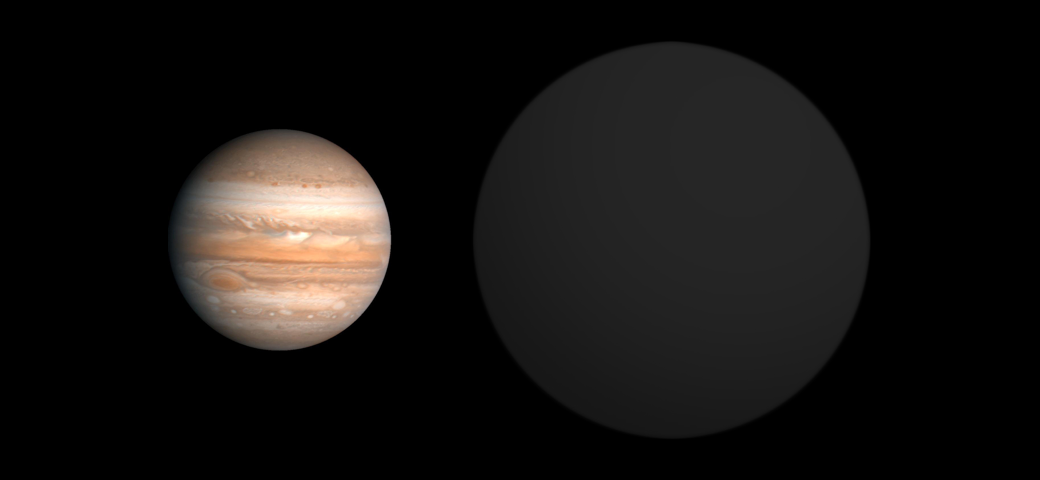
Size comparison of WASP-12b (right) with Jupiter
Discovery
Discovered byCameron et al. (SuperWASP)
Discovery siteSAAO
Discovery dateApril 2008[1]
Transit
Orbital characteristics
0.0234+0.00056
−0.00050
 AU
Eccentricity0.049 ± 0.015
1.0914199±0.0000002 d[2]
Inclination81.92°±1.51°[2]
−74°+13°
−10°
StarWASP-12
Physical characteristics
1.937±0.056[3] RJ
Mass1.47+0.076
−0.069
[4] MJ
Mean density
0.266 g/cm3[4]
3.004±0.015 g[4]
Temperature3128+64
−68
 K
(2885+64
−68
 °C
, 5225+147
−155
 °F
)[5]

WASP-12b is a hot Jupiter[6] (a class of extrasolar planets) orbiting the star WASP-12, discovered in April of 2008, by the SuperWASP planetary transit survey.[7][1] The planet takes only a little over one Earth day to orbit its star, in contrast to about 365.25 days for the Earth to orbit the Sun. Its distance from the star (approximately 3.5 million kilometers [2.2 million miles; 0.023 astronomical units]) is only the Earth's distance from the Sun, with an eccentricity the same as Jupiter's. Consequently, it has one of the lowest densities for exoplanets ("inflated" by the flux of energy from the star). On December 3, 2013, scientists working with the Hubble Space Telescope (HST) reported detecting water in the atmosphere of the exoplanet.[8][9] In July 2014, NASA announced finding very dry atmospheres on three exoplanets (HD 189733b, HD 209458b, WASP-12b) orbiting sun-like stars.[10]

In September 2017, researchers working on the HST announced that WASP-12b reflects just 6% of the light that shines on its surface. As a result, its reflectivity has been described as "black as asphalt" and as "pitch black", although it is so hot that it emits a reddish glow.[11]

Characteristics

[edit]
Artist's depiction of WASP-12b's atmosphere being tidally stripped by its parent star

Since hot Jupiter exoplanets are tidally locked, one side is in permanent day while the other side is in permanent night, just as the same side of the Moon always faces the Earth. This is thought to induce a large flow of heat from the highly irradiated day side to the cooler night side, resulting in strong winds rushing around the planet's atmosphere.

Taylor Bell and Nicolas Cowan have pointed out that hydrogen will tend to be ionised on the day side. After flowing to the cooler face in a wind, it will then tend to recombine into neutral atoms, and thus will enhance the transport of heat.

The planet is so close to its star that its tidal forces are distorting it into a prolate spheroid and pulling away its atmosphere at a rate of about 10−7 MJ (about 189 quadrillion tons) per year (6 billion tons per second).[12] The so-called "tidal heating", and the proximity of the planet to its star, combine to bring the surface temperature to more than 2,500 K (2,200 °C).

On May 20, 2010, the Hubble Space Telescope spotted WASP-12b being "consumed" by its star. Scientists had been aware that stars could consume planets; however, this was the first time such an event had been observed so clearly. It has been estimated that the planet has between 3 and 10 million years left of its life.[13][14][15]

The Hubble Space Telescope observed the planet by using its Cosmic Origins Spectrograph (COS). The observations have confirmed predictions published in Nature in February 2009 by Peking University's Shu-lin Li. The planet's atmosphere has ballooned to be nearly three times the radius of Jupiter, while the planet itself has 40% more mass than Jupiter.

Orbit

[edit]

A study in 2012, utilizing the Rossiter–McLaughlin effect, determined that WASP-12b's orbit is strongly misaligned with the equatorial plane of its star by 59+15
−20
°.[16]

A study from 2019 found that the time interval between two transits has decreased by 29 ± 2 msec/year since the discovery in 2008. The value was updated in 2020 to 32.53±1.62 msec/year, giving WASP-12b an estimated lifetime of 2.90±0.14 million years.[14] The study came to the conclusion that the orbit of WASP-12b is decaying as a result of tidal interactions between the planet and the host star WASP-12. Due to this decay, the orbital period will get shorter and the planet will get closer to the host star, until it will become part of the star. The decay is much faster than the decay of WASP-19b, which does not show a decay with current data.[17][18] In 2022, the decay rate was further refined to 29.81±0.94 msec/year, which corresponds to an estimated lifetime of 3.16±0.10 Ma.[15]

Carbon content

[edit]

Evidence reported in a 2010 study indicates that WASP-12b has an enhanced carbon-to-oxygen ratio, significantly higher than that of the Sun, indicating that it is a carbon-rich gas giant. The C/O ratio compatible with observations is about 1, while the solar value is 0.54. The C/O ratios suggest that carbon-rich planets may have formed in the star system.[19] One of the researchers behind that study commented that "with more carbon than oxygen, you would get rocks of pure carbon, such as diamond or graphite".[20]

The published study states, "Although carbon-rich giant planets like WASP-12b have not been observed, theory predicts myriad compositions for carbon-dominated solid planets. Terrestrial-sized carbon planets, for instance, could be dominated by graphite or diamond interiors, as opposed to the silicate composition of Earth."[19] These remarks have led the media to pick up on the story,[21] some even calling WASP-12b a "diamond planet".[22]

The carbon content of the planet is located within its atmosphere, in the form of carbon monoxide and methane. The study appears in the journal Nature.[23]

Comparison of "hot Jupiter" exoplanets - from top left to lower right: WASP-12b, WASP-6b, WASP-31b, WASP-39b, HD 189733b, HAT-P-12b, WASP-17b, WASP-19b, HAT-P-1b and HD 209458b.

Candidate satellite

[edit]

Russian astronomers studying a curve of change of shine of the planet observed regular variation of light that may arise from plasma torus surrounding at least one exomoon in orbit around WASP-12b.[24] This is not expected, as hot Jupiter-type planets are expected to lose large moons within geologically short timescales.[25] The satellite in question could instead be a Trojan body.[26]

See also

[edit]

References

[edit]
[edit]
Revisions and contributorsEdit on WikipediaRead on Wikipedia
from Grokipedia
WASP-12b is an extrasolar planet classified as a , orbiting the F-type star WASP-12 every 1.091 days at a distance of 0.0234 AU, with a mass of 1.47 Jupiter masses, a radius of 1.965 Jupiter radii, and an equilibrium temperature of 2593 K. It was discovered in 2008 using the transit method and lies approximately 1,400 light-years away in the constellation Auriga. Due to its extremely close , WASP-12b experiences intense tidal forces from its host star, distorting the planet into an egg-like shape and causing its to decay at a rate of 30 milliseconds per year, as confirmed by recent observations (as of 2025). This inward spiral, driven by gravitational interactions, is expected to lead to the planet's engulfment by its star within about 3 million years, potentially leaving behind a rocky remnant. The star WASP-12 has a mass of 1.325 solar masses, a radius of 1.69 solar radii, and an of 6265 K. WASP-12b's atmosphere is notably carbon-rich, with a carbon-to-oxygen exceeding 1—higher than Earth's of 0.5—marking it as the first confirmed carbon-dominant . This composition suggests possible or interiors rather than rocks, and observations indicate excess with minimal . Additionally, the planet's dayside is pitch-black, absorbing over 94% of incoming visible light due to hydrogen-dominated absorption, with temperatures reaching 4,600°F that prevent cloud formation. The nightside, cooler by over 2,000°F, shows signs of , clouds, and hazes. Recent observations (as of 2025) continue to confirm the rapid and reveal details of its extreme atmosphere. These extreme conditions highlight WASP-12b as a key example of planetary destruction and atmospheric extremes in close-in exoplanets.

Discovery and Observation

Discovery

WASP-12b was discovered in April 2008 by the (SuperWASP) project, a ground-based photometric survey designed to detect transiting exoplanets around bright stars. The detection occurred through the transit method, utilizing time-series photometry from the SuperWASP-N camera array on , , which identified periodic dips in the brightness of the host star WASP-12 with a period of approximately 1.09 days. The initial candidate was confirmed as a planetary transit via follow-up observations, including measurements obtained with the high-resolution spectrograph mounted on the 1.93-meter at Observatoire Haute-Provence in . These measurements revealed sinusoidal variations in the star's with an amplitude consistent with a massive planetary companion, ruling out astrophysical false positives such as eclipsing binaries. Additional photometric follow-up with telescopes like the 0.81-meter Tenagra II and the 2-meter further validated the transit signal. The discovery was formally announced in a 2009 paper by Hebb et al. published in , marking WASP-12b as the hottest known transiting at the time. Early analyses from the transit light curves and data yielded initial estimates of the planet's mass as 1.41±0.101.41 \pm 0.10 Jupiter masses and radius as 1.790.09+0.091.79^{+0.09}_{-0.09} Jupiter radii, highlighting its status as an inflated .

Observational History

Following its discovery, transmission spectroscopy observations of WASP-12b were conducted using the (HST) in 2010, which detected metals in the indicative of atmospheric mass loss due to the planet's extreme irradiation. Contemporaneous modeling of ground-based transit s provided evidence of tidal distortion, supporting a prolate planetary shape with the light curve deviating by approximately 10% from a spherical model and confirming strong tidal interactions. In 2011, the performed infrared observations of WASP-12b's thermal phase variations at 3.6 and 4.5 μm, detecting significant thermal emission from the dayside with a phase offset suggesting inefficient heat redistribution. These measurements indicated a low of less than 0.1, consistent with a dark, absorbing atmosphere dominated by thermal re-emission rather than reflection. The full-orbit phase curve showed a dayside of about 2900 K, highlighting the planet's extreme thermal environment. Ground-based and space-based campaigns continued with (TESS) transits in sectors 4 (2019) and 20 (2019–2020), which refined transit timing variations and confirmed the planet's at a rate of -29.4 ± 1.4 ms yr⁻¹. These observations, combined with prior data, improved constraints on the to 1.09142013 ± 0.00000025 days, providing evidence of ongoing tidal inspiral. A 2025 analysis by Winn and Stefansson incorporated new transit times from the Agnes (AG) Optical telescope, along with archival data, to further refine the orbital ephemeris and decay rate to -29.81 ± 0.94 ms yr⁻¹. This study emphasized cumulative ground-based monitoring to mitigate space-based gaps, enhancing precision in timing predictions. Over time, parameter uncertainties have narrowed; for instance, the planetary radius estimate evolved from an initial 1.79 ± 0.09 Rⱼ in 2009 to 1.965 ± 0.020 Rⱼ by 2025, based on integrated HST, Spitzer, TESS, and ground-based photometry.

Host Star

Stellar Properties

WASP-12 is a late classified as spectral type F5, characterized by its yellow-white appearance and relatively high temperature for a star of its class. The star has an of approximately 6265 , which places it hotter than the Sun and contributes to its classification as an F-type dwarf. With a mass of 1.325 solar masses and a of 1.69 solar , WASP-12 is somewhat more massive and larger than the Sun, reflecting its position on the where it fuses in its core. Its is log g = 4.11, consistent with a main-sequence star of this mass and . The exhibits slightly metal-rich composition, with a of [Fe/H] = 0.00 ± 0.08, indicating an abundance of elements heavier than and similar to solar levels. This influences the star's evolution and atmospheric properties. WASP-12 is estimated to be about 2.3 billion years old, placing it in a mature phase of its main-sequence lifetime. Its is approximately 4.0 times that of the Sun, derived from its temperature and radius, which drives significant of its close-in . Located in the constellation Auriga, WASP-12 lies at a distance of about 1390 light-years from , corresponding to a parallax measurement from DR3 observations. The star's apparent visual magnitude is V = 11.57, making it faint enough to require telescopes for observation but accessible to ground-based surveys that led to the detection of its transiting . These position WASP-12 as a typical host for hot Jupiters, with its evolutionary stage influencing the dynamical interactions within the system.

Binary Companion

The host star WASP-12A forms a hierarchical triple system with a binary companion, WASP-12BC, consisting of two low-mass stars. High-resolution observations first identified a candidate companion at a projected separation of approximately 1.2 arcseconds in 2011, with subsequent imaging in 2013 resolving it as a close binary pair separated by about 84 mas (approximately 36 AU). Spectroscopic analysis of the companions' near-infrared spectrum, obtained using imaging in 2012, confirms they are M3V red dwarfs with masses of 0.38 ± 0.05 M⊙ and 0.37 ± 0.05 M⊙, respectively. These masses place the companions in the low-mass stellar regime, consistent with their spectral types and the dilution effects observed in previous photometric data of the WASP-12 system. monitoring of the primary star has ruled out additional massive companions (≥5 M_J) within ~8 AU but provides no detectable signal from the distant WASP-12BC due to their wide separation and long , estimated at thousands of years. The projected separation of the WASP-12BC binary from the primary corresponds to ~510 AU at the system's of 427 pc, forming a hierarchical configuration. This wide binary can induce long-term gravitational perturbations on the inner orbit of WASP-12b, potentially exciting small eccentricities (e ~ 0.01–0.05) through secular interactions, which may contribute to the observed transit timing variations and orbital evolution. Such dynamics highlight the role of the companion in the overall stability of the , though detailed modeling is required to quantify its impact amid dominant tidal effects. As of 2025, direct imaging has firmly established the companions' existence, with DR3 astrometry providing precise s and parallaxes that confirm shared space motion, supporting their bound nature within the triple system ( difference <1 mas yr⁻¹, consistent with orbital binding at >99% probability). No closer unresolved companions have been detected via these astrometric constraints, limiting potential perturbers to separations beyond ~1000 AU.

Planetary Characteristics

Physical Parameters

WASP-12b has a mass of 1.47 ± 0.08 masses, determined through measurements and transit timing analysis. Its radius measures 1.90 ± 0.03 radii, derived from high-precision photometry that accounts for the planet's inflated envelope. These parameters yield a mean density of 0.33 ± 0.04 g/cm³, among the lowest for transiting hot , reflecting extensive atmospheric inflation from stellar irradiation. As an ultrahot , WASP-12b exhibits a global equilibrium temperature of approximately 2580 , calculated assuming zero and efficient heat redistribution. Recent multi-wavelength observations reveal a dayside averaging around 2870 . Tidal forces from the host distort WASP-12b into a prolate, egg-like shape, with modeling showing a significant bulge along the star-planet axis. This deformation arises primarily from and rapid orbital motion, rather than internal rotation. Recent phase-curve analysis measures the tidal h₂ = 1.55^{+0.45}_{-0.49}, confirming significant prolate deformation consistent with models of the planet's interior. The planet's is very low, with an upper limit of less than 0.064 in the from spectral eclipse photometry, implying it absorbs over 94% of incident starlight and appears nearly pitch-black.

Atmospheric Composition

The atmosphere of WASP-12b is characterized by a carbon-rich composition, with a carbon-to-oxygen (C/O) ratio greater than 1, as inferred from multi-wavelength photometry of its dayside . This supersolar C/O ratio implies dominance of carbon-bearing molecules such as (CO) over oxygen-bearing ones like (H₂O) and (CH₄), leading to reduced abundance of CH₄ and enhanced CO in atmospheric models. Such a composition suggests the possible formation of exotic features, including or particles in the interior beneath the gaseous layers, potentially manifesting as diamond rain, or carbon-based hazes that contribute to optical opacity in the upper atmosphere. Transmission spectroscopy observations have revealed the presence of water vapor in the terminator region, alongside potential signatures of metal oxides such as titanium oxide (TiO) and vanadium oxide (VO). These oxides act as efficient absorbers of stellar radiation in the optical wavelengths, facilitating heat transport from the dayside to the nightside and contributing to the planet's inflated radius by enhancing atmospheric redistribution of energy. However, the exact abundance of TiO and VO remains debated, with some analyses indicating depleted TiO due to aerosol formation or cold trapping on the cooler nightside. General circulation models (GCMs) of WASP-12b's atmosphere predict strong dynamical features, including equatorial superrotating winds reaching speeds of a few kilometers per second, driven by the intense stellar and short rotation period. These winds result in a significant day-night contrast exceeding 1000 , with the dayside reaching brightness temperatures around 2900 while the nightside remains cooler due to inefficient recirculation. The models align with phase-curve observations showing low and poor global transport, emphasizing the role of radiative and advective processes in shaping the atmospheric dynamics.

Orbital Dynamics

Orbital Parameters

WASP-12b orbits its F-type host star at a very close distance, completing one revolution every 1.09142225 ± 0.00000014 days, as determined from extensive transit timing analysis. This short orbital period places the planet in a hot Jupiter configuration, with a semi-major axis of 0.02317 ± 0.00014 AU, calculated from the scaled semi-major axis a/Ra/R_\star and stellar radius measurements. The orbit is highly inclined relative to the sky plane, with an inclination of 83.31 ± 0.14 degrees derived from transit geometry, indicating a near-edge-on view that enables deep transits. Transit observations reveal a duration of approximately 3.00 hours from first to fourth contact and an of about 1.5%, corresponding to a planetary radius ratio Rp/R0.121R_p/R_\star \approx 0.121. measurements initially suggested a modest eccentricity of e0.06e \approx 0.06 with an argument of pericenter ω90\omega \approx 90^\circ, implying Roche lobe overflow at periastron due to the planet's proximity to its . However, more recent analyses of combined and transit data attribute this apparent eccentricity to planetary-induced tidal distortions in the host star rather than true orbital non-circularity, yielding a best-fit eccentricity consistent with zero (e0e \approx 0) and rendering ω\omega undefined. Other Keplerian elements, such as the Ω\Omega, remain unconstrained in fits for this single-planet system, typically fixed to arbitrary values like 0° due to degeneracies in the transiting geometry.

Tidal Effects and Decay

WASP-12b experiences strong tidal interactions with its host star due to its extremely close , resulting in synchronous where the planet's spin period matches its of approximately 1.09 days. However, evidence points to a significant spin-orbit misalignment, or obliquity, which enhances tidal and contributes to the planet's distorted . These forces elongate the into a prolate, egg-like form, with the long axis pointing toward the star, deviating from sphericity and altering its observed transit by about 10%. The most prominent manifestation of these tidal effects is the planet's , detected through precise measurements of transit timing variations (TTVs). Analysis of transit times spanning over a reveals a decreasing at a rate of -29 ± 2 milliseconds per year, providing the first robust evidence of inspiral in an exoplanetary system. This finding was established in a 2020 Princeton-led study using data, which ruled out alternative explanations like . A 2025 reanalysis incorporating additional ground-based and space-based transit observations by et al. confirms the decay rate at -30.31 ± 0.92 ms/yr and refines the timing baseline with 391 transits, strengthening the case for ongoing orbital contraction; this study also reports an updated inclination of 83.54° and eccentricity of 0.0031. Tidal energy primarily occurs within the , where the raises persistent tidal bulges that lag due to friction, transferring from the to the 's spin. This process accelerates the 's inward migration, with models predicting engulfment by the in roughly 3 million years. The is quantified using the equilibrium tide model, where the rate of change in semi-major axis a˙\dot{a} relates to the observed period derivative via a˙=92MpM(Ra)5naQ,\dot{a} = -\frac{9}{2} \frac{M_p}{M_\star} \left( \frac{R_\star}{a} \right)^5 \frac{n a}{Q'_\star}, with MpM_p and MM_\star the planet and star masses, RR_\star the stellar radius, nn the mean motion, and QQ'_\star the modified tidal quality factor. The decay timescale is then τ=a/a˙3.25\tau = a / |\dot{a}| \approx 3.25 million years, consistent with a stellar Q1.8×105Q'_\star \approx 1.8 \times 10^5.

Potential Satellites

Evidence for Moons

One of the primary lines of evidence for potential moons around WASP-12b comes from anomalous ultraviolet absorption features observed during transits with the Hubble Space Telescope, interpreted as ionized plasma tori generated by exomoons orbiting the planet. These features, detected in near-UV spectra, show early ingress absorptions extending beyond the planet's Roche lobe, consistent with a plasma structure formed by material ejected from a satellite similar to Io's torus around Jupiter. The model requires an exomoon transiting approximately 6 planetary radii ahead of WASP-12b, ejecting on the order of 10^{28} Mg II ions per second to explain the observed absorption depths. Early proposals suggested transit timing variations (TTVs) in WASP-12b's as indirect evidence for moons from gravitational perturbations, based on a multi-site campaign from 2009 to 2012 that identified a signal with 0.00068 ± 0.00013 days and period of about 500 planetary orbits. However, subsequent analyses attribute these TTVs to the planet's rather than moons or companions. Despite these observations, the evidence for moons remains tentative, with alternative explanations including planetary rings, atmospheric spots, or extended exospheres from mass loss. The planet's close-in orbit and strong tidal forces make stable exomoons unlikely, as the small Hill radius and dynamical instability limit satellite retention around short-period hot Jupiters.

Implications for System Evolution

WASP-12b's tidal interactions and (detailed in the Orbital Dynamics section) would further destabilize any potential satellites, accelerating their loss through Roche-lobe overflow or ejection. The wide binary companions (described in the Host Star section) have minimal perturbative effects on the inner over short timescales but contribute to long-term stability models. If exomoons were present, their would provide insights into dynamical disruptions during the planet's impending engulfment by the star in approximately 3 million years.

References

Add your contribution
Related Hubs
User Avatar
No comments yet.