


Community hub
Recent from talks
Contribute something
Nothing was collected or created yet.
Warner Anderson
View on Wikipedia
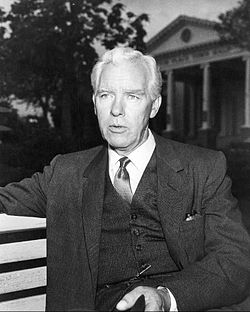
Warner Anderson (March 10, 1911 – August 26, 1976) was an American actor, best known for his starring roles in TV dramas The Lineup and Peyton Place.
Key Information


Early years
[edit]Anderson was born to "a theatrical family" in Brooklyn, New York, March 10, 1911.[1] He was a Republican.[2]
Film
[edit]Anderson had a small part in a film in 1915. A contemporary newspaper article about the movie Sunbeam, in which Anderson appeared in 1917, noted, "Warner Anderson is one of the cleverest children in motion pictures."[3] "He made his adult screen debut in This Is the Army in 1943.[1]
He had supporting parts in several films through the years. They included The Caine Mutiny, Blackboard Jungle, and Destination Tokyo.[4] Operation Burma with Errol Flynn.
Stage
[edit]Anderson's work on stage included Broadway appearances in Maytime (1917–1918), Happiness (1917–1918), Medea (1920), Within Four Walls (1923), Broken Journey (1942), and Remains to Be Seen (1951–1952).[5]
Radio
[edit]In the 1940s, Anderson was the announcer for The Bell Telephone Hour.[6]
Television
[edit]Anderson starred as Lt. Ben Guthrie in the TV series The Lineup,[7] which ran from 1954 to 1960. In syndication, reruns of The Lineup were broadcast under the title San Francisco Beat. His The Lineup costar was Tom Tully. Anderson played the same role in the 1958 film The Lineup.
He played newspaper publisher Matthew Swain on the TV series Peyton Place. He also served as the narrator at the beginning of each episode. He continued as narrator even after his character was written out of the series.[1]
Death
[edit]Anderson died August 26, 1976, at the age of 65, in a hospital in Santa Monica, California.[4] He was survived by his wife and a son.[8]
Partial filmography
[edit]- The Sunbeam (1916) as Bobby Rutherford
- This Is the Army (1943) as Kate Smith's Announcer (uncredited)
- Destination Tokyo (1943) as Andy
- Objective, Burma! (1945) as Col. J. Carter
- Dangerous Partners (1945) as Miles Kempen
- Her Highness and the Bellboy (1945) as Paul MacMillan
- Week-End at the Waldorf (1945) as Dr. Robert Campbell
- Abbott and Costello in Hollywood (1945) as Norman Royce
- My Reputation (1946) as Frank Everett
- Bad Bascomb (1946) as Luther Mason
- Faithful in My Fashion (1946) as Walter Medcraft
- Three Wise Fools (1946) as The O'Monahan
- The Arnelo Affair (1947) as Det. Sam Leonard
- The Beginning or the End (1947) as Captain William S. Parsons U.S.N.
- Dark Delusion (1947) as Teddy Selkirk
- Song of the Thin Man (1947) as Dr. Monolaw
- High Wall (1947) as Dr. George Poward
- Alias a Gentleman (1948) as Capt. Charlie Lopen
- Tenth Avenue Angel (1948) as Joseph Mills
- Command Decision (1948) as Colonel Earnest Haley
- The Lucky Stiff (1949) as Eddie Britt
- The Doctor and the Girl (1949) as Dr. George Esmond
- Destination Moon (1950) as Dr. Charles Cargraves
- Santa Fe (1951) as Dave Baxter
- Only the Valiant (1951) as Trooper Rutledge
- Go For Broke (1951) as Col. Charles W. Pence
- Bannerline (1951) as Roy
- Detective Story (1951) as Endicott Sims
- The Blue Veil (1951) as Bill Parker
- The Star (1952) as Harry Stone
- The Last Posse (1953) as Robert Emerson
- A Lion Is in the Streets (1953) as Jules Bolduc
- The Yellow Tomahawk (1954) as Major Ives
- The Caine Mutiny (1954) as Capt. Blakely
- Drum Beat (1954) as Gen. Canby
- The Violent Men (1954) as Jim McCloud
- Blackboard Jungle (1955) as Dr. Bradley
- A Lawless Street (1955) as Hamer Thorne
- The Lineup (1958) as Lt. Ben Guthrie
- Armored Command (1961) as Lt. Col. Wilson
- Rio Conchos (1964) as Col. Wagner
- The Bubble (1966) as Doctor (uncredited)
- Peyton Place (1964–1969, TV Series) as Narrator / Matthew Swain
- Bearcats! (1971, TV Series) as Mr. Huddleston
- The Rockford Files (1975, TV Series) as Alfred Bannister
References
[edit]- ^ a b c Aaker, Everett (2006). Encyclopedia of Early Television Crime Fighters. McFarland & Company, Inc. ISBN 978-0786464098. pp. 14–16.
- ^ Critchlow, Donald T. (2013). "When Hollywood Was Right: How Movie Stars, Studio Moguls, and Big Business Remade American Politics". Cambridge University Press. ISBN 978-0521199186. Retrieved July 29, 2017.
- ^ "At... The Star". The Daily Chronicle. October 3, 1917. p. 4. Retrieved October 22, 2015 – via Newspapers.com.

- ^ a b "Actor Warner Anderson dies". The Argus. August 28, 1976. p. 11. Retrieved October 23, 2015 – via Newspapers.com.
- ^ "Warner Anderson". Playbill Vault. Retrieved October 23, 2015.
- ^ Ranson, Jo (April 22, 1942). "Radio Dial Log". The Brooklyn Daily Eagle. p. 18. Retrieved October 23, 2015 – via Newspapers.com.
- ^ "Warner Anderson Lives His Role As Police Lieutenant". Ocala Star-Banner. October 24, 1958. p. 3. Retrieved June 5, 2011.
- ^ "Actor dies at age 65". Independent Press-Telegram. August 29, 1976. p. 209. Retrieved October 23, 2015 – via Newspapers.com.

External links
[edit]

Warner Anderson
View on GrokipediaEarly life
Family and upbringing
Warner Anderson was born on March 10, 1911, in Brooklyn, New York, into a theatrical family whose involvement in vaudeville and stage performances immersed him in the world of entertainment from childhood.[4][3] His family's profession in the performing arts offered early opportunities for exposure to theater and public performance, fostering his initial interest in acting amid the bustling cultural landscape of early 20th-century New York City.[4] Growing up in Brooklyn, Anderson attended local schools, including the Professional Children's School, which catered to young performers and supported his developing talents.[3][4]Initial entry into entertainment
Warner Anderson entered the entertainment industry as a child, leveraging his family's theatrical connections to secure early opportunities in both film and stage. Born into a family with ties to the performing arts, he began performing professionally at the age of five.[5] His film debut came in 1916 in The Sunbeam, directed by Edwin August, where he played Bobby Rutherford in a story centered on slum life and kindness; this role highlighted the expressive physicality required of child actors in the silent era, as dialogue was absent and performances relied on gestures and facial expressions to convey emotion.[6] Child performers like Anderson faced rigorous schedules on set, often working extended hours under the glare of primitive lighting and arc lamps, which posed physical strains such as eye fatigue and heat exhaustion, while the lack of child labor regulations in the nascent industry amplified these hardships.[6] Transitioning to the stage, Anderson made his Broadway debut at age six in the operetta Maytime (1917–1918), portraying Little Dick Wayne in Sigmund Romberg's production at the Shubert Theatre, which ran for 492 performances and showcased his singing and dancing abilities amid a cast including Peggy Wood.[7] He followed this with a role as a performer in the comedy Happiness (1917–1918) and then appeared as one of the children in Euripides' Medea (1920), translated by Gilbert Murray, demonstrating versatility in dramatic theater. Early Broadway for young actors involved intensive rehearsals and nightly shows, often requiring memorization of lines and cues without the safety nets of modern child protections, though family guidance provided essential support in navigating these environments.[8] As Anderson entered his pre-teen years in the early 1920s, his child acting career shifted due to his advancing age and evolving industry dynamics, including the rise of sound films that altered casting preferences for juveniles. He took a brief hiatus from Broadway after 1920, focusing instead on education at the Professional Children's School in New York City, an institution founded to accommodate working child artists with flexible scheduling for lessons between performances and tours. During this period, he performed in vaudeville and burlesque circuits as a teenager, gaining practical experience in smaller venues before returning to major stage roles in 1923.[9]Film career
Early silent and child roles
Warner Anderson entered the film industry as a child during the silent era, with a small uncredited role in a 1915 production starring Charles Ray.[3] His credited debut came at age five in the short drama The Sunbeam (1916), directed by Edwin Carewe. In this role, he played Bobby Rutherford, the young son of a tenement resident, in a sentimental story of slum dwellers uniting for a birthday celebration.[10] The film, produced by Rolfe Photoplays, highlighted Anderson's natural presence as a child performer amid a cast including Mabel Taliaferro, Helen Alexandria, and Maggie Breyer as Granny, capturing the era's interest in sentimental urban tales.[11] Despite this promising start, Anderson's film opportunities remained extremely limited throughout the 1910s and 1920s, with no additional credited roles during his childhood or adolescence; he instead pursued theater and vaudeville to hone his craft.[1] The arrival of sound films in the late 1920s offered little immediate prospects for Anderson, as the Great Depression curtailed production budgets and roles for young actors, contributing to his sparse screen presence in the pre-war years.[3]Adult roles in wartime and postwar films
Anderson's transition to adult roles in film began during World War II, with his debut in the wartime musical This Is the Army (1943), where he appeared as Kate Smith's announcer in a production that celebrated American military efforts through Irving Berlin's songs and sketches.[12] This marked his return to the screen after years away from child acting, leveraging his early experience to secure supporting parts in propaganda films that boosted morale. He followed this with a key role in Destination Tokyo (1943), directed by Delmer Daves, portraying Andy, the executive officer on a U.S. submarine mission to gather intelligence ahead of an air raid on Tokyo; the film, starring Cary Grant, was a commercial success, grossing over $3.6 million domestically and ranking among the top earners of the year.[13][14] Anderson's performance as a steadfast naval officer exemplified his emerging typecasting as reliable authority figures in military settings, a pattern seen in other WWII-era productions. In the postwar period, Anderson continued to embody authoritative characters, often in military or institutional contexts, as seen in The Caine Mutiny (1954), where he played Captain Blakely, the presiding officer at a pivotal court-martial; the film, adapted from Herman Wouk's novel, received critical acclaim for its tense drama and earned seven Academy Award nominations, including Best Picture, while becoming the second-highest-grossing film of 1954.[15] His role contributed to the ensemble's exploration of leadership and duty under pressure. Similarly, in Blackboard Jungle (1955), Anderson portrayed Dr. Bradley, a school administrator navigating urban educational challenges; the film sparked national controversy over its depiction of juvenile delinquency and featured the first use of rock 'n' roll in a major Hollywood picture ("Rock Around the Clock"), influencing youth culture and cinema's approach to social issues.[16] That same year, he appeared as Lieutenant Colonel Norton in To Hell and Back (1955), Audie Murphy's autobiographical war epic, further solidifying his association with military narratives.[17] Throughout the 1940s, Anderson appeared in multiple films annually, frequently as military personnel or officials, which established his niche in Hollywood's postwar output.[2] By the 1950s, as television's popularity surged, his film roles diminished, shifting his career toward broadcast work while occasionally returning to cinema for high-profile projects that highlighted his authoritative presence.[2]Stage career
Childhood Broadway appearances
Warner Anderson, born into a theatrical family in Brooklyn, New York, on March 10, 1911, began his Broadway career at the age of six with appearances in two simultaneous productions during the 1917-1918 season. In the operetta Maytime, composed by Sigmund Romberg with a libretto by Rida Johnson Young, he portrayed Little Dick Wayne, a young boy in the story's framing device set in the 1880s, appearing primarily in the third act; the show opened on August 16, 1917, at the Shubert Theatre and ran for 492 performances until October 19, 1918, becoming one of Broadway's longest-running musicals at the time.[7][3] Concurrently, Anderson performed in the musical Happiness, where he had a more substantial role, though unspecified in credits; this production opened on December 31, 1917, at the Criterion Theatre and continued until May 1918, for 136 performances.[18][3] These early roles immersed him in the vibrant New York theater scene of the late 1910s, characterized by lavish operettas and emerging revue styles influenced by the Ziegfeld Follies era.[19] By age nine, Anderson expanded into dramatic theater with a role as a child in the Euripides tragedy Medea, translated by Gilbert Murray and produced by Maurice Browne at the Garrick Theatre; he appeared from March 22, 1920, through April 1920, during its brief run of 14 performances.[8] Three years later, at age 12, he took on the role of John Minuit, a young character in a family drama, in Within Four Walls by Frederick Jackson and Vincent Lawrence, which opened on April 17, 1923, at the Selwyn Theatre and closed after 15 performances the same month.[20][21] These childhood performances, spanning musical and dramatic genres, showcased his versatility at a young age and were facilitated by his family's connections in the entertainment industry.[4] Anderson's early Broadway work received attention for its precocity, with his limited but notable presence in the hit Maytime highlighting his poise as a child performer amid established stars like Peggy Wood and Charles Purcell, contributing to his budding reputation in New York theater circles.[3][7] The dual commitments in Maytime and Happiness demonstrated his endurance, and these experiences laid the groundwork for his later ventures into vaudeville and burlesque as a teenager, shaping a stage style rooted in the energetic, ensemble-driven traditions of the period.[22][3]Adult stage performances
After a period focused on film during the 1930s and early 1940s, Warner Anderson returned to Broadway in the drama Broken Journey (1942), portraying Dan Hardeen in a three-act play by Andrew Rosenthal that explored interpersonal tensions amid crisis.[23] The production, directed by Arthur Hopkins at Henry Miller's Theatre, opened on June 23, 1942, and ran for 23 performances, marking Anderson's first major adult stage role following his juvenile appearances.[19] Co-starring Edith Atwater as Christina Landers and Zita Johann as Rachel Thatcher Arlen, the play received limited attention amid wartime theater constraints but showcased Anderson's transition to mature dramatic parts.[24] Anderson's most prominent adult Broadway appearance came nearly a decade later in the comedy-mystery Remains to Be Seen (1951–1952), where he starred as Dr. Charles Gresham, a physician entangled in a Park Avenue murder investigation. Written by Howard Lindsay and Russel Crouse and produced by Leland Hayward, the play opened on October 3, 1951, at the Morosco Theatre and enjoyed a solid run of 199 performances, blending lighthearted suspense with character-driven humor around suspects gathered after the death of an eccentric anti-vice crusader.[25] Anderson shared the stage with a notable ensemble, including Dorothy Lovett as the aspiring singer Jody Revere, Jackie Cooper as apartment manager Waldo Williams, Janis Paige as the enigmatic Valeska, and Howard Lindsay in the dual role of author and character Benjamin Goodman.[26] The New York Times described the production as a "boyish mystery-comedy full of gusto," praising its energetic tone while noting it fell short of the authors' prior hits like Arsenic and Old Lace.[25] During the mid-20th century, Anderson's stage work remained selective, with Remains to Be Seen serving as his final Broadway credit and reflecting a deliberate balance against his rising commitments in film and emerging television.[19] This role highlighted his commanding presence in live theater, drawing on the foundational experience of his childhood Broadway debuts to inform his poised, authoritative delivery in ensemble-driven narratives.[27]Broadcasting career
Radio work
Warner Anderson transitioned to radio broadcasting in the 1940s after his early career in theater, vaudeville, and burlesque in the 1920s and early 1930s. He had debuted as a child performer in silent films and Broadway shows like Maytime during World War I, before appearing in adult films such as This Is the Army (1943). His move to radio capitalized on his resonant baritone voice and theatrical experience, marking a natural extension of his performance career into the audio-only format dominant before television's rise.[28] During the 1940s, Anderson primarily worked as the announcer for The Bell Telephone Hour, a long-running NBC Radio Network concert series that debuted on April 29, 1940, and continued until June 30, 1958. The program followed a musical variety format, often structured around thematic celebrations of seasons, holidays, musical genres, or tributes to notable figures, featuring live orchestral performances, soloists, and choral pieces. Anderson introduced segments, narrated transitions, and delivered Bell System advertisements, as heard in broadcasts like the October 28, 1940, episode with tenor James Melton and soprano Francia White, backed by the Bell Telephone Hour Orchestra and Chorus under conductor Donald Voorhees. Other notable episodes included the March 17, 1941, airing, which showcased Irish folk songs, waltzes, and operetta excerpts in a 30-minute live format.[29][30][31] In addition to announcing, Anderson appeared as an actor in various radio dramas and serials spanning the 1930s to 1950s, drawing on his dramatic training to portray characters in the era's audio narratives, for instance, portraying Pat Ryan in the adventure serial Terry and the Pirates during the 1940s. These roles, though less documented than his later television work, underscored his versatility in the medium during radio's Golden Age, a period from roughly 1930 to 1955 when live broadcasts peaked in popularity and cultural influence.[28][32] Radio's technical demands, including live scripting from cue sheets and instantaneous delivery without editing, honed Anderson's vocal precision and timing, essential for engaging audiences reliant solely on sound. This experience built his distinctive voice recognition among listeners, facilitating his broader broadcasting career arc into the emerging medium of television.[32][28]Television roles and series
Anderson began his television career in the early 1950s with hosting duties on the medical anthology series The Doctor (1952–1953), where he introduced episodes focusing on emotional and psychological issues faced by patients and physicians, though he rarely acted in the stories themselves.[33] He also made guest appearances in prominent live anthology programs of the era, including Studio One and Kraft Television Theatre, contributing to dramatic sketches and adaptations that showcased his versatile baritone voice and authoritative presence.[1] Anderson achieved widespread recognition in television through his starring role as Detective Lieutenant Ben Guthrie in the police procedural The Lineup (1954–1960), a CBS series adapted from its radio predecessor of the same name, which had aired from 1950 to 1953.[34] The show centered on Guthrie and his partner, Inspector Matt Grebb (played by Tom Tully), investigating crimes based on real cases from the San Francisco Police Department files, emphasizing procedural details and urban pursuits in a gritty, location-shot format set in San Francisco.[35] Over its six seasons, The Lineup produced 201 episodes, with Anderson appearing in all of them, transitioning the audio-only radio concept to visual storytelling while maintaining its focus on methodical detective work.[34] Later in his career, Anderson portrayed newspaper editor Matthew Swain in the prime-time soap opera Peyton Place (1964–1969) on ABC, appearing as a regular cast member during the first season before continuing as the series' narrator through its entire run of 514 episodes.[36] As Swain, the owner and editor of the Peyton Place Clarion, Anderson's character served as a moral compass and chronicler of the small New England town's scandals, secrets, and interpersonal dramas, often framing episodes with voiceover recaps that heightened the serialized tension in this pioneering twice-weekly format inspired by Grace Metalious's novel.[37] His narration provided continuity across the soap's evolving storylines of romance, betrayal, and social hypocrisy, underscoring Swain's role as an observant elder statesman intertwined with key residents' arcs. These television roles significantly elevated Anderson's fame, with The Lineup ranking among the top 20 Nielsen-rated programs in the 1956–1957 season and establishing him as a reliable lead in procedural dramas, while Peyton Place helped pioneer the prime-time serial genre, drawing up to 18 million viewers at its 1964 debut and influencing subsequent soaps through its bold exploration of taboo subjects.Personal life and death
Marriage and family
Warner Anderson married Leeta Anderson, a fellow stage actress, in 1937, and the couple remained together until his death almost 40 years later.[4] They shared a family life in California, where Anderson had relocated from his native New York to pursue opportunities in film and theater.[3] The couple had one son, Michael, born during their marriage.[3] At the time of Anderson's passing, the family resided in Santa Monica, California.[3]Illness and death
In the mid-1970s, Warner Anderson's health deteriorated due to cancer, a condition linked to his lifelong smoking habit, prompting his retirement from acting after his final television role in 1975.[4][1][38] He passed away on August 26, 1976, at the age of 65, in a Santa Monica hospital.[3] His remains were cremated, with ashes scattered at sea.[4] Anderson was survived by his wife, Leeta Anderson, a stage actress to whom he had been married since 1937, and their son, Michael. His death was reported in major outlets including The New York Times.[3][4] His passing drew immediate recognition from the entertainment community, with obituaries highlighting his versatile career in film and television, as noted in contemporary press coverage.[3]Legacy and filmography
Cultural impact and recognition
Warner Anderson portrayed Lieutenant Ben Guthrie in the CBS police procedural The Lineup (1954–1960).[39] In Peyton Place (1964–1969), Anderson's role as Matthew Swain, the wise newspaper editor and narrator, provided a stabilizing voice amid the series' exploration of small-town scandals, adultery, and social taboos, helping to anchor the narrative as the first successful prime-time soap opera.[40] The show's groundbreaking twice-weekly format and indirect handling of sensitive topics under censorship constraints shattered television conventions, paving the way for serialized dramas and modern soaps by normalizing ongoing storylines in prime time.[41] While Peyton Place received Emmy nominations for its production and guest performances, Anderson's contributions were recognized through his billing among the top cast members, underscoring his role in bridging moral authority with dramatic tension.[41] Posthumously, Anderson's work in The Lineup has been referenced in television histories as emblematic of mid-century genre evolution, cited in analyses of police procedurals' shift toward urban realism.[42] His portrayals of authoritative figures continue to be noted in discussions of typecasting in classic TV, highlighting how actors like him shaped audience perceptions of law, ethics, and community leadership in post-war media.[39] As of 2025, Anderson's key series remain largely unavailable on major streaming platforms, with The Lineup not offered for subscription or rental, though select episodes circulate on YouTube.[43] Similarly, Peyton Place episodes are accessible via fan-uploaded YouTube content rather than official archives, limiting broader rediscovery but preserving cultural relevance through niche online preservation efforts.[44]Selected filmography
Warner Anderson appeared in more than 50 films and over 60 television productions across his career spanning from the silent era to the 1970s.[45][3]| Year | Title | Role |
|---|---|---|
| 1916 | The Sunbeam | Bobby Rutherford[1] |
| 1943 | Destination Tokyo | Andy Walker[13] |
| 1943 | This Is the Army | Kate Smith's Announcer (uncredited)[46] |
| 1945 | Objective, Burma! | Sgt. Miles[5] |
| 1946 | My Reputation | Frank Everett |
| 1950 | Destination Moon | Dr. Charles Cargraves[47] |
| 1951 | Go for Broke! | Col. Charles W. Pence |
| 1951 | Detective Story | Endicott Sims[48] |
| 1951 | Only the Valiant | Trooper Rutledge |
| 1954 | The Caine Mutiny | Capt. Blakely[15] |
| 1955 | Blackboard Jungle | Dr. Bradley |
| 1955 | A Lawless Street | Hamer Thorne |
| 1955 | The Violent Men | Jim McCloud |
| 1964 | Rio Conchos | Col. Wagner |
Selected Television Roles
- The Lineup (1954–1960) – Lt. Ben Guthrie
- Peyton Place (1964–1969) – Matthew Swain
- Ironside (1973) – Matty Millane (guest role)[45]
- Mannix (1972) – Prof. Thompson (guest role)[45]
- The Rockford Files (1974) – Alfred Bannister (guest role)