Hubbry Logo
Web applicationWeb applicationMain
Open search
Web application
Community hub
Web application
logo
8 pages, 0 posts
0 subscribers
Be the first to start a discussion here.
Web application
Web application
from Wikipedia

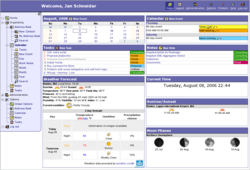
Screenshot from 2007 of Horde, a groupware and open-source web application

A web application (or web app) is application software that is created with web technologies and runs via a web browser.[1][2] Web applications emerged during the late 1990s and allowed for the server to dynamically build a response to the request, in contrast to static web pages.[3]

Web applications are commonly distributed via a web server. There are several different tier systems that web applications use to communicate between the web browsers, the client interface, and server data. Each system has its own uses as they function in different ways. However, there are many security risks that developers must be aware of during development; proper measures to protect user data are vital.

Web applications are often constructed with the use of a web application framework. Single-page applications (SPAs) and progressive web apps (PWAs) are two architectural approaches to creating web applications that provide a user experience similar to native apps, including features such as smooth navigation, offline support, and faster interactions.

Web applications are often fully hosted on remote cloud services, can require a constant connection to them, and can replace conventional desktop applications for operating systems such as Microsoft Windows, thus facilitating the operation of software as a service as it grants the developer the power to tightly control billing based on use of the remote services as well as vendor lock-in by hosting data remotely. Modern browsers such as Chrome offer sandboxing for every browser tab which improves security and restricts access to local resources. No software installation is required as the app runs within the browser which reduces the need for managing software installations. With the use of remote cloud services, customers do not need to manage servers as that can be left to the developer and the cloud service and can use the software with a relatively low power, low-resource PC such as a thin client. The source code of the application can stay the same across operating systems and devices of users with the use of responsive web design, since it only needs to be compatible with web browsers which adhere to web standards, making the code highly portable and saving on development time. Numerous JavaScript frameworks and CSS frameworks facilitate development.

History

[edit]

The concept of a "web application" was first introduced in the Java language in the Servlet Specification version 2.2, which was released in 1999. At that time, both JavaScript and XML had already been developed, but the XMLHttpRequest object had only been recently introduced on Internet Explorer 5 as an ActiveX object.[citation needed] Beginning around the early 2000s, applications such as "Myspace (2003), Gmail (2004), Digg (2004), [and] Google Maps (2005)," started to make their client sides more and more interactive. A web page script is able to contact the server for storing/retrieving data without downloading an entire web page. The practice became known as Ajax in 2005. Eventually this was replaced by web APIs using JSON, accessed via JavaScript asynchronously on the client side.

In earlier computing models like client-server, the processing load for the application was shared between code on the server and code installed on each client locally. In other words, an application had its own pre-compiled client program which served as its user interface and had to be separately installed on each user's personal computer. An upgrade to the server-side code of the application would typically also require an upgrade to the client-side code installed on each user workstation, adding to the support cost and decreasing productivity. Additionally, both the client and server components of the application were bound tightly to a particular computer architecture and operating system, which made porting them to other systems prohibitively expensive for all but the largest applications.

Later, in 1995, Netscape introduced the client-side scripting language called JavaScript, which allowed programmers to add dynamic elements to the user interface that ran on the client side. Essentially, instead of sending data to the server in order to generate an entire web page, the embedded scripts of the downloaded page can perform various tasks such as input validation or showing/hiding parts of the page.

"Progressive web apps", the term coined by designer Frances Berriman and Google Chrome engineer Alex Russell in 2015, refers to apps taking advantage of new features supported by modern browsers, which initially run inside a web browser tab but later can run completely offline and can be launched without entering the app URL in the browser.

Structure

[edit]

Traditional PC applications are typically single-tiered, residing solely on the client machine. In contrast, web applications inherently facilitate a multi-tiered architecture. Though many variations are possible, the most common structure is the three-tiered application. In its most common form, the three tiers are called presentation, application and storage. The first tier, presentation, refers to a web browser itself. The second tier refers to any engine using dynamic web content technology (such as ASP, CGI, ColdFusion, Dart, JSP/Java, Node.js, PHP, Python or Ruby on Rails). The third tier refers to a database that stores data and determines the structure of a user interface. Essentially, when using the three-tiered system, the web browser sends requests to the engine, which then services them by making queries and updates against the database and generates a user interface.

The 3-tier solution may fall short when dealing with more complex applications, and may need to be replaced with the n-tiered approach; the greatest benefit of which is how business logic (which resides on the application tier) is broken down into a more fine-grained model.[4] Another benefit would be to add an integration tier, which separates the data tier and provides an easy-to-use interface to access the data.[4] For example, the client data would be accessed by calling a "list_clients()" function instead of making an SQL query directly against the client table on the database. This allows the underlying database to be replaced without making any change to the other tiers.[4]

There are some who view a web application as a two-tier architecture. This can be a "smart" client that performs all the work and queries a "dumb" server, or a "dumb" client that relies on a "smart" server.[4] The client would handle the presentation tier, the server would have the database (storage tier), and the business logic (application tier) would be on one of them or on both.[4] While this increases the scalability of the applications and separates the display and the database, it still does not allow for true specialization of layers, so most applications will outgrow this model.[4]

Security

[edit]

Security breaches on these kinds of applications are a major concern because it can involve both enterprise information and private customer data. Protecting these assets is an important part of any web application, and there are some key operational areas that must be included in the development process.[5] This includes processes for authentication, authorization, asset handling, input, and logging and auditing. Building security into the applications from the beginning is sometimes more effective and less disruptive in the long run.

Development

[edit]

Writing web applications is simplified with the use of web application frameworks. These frameworks facilitate rapid application development by allowing a development team to focus on the parts of their application which are unique to their goals without having to resolve common development issues such as user management.[6]

In addition, there is potential for the development of applications on Internet operating systems, although currently there are not many viable platforms that fit this model.[citation needed]

See also

[edit]

References

[edit]
[edit]
Revisions and contributorsEdit on WikipediaRead on Wikipedia
from Grokipedia
A web application, commonly referred to as a web app, is software that runs on a and is accessed by users through a over a network, such as the or an , utilizing protocols like HTTP or to deliver dynamic content and interactive functionality. Unlike static websites, web applications process user inputs, interact with databases, and generate responses in formats such as , CSS, , or , enabling features like real-time updates and personalized experiences without requiring software installation on the client device. This client-server separates the user , handled by the browser, from the backend logic and managed by the server. The development of web applications traces its roots to the invention of the in 1989 by at , where the first and browser were implemented in 1990, and the system became publicly available in 1991. Early web applications emerged in 1993 with the introduction of the (CGI) by the (NCSA), which allowed web servers to execute external programs for generating dynamic content. Subsequent milestones included the release of in 1995 for client-side scripting, server-side languages like in 1995, and the coining of AJAX (Asynchronous JavaScript and XML) in 2005 by Jesse James Garrett, which revolutionized interactive web experiences by enabling partial page updates without full reloads. Modern web applications leverage a stack of technologies including frontend frameworks like React or for user interfaces, backend frameworks such as Django or for server logic, and APIs for data exchange, often adhering to standards from the W3C and IETF. They power diverse services from platforms to social networks, emphasizing security through practices like encryption and input validation to mitigate vulnerabilities such as (XSS). Recent advancements include progressive web apps (PWAs), introduced around 2015, which combine web technologies with native app-like features such as offline access and push notifications.

Introduction

Definition

A web application, often abbreviated as web app, is application software that is stored on a remote server and delivered over the to a user's device, where it runs within a interface via protocols such as HTTP or . This client-server model enables the delivery of dynamic, interactive content without the need for local installation or downloads on the user's device. Unlike traditional desktop applications, web applications rely on the browser to handle execution, rendering, and user interactions. Core attributes of web applications include their browser-based execution, which promotes cross-platform accessibility across various devices and operating systems through adherence to web standards such as for content structure, CSS for presentation, and for dynamic behavior. The underlying HTTP protocol is inherently stateless, treating each request as independent unless explicit mechanisms, like sessions or , are implemented to maintain user context across interactions. This design facilitates scalability and simplicity in deployment, as updates occur centrally on the server without user intervention. Representative examples of web applications include email services like , which provide real-time messaging and attachment handling, and collaborative document editors such as , enabling multiple users to edit content simultaneously in a browser. Web applications emerged as an from early static web pages, which primarily displayed fixed content, to more sophisticated interactive software that supports complex user experiences over the network.

Key Characteristics

Web applications exhibit platform independence by executing within any modern , irrespective of the underlying operating system or hardware, due to adherence to universal web standards such as , CSS, and . This is facilitated by the Working Group's specifications, which ensure consistent rendering and functionality across diverse devices, from desktops to mobiles, without requiring platform-specific installations. As a result, developers can target a broad audience with a single , reducing fragmentation and promoting widespread . A core trait of web applications is their support for dynamic interactivity, enabling real-time content updates without necessitating full page reloads, primarily through Asynchronous JavaScript and XML (AJAX) technology. AJAX allows client-side scripts to exchange data with servers asynchronously, refreshing only specific page elements to deliver seamless user experiences, such as auto-completing form fields or loading dynamic feeds. This approach enhances responsiveness and reduces latency compared to traditional synchronous models, forming the foundation for modern interactive features in applications like collaborative editing tools. Web applications are inherently designed for , accommodating distributed access from numerous users by leveraging server-side resources to manage variable loads efficiently. Through horizontal scaling techniques, additional server instances can be provisioned dynamically to distribute , ensuring reliable during peak usage without compromising . Cloud platforms further amplify this by providing elastic infrastructure that automatically adjusts resources based on demand, allowing applications to handle global audiences effectively. Accessibility is a fundamental characteristic, with web applications adhering to (WCAG) to ensure inclusive design for users with disabilities, including provisions for responsive layouts that adapt to various screen sizes and input methods. WCAG 2.2 emphasizes perceivable, operable, understandable, and robust content, mandating features like sufficient contrast, keyboard navigation, and reflowable layouts to support mobile and assistive technologies. This compliance not only broadens user reach but also aligns with legal standards in many regions, promoting equitable digital experiences. Despite these strengths, web applications face limitations, including a primary dependency on connectivity for core operations, which can disrupt functionality in offline scenarios unless augmented by advanced caching mechanisms. Additionally, browser compatibility issues arise from varying implementations of web standards across engines like Blink, , and , potentially leading to inconsistent rendering or feature support that requires polyfills or testing. These constraints highlight the need for strategies to mitigate reliability gaps in diverse environments.

History

Early Development

The early , emerging in the early , relied primarily on static pages for content delivery, consisting of simple text, hyperlinks, and basic formatting served directly from web servers without dynamic processing. This static model limited interactivity, as pages were pre-authored and unchanged during user sessions. The transition to basic server-side processing began in 1993 with the introduction of the (CGI) by the (NCSA), enabling web servers to execute external scripts—often in —to generate dynamic content in response to user requests. CGI scripts facilitated early form processing and database queries, marking the foundational shift from purely static sites to rudimentary web applications. Key innovations in the mid-1990s further advanced client- and server-side capabilities. In May 1995, introduced , developed by , as a lightweight for client-side within the browser, allowing dynamic updates to page elements without server round-trips. On the server side, announced Java servlets in May 1996, with the specification finalized as version 1.0 in June 1997, providing a platform-independent API for handling HTTP requests and generating dynamic responses in . Building on this, JavaServer Pages (JSP) emerged in late 1999 as an extension of servlet technology, enabling developers to embed Java code directly into HTML-like templates for simplified server-side rendering of dynamic web content. Among the first notable web applications were prototypes in and simple . In May 1995, Wells Fargo launched the first U.S. bank internet service, allowing customers free access to checking and savings account balances via a secure web interface. Late in the decade, e-commerce sites like Amazon (launched July 1995 as an online bookstore) and (September 1995 as an auction platform) demonstrated practical web applications, using CGI and early scripting to process orders, manage inventories, and handle user interactions over HTTP. Development faced significant challenges, including limited bandwidth from dial-up connections that restricted media-rich content and prolonged load times. Browser inconsistencies exacerbated issues, as competing implementations of and scripting standards led to fragmented rendering across platforms. This rivalry culminated in the "" of 1995–2001, primarily between and Microsoft's , where proprietary extensions and non-compliance with standards hindered cross-browser compatibility and slowed web application adoption.

Evolution and Modern Milestones

The evolution of web applications entered a transformative phase with the advent of , a concept popularized by in 2005 to describe interactive platforms emphasizing and collaboration, building on earlier static web foundations. This era marked a shift toward dynamic, participatory experiences, exemplified by the launch of social platforms like , which opened to the general public on September 26, 2006, enabling widespread sharing and networking. Similarly, Twitter's public debut on July 15, 2006, introduced real-time , further accelerating user-driven content creation and social connectivity in web applications. A pivotal milestone came in 2005 with the coining of "AJAX" by Jesse James Garrett, referring to Asynchronous and XML techniques that allowed web applications to update content dynamically without full page reloads, revolutionizing interactivity. Early adopters like , launched on April 1, 2004, and on February 8, 2005, demonstrated AJAX's potential for seamless, responsive interfaces, such as real-time search and map panning, setting the stage for richer user experiences. By the mid-2010s, the focus shifted to mobile and responsive design, with achieving W3C Recommendation status on October 28, 2014, introducing native support for offline storage, multimedia, and geolocation to enhance cross-device compatibility. This paved the way for Progressive Web Apps (PWAs), formalized in June 2015 by Google engineers Alex Russell and Frances Berriman as web applications leveraging service workers for app-like reliability and offline functionality. In the late and , web applications embraced single-page applications (SPAs) and cloud-native architectures for and . Facebook's React library, open-sourced on May 29, 2013, popularized component-based SPAs, enabling faster rendering and modular development adopted by platforms like and . Concurrently, AWS Lambda's launch on November 13, 2014, introduced , allowing developers to build event-driven web backends without managing servers, which facilitated cloud-integrated applications for and data processing. The in 2020 accelerated this trend, with remote tools like video conferencing and collaborative platforms seeing explosive growth—telework accounted for about 50% of paid work hours from April to December 2020, driving demand for robust web-based solutions. Recent milestones reflect integration of advanced technologies for enhanced intelligence and performance. OpenAI's web interface, released on November 30, 2022, exemplified AI-driven web applications, offering conversational interfaces that process queries directly in browsers and influencing tools for content generation and . By 2025, has gained widespread adoption in web applications, processing data closer to users to achieve low-latency experiences in real-time scenarios like streaming and IoT, with global spending projected to reach $260 billion. These developments underscore web applications' progression toward seamless, intelligent, and distributed systems.

Architecture

Client-Side Components

Client-side components in web applications encompass the technologies and mechanisms that execute within the user's to render content, manage interactions, and handle local data. These elements form the front-end layer, enabling dynamic user experiences without requiring constant server involvement. At the core of rendering are , which provides the structural foundation for web pages through semantic elements and forms; CSS3, which handles visual styling, layout, and animations via modules like Flexbox and Grid; and JavaScript engines such as V8, which compile and execute client-side scripts for enhanced interactivity. User interface functionality relies on the (DOM), a platform-neutral representation of the document's structure that allows to manipulate elements, attributes, and content dynamically. For instance, developers can add, remove, or modify nodes in the DOM tree to update the page in real-time. Interactivity is facilitated through event handling, where the browser dispatches events like clicks or key presses to registered handlers, enabling responsive behaviors such as form validation or menu toggles. Client-side data persistence is achieved via storage APIs that allow web applications to store user data locally without server round-trips. LocalStorage offers a simple key-value store for up to 5-10 MB of string data per origin, persisting across browser sessions until explicitly cleared. For more complex needs, IndexedDB provides a full database interface supporting structured objects, transactions, and indexes, suitable for offline applications handling larger datasets like cached media. To optimize performance, techniques like defer the fetching of non-essential resources, such as images below the fold, until they enter the , reducing initial page weight and improving load times. Code splitting further enhances efficiency by dividing bundles into smaller chunks loaded on demand—via dynamic imports—minimizing parsing and execution overhead for large applications. These methods can significantly cut first-contentful-paint times.

Server-Side Components

Server-side components constitute the backend infrastructure of web applications, processing incoming requests from clients, executing core logic, and maintaining through secure, server-hosted operations. These elements operate independently of the user's device, leveraging server resources for tasks that demand and computational power, such as database queries and algorithmic . In multi-tier architectures, they form the middle layer, bridging user interactions with persistent storage. Application servers serve as the primary core engines for handling HTTP requests, enabling the deployment and execution of web application code. Node.js functions as a JavaScript runtime environment built on Chrome's V8 engine, offering an asynchronous, event-driven model that supports non-blocking I/O for efficient management of concurrent connections in scalable network applications. This design allows Node.js to handle thousands of simultaneous requests with minimal overhead, making it suitable for real-time features like chat systems or API endpoints. Apache Tomcat, an open-source implementation of the Jakarta Servlet and Jakarta Server Pages specifications, acts as a lightweight for Java-based web applications, processing HTTP requests and deploying applications as web archive () files. It supports enterprise-level features, including session tracking and security realms, under the Apache License 2.0, and is widely used for mission-critical systems due to its robustness and extensibility. Business logic resides on the server side, where scripting languages and frameworks manage computations, input validation, and workflow orchestration to ensure reliable application behavior. , a for "PHP: Hypertext Preprocessor," is a language designed for , embedding directly into to dynamically generate content, perform server-side validations, and interact with databases like for tasks such as user authentication and . Its interpreted nature allows for and execution of complex logic without compilation. Python, often utilized with frameworks like Django, provides a versatile environment for implementing server-side through high-level abstractions for , templating, and object-relational mapping. Django, a free and open-source framework, promotes the development of maintainable applications by enforcing the model-view-controller pattern, handling computations like data aggregation and validation with built-in security features against common vulnerabilities such as . This approach reduces and accelerates the creation of data-driven web backends. Session management on the server side preserves user state across stateless HTTP interactions, primarily through cookies and tokens to track authentication and preferences without exposing sensitive data to the client. Cookies, as standardized in RFC 6265, enable servers to issue session identifiers via the Set-Cookie header, which browsers store and return in subsequent Cookie headers, supporting attributes like Secure (for HTTPS-only transmission) and HttpOnly (to block client-side script access) for enhanced protection against interception and XSS attacks. Non-persistent cookies with short expiration times are preferred for temporary sessions, ensuring automatic cleanup upon browser closure. Tokens complement cookies by serving as opaque identifiers or self-contained claims (e.g., Web Tokens), generated with cryptographically secure pseudorandom number generators to bind user credentials to requests and enforce access controls. recommends tokens with at least 64 bits of , periodic renewal (e.g., after or privilege changes), and timeouts—such as 2-30 minutes for idle sessions and 4-8 hours absolute—to mitigate fixation and hijacking risks, while storing no sensitive information client-side. Integration points with third-party services occur via APIs, allowing server-side components to consume external resources like providers or gateways without duplicating functionality. Secure integration employs protocols such as OAuth 2.0 for delegated access, with server-side validation of responses to prevent unauthorized data exposure, and modular implementations (e.g., using libraries in Python or ) to isolate dependencies and facilitate updates. This approach enhances application extensibility while adhering to best practices like and to manage reliability and security challenges.

Communication and Data Layers

Web applications rely on standardized protocols to facilitate communication between client and server components, enabling efficient exchange over the . The primary protocols for most modern web interactions are , introduced in 2015, and , standardized in 2022, both of which support multiplexing to allow multiple requests and responses over a single connection, reducing latency compared to HTTP/1.1. uses the transport protocol over UDP for improved performance in lossy networks and faster connection establishment. As of November 2025, is used by approximately 36% of websites, surpassing 's 34% adoption. For real-time bidirectional communication, WebSockets provide a persistent, full-duplex channel that upgrades from an HTTP connection, allowing servers to push updates to clients without repeated polling. To ensure confidentiality and integrity during transmission, is universally adopted, layering (TLS) over HTTP to encrypt payloads and authenticate endpoints. Data exchanged via these protocols is typically structured in formats like or XML to ensure interoperability across diverse systems. , a lightweight, human-readable format based on JavaScript object notation, has become the de facto standard for payloads due to its simplicity and native support in modern programming languages. XML, while more verbose, remains relevant for legacy systems and scenarios requiring schema validation, such as SOAP-based web services. These formats underpin designs, including RESTful architectures that use standard HTTP methods (e.g., GET, ) for stateless, resource-oriented interactions, promoting and ease of integration. , an alternative developed by in 2012 and open-sourced in 2015, allows clients to request precisely the data needed in a single query, minimizing over-fetching and under-fetching common in . In the persistence layer, web applications integrate databases to store and retrieve data reliably. Relational databases like , which implements the SQL standard for structured querying and transactions, are ideal for applications requiring complex joins and data consistency. NoSQL databases such as , using a document-oriented model with JSON-like storage, excel in handling unstructured or at scale, supporting horizontal distribution for high-velocity workloads. These databases connect to the via drivers or object-relational mappers, forming the backbone for data durability beyond volatile sessions. To optimize performance and reduce load times, web applications employ caching strategies, particularly content delivery networks (CDNs) for distributing static assets like images, scripts, and stylesheets globally. CDNs cache content at edge servers closer to users, leveraging protocols like for efficient delivery and mitigating bandwidth bottlenecks. Client-side storage mechanisms, such as localStorage, can complement this by persisting small amounts of data in the browser for offline access.

Development

Technologies and Frameworks

Web applications are constructed using a variety of programming languages, libraries, and frameworks that handle client-side rendering, server-side logic, and integration between the two. These technologies have evolved to support dynamic, interactive experiences while optimizing for performance and scalability. Modern stacks typically combine front-end frameworks for user interfaces with back-end runtimes for data processing, often leveraging as a unifying across tiers.

Front-End Technologies

Front-end development primarily relies on and its ecosystems to create responsive user interfaces. React, released in 2013 by , is a declarative library that uses a to efficiently update UI components, enabling reusable code for complex applications. , introduced in 2014 by Evan You, offers a progressive framework with a lightweight core that can scale from simple scripts to full-featured applications, emphasizing ease of integration and a reactive . Angular, originating as in 2010 from , provides a comprehensive framework with two-way data binding and , though its 2016 rewrite shifted to a component-based architecture using . , developed by in 2012, enhances with static typing to catch errors early and improve code maintainability in large-scale web projects.

Back-End Technologies

Back-end technologies manage server-side operations, including API handling and database interactions. Node.js, launched in 2009 by Ryan Dahl, is a JavaScript runtime built on Chrome's V8 engine, allowing asynchronous, event-driven programming for scalable network applications. Ruby on Rails, created in 2004 by David Heinemeier Hansson, is a full-stack web framework for Ruby that follows the model-view-controller pattern, promoting rapid development through conventions like "convention over configuration." Spring Boot, released in 2014 as part of the Spring Framework for Java, simplifies microservices and enterprise applications by auto-configuring dependencies and embedding servers for standalone deployment. Serverless options like AWS Lambda, introduced in 2014 by Amazon Web Services, enable function-as-a-service execution without managing infrastructure, automatically scaling to handle variable loads for event-driven web back-ends.

Full-Stack Technologies

Full-stack solutions integrate front-end and back-end components into cohesive stacks, often centered on . The MERN stack combines for databases, for server routing, React for UI, and for runtime, facilitating isomorphic development where code runs on both client and server. The MEAN stack similarly uses , , Angular for the front-end, and , supporting real-time applications through its end-to-end approach. Progressive frameworks like , developed in by Zeit (now ), extend React with server-side rendering and static site generation, optimizing for SEO and performance in full-stack web apps.

Emerging Technologies

Established tools like (Wasm), standardized in 2017 by the W3C, continue to enable high-performance applications by compiling languages such as C++ and to run at near-native speeds in browsers for tasks like image processing or games. Similarly, AI and machine learning libraries such as TensorFlow.js, released in 2018 by , support browser-based model training and inference using for privacy-preserving features like real-time . As of 2025, emerging advancements include , a graphics and compute API proposed by the W3C in 2021 and gaining widespread browser support, which allows developers to harness the system's GPU for complex 3D rendering, simulations, and accelerated machine learning directly in web applications without plugins. Additionally, AI-powered development tools, such as code generation assistants integrated into editors (e.g., enhancements), are automating aspects of web app creation, from code completion to debugging, to boost developer productivity.

Processes and Methodologies

The development of web applications typically follows a lifecycle (SDLC) that ensures systematic progression from initial conceptualization to a functional product. This lifecycle encompasses key phases such as requirements gathering, , , and testing, adapting traditional models to the dynamic nature of web technologies. Requirements gathering initiates the process by identifying user needs, business objectives, and technical constraints through stakeholder interviews, surveys, and analysis of existing systems. This phase establishes functional requirements, such as user authentication features, and non-functional ones, like performance benchmarks, serving as the foundation for subsequent stages. In web application contexts, this often involves prioritizing responsive elements to support diverse devices. The design phase builds on gathered requirements by creating wireframes, prototypes, and architectural blueprints that outline user interfaces, data flows, and system interactions. Wireframing tools help visualize layouts, while emphasizing principles—such as perceivable, operable, understandable, and robust content—ensures inclusivity from the outset, aligning with (WCAG). For instance, designers incorporate keyboard navigation and resizable text alternatives early to accommodate users with disabilities. Implementation, or the coding phase, translates designs into executable code, integrating client-side and server-side components to build the application's core functionality. Developers adhere to modular coding practices to facilitate and . Testing follows implementation, encompassing unit tests to verify individual components and integration tests to ensure seamless interactions between modules, such as API endpoints and frontend rendering. Automated testing frameworks are commonly employed to detect issues early, reducing defects in production. Methodologies like Agile and Scrum promote iterative development, allowing teams to deliver incremental value through short cycles known as sprints, typically lasting two to four weeks. In Agile, principles such as customer collaboration and responding to change over rigid planning guide web application projects, enabling frequent feedback and adaptation to evolving user needs. Scrum, a framework within Agile, structures these iterations with defined roles (e.g., product owner, scrum master), events (e.g., daily stand-ups, sprint reviews), and artifacts (e.g., ), fostering transparency and continuous improvement in workflows. DevOps methodologies extend these practices by integrating development and operations through pipelines, automating build, test, and deployment processes to accelerate releases while maintaining quality. In web applications, CI/CD ensures that code changes are automatically validated and merged, minimizing manual errors and supporting rapid iterations. Version control systems, particularly , underpin these methodologies via structured workflows and branching strategies that enable parallel development without conflicts. Common strategies include feature branching, where developers create isolated branches for new features before merging into a main branch via pull requests, and Gitflow, which uses dedicated branches for development, releases, and hotfixes to manage complexity in team environments. These approaches, often paired with code reviews, enhance collaboration and code stability. Collaboration in web application development, especially for remote teams, relies on integrated tools that facilitate real-time communication, shared repositories, and task tracking, such as platforms combined with issue trackers. Studies highlight the importance of selecting tools that support asynchronous interactions and models, like shared editing for design artifacts, to overcome geographical barriers and maintain productivity. Accessibility considerations are embedded in collaborative design phases, with teams using guidelines to audit prototypes collectively, ensuring equitable participation.

Security

Vulnerabilities and Threats

Web applications are susceptible to a variety of vulnerabilities that exploit weaknesses in , configuration, and user interactions, potentially leading to data breaches, unauthorized access, and system compromise. These risks have evolved with the increasing complexity of web architectures, including the integration of APIs and third-party components, making comprehensive threat awareness essential for developers and security professionals. Injection attacks represent one of the most prevalent threats to web applications, where untrusted user input is improperly handled and executed by the application or underlying database. occurs when attackers insert malicious SQL code into input fields, such as login forms, to manipulate database queries and extract or alter sensitive data. Similarly, involves injecting malicious scripts into web pages viewed by other users, enabling attackers to steal cookies, session tokens, or redirect users to phishing sites. A notable real-world example is the 2017 Equifax breach, where attackers exploited an unpatched remote code execution vulnerability (CVE-2017-5638) in the Apache Struts framework, allowing access and exfiltration of personal information of approximately 147 million individuals. Authentication issues further compound risks in web applications by undermining user verification processes. Weak password practices, such as reusing credentials or failing to enforce complexity requirements, allow brute-force or credential-stuffing attacks to succeed, compromising user accounts. exploits insecure session management, where attackers intercept or predict session IDs to impersonate legitimate users during active sessions, often via unsecured network transmissions. Post-2020, API vulnerabilities have surged due to the rapid adoption of RESTful APIs in web ecosystems, with issues like broken enabling unauthorized API endpoint access and ; reports indicate a 363% increase in SQL injection-related CVEs targeting APIs between 2020 and 2023. Emerging threats highlight the dynamic nature of web application risks, particularly those leveraging modern technologies. Supply chain attacks, such as the 2020 SolarWinds incident, involved compromising trusted software updates to infiltrate networks, affecting web-based management tools and enabling persistent access to enterprise web applications used by thousands of organizations. By 2025, AI-driven phishing has become a significant concern in web contexts, where generative AI tools craft hyper-personalized attacks mimicking legitimate web interfaces or emails, tricking users into divulging credentials or clicking malicious links, with attacks increasing significantly such as a 500% rise in AI-enhanced ClickFix schemes. Data exposure vulnerabilities allow attackers to access or manipulate information beyond intended boundaries. Cross-site request forgery (CSRF) tricks authenticated users into performing unintended actions, such as fund transfers or profile changes, by forging requests from malicious sites that exploit the user's active session. Insecure direct object references (IDOR) arise when applications expose internal object identifiers (e.g., file paths or user IDs) in URLs or parameters without proper authorization checks, enabling attackers to access unauthorized resources like other users' data.

Mitigation Strategies

Mitigation strategies for web application security emphasize layered defenses that address authentication weaknesses, input handling flaws, and operational oversights. Robust authentication and authorization mechanisms are foundational, with OAuth 2.0 serving as a widely adopted framework for delegating access without sharing credentials, standardized in 2012 by the IETF. This protocol supports various grant types, such as authorization code flows, enabling secure third-party integrations in applications like social logins. Complementing OAuth, JSON Web Tokens (JWTs) provide a compact, self-contained format for securely transmitting claims between parties, defined in RFC 7519, and are commonly used for stateless session management in distributed systems. To enhance resistance against credential-based attacks, (MFA) standards require verification through at least two distinct factors—such as something known (e.g., password), possessed (e.g., token), or inherent (e.g., biometric)—as outlined by NIST guidelines, significantly reducing unauthorized access risks by verifying user identity beyond single credentials. Input validation forms a critical barrier against injection and other manipulation attacks, involving rigorous checking and sanitization of all user-supplied data to ensure it conforms to expected formats and types. recommends whitelisting allowable characters and patterns, coupled with encoding outputs, to prevent malicious payloads from executing unintended operations. For database interactions, prepared statements separate SQL code from user input parameters, automatically handling escaping and binding to mitigate injection vulnerabilities, a primary defense endorsed by for languages like , , and Python. Additionally, Web Application Firewalls (WAFs) act as runtime filters, inspecting HTTP traffic against rule sets to block anomalous requests, such as those attempting or , before they reach the ; 's Core Rule Set provides an open-source foundation for such protections. Broader best practices reinforce these measures through enforced encryption and ongoing assessments. HTTPS enforcement via (HSTS) headers mandates secure connections, preventing downgrade attacks and ensuring data confidentiality in transit, as detailed in Mozilla's web security guidelines. Regular security audits, guided by the Top 10—updated in 2021 to prioritize risks like broken and injection—help identify and remediate vulnerabilities systematically, with the 2025 release candidate introducing enhanced focus on insecure design and issues. By 2025, zero-trust models have gained prominence, assuming no implicit trust and requiring continuous verification of users, devices, and resources, as formalized in NIST SP 800-207 and exemplified in practical implementations using commercial tools. Effective monitoring involves comprehensive of security events and proactive testing to detect and respond to incidents. Applications should capture anomalies such as failed logins, privilege escalations, and unusual calls in structured logs, enabling real-time analysis with tools like SIEM systems to alert on deviations from baselines, as emphasized in OWASP's logging guidance. Penetration testing tools, including from PortSwigger, facilitate simulated attacks to uncover weaknesses, offering features like proxy interception and automated scanning for comprehensive assessments during development and cycles.

Deployment and Operations

Hosting and Deployment Models

Web applications are deployed through various hosting models that determine the infrastructure, management responsibilities, and scalability options available to developers and organizations. Traditional hosting relies on physical or virtualized servers, where providers offer different levels of resource isolation and control. Shared hosting involves multiple web applications running on a single physical server, sharing CPU, memory, RAM, and bandwidth among users, which makes it economical for low-traffic sites but risks performance degradation due to resource contention from neighboring sites. Virtual private servers (VPS) partition a physical server into isolated virtual environments using hypervisors like KVM or VMware, providing dedicated resources and root access for greater customization and reliability compared to shared hosting, suitable for growing web applications needing consistent performance. Dedicated hosting assigns an entire physical server to one user, offering maximum control, security, and performance for resource-intensive web apps, though it requires in-house expertise for maintenance and incurs higher costs. Common web servers in these traditional setups include Apache HTTP Server, an open-source platform that powers approximately 25% of websites globally as of November 2025 and supports modular extensions for dynamic content via languages like PHP, and Nginx, a lightweight, event-driven server renowned for handling high concurrency with low memory usage, often deployed as a reverse proxy to balance loads across backend servers. Cloud-based models have largely supplanted traditional hosting for modern web applications by providing on-demand resources and reduced operational overhead. (IaaS) delivers virtualized computing environments, storage, and networking over the internet, enabling users to deploy and manage operating systems and applications on virtual machines; (AWS) EC2, for instance, allows provisioning of scalable instances for hosting web servers with options for auto-scaling groups to handle variable traffic. (PaaS) builds on IaaS by managing the underlying infrastructure and runtime environment, letting developers focus on code deployment and updates without configuring servers; exemplifies this by supporting web app deployment through integration, automatic scaling, and built-in databases for languages like and . extends PaaS by eliminating server provisioning entirely, executing code in response to events and automatically scaling to zero when idle, which optimizes costs for sporadic workloads; implements this for frontend web applications via its edge network, deploying functions that run globally without managing infrastructure. Containerization has transformed cloud deployments since the mid-2010s by packaging applications with dependencies into portable units. Docker, released in 2013, standardizes application environments to ensure consistency from development to production, enabling efficient image-based distribution for web apps across hybrid infrastructures. , originally developed by and open-sourced in June 2014, automates the orchestration of Docker containers, handling deployment, networking, and to manage microservices-based web applications at scale. Effective deployment relies on automated pipelines to streamline releases from code commit to production. Continuous Integration/Continuous Deployment () tools automate building, testing, and deploying web applications to minimize errors and accelerate iterations. Jenkins, an open-source automation server launched in 2011, uses pipeline-as-code to define workflows for integrating code changes, running tests, and pushing updates to hosting environments like AWS or . GitHub Actions, introduced in 2018, integrates natively with repositories to create event-driven workflows, supporting automated deployments for web apps through configurations that trigger on pull requests or merges, often combined with container builds for platforms like . Hybrid hosting approaches merge on-premises or traditional elements with services to optimize performance and cost, particularly through . positions application components, such as caching or processing, on distributed nodes near end-users via content delivery networks (CDNs), significantly reducing latency—potentially by 50-80 milliseconds globally—compared to centralized data centers, a trend accelerating by 2025 for applications like or streaming services. Services like Cloudflare's edge network enable this by executing serverless functions at over 300 global locations, blending with core backends for seamless, low-latency delivery.

Maintenance and Scaling

Maintenance of web applications involves continuous monitoring, performance optimization, and timely updates to ensure reliability and user satisfaction post-deployment. Scaling strategies address growing demands by expanding resources efficiently, often leveraging cloud-native capabilities to handle variable traffic loads without . Monitoring tools are essential for tracking application health and identifying issues proactively. (APM) platforms, such as , provide real-time insights into metrics like response times, throughput, and error rates across distributed systems, enabling developers to diagnose bottlenecks swiftly. Similarly, error tracking solutions like Sentry capture exceptions, stack traces, and user sessions in real-time, facilitating rapid debugging and reducing mean time to resolution (MTTR) for production incidents. Scaling web applications typically involves horizontal and vertical approaches to accommodate increased user traffic. Horizontal scaling distributes workloads across multiple servers using load balancers, which route incoming requests evenly to prevent any single instance from becoming overwhelmed, thereby improving and capacity. In contrast, vertical scaling enhances a single server's capabilities by upgrading resources such as CPU, RAM, or storage, offering a straightforward boost for compute-intensive tasks but limited by hardware constraints. Auto-scaling in cloud environments, exemplified by AWS Auto Scaling, dynamically adjusts the number of instances based on predefined metrics like CPU utilization, ensuring cost-effective performance during traffic spikes. Updates and patching maintain and functionality through controlled release processes. Rolling deployments incrementally update instances in a cluster, minimizing by gradually replacing old versions with new ones while maintaining service availability, which is particularly useful for stateless web services. complements this by comparing feature variants—such as UI changes or algorithms—across user subsets to validate improvements before full rollout, reducing risks associated with untested updates. Performance metrics guide optimization efforts, with Google's Core Web Vitals serving as a benchmark since their introduction in 2020 to measure user-centric aspects like loading speed (Largest Contentful Paint), interactivity (Interaction to Next Paint), and visual stability (Cumulative Layout Shift). In 2025, low-code platforms are increasingly optimized for and scaling, as recognized in Gartner's for Enterprise Low-Code Application Platforms, enabling faster iterations and resource adjustments through visual development tools that integrate with monitoring and auto-scaling features.

Advanced Topics

Progressive Web Applications

Progressive Web Applications (PWAs) represent an evolution of web applications that leverage modern web standards to deliver experiences akin to native mobile apps, emphasizing reliability, speed, and engagement across devices. They are built using standard web technologies such as , CSS, and , but incorporate key APIs to enable enhanced functionality. The concept was introduced in 2015 by Google Chrome engineer Alex Russell and designer Frances Berriman to describe web apps that progressively improve based on device capabilities. Central to PWAs are two primary standards: Service Workers and the Web App Manifest. Service Workers, introduced in their first draft specification in 2014 through collaboration between , , and others, act as proxy scripts running in the background to handle network requests, enabling tasks like caching and synchronization without interfering with the main thread. The Web App Manifest, a JSON-based file defined by the W3C, provides metadata for installability, including icons, names, and display modes, allowing users to add the PWA to their as a standalone application. These standards ensure PWAs are secure, as they require serving over to prevent man-in-the-middle attacks and enable secure contexts for features like Service Workers. PWAs offer significant benefits, including offline functionality through intelligent caching, push notifications for re-engagement even when the app is not open, and seamless home-screen installation that bypasses app stores. Offline support allows users to access core features without an connection, improving reliability in low-connectivity scenarios. Push notifications, powered by the Push API and Notification API, deliver timely updates similar to native apps. Home-screen installation provides a full-screen, app-like interface, enhancing user retention by making the experience feel native. Implementation involves registering a Service Worker to manage caching strategies, such as cache-first for static assets to ensure instant loads or network-first for dynamic content to prioritize freshness while falling back to cache on failure. Developers must include a linked in the head and ensure deployment, as browsers like Chrome and enforce this for PWA features. Tools like Workbox from simplify Service Worker boilerplate for common caching patterns. Notable examples include Lite, launched in 2017, which used Service Workers for offline tweet viewing and reduced data usage by 70% compared to the previous mobile site, leading to a 20% drop in bounce rates. Similarly, ' 2017 PWA enabled offline menu browsing and order customization, doubling the number of daily active users (a 2x increase) on mobile devices. By 2025, PWAs have seen widespread adoption in , where their fast loading and offline capabilities address mobile performance challenges, with studies showing up to 20% reductions in bounce rates and average conversion increases of 52% compared to traditional responsive sites. As of 2025, the global PWA market is projected to exceed $15 billion, with advancements in AI integration enhancing personalization and security. For instance, platforms like reported an 82% increase in iOS conversion rate after PWA , highlighting their impact on user engagement and sales in high-traffic scenarios.

Single-Page Applications

A (SPA) is a web application that loads a single document and dynamically updates its content in the browser using , without requiring full page reloads for navigation or interactions. This architecture relies on client-side routing, where a router component intercepts changes and renders corresponding views or components within the same page, enabling seamless transitions between different sections of the application. For efficient updates, SPAs often employ a —a lightweight, in-memory representation of the actual DOM—that allows the framework to compute minimal changes before applying them to the real DOM. In React, this is achieved through a process, where the framework compares the new virtual DOM tree with the previous one using a diffing algorithm, then commits only the necessary updates to avoid unnecessary DOM manipulations, preserving elements like input values across re-renders. Early frameworks laid the groundwork for SPAs by introducing structured client-side development patterns. , released on October 13, 2010, by Jeremy Ashkenas, was a pioneering lightweight framework that provided models for data management, views for UI rendering, and routers for handling navigation in SPAs, often relying on for utilities and optional for DOM interactions. It popularized the model-view-controller (MVC) pattern for organizing code in browser-based applications, facilitating real-time updates and RESTful API synchronization without server round-trips for every user action. More contemporary frameworks build on these foundations with advanced optimizations; for instance, , first introduced in 2016, operates primarily at by transforming declarative components into highly efficient, framework-free vanilla code, eliminating the runtime overhead of diffing seen in libraries like React. This approach results in smaller bundle sizes and faster execution, as reactivity and DOM updates are surgically targeted during the build process rather than handled dynamically in the browser. SPAs deliver faster perceived by loading resources once and subsequently updating only the changed portions of the page via asynchronous requests, reducing latency for subsequent interactions compared to traditional multi-page applications that reload entire documents. This leads to a superior (UX), mimicking native desktop or mobile apps with smooth animations, instant feedback, and fluid navigation that keeps users engaged without disruptive interruptions. Despite these benefits, SPAs face challenges such as extended initial load times, as the browser must download and execute a large JavaScript bundle to render the first view, potentially delaying time-to-interactive for users on slower connections. Search engine optimization (SEO) is another hurdle, since content is rendered client-side after JavaScript execution, which can limit discoverability if crawlers do not fully process dynamic updates; this issue is commonly addressed through server-side rendering (SSR), where the server generates and delivers fully rendered for the initial page load, hydrating into an interactive SPA thereafter. As of 2025, SPAs remain prevalent for constructing interactive dashboards and admin panels, where their dynamic rendering excels in visualization and user-driven workflows, as seen in tools like Retool and Appsmith for internal business applications. They are also increasingly integrated with micro-frontends architectures, enabling complex web applications to be modularized into independently developed and deployed frontend components that compose into a cohesive experience, enhancing for large teams and migrations.

References

Add your contribution
Related Hubs
User Avatar
No comments yet.