Hubbry Logo
Welcome swallowWelcome swallowMain
Open search
Welcome swallow
Community hub
Welcome swallow
logo
8 pages, 0 posts
0 subscribers
Be the first to start a discussion here.
Welcome swallow
Welcome swallow
from Wikipedia

Welcome swallow
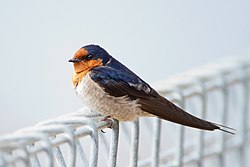
At Risdon Brook Park in Tasmania
Scientific classification Edit this classification
Kingdom: Animalia
Phylum: Chordata
Class: Aves
Order: Passeriformes
Family: Hirundinidae
Genus: Hirundo
Species:
H. neoxena
Binomial name
Hirundo neoxena
Gould, 1842

The welcome swallow (Hirundo neoxena) is a small passerine bird in the swallow family Hirundinidae that is native to Australia and nearby islands. It has self-introduced into New Zealand in the middle of the twentieth century.[2] It is very similar to the Pacific swallow with which it is often considered conspecific.

This species breeds in southern and eastern Australia in a variety of habitats, mostly in open areas, man-made clearings or urban environments, but not desert or dense forest.[3] Eastern populations are largely migratory, wintering in northern Australia. Western birds and those in New Zealand are mainly sedentary.

Taxonomy

[edit]

The welcome swallow was first described in 1842 by John Gould in his The Birds of Australia[4] as a member of the genus Hirundo, but the first publication is often incorrectly given as in the Proceedings of the Zoological Society of London.[5][6] Both its species name and common name refer to people welcoming its return as a herald of spring in southern parts of Australia.[5]

Description

[edit]

The welcome swallow is a small fast-flying bird. Its flying style is circular in pattern with swift darting motions. It has graceful shape and flight, moreover it often flies singly, in couples or in clusters.[7] The welcome swallow is metallic blue-black above, light grey below on the breast and belly, and rusty on the forehead, throat and upper breast. It has a long forked tail, with a row of white spots on the individual feathers. These birds are about 15 cm (5.9 in) long, including the outer tail feathers which are slightly shorter in the female. The welcome swallow's weight is about 9-20g. From the Gould collection in Tasmania a "natural size" male had a wing size of 11.1 cm (4.4 in), tail size of 7.4 cm (2.9 in), and a culmen of 0.7 cm (0.28 in). While the female has 10.9 cm (4.3 in) wings, a 6.25 cm (2.46 in) tail, and a culmen of 0.7 cm (0.28 in).[8] The call is a mixture of twittering and soft warbling notes, and a sharp whistle in alarm. However, their call is normally quiet and does not travel very far.[7]

Young welcome swallows are buffy white, instead of rufous, on the forehead and throat, and have shorter tail streamers.

Distribution and habitat

[edit]

The winter range in northern Australia overlaps with that of wintering barn swallow (Hirundo rustica), but the latter is readily separable by its blue breast band.[9] Welcome swallows readily breed close to human habitation. Welcome swallows are commonly found on wires, posts and other perches.[10]

Natural global range

[edit]

Welcome swallows have a very large distributional range because they are a cross-regional species.[7] Welcome swallows live mostly in eastern, western, southern and central Australia. The welcome swallows that live in eastern Australia move to northern Australia in winter. The welcome swallows that live in Western Australia and others that live in New Zealand are mostly not migratory.[11] This swallow species has been observed nesting in the majority of New Zealand and its surrounding islands, Australia and some parts of Tasmania.[12] Currently, this species has been recorded in New Guinea, New Caledonia and other surrounding islands. The distribution of the welcome swallow also depends on seasonal change. During the winter, the welcome swallow in Australia will move towards the north which places it closer to the equator and warm weather. For the following spring, they will return to southern Australia to breed.[11]

New Zealand range

[edit]

The welcome swallow is a self-introduced species from Australia that is believed to have flown over to New Zealand in the early 1900s.[7] The welcome swallow is found throughout most parts of New Zealand, but it is very rare in Fiordland.[7] The shape of New Zealand is narrow and long, which helped the birds to easily get to areas near water. They are also on Chatham and Kermadec Islands and in some instances have been seen on Campbell Island, Auckland Island and the Snares.[7]

Habitat preferences

[edit]

Although welcome swallows are more often near coastal and wetland areas, they can live in almost all types of habitat, except alpine areas and very dense forest.[7] They have been documented in open areas such as farmlands, grasslands, partly cleared areas that are wooded, lands associated with bodies of water such as lakes or reservoirs, and along coastlines.[12] This species is well-adapted for urban and suburban life as well; it is even able to live in high altitude areas due to the provision of nesting materials provided by humans.[12] During winter, welcome swallows move to a warmer habitat which can provide them enough food and safe shelter.[13]

Behaviour

[edit]

Breeding

[edit]
Copulating welcome swallows

Once the welcome swallow reaches maturity it has a long breeding period. They have a monogamous social structure and a breeding period that lasts from August until March.[7] The nest is an open cup of mud and grass, made by both sexes, and is attached to a structure, such as a vertical rock wall or building. It is lined with feathers and fur, and three to five eggs are laid. Two broods are often raised in a season. The nest size ranges from 5 centimetres to 13.5 centimetres.[7] One particular study showed that the nests that were the highest tended to have a higher fledgling success rate possibly due to the inability of mammals to access the nests.[14] Nesting sites can be a variety of areas and have been documented to be from urban and suburban areas to rural areas. Buildings, moveable boats and ferries, hollowed-out trees, caves and cliffs, mine tunnels and shafts, as well as underground water tanks have all been observed areas of nesting swallows.[12] They build the cup-shape nests connecting to vertical rock walls or buildings to avoid sunlight.[11] Nests on average take 8–23 days to build, and are often re-used for consecutive years of breeding. Welcome swallows often go back to their old nests for the next year to breed.[13] They always work as a flock. When breeding, they usually work in pairs but often small loose groups to protect their nest and territory, especially against predatory birds.[7] The number of successful broods can vary year to year; however, the maximum number of broods recorded is three. Each brood or clutch can range from two to seven eggs with an average of four.[7] However, during the beginning of a breeding season, clutch sizes have been known to be bigger, whereas towards the end of the breeding season clutch sizes may be smaller.[15] Eggs are generally laid in twenty-four- to forty-eight-hour intervals; however, one nest can have multiple clutches because the parent pair may abandon a nest if the clutch size is too small and then another pair will lay their eggs within that same nest.[12] Eggs are generally 18 mm in length and 13mm in width with a pink colour and brown speckles.[7] Male welcome swallows do not participate in the incubation of the eggs. Rather they forage while the female incubates, and when the female forages they either watch the nest for a short period or accompany the female in foraging.[15]

Chicks the day after fledging

The female alone incubates the eggs, which hatch after two to three weeks. The young are fed by both parents, and leave the nest after a further two to three weeks. Males have been known to remove fecal sacs after coaxing the cloaca of the young to dispose of them as well.[15] The fledglings stay in the nest from 18 to 23 days and become completely independent around 35 days. However, they don't start breeding until 8 months to 14 months of age.[7] Although welcome swallows are monogamous, more than just the breeding pair may take care of the young. Also, many swallows may live within the nest like during non-breeding periods where colonies will roost together in large numbers.[7] Welcome swallows are good indicators of temperature, as the temperature drops lower, the less likely a swallow will be observed in the South. When swallows are around, the temperature usually does not drop below -2/-3 degree Celsius.[7] Migration may occur during non-breeding seasons for larger more reliable food sources. These distances may be quite large as well during winter when food is not readily available.[7] Individuals in this species have been known to live up to 6 years creating up to three broods a year during the breeding season.[7]

Food and feeding

[edit]

These birds are extremely agile fliers, which feed on insects while in flight. They often fly fast and low to the ground on open fields in large circles or figure eight patterns. They will often swoop around animals or people in the open. Males and females tend to forage together during breeding season even with fledglings within the nest.[15] Welcome swallows do show a habit of drinking water while flying, they do this by scooping water within their bills from lake and pond surfaces.[7] This is because welcome swallows need to drink water frequently, which allows them to catch insects in the water as well.[7] Welcome swallows can also cooperate with other birds or companions to drive the insects together.[11] They can remember the insects' activity routines to make foraging more efficient.

It has been found welcome swallows have slow growing wings that are not affected by food intake unless they are starving. This suggests that the welcome swallow prioritizes wing growth even when fasting for up to six hours at a time.[16] It is also believed that the swallow accumulates fat in order to survive time periods when food is scarce or conditions are bad. This method allows rapid growth when conditions are good and stable growth when conditions are bad.[16]

Predators, parasites and diseases

[edit]

The hawk, snake and feral cat are the main predators that hunt welcome swallows.[17] Especially in Australia, snakes are the most dangerous predator for the birds. Snakes can climb trees to reach the nests and eat the eggs or young birds. According to one New Zealand study, the only time a nest failed was from disturbing the nest during the incubation period; these instances were from humans, mammals such as mustelids, and blackbirds preying upon the eggs.[15] In swallows' excreta, there are various kinds of bacteria and parasites,[13] which breed in the nest and cause very severe diseases; for example, histoplasmosis, encephalitis, salmonella, meningitis and toxoplasmosis. Hatchlings depend on maternal antibodies and immunity provided by the yolk sac within the egg.[18] Although no specific parasites were found, welcome swallows are known as colonial breeders and are at a high risk for parasites, which may be a cause of lower breeding success but an increase in immune responsiveness.[18] Another disease that not only affects the poultry business, but also the welcome swallow is fowlpox.[19] This virus has two forms, cutaneous (mild harm) and diphtheritic (deadly); poultry is usually vaccinated for the virus, but wildlife is not.[19]

[edit]

References

[edit]
Revisions and contributorsEdit on WikipediaRead on Wikipedia
from Grokipedia
The Welcome swallow (Hirundo neoxena) is a small, agile bird in the swallow family Hirundinidae, native to , with vagrant records in adjacent islands such as and , and self-introduced but now established populations in since the mid-20th century. Measuring approximately 15 cm in length and weighing 9–20 g, it features metallic blue-black upperparts, a forehead, throat, and upper breast, pale buff underparts, long pointed wings, and a deeply forked with white spots near the tips—the latter slightly shorter in females. The bird's common name derives from its role as a herald of spring in southern , where its arrival signals the end of winter to observers, or from European sailors who viewed swallows as welcome indicators of approaching land. Welcome swallows occupy diverse open habitats, including grasslands, wetlands, farmlands, coastal areas, and urban environments, but they generally avoid dense rainforests and arid inland regions. Partially migratory, populations in southeastern travel northward during winter, with northern populations largely resident, allowing the species to exploit seasonal abundances across a broad range. They are gregarious, often in small groups or flocks and roosting communally under bridges or in reedbeds, while exhibiting territorial during breeding. These birds are aerial insectivores, capturing prey such as flies, beetles, and moths in mid-flight through swift, circular maneuvers often performed low over water, ground, or behind livestock to flush insects. Breeding season spans August to February in Australia, during which pairs—or sometimes assisted by helpers—build cup-shaped nests from mud, grass, and saliva, lined with feathers and fur, typically attached to vertical surfaces like cliffs, buildings, or culverts. Females lay 3–5 speckled eggs, which both parents incubate for 14–16 days, with fledging occurring after 18–20 days; multiple broods are common annually. Graded as Least Concern on the IUCN Red List owing to its extensive range, large population, and stable or increasing trends, the welcome swallow faces no major threats but may be impacted locally by nest site competition or pesticide use.

Taxonomy

Classification and etymology

The welcome swallow (Hirundo neoxena) was originally described by English ornithologist in 1842 in the Proceedings of the Zoological Society of London, with the type locality designated as the southern coast of and (). This description established it as a novel species within the swallow genus, based on specimens collected from southeastern . The species is classified in the genus Hirundo of the family Hirundinidae (swallows and martins) and the order Passeriformes (perching birds). The genus Hirundo derives from the Latin word hirundo, meaning "swallow," reflecting the group's aerial insectivorous habits. The specific epithet neoxena combines the Greek prefix neo- ("new") with xenos ("stranger" or "guest"), underscoring its perceived novelty and isolation from Eurasian congeners like the barn swallow. Historically, the welcome swallow's taxonomy has undergone revisions to affirm its status as a distinct species, separate from the widespread barn swallow (Hirundo rustica). Early confusions arose due to superficial similarities in aerial foraging, but morphological analyses revealed key differences, including the welcome swallow's more extensive rufous coloring on the forehead, throat, and underparts. Genetic studies, including phylogenetic reconstructions of the Hirundo genus, have further confirmed this distinction, showing H. neoxena as a well-supported Australasian lineage divergent from the H. rustica complex.

Subspecies

The welcome swallow (Hirundo neoxena) is recognized as comprising two based on current taxonomic assessments. The nominate subspecies, H. n. neoxena, occurs in south-central and eastern , including , as well as on offshore islands such as and ; it has been introduced to (including the Great Barrier Islands), the , , and , where it is now established and resident or partially migratory. Populations of this subspecies undertake partial northward migrations during the austral winter, reaching including the region. The second subspecies, H. n. carteri, is endemic to western Australia, ranging from the Pilbara region southward to the southwest coastal areas, and is primarily resident with limited seasonal movements. Morphological distinctions between the subspecies are subtle and primarily involve variations in overall size (wing chord 106–117 mm), with H. n. carteri averaging slightly smaller, paler plumage intensity on the dorsal surfaces in the western form, and minor differences in tail streamer length. These traits show some overlap and are less pronounced than geographic isolation suggests. Genetic studies using genomic data have confirmed the validity of these subspecies, revealing significant pairwise fixation index (F_ST) values between H. n. neoxena and H. n. carteri (F_ST ≈ 0.07), indicative of genetic differentiation driven by geographic barriers such as the arid interior of Australia, with limited hybridization in overlap zones. As of 2025, taxonomic classifications remain stable with these two subspecies, supported by molecular phylogenies that affirm the split from related Pacific swallows (H. tahitica group) and reject proposals for additional divisions based on island populations; no major debates persist, though ongoing genomic research continues to refine phylogeographic patterns.

Description

Physical characteristics

The Welcome swallow (Hirundo neoxena) is a small bird measuring 15–17 cm in length and weighing 9–20 g. Its body is streamlined for agile flight, featuring long, pointed wings that enable swift, darting maneuvers in the air. The consists of glossy blue-black upperparts, off-white to light grey underparts, and distinctive patches on the forehead, throat, and upper breast. The tail is long and deeply forked, with white spots visible on the outer feathers, aiding in maneuverability during aerial pursuits. is minimal, though females typically have slightly shorter outer tail feathers (streamers) than males. The short, broad bill is equipped with rictal bristles at the mouth corners, which help guide into the open mouth while feeding on the wing and protect the eyes from debris. Juveniles exhibit duller plumage, with buffy white replacing the rufous on the forehead and throat, and shorter tail streamers overall. They undergo a complete post-juvenile molt to attain adult plumage after their first breeding season.

Vocalizations

The Welcome swallow (Hirundo neoxena) employs a variety of vocalizations for communication, including distinct calls and songs that facilitate social interactions and territorial defense. The primary song is a simple, repetitive sequence of twittering interspersed with trills, primarily produced by males while perched on wires, fences, or other elevated structures to attract mates or assert territory. These songs are characterized by their musical yet uncomplicated structure, often lasting several seconds and repeated in bouts. Key calls include a soft, high-pitched contact note rendered as "seet," used during flight or near nests to maintain group cohesion. For alarm situations, such as perceived threats, the bird emits sharp, piercing whistles or variants like "twsee," "sweert," or "tit-swee," which alert nearby individuals. Additionally, soft warbling notes form part of the vocal repertoire, contributing to displays where pairs exchange gentle, melodic phrases. Fledgling begging calls are high-pitched and insistent, resembling rapid chirps that solicit parental feeding responses from hatchlings and juveniles. In foraging flocks, welcome swallows produce chattering twittering and chirrups, creating a collective that coordinates group movements over open areas. These vocalizations are generally quiet and do not carry far, adapted to the ' close-range . Regional variations may occur, potentially influenced by subspecies differences across , , and nearby islands, though comprehensive comparative data remain limited.

Distribution and habitat

Global range

The welcome swallow (Hirundo neoxena) is native to (including ), where it occurs widely across the continent except in the arid interior regions, and is less common in the far north; vagrant records occur in southern . The species has self-introduced to through wind-assisted dispersal from , with the first confirmed breeding recorded in Northland in 1958; it spread rapidly, becoming common throughout the by 1965 and establishing breeding populations on the shortly thereafter, and is now widespread across the including offshore islands such as the Chatham, Kermadec, and Great Barrier Islands. Vagrant records of the welcome swallow occur in , with occasional sightings but no established . Vagrant records of the welcome swallow occur on , with the first confirmed sighting in 1907 and occasional subsequent observations, though it has not established a breeding there. As of 2025, eBird data indicate the welcome swallow's range remains stable and widespread in its native Australian and territories as well as in , with ongoing expansions noted in introduced areas and an overall increasing trend linked to modifications such as agricultural development. The subspecies H. n. neoxena predominates in eastern , , , and nearby islands, while H. n. carteri is restricted to western .

Habitat preferences

The Welcome swallow (Hirundo neoxena) primarily inhabits open landscapes that provide ample aerial foraging opportunities, including grasslands, farmlands, wetlands, coastal areas, and urban parks. These environments are often characterized by low vegetation cover and proximity to water bodies, such as rivers, lakes, ponds, and coastal zones, which are essential for the species' insectivorous diet and drinking habits. The species avoids dense forests, extreme deserts, and high-altitude regions above approximately 1,500 m, where suitable open spaces and availability are limited. It is typically found at elevations from up to 1,200 m, reflecting its preference for lowland and temperate to subtropical zones. Welcome swallows have adapted well to human-modified landscapes, thriving in rural, suburban, and urban settings where they frequently nest on artificial structures like bridges, , buildings, and culverts. This flexibility has enabled population increases linked to and . Regional variations in habitat use are evident across its range; in , the species particularly favors open riverbeds, ponds, and coastal wetlands, while in , it shows a stronger association with coastal fringes and mangroves during non-breeding periods.

Behavior

Breeding

The breeding season of the Welcome swallow (Hirundo neoxena) typically spans from August to February in both and , aligning with the southern hemisphere's spring and summer when insect abundance peaks to support nestling growth. This timing is influenced by the availability of flying , which form the primary food source for provisioning young, with earlier onset in warmer regions or years of favorable weather. Pairs may produce one to three broods per season, depending on environmental conditions and nest success. Welcome swallows exhibit a monogamous , where pairs form lasting bonds for the breeding season and sometimes beyond. involves males performing elaborate aerial displays, including swift, acrobatic flights and chases to impress females, often accompanied by twittering vocalizations. These displays highlight the male's agility and foraging prowess, essential for successful . Nest is a collaborative effort by both sexes, resulting in a durable, cup-shaped made from pellets, woven grasses, and lined with softer materials like feathers or . Preferred sites include sheltered ledges under cliffs, bridges, culverts, or human-built such as and rafters, providing protection from predators and weather. Nests are frequently reused or repaired in subsequent seasons, with studies showing up to 89% reuse rates, which reduces time and energy expenditure. Clutches consist of 3–6 eggs, with a mean of approximately 4, laid at intervals of 24–48 hours; the eggs are pale pinkish-white with reddish-brown speckles. Incubation, performed solely by the , lasts 14–18 days, during which she is fed by the . Nestlings fledge after 18–23 days, remaining dependent on parents for feeding and during a post-fledging period that can extend for weeks. Parental care is biparental throughout the cycle, with both sexes sharing nest-building and chick provisioning via regurgitated ; however, males often increase their provisioning efforts post-fledging to support the mobile young. Occasionally, non-breeding helpers from prior broods assist in feeding, enhancing overall .

Foraging and diet

The Welcome swallow (Hirundo neoxena) is primarily an aerial , with its diet consisting mainly of flying insects captured during flight. Key prey items include flies (Diptera), such as wasps and ants, beetles (Coleoptera), bugs (both heteropterans and homopterans), (Plecoptera), dragonflies and damselflies (), and (Trichoptera). Occasional non-aerial items, such as spiders or berries, supplement the diet during periods of low insect availability. Foraging occurs predominantly through aerial hawking, where the bird pursues and captures in mid-air during low-altitude flights, typically 1–10 m above ground, water, or open terrain. Individuals often skim the water's surface to drink on the wing, a facilitated by their agile flight. Foraging is usually solitary or in pairs during the breeding season, but shifts to loose flocks in areas of high insect density, enhancing efficiency in capturing swarms. Short rictal bristles at the mouth edges guide prey into the wide gape and shield the eyes during high-speed pursuits. A single Welcome swallow can consume hundreds of daily, comparable to the up to 850 documented for closely related species like the barn swallow (Hirundo rustica), with intake rising during breeding to provision nestlings. In seasonal variations, particularly during dry or cold periods when flying decline, birds may resort to ground-foraging techniques, such as rapid walking, pecking, or systematic scanning for accessible prey like moths, , or beetles. This adaptability underscores their ecological role in agricultural areas, where they contribute to natural by reducing populations of crop-damaging like flies and beetles.

Migration and movements

The Welcome swallow (Hirundo neoxena) exhibits partial migratory behavior in , where southern populations, including those in , move northward to warmer regions such as during the non-breeding winter period from March to July, while northern populations remain largely sedentary. These movements are primarily driven by food availability, with birds shifting to areas where populations support their aerial needs. In , where the species self-colonized from around the mid-20th century, welcome swallows show intra-island movements, particularly from colder southern regions to warmer northern areas during winter to access reliable food sources. Some individuals undertake cross-Tasman flights to , evidenced by exhausted birds recorded on New Zealand's western coasts and mid-ocean sightings, often during periods of adverse weather or resource scarcity. Dispersal in welcome swallows includes post-fledging wanderings by juveniles, which contribute to the species' rapid range expansion, as seen in its establishment across islands shortly after arrival. Irruptive movements occur in response to food shortages or , such as droughts, prompting flocks to retreat to coastal or more favorable habitats over significant distances. Observations indicate these events can involve travels of several hundred to over a thousand kilometers, though specific tracking data remains limited.

Conservation and threats

Population status

The global population of the Welcome swallow (Hirundo neoxena) has not been precisely quantified but is described as common across its range, well above thresholds for conservation concern. Overall, the population is considered stable to increasing, driven by range expansions facilitated by human-modified habitats such as and artificial nesting structures. Regionally, the species shows positive trends in , where it self-introduced in the late 1950s and has since expanded rapidly to become widespread and common, largely due to increased availability of open habitats from farming and urbanization. In , its native range, the population remains stable and abundant, particularly in southern and eastern regions, though it is less common in arid northern areas. The International Union for Conservation of Nature (IUCN) classifies the Welcome swallow as Least Concern, with the most recent assessment in 2024 confirming no major threats that would elevate it to vulnerable status. Monitoring through platforms like eBird reveals ongoing expansion in introduced ranges, such as , with relative abundance trends indicating stable or growing presence in core Australian habitats from 2014 to 2022.

Predators, parasites, and diseases

The Welcome swallow faces predation primarily from , reptiles, and introduced mammals that target nests, eggs, and fledglings. In , snakes are a major threat, capable of climbing to nests to consume eggs or young birds, while hawks and feral cats also hunt adults and juveniles. A nesting study in southern identified rats (Rattus rattus), house sparrows (Passer domesticus), grey butcherbirds (Cracticus torquatus), and cats as the principal predators, with predation accounting for a substantial portion of nest failures. Welcome swallows are affected by both ectoparasites and . Ectoparasites such as mites and commonly infest nests, feeding on nestlings and potentially biting hosts, though birds are the preferred targets over humans. include nematodes and trematodes. Diseases impacting the welcome swallow include avian pox (), a viral infection that produces wart-like lesions on unfeathered skin, potentially leading to secondary infections and mortality. , caused by bacteria, can occur through of contaminated or , with nests harboring pathogens that exacerbate transmission in colonies. These health issues may contribute to reduced breeding success, though population-level effects are monitored through broader conservation assessments. Anthropogenic factors pose additional risks, including collisions with windows and vehicles during low-level flight , which cause direct mortality in urban environments. exposure indirectly threatens the by diminishing populations, their primary prey, particularly in agricultural areas where broad-spectrum insecticides are applied.

References

Add your contribution
Related Hubs
User Avatar
No comments yet.