


Community hub
Recent from talks
Contribute something
Nothing was collected or created yet.
Hirundo
View on Wikipedia
| Hirundo | |
|---|---|

| |
| A barn swallow collecting nest material in Germany | |
Scientific classification 
| |
| Kingdom: | Animalia |
| Phylum: | Chordata |
| Class: | Aves |
| Order: | Passeriformes |
| Family: | Hirundinidae |
| Subfamily: | Hirundininae |
| Genus: | Hirundo Linnaeus, 1758 |
| Type species | |
| Hirundo rustica (barn swallow) Linnaeus, 1758
| |
| Species | |
|
See text | |
The bird genus Hirundo is a group of passerines in the family Hirundinidae (swallows and martins). The genus name is Latin for a swallow.[1] These are the typical swallows, including the widespread barn swallow. Many of this group have blue backs, red on the face and sometimes the rump or nape, and whitish or rufous underparts. With fifteen species this genus is the largest in its family.
Taxonomy
[edit]The genus Hirundo was introduced in 1758 by the Swedish naturalist Carl Linnaeus in the tenth edition of his Systema Naturae.[2] The genus name is the Latin word for a swallow.[3] Linnaeus included eight species in the genus and of these William Swainson designated the barn swallow (Hirundo rustica) as the type species.[4][5]
Extant species
[edit]The genus contains sixteen species. The linear sequence is based on two molecular phylogenetic studies published in 2005 and 2018.[6][7][8]
| Image | Common name | Scientific name | Distribution |
|---|---|---|---|

|
Black-and-rufous swallow | Hirundo nigrorufa | Angola, Democratic Republic of the Congo and Zambia. |

|
Blue swallow | Hirundo atrocaerulea | from South Africa to Tanzania |
.jpg)
|
Pied-winged swallow | Hirundo leucosoma | Benin, Burkina Faso, Cameroon, Ivory Coast, Gambia, Ghana, Guinea, Guinea-Bissau, Mali, Niger, Nigeria, Senegal, Sierra Leone, and Togo. |

|
White-tailed swallow | Hirundo megaensis | Oromia, Ethiopia. |
.jpg)
|
Pearl-breasted swallow | Hirundo dimidiata | southern Africa from Angola, southern Congo and Tanzania southwards. |

|
Pacific swallow | Hirundo javanica | southern Asia and the islands of the south Pacific. |
| Tahiti swallow | Hirundo tahitica | islands of Moorea and Tahiti in French Polynesia | |
_by_Dharani_Prakash.jpg)
|
Hill swallow | Hirundo domicola | southern India and Sri Lanka. |

|
Welcome swallow | Hirundo neoxena | Australia and nearby islands |
_(6817418149)_(cropped).jpg)
|
White-throated swallow | Hirundo albigularis | southern Africa from Angola and Zambia southwards to the Cape in South Africa. |
.jpg)
|
Wire-tailed swallow | Hirundo smithii | southern Africa and southeastern Asia. |
_(cropped).jpg)
|
White-bibbed swallow | Hirundo nigrita | Angola, Benin, Cameroon, Central African Republic, Republic of the Congo, Democratic Republic of the Congo, Ivory Coast, Equatorial Guinea, Gabon, Ghana, Guinea, Guinea-Bissau, Liberia, Nigeria, Sierra Leone, and Uganda. |
 |
Barn swallow | Hirundo rustica | North and South America, most of Africa aside from the Sahara Desert, most of Eurasia aside from the northern Siberia, and northern Australia. |
 |
Angola swallow | Hirundo angolensis | Angola, Burundi, Democratic Republic of the Congo, Gabon, Kenya, Malawi, Namibia, Rwanda, Tanzania, Uganda, and Zambia. |
.jpg) |
Red-chested swallow | Hirundo lucida | West Africa, the Congo Basin and Ethiopia. |
.jpg) |
Ethiopian swallow | Hirundo aethiopica | Benin to Burkina Faso, Cameroon, Central African Republic, Chad, Democratic Republic of the Congo, Ivory Coast, Eritrea, Ethiopia, Ghana, Guinea, Israel, Kenya, Mali, Niger, Nigeria, Senegal, Somalia, Sudan, Tanzania, Togo, Uganda |
Extinct species
[edit]There are at least two fossil species included in this genus:
- †Hirundo gracilis (late Miocene of Polgardi, Hungary)[9]
- †Hirundo major (Pliocene of Csarnota, Hungary)[9]
Former species
[edit]Some authorities, either presently or formerly, recognize several additional species as belonging to the genus Hirundo including:
- West African swallow (as Hirundo domicella)[10]
Distribution and habitat
[edit]All of the species are found in the Old World, although one, the barn swallow, is cosmopolitan, also occurring in the Americas.
Gallery
[edit]-
 H. rustica foraging
 -
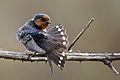 Windows in the tail of H. rustica
 -
 Tail streamers of H. smithii filifera
 -
 Nest of H. rustica
 -
 Clutch of H. rustica gutturalis
 -
 Clutch of H. smithii


References
[edit]
- ^ Jobling, James A (2010). The Helm Dictionary of Scientific Bird Names. London: Christopher Helm. p. 193. ISBN 978-1-4081-2501-4.
- ^ Linnaeus, Carl (1758). Systema Naturae per regna tria naturae, secundum classes, ordines, genera, species, cum characteribus, differentiis, synonymis, locis (in Latin). Vol. 1 (10th ed.). Holmiae (Stockholm): Laurentii Salvii. p. 191.
- ^ Jobling, James A. (2010). The Helm Dictionary of Scientific Bird Names. London: Christopher Helm. p. 193. ISBN 978-1-4081-2501-4.
- ^ Swainson, William (1837). On the Natural History and Classification of Birds. Vol. 2. London: John Taylor. p. 340.
- ^ Dickinson, E.C.; Christidis, L., eds. (2014). The Howard & Moore Complete Checklist of the Birds of the World. Vol. 2: Passerines (4th ed.). Eastbourne, UK: Aves Press. p. 479. ISBN 978-0-9568611-2-2.
- ^ Sheldon, Frederick H.; Whittingham, Linda A.; Moyle, Robert G.; Slikas, Beth; Winkler, David W. (April 2005). "Phylogeny of swallows (Aves: Hirundinidae) estimated from nuclear and mitochondrial DNA sequences". Molecular Phylogenetics and Evolution. 35 (1): 254–270. Bibcode:2005MolPE..35..254S. doi:10.1016/j.ympev.2004.11.008. ISSN 1055-7903. PMID 15737595.
- ^ Silva, Thilina N. de; Fernando, Sumudu W.; Robbins, Mark B.; Cooper, Jacob C.; Fokam, Eric B.; Peterson, A. Townsend (2018). "Recognition of a new generic-level swallow taxon from central Africa". Journal of Avian Biology. 49 (9) e01698. doi:10.1111/jav.01698. ISSN 1600-048X. S2CID 90611033.
- ^ Gill, Frank; Donsker, David; Rasmussen, Pamela, eds. (August 2024). "Swallows". IOC World Bird List Version 14.2. International Ornithologists' Union. Retrieved 5 October 2024.
- ^ a b Kessler, E. (2013). Neogene songbirds (Aves, Passeriformes) from Hungary. Hantkeniana Budapest 8: 37-149.
- ^ "Cecropis domicella - Avibase". avibase.bsc-eoc.org. Retrieved 2017-05-05.
| National | |
|---|---|
| Other | |

 | This Hirundinidae-related article is a stub. You can help Wikipedia by expanding it. |
Hirundo
View on GrokipediaTaxonomy
Etymology and history
The genus name Hirundo derives from the Latin word for "swallow" (hirundō), reflecting the group's characteristic aerial habits, and was first formally established by Carl Linnaeus in the 10th edition of Systema Naturae in 1758, where he classified eight species under the genus.[8] The type species, Hirundo rustica (barn swallow), was subsequently designated by William Swainson in 1827 through a process of subsequent designation to anchor the genus taxonomically.[9] Early classifications under Hirundo broadly included numerous swallow species based on superficial morphological similarities, such as mud-nesting behaviors and forked tails, leading to a more expansive definition in the 18th and 19th centuries. Taxonomic revisions in the 20th and 21st centuries, driven by molecular phylogenetics, have significantly delimited the genus by reassigning many species to other genera within Hirundinidae, such as Cecropis and Petrochelidon. Sheldon et al. (2005) provided a foundational analysis using nuclear beta-fibrinogen intron 7 and mitochondrial cytochrome b and ND2 sequences from 75 swallow species, confirming the monophyly of Hirundo and its close phylogenetic relation to other Old World mud-nesting genera through Bayesian and maximum parsimony methods. This study highlighted Hirundo as a distinct clade sister to groups like the wire-tailed swallows, resolving longstanding ambiguities in family-level relationships. Subsequent work by Dor et al. (2010) refined the intrageneric phylogeny using 5,217 bp of mitochondrial DNA and 1,039 bp of nuclear intron data across all 14 then-recognized Hirundo species, further supporting monophyly and identifying four major clades while excluding non-monophyletic elements previously included.[10] These molecular insights, building on earlier morphological assessments, reduced the genus to its modern scope of 17 species by 2025, following recent splits such as the 2024 division of the Pacific Swallow complex, emphasizing genetic divergence over traditional groupings.[11]Extant species
The genus Hirundo includes 17 extant species of swallows in the family Hirundinidae, primarily native to Africa, Asia, Australia, and the Pacific region, with one species exhibiting a nearly cosmopolitan range. These species are adapted to diverse habitats but share typical swallow features such as streamlined bodies and forked tails suited for aerial foraging. Phylogenetic analyses have clarified relationships within the genus, with a 2010 study using mitochondrial and nuclear DNA sequences to reconstruct the phylogeny of all 14 then-recognized species (now 17 following subsequent splits, including the 2024 IOC-recognized split of the Pacific Swallow into Hill and Tahiti swallows), confirming Hirundo monophyly and the recent derivation of the widespread H. rustica complex from African ancestors.[11] The species are listed below, with scientific and common names, primary breeding distributions, and brief characterizations of unique morphological or ecological traits. Distributions reflect current taxonomic consensus as of 2025.[11]| Common Name | Scientific Name | Primary Distribution | Unique Traits |
|---|---|---|---|
| Barn Swallow | Hirundo rustica | Cosmopolitan (breeds in Europe, Asia, North America; winters in Africa, South America) | Steely blue upperparts with deeply forked tail and rufous underparts; highly adaptable to human structures for nesting.[12] |
| Red-rumped Swallow | Hirundo daurica | Southern Europe, Africa, Asia | Distinctive rufous rump and pale throat; long tail streamers in adults; often nests in cliffs or buildings. |
| Angola Swallow | Hirundo angolensis | Central and southern Africa | Glossy blue upperparts with white underparts; relatively short tail; prefers riverine habitats.[11] |
| Hill Swallow | Hirundo javanica | Southeast Asia | Uniform dark brown plumage with white undertail coverts; lacks prominent tail fork; adapted to coastal and urban environments. |
| Tahiti Swallow | Hirundo tahitica | Pacific Islands | Uniform dark brown plumage with white undertail coverts; lacks prominent tail fork; island specialist in tropical environments. |
| Welcome Swallow | Hirundo neoxena | Australia, New Zealand, nearby islands | Red-brown forehead and throat with blue-black upperparts; acrobatic flight; introduced to New Zealand where it thrives. |
| White-throated Swallow | Hirundo albigularis | Southern Africa | White throat and underparts contrasting with dark blue upperparts; nests in burrows along rivers.[11] |
| Ethiopian Swallow | Hirundo aethiopica | Eastern Africa | Pale underparts with streaked breast; short tail; confined to Ethiopian highlands. |
| Mosque Swallow | Hirundo senegalensis | Sub-Saharan Africa | Metallic blue head and back with white underparts; square tail; often associates with human settlements. |
| Preuss’s Swallow | Hirundo preussi | West and central Africa | Dark sooty plumage with white forehead patch; montane forest specialist. |
| Lesser Striped Swallow | Hirundo abyssinica | Sub-Saharan Africa | Striped underparts and rufous crown; builds mud nests under eaves; migratory in parts of range. |
| Greater Striped Swallow | Hirundo cucullata | Sub-Saharan Africa | Larger size with bold black-and-white streaking on underparts; long tail; often seen in open savannas. |
| Rufous-chested Swallow | Hirundo semirufa | Central and southern Africa | Rufous chest and white underparts; short tail; inhabits miombo woodlands.[11] |
| South African Swallow | Hirundo spilodera | Southern Africa | Spotted underparts with blue upperparts; recently split from Barn Swallow based on genetic differences.[13] |
| Blue Swallow | Hirundo atrocaerulea | Central and southern Africa | Deep blue plumage overall; long tail streamers; endangered due to habitat loss in grasslands. |
| Forest Swallow | Hirundo fuligula | Central Africa | Sooty black plumage with white belly patch; restricted to Congo Basin forests; builds nests in trees.[11] |
| White-tailed Swallow | Hirundo megaensis | Southern Ethiopia | Glossy blue upperparts, white tail with dark rim; endangered, restricted to acacia savannas and cliffs for nesting.[7] |
| Pearl-breasted Swallow | Hirundo dimidiata | Southern Africa | Blue upperparts, pearly white spots on breast and flanks; mud nests on buildings or cliffs. |
| Black-and-rufous Swallow | Hirundo nigrorufa | Central Africa | Black upperparts and head, rufous underparts; long tail; forest-edge dweller. |
Fossil species
The genus Hirundo includes two well-recognized extinct species from the fossil record, providing insights into the early evolutionary history of swallows. Hirundo gracilis is known from the late Miocene (approximately 11–5 million years ago) of Polgárdi, Hungary, in Europe.[14] This species is represented by fragmentary postcranial bones, notably the ulna, which measures 24–25 mm in length and exhibits notably slender proportions compared to modern Hirundo species such as the barn swallow (H. rustica).[14] The asymmetry in the ulna's cotylae and the conical ventral condyle suggest adaptations for agile aerial foraging, consistent with the genus's specialized flight morphology, though the overall smaller size indicates it was a more delicate form than extant relatives.[14] The second species, Hirundo major, dates to the Pliocene (approximately 5.3–2.6 million years ago) from Csarnóta, Hungary, also in Europe.[14] Fossils include elements of the ulna and tibiotarsus, with the ulna showing a hook-like dorsal condyle and wide tuberculum carpale, while the tibiotarsus features a rounded extensor sulcus.[14] These bones are larger than those of modern H. rustica, with ulna dimensions including an epicondyle width of 1.86 mm and a tuberculum carpale height of 3.18 mm, pointing to a more robust build potentially suited to varied environmental pressures during the Pliocene.[14] These fossils underscore the ancient diversification of Hirundo within the Old World, with H. gracilis representing an early Miocene offshoot and H. major evidencing continued presence into the Pliocene.[14] Evidence from contemporaneous North American fossils, such as H. aprica from the upper Pliocene (3.5–3.3 million years ago) of Kansas, further indicates transcontinental migration to the New World by this epoch, likely via Beringian land bridges during climatic fluctuations.[15][16] The humerus of H. aprica is comparable in size to modern barn swallows but more robust, suggesting parallel evolutionary trends in aerial specialization across hemispheres.[15] Overall, these records highlight Hirundo's adaptability and range expansion predating the Pleistocene, informing phylogenetic reconstructions of Hirundinidae.[16]Description
Physical characteristics
Species in the genus Hirundo are small to medium-sized passerine birds, typically measuring 11–19 cm in total length, with wingspans of 28–36 cm and body masses ranging from 10–25 g.[17] These dimensions vary modestly across the 16 extant species, with the Barn Swallow (H. rustica) representing a larger end of the spectrum at 15–19 cm long and 17–20 g.[4] Their morphology is highly specialized for sustained aerial life, featuring a streamlined body form that minimizes drag during flight.[18] The wings are long and sharply pointed, comprising ten primaries in which the outermost feather is greatly reduced to optimize aerodynamic efficiency and enable precise maneuvers while foraging.[17] The tail is characteristically long and deeply forked, with the outer feathers often elongated into streamers that are proportionally longer in males, enhancing stability and agility in the air.[17][19] The bill is short, broad, and flattened, ideally suited for scooping up flying insects with minimal resistance.[17] The legs are short with small, weak feet equipped for brief perching on vertical surfaces rather than ground locomotion, reflecting their predominantly aerial lifestyle.[17] Internally, the skeleton supports these adaptations through a prominent keel on the sternum, which anchors the large pectoral flight muscles essential for powered flight.[18]Plumage variation
Species in the genus Hirundo typically exhibit a characteristic plumage pattern featuring glossy blue-black upperparts, pale underparts, and a deeply forked tail, with some species displaying white spots on the inner webs of the outer tail feathers. For instance, the barn swallow (Hirundo rustica) has steely blue upperparts contrasting with rufous to tawny underparts, a cinnamon-colored forehead and throat, and white under the chin and on the breast and belly.[12] The forked tail in these birds enhances aerial maneuverability, and the metallic sheen on the upper plumage provides subtle visual cues during flight.[20] Sexual dimorphism in Hirundo plumage is prominent, particularly in tail morphology, where males possess longer outer tail feathers than females, often by up to 2 cm, which serves as a sexually selected trait. In H. rustica, females are generally duller in coloration, with less vibrant blue on the upperparts and shorter tail streamers compared to males. This dimorphism varies slightly across populations; for example, in European subspecies, the tail length difference is more pronounced, while in North American populations, ventral coloration also plays a role in mate choice.[21][22][23] Juvenile Hirundo birds differ markedly from adults, displaying shorter tails and browner, less glossy tones on the upperparts, lacking the metallic blue-black sheen of mature plumage. In H. rustica, juveniles have paler foreheads and throats, with buffy underparts and reduced tail fork depth, making them resemble certain other swallow species at a distance. These young birds undergo a post-fledging moult to acquire the definitive adult plumage, typically within the first few months after leaving the nest.[20][12] Interspecies variation within Hirundo includes unique features in species such as the Ethiopian swallow (H. aethiopica), which shows a brick-red forehead patch and pale buff throat with dark breast marks, contrasting with the more extensive rufous elements in related taxa. These differences aid in species identification across the genus's diverse African and Eurasian ranges.[24]Distribution and habitat
Geographic range
The genus Hirundo is predominantly distributed across the Old World, with the majority of its species native to Africa, where ten are restricted to the continent.[25] Several species occur in Asia and Europe, reflecting the genus's evolutionary origins and historical expansions in these regions.[25] The Barn Swallow (Hirundo rustica) stands out as the most widespread member of the genus, with a cosmopolitan distribution that includes breeding populations across Europe, Asia, and North America, as well as overwintering sites in Africa, South America, and Australasia.[26] This species is the only Hirundo to extend into the Western Hemisphere, where its North American subspecies (H. r. erythrogaster) has undergone significant range expansion since the 19th century, facilitated by human-altered landscapes providing new nesting opportunities on buildings and bridges.[27] More recently, H. rustica has established breeding populations in Argentina since the early 1980s, representing a human-mediated long-distance expansion of over 7,000 km from its core Palearctic and Nearctic ranges.[28] Other species illustrate more localized distributions within the Old World. For instance, the Red-chested Swallow (Hirundo lucida) ranges across sub-Saharan Africa from Senegal east to Ethiopia and south to northern South Africa.[29] In Asia, the Pacific Swallow (Hirundo javanica) inhabits Southeast Asia, extending from India and southern China through the Malay Peninsula and Indonesian archipelago to the Philippines and as far north as the Nansei Islands of Japan, often following human settlements inland and to higher elevations.[5]Habitat preferences
Species of the genus Hirundo generally prefer open habitats that provide ample space for aerial foraging, such as grasslands, farmlands, and savannas, often in proximity to water bodies like rivers, lakes, and wetlands where insect prey is abundant.[30][31] For instance, the barn swallow (Hirundo rustica) is commonly associated with agricultural landscapes, riparian zones, and open grasslands across its wide range.[30] Similarly, the wire-tailed swallow (Hirundo smithii) favors open woodlands, cultivation areas, and savanna clearings near water.[31] These preferences reflect the genus's adaptation to environments with low vegetation cover that facilitate flight.[32] Many Hirundo species exhibit strong anthropogenic adaptations, frequently utilizing human-modified structures for nesting and roosting, which has expanded their range into urban and suburban settings. The barn swallow, for example, readily occupies rural buildings, bridges, and barns, contributing to its near-cosmopolitan distribution.[30] The Ethiopian swallow (Hirundo aethiopica) is also tolerant of human habitations, including towns and coastal settlements, alongside natural open areas like arid savannas and forest clearings.[33] This association with anthropogenic environments is evident in species like the red-chested swallow (Hirundo lucida), which inhabits marshes, rivers, and agricultural regions modified by human activity.[34] Altitudinal preferences within the genus span from sea level to high elevations, accommodating diverse climatic conditions. Lowland species such as the Pacific swallow (Hirundo javanica) thrive in coastal and riverine habitats up to moderate elevations, often near rocky cliffs or mangroves.[35] In contrast, montane-adapted taxa like the rock martin (formerly Hirundo fuligula, now Ptyonoprogne fuligula) occur in hilly and mountainous rocky terrains, reaching altitudes of up to 4,000 m in African highlands.[36] The white-tailed swallow (Hirundo megaensis) demonstrates flexibility by occupying subtropical high-altitude shrublands and dry savannas.[37] Habitat specialization varies across the genus, with some species favoring semi-arid or desert-edge environments, such as the Ethiopian swallow in arid savannas and coastal cliffs, while others like the Pacific swallow extend into tropical forest edges and moist lowlands.[33][35] The red-chested swallow shows affinity for wetter microhabitats, including forest clearings and lakesides in savanna regions.[34] These variations highlight the genus's ecological versatility while maintaining a core preference for open, insect-rich landscapes.[38]Behavior and ecology
Foraging and diet
Hirundo species are exclusively aerial insectivores, capturing flying insects in mid-air through agile, acrobatic flight maneuvers facilitated by their wide gape and bristle-fringed mouths.[39] These birds pursue prey at heights typically 7–8 m above ground or water, often in open habitats like fields, meadows, or near water bodies, where they exploit concentrations of emerging or disturbed insects.[40] For example, the barn swallow (H. rustica) can consume up to 850 insects per day, reflecting their high-energy lifestyle dominated by continuous flight.[41] The diet of Hirundo swallows consists almost entirely of insects. For example, in the barn swallow, over 99% comprises flying arthropods such as flies (Diptera, ~31%), ants and other Hymenoptera (~40%), aphids and true bugs (Hemiptera, ~15%), and beetles (Coleoptera, ~12%).[42] In this species, prey selection favors intermediate-sized insects (4–8 mm in length) with poor flight capabilities, while avoiding very small or large items; during the breeding season, there is a noted shift toward larger, more nutritious prey to meet elevated energy needs for reproduction.[42] Non-insect items like spiders or occasional berries are rare and incidental.[39] Foraging techniques vary by context but emphasize aerial hawking, where birds dart and twist to intercept prey, often following large mammals, farm machinery, or human activity to capitalize on flushed insects.[22] They also skim low over water surfaces to drink or snatch insects from the surface film, and in non-breeding periods, engage in communal flock foraging to exploit abundant insect swarms during migration.[39] These strategies align with their physical adaptations for sustained, maneuverable flight, such as streamlined bodies and long wings.[22] Due to their rapid metabolism and flight-intensive lifestyle, Hirundo species require substantial daily energy intake, consuming approximately one-third of their body weight in insects to sustain activities like long-distance migration and territory defense.[43] This high demand underscores their role as efficient predators in insect population control across diverse ecosystems.[41]Social structure
Hirundo swallows exhibit a range of social behaviors, from solitary foraging to formation of loose colonies during breeding and large flocks during migration and winter; for example, the Pacific swallow (H. tahitica) is often solitary or in small groups, while others are more colonial.[44] Species such as the barn swallow (H. rustica) typically breed in small, loose colonies of up to 83 pairs, often on human-made structures like barns or bridges, which provide suitable nesting sites and may enhance predator detection through group vigilance.[45] During non-breeding periods, individuals form loose flocks that can number in the thousands, facilitating communal migration and resource sharing in open habitats.[40] Communication in Hirundo involves both vocal and visual signals to coordinate group activities and maintain social bonds. Vocalizations include rapid twittering songs for courtship and contact calls such as the repeated "witt-witt" uttered in flight or near nests, which serve to alert others to food sources or threats.[46] Visual displays, like tail-spreading and aerial chases, are prominent during interactions, helping to signal dominance or attraction within flocks or colonies.[22] Territoriality is primarily centered on nest sites rather than large foraging areas, with males aggressively defending small territories around nests—typically 4 to 8 square meters in H. rustica—to secure breeding resources. Intra-specific aggression remains low within colonies, promoting tolerance among neighbors, though inter-specific competition for prime sites can lead to displacement by other swallow species.[22] [45] In winter, many Hirundo species form large communal roosts; for example, barn swallows can number 15,000 or more individuals in sites like reedbeds or overhead wires, which provide thermal benefits and collective defense against predators through mobbing behaviors.[47] These roosts peak in size during mid-winter, reflecting adaptive social strategies for survival in non-breeding ranges.[47]Reproduction
Breeding biology
Hirundo species are socially monogamous, forming seasonal pair bonds each breeding season upon arrival at breeding grounds; for example, in the barn swallow (H. rustica), genetic polygamy is prevalent due to frequent extra-pair copulations, with extra-pair paternity accounting for approximately 22–30% of offspring in studied populations.[48][22] Clutches typically consist of 3–7 eggs, with an average of 4–5, laid by the female and primarily incubated by her for 12–17 days until hatching.[27][49][1] Pairs often raise multiple broods per season, ranging from 1–3 in temperate regions, contributing to annual productivity of 5–10 fledglings per pair under favorable conditions.[50][48] Breeding timing varies geographically: in northern temperate zones, it occurs from spring (April–May) through summer (July–August), synchronized with peak insect availability, while tropical populations exhibit extended or near-continuous breeding influenced by local food resources.[22][51] Average adult lifespan ranges from 2–7 years, with many individuals surviving 4 years on average, though maximum recorded longevity exceeds 8 years; lifetime fecundity per pair yields 20–50 fledglings, heavily dependent on survival and annual breeding output.[22][52][53]Nesting habits
Hirundo species construct open cup-shaped nests primarily from wet mud pellets mixed with saliva for adhesion, reinforced with grass, rootlets, or other plant fibers, and lined with softer materials such as feathers, hair, or fine grass.[54][55] Both sexes participate in nest building, collecting mud in their beaks and applying 750–1800 pellets per nest depending on species and location, with construction typically taking 4–12 days.[56][54] Nests are attached to vertical surfaces using the mud's cohesive properties, often in sheltered positions to protect from weather and predators.[55] Site selection favors elevated, protected ledges or overhangs, such as under building eaves, bridges, or cliffs, where nests can be secured without direct exposure.[56] In the barn swallow (H. rustica), pairs commonly choose anthropogenic structures like farm sheds or porches, affixing nests to walls or beams with minimal clearance from ceilings (typically 2.5–6 cm).[56] The Ethiopian swallow (H. aethiopica) prefers similar sheltered sites inside buildings or under eaves, though it may use exterior walls supported by ledges.[55] Many Hirundo species reuse or repair nests from previous seasons, which accelerates subsequent breeding attempts by up to 12 days and increases fledging success.[57] For instance, in H. rustica, 45–82% of pairs select old nests, adding fresh mud (in 65% of cases) or feathers (in 89%) for reinforcement.[57][56] Nest dimensions vary slightly, with cups measuring 6–10 inches long and 3–5 inches wide across species.[54] Variations occur among species adapted to different environments; the Pacific swallow (H. tahitica), common on islands, builds its mud cup nests under cliff ledges or in sea caves, occasionally on man-made bridges or tunnels.[58]Conservation
Species status
The genus Hirundo comprises 16 species of swallows, most of which are assessed as Least Concern on the IUCN Red List due to their extensive ranges and large populations. For instance, the barn swallow (H. rustica), the most widespread species, maintains a global population of 290–487 million mature individuals and is considered stable overall, though regional variations exist.[59] Similarly, species such as the wire-tailed swallow (H. smithii) and the Pacific swallow (H. tahitica) are classified as Least Concern, with increasing or stable trends in their tropical and subtropical distributions.[32][60] However, a few endemic or range-restricted species face higher risks. The white-tailed swallow (H. megaensis), confined to southern Ethiopia, is listed as Vulnerable, with a declining population estimated at 2,500–9,999 mature individuals.[37] The blue swallow (H. atrocaerulea), an African endemic breeding in montane grasslands, is Endangered, with a global population of 1,500–3,000 mature individuals and ongoing declines.[61] The hill swallow (H. domicola), restricted to southern India and Sri Lanka, remains Least Concern. Population trends for H. rustica illustrate broader patterns within the genus: declines of 20–50% have occurred in Europe and North America since the 1970s, primarily linked to agricultural intensification, while tropical populations remain stable or show minimal change.[62] These assessments are monitored through BirdLife International's ongoing evaluations, with the latest IUCN Red List updates as of 2025.[59]Threats and measures
Hirundo species, such as the barn swallow (H. rustica), face significant threats from habitat loss primarily driven by agricultural intensification, which diminishes suitable nesting and foraging areas through land conversion and reduced structural diversity in farmlands.[59] Pesticides and other contaminants further exacerbate declines by reducing insect prey availability, a staple in their diet, leading to lower reproductive success and adult survival rates.[50][63] Climate change compounds these pressures by altering migration routes, breeding phenology, and weather patterns, potentially causing phenological mismatches with peak insect abundance.[50] Specific impacts include the destruction of nest sites in urban and rural structures, often due to renovations, demolitions, or cleaning that removes mud nests from buildings and bridges.[64] Collisions with man-made structures, such as windows in buildings and blades of wind turbines, result in direct mortality, particularly for low-flying species like barn swallows during foraging or migration.[65] Conservation measures address these threats through the designation of protected areas, including Important Bird Areas in Africa that safeguard wintering and breeding habitats for migratory Hirundo populations, such as those used by the blue swallow (H. atrocaerulea).[66] Provision of artificial nests, including pre-formed cups or platforms, has proven effective in providing alternative sites, with studies showing higher reproductive success compared to natural nests in altered environments.[67] In the European Union, the Farm to Fork Strategy, launched in 2020, promotes a 50% reduction in chemical pesticide use by 2030 to protect biodiversity, including insectivorous birds, thereby supporting insect populations essential for Hirundo foraging.[68] Success stories include recovery initiatives for H. rustica in Canada, such as the Upper Columbia Swallow Habitat Enhancement Project (2021-2026), which focuses on restoring nesting structures and foraging habitats, leading to increased local breeding pairs and occupancy rates in restored sites.[69] These efforts, combined with broader habitat management, demonstrate potential for population stabilization when threats are actively mitigated.References
- https://en.wiktionary.org/wiki/hirundo