


Community hub
Recent from talks
Contribute something
Nothing was collected or created yet.
Wes Chandler
View on Wikipedia
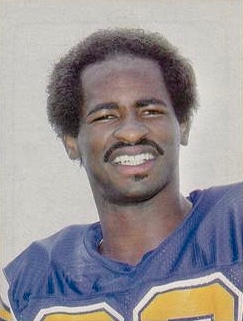
Wesley Sandy Chandler (born August 22, 1956) is an American former professional football player who was a wide receiver in the National Football League (NFL) for eleven seasons during the 1970s and 1980s. He was selected to the Pro Bowl four times, and ranked twelfth in NFL history in receiving yards and thirteenth in receptions when he retired. Chandler is a member of the Chargers Hall of Fame. He played college football for the Florida Gators and was also inducted into the College Football Hall of Fame in 2015.
Key Information


Playing as a receiver in a run-oriented wishbone offense at Florida, Chandler set a school record with 28 touchdowns. He was named both an All-American and an Academic All-American in 1977. He was picked third overall by the New Orleans Saints in the 1978 NFL draft. Over an 11-year NFL career, Chandler played for the Saints, the San Diego Chargers and the San Francisco 49ers. He holds the NFL record for most receiving yards per game in a season, set in 1982 with the Chargers. After retiring as a player, he became a football coach, and served as the wide receivers coach for various teams at the professional and college level.
Early life
[edit]Chandler was born in New Smyrna Beach, Florida. He attended New Smyrna Beach High School,[1] where he was a standout high school football player for coach Bud Asher's New Smyrna Beach Barracudas.[2] In his junior year the team was undefeated, including a victory over the Rams of Interlachen High School which snapped their 21-game regular season win streak.[3][4] Chandler scored twenty-two touchdowns as a senior in 1973 (scoring five in a single game), and rushing for 1,052 yards and catching 22 receptions as a wishbone halfback.[2] Prominent with him in the backfield were the brothers Reggie and Keith Beverly.[5] Chandler earned the nickname "Little Joe" due to his small size.[6] In 2007, thirty-three years after he graduated from high school, the Florida High School Athletic Association (FHSAA) recognized Chandler as one of the "100 Greatest Players of the First 100 Years" of Florida high school football.[2]
College career
[edit]Chandler accepted an athletic scholarship to attend the University of Florida in Gainesville, Florida, where he was a wide receiver under coach Doug Dickey on the Gators football team from 1974 to 1977.[7] While he was a Florida undergraduate, Chandler became a member of Alpha Phi Alpha fraternity (Theta Sigma chapter). As a Gator, he caught ninety-two passes for 1,963 yards and a school record twenty-two touchdowns in a run-oriented offense, adding six more scores on rushes and kick returns to set the school record for total touchdowns with twenty-eight. He led the Gators in receiving yards for three straight seasons (1975, 1976 and 1977), and despite many seasons of pass-oriented offenses since his time in Gainesville, he still holds Florida's career records in average yards per catch (21.3) and touchdown to reception ratio (one touchdown per 4.18 catches).[7]
Chandler was a first-team All-Southeastern Conference (SEC) selection and a first-team All-American in 1976 and 1977, a first-team Academic All-American in 1977, and the recipient of the Gators' Fergie Ferguson Award as a senior team captain in 1977.[7] He also finished tenth in the balloting for the Heisman Trophy in 1977.[8] He is widely considered to be one of the best all-around football players to ever play for the University of Florida,[9] and has been named to several all-time Gators and all-SEC teams, and was inducted into the University of Florida Athletic Hall of Fame as a "Gator Great" in 1989.[10][11] In 2006, The Gainesville Sun recognized Chandler as No. 6 among the top 100 Florida Gators players of the first 100 years of the team,[12] and in 2015, Chandler was inducted into the College Football Hall of Fame.[13]
Professional career
[edit]
The New Orleans Saints selected Chandler in the first round (third pick overall) in the 1978 NFL Draft,[14] and he played for the Saints for four seasons from 1978 to 1981.[15] Chandler was selected to the Pro Bowl after his second season in the league after finishing with 1,069 yards and six touchdown receptions. He was traded to the San Diego Chargers on September 30, 1981,[16] to replace star receiver John Jefferson, who was traded to the Green Bay Packers after a bitter contract hold-out.[17] In the opening round of the playoffs that year in a game known as The Epic In Miami, he caught six passes for 106 yards and returned a punt 56 yards for a touchdown in the Chargers 41–38 victory.[17]
The following season was Chandler's best, when he led the NFL with 1,032 receiving yards and nine receiving touchdowns in the strike-shortened 1982 season;[17] his average of 129 yards receiving per game that year is still an NFL record.[18][19] He also caught nine passes for 124 yards in a playoff win over the Pittsburgh Steelers. Chandler represented Chargers players in the players' union, and many NFL players in that role were cut or traded after the 1987 NFL strike. After he was elected to the union's executive committee, Chandler was traded to the San Francisco 49ers, with whom he finished his career in 1988.[17] He played in four games before retiring in October after tendinitis in a knee and frustration over his performance. The 49ers went on to win the Super Bowl that season. "My heart wasn't in it. It had nothing to do with being a quitter. It was more about real-life decisions," he said.[20][21]

During his 11-year NFL career, Chandler caught 559 passes for 8,966 yards and 56 touchdowns, rushed for 84 yards, returned 48 kickoffs for 1,048 yards, and gained 428 yards on 77 punt returns.[22] Overall, he amassed 10,526 all-purpose yards.[22] At the time of his retirement, Chandler ranked twelfth in NFL history in receiving yards and thirteenth in receptions.[23] He also earned four Pro Bowl selections, including three with the San Diego Chargers.[22] In 2001, Chandler was inducted into the Chargers Hall of Fame.
NFL career statistics
[edit]Regular season
[edit]| Year | Team | Games | Receiving | |||||
|---|---|---|---|---|---|---|---|---|
| GP | GS | Rec | Yds | Avg | Lng | TD | ||
| 1978 | NO | 16 | 5 | 35 | 472 | 13.5 | 58 | 2 |
| 1979 | NO | 16 | 16 | 65 | 1,069 | 16.4 | 85 | 6 |
| 1980 | NO | 16 | 16 | 65 | 975 | 15.0 | 50 | 6 |
| 1981 | NO | 4 | 4 | 17 | 285 | 16.8 | 39 | 1 |
| SD | 12 | 11 | 52 | 857 | 16.5 | 51 | 5 | |
| 1982 | SD | 8 | 8 | 49 | 1,032 | 21.1 | 66 | 9 |
| 1983 | SD | 16 | 14 | 58 | 845 | 14.6 | 44 | 5 |
| 1984 | SD | 15 | 15 | 52 | 708 | 13.6 | 63 | 6 |
| 1985 | SD | 15 | 13 | 67 | 1,199 | 17.9 | 75 | 10 |
| 1986 | SD | 16 | 14 | 56 | 874 | 15.6 | 40 | 4 |
| 1987 | SD | 12 | 11 | 39 | 617 | 15.8 | 27 | 2 |
| 1988 | SF | 4 | 4 | 4 | 33 | 8.3 | 9 | 0 |
| Career | 150 | 131 | 559 | 8,966 | 16.0 | 85 | 56 | |
Post-playing career
[edit]Chandler eventually went to Dallas after seven years coaching in NFL Europe, including a stint as head coach of the Berlin Thunder in 1999. Before that, he also coached at the University of Central Florida in Orlando, Florida and Father Lopez Catholic High School in Daytona Beach, Florida. In January 2012, he joined the California Golden Bears as their receivers coach.[24]
Chandler has established a scholarship fund for minority students through the Wes Chandler Celebrity Golf Classic.
Chandler also has two nephews in athletics. Dallas Baker was a standout wide receiver for the Florida Gators and was drafted by the Pittsburgh Steelers in the 2007 NFL draft. Chandler's other nephew and Dallas's younger brother, Perry Baker, is a professional rugby player with the United States national rugby sevens team.[25]
In 2015, he was one of the founders of the proposed league, Major League Football, and served as its first president. He resigned in July 2017 when the league was reorganizing after failing to launch.[26]
See also
[edit]


- 1976 College Football All-America Team
- 1977 College Football All-America Team
- List of Alpha Phi Alpha brothers
- List of Florida Gators football All-Americans
- List of Florida Gators in the NFL draft
- List of National Football League season receiving yards leaders
- List of New Orleans Saints first-round draft picks
- List of New Orleans Saints players
References
[edit]- ^ databaseFootball.com, Players, Wes Chandler. Retrieved June 2, 2010.
- ^ a b c "FHSAA unveils '100 Greatest Players of First 100 Years' as part of centennial football celebration Archived March 22, 2012, at the Wayback Machine," Florida High School Athletic Association (December 4, 2007). Retrieved May 26, 2011.
- ^ Ken Willis. "New Smyrna Beach rallies around its Barracudas as they go for 9-0".
- ^ "'Cudas Go After 5th Straight". Daytona Beach Morning Journal. October 12, 1973.
- ^ "Leading the Way". December 4, 1998.
- ^ "Chandler May Make Gator Fans Forget McGriff". Daytona Beach Morning Journal. September 15, 1975.
- ^ a b c 2011 Florida Gators Football Media Guide Archived April 2, 2012, at the Wayback Machine, University Athletic Association, Gainesville, Florida, pp. 86, 89, 91, 96, 100, 103, 124, 127, 139, 143–145, 147–148, 150, 180 (2011). Retrieved August 28, 2011.
- ^ "1977 Heisman Trophy Voting". Sports Reference. Retrieved January 8, 2024.
- ^ See, e.g., Pat Dooley, "Dooley: Percy might be the best Gator ever Archived June 15, 2011, at the Wayback Machine," Gainesville Sun (November 22, 2008). Retrieved June 2, 2010.
- ^ F Club, Hall of Fame, Gator Greats. Retrieved December 13, 2014.
- ^ Jack Hairston, "Chandler, Ellenson worthy additions to UF Hall of Fame," The Gainesville Sun, pp. 1C & 2C (April 14, 1989). Retrieved July 24, 2011.
- ^ Robbie Andreu & Pat Dooley, "No. 6 Wes Chandler Archived July 19, 2014, at the Wayback Machine," The Gainesville Sun (August 28, 2006). Retrieved March 31, 2013.
- ^ "NFF Proudly Announces Star-Studded 2015 College Football Hall of Fame Class". National Football Foundation. January 9, 2015. Retrieved February 3, 2016.
- ^ Pro Football Hall of Fame, Draft History, 1978 National Football League Draft Archived June 10, 2011, at the Wayback Machine. Retrieved June 2, 2010.
- ^ National Football League, Historical Players, Wes Chandler. Retrieved June 2, 2010.
- ^ "SPORTS PEOPLE; Only for the Best - The New York Times". The New York Times. September 18, 2023. Archived from the original on September 18, 2023. Retrieved November 17, 2023.
- ^ a b c d Lahman, Sean (2007). The Pro Football Historical Abstract: A Hardcore Fan's Guide to All-Time Player Rankings. Globe Pequot. p. 166. ISBN 9781592289400. Retrieved January 4, 2021 – via Internet Archive.
- ^ Cobbs, Chris (August 15, 1986). "Don't Mess With Wes : Chandler Uses Fear to His Own Advantage Against Pain, Pressure". Los Angeles Times. Archived from the original on July 18, 2012.
- ^ "NFL Receiving Yards per Game Single-Season Leaders". Pro Football Reference. Retrieved January 8, 2024.
- ^ Crumpacker, John (August 11, 2012). "Wes Chandler finds home on Cal staff". San Francisco Chronicle. Archived from the original on February 20, 2014.
- ^ "Names in the News". Los Angeles Times. October 1, 1988. Archived from the original on March 1, 2014.
- ^ a b c "Wes Chandler Stats, Height, Weight, Position, Draft, College". Pro Football Reference. Retrieved January 8, 2024.
- ^ Kuperberg, Jonathan (January 18, 2012). "Cal names Wes Chandler new wide receivers coach". The Daily Californian. Archived from the original on April 14, 2012.
- ^ Miller, Ted (January 19, 2012). "Cal hires former All-Pro Wes Chandler". ESPN.com. Archived from the original on January 24, 2012.
- ^ Pengelly, Martin (February 13, 2015). "USA sevens rugby star Perry Baker earns Eagles wings in new arena". The Guardian. Retrieved January 4, 2021.
- ^ "Major League Football, Inc. (OTCMKTS:MLFB) Files An 8-K Departure of Directors or Certain Officers; Election of Directors; Appointment of Certain Officers; Compensatory Arrangements of Certain Officers". Market Exclusive. July 28, 2017.
External links
[edit]
Wes Chandler
View on GrokipediaEarly years
Early life
Wesley Sandy Chandler was born on August 22, 1956, in New Smyrna Beach, Florida.[1][3][5] He grew up in New Smyrna Beach, Florida.[6]High school career
Chandler attended New Smyrna Beach High School in New Smyrna Beach, Florida, where he emerged as a standout athlete for the Barracudas football team under head coach Bud Asher.[7][8] During his high school career from 1971 to 1973, Chandler demonstrated versatility by playing wide receiver, tailback (including left halfback), defensive back, and punter, contributing across offensive, defensive, and special teams roles.[9] In his junior year of 1972, he helped lead the team to an 11-1 record and the school's first appearance in the state playoffs, reaching the Class 3A semifinals before a loss to Milton; the squad featured a speedy backfield that emphasized quickness and team cohesion under Asher's guidance.[7] Asher, who later became mayor of Daytona Beach, highlighted Chandler's explosive ability to "go all the way with the football," crediting the coach's system for honing his speed and decision-making on the field.[7] As a senior in 1973, Chandler anchored the wishbone offense as the primary running back and kick returner, rushing for 1,052 yards while catching 22 passes for 542 yards; he set a school record with 22 touchdowns that season, including a five-touchdown performance in one game, leading the Barracudas in scoring and rewriting multiple program records.[10][11] His dominant play earned widespread recognition as one of Florida's premier high school talents and the top player in Volusia and Flagler counties, drawing recruitment interest that culminated in a scholarship to the University of Florida.[12][8]College career
University of Florida
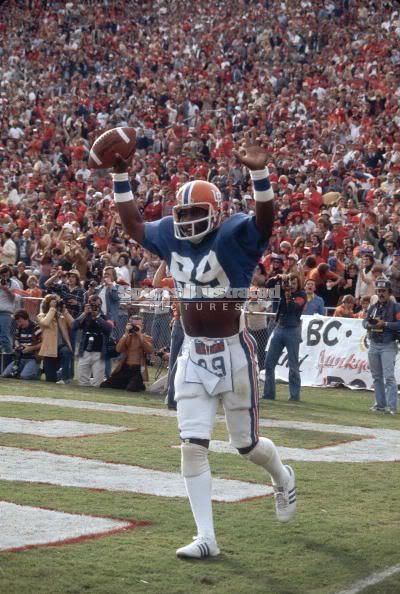
Wes Chandler enrolled at the University of Florida in 1974, joining the Gators football team as a freshman wide receiver under head coach Doug Dickey. In a run-oriented wishbone offense, he initially adjusted to the rigors of college-level defenses, seeing limited playing time with just 3 receptions for 49 yards and 1 touchdown during the season.[13][14] During his sophomore year in 1975, Chandler began to develop more prominently, recording 20 receptions for 457 yards and 5 touchdowns while leading the Southeastern Conference (SEC) in receiving touchdowns.[13] As a junior in 1976, he emerged as one of the top receivers in the nation, hauling in 44 catches for 967 yards and a league-leading 10 touchdowns, topping the SEC in both receiving yards and scores that year.[13] His ability to stretch the field and exploit defenses in the wishbone scheme contributed significantly to Florida's offensive output, building toward his career totals of 92 receptions for 1,963 yards and 22 receiving touchdowns.[13] In his senior season of 1977, Chandler earned first-team All-American honors and adapted further by taking on a hybrid role, including rushing duties with 61 carries for 353 yards and 6 touchdowns alongside 25 receptions for 490 yards and 6 more scores, for a total of 12 touchdowns that year.[13][15] A highlight came in the rivalry game against Georgia on November 5, where he shifted to running back and scored all three Florida touchdowns—including a 12-yard touchdown reception, an 18-yard run, and a 1-yard run—securing a 22-17 victory for the Gators.[16][17] His versatility and production in facing tough SEC defenses underscored his impact on the team before concluding his collegiate career.Achievements and records
During his tenure at the University of Florida, Wes Chandler established several enduring school records as a wide receiver and scorer. He concluded his career with a then-school record of 22 receiving touchdowns, accomplished over 92 receptions for 1,963 yards, while also adding six rushing touchdowns to reach a total of 28 touchdowns—another mark that led Florida's all-time list at the time.[3][18] Additionally, Chandler set the Gators' record for the highest points scored by a non-kicker with 172, reflecting his versatility in a run-heavy wishbone offense.[3][19] Chandler earned widespread recognition for his on-field excellence, securing first-team All-Southeastern Conference (SEC) honors in both 1976 and 1977, as well as first-team All-American selections in those same years.[20][18] His senior year performance in 1977, where he recorded 25 receptions for 490 yards and six touchdowns despite team struggles, was pivotal in affirming his All-American status. In 1977, Chandler finished 10th in Heisman Trophy voting.[3][13] Chandler's contributions extended to team success, helping the Gators achieve three consecutive bowl appearances from the 1974 through 1976 seasons, including the 1974 Sugar Bowl, 1975 Gator Bowl, and 1976 Sun Bowl.[21] As a senior team captain, he also received the Fergie Ferguson Award in 1977 for exemplifying leadership, character, and courage on the field.[3] Academically, Chandler was honored as a first-team Academic All-American and SEC Honor Roll member in 1977, highlighting his balance of athletic and scholarly pursuits.[3][20] His achievements cemented a lasting legacy in Florida's receiving history, with his touchdown and scoring records standing as benchmarks for decades and influencing the program's offensive standards.[18][13]Professional career
New Orleans Saints
Chandler was selected by the New Orleans Saints in the first round, third overall, of the 1978 NFL Draft out of the University of Florida.[1] His status as a consensus All-American wide receiver in college contributed to his high draft position.[22] As a rookie in 1978, Chandler adapted to the professional game by appearing in all 16 contests, though he started only five, finishing with 35 receptions for 472 yards and two touchdowns.[1] He transitioned into a full-time starter the following year, posting career highs with the Saints in 1979 of 65 catches for 1,069 receiving yards and six touchdowns, which earned him his first Pro Bowl nod.[1][23] Chandler maintained strong production in 1980, starting every game and recording another 65 receptions for 975 yards and six scores.[1] Across four seasons with New Orleans, Chandler totaled 182 receptions for 2,801 yards and 15 touchdowns in 52 games, establishing himself as the team's primary wideout despite the Saints' overall struggles, including a 1-15 finish in 1980.[1] His tenure ended early in 1981 after four starts, during which he had 17 catches for 285 yards and one touchdown; on September 30, he was traded to the San Diego Chargers for wide receiver Aundra Thompson and San Diego's first-round (13th overall) and third-round picks in the 1982 NFL Draft.[1][24] The deal reflected the Saints' roster overhaul under new leadership following their dismal prior campaign.[25]San Diego Chargers
Chandler was traded from the New Orleans Saints to the San Diego Chargers in September 1981, just four games into the season, where he immediately became a key component of the team's high-powered offense.[1] In his first full season with the Chargers in 1982, during the strike-shortened nine-game schedule, Chandler led the NFL with 1,032 receiving yards and nine touchdowns on 49 receptions, averaging an NFL-record 129.0 yards per game that still stands.[26] His explosive performance earned him First-Team All-Pro honors and a Pro Bowl selection that year.[27] Under head coach Don Coryell's "Air Coryell" system, which emphasized vertical passing and stretching the field, Chandler thrived as a deep-threat receiver, forming a dynamic partnership with quarterback Dan Fouts.[28] This offense propelled the Chargers to deep playoff runs in 1981 and 1982, with Chandler contributing significantly: in 1981, he recorded 12 receptions for 185 yards across two postseason games en route to the AFC Championship Game; in 1982, he added 11 catches for 162 yards, including nine receptions for 124 yards in a divisional playoff victory over the Pittsburgh Steelers.[29] The Chargers reached the AFC Championship in both seasons but fell short of the Super Bowl.[30] Chandler earned additional Pro Bowl nods in 1983 and 1985, with his 1985 campaign marking a personal pinnacle as he amassed career highs of 67 receptions for 1,199 yards and 10 touchdowns.[1] Over his seven seasons with the Chargers through 1987, Chandler totaled 373 receptions for 6,132 yards and 41 touchdowns in 94 games, solidifying his legacy as one of the franchise's premier wideouts in an era of innovative passing attacks.[1]San Francisco 49ers
After being traded from the San Diego Chargers to the San Francisco 49ers on June 2, 1988, in exchange for offensive lineman Fred Quillan, Chandler joined a team poised to contend for the NFL championship.[31] The move came amid a shift in the Chargers' roster, where Chandler faced competition from younger receivers, marking a departure from his prior role as a high-production veteran who had amassed over 1,000 receiving yards in multiple seasons with San Diego.[32] Chandler appeared in four games for the 49ers that season, starting all four, but managed only four receptions for 33 yards due to ongoing injuries, including tendinitis in his knee.[1] His limited output reflected the physical toll of an 11-year NFL career, as persistent pain hampered his ability to contribute meaningfully to the offense.[33] On October 1, 1988, at age 32, Chandler announced his retirement, citing frustration with his diminished performance and the cumulative strain on his body.[33] Despite the brevity of his tenure, the 49ers went on to win Super Bowl XXIII later that season, though Chandler's role was negligible by then.[34]Career statistics
Regular season
Wes Chandler's NFL regular season career, spanning 11 seasons from 1978 to 1988, showcased his emergence as a dynamic wide receiver with exceptional speed and route-running precision. Across 150 games, he tallied 559 receptions for 8,966 yards and 56 receiving touchdowns, achieving an average of 16.0 yards per reception that highlighted his big-play threat.[1] Chandler also added minor contributions on the ground with 16 rushing attempts for 84 yards, alongside return duties that produced 1,032 kickoff return yards and 428 punt return yards, particularly prominent in his rookie year.[1] The table below provides a year-by-year breakdown of his regular season statistics, illustrating his progression from volume receiver to efficient deep threat.| Year | Team | G | Rec | Rec Yds | Y/R | Rec TD | Rush Yds | KR Yds | PR Yds |
|---|---|---|---|---|---|---|---|---|---|
| 1978 | NO | 16 | 35 | 472 | 13.5 | 2 | 10 | 760 | 233 |
| 1979 | NO | 16 | 65 | 1,069 | 16.4 | 6 | 0 | 136 | 13 |
| 1980 | NO | 16 | 65 | 975 | 15.0 | 6 | 9 | 0 | 36 |
| 1981 | 2TM | 16 | 69 | 1,142 | 16.6 | 6 | -1 | 125 | 79 |
| 1982 | SD | 8 | 49 | 1,032 | 21.1 | 9 | 32 | 0 | 0 |
| 1983 | SD | 16 | 58 | 845 | 14.6 | 5 | 25 | 0 | 26 |
| 1984 | SD | 15 | 52 | 708 | 13.6 | 6 | 0 | 0 | 0 |
| 1985 | SD | 15 | 67 | 1,199 | 17.9 | 10 | 9 | 0 | 0 |
| 1986 | SD | 16 | 56 | 874 | 15.6 | 4 | 0 | 11 | 13 |
| 1987 | SD | 12 | 39 | 617 | 15.8 | 2 | 0 | 0 | 0 |
| 1988 | SF | 4 | 4 | 33 | 8.3 | 0 | 0 | 0 | 28 |
| Career | 150 | 559 | 8,966 | 16.0 | 56 | 84 | 1,032 | 428 |