Hubbry Logo
Cris CarterCris CarterMain
Open search
Cris Carter
Community hub
Cris Carter
logo
8 pages, 0 posts
0 subscribers
Be the first to start a discussion here.
Contribute something
Cris Carter
Cris Carter
from Wikipedia

Graduel Christopher Darwin Carter[1] (born November 25, 1965) is an American former professional football wide receiver who played in the National Football League (NFL) for the Philadelphia Eagles (1987–1989), the Minnesota Vikings (1990–2001) and the Miami Dolphins (2002).[2] He is widely regarded as one of the greatest wide receivers of all time.[3][4][5][6]

Key Information

Carter played college football for the Ohio State Buckeyes and was selected by the Eagles in the fourth round of the 1987 NFL supplemental draft. While in Philadelphia, head coach Buddy Ryan helped to coin one of ESPN's Chris Berman's famous quotes about Carter: "All he does is catch touchdowns." He was let go by Ryan in 1989, however, due to off-the-field issues. Carter was signed by the Vikings and turned his life and career around, becoming a two-time first-team and one-time second-team All-Pro and playing in eight consecutive Pro Bowls. When he left the Vikings after 2001, he held most of the team career receiving records. He briefly played for the Dolphins in 2002 before retiring.[7]

Since retiring from the NFL, Carter has worked on HBO's Inside the NFL, ESPN's Sunday NFL Countdown and Monday Night Countdown, and online at Yahoo Sports.[8] He also works as an assistant coach at St. Thomas Aquinas High School, where his son played wide receiver. In 2017, Carter began co-hosting First Things First with Nick Wright on FS1. He was terminated from the show following a suspension and investigation in 2019. Carter resides in Boca Raton, Florida. He is the brother of former NBA player and coach Butch Carter.[9]

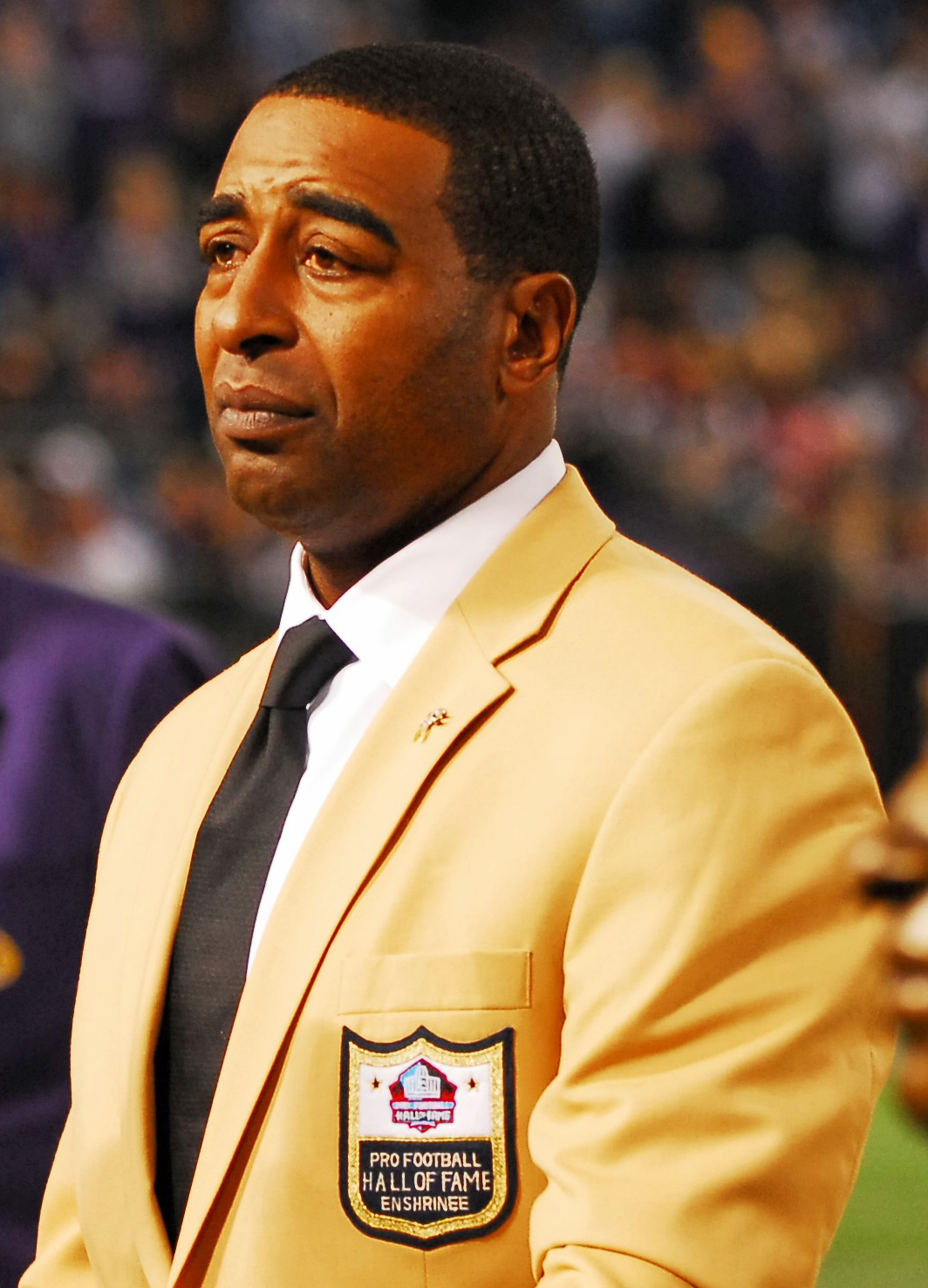
After six years, and five finalist selections, Carter was voted to the Pro Football Hall of Fame on February 2, 2013.[10]

Early life

[edit]

Carter was born in Troy, Ohio. For elementary school he went to Heywood Elementary in Troy, Ohio. He spent his early childhood there before moving to Middletown, Ohio, with his mother, three brothers, and two sisters. They lived in a small four-bedroom apartment.[11] He attended Middletown High School[12] and starred in both football and basketball.

Named after his grandfather, Graduel, Carter dropped his birth name and unofficially changed his name to Cris after wide receiver Cris Collinsworth (whom he idolized), stating that he would never be famous with the name Graduel. According to Carter on ESPN Radio's "Mike & Mike" (on September 15, 2014), he dropped the name during 7th grade, and his name is still listed as Christopher on official documents, including his driver's license.

College career

[edit]

Carter was heavily recruited out of high school for both basketball and football. He accepted the offer to attend Ohio State University from Buckeyes head coach Earle Bruce. Carter became a consensus All-American selection after his junior season, Ohio State's first All American at wide receiver.[13]

Carter had intended to play both football and basketball at Ohio State, but decided to focus on football after making an immediate impact his freshman year. That year, he set a Rose Bowl record with nine receptions for 172 yards. In his junior season, he caught 69 passes for 1,127 yards and 11 touchdowns.

Carter at Ohio State in 1986

Carter was known for great hands, running precise routes, and for acrobatic leaps. He had remarkable body control and footwork when making catches near the sidelines. At the Citrus Bowl at the end of the 1985 season, Carter caught a ball that quarterback Jim Karsatos was intending to throw away.[14] Karsatos has claimed that catch by Carter was the greatest in the history of college football: "When I finally saw it on film, he was tiptoeing the sidelines and he jumped up and caught the ball left-handed by the point of the football at least a yard out of bounds. Then he somehow levitated back in bounds to get both his feet in bounds. I swear to this day he actually levitated to get back in bounds. When I saw it on film, it just blew me away."

Prior to Carter's senior season, he secretly signed with notorious sports agent Norby Walters. When the contract was discovered, Carter was ruled ineligible. The absence of Carter in the 1987 offense contributed to a disappointing 6–4–1 season and the firing of Coach Bruce. Missing this season also cost him a chance at evening his personal record against Michigan; Carter finished 1–2, his lone taste of victory in the series being his freshman year.

Despite losing his senior year, Carter left Ohio State holding the school record for receptions (168), gaining 2,725 yards and 27 touchdowns from them. In 2000, he was selected as a member of the Ohio State Football All-Century Team. In 2003, he was inducted into the Ohio State Varsity O Hall of Fame.

Professional career

[edit]

Philadelphia Eagles

[edit]

A fourth round pick by the Philadelphia Eagles in the 1987 supplemental draft,[15] Carter saw limited action during his rookie season catching just 5 passes for 84 yards and 2 touchdowns. His first professional catch was a 22-yard touchdown vs. the St. Louis Cardinals.[16]

Carter got more involved in the Eagles offense in 1988 catching 39 passes for 761 yards and tying for the team lead with 6 scoring receptions. In 1989, he became the teams' primary red zone receiver, leading the Eagles with 11 touchdown catches (3rd in the NFC) while hauling in 45 passes for 605 yards.[17]

Shortly after, Carter had a falling out with coach Buddy Ryan and was a surprise cut following the pre-season. Carter later admitted that Ryan released him because of alcohol and drug abuse, including large amounts of ecstasy, cocaine and marijuana, and credits his former coach with helping him turn his life around as a result.[18]

Minnesota Vikings

[edit]

The Minnesota Vikings claimed the troubled wide receiver off waivers on September 4, 1990, for only $100. Stuck behind Hassan Jones and resident star receiver, Anthony Carter (no relation), Carter didn't see very many passes come his way during his first season in Minnesota. He did gain a measure of revenge against his former team, however, catching six passes for 151 yards, including a 78-yard touchdown, in a Monday Night contest at Philadelphia on October 15. Carter finished the 1990 campaign with 27 receptions for 413 yards and 3 touchdowns.

In 1991, Carter stepped forward as Minnesota's top pass catcher. He led the team with 72 receptions, 962 yards, and 5 touchdown catches. The winds of change were blowing in Minnesota; after a second straight disappointing season head coach Jerry Burns retired. Stanford head coach Dennis Green was named as his replacement on January 10, 1992, and began a house cleaning process. "The New Sheriff in Town" released stalwarts like RB Herschel Walker and QB Wade Wilson and traded DT Keith Millard to the Seattle Seahawks.

The Vikings returned to NFL prominence in 1992, posting an 11–5 record and capturing their first NFC Central Division title since 1989. With Rich Gannon and Sean Salisbury alternating at QB, Carter remained the team's primary aerial weapon—leading the team with 53 receptions, 681 yards, and 6 touchdowns despite missing the final four games of the season with a broken collar bone. The Vikings season ended in disappointment, however, as the defending Super Bowl champions Washington Redskins upended them 24–7 in the Wild Card round.

In 1993, veteran QB Jim McMahon acted as the team's primary signal-caller and Carter had a breakout season. He posted career highs in receptions, 86, and yards, 1,071, while catching 9 touchdowns — all team highs, and appeared in his first Pro Bowl. The Vikings finished the season 9–7, good enough for a playoff berth, but fell 17–10 to the New York Giants in the Wild Card round.

Veteran quarterback Warren Moon was acquired before the 1994 season and immediately developed a rapport with Carter. The veteran helped Carter set the NFL single-season record for receptions with 122 (the record was broken in 1995 by Detroit's Herman Moore). Carter also led the team with 1,256 yards and 7 receiving touchdowns, which earned him First-team All Pro honors. Moon and Carter carried the team to a 10–6 record and the NFC Central title, but couldn't stop the Vikings from a third straight first-round playoff exit — a 35–18 home loss to the Chicago Bears.

Carter teamed up with Moon in 1995 to post his finest statistical season. He caught 122 passes for a career-high 1,371 yards and led the NFL with 17 touchdown receptions. Carter received Second-team All Pro honors for his efforts. The Vikings, however, finished 8–8 and missed the playoffs for the first time under Green.

Midway through the 1996 season Brad Johnson took over at QB for the Vikings. Carter didn't miss a beat, catching 96 passes for 1,163 yards and 10 touchdowns. The Vikings returned to the playoffs with a 9–7 record, but were routed by the Dallas Cowboys 40–15 in the Wild Card round. Carter appeared in his fourth straight Pro Bowl following the season.

Carter continued to be the focal point of the Vikings' offense in 1997. He was named to his fifth consecutive Pro Bowl, leading the NFL with 13 touchdown receptions while pacing the team with 89 catches and 1069 yards. Even though he had more impressive seasons statistically, 1997 may have been Carter's finest hour, as week after week he dazzled with one spectacular catch after another. With Randall Cunningham at QB (he replaced the injured Johnson late in the season) the Vikings finally broke through in the playoffs, defeating the Giants 23–22 in a last-minute miracle comeback. The playoff success was fleeting, however, as the team fell to the San Francisco 49ers 38–22 the following week.

Cris Carter jersey shown at Pro Football Hall of Fame in Canton, Ohio

In 1998 the Vikings drafted Marshall wide receiver Randy Moss with 21st pick in the first round. Suddenly, the Vikings possessed the NFL's most dangerous weapon. They cruised through the regular season, posting a 15–1 record while scoring a then-league record 556 points. Carter, who made the Pro Bowl for the fifth time, caught 78 passes for 1,011 yards and 12 touchdowns. Led by Moss, Carter, and Miller Lite Player of the Year Randall Cunningham, the Vikings entered the playoffs as heavy favorites to reach the Super Bowl. They easily defeated the Arizona Cardinals 41–21 in the Divisional Round, advancing to the NFC Championship Game for the first time since 1987. The Vikings entered that game as 13 and a half point favorites over the Atlanta Falcons, but lost in overtime 30–27 to become the biggest favorite to ever lose a home playoff game. Carter later said losing that game was the lone regret of his time in Minnesota, and that he didn't even know if he wanted to play anymore afterwards.

The following year, Carter had his finest individual season since 1995— the First-team All Pro caught 90 passes for 1,241 yards and an NFL-best 13 touchdowns. The Vikings easily defeated the Dallas Cowboys 27–10 in the Wild Card round and headed to St. Louis to face the NFL's new hottest offense. Minnesota led the eventual Super Bowl champions 17–14 at the half, but a second-half flurry led to a 49–37 Rams win.

Carter finished the decade of the '90s with 835 receptions, second only to Jerry Rice's 860, and was named to the NFL's All Decade team.

In 2000, led by Daunte Culpepper, the Vikings won the NFC Central division, and Carter finished the season with 96 receptions, 1,274 yards, 9 touchdowns, and an eighth Pro Bowl.[19] On November 30, Carter became only the second player in NFL history to reach the 1,000 reception plateau when he caught a 4-yard touchdown pass against Detroit.

In 2001, the Vikings floundered with a record of 5–11, their first losing season since 1990. Carter's production dipped to its lowest point since 1992 (mostly because of QB Spergon Wynn's ineffectiveness in the last three games) — 73 catches, 871 yards, 6 touchdowns — and his streak of eight straight Pro Bowls came to an end.[20] Following the season, the longest-tenured Viking exercised an out clause in his contract that ended his career in Minnesota.

Cris Carter left the Vikings as their all-time leader in, among other things, receptions (1,004), receiving yards (12,383), and touchdowns (110).[21]

Miami Dolphins

[edit]

Carter spent the spring of 2002 looking for a team. Although he talked with the Rams, Browns, and Dolphins, he was unable to complete a deal and joined HBO's Inside the NFL team as an analyst on May 21. He served in that capacity until October 21 when the Miami Dolphins lured the veteran back onto the playing field to bolster their injury-riddled receiving corps.

The Boca Raton resident started in his first game as a Dolphin at Lambeau Field in week 9. Carter showed signs of rust, catching just three passes for 31 yards and fumbling once. During the week that followed, he checked into the hospital with a kidney ailment and was sidelined for the next four weeks.

Carter returned in week 14, but struggled to get back into the Dolphins receiver rotation. In week 15, however, he caught a one-handed touchdown pass as the Dolphins beat the Raiders 23–17. The following week against the Vikings, however, he made a key drop in the end zone that cost Miami a touchdown. The Dolphins wound up losing that game and then lost to the Patriots the following week, missing the playoffs. Even though he put up respectable numbers for the number of games that he played, he retired after the season.

Legacy

[edit]

At the time of his retirement, Carter's 1,101 career receptions and 130 touchdowns as a receiver placed him second in NFL history behind Jerry Rice, although his reception total has since been surpassed by Marvin Harrison, and his touchdown receptions by Randy Moss and Terrell Owens. Carter is one of 14 players in NFL history with 1,000 or more receptions.[22] He was named to the NFL 1990s All-Decade Team. Carter was one of 15 finalists for the Pro Football Hall of Fame class of 2008, but was not elected in a surprise to some commentators. Carter was once again excluded in 2009 and again in 2010 as receivers Jerry Rice and Tim Brown became eligible for the first time, though Brown did not make it.[23] Additionally, Andre Reed was another possible candidate that diminished Carter's chance for enshrinement in 2010. In 2011, he also did not make it despite not having a single wide receiver in the class.

NFL Network's NFL's Top 10 placed him atop the list of wide receivers with the best hands.[24]

On February 2, 2013, Carter was announced as an inductee into the Hall of Fame Class of 2013 along with Bill Parcells, Larry Allen, Jonathan Ogden, Warren Sapp, Curley Culp, and Dave Robinson.[25]

NFL career statistics

[edit]
Legend
Led the league
Bold Career high
General Receiving
Season Team GP GS Tgt Rec Yards Y/R Y/G TD
1987 PHI 9 0 [a] 5 84 16.8 9.3 2
1988 PHI 16 16 39 761 19.5 47.6 6
1989 PHI 16 15 45 605 13.4 37.8 11
1990 MIN 16 5 27 413 15.3 25.8 3
1991 MIN 16 16 72 962 13.4 60.1 5
1992 MIN 12 12 92 53 681 12.8 56.8 6
1993 MIN 16 16 143 86 1,071 12.5 66.9 9
1994 MIN 16 16 188 122 1,256 10.3 78.5 7
1995 MIN 16 16 197 122 1,371 11.2 85.7 17
1996 MIN 16 16 167 96 1,163 12.1 72.7 10
1997 MIN 16 16 158 89 1,069 12.0 66.8 13
1998 MIN 16 16 125 78 1,011 13.0 63.2 12
1999 MIN 16 16 137 90 1,241 13.8 77.6 13
2000 MIN 16 16 161 96 1,274 13.3 79.6 9
2001 MIN 16 16 130 73 871 11.9 54.4 6
2002 MIA 5 1 17 8 66 8.3 13.2 1
Career 234 209 1,515 1,101 13,899 12.6 59.4 130

Career notables

[edit]
  • One of four players to record at least 120 receptions in a season twice, 1994 and 1995 (Wes Welker, Antonio Brown, Michael Thomas)[27]
  • Most games with at least 12 receptions in a single season (4) in 1995[28]
  • One of three players (Clarke Gaines and Jerry Rice) to record at least 12 receptions in consecutive games
  • Most consecutive games with 2 touchdown receptions (4) – tied with Calvin Johnson and Doug Baldwin
  • Most consecutive seasons with at least 5 touchdown receptions, 1991–2001 (11) – Terrell Owens, Jerry Rice, Marvin Harrison, Don Hutson, and Tim Brown
  • Most consecutive seasons with at least 5 touchdowns, 1991–2001 (11) – Terrell Owens, Jerry Rice, Marvin Harrison, Don Hutson, Tim Brown, and Frank Gore
  • First player to record a 150-yard receiving game in three different decades (Jerry Rice is the only other player to do so)[29]
  • Member of 2013 Hall of Fame Class
  • Only guest on Good Morning Football to get the ball on the peg during The Long Show on February 2, 2022.

After football

[edit]

Carter was one of the hosts of HBO's Inside the NFL and also was an NFL Analyst for Yahoo Sports and ESPN. He is also a faculty member and assistant coach at St. Thomas Aquinas High School, where his son played wide receiver in 2008. He is the owner of Cris Carter's FAST Program, a sports training center in South Florida and is an ordained minister. He also appeared in the 2005 sports video game NFL Street 2 as a wide receiver for the NFL Gridiron Legends team along with former teammate, safety Joey Browner, and a few other historical NFL legends.

Carter was a speaker at the 2008 NFL rookie symposium[30] and again at the 2009 NFL Rookie Symposium.[31] He also spoke at the 2014 NFL rookie symposium, where he encouraged players to get a fall guy they can trust to take the blame if they get in trouble. The comments were revealed in 2015 in an ESPN The Magazine story about Chris Borland.[32] The NFL took the video of the speech down from its website and released a statement saying in part: "The comment was not representative of the message of the symposium or any other league program...The comment was not repeated in the 2014 AFC session or this year's symposium." Carter apologized on Twitter, saying he realized it was bad advice, and everyone should take responsibility for their own actions.[33] ESPN also released a statement saying Carter's comments do not reflect the company's views.[34]

Carter was chosen to be a coach for a team in the 2015 Pro Bowl, along with former Dallas Cowboys wide receiver Michael Irvin.

In December 2016, Carter was hired by Fox Sports as a football analyst. In May 2017, his role was expanded as it was announced that Carter would co-host a morning show, First Things First, on Fox Sports 1 with radio personality Nick Wright and moderator Jenna Wolfe. The show premiered on September 5, 2017. His tenure ended in November 2019 following a suspension.[35]

Since 2021 he has been part of Good Morning Football as an analyst.

In fall 2023, Carter joined Florida Atlantic under head coach Tom Herman as a volunteer coach.[36] Following the season he was promoted to executive director of player engagement.[37][38]

Personal life

[edit]

Carter is a Christian and has two children. His daughter, Monterae works in philanthropy. His son, Duron Carter, played wide receiver at Ohio State in 2009 and Coffeyville Community College in 2010, and played for several Canadian Football League teams. Cris is the younger brother of ex-NBA player and coach Butch Carter.

References

[edit]

Notes

[edit]
[edit]
Revisions and contributorsEdit on WikipediaRead on Wikipedia
from Grokipedia
Cris Carter (born November 25, 1965) is a former who played professionally in the () for 16 seasons from 1987 to 2002, primarily with the Minnesota Vikings, and is enshrined in the as a member of the Class of 2013. Born in , and raised in , Carter excelled at , where he played and recorded 168 receptions for 2,725 yards and 27 touchdowns over three seasons, earning All-Big Ten honors in 1986. Selected by the in the fourth round of the 1987 NFL Supplemental Draft, Carter began his professional career there for three seasons before being released amid off-field issues; he then signed with the Minnesota Vikings in 1990, where he spent the bulk of his career through 2001, amassing the majority of his production with 1,004 receptions for 12,383 yards and 110 touchdowns while helping the team to multiple playoff appearances, including NFC Championship Games in 1998 and 2000. Carter concluded his playing days with brief stints for the and in 2002. Over his 234-game career, Carter totaled 1,101 receptions for 13,899 yards and 130 touchdowns, ranking him among the league's all-time leaders in those categories at the time of his and setting the single-season record for receptions (122 in 1994). His accolades include eight consecutive selections (1993–2000), two first-team honors (1994, 1999), leading the in receptions twice (1994–1995), selection to the 1990s All-Decade Team, and the 1999 Man of the Year Award for his on-field excellence and off-field community work. Known for his precise route-running, reliable hands, and physicality after the catch, Carter's induction speech in 2013 highlighted his journey from a troubled early career to becoming one of the most prolific and respected receivers in history.

Early life

Family background

Graduel Christopher Darin Carter was born on November 25, 1965, in . Named after his grandfather, he later changed his first name to Cris, inspired by NFL wide receiver . Carter's family soon relocated to , where he grew up in the challenging environment of projects. Raised by his single mother, Joyce Carter, in a home marked by financial struggles and limited resources, he experienced the difficulties of firsthand. Joyce, who had dropped out of high school at age 17 to support her growing family, raised Carter and his six siblings without a father present, relying on her unwavering determination to provide for them in a four-room . The absence of his father amplified the family's hardships, yet it cultivated a profound resilience in Carter, shaped by his mother's example of perseverance—she later earned her , a degree, and a while continuing to support her children. This upbringing instilled in him a strong and appreciation for opportunity, as he often reflected in later years. Carter's early exposure to sports came through local youth football leagues in Middletown, where family encouragement from his siblings and mother helped channel his energy and build his initial interest in the game.

High school career

Cris Carter attended Middletown High School in , where he emerged as a standout . As a multi-sport standout, Carter excelled in football and , earning six varsity letters across the two sports during his high school tenure. In , he tallied 1,299 points over his career and was named the team's most valuable player in his senior year. On the gridiron, Carter played both wide receiver and defensive back, securing two-time All-Ohio honors in football. His senior season marked a pinnacle, as he earned Parade All-American and USA Today All-American recognition, highlighting his prowess as one of the nation's top receivers. Throughout his high school football career, Carter recorded 80 receptions for over 2,000 yards, demonstrating exceptional hands and speed that foreshadowed his future success. Carter's versatility and talent drew widespread attention, with scholarship offers pouring in from numerous colleges for both football and basketball programs. Ultimately, he committed to on a football scholarship, opting to pursue his passion for the sport at the collegiate level.

College career

Ohio State Buckeyes

Carter was heavily recruited out of Middletown High School in Ohio, where his standout performance as a multi-sport athlete drew interest from top programs, ultimately leading him to commit to over offers including from . Upon arriving at in 1984 as a true , Carter quickly adapted to the college level, contributing on the field while adjusting to the demands of Big Ten competition. He emerged as a key contributor in his second year, starting regularly in 1985 and showcasing his development as a reliable target in the Buckeyes' passing attack. Throughout his tenure, Carter demonstrated position versatility, lining up primarily as a but also contributing as a on kickoffs and punts, adding value to the special teams unit. Carter's playing style was marked by his physical presence downfield, where he used his 6-foot-3 frame to battle defenders for contested catches, combined with exceptionally sure hands that earned him a reputation as one of the most dependable receivers in the program. Despite occasional early drops in his development, his ability to secure tough receptions in traffic became a hallmark, helping him become the Buckeyes' primary playmaker. One of his standout performances came in the 1985 Rose Bowl against USC, where he set a game record with nine receptions for 172 yards and a touchdown, earning offensive MVP honors despite the 20-17 loss. Carter's contributions in the 1985 season included a key role in the Buckeyes' Florida Citrus Bowl victory over BYU. In 1986, he played a pivotal role in the Buckeyes' 10-3 campaign, which included a share of the Big Ten title and a victory in the Cotton Bowl over Texas A&M. His contributions were especially vital in high-stakes Big Ten matchups, navigating intense rivalries such as the annual clash with that defined the conference's competitive landscape. Amid these team challenges, Carter balanced the rigors of academics with the physical and mental demands of football, maintaining eligibility while excelling on the field under coach .

College statistics and awards

During his three seasons at Ohio State from 1984 to 1986, Cris Carter established himself as one of the program's most prolific wide receivers, amassing 168 receptions for 2,725 receiving yards and 27 receiving touchdowns. His performance showcased consistent growth, culminating in a standout junior year that earned him national recognition. Carter's contributions extended beyond primary receiving duties. Carter's statistical breakdown by season highlights his development:
SeasonReceptionsReceiving YardsTouchdowns
1984416488
1985589508
1986691,12711
Career1682,72527
These figures positioned him as Ohio State's all-time leader in receptions and touchdown catches at the time of his departure, with his 1986 output ranking among the best single-season marks in program history. In terms of awards, Carter earned first-team All-Big Ten honors in both 1985 and 1986, reflecting his dominance within the conference. As a junior in 1986, he received consensus first-team All-American recognition, becoming the first in State history to achieve that distinction. He was also named the offensive MVP of the 1985 Rose Bowl, where he set a game record with nine receptions for 172 yards and a . Carter did not play in 1987 due to academic ineligibility, forgoing his senior season.

Professional career

Philadelphia Eagles

Cris Carter entered the through the 1987 supplemental draft, where he was selected by the in the fourth round, third overall. This selection came after Carter had declared early for the draft following his junior year at Ohio State, where his standout college production as a versatile receiver and return specialist highlighted his potential despite the supplemental status typically reserved for players with eligibility complications. In his season of 1987, Carter faced a limited role with the Eagles, appearing in only nine games without a start amid a crowded depth chart featuring established receivers like Mike Quick and a mid-season players' strike that disrupted team continuity. He recorded 5 receptions for 84 yards and two touchdowns, including his first career catch—a 22-yard score from Randall —demonstrating flashes of red-zone ability but struggling for consistent opportunities under the defensive-minded regime of Buddy . The strike, which saw replacement players fill rosters for three weeks, further hampered his integration into the offense, as the Eagles prioritized veteran stability during the labor unrest. Carter showed significant development from 1988 to 1989, emerging as a key contributor while battling for playing time in Ryan's aggressive, run-heavy scheme that emphasized a strong defense over passing attacks. In , he started all 16 games, hauling in 39 receptions for 761 yards and six touchdowns, including an 80-yard score against the that underscored his big-play potential. By , he solidified his role as the team's primary red-zone threat, leading the Eagles with 45 catches for 605 yards and 11 receiving touchdowns, helping the squad reach the despite his yards-per-catch dipping to 13.4 amid shorter routes tailored to his reliability near the goal line. Over his three seasons in , Carter amassed 89 receptions for 1,450 yards and 19 touchdowns, illustrating his growth from a peripheral to a productive scorer, though he often clashed with Ryan's tough coaching style and the team's limited aerial emphasis. Despite his on-field progress, Carter was waived by the Eagles following the season due to persistent off-field issues, including alcohol and drug abuse—specifically and marijuana—that led to multiple failed drug tests and legal troubles such as a for and obstruction of justice related to a stolen scheme. cited these violations of team policy as the primary reason for the release, viewing them as incompatible with the Eagles' disciplined culture, even as Carter's production had peaked. The waiver cleared the way for his immediate claim by the Minnesota Vikings, marking a pivotal transition that allowed him to address his personal challenges in a fresh environment.

Minnesota Vikings

After being waived by the after the 1989 season due to off-field issues, Cris Carter was claimed off waivers by the Minnesota Vikings on September 4, 1990, for a nominal fee of $100. He quickly became a starter, recording 27 receptions for 413 yards and three touchdowns in his first year with the team, marking an immediate turnaround in his professional trajectory. Carter's tenure with the Vikings peaked in the mid-1990s, highlighted by back-to-back seasons of 122 receptions each in 1994 and 1995, setting an record at the time for consecutive 100-catch campaigns. In 1994, he amassed 1,256 receiving yards and seven s, contributing to the ' 10-6 record and NFC Central Division title. The following year, 1995, proved even more dominant with 1,371 yards and a league-leading 17 receptions, earning him another selection and helping propel to an 11-5 finish and another playoff berth. Over his 12 seasons with the (1990–2001), Carter's consistency fueled eight playoff appearances, including deep runs in 1998 and 2000. Central to Carter's success were his quarterback partnerships, first with during the late 1990s high-octane offense that featured explosive plays alongside rookie , and later with starting in 1999, forming a dynamic duo that powered the ' potent passing attack. This era, often remembered for the team's record-setting scoring output—such as the 1998 squad's 15-1 regular season—highlighted Carter's role as a reliable red-zone target and possession receiver. In total, Carter compiled 1,004 receptions for 12,383 yards and 110 touchdowns during his career, establishing franchise records in each category upon his departure. He earned eight consecutive nods from 1993 to 2000. Following the 2001 season, Carter voided the final year of his contract to provide the with salary cap relief, effectively ending his time in before signing with the .

Miami Dolphins

After retiring briefly in the spring of 2002, Cris Carter signed a one-year contract with the on October 21, worth a base of $550,000 plus incentives, to bolster their injury-depleted group. He served primarily as a backup to emerging star and contributed on special teams during his brief tenure. Carter appeared in five games, recording eight receptions for 66 yards and one , including a five-yard score against the in Week 14. Carter's time with Miami was limited by a kidney ailment that sidelined him indefinitely starting in Week 10, though he returned for the final regular-season game. The Dolphins finished the 2002 season with a 9-7 record under head coach , securing third place in the but missing the playoffs for the first time since 1996. Following the season's end, Carter retired from the NFL after 16 professional seasons, concluding a career that began as a supplemental draft pick in 1987.

Career statistics and achievements

NFL regular season and playoff stats

Cris Carter concluded his 16-season NFL career with 1,101 receptions for 13,899 receiving yards and 130 receiving touchdowns, rankings that placed him second all-time in both receptions and receiving touchdowns behind upon his retirement in 2002. Over 234 regular-season games, he demonstrated remarkable durability, appearing in at least 15 games in 13 of his seasons and missing just 25 games total due to injury or other reasons. His career yards per reception stood at 12.6, reflecting a balance of volume catching and big-play ability, while his catch percentage of 60.4% underscored his reliability on contested throws. Carter's production varied across his three teams, with the bulk occurring during his 12-year tenure with the Minnesota Vikings after early development with the and a late-career cameo with the . The following table summarizes his regular-season receiving statistics by franchise:
TeamYearsGamesReceptionsYardsTouchdowns
1987–198943891,4509
Minnesota Vikings1990–20011861,00412,383120
200258661
Career Totals1987–20022341,10113,899130
These figures highlight Carter's emergence as a possession receiver with the Eagles, where he averaged 16.3 yards per catch, before becoming a prolific scorer and yardage accumulator with the . In the postseason, Carter appeared in 12 games across seven playoff berths, primarily with the , recording 63 receptions for 870 yards and 8 . His playoff yards per reception rose to 13.8, indicating amplified big-play potential in high-stakes situations, though his touchdown output was lower relative to the . A standout performance came in the , where he caught 6 passes for 67 yards despite the ' 30–27 overtime loss to the .

Notable records and honors

Upon retiring after the , Cris Carter ranked second all-time in receptions with 1,101 and third in receiving yards with 13,899. He also held the ' franchise records for career receptions (1,004) and receiving yards (12,383), marks that underscored his dominance during 12 seasons with the team. Carter earned eight selections from 1993 to 2000, highlighting his consistent excellence as a during the . He received First-team honors in 1994 and 1999, along with a Second-team selection in 1995, recognizing his standout performances in those seasons. Among his other major accolades, Carter was named to the 1990s All-Decade Team, reflecting his pivotal role in the era's passing game. He also secured a spot on the 100th Anniversary All-Time Team as one of the league's greatest wide receivers. In 1999, Carter won the Man of the Year Award, honoring his on-field achievements and off-field community contributions. The inducted Carter into their in 2013, cementing his status as one of the franchise's all-time legends.

Legacy

Cris Carter's path to the was marked by persistence, as he became a finalist for induction in 2008 through 2012 before finally being selected. On February 2, 2013, the Hall of Fame's selection committee elected him as part of the Class of 2013, recognizing his exceptional career after six years of eligibility and multiple near-misses. Ultimately, the committee honored his reliability and impact as a , inducting him alongside , , , Dave Robinson, Warren Sapp, and . Carter's enshrinement ceremony took place on August 3, 2013, at Hall of Fame Stadium in , capping the 50th class induction festivities. During his emotional speech, he expressed deep gratitude to Minnesota Vikings fans for their unwavering support throughout his career, crediting them for helping him reach "football heaven." He also paid tribute to his mother, Joyce Carter, who raised seven children alone in the projects of , calling her his hero and role model whose sacrifices inspired his journey from adversity to success. The ceremony included the traditional bust unveiling, sculpted to capture Carter's intense on-field presence. Following his induction, Carter received his gold jacket at the annual Enshrinees Dinner, a symbolic honor presented by his son, , highlighting the personal significance of the moment. As a Gold Jacket member, he has since served as an ambassador for the Hall of Fame, participating in events, spotlight features, and initiatives to promote the legacy of professional football.

Impact on the game

Cris Carter's playing style significantly influenced the evolution of the position in the , particularly through his pioneering role as a possession receiver. Known for his exceptional hands and reliability in securing catches under pressure, Carter emphasized precise route running that allowed him to consistently separate from defenders and excel in critical situations. His mastery of short-to-intermediate routes made him a prototype for the modern slot receiver, as noted by former coach , who credited Carter with inventing the slot position by leveraging his physicality and body control to create separation in tight spaces. This approach highlighted route precision over raw speed, setting a standard for receivers focused on chain-moving plays and red-zone efficiency, where Carter's acrobatic leaps and body positioning turned contested catches into routine touchdowns. Beyond his on-field techniques, Carter's impact extended to mentorship, shaping the development of subsequent generations of wide receivers. He played a pivotal role in guiding during Moss's early years with the Minnesota Vikings, teaching him essential habits like proper , , and body maintenance to transition from college stardom to professionalism. Carter's advocacy for player development emphasized discipline and preparation, influencing not only Moss but also broader receiver methodologies that prioritized longevity and consistency over explosive but unsustainable play. Carter's cultural footprint on the , especially within the organization, further amplified his influence during the . His nickname "All Day," reflecting his relentless availability and productivity as a target, became synonymous with his unyielding presence in the offense. As the focal point of Minnesota's high-octane passing attack under coach , Carter helped popularize innovative offensive schemes that stretched defenses horizontally and vertically, contributing to the era's shift toward pass-heavy strategies. This role in the ' trendsetting offense of the decade underscored his embodiment of team-oriented play within a rising emphasis on aerial dominance. In the broader context of NFL history, Carter's contributions reinforced the league's growing emphasis on the passing game, as his career totals positioned him as a benchmark for sustained excellence. As of 2025, he ranks 13th in all-time receiving yards, a testament to his enduring impact on how receivers are evaluated for volume and reliability. His legacy continues to inform modern rankings and analyses of wide receiver greatness, highlighting the value of precision and possession skills in an increasingly dynamic offensive landscape.

Post-retirement activities

Coaching and broadcasting

Following his retirement from the in 2002, Cris Carter transitioned into broadcasting, beginning with a role as co-host on HBO's . He held this position from 2002 to 2007, providing analysis alongside fellow veterans. In 2008, Carter joined as a studio analyst, contributing to flagship programs such as and , where his insights drew from his extensive playing experience as a . Carter's tenure at ESPN lasted until early 2016, when the network parted ways with him and fellow analyst as part of a studio show overhaul that included adding to the lineup. During his time there, he was noted for his straightforward and candid commentary, often critiquing strategies and performances, including those of his former team, the Minnesota Vikings. He also served as a contributor to coverage, offering pre- and post-game analysis. After leaving ESPN, Carter briefly transitioned to other media outlets before joining Fox Sports in late 2016 as an NFL analyst. From 2017 to 2019, he co-hosted FS1's morning show First Things First with Nick Wright and , where he continued delivering pointed opinions on league matters. He was terminated from Fox Sports in November 2019 following a suspension related to an internal dispute over his exclusion from assignments. His broadcasting career emphasized practical advice for receivers, informed by his Hall of Fame playing tenure. In addition to media work, Carter pursued coaching opportunities at the high school level, serving as an assistant coach at St. Thomas Aquinas High School in to mentor young players, including his son .

Executive roles and recent developments

In the , Cris Carter served in advisory capacities for the , including as a speaker at the league's rookie symposiums where he mentored incoming players on professional conduct and decision-making. His involvement highlighted the importance of personal accountability, though a 2014 session drew controversy for advice on , leading to a public apology from Carter. Carter's university involvement began in fall 2023 when he joined (FAU) football staff as a volunteer coach under head coach , before being officially named Executive Director of Player Engagement in November 2023. As of November 2025, Carter continues in his FAU position, emphasizing life skills training and guidance on Name, Image, and Likeness (NIL) opportunities to prepare players for post-college transitions. He has also offered public commentary on the ' 2024 season, critiquing team performance and quarterback decisions amid their competitive campaign. Beyond administration, Carter maintains an active schedule of speaking engagements on leadership and football fundamentals, drawing from his Hall of Fame career. He co-authored the 2013 book Going Deep: How Wide Receivers Became the Most Compelling Figures in Pro Sports, providing insights into receiver techniques and the evolution of the position.

Personal life

Family and relationships

Cris Carter was born the seventh of seven children to Joyce Carter, who raised the family as a single mother after his father left when Carter was young. The family, including Carter's six siblings—three brothers and two sisters—relocated from , to , seeking better opportunities, though they continued to face significant hardships in a low-income neighborhood. Joyce Carter, who dropped out of high school at 17 to support her children, later earned a at age 50 and remained a profound influence on Carter, instilling resilience amid frequent hunger and financial struggles. Among his siblings, Carter's older brother Butch Carter achieved prominence as an NBA player and coach, while another brother, George, served time in prison for burglary. Carter has publicly reflected on these difficulties, crediting his mother's determination for helping the family overcome poverty. In his personal life, Carter married Melanie Morgan in 1990, with whom he had two children: son Duron Carter, a former college and professional football wide receiver who played for teams including the Saskatchewan Roughriders and Ottawa Redblacks, and daughter Monterae Carter. The couple separated after more than a decade and finalized their divorce in 2017 amid reported tensions. Carter remarried Susanna Baumann, a former makeup artist, in 2018; the couple met during his time as an ESPN analyst.

Philanthropy and interests

Cris Carter co-founded the Carter-White Charitable Foundation with former player William White to support underprivileged children through nonprofit football camps and educational programs aimed at keeping youth engaged in school. The foundation also established the Cris Carter Honor Roll and the Cris Carter Academic Athlete youth program to promote among . Drawing from his own experiences growing up in a single-parent household in , Carter has extended support to single-parent families through initiatives like Project Isaiah, which provides meals to families facing food insecurity during crises such as the . In the Minneapolis community, where he spent much of his NFL career with the Vikings, Carter has been actively involved in mentoring programs, including partnerships with The Salvation Army to combat homelessness and support youth development. He has donated to and visited Boys & Girls Clubs in South Minneapolis, inspiring young athletes and emphasizing the importance of community involvement for personal growth. Carter's charitable efforts earned him the Walter Payton NFL Man of the Year Award in 1999 for his work with inner-city youth. Beyond philanthropy, Carter is an avid enthusiast who hosts annual charity outings to raise funds for causes and participates in exhibitions, such as the 2025 Greats of the Game event at the Sanford International. As an advocate for among athletes, Carter shares his recovery story from through speaking engagements and resources, encouraging open discussions on and emotional . In 2025, as of Player Engagement at , Carter has spearheaded initiatives for student-athlete wellness, including mentoring programs under the Obama “My Brother’s Keeper” framework to build and prepare players for post-college success, tying directly into his broader philanthropic focus on youth development.

References

Add your contribution
Related Hubs
Contribute something
User Avatar
No comments yet.