


Community hub
Recent from talks
Contribute something
Nothing was collected or created yet.
Willie D
View on Wikipedia
Key Information


William James Dennis (born November 1, 1966) is an American rapper from Houston, Texas. He emerged as a member of the hip hop group Geto Boys, which he formed in 1986 alongside fellow Houston rappers Scarface and Bushwick Bill. He signed with the regionally-based label Rap-A-Lot Records to release his albums Controversy (1989) and I'm Goin' Out Lika Soldier (1992), the latter of which entered the Billboard 200.
As an online broadcaster, he has been outspoken on political and social issues in Houston. His YouTube channel, created in 2011, has gained one million subscribers as of 2024.[1]
Early life
[edit]Willie took up boxing at the age of 11. In 1985, he became the Golden Gloves Champion for the State of Texas. Rather than become a professional boxer, he decided to become a rap music MC. He attended Forest Brook High School but in 1984, two months prior to his scheduled graduation, he was expelled for fighting. He never returned to school.[2][3]
Career
[edit]His reputation reached J Prince, founder of Rap-A-Lot Records. At the time Prince was looking to revamp the Geto Boys and knew that Willie D would be a key factor in the group's success. Once Willie D was on board, Scarface was added to complete the group.[4]
Considered the classic line up, Willie D, Scarface, and Bushwick Bill first emerged as the Geto Boys in 1989 with their gold record, Grip It! On That Other Level. The record contained the songs "Gangster of Love," "Do It Like a G.O.," "Size Ain't Shit," and "Read These Nikes," all penned by Willie D. Willie went on to record a string of critical and commercially successful solo and group albums including the Geto Boys' "We Can't Be Stopped" (platinum), which featured the single "Mind Playing Tricks on Me," co-written by Willie D.
In 2009, Willie D was featured on a song called "Down South Hustlaz", along with Young Buck, Trae, Bun B, and Rick Ross.
He was featured on a track on Mike E. Clark's Extra Pop Emporium along with Insane Clown Posse and Twiztid called Scrubstitute Teachers. In April 2012, he released "Hoodiez" featuring Scarface, D-Boi and Propain. The song quickly went viral and became an internet hit. It is a tribute to slain teenager Trayvon Martin who was shot by neighborhood watchman George Zimmerman.
Family
[edit] | This section of a biography of a living person does not include any references or sources. (November 2023) |
Willie D's mother, Marvelous Dennis, who later became Marvelous Basey through marriage (died February 14, 1994), was born in Houston, Texas. She named him after his maternal grandfather, Willie Dennis. She was a cafeteria cook for the Houston Independent School District (HISD) for several years. His father, Alfred Deboest (died May 17, 1998), was from Lake Charles, Louisiana. He was a carpenter and construction worker by trade.
Willie D was raised by his mother in Houston after his parents separated when he was four-years old. He has stated in interviews that both his parents were alcoholics and that his mother was physically and verbally abusive. Although he rarely saw his father while growing up, when it was discovered that his father had lung cancer, Willie D took him in to live with him before he succumbed to the disease. Furthermore, despite a troubled relationship with his mother, in 1991 he took his first large paycheck from his music royalties and purchased a four-bedroom house for her while he was still living in an apartment.
On September 3, 1994, he married Bridget Bonier, who is a mechanical engineer, in a private ceremony on a yacht in Clear Lake City, Texas. They have two children, a daughter, Caen (pronounced Cain), who was born April 26, 1995, and a son, Blake, born July 8, 1999. They were divorced in 2010. Willie D has four siblings, Karen Williams (half), Warren Vann (half), Ernestine Dennis, and Isaac Dennis (half).
Boxing career
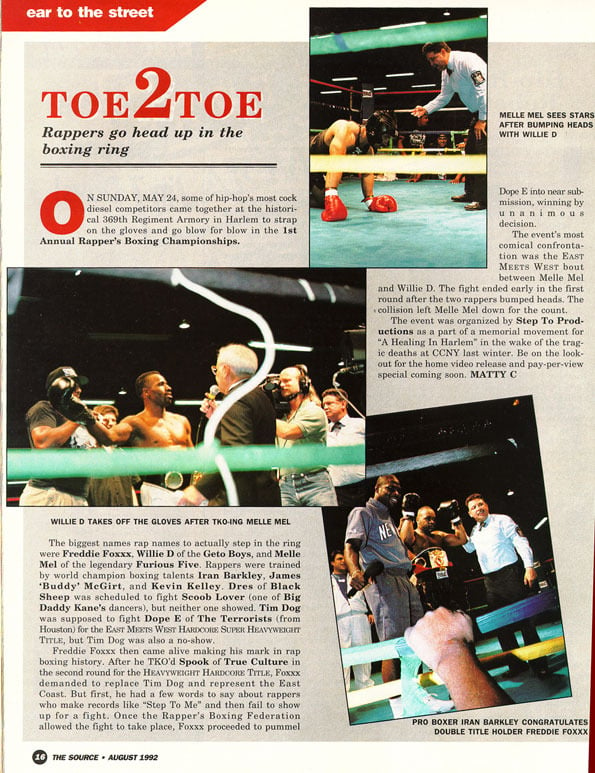
[edit]Willie D began boxing at the age of 11, and won the Golden Gloves for the state of Texas in 1985. He went on to choose a career as a rapper over turning professional, but he eventually returned to boxing during the 1990s. He won his first professional fight in 1992, knocking out Melle Mel at a charity boxing show by accident after the two bumped heads in the first round.[5] Willie D had two more fights between 1999 and 2000, beating Charles Aguilera by TKO in October 1999 and John Tarmon by KO in June 2000, and drew against John Washington on August 24, 2000. In Willie D's last professional fight, he lost to Yameen Muhammad by TKO in October 2000.[6]
Legal issues
[edit]In 1984 after turning 18, Dennis and Ronald Hope were arrested for holding up a gas station and were held for several months awaiting trial. A 1992 Houston Chronicle article stated that Dennis did six months in jail for aggravated robbery. Dennis was still in attendance at Forest Brook High School prior to his 1986 expulsion.
Dennis was sentenced to deferred adjudication in 1994 for an alleged theft of service concerning a car repair bill.
Dennis was arrested by FBI agents on May 13, 2009, on federal wire fraud charges, stemming from his purported sales of Apple iPhones through a company known as Texas One Wireless after luring potential buyers off Ebay (which he had used to build a reputation as a reliable seller); victims would pay for the electronics, after which all contact would cease and their products would fail to be delivered.[7] The total amount defrauded was alleged to be $194,087.17 (according to authorities investigation the 35 claims of fraud related to the case). Willie D was sentenced to a year in federal prison in December 2010 after pleading guilty to all charges.[8] He was given BOP#99063-179 and spent his sentence at FCI Beaumont and FDC Houston.[9]
Cryptocurrency
[edit]Willie D partnered with Saitama Inu token.[10][11] This token was later found to be a fraud, resulting in first-ever criminal charges against financial services firms for market manipulation and “wash trading” in the cryptocurrency industry.[12]
Discography
[edit]Studio albums
[edit]- Controversy (1989)
- I'm Goin' Out Lika Soldier (1992)
- Play Witcha Mama (1994)
- Loved by Few, Hated by Many (2000)
- Unbreakable (2003)
See also
[edit]- Thug Life – 2001 American crime drama film in which Willie D appears
References
[edit]- ^ Sadler, Armon (January 9, 2024). "Willie D Says Katt Williams Will "Break The Internet Again" With Upcoming Interview". Vibe.com. Retrieved November 15, 2024.
- ^ I'm Hypnotized by My Ex's Booty. Help!, Blogs.houstonpress.com; accessed April 29, 2015.
- ^ Big Talker, Houstonpress.com; accessed November 13, 1997.
- ^ Colin Larkin, ed. (1998). The Virgin Encyclopedia of Dance Music (First ed.). Virgin Books. p. 70. ISBN 0-7535-0252-6.
- ^ "Photographic image of The Source" (JPG). Images.rapgenius.com. August 1992. Retrieved February 14, 2020.
- ^ "BoxRec: Willie Dennis". Boxrec.com. Retrieved May 29, 2019.
- ^ "Willie D Sentenced To A Year In Jail For Wire Fraud Charges". Hot963.com. November 3, 2010. Retrieved August 25, 2018.
- ^ "Rapper Willie D Sentenced in Wire Fraud Scam". Archives.fbi.gov. Retrieved August 25, 2018.
- ^ "Willie D. Out Of Prison, Banned From The Internet". Allhiphop.com. June 18, 2009.
- ^ "Willie D partners with Saitama LLC in Mulit Million Dollar Crypto And NFT Content Creation Team Deal". Prlog.org. Retrieved November 15, 2024.
- ^ Jawnson, Kershaw St (October 13, 2021). "Willie D From The Geto Boys Joins New Crypto And NFT Company". Allhiphop.com. Retrieved November 15, 2024.
- ^ "District of Massachusetts | Eighteen Individuals and Entities Charged in International Operation Targeting Widespread Fraud and Manipulation in the Cryptocurrency Markets | United States Department of Justice". Justice.gov. October 9, 2024. Retrieved November 15, 2024.
External links
[edit]- "Willie D". Discogs.com. Retrieved December 21, 2007.
- "Legendary Houston Rapper Willie D Goes to Prison". Myfoxhouston.com.
- "Willie D out of Prison; on twitter". Houstonpress.com.
| International | |
|---|---|
| National | |
| Artists | |
| Other | |

Willie D
View on GrokipediaEarly Life
Childhood and Formative Influences in Houston
William James Dennis, professionally known as Willie D, was born on November 1, 1966, in Houston, Texas. His parents separated when he was four years old, after which he was raised primarily by his mother amid the economic hardships common in urban Houston neighborhoods during that era. His father worked as a carpenter and construction worker, a trade that influenced Dennis's early exposure to manual labor and resilience in a working-class environment.[9] Growing up on Houston's north side, Dennis navigated a formative environment marked by street challenges and systemic issues like bullying in schools, which shaped his worldview and confrontational style. He was expelled from high school after engaging in fights he later described as defending against older students' systemic harassment of freshmen, reflecting the rough dynamics of his youth. These experiences instilled a sense of defiance and self-reliance, key elements that later informed his lyrical themes of social critique and personal agency.[10][11] As a teenager in the early 1980s, Dennis became immersed in the emerging rap music scene, listening avidly to pioneers of the genre, which sparked his initial creative interests alongside the physical outlets he pursued. This blend of Houston's gritty urban realities and cultural vibrancy provided the foundational influences for his transition into hip-hop, emphasizing raw authenticity over polished narratives.[12]Introduction to Boxing and Athletic Development
William James Dennis, known professionally as Willie D, initiated his athletic endeavors in Houston, Texas, by taking up boxing at the age of 11. This early entry into the sport stemmed from his environment in a high-risk urban setting, where boxing served as a structured discipline fostering physical conditioning, mental toughness, and self-defense skills amid prevalent street challenges. As a naturally gifted athlete, Dennis committed to rigorous training regimens typical of amateur boxing, emphasizing footwork, punching technique, and endurance to build a foundation for competitive performance.[12] His development progressed steadily through adolescence, with consistent participation in local bouts honing his reflexes and strategic acumen. By his late teens, Dennis had cultivated the attributes essential for success in the ring, including cardiovascular stamina and power generation, which reflected broader athletic maturation beyond mere physicality. These formative experiences in Houston's boxing scene not only enhanced his bodily coordination but also instilled a competitive ethos that influenced his later pursuits.[12][11] Culminating this phase, in 1985 at age 19, Dennis secured the Golden Gloves Championship for the State of Texas, a prestigious amateur title recognizing his technical proficiency and ring generalship after years of incremental advancement. This victory validated his athletic trajectory, marking a peak in his pre-music dedication to boxing as a potential lifelong vocation before hip-hop opportunities redirected his path.[12]Musical Career
Role in Geto Boys and Group Dynamics
Willie D, born William James Dennis, joined the Houston-based hip-hop group originally known as Ghetto Boys in the late 1980s, contributing to its reformation into the core trio alongside Scarface and Bushwick Bill.[6][13] This lineup shift followed earlier iterations featuring members like Prince Johnny C and The Sire, which had yielded the 1987 debut Making Trouble but limited commercial traction.[14] By 1989, with the name stylized as Geto Boys, the group released Grip It! On That Other Level, where Willie D's aggressive, politically charged lyricism helped define their breakthrough sound, blending raw depictions of street violence, paranoia, and social critique.[15][16] In the group's dynamics, Willie D served as the primary political and conscious voice, often addressing systemic issues like poverty, police brutality, and urban decay, contrasting Scarface's introspective storytelling and Bushwick Bill's erratic, horror-infused narratives.[17] His contributions extended beyond rapping to songwriting and coordinating live performances, enhancing the Geto Boys' high-energy stage presence and cohesive output on albums like We Can't Be Stopped (1991), which peaked at No. 24 on the Billboard 200 and featured hits such as "Mind Playing Tricks on Me."[18][19] The trio's chemistry thrived on unfiltered authenticity, drawing from Fifth Ward experiences, though interpersonal communication remained minimal outside recording and touring, with Willie D noting limited off-stage interactions.[20] Tensions arose from creative differences and solo pursuits; Willie D departed after We Can't Be Stopped to focus on his debut album I'm Goin' Out Lika Soldier (1992), temporarily reducing the group to a duo before rejoining for Till Death Do Us Part (1993).[21] This pattern of intermittent involvement underscored the Geto Boys' resilience, as their provocative themes—pioneering Southern rap's gritty horrorcore edge—faced censorship battles, including a 1990 parental advisory warning that boosted underground appeal.[13] Despite occasional friction, such as public disputes over recognition in later years, Willie D's role solidified the group's legacy as innovators who elevated Houston's hip-hop scene without mainstream polish.[7]Solo Projects and Lyrical Evolution
Willie D's debut solo album, Controversy, released on December 21, 1989, via Rap-A-Lot Records, marked his transition from group dynamics to individual expression while retaining the gritty, confrontational style honed with the Geto Boys. Tracks like "5th Ward" depicted the harsh realities of Houston's Fifth Ward, blending vivid street narratives with calls for community resilience, while "Fuck the KKK" delivered unfiltered anti-racist rhetoric through aggressive flows and explicit imagery.[18][22] The album's lyrics mixed humor with social critique, as in "Welfare Bitches," which satirized dependency cycles without diluting underlying concerns about systemic failures, establishing Willie D's signature blend of provocation and realism.[23] In 1992, amid disputes with Rap-A-Lot and the Geto Boys, Willie D independently released I'm Goin' Out Lika Soldier on September 15, amplifying a militant edge reflective of personal and professional battles. Songs emphasized defiance and survival, with raw, declarative verses prioritizing authenticity over polished production, signaling a lyrical shift toward self-reliant bravado unburdened by group consensus.[24][25] This period highlighted his evolution from collaborative horror-tinged tales to solo assertions of agency, though core themes of urban strife and authority confrontation persisted. Play Witcha Mama, issued October 25, 1994, through Wize Up/Wrap Records, incorporated West Coast G-funk influences via smoother synths and basslines, yet preserved Willie D's bombastic, outspoken delivery on tracks critiquing relationships and street hustles.[26] The album's playful title belied substantive bars on power dynamics, illustrating a maturation where production polish complemented rather than softened his direct, issue-driven content. Subsequent releases like No Pain No Gain (1998) and Loved by Few, Hated by Many (October 24, 2000) further refined this trajectory, integrating motivational undertones with incisive social jabs—such as accountability in "Clean Up Man"—prioritizing lyrical wit over shock value alone.[27][28] Across these projects, Willie D's lyrics evolved from the visceral, group-amplified outrage of Geto Boys-era work to more introspective yet equally unyielding solos, emphasizing personal testimony on race, economics, and self-determination; reviews note this as a consistent thread of "confrontational, politically aware" prose that avoided mainstream sanitization.[23] By the early 2000s, albums like Relentless (2001) and Unbreakable (2003) underscored resilience motifs, with flows adapting to contemporary beats while upholding empirical storytelling rooted in Fifth Ward experiences.[29] This progression reflected causal priorities—street survival informing broader advocacy—without compromising the raw candor that defined his output.[30]Key Discography and Commercial Milestones
Willie D contributed to several Geto Boys albums that achieved notable commercial success, particularly following his addition to the group lineup in 1989. The album Grip It! On That Other Level (released March 12, 1989, Rap-A-Lot Records) marked his debut with the group, featuring raw Southern rap production and tracks like "Do It Like It G.O.," though it did not chart on the Billboard 200. The breakthrough came with We Can't Be Stopped (released July 9, 1991, Def American Recordings), which peaked at number 24 on the Billboard 200 and included the hit single "Mind Playing Tricks on Me," reaching number 23 on the Billboard Hot 100; the album's sales led to platinum certification by the RIAA in early 1992.[31] [32] Subsequent Geto Boys releases with Willie D, such as Till Death Do Us Part (released March 9, 1993, Rap-A-Lot/Priority Records), peaked at number 31 on the Billboard 200, reflecting sustained group momentum amid internal tensions.[33] His solo discography began with Controversy (released December 21, 1989, Rap-A-Lot Records), which peaked at number 53 on the Billboard Top R&B/Hip-Hop Albums chart and featured aggressive tracks like "Fuck the KKK," establishing his confrontational style outside the group.[34] The follow-up I'm Goin' Out Lika Soldier (released September 15, 1992, Rap-A-Lot Records) achieved his highest solo commercial peak, entering the Billboard 200 and reaching number 27 on the Top R&B/Hip-Hop Albums chart, bolstered by the single "Clean Up Man" at number 48 on the Hot R&B/Hip-Hop Songs chart.[35] [36] Later solo efforts included Play Witcha Mama (1994, Rap-A-Lot Records), which maintained his lyrical focus on social critique but saw diminished chart presence, and independent releases like Loved by Few, Hated by Many (2000) and Relentless (2001), the latter yielding the single "Dear God" peaking at number 78 on the Hot R&B/Hip-Hop Songs chart.[36] These works underscored Willie D's evolution toward motivational and politically charged content, though they did not replicate the group-era sales milestones.| Album | Release Date | Label | Key Chart Peak | Notes |
|---|---|---|---|---|
| We Can't Be Stopped (Geto Boys) | July 9, 1991 | Def American | #24 Billboard 200 | Platinum-certified; featured "Mind Playing Tricks on Me"[31][32] |
| I'm Goin' Out Lika Soldier (Solo) | September 15, 1992 | Rap-A-Lot | #27 Top R&B/Hip-Hop Albums | Entered Billboard 200; single "Clean Up Man" #48 R&B[35][36] |
| Till Death Do Us Part (Geto Boys) | March 9, 1993 | Rap-A-Lot/Priority | #31 Billboard 200 | Reflected group dynamics post-breakthrough[33] |