


Community hub
Recent from talks
Contribute something
Nothing was collected or created yet.
Woolpit
View on Wikipedia
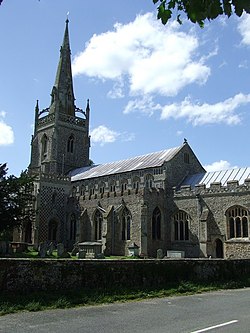
Woolpit (/ˈwʊlpɪt/ WUUL-pit[1]) is a village in the English county of Suffolk, midway between the towns of Bury St. Edmunds and Stowmarket. In 2011 Woolpit parish had a population of 1,995.[2] It is notable for the 12th-century legend of the green children of Woolpit and for its parish church, which has especially fine medieval woodwork. Administratively Woolpit is a civil parish, part of the district of Mid Suffolk.
Key Information


History
[edit]The village's name, first recorded in the 10th century as Wlpit and later as Wlfpeta, derives from the Old English wulf-pytt, meaning "pit for trapping wolves".[3]
Before the Norman Conquest of England, the village belonged to Ulfcytel Snillingr.[4] Between 1174 and 1180, Walter de Coutances, a confidant of King Henry II, was appointed to Woolpit. After his "death or retirement" it was to be granted to the monks of Bury St Edmunds Abbey. A bull of Pope Alexander III likewise confirms that revenues from Woolpit are to be given to the abbey.[5]
In the 15th century and for some time afterwards, two fairs were held annually. The Horse Fair was held on two closes, or fields, on 16 September. The Cow Fair was held on its own field on 19 September; here toys, as well as cattle, were sold.
Sir Robert Gardiner, Lord Chief Justice of Ireland, was Lord of the Manor from 1597 to 1620. He founded an almshouse for the care of the poor women of Woolpit and nearby Elmswell. The Gardiner charity still exists. Woolpit passed at his death to his grandnephew, Gardiner Webb, who died in 1674.
From the 17th century, the area became an important manufacturing centre for "Suffolk White" bricks, but today only the pits remain.
Woolpit is in the hundred of Thedwestry, 8 miles (13 km) southeast of Bury. The area of the parish is 2,010 acres (8.1 km2); the population in 1831 was 880, less than half agricultural.
Mill Lane marks the site of a post mill which was demolished in about 1924. Another mill, which fell down in 1963, stood in Windmill Avenue.
The village contains one pub, The Bull, two tea rooms, estate agents, a grocers, hairdressers, a fish and chip shop, Palmers Bakery, a dentist and Woolpit Interiors within the village and two industrial estates containing more larger businesses as well as a health surgery and school.
Demographics
[edit]In 1811, Woolpit had 625 inhabitants in 108 houses. By 1821 the population had increased to 801 inhabitants in 116 houses.[4]
Legend of the green children
[edit]
The medieval writers Ralph of Coggeshall and William of Newburgh report that two children appeared mysteriously in Woolpit sometime during the 12th century. The brother and sister were of generally normal appearance except for the green colour of their skin. They wore strange-looking clothes, spoke in an unknown language, and the only food they would eat was raw beans. Eventually, they learned to eat other food and lost their green pallor, but the boy was sickly and died soon after the children were baptised.[6] The girl adjusted to her new life, but she was considered to be "rather loose and wanton in her conduct".[7] After learning to speak English she explained that she and her brother had come from St Martin's Land, an underground world whose inhabitants are green.[6]
Some researchers believe that the story of the green children is a typical folk tale, describing an imaginary encounter with the inhabitants of another world, perhaps one beneath our feet or even extraterrestrial. Others consider it to be a garbled account of a historical event, perhaps connected with the persecution of Flemish immigrants living in the area at that time.[6]
Local author and folk singer Bob Roberts stated in his 1978 book A Slice of Suffolk that, "I was told there are still people in Woolpit who are 'descended from the green children', but nobody would tell me who they were!"[6]
St Mary's Church
[edit]St Mary's Church is in the Deanery of Lavenham, in the Diocese of St Edmundsbury and Ipswich. It is combined with neighbouring Drinkstone as the "Benefice of Woolpit (Blessed Virgin Mary) with Drinkstone".[8] The church had a statue to Saint Mary and an associated well.
Woolpit bricks
[edit]Records of brick production in Woolpit date back to the 16th century, when Edward Duger and Richard Reynolds both had "brick-kells" (kell being a local word for a kiln).[9] The bricks were very white and Frederic Shoberl suggested they were "equal in beauty to stone". In 1818 he remarked that most of the mansions in Suffolk were built from these bricks.[10]
Notable residents
[edit]- Dr Helen Geake – archaeologist and a member of Channel 4's Time Team.
- Ian Lavender – actor and cast member of Dad's Army.
References
[edit]Citations
[edit]- ^ The Oxford English Dictionary. Vol. 20 (2nd ed.). Oxford University Press. 1989. p. 524.
- ^ Action with Communities in Rural England (2013). "Rural Community Profile for Woolpit (Parish)" (PDF). www.woolpit.org. Retrieved 9 October 2019.
- ^ Mills, A. D. (2003), "Woolpit", A Dictionary of British Place-Names, Oxford University Press, ISBN 978-0-19-960908-6, retrieved 25 April 2009
- ^ a b A concise description of Bury St. Edmund's: and its environs, within the distance of ten miles, London: Longman, 1827, pp. 357–61
- ^ Arnold, Thomas (1896), Memorials of St. Edmund's abbey: Cronica Buriensis, 1020–1346, H. M. Stationery, pp. 84–85
- ^ a b c d e Clark, John (2006), "'Small, Vulnerable ETs': The Green Children of Woolpit", Science Fiction Studies, 33 (2): 209–229, doi:10.1525/sfs.33.2.209
- ^ Simpson, Jacqueline; Roud, Steve (2000), "Green Children", A Dictionary of English Folklore (online ed.), Oxford University Press, ISBN 978-0-19-860766-3, retrieved 5 April 2009
- ^ "The Benefice of Woolpit (Blessed Virgin Mary) with Drinkstone". www.crockford.org.uk. Retrieved 5 December 2021.
- ^ Dufour, Ian. "Bricks". www.pevsnersuffolk.co.uk. Ian Dufour. Retrieved 19 January 2021.
- ^ Shoberl, Frederic (1818). Suffolk, or, Original delineations, topographical, historical, and descriptive of that county: the result of person survey / by Mr. Shoberl. London: Printed for J. Harris.
Bibliography
[edit]- Jenkins, Simon, England's Thousand Best Churches, 1999, Allen Lane, ISBN 0-7139-9281-6
- John Julius Norwich, The Architecture of Southern England, Macmillan, London, 1985, ISBN 0-333-22037-4
- Suffolk Churches Illustrated details about the parish church
External links
[edit]
| International | |
|---|---|
| National | |
| Other | |

Woolpit
View on GrokipediaGeography and administration
Location and topography
Woolpit is a village located in the county of Suffolk within the East Anglia region of England, positioned approximately 8 miles (13 km) east of Bury St Edmunds and 7 miles (11 km) west of Stowmarket. It lies along the A14 trunk road, a major east-west route that facilitates connections to nearby cities such as Cambridge to the west and Ipswich to the east. This strategic placement has historically supported the village's accessibility and integration into broader regional networks.[5][6][7] The village occupies a flat clay soil plateau at an elevation of around 60 meters (200 feet) above sea level, characteristic of the ancient plateau claylands landscape type prevalent in central Suffolk. This gently undulating terrain, formed by glacial till deposits, rises subtly toward the south and is surrounded by expansive farmland dotted with historical wolf pits—deep excavations used for trapping wolves, from which the village derives its Old English name, wulfpytt. At its southern edge, the plateau approaches the River Rat, a small stream that marks the transition to lower-lying valleys.[8][7][9][1] Woolpit's proximity to ancient Roman roads, such as the route traced along Deadman's Lane within the village, underscores its role in early settlement patterns influenced by Roman infrastructure. The surrounding environmental features emphasize a predominantly agricultural landscape of arable fields and pastures, interspersed with woodlands, including areas linked to local folklore near the historical wolf pits. While the village itself lacks major rivers, minor streams in the vicinity contribute drainage toward the River Rat and ultimately feed into the River Gipping to the south, shaping the area's hydrological context within the broader East Anglian watershed.[10][7][11]Local government and demographics
Woolpit is a civil parish situated within the Mid Suffolk district of Suffolk, England, and is governed at the county level by Suffolk County Council. It forms part of the Bury St Edmunds and Stowmarket parliamentary constituency, represented since the 2024 general election by Labour MP Peter Prinsley. Local affairs are managed by the Woolpit Parish Council, which convenes monthly meetings at the Woolpit Institute open to residents and the press, and oversees community initiatives including funding allocations through Community Infrastructure Levy (CIL) applications for local projects.[12][13][14][15] The parish covers an area of 7.60 km² and incorporates the main village along with the hamlets of Borley Green, Woolpit Green, and Woolpit Heath. Ecclesiastically, it shares a benefice with the neighbouring parish of Drinkstone under the Lavenham Deanery in the Diocese of St Edmundsbury and Ipswich.[1][16] The 2011 census recorded a population of 1,995 for Woolpit parish. This figure rose to 2,094 in the 2021 census, indicating an average annual growth rate of 0.49% between the two dates, with a density of 276 residents per km² (2021). Earlier records show 625 inhabitants living in 108 houses in 1811, increasing to 801 inhabitants in 116 houses by 1821.[17][2] The parish remains predominantly rural in character, featuring a high rate of home ownership, with 77.6% of households owning their property outright or with a mortgage according to 2011 data.[18] Woolpit's position along the A14 trunk road enhances connectivity to regional centres like Bury St Edmunds and Ipswich.History
Early and medieval history
The name Woolpit derives from the Old English wulf-pytt, meaning "pit for trapping wolves," reflecting the presence of such traps in the area to protect livestock from predators. The village is first recorded in 10th-century charters as Wlpit and later as Wlfpeta, indicating its Anglo-Saxon origins. Archaeological evidence suggests possible pre-Roman settlement in the vicinity, with prehistoric remains including pottery and tools uncovered on the village's edge, likely drawn by the fertile clay soils suitable for early agriculture. The site's proximity to ancient trackways, including a Roman road running nearby, further supports continuous human activity from prehistoric times through the Roman period, where sherds of Roman pottery indicate exploitation of local clay resources.[3][19][20][21] In the Domesday Book of 1086, Woolpit is described as a modestly prosperous settlement in the hundred of Thedwastre, Suffolk, with land valued at £12 annually. Prior to the Norman Conquest, the manor belonged to Ulfcytel Snillingr, an Anglo-Saxon ealdorman of East Anglia, who bequeathed it to Bury St Edmunds Abbey among other estates. Post-Conquest, it remained under the abbey's ownership, recorded as supporting 17 villeins, 3 bordars, and 40 freemen, alongside 9 plough teams and meadow for livestock. These figures indicate a mixed agrarian economy centered on arable farming and animal husbandry, with the freemen suggesting a degree of social independence uncommon in some regions.[22][1][21] By the late 12th century, the manor was formally granted to Bury St Edmunds Abbey following the tenure of Walter de Coutances, a royal clerk and confidant of King Henry II, who held it between 1174 and 1180 before his elevation to higher ecclesiastical office. The abbey managed Woolpit as part of its extensive Liberty of St Edmund, fostering agricultural development amid regional stability. Brick-making emerged in the 12th to 13th centuries, leveraging the abundant clay deposits, with some of the earliest medieval brickwork in England appearing in Suffolk during this period, contributing to local construction and trade. The medieval economy emphasized farming, supplemented by fairs first chartered in the 13th century and held from the 15th century: the Horse Fair on 16 September for livestock sales on designated fields, and the Cow Fair on 19 September, which also featured toys and other goods. In the 13th century, Woolpit received royal charters for a weekly market and the two annual fairs, enhancing its role as a local commercial hub. Socially, the population is estimated at around 300-400 based on Domesday household multipliers adjusted for family sizes of about 4-5 persons per adult male, reflecting a stable rural community. During the Anarchy (1135-1154) under King Stephen, Woolpit lay in a contested East Anglian region affected by civil strife, and it is in this era that the legend of the green children reportedly unfolded, adding a layer of folklore to the village's medieval record.[3][19][1]Post-medieval and modern developments
In the late 16th and early 17th centuries, the manor of Woolpit passed into the hands of the Gardiner family following the Dissolution of the Monasteries, with Sir Robert Gardiner serving as Lord of the Manor from 1597 until his death in 1620.[23] Sir Robert, a prominent judge and landowner from nearby Elmswell, founded an almshouse charity that provided accommodation for elderly women from both Elmswell and Woolpit, reflecting his commitment to local welfare amid the social changes of the Tudor period. During this time, the village's brick industry began to expand, leveraging local clay deposits to produce "Suffolk White" bricks, which by the early 19th century were widely used in constructing mansions and buildings across the region, including in Ipswich.[24] The 18th and 19th centuries brought agricultural transformations through parliamentary enclosure acts, which consolidated open fields and commons into private farmland, enhancing productivity but altering traditional land use patterns in Woolpit and surrounding Suffolk parishes.[25] By 1821, the village's population had grown to 801 residents across 116 households, driven by industrial opportunities and rural migration.[3] Integration into broader transport networks followed with the opening of the Ipswich to Bury St Edmunds railway line in 1846, which, though lacking a direct station in Woolpit, facilitated goods movement and connectivity via the nearby Elmswell station, supporting the brick trade and agricultural exports.[26] The 20th century saw Woolpit evolve amid national shifts, with no major direct conflicts but indirect influences from regional World War II airfields in Suffolk, where American and British forces established bases that boosted local economies through supply demands and temporary employment.[27] Postwar suburbanization along the A14 corridor introduced new housing with large gardens, achieving densities of around 16 dwellings per hectare and blending rural character with modern expansion.[7] Community amenities developed in this era, including the Woolpit Institute—established in 1891 but expanded for public use in the mid-20th century—and the Village Hall built in 1983, serving as hubs for social and recreational activities.[28] Agriculture remained a cornerstone, with former brick pits reclaimed for farming, maintaining the village's agrarian continuity into the present day.[29] In recent years, Woolpit has focused on sustainable growth, with the parish council actively discussing Community Infrastructure Levy (CIL) funding in 2025 for projects such as roof repairs at the Institute and a new footpath linking Woolpit to Elmswell, aimed at enhancing pedestrian and cycling connectivity.[30][31] These initiatives underscore the village's adaptation to contemporary needs while preserving its historical fabric.Cultural heritage
Legend of the green children
The legend of the green children of Woolpit originates from accounts recorded in the mid- to late 12th century, during the reign of King Stephen (1135–1154), amid the political turmoil of the Anarchy in England.[4] Two children, a boy and a girl, with green-tinted skin and clad in unfamiliar garments, reportedly emerged from a pit in fields near the village of Woolpit in Suffolk, speaking an unknown language and initially refusing all food except raw beans.[32] The children were discovered by local reapers during harvest time and taken to the household of a prominent landowner, where they gradually adapted to ordinary sustenance, though the boy soon died while the girl survived and integrated into society.[33] The primary sources for the tale are two independent medieval chronicles: William of Newburgh's Historia Rerum Anglicarum (completed around 1189) and Ralph of Coggeshall's Chronicon Anglicanum (written circa 1220).[4] In William's account, the children appeared near wolf pits in East Anglia, approximately four or five miles from the monastery of Bury St. Edmunds, and were said to hail from "St. Martin's Land," a twilight realm without direct sunlight where their people dwelt in perpetual dimness; the girl, after learning English, described how she and her brother had followed the sound of church bells while herding into a cavern that led them to the surface world, from which they could not return.[4] Ralph's version, drawing from local testimony including that of the landowner Richard de Calne (or de Cadeigne), places the emergence explicitly at Woolpit near the church of St. Mary, noting the children's human form but unusual green hue and their initial sustenance solely on bean pods; he records that the girl was baptized, lost her green coloration over time, served in de Calne's household for years, and later married, becoming known for her lively disposition, while confirming the origin in a sunless land entered via a cave pursued by bell sounds.[33] Both chroniclers tie the event to specific features of the Woolpit landscape, particularly the wolf pits—deep traps used for capturing wolves—that dotted the area's fields and may have inspired the "pit" from which the children emerged.[4] William, a monk at Newburgh Priory in Yorkshire, included the story in his historical narrative as a credible wonder reported by a reliable knight, emphasizing its veracity amid his broader chronicle of English affairs from 1066 onward.[4] Ralph, abbot of Coggeshall Abbey in Essex, presented it similarly as a factual local marvel in his annals, based on eyewitness reports from Suffolk residents, reflecting the medieval genre of mirabilia where such phenomena were documented without skepticism to illustrate divine or natural curiosities.[33]Local traditions and folklore
Woolpit's local traditions include remnants of medieval fairs that once defined the village's communal life. In the thirteenth century, the village received royal charters for a weekly market and two annual fairs: the Horse Fair and the Cow Fair, both held around early September.[1] The Cow Fair, focused on cattle sales and toys, was discontinued in the seventeenth century, while the Horse Fair continued into the nineteenth century before being abandoned due to concerns over crime.[1] Although no formal revivals have occurred, these events echo in contemporary community gatherings, such as the Woolpit Women's Institute (W.I.) meetings, which feature local entertainment and speakers to foster social bonds.[34] For instance, the W.I.'s December 2025 Christmas party at the village hall includes a performance by Shantyfolk, a five-piece a cappella group specializing in sea shanties with audience participation.[34] Folklore in Woolpit centers on sites tied to medieval devotion, particularly the Shrine of Our Lady of Woolpit and the adjacent holy well. The shrine, now incorporated into the church vestry, attracted pilgrims throughout the Middle Ages, with bequests of land, money, and devotional items recorded in local wills.[1] Nearby, Our Lady’s Well—located northeast of St Mary's Church and first documented in 1574—gained repute for its healing properties, especially for sore eyes, attributed to its high sulphate content identified in analyses from the late 1970s.[1] These elements reflect broader Suffolk customs, including adaptations of regional mumming plays, where masked performers enact folk dramas during winter festivals to invoke good fortune, though specific Woolpit variants remain undocumented in historical records.[35] Efforts to preserve Woolpit's cultural heritage occur through village institutions like the hall and guilds. Built in 1983, the Woolpit Village Hall serves as a hub for community events, including historical talks and socials organized by groups such as the W.I. and parish council, which promote awareness of the area's past.[36] These activities connect to East Anglian harvest traditions, incorporating pagan remnants like Lammas celebrations on August 1, which honor the first grain harvest with communal feasts and bread-making rituals rooted in pre-Christian agrarian rites.[37] Medieval guilds, such as the Gild of Our Blessed Lady, similarly supported families and funded communal prayers, influencing modern preservation initiatives.[1] In the twenty-first century, Woolpit's folklore has spurred tourism focused on its traditions, including guided walks that highlight sites like the holy well and medieval pilgrimage routes.[38] The most famous tale, that of the green children, continues to shape local identity by drawing visitors interested in Suffolk's mystical heritage.[39]Landmarks and economy
St Mary's Church
St Mary's Church, dedicated to the Blessed Virgin Mary, serves as the central parish church of Woolpit and stands as a Grade I listed medieval structure exemplifying East Anglian ecclesiastical architecture.[40] Its origins trace to the late 11th century, with remnants of a Norman priest's door indicating early construction under the influence of St Edmundsbury Abbey, to which the site was gifted around 1087.[41] The bulk of the building dates to the 15th century, rebuilt in the Perpendicular Gothic style during a period of prosperity that supported extensive additions like the nave, north and south aisles, clerestory, and a renowned double hammerbeam roof installed between 1439 and 1451.[40] This roof spans ten bays, featuring carved angels and canopied figures that highlight the church's role as a pilgrimage destination centered on a statue of the Virgin Mary, known as Our Lady of Woolpit, housed in a medieval shrine at the east end of the south aisle.[41] The west tower, containing a ring of bells, was originally medieval but collapsed twice—first in 1702 and again in 1852 due to lightning—leading to its rebuilding in Decorated style with a distinctive spire by architect Richard Makilwe Phipson in the 1850s.[40] A holy well associated with the church and linked to local legends lies nearby in the churchyard vicinity, reflecting the site's longstanding spiritual significance.[41] Ecclesiastically, St Mary's belongs to the Lavenham Deanery within the Archdeaconry of Sudbury and the Diocese of St Edmundsbury and Ipswich, maintaining its status as a rectory since medieval times when it was granted to the monks of St Edmund's Abbey in 1211 for hospitality support while preserving a vicarage.[42] In the 20th century, it formed a combined benefice with All Saints' Church in neighboring Drinkstone, sharing clergy and community functions to this day.[43] The church has historically hosted key community rites, including baptisms such as that of the "green boy" from medieval accounts, underscoring its enduring role in village life.[41] Architecturally, the church comprises a broad nave with aisles, a chancel incorporating 14th-century elements like a south doorway and net-tracery east window, and an exceptional south porch constructed around 1439–1451 with fan vaulting, flushwork panels, and heraldic motifs.[40] Inside, highlights include a late 14th-century octagonal font with traceried panels, a profusion of medieval carved bench ends (supplemented by 19th-century recreations), a 15th-century painted rood screen, and fragments of medieval stained glass.[44] Memorials to prominent local families, such as the Gardiners—including a monument to Sir Robert Gardiner (d. 1620), Lord of the Manor of Woolpit—adorn the interior, commemorating their contributions to the parish.[45] An early 16th-century brass eagle lectern further enriches the fittings, predating the Reformation.[41] Restorations in the Victorian era addressed decay and damage, with 19th-century interventions including the renewal of the chancel roof (incorporating medieval timbers), repainting of the rood screen, and recreation of bench ends to preserve the medieval aesthetic.[40] The angel figures on the hammerbeam roof were also restored during this period.[44] Today, St Mary's remains an active parish church, hosting regular worship services, community events, and visitors drawn to its historical and architectural prominence in the heart of Woolpit.[46]Woolpit bricks and local industry
Brick production in Woolpit originated in the 16th century, with the first recorded kilns appearing in the Manorial Extent of 1574, where individuals such as Edward Duger and Richard Reynolds operated sites near clay pits referred to as "le bryckell" and "brick-kells."[1][47] These early efforts utilized abundant local deposits of bluish-grey plastic clay, which, due to its high lime and chalk content, produced the distinctive pale "Suffolk White" bricks prized for their fine quality and uniformity.[24][48] Traditional firing methods involved arranging unfired bricks in temporary clamps stacked with fuel, a labor-intensive process that allowed for small-scale output suited to local demand.[49] The industry reached its peak in the 19th century, transforming Woolpit into a key manufacturing hub. Kiln Farm Brickworks, established in 1819, became the most prominent site, producing both white and red bricks using steam-powered machinery by the late 1800s and employing local workers in roles from clay extraction to firing in advanced Hoffman kilns introduced in the 1930s.[50][51] By 1818, these bricks were widely exported, forming the basis for many Suffolk mansions, with contemporary observer Frederic Shoberl noting their "beauty equal to stone" and their use in the majority of the county's grand residences.[47] The Woolpit Brick & Tile Company, operating from 1883 to 1937, further boosted village prosperity by supplying high-quality tiles and bricks for regional construction, supporting dozens of families through steady employment and contributing significantly to the local economy.[52][51] Production declined after World War II amid shifts to modern industrial methods and competition from larger facilities, with the final operations at Suffolk Brickworks (Woolpit) Ltd ceasing in 1948.[50][51] Today, physical remnants include disused clay pits, scattered kiln foundations, and early brick structures like the circa-1614 almshouses built for Sir Robert Gardener using narrow red and buff bricks.[53] The Woolpit and District Museum preserves this legacy through a 3D model of the brickworks, artifact collections, and historical photographs, highlighting the industry's role without ongoing commercial production.[54] Historically, brickmaking complemented Woolpit's agricultural base by repurposing marginal clay-rich lands unsuitable for farming, providing seasonal work for laborers.[1] In the contemporary economy, the village blends traditional farming with light industrial units on former brickworks sites, daily commuting to Bury St Edmunds for employment in services and manufacturing, and tourism drawn to its folklore and heritage attractions. As of November 2025, ongoing residential and commercial developments are driving population growth and increased traffic in the area.[55][1][56][57]Notable people
Historical figures
Ulfcytel Snillingr (died 1016), also known as Ulfketel, was an Anglo-Saxon ealdorman of East Anglia who held significant land holdings in the region, including the manor and church of Woolpit, which he granted to the shrine of St. Edmund at Bury St. Edmunds in 1005.[1] As a prominent military leader, he commanded East Anglian forces against Danish invaders, notably at the Battle of Ringmere in 1010, where he initially repelled the Vikings led by Thorkell the Tall before ultimately falling at the Battle of Assandun in 1016. His pre-Conquest ownership of Woolpit underscores the village's early ties to Anglo-Saxon nobility and ecclesiastical institutions. Walter de Coutances (died 1207), an Anglo-Norman cleric and royal administrator, managed the abbey lands of Bury St. Edmunds, including Woolpit, from 1174 to 1180 as part of his early preferments under King Henry II.[58] Rising through royal service, he later became archdeacon of Oxford, Bishop of Lincoln in 1182, and ultimately Archbishop of Rouen in 1190, playing key roles in the Third Crusade's logistics and the governance of Normandy.[58] His oversight of Woolpit during this period reflects the integration of local manors into broader ecclesiastical and royal administrative networks. Sir Robert Gardiner (c. 1540–1620), a Suffolk-born lawyer and judge, acquired the manor of Woolpit around 1597 and held it until his death, alongside his estates at Elmswell. Appointed Lord Chief Justice of Ireland in 1603, he served for eighteen years, contributing to legal administration during the early Stuart period, including oversight of judicial proceedings in a turbulent colonial context.[59] In his later years, Gardiner founded an almshouse in Elmswell in 1615 to provide for poor aged widows from both Elmswell and Woolpit parishes, endowing it with lands to ensure ongoing support for the needy. Medieval chroniclers Ralph of Coggeshall (died c. 1227), abbot of Coggeshall Abbey, and William of Newburgh (died 1198), a scholar at Newburgh Priory, are notable for recording the 12th-century legend of the green children of Woolpit in their respective works, the Chronicon Anglicanum and Historia rerum Anglicarum, though neither resided in the village. Their accounts provide the primary historical documentation of this folklore associated with Woolpit.Modern residents
Ian Lavender (1946–2024), best known for portraying the naive Private Frank Pike in the BBC sitcom Dad's Army from 1968 to 1977, resided in Woolpit for many years until his death.[60] The Birmingham-born actor, the last surviving main cast member of the series, became an active participant in village life, supporting local events such as cricket matches and contributing to community activities in the Suffolk countryside he called home.[61] His presence helped foster a sense of cultural vibrancy, with residents recalling his approachable demeanor and involvement in parish affairs.[62] Dr. Helen Geake (b. 1967), a prominent archaeologist and finds liaison officer for the Portable Antiquities Scheme in East Anglia, has been a long-time resident of Woolpit.[63] Specializing in Anglo-Saxon artifacts and medieval small finds, she gained public recognition as a regular expert on Channel 4's Time Team from 1994 to 2014, where she analyzed historical discoveries across Britain.[64] Her work has deepened understanding of Suffolk's early medieval heritage, including excavations and studies of local sites that connect to the region's Iron Age and Roman past. As chair of the Woolpit Parish Council since at least 2022, Geake has advocated for community-led heritage initiatives, bridging her professional expertise with village governance.[65] In the 21st century, Woolpit has seen growth in its resident population, with many post-2000 arrivals being commuting professionals drawn to the village's proximity to Bury St Edmunds and rail links to London and Norwich.[66] This influx has diversified the community, including figures active in local governance such as parish council members who organize events like Women's Institute meetings featuring speakers on arts and history in 2025.[34] While specific notables beyond public figures like Geake remain limited, the parish's nine-member council, including professionals like Frederick Guyler and Hilary Hammond, handles day-to-day administration and community engagement.[67] Modern residents have played a key role in promoting Woolpit's cultural heritage, particularly through efforts to highlight the legend of the green children for tourism and preservation. The Woolpit History Group, led by locals including chair John Christie, conducts research and public talks on the village's folklore and artifacts, encouraging visitors to explore sites tied to the 12th-century tale.[68] Initiatives like the Woolpit Museum, supported by community volunteers, showcase exhibits on local history and industry, drawing tourists interested in the green children story and sustaining economic interest in the village's medieval legacy.[54]References
- https://en.wikisource.org/wiki/Dictionary_of_National_Biography%2C_1885-1900/Coutances%2C_Walter_de