Hubbry Logo
Ford Falcon (XR)Ford Falcon (XR)Main
Open search
Ford Falcon (XR)
Community hub
Ford Falcon (XR)
logo
8 pages, 0 posts
0 subscribers
Be the first to start a discussion here.
Ford Falcon (XR)
Ford Falcon (XR)
from Wikipedia

Ford Falcon (XR)
Ford Fairmont (XR)
Ford Falcon 500 Sedan (XR)
Overview
ManufacturerFord Australia
ProductionSeptember 1966 – March 1968
Body and chassis
ClassFull-size car
Body style4-door sedan
5-door station wagon
2-door coupe utility
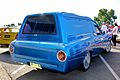
2-door panel van
RelatedFord Fairlane (ZA)
Powertrain
Engine170 ci (2.8 L) Inline 6
200 ci (3.3 L) Inline 6
289 ci (4.7 L) "Windsor" V8
Transmission3-speed manual
3-speed automatic
3-speed Cruis-O-Matic/4-speed manual(GT only)
Dimensions
Length4,689 mm (184.6 in)
Width1,875 mm (73.8 in)
Height1,389 mm (54.7 in)
Curb weight1,333 kg (2,938.8 lb)
Chronology
PredecessorFord Falcon (XP)
SuccessorFord Falcon (XT)

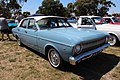
The Ford Falcon (XR) is a full-sized car produced by Ford Australia from 1966 to 1968. It was the first of the second generation of the Falcon and also included the Ford Fairmont (XR), the luxury-oriented version.

Overview

[edit]

The XR series was introduced in September 1966. Styling was based on the third-generation 1966 US Ford Falcon, and it was promoted as the "Mustang-bred Falcon". It was the first Australian Falcon to be offered with a V8 engine, the 200 bhp (150 kW), 289 cubic inch (4.7 L) Windsor unit.[1] The XR marked the first time a V8 engine could be optioned in all trim levels of an Australian car, V8s having previously been reserved for the more upmarket variants. The 144 cubic inch (2.4 L) six-cylinder engine was deleted for the XR series, leaving the 170 cubic inch (2.8 L) six as the base Falcon engine. A 200 cubic inch (3.3 L) six was also available and a 200ci super pursuit motor.[1]

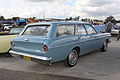
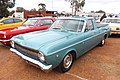
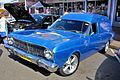
The XR series was initially offered in 9 different models: Falcon, Falcon 500, and Fairmont sedans, Falcon, Falcon 500, and Fairmont wagons, Falcon and Falcon 500 utilities, and the Falcon Van.[1] The new wagons shared the 111-inch (2,800 mm) wheelbase with the XR sedans, unlike the 1966 US Falcon wagons which featured a 115-inch (2,900 mm) wheelbase.[2] The Falcon 500 replaced the Falcon Deluxe of the XP series[2] and the two-door hardtop body style available in the XP series was not offered in the XR range.

The Falcon XR won the Wheels Car of the Year award in 1966, giving Ford Falcon two straight wins.[3]

The Falcon XR was the first Falcon to be assembled at the Ford New Zealand assembly plant at Seaview, the previous XL, XM and XP models being previously imported fully built up from Australia, essentially only in station wagon form.

Falcon GT

[edit]

The marketing focus on the Falcon's relationship with the Mustang's sporty appeal led to Ford introducing a Falcon GT variant of the XR in 1967, featuring a 225 bhp (168 kW) version of the 289 cubic inch (4.7 L) Windsor V8 engine, sourced from the Ford Mustang. The GT heralded the dawn of the Aussie muscle car. All of the original XR GTs were painted in the colour GT Gold, except for eight that were Gallaher Silver and another five that were Russet Bronze, Sultan Maroon, Polar White, Avis White and Ivy Green. The non-gold GTs, while having the same specifications, are the rarest of the early Australian muscle cars.

Motorsport

[edit]
A "race replica" of the XR Falcon GT which won the 1967 Gallaher 500

Ford Works Team manager/driver Harry Firth, and a young Fred Gibson won the 1967 Gallaher 500 at the Mount Panorama Circuit in Bathurst driving an XR Falcon GT.[4][5] Firth and Gibson won the race by 11 seconds from their Sydney-based teammates Ian and Leo Geoghegan. The Geoghegan Falcon was initially flagged in first, but a protest from Firth resulted in a recount of laps and the win being awarded to Firth and Gibson.

With the Falcon powered by a 289-cubic-inch Ford V8 engine, it was the first ever Bathurst 500/1000 won by a V8-powered car. Prior to 1967, the Mount Panorama Circuit had been regarded as too tough on the larger V8 cars (primarily the Studebaker Lark), and had been the domain of smaller cars such as the Morris Cooper S and Ford's own Cortina GT500.

References

[edit]
Revisions and contributorsEdit on WikipediaRead on Wikipedia
from Grokipedia
The Ford Falcon (XR) was a manufactured by from June 1966 to March 1968, representing the second generation of the Falcon model adapted for the Australian market. It featured all-new styling with a long-hood, short-deck design, including Mustang-inspired Coke-bottle hips at the rear and a protruding mesh grille at the front, while offering body styles such as sedans, wagons, utilities, and vans. The XR series introduced affordable V8 power to Australian family cars, with engine options including 170 cubic-inch and 200 cubic-inch inline-sixes, as well as a 289 cubic-inch V8 producing 200 horsepower. Developed with a $35 million investment to compete directly with models, the XR incorporated Australian-specific engineering, such as an extended torque-box for improved torsional stiffness, redesigned suspension, and 14-inch wheels with low-profile tire options, addressing local road conditions and consumer preferences. Launched in September 1966, it was larger than its predecessors, with increased length, width, and wheelbase, and minimal chrome trim for a modern aesthetic. The performance-oriented XR GT variant, equipped with a high-output 289 V8 rated at 225 horsepower, was introduced eight months later in March 1967 and quickly gained acclaim for its handling and power. Production totaled 90,810 units over 19 months, contributing to Ford's market leadership in during that period, with the XR winning the prestigious Wheels magazine award. In motorsport, the XR GT dominated the 1967 Hardie-Ferodo 500 race at Bathurst, posting lap times over seven seconds faster than the previous year's winner, underscoring its engineering prowess. The series was succeeded by the facelifted XT Falcon in , which retained much of the XR's mechanical foundation while updating the grille and taillights. Overall, the XR solidified the model's reputation as a versatile, powerful, and distinctly Australian icon in the automotive landscape.

Development and Design

Background and Development

The Ford Falcon XR series was developed as the successor to the XP Falcon, marking Ford Australia's effort to revitalize its compact car lineup amid intensifying competition from in the mid-1960s Australian market. Following the XP's moderate success, Ford committed a substantial $35 million to redesign and update the model, focusing on enhanced size, styling, and performance capabilities to better suit local demands. This initiative was driven by the need to address earlier criticisms of the Falcon's ride quality and durability on Australia's diverse road conditions, with planning accelerating in 1965 under the leadership of newly appointed sales and marketing head Bill Bourke, who emphasized rugged testing and market positioning. The XR drew significant influence from the third-generation 1966 Ford Falcon, adopting its overall platform while incorporating Australian-specific modifications to increase dimensions for greater interior space and load-carrying capacity—resulting in a longer and wider body compared to the XP. engineering teams in contributed key adaptations, such as a stiffer , reinforced suspension components with heavier coil springs and longer leaf springs, and a quicker 20:1 (versus the model's 22:1), all aimed at improving ride comfort and handling on rough rural roads. Development emphasized durability, with prototypes undergoing extensive 10,000-mile rough-road simulations and 40,000-mile endurance tests at the You Yangs Proving Ground near , which replicated conditions to ensure reliability in extreme environments. These changes were approved as early as but refined through 1965 with input from Ford's Australian engineering departments, prioritizing cost-effective local sourcing for parts like shock absorbers and window mechanisms. Launched in September 1966 at Ford's Broadmeadows assembly plant in Victoria, the XR was positioned to capture family buyers seeking practical sedans and wagons, as well as fleet sales in commercial sectors, by offering a more spacious and versatile alternative to Holden's offerings. The model's expanded lineup, including provisions for a option, was strategically designed to challenge Holden's performance edge, ultimately leading to 88,786 units produced and establishing the as a cornerstone of Australian automotive production.

Styling and Features

The Ford Falcon XR series introduced significant exterior styling updates inspired by the contemporary , featuring a modified rear design with pronounced Coke-bottle curves that accentuated the hips and extended the for a more dynamic profile. The front end showcased a new grille housing dual round headlights, flanked by minimal chrome trim and thin-line mouldings, marking a shift toward cleaner, less ornate compared to the preceding XP model. Overall, the XR's body grew in size, with a extended by 1.5 inches to 111 inches for improved stability and ride quality. Inside, the XR offered enhanced comfort through improved seating with softer foam and optional bucket seats available on higher trims like the Fairmont, providing better support for driver and front passenger. The underwent a complete redesign with a swept-away layout that included fine-line instrumentation dials, a scaled to 120 mph, and full as standard, contributing to a sense of spaciousness. Cabin dimensions expanded notably, with shoulder room increased to 57.1 inches and hip room to 59.6 inches, comfortably accommodating five passengers while boot capacity reached 26 cubic feet. Safety and convenience features emphasized practicality for Australian conditions, including a standard padded instrument panel and optional for easier handling. was available but rare due to its high cost and limited demand in the market at the time, while radial-ply tires became an optional upgrade for improved traction and longevity. Australian-specific adaptations included corrosion-resistant underbody parts and stronger unitized construction to combat rust from harsh coastal and environments. For sedans, key dimensions measured 184.6 inches in overall , 73.8 inches in width, and 54.7 inches in , balancing compactness with family usability.

Model Lineup

Standard Models

The standard models of the Ford Falcon (XR) were offered in four core body styles: the four-door sedan, which was the most popular configuration; the five-door ; the two-door coupe (ute), designed for work and trade applications; and the two-door , intended for commercial delivery duties. The base Falcon represented the entry-level variant, equipped as standard with a 170 (2.8 ) inline-six producing 111 or optional 200 (3.3 ) inline-six producing 121 , a three-speed , and minimal trim including rubber floor mats and basic hubcaps. This model appealed to budget-conscious buyers seeking reliable transportation, with the sedan priced at AU$2,226 upon its September 1966 launch. Positioned as the mid-level option, the Falcon 500 added cosmetic enhancements such as chrome accents on the grille and side trim, whitewall tires, and the availability of an optional 289 cubic inch (4.7 L) paired exclusively with the . These upgrades targeted a broader audience, including rural users needing durability for rough roads and urban drivers desiring improved style and power. The variant, available in both base and Falcon 500 trims, provided practical family and utility features, including fold-flat rear seating for expanded load space. It also incorporated woodgrain-style trim accents on the interior and exterior panels for a premium appearance. An upscale Fairmont variant was available for buyers seeking additional luxury refinements.

Trim Levels and Options

The Ford Falcon XR series offered a range of trim levels, with the Fairmont positioned as the premium variant for both sedan and body styles. This top-tier trim featured a , deluxe interior fabrics, optional power windows, and enhanced for improved cabin quietness. The Fairmont also included reclining front bucket seats and was priced up to $3,125 for the automatic sedan model at introduction. Buyers could select from various option packages to customize their XR Falcon. The Custom trim group included two-tone paint schemes, a factory radio, and heater for added comfort. A heavy-duty suspension option was available. variants were produced specifically for the market, where the XR was assembled locally to meet regional specifications. The XR lineup provided 12 standard exterior colors, including distinctive shades such as and aquamarine blue, allowing for personalization without GT-exclusive hues. All XR Falcons were configured for right-hand drive to suit the market, with factory options like hand controls available for disabled drivers to enhance accessibility. These trims and options were compatible with the base inline-six , emphasizing family-oriented upgrades over performance modifications.

Powertrain Specifications

Engine Options

The Ford Falcon (XR) featured a range of inline-six and V8 engines, all petrol-powered and carbureted, tailored for Australian conditions including local availability and driving needs. These powerplants provided a balance of economy, performance, and reliability, with the inline-six options serving as standard fare and the V8 marking a significant upgrade for power-hungry buyers. The base engine was the 170 cubic inch (2.8 L) inline-six, delivering 111 horsepower at 4,400 rpm and 158 lb-ft of torque at 2,400 rpm. Equipped with a , it emphasized fuel economy and smooth operation suited to urban commuting and everyday use. A step up was the optional 200 cubic inch (3.3 L) inline-six, producing 121 horsepower at 4,400 rpm and 190 lb-ft of torque at 2,400 rpm. This mid-range engine used a , making it ideal for highway driving and offering better overall performance across the model lineup. The top option was the 289 (4.7 L) V8, rated at 200 horsepower at 4,400 rpm and 282 lb-ft of at 2,400 rpm. Introduced as the first V8 for an Australian Falcon, it featured a 9.3:1 . All engines relied on carbureted fuel systems with a standard 16-gallon tank, and no diesel variants were offered. These powertrains paired effectively with available manual and automatic transmissions to deliver responsive drivability suited to diverse Australian road conditions.

Transmissions and Performance

The Ford Falcon XR offered a range of transmission options tailored to its lineup and intended use in market. The standard transmission was a three-speed manual with column-mounted shifter and full synchromesh on all forward gears, featuring a first gear ratio of 2.95:1 and a final drive ratio of 3.50:1, which provided adequate low-end pull for the base six-cylinder models. This setup enabled a top speed of approximately 95 mph for the entry-level 170 ci six-cylinder variant. An optional three-speed automatic transmission, the C4 Fordomatic with torque converter, was available across all engine options, delivering smoother operation for urban driving and highway cruising; for the 200 ci inline-six model, it achieved 0-60 mph acceleration in around 12-13 seconds. V8-equipped XR models used a three-speed manual or the three-speed automatic, while the close-ratio four-speed manual transmission was available on the GT variant, facilitating quicker, more engaging shifts suited to the engine's broader power band, yielding combined fuel economy of 15-18 mpg under typical conditions. The XR's chassis and suspension were engineered for durability on Australian roads, incorporating independent front suspension with coil springs and control arms, paired with a live rear on leaf springs for load-carrying capability. Braking was handled by 10-inch drum brakes at all four wheels as standard, with 11-inch drums optional for enhanced . These components contributed to balanced handling characteristics, with the longer and stiffer tuning providing stable cornering and responsive steering suited to varied terrain, though shift points in manual models were influenced by the engines' curves for optimal performance.

Falcon GT

Development and Introduction

The development of the Ford Falcon XR GT originated in late 1966, spearheaded by Ford Australia's performance team under the supervision of Harry Firth, with the initial concept proposed by deputy managing director Bill Bourke to counter the threat posed by Holden's forthcoming HK Monaro V8 coupe. This initiative marked the birth of Australia's first true , blending American-inspired V8 power with local engineering adaptations to create a high-performance variant of the recently introduced XR sedan. The project drew on input from Ford's U.S. division for seamless integration of the 289 cubic-inch Windsor V8 engine into the XR platform, aiming to establish a halo model that would elevate the lineup's appeal and drive broader sales growth. The XR GT entered production in March 1967 to meet racing requirements for events like the Gallaher 500 and made its public debut at the 1967 International Motor Show (March 9–18), with sales commencing in May 1967, where it was unveiled as a premium performance offering priced at $3,890—including —a substantial markup from the base XR Falcon's $2,226. Initially targeting around 260 units for homologation, overwhelming consumer interest resulted in 596 vehicles completed by February 1968, all sharing the standard XR Falcon's chassis and body structure for cost efficiency and available exclusively as a four-door sedan. Ford positioned the GT strategically in the market as an aspirational flagship to combat Holden's performance push, with early advertising campaigns emphasizing its V8 potency and road-racing potential to attract enthusiasts and bolster the brand's image. Initially restricted to the signature GT Gold exterior color with black interior trim to reinforce its exclusive status, the XR GT's rollout included limited special-order options in other hues toward the end of production, reflecting Ford's intent to capitalize on the model's amid rising demand for V8-powered vehicles in . This launch not only ignited the local era but also secured immediate police fleet orders in and Victoria, further amplifying its visibility and sales momentum.

Specifications and Features

The Ford Falcon XR GT was powered by a 289 (4.7 L) Windsor V8 engine, tuned for high performance with a of 9.8:1, a high-performance , and dual , delivering 225 horsepower at 4,800 rpm and 305 lb-ft of at 3,200 rpm. This configuration provided a balance of power and reliability suited to the Australian market, distinguishing it from milder V8 options in the standard XR lineup. Key mechanical upgrades included front disc brakes for improved stopping power, a heavy-duty suspension setup with a front stabilizer bar and reinforced components for better handling, and a Borg Warner rear differential with a 2.93:1 ratio to optimize . The GT rode on 14-inch wheels fitted with wider 6.95 x 14-inch tires, enhancing grip and road presence compared to the base models. Exterior styling featured prominent GT badging on the grille, rear pillars, and boot lid, along with V8 emblems on the front fenders, while the interior boasted sporty bucket seats, a woodgrain-trimmed console, and an integrated for driver-focused . Performance figures for the XR GT reflected its credentials, with a 0-60 mph time of approximately 9.7 seconds and a top speed of 121 mph, achieved through its standard four-speed . Unlike the GT, which was manual-only, standard XR models offered the option of a three-speed for broader appeal. A rare variant consisted of eight units painted in Gallaher Silver, a special commissioned for promotional use by sponsor Gallaher, with three allocated to racing teams ahead of the Bathurst event.

Motorsport

Touring Car Participation

entered the XR Falcon into in by supporting privateer teams in the Australian Touring Car Championship (ATCC), while establishing a to compete in the series and the associated Manufacturers' Championship. The V8-powered XR GT models were positioned as direct rivals to 's HR 186S entries, leveraging their performance credentials in a bid to challenge the dominant Holden platform. Harry Firth, serving as team manager and chief preparer, oversaw the modification of GT variants for competition, including the installation of lightweight body panels to reduce weight and improve handling. Factory cars were reinforced with roll cages for enhanced safety during high-speed battles. Sponsorship deals with Shell for fuels and lubricants, alongside for components, provided crucial backing for the program's logistics and development. The driver roster featured experienced works pilots such as Harry Firth and Fred Gibson, alongside the Geoghegan brothers—Ian and Leo—who piloted supported entries. Privateer efforts, often aligned with Ford dealerships, added depth to the lineup. The XR GT's competitive debut occurred at Warwick Farm in September 1967, where Gallaher-sponsored factory cars made their track appearance ahead of the season's endurance highlight at Bathurst.

Key Victories and Achievements

The Ford Falcon XR GT achieved its most prominent motorsport triumph at the 1967 Gallaher 500 at Mount Panorama, Bathurst, marking the model's debut in endurance racing and the first outright victory for a V8-powered car in the event. Driven by Harry and Fred Gibson for the Ford Works Team, the XR GT completed 130 laps in a time of 6 hours, 54 minutes, and 59 seconds, at an average race speed of approximately 72 mph, securing a one-two finish ahead of the sister car entered by the Geoghegan brothers, Ian and Leo, after a post-race review corrected a lap-scoring error that initially appeared to favor the Geoghegans. Firth and Gibson's car set the fastest race lap of 3 minutes and 3 seconds, demonstrating the XR GT's superior straight-line speed and handling on the demanding 3.875-mile circuit despite challenges from smaller, more agile European competitors like GTVs. This win not only validated the XR GT's design as a special but also ignited the intense Ford-Holden rivalry in Australian . In the Australian Touring Car Championship (ATCC), the XR Falcon GT models secured multiple class victories during the 1967 and 1968 seasons under improved production rules, with drivers like the Geoghegan brothers and others dominating the over-2.5-liter category against Holdens and imports. These successes highlighted the XR's competitive edge in sprint and formats, contributing to Ford's strong presence in national series events at tracks such as and Warwick Farm, where the V8 powertrain proved decisive in acceleration and top speed. The XR GT also established key performance benchmarks at Bathurst, including the fastest production car lap time of the era during the 1967 Gallaher 500, underscoring its influence on circuit records for series-production vehicles. This achievement prompted regulatory adjustments in Australian racing, emphasizing closer adherence to standards for future models. The XR Falcon's racing exploits laid the foundation for subsequent high-performance variants, directly inspiring the development of the XW GT-HO through Ford's collaboration with Firth's team, while achieving numerous victories in national events between 1967 and 1968 that solidified its role in shaping the of Australian competition.

Production and Legacy

Manufacturing and Sales

The Ford Falcon XR was assembled exclusively at Ford Australia's Broadmeadows manufacturing facility in Victoria, with production commencing in September 1966 and concluding in March 1968. The plant utilized unitary construction methods for the body, incorporating a high degree of locally sourced components to meet Australian manufacturing requirements, while V8 engines were imported from the . Output at Broadmeadows supported a range of body styles, including four-door sedans, station wagons, utilities, and panel vans, reflecting the model's versatility for family and commercial use. A total of 90,810 XR Falcons were built over the 19-month production run, marking a significant increase from prior models and contributing to Ford Australia's record annual sales of 95,750 vehicles in 1968. The first units rolled off the line on September 28, 1966, ahead of the official launch, with steady production ramping up to meet demand across and assembly operations. Sales performance was strong from launch, exceeding 90,000 units overall and benefiting from the model's recognition as Wheels magazine's in January 1967—the second consecutive win for the lineup following the XP series. This accolade, highlighting the XR's engineering advancements and market appeal, propelled first-year sales to over 50,000 units, helping Ford capture a larger share of the V8 segment against competitors like . The GT variant emerged as the top-selling performance option within the lineup. Limited exports of the XR were directed to markets including and the , expanding Ford's international reach for the Australian-developed model. Production ceased in March 1968 to make way for the XT series, which introduced refreshed styling cues inspired by contemporary U.S. Falcon updates.

Cultural and Historical Significance

The Ford Falcon XR GT, introduced in 1967, is regarded as the pioneer of Australian muscle cars, igniting the local performance era with its 4.7-liter and sporty features that challenged competitors and established a benchmark for high-output family sedans. This model sparked a "horsepower war" among manufacturers, directly inspiring later icons like the XY GTHO Phase III in 1970 and the performance-oriented BA XR series in the early 2000s, which revived the GT badge for modern enthusiasts. Its debut not only elevated Ford Australia's performance image but also contributed to the evolution of V8-powered vehicles in the country's automotive culture. As a cultural symbol of Australia, the XR Falcon embodied the era's rising affluence and enthusiasm for American-style motoring, blending everyday practicality with aspirational power. Similar later models, such as the XB Falcon GT portrayed as the V8 Interceptor in the 1979 film , extended the Falcon's iconic status in popular media, representing and post-war optimism. Today, the XR GT holds significant collector appeal, with well-restored examples routinely fetching over $200,000 at auction due to their rarity and historical prestige—with only about 600 produced. Historically, the XR Falcon bolstered Ford's market position, helping increase its Australian share from around 10% pre-Falcon to nearly 20% by the mid-1960s, while its success underscored the viability of local manufacturing and influenced government policies favoring domestic production to sustain the industry. The model's V8 prowess also nurtured 's enduring V8 culture, particularly in , where modified XR Falcons became staples for quarter-mile runs and grassroots competitions. Its 1967 Bathurst victory amplified this fame, solidifying the Falcon's role in national motorsport lore. In modern times, dedicated groups like the Falcon GT Club of preserve its legacy through active memberships and events, including 50th anniversary celebrations in 2017 that showcased restorations and community gatherings.

References

Add your contribution
Related Hubs
User Avatar
No comments yet.