



Community hub
Recent from talks
Contribute something
Nothing was collected or created yet.
Yellow Ledbetter
View on Wikipedia
| "Yellow Ledbetter" | |
|---|---|
| Song by Pearl Jam | |
| A-side | "Jeremy" |
| Released | August 1992 |
| Recorded | March 27 – April 26, 1991 at London Bridge Studios, Seattle, Washington |
| Genre | Grunge, blues rock |
| Length | 5:01 |
| Label | Epic |
| Songwriters | Jeff Ament, Mike McCready, Eddie Vedder |
| Producer | Rick Parashar |
"Yellow Ledbetter" is a song by the American band Pearl Jam. Featuring lyrics written by vocalist Eddie Vedder and music co-written by bassist Jeff Ament and guitarist Mike McCready, "Yellow Ledbetter" was an outtake from the band's debut album, Ten (1991). "Yellow Ledbetter" was selected by the band to be on the B-side of the 1992 single "Jeremy", where it was first released.[1] The song eventually found its way onto radio, peaking at number 21 on the Billboard Mainstream Rock Tracks chart. The song was also included on Pearl Jam's 2003 B-sides and rarities album Lost Dogs, and on their 2004 greatest hits album Rearviewmirror (Greatest Hits 1991–2003).
Origin and recording
[edit]"Yellow Ledbetter" was a Ten outtake and one of the first songs Pearl Jam wrote as a group.[2] The song features lyrics written by vocalist Eddie Vedder and music co-written by bassist Jeff Ament and guitarist Mike McCready.[3] The version of "Yellow Ledbetter" that was eventually released was the second take of the song.[4] McCready says of the song:
That was written around the time of the first record [Ten]. I think that was the second thing Ed and I wrote together. It came out of a jam in the studio and Ed didn't really have any lyrics. He came up with some ideas right there on the spot, and that's what we recorded. For some reason, it didn't make it on Ten. I was kind of bummed at the time. I really wanted it to be on our first record. But at the time, I was really young and just happy to be around this situation, so I did whatever.[5]
Lyrics
[edit]The song title "Yellow Ledbetter" is derived from the actual name of an old friend of Vedder's from Chicago, named Tim Ledbetter.[2] Although many fans have made their own interpretations of the song's meaning, a common theory has been that the song is about someone receiving a letter saying that his or her brother had died overseas in war,[6] as cited from the lyrics in the Live at the Garden version, "I don't know whether my brother will be coming home in a box or a bag."[7] On the official bootleg release of 5/3/03 – State College, Pennsylvania, Vedder sings "I'd like to wish this war away, and I tried, but it just, just don't happen, don't happen that way/And my brother...they sent him off to fight for the flag. I just, I don't hope he comes home in a box or a bag", and "And I know that he's just following his path. As long, as long as it's not a box or a bag."[8] On the official bootleg release of 7/11/03 – Mansfield, Massachusetts, Vedder sings in the first verse "I think of him when I go to bed, and he's coming home in a box or a bag."[9]
Vedder has been known to change the lyrics of the song when singing it live, so it is difficult to know if what he is singing at the time are the original lyrics from 1991. In the liner notes for Lost Dogs, McCready said:
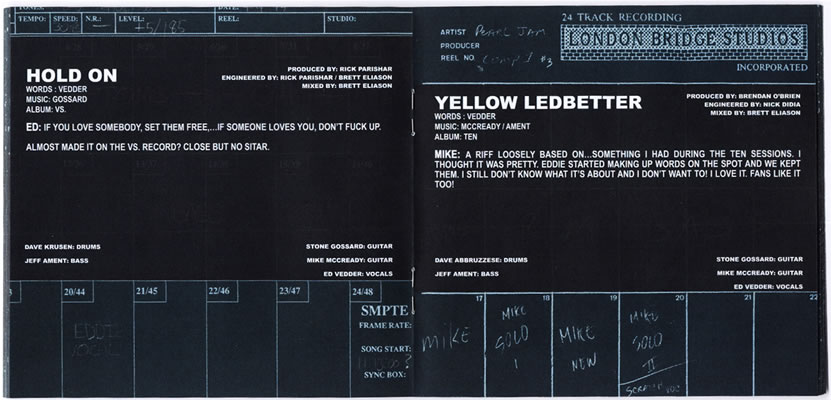
"A riff loosely based on something...I had during the Ten sessions. I thought it was pretty. Eddie started making up words on the spot and we kept them. I still don't know what it's about and I don't want to! I love it. Fans like it too!"[10]
On November 2, 2020 during an interview with Howard Stern, Vedder and Stern discussed the lyrics. Vedder told Stern that Stern's "misheard lyric" to Yellow Ledbetter - "boxer or the bag" instead of "box or a bag" - was actually better than the actual lyrics.[11] Vedder subsequently sang Stern's lyrics during Pearl Jam's performance on the Howard Stern Show the same day. [12]
Vedder said in an online chat that the song was written around the time of the Gulf War and added that "it's an anti-patriotic song, actually."[13] On August 7, 2008, at a solo performance at the New Jersey Performing Arts Center in Newark, New Jersey, Vedder took a question from the audience requesting that he explain the meaning of "Yellow Ledbetter". At first, Vedder joked, "Wait...you mean there's lyrics?" He went on to talk about how the song took as its subject a friend of his from Seattle whose brother served in the first Gulf War. His friend received a "yellow letter" in the mail informing him that his brother had died in the war. Vedder and his friend then went for a walk. On this walk, the friend, whom Vedder described as "alternative looking", happened by a house with an American flag flying and people on the porch. He stopped and gestured to the flag, as if to salute it, but the people on the porch glared at him disapprovingly due to his appearance.[14]
Reception
[edit]Without being released as a single, "Yellow Ledbetter" peaked at number 21 on the Billboard Mainstream Rock Tracks chart and number 26 on the Billboard Modern Rock Tracks chart in 1994. The song has become a favorite among fans of the band. Although the song was not released on any of Pearl Jam's studio albums, it remains one of their most popular songs.[15]
Steve Huey of Allmusic said that McCready's "airy Stevie Ray Vaughan imitations provide the essential meat of the song." He added, "Eddie Vedder's vocal is alternately intense and achingly wistful, with the latter particularly suiting the song's mood." He proclaimed "Yellow Ledbetter" as "the sound of a band overflowing with prime material."[16] Will Hermes of Spin said, "The Hendrix-indebted power ballad "Yellow Ledbetter" is some of the best Pearl Jam music ever recorded."[17][18]
"Yellow Ledbetter" has since been regarded as one of the band's best songs. In 2021, American Songwriter ranked the song number seven on their list of the 10 greatest Pearl Jam songs,[19] and Kerrang ranked the song number three on their list of the 20 greatest Pearl Jam songs.[20]
Live performances
[edit]The first full live performance of "Yellow Ledbetter" occurred at the band's February 15, 1992, concert in Madrid, Spain.[21] "Yellow Ledbetter" is frequently performed at Pearl Jam concerts, often as the last song of the concert. The freeform nature of the song allows the band to improvise and change the song around when performing it live. During performances, McCready often plays the main riff quite differently than on the record and uses overdrive as opposed to the previous clean channel. He also lengthens the outro, sometimes incorporating various songs which have influenced his playing style, such as Jimi Hendrix's "Little Wing" or "The Star-Spangled Banner", which bears many similarities to the song. Similarly, Vedder almost always changes the lyrics around, though he sticks with the same rhythm as the original recording.
Live performances of "Yellow Ledbetter" can be found on the "Daughter" single, the Tibetan Freedom Concert compilation box set, various official bootlegs, the live album Live at Benaroya Hall, and the Live at the Gorge 05/06 box set. Performances of the song are also included on the DVDs Live at the Showbox, Live at the Garden, and Immagine in Cornice, which are some of the special features. The version of the song on Tibetan Freedom Concert is a performance by Vedder and McCready that was recorded live at the Tibetan Freedom Concert.
Soundtracks
[edit]A brief snippet of the song appears in the series finale of the television series Friends after Rachel boards the plane. This marked the first time that Pearl Jam licensed a song for usage in a television show. According to a spokesperson for the group, it was "simply a matter of the show's producers asking permission."[22] The song also played over the end credits of the 2011 film 50/50. The song was used in season 1, episode 8 of Stumptown. It was also used in the closing credits of the final episode of the Showtime epic ensemble Super Pumped: The Story of Uber following CEO Travis Kalanick’s demise about what he may do next and the aftermath of the Uber behemoth. It is also featured at the end of episode 6 of season 3 of House M.D., "Epic Fail". It also is featured in the last scene of episode 22 ("The Long Blue Line") of season 6 of Cold Case.
Personnel
[edit]|
Performers
|
Production
|
Chart positions
[edit]| Chart (1994) | Position |
|---|---|
| US Mainstream Rock Tracks[23] | 21 |
| US Modern Rock Tracks[23] | 26 |
Certifications
[edit]| Region | Certification | Certified units/sales |
|---|---|---|
| New Zealand (RMNZ)[24] | 2× Platinum | 60,000‡ |
|
‡ Sales+streaming figures based on certification alone. | ||
See also
[edit]References
[edit]- ^ Haney, Shawn. "Jeremy" (US) Review. Allmusic.
- ^ a b Neely, Kim. Five Against One. Diane Publishing Company. 1999. ISBN 0-7567-7409-8
- ^ Huey, Steve. "Yellow Ledbetter" Review. Allmusic.
- ^ Weisbard, Eric, et al. "Ten Past Ten". Spin. August 2001.
- ^ Cohen, Jonathan. ""The Pearl Jam Q & A: Lost Dogs"". Archived from the original on March 17, 2005. Retrieved March 17, 2005.
{{cite web}}: CS1 maint: bot: original URL status unknown (link). Billboard. 2003. - ^ Letkemann, Jessica, John Reynolds, and Kathy Davis. "In Search of "Yellow Ledbetter"". TwoFeetThick.com. March 12, 2005.
- ^ Live at the Garden. Pearl Jam. Video. Epic, 2003.
- ^ Vedder, Eddie. (Speaker). (2003). 5/3/03, Bryce Jordan Center, State College, Pennsylvania. [Audio Recording]. Epic.
- ^ Vedder, Eddie. (Speaker). (2003). 7/11/03, Tweeter Center, Mansfield, Massachusetts. [Audio Recording]. Epic.
- ^ "Lost Dogs liner notes".
- ^ "Eddie on Howard Stern today! - Page 3". Pearl Jam Community. November 2, 2020. Retrieved June 6, 2025.
- ^ The Howard Stern Show (April 25, 2024). Pearl Jam “Yellow Ledbetter” Live on the Stern Show. Retrieved June 6, 2025 – via YouTube.
- ^ Vedder, Eddie. "Pearl Jam's First Online Chat at Lycos" Archived February 10, 2007, at the Wayback Machine. Lycos.com. May 15, 2000.
- ^ "2008 Eddie Vedder Concert Chronology". TwoFeetThick.com.
- ^ "Readers Poll: The Best Pearl Jam Songs of All Time". Rolling Stone. September 14, 2011. Retrieved September 1, 2020.
- ^ Huey, Steve. "Yellow Ledbetter > Review". Allmusic. Retrieved on May 16, 2008.
- ^ Hermes, Will. "Pearl Jam, Lost Dogs; Rage Against the Machine, Live at the Grand Olympic Auditorium (Epic)". Spin. January 26, 2004.
- ^ "Pearl Jam Music". Pearljam.com. November 11, 2003. Retrieved July 27, 2016.
- ^ Uitti, Jacob (December 30, 2021). "Top 10 Pearl Jam Songs". American Songwriter. Retrieved March 8, 2022.
- ^ Law, Sam (January 19, 2021). "The 20 greatest Pearl Jam songs – ranked". Kerrang. Retrieved March 8, 2022.
- ^ "Pearl Jam Songs: "Yellow Ledbetter"". pearljam.com.
- ^ Cohen, Jonathan (May 11, 2004). "Pearl Jam helps bid adieu to 'Friends'". Today.com.com. Retrieved July 5, 2007.
- ^ a b "Pearl Jam Artist Chart History". Billboard. Retrieved April 28, 2007.
- ^ "New Zealand single certifications – Pearl Jam – Yellow Ledbetter". Radioscope. Retrieved February 6, 2026. Type Yellow Ledbetter in the "Search:" field and press Enter.
External links
[edit]

Yellow Ledbetter
View on GrokipediaOrigins and Development
Inspiration and Writing
The lyrics for "Yellow Ledbetter" were penned by Pearl Jam frontman Eddie Vedder, drawing from a personal anecdote involving an acquaintance whose brother was killed during the 1991 Gulf War; the man received a yellow-enveloped telegram notifying him of the death, which Vedder used as the song's central motif to explore themes of grief and opposition to war.[1][2] Vedder has characterized the track as conveying anti-war sentiment, explicitly describing it in a 2000 online fan chat as "an anti-patriotic song" amid the era's patriotic fervor under President George H. W. Bush.[2] This inspiration stemmed from Vedder imagining the recipient—a long-haired, alternative-styled individual from a Seattle suburb—reacting with confusion and sorrow upon learning of the loss, prompting him to walk off in distress.[1] The music was co-composed by bassist Jeff Ament and guitarist Mike McCready, marking an early collaborative effort with Vedder during Pearl Jam's formative period.[1] The song originated in 1991, composed as part of the sessions for the band's debut album Ten but ultimately set aside as an outtake.[2] Vedder opted for deliberately mumbled and slurred vocal delivery to amplify the lyrics' emotional immediacy and interpretive ambiguity, treating his voice as an instrumental element to immerse listeners in the protagonist's raw anguish rather than providing clear narrative exposition.[1] This approach echoed Vedder's broader stylistic influences, including Neil Young's emotive, unpolished singing, which prioritized feeling over precision.[2]Recording and Production
"Yellow Ledbetter" was recorded at London Bridge Studios in Seattle, Washington, during the March 27 to April 26, 1991, sessions for Pearl Jam's debut album Ten.[2][5] The track, initially an outtake from those sessions, was produced by the band alongside Rick Parashar, who also served as mixing engineer.[6][5] This collaboration reflected Parashar's role in shaping the raw sonic identity of early Pearl Jam recordings, prioritizing unrefined energy over extensive studio polish. The production process focused on capturing a live-band feel through limited overdubs, aligning with the grunge movement's rejection of the glossy production techniques common in 1990s mainstream rock.[2] Eddie Vedder's vocals were tracked in an improvisational manner, with his mumbled delivery intended to evoke emotional immediacy rather than lyrical clarity, a choice that Vedder later humorously acknowledged by implying the words were spontaneously devised during recording.[7] Backing vocals from bandmates Jeff Ament and Stone Gossard added layered texture, while Mike McCready's blues-inflected guitar solos provided dynamic peaks, underscoring the song's garage-rock roots.[8] These choices preserved the track's authenticity as a B-side for the "Jeremy" single, released on August 11, 1992, emphasizing Pearl Jam's commitment to organic sound over commercial refinement.[2][5]Composition
Musical Style and Structure
"Yellow Ledbetter" embodies a grunge rock style tempered by classic rock influences, characterized by clean, jangly electric guitar riffs that evoke a sense of raw immediacy rather than the heavy distortion prevalent in contemporaries like Nirvana or Soundgarden. The song's signature guitar line, played by Mike McCready, draws direct inspiration from Jimi Hendrix's tonal approach, utilizing chimey Stratocaster-like tones with subtle reverb to create a spacious, unpolished texture.[9] [10] Bassist Jeff Ament's driving, melodic bassline anchors the track, co-written by him and McCready, providing a steady pulse that complements the guitars without overpowering the ensemble.[11] [12] The composition unfolds at a mid-tempo pace of approximately 70 beats per minute, fostering a deliberate, brooding groove that half-times the detected 140 BPM rhythm, allowing for emotional build-up through its instrumentation. Structurally, it adheres to a verse-chorus framework, with verses featuring layered guitar arpeggios and rhythmic strums over an E major progression (primarily E-A-B chords), transitioning into a repetitive chorus that heightens tension before resolving into instrumental passages. [13] [14] The song culminates in an extended outro dominated by McCready's improvisational guitar solo, which incorporates distortion and sustains the jam-like quality inspired by Neil Young's extended performances, extending beyond four minutes and fading out to emphasize live adaptability.[15] Production elements enhance the track's aesthetic, including moderate reverb on guitars for depth and a clean-to-overdriven dynamic shift in the solo, contributing to its B-side rawness that diverges from the polished alternative rock trends of the early 1990s by prioritizing organic interplay over aggressive compression. This unrefined approach, captured during sessions for the 1991 album Ten, underscores Pearl Jam's roots in Seattle's garage-derived grunge scene while nodding to '70s rock improvisational freedom.[16] [17]Lyrics and Interpretation
The lyrics of "Yellow Ledbetter" depict a narrator grappling with a letter informing him of a loved one's uncertain fate in wartime, evoking themes of grief, denial, and anti-war sentiment amid suburban disconnection. Key lines include: "Unsealed on a porch a letter sat / Then you said I wanna leave it again," portraying avoidance of bad news, and "I don't know whether my man alive or if he's whole," capturing raw uncertainty about survival.[5][18] Eddie Vedder, the lyricist, confirmed the song's origins in the 1990–1991 Gulf War era under President George H. W. Bush, drawing from a scenario where a recipient receives official notification of a family member's death but conceals it to shield others from pain.[1] He emphasized an initial anti-patriotic undercurrent, rejecting blind support for military actions, though he noted the lyrics' meaning evolved for him personally over time, allowing broader emotional resonance beyond strict literalism.[1] Vedder intentionally crafted ambiguity through mumbled, improvised delivery, fostering subjective interpretations while underscoring rejection of rigid narratives—a pattern seen in his live alterations of the words, which vary by performance to evade commodification.[2] The song's title derives from a tongue twister ("yellow better, red better" repeated rapidly), not a literal reference, further blurring clarity.[2] No official lyric sheet accompanied the 1992 single release, prompting fan-driven transcriptions that often diverged from Vedder's intent, amplifying its mystique.[19] This vocal style has spawned widespread mondegreens—misheard phrases like "yellow lederhosen" or incoherent strings such as "rest my head around a bag of cheese"—transforming the track into a cultural exemplar of phonetic confusion, with viral videos cataloging fan errors since the early 2000s.[20] Such misinterpretations, while humorous, inadvertently highlight the lyrics' core realism: war's impersonal bureaucracy erodes personal truth, leaving listeners to project their own voids onto the haze.[1]Release and Commercial Performance
Single Release Details
"Yellow Ledbetter" was released on November 5, 1992, as the B-side to Pearl Jam's "Jeremy" single, which supported promotion for the band's debut album Ten. The track received no dedicated marketing push from Epic Records, as it was not positioned as a standalone commercial release.[2][1] Despite the absence of an official music video—a deliberate choice aligning with Pearl Jam's growing resistance to MTV-driven video production requirements—the song garnered listener interest through radio stations independently selecting it from the "Jeremy" B-side format. This grassroots airplay in late 1992 and early 1993 exemplified demand emerging from audience and programmer preferences rather than label-orchestrated campaigns.[2] The song appeared on subsequent compilations, including the 2003 B-sides and rarities collection Lost Dogs, which aggregated outtakes and non-album tracks from the band's early catalog. Its initial traction remained rooted in the unpromoted radio exposure, underscoring Pearl Jam's broader skepticism toward traditional single strategies amid concerns over industry practices like payola influencing charts.[21][2]Chart Performance and Sales
"Yellow Ledbetter" achieved notable radio airplay success without an official commercial single release in the United States, where it served primarily as the B-side to the "Jeremy" single. The track peaked at number 21 on the Billboard Mainstream Rock Tracks chart in 1995.[2] It also reached number 26 on the Billboard Modern Rock Tracks chart during the same period, reflecting strong organic demand from alternative rock audiences.[2]| Chart | Peak Position | Year |
|---|---|---|
| Billboard Mainstream Rock Tracks | 21 | 1995 |
| Billboard Modern Rock Tracks | 26 | 1995 |