Recent from talks
Nothing was collected or created yet.
Do the Evolution
View on Wikipedia
| "Do the Evolution" | |
|---|---|
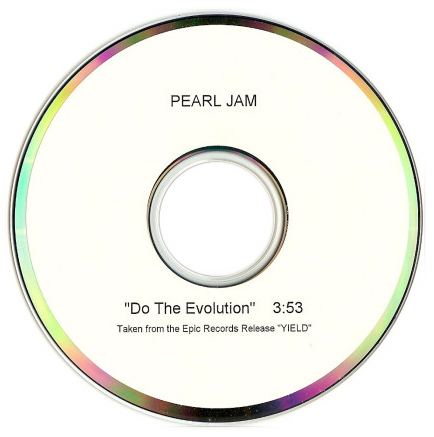
U.S. promotional CD single | |
| Promotional single by Pearl Jam | |
| from the album Yield | |
| Released | February 3, 1998 |
| Recorded | 1997 |
| Genre | Hard rock,[1] garage rock |
| Length | 3:54 |
| Label | Epic |
| Composer | Stone Gossard |
| Lyricist | Eddie Vedder |
| Producers | Brendan O'Brien, Pearl Jam |
"Do the Evolution" is a song by American rock band Pearl Jam. Featuring lyrics written by vocalist Eddie Vedder and music written by guitarist Stone Gossard, "Do the Evolution" is the seventh track on the band's fifth studio album, Yield (1998). Despite the lack of a commercial single release, the song managed to reach number 33 on the Billboard Modern Rock Tracks chart. The song was included on Pearl Jam's 2004 greatest hits album, rearviewmirror (Greatest Hits 1991–2003). It was the first of the band's songs to receive a music video since "Oceans", the final single from the group's 1991 debut Ten.
Origin and recording
[edit]"Do the Evolution" features lyrics written by vocalist Eddie Vedder and music written by guitarist Stone Gossard. Bassist Jeff Ament does not appear on the track. Gossard recorded the bass line for the track.[2] Vedder said that it is his favorite song from Yield.[3] He stated, "I can listen to it like it's some band that just came out of nowhere. I just like the song. I was able to listen to it as an outside observer and just really play it over and over. Maybe because I was singing it from a third person so it didn't really feel like me singing."[3]
Lyrics
[edit]When speaking about "Do the Evolution", Vedder stated, "That song is all about someone who's drunk with technology, who thinks they're the controlling living being on this planet. It's another one I'm not singing as myself."[4] Pearl Jam has stated that the novel Ishmael influenced the writing of Yield,[5] and according to the novel's writer, Daniel Quinn, this song comes the closest to expressing the ideas of the book.[6] Vedder stated:
This Daniel Quinn book, Ishmael...I've never recommended a book before, but I would actually, in an interview, recommend it to everyone....But this book, it's kind of the book of my ... My whole year has been kind of with these thoughts in mind. And on an evolutionary level, that man has been on this planet for 3 million years, so that you have this number line that goes like this [hands wide apart]. And that we're about to celebrate the year 2000, which is this [holds hands less than one inch apart]. So here's this number line; here's what we know and celebrate. This book is a conversation with a man and an ape. And the ape really has it all together. He kinda knows the differences between him and the man, and points out how slight they are, and it creates an easy analogy for what man has done, thinking that they were the end-all. That man is the end-all thing on this earth. That the earth was around even so much longer before the 3 million years. Fifty million years of sharks and all these living things. Then man comes out of the muck, and 3 million years later he's standing, and now he's controlling everything and killing it. Just in the last hundred! Which is just a speck on this line. So what are we doin' here? This is just a good reminder...And I'm anxious to see what happens. You know, I've got a good seat for whatever happens next. It'll be interesting.[7]
Reception
[edit]Without being released as a single, "Do the Evolution" peaked at number 40 on the Billboard Mainstream Rock Tracks chart and number 34 on the Billboard Modern Rock Tracks chart in 1998.[8][9] In Canada, the song reached number 50 on the RPM 100 Hit Tracks chart.[10] At the 1999 Grammy Awards, "Do the Evolution" received a nomination for Best Hard Rock Performance.[11]
In E! Online's review of Yield, "Do the Evolution" was described as having a "Neil Young-Beck hybrid feel."[12] Tom Sinclair of Entertainment Weekly stated, "On the album's most gleeful hip shaker, "Do the Evolution", Vedder howls throwaway lyrics...while the guitars gnash and grind at the primitive melody, briefly evoking the gnarly cacophony of the Stooges' monumental Fun House."[13]
Music video
[edit]The animated music video for "Do the Evolution" was co-directed by Kevin Altieri, known for his direction on Batman: The Animated Series, and Todd McFarlane, better known for his work with the popular comic book Spawn and Korn's 1999 "Freak on a Leash" video.[14] Vedder saw the first season of Spawn: The Animated Series on HBO in 1997, and was inspired by the art style of this series. After initially contacting McFarlane to work on the video, Vedder sent him a tape, where he put the music of the song over scenes from Spawn: The Animated Series. Vedder had recorded episodes of the series off HBO onto a VHS, and used the Avid video editing software to edit in the music.[15]
The "Do the Evolution" video was produced by Joe Pearson, the president of Epoch Ink animation, and Terry Fitzgerald at TME. It was written and developed by Pearson and Altieri with input from McFarlane and Vedder.[14] The total production time on the music video was 16 weeks.[14] The animation pre-production was produced by Epoch Ink Animation at their studio in Santa Monica. Under Altieri and Pearson’s supervision the Epoch team boarded and designed the short in less than six weeks.[14] Once McFarlane, Vedder, and Sony gave their final approvals, the designs were outsourced at Seoul, South Korea, to be animated at Sunmin Image Pictures and Jireh Animation. This process mirrored the animation for the Spawn: The Animated Series, which was also outsourced to South Korea.[16] Over a four-week period, a team of over one hundred artists worked to deliver the finished animation.[14]
Once the final animation was back in Los Angeles, California, Altieri, McFarlane, and Vedder edited the final cut at Vittello Productions. In a press release, McFarlane stated, "We choose to work with people who convey a particular attitude and this video is a tribute to that attitude," while Pearl Jam stated, "As artists we are challenged to expand the meaning of our work and by utilizing this visual medium and working with a visionary like Todd, we were able to further explore some of the themes we depicted in the song "Do the Evolution". Basically we've tried to make a good stoner video."[17] The video premiered on August 24, 1998, on MTV's 120 Minutes.[18] The video was the band's first since the final video for Ten, "Oceans". At the 1999 Grammy Awards, the music video received a nomination for Best Music Video, Short Form.[11] The video clip for "Do the Evolution" can be found on the Touring Band 2000 DVD as one of the Special Features.
Video summary
[edit]
Throughout the video, a pale skinned woman in a black skimpy dress (similar in appearance to the character Death from the DC comic book series, The Sandman)[original research?] dances and laughs, representing "Death" as it follows mankind through all of its history. The video begins with the evolution of life, from the smallest cell to the extinction of dinosaurs and reign of Homo sapiens. The video then cuts back and forth throughout human history, depicting man's primitive, violent nature that has remained essentially unchanged over the centuries. Such depictions include a knight preparing for the coming slaughter during the Crusades, a ritual dance by KKK (the dance is repeated with other groups throughout the video), a rally by Nazi-esque troops (with a symbol reminiscent of the Sig Rune, itself reminiscent the flash and circle used by the British Union of Fascists, instead of a swastika), concentration camp prisoners, a book burning, carnage upon a World War I-era battlefield, a girl stepping on an anthill as she runs blissfully through a field with the image suddenly changing to that of a landmine going off (as if the mine had been buried under the anthill itself), a death row inmate nervously waiting on an electric chair, the apparent virtual-reality rape of a woman, and the bombing of a Vietnamese village by an American jet, specifically an A-4 Skyhawk, the pilot of which removes his oxygen mask to reveal a skull laughing wildly, and a scene with a crying baby representing Bloody Saturday. Every scene portrayed complements the song's meaning and tightly follows the lyrics. When Vedder sings "Buying stocks on the day of the crash," a scene is shown where businessmen are committing suicide by jumping from buildings, a reference to the apocryphal suicides of Black Thursday during the Wall Street Crash of 1929.[19]
Other social and environmental issues such as slavery, whaling, colonialism, Manifest Destiny, uncontrolled urbanization, vivisection, pollution, genetic modification and techno-progressivism are included. The music video blames humankind's brutality on leadership; with various scenes depicting a judge, a bishop or pope, a military dictator and an American president candidate, who is being portrayed as a puppet, controlled by someone unseen, from behind the scene. The video concludes in what seems to be future scenarios of the self-destruction of the human race, including the carpet bombing of a city of clones by futuristic aircraft, computers hijacking the human mind, and finally a nuclear explosion which leaves not only a city in ruins, but the planet damaged beyond recognition. However, near the end of the animation, the earth is briefly seen as an ovum, suggesting a rebirth and the perpetuation of the human condition. During the sequence of flashing images near the end of the video an image of a yield sign being smashed at the corner can be seen, which references the album title and cover art.
Live performances
[edit]"Do the Evolution" was first performed live at the band's November 12, 1997, concert in Santa Cruz, California at The Catalyst.[20] Live performances of "Do the Evolution" can be found on the live album Live on Two Legs, various official bootlegs, the Live at the Gorge 05/06 box set, and the live album Live at Lollapalooza 2007. Performances of the song are also included on the DVDs Single Video Theory, Touring Band 2000, Live at the Showbox, and Live at the Garden. On Touring Band 2000, Vedder adds the lyrics "free the West Memphis 3!" to the song.
Credits
[edit]Pearl Jam
[edit]- Stone Gossard – guitar, bass guitar[2]
- Jack Irons – drums
- Mike McCready – guitar
- Eddie Vedder – vocals
Additional musicians
[edit]- Brendan O'Brien, Alana Baxter, Mary Olsen, Mark Raver – backing vocals
Charts
[edit]| Chart (1998) | Peak position |
|---|---|
| Canada Top Singles (RPM)[10] | 50 |
| US Alternative Airplay (Billboard)[9] | 33 |
| US Mainstream Rock (Billboard)[8] | 40 |
References
[edit]- ^ Pearl Jam (September 10, 2013). Pearl Jam Twenty. Simon and Schuster. p. 207. ISBN 978-1-4391-6937-7.
- ^ a b Marsh, Dave. "Pearl Jam: Art and Economy". Musician. April 1998.
- ^ a b "Pearl Jam Talks About New Approach To Yield". MTV.com. February 4, 1998.
- ^ Moon, Tom. "Calling Off the Crusades" Archived January 8, 2008, at the Wayback Machine. The Philadelphia Inquirer. February 8, 1998.
- ^ Papineau, Lou. "20 Things You Should Know About Pearl Jam" Archived June 29, 2011, at the Wayback Machine. VH1.com. June 30, 2006.
- ^ Quinn, Daniel. "Questions and Answers..." Archived September 28, 2007, at the Wayback Machine. Ishmael.com.
- ^ Marsh, Dave. "Pearl Jam's New Day Rising". Addicted to Noise. February 1998.
- ^ a b "Pearl Jam Chart History (Mainstream Rock)". Billboard.
- ^ a b "Pearl Jam Chart History (Alternative Airplay)". Billboard.
- ^ a b "Top RPM Singles: Image 6996". RPM. Library and Archives Canada. Retrieved January 16, 2020.
- ^ a b "41st Grammy Awards". Rockonthenet. Retrieved September 5, 2007.
- ^ "Pearl Jam: Yield". E! Online. 1998.
- ^ Sinclair, Tom (February 6, 1998). "Last Band Standing". Entertainment Weekly. Archived from the original on December 25, 2007. Retrieved May 28, 2008.
- ^ a b c d e "Music Videos & Shorts". Epoch Ink Animation. Archived from the original on September 3, 2013. Retrieved September 6, 2007.
- ^ Villa, Luca (February 15, 2023). "Yield 25: Todd McFarlane speaks about Do The Evolution video".
- ^ McFarlane, Todd. Audio commentary for Todd McFarlane's Spawn (1997).
- ^ "Do the Evolution" Archived September 14, 2008, at the Wayback Machine. sonymusic.com.
- ^ "DTE Scheduled to Air August 24". fivehorizons.com. August 21, 1998.
- ^ Adams, Cecil (August 30, 2002). "Did investors jump from the windows?". The Strait Dope. Retrieved July 10, 2012.
- ^ "Pearl Jam Songs: "Do the Evolution"" Archived May 23, 2009, at the Wayback Machine. pearljam.com.
External links
[edit]Do the Evolution
View on GrokipediaBackground and Recording
Development and Inspiration
Stone Gossard composed the music for "Do the Evolution" during sessions for Pearl Jam's 1998 album Yield, determining that the band required an additional high-energy rock track to balance the record's diversity. He crafted initial riffs, presented them to the group, and expanded them into a complete composition upon receiving positive feedback from bandmates.[2] Eddie Vedder penned the lyrics, drawing primary inspiration from Daniel Quinn's 1992 philosophical novel Ishmael, which critiques human civilization's destructive tendencies and anthropocentric worldview through a dialogue between a human and a gorilla. The book's examination of humanity's "taker" culture—contrasted with sustainable "leaver" societies—informed Vedder's sardonic portrayal of evolutionary progress as a catalyst for violence, conquest, and environmental ruin.[3] This collaborative process reflected Pearl Jam's evolving songwriting dynamic in the late 1990s, emphasizing Gossard's guitar-driven foundations paired with Vedder's thematic depth, amid the band's recovery from legal battles over ticketing and a deliberate shift toward artistic control following Vitalogy (1994) and No Code (1996).[2]Studio Production
"Do the Evolution" was recorded in 1997 during the sessions for Pearl Jam's fifth studio album, Yield. The track was produced by Brendan O'Brien in collaboration with the band, marking his fourth consecutive project with Pearl Jam following Vs. (1993), Vitalogy (1994), and No Code (1996).[5][6] Recording occurred primarily at two Seattle-based facilities: Studio X and Studio Litho, both owned or associated with band members and local production networks. Engineering duties were led by Nick DiDia, who captured the band's performances with an emphasis on live-room energy and minimal overdubs for select tracks.[5][6][7] Unlike earlier albums where extensive jamming shaped material in the studio, bassist Jeff Ament noted that for Yield, most songs—including "Do the Evolution"—arrived with arrangements largely finalized, streamlining the process under O'Brien's direction. O'Brien mixed the track himself, prioritizing the raw intensity of Eddie Vedder's vocal delivery, which featured deliberate peaks into distortion to convey urgency.[8][7] The production approach reflected O'Brien's signature style of balancing polished sonics with grunge-era grit, utilizing analog tape for warmth while incorporating subtle digital enhancements for clarity in the rhythm section and guitar layers. This resulted in a dense, propulsive soundscape that highlighted Stone Gossard's driving riff as the song's backbone.[5][9]Musical Composition
Instrumentation and Arrangement
"Do the Evolution" employs the core instrumentation of Pearl Jam's lineup for the Yield album, consisting of lead vocals by Eddie Vedder, lead guitar by Mike McCready, rhythm guitar and bass guitar by Stone Gossard, and drums by Jack Irons, with production by Brendan O'Brien.[10][11] Notably, Gossard handled bass duties on this track instead of bassist Jeff Ament, a choice confirmed by Ament in a radio interview where he stated, "you did" when asked who played bass.[12] The recording, completed in 1997 at Studio X and Studio Litho in Seattle, features no additional instruments beyond the band's standard rock setup, emphasizing raw guitar tones and percussion.[7] The arrangement, primarily composed by Gossard with lyrics by Vedder, revolves around a punchy, riff-driven structure in standard E tuning across instruments, opening with interlocking guitar riffs that propel the verses before exploding into a high-energy chorus.[13] Mid-level guitar distortion provides the grunge edge, complemented by heavy drum distortion on the kick, snare, and toms—while cymbals remain clean for clarity—creating a propulsive rhythm section that underscores the song's aggressive tempo of approximately 150 beats per minute.[7] A bridge introduces tension with dissonant guitar layers and Vedder's barked vocals, resolving into an outro that fades on sustained riffing and rhythmic fades, prioritizing dynamic builds over complex orchestration to evoke primal urgency.[13][14]Influences and Style
"Do the Evolution" exemplifies Pearl Jam's return to a straightforward, riff-driven hard rock style on the 1998 album Yield, departing from the experimental art-rock tendencies of prior releases like Vitalogy (1994) and No Code (1996). The song's music, composed by guitarist Stone Gossard, centers on a propulsive guitar riff played at a brisk tempo of approximately 146 beats per minute, underpinned by Jeff Ament's steady bass line and Jack Irons' dynamic drumming that builds intensity through the track.[15] This arrangement prioritizes raw energy over complexity, with Eddie Vedder's baritone vocals delivering forceful, near-shouted phrasing that amplifies the song's urgent momentum.[16] Stylistically, the track incorporates punk rock elements, evident in its reliance on just two power chords for the main progression and Vedder's aggressive, barking vocal delivery, which conveys a sense of controlled chaos akin to the band's earlier grunge-era output.[15] Despite Pearl Jam's broad influences from classic rock acts like The Who and Led Zeppelin—reflected in Gossard's riff craftsmanship—the song avoids overt pastiche, instead fusing these with post-grunge aggression to create a catchy yet abrasive sound that propelled it to frequent live performances.[17] Critics noted its "ragged-edged stomp" quality, highlighting how the instrumentation careens forward in a manner true to the band's foundational hard rock ethos.[18] The style's effectiveness lies in its balance of accessibility and intensity, making "Do the Evolution" one of Pearl Jam's most radio-friendly yet thematically pointed compositions from the period, with Mike McCready's lead guitar adding melodic flourishes amid the rhythmic drive.[16] This approach underscores the album's overall shift toward concise, hook-laden rock, influenced by the band's desire to recapture the directness of their debut Ten (1991) while evolving beyond it.[19]Lyrics and Themes
Lyrical Analysis
The lyrics of "Do the Evolution," written by Eddie Vedder over music by Stone Gossard, present a satirical depiction of human evolution as a trajectory of unchecked aggression, religious rationalization, and technological hubris leading to planetary destruction.[20][2] The opening verse establishes humanity's self-proclaimed superiority—"I'm ahead, I'm a man / I'm the first mammal to wear pants"—while immediately undercutting it with lines endorsing violence justified by faith: "I can kill 'cause in God I trust." Vedder has described the song as portraying "someone who's drunk with technology, who thinks he's in control of everything," framing evolution not as biological adaptation but as a "perverted version" dominated by destructive impulses.[2] This irony recurs in the chorus, where "Do the evolution" serves as a mocking mantra, implying that humanity's vaunted progress equates to rapacious expansion rather than genuine advancement. Subsequent verses chronicle historical and modern atrocities to illustrate this perverted evolution. The second verse evokes prehistoric dominance ("Woo... / A better version of myself") escalating to organized conquest: "Wrench in one hand, Bible in the other / Building empires by the sweat of his brow." These images critique imperialism and religiously sanctioned exploitation, with the "mother's blood" metaphor in the bridge—"Suckin' on the mother's blood / Another hundred years of the same old story"—symbolizing the depletion of Earth's resources through industrialized greed.[20] The narrative culminates in apocalyptic foreshadowing: "Headed for a crash / Woo-hoo," warning of self-inflicted extinction, a theme resonant with environmentalist concerns Vedder has voiced in interviews.[2] Thematically, the lyrics reject anthropocentric triumphalism, aligning with critiques of "Taker" societies in Daniel Quinn's Ishmael, which influenced the song's worldview by portraying civilization's origins in agriculture as the root of ecological imbalance and violence.[3] Rather than celebrating Darwinian survival, Vedder inverts it to expose causal links between human exceptionalism, monotheistic doctrines enabling conquest, and technological overreach—evident in lines like "It's evolution, baby"—as drivers of inevitable downfall. This analysis draws from Vedder's own explanations, emphasizing the song's intent to provoke reflection on humanity's trajectory without prescribing solutions, consistent with Pearl Jam's pattern of ambiguous, listener-interpreted lyricism.[2]Philosophical Interpretations
The lyrics of "Do the Evolution" reflect a philosophical critique of human exceptionalism, heavily influenced by Daniel Quinn's 1992 novel Ishmael, which posits that modern "Taker" societies—characterized by agriculture, expansionism, and dominance over nature—represent a deviation from sustainable evolutionary patterns, inevitably leading to ecological collapse.[2][21] In Quinn's framework, humans erroneously view themselves as the pinnacle of evolution, exempt from natural laws, a delusion mirrored in the song's sarcastic celebration of milestones like tool use and conquest, which mask underlying self-destruction.[22] Pearl Jam's bassist Jeff Ament and vocalist Eddie Vedder have acknowledged Ishmael as shaping the album Yield (1998), with the track explicitly embodying its cautionary narrative against anthropocentric hubris.[3] Vedder described the song as depicting "someone who's drunk with technology, who thinks they're the controlling living being on this planet," distancing himself from the persona to underscore a detached indictment of unchecked technological optimism and species-level arrogance.[2] This aligns with philosophical skepticism toward progress narratives, echoing thinkers who question whether human advancements in weaponry, religion, and economics constitute genuine evolution or merely accelerated maladaptation. Lines such as "I can kill 'cause in God I trust" satirize religiously sanctioned violence as an evolutionary "advantage," while references to land appropriation ("This land is mine, this land is free") critique imperial expansion as a false triumph over nature.[23] The track's progression from primordial pride ("I'm the first mammal to wear pants") to apocalyptic imagery ("2010, watch it go to fire") philosophically interrogates causality in human history, suggesting that evolutionary success is not linear ascent but a cycle of exploitation culminating in planetary ruin unless disrupted by conscious restraint.[2] This interpretation challenges Darwinian optimism by implying devolution through overreach, resonant with ecological realism that prioritizes symbiosis over domination. Vedder's delivery, detached and ironic, reinforces a meta-awareness of humanity's flawed self-narrative, urging reinterpretation of evolution as adaptive humility rather than conquest.[23]Release and Reception
Album Context and Singles
Yield, Pearl Jam's fifth studio album, was released on February 3, 1998, through Epic Records, marking a shift toward a more collaborative and rock-focused sound following the experimental leanings of their prior release, No Code (1996).[17] Recorded across 1997 at Studio Litho and Studio X in Seattle, with overdubs at Southern Tracks in Atlanta, the album was co-produced by the band and Brendan O'Brien, who had previously helmed their breakthrough records Vs. and Vitalogy.[15] The title Yield encapsulated the band's philosophy of surrendering to collective creativity during songwriting and production, allowing ideas to flow without overproduction.[24] Commercially, Yield debuted at number 2 on the Billboard 200 chart, moving 358,000 units in its first week and eventually achieving platinum certification in the United States.[17] This performance reflected sustained fan loyalty amid the band's avoidance of traditional music industry promotion, including limited music videos and no Ticketmaster boycott distractions during recording.[15] The album spawned three singles: "Given to Fly," released January 6, 1998, as the lead track, which topped the Billboard Mainstream Rock Tracks chart; "Wishlist," issued in June 1998 and peaking at number 9 on Alternative Airplay; and "Do the Evolution," promoted via radio and a standout animated music video rather than a full commercial single release in the U.S., yet reaching number 33 on the Alternative Songs chart in October 1998. "Do the Evolution" also charted in Canada within the top 50 singles.[8] These releases underscored Yield's emphasis on melodic hooks and guitar-driven energy, with "Do the Evolution" standing out for its aggressive riffing and thematic bite.Critical and Commercial Response
Critics generally praised "Do the Evolution" for its raw energy, driving rhythm, and Eddie Vedder's incisive lyrics decrying humanity's self-destructive tendencies under the guise of progress. In its review of the parent album Yield, AllMusic highlighted the track's garage rock potential, though it critiqued the production for emphasizing Vedder's distorted vocals over guitar bite. Rolling Stone described Yield's rockers, including "Do the Evolution," as possessing an "uncommonly easy touch" that marked a maturation from the band's earlier bluster.[25] The song's themes, inspired by Daniel Quinn's novel Ishmael, drew commendation for blending hard rock aggression with philosophical depth, positioning it as a standout on an album that aggregated positive scores like 8/10 from Spin and 7/10 from NME.[3] The music video, animated by Todd McFarlane, amplified the song's impact through visceral depictions of war, environmental ruin, and evolutionary hubris, earning acclaim for its bold visual storytelling and cultural relevance.[26] Outlets described it as "deeply powerful" and a "seminal" work that entranced viewers with its unflinching critique of human behavior, marking Pearl Jam's rare return to video production after a six-year hiatus.[27] This visual component broadened the track's reach, contributing to its nomination for a Grammy Award for Best Hard Rock Performance in 1999.[28] Commercially, "Do the Evolution" achieved moderate success as a promotional single from Yield, benefiting from album-driven airplay and the video's MTV rotation despite Pearl Jam's general aversion to mainstream promotion.[17] Sales estimates place the track at over 1.6 million units worldwide, incorporating physical sales, downloads, and streaming equivalents as of recent tabulations.[29] While not matching the chart dominance of earlier hits like "Jeremy," it underscored Yield's platinum certification in the US and the band's enduring draw amid shifting grunge-era dynamics.[29]Chart Performance
"Do the Evolution" received significant radio airplay despite not being released as a commercial single in the United States, which precluded it from charting on the Billboard Hot 100.[30] It peaked at number 40 on the Billboard Mainstream Rock Tracks chart in October 1998. The track also reached number 33 on the Billboard Modern Rock Tracks chart during the same period, reflecting its popularity within alternative and rock radio formats.[30] Outside the US, it did not achieve notable positions on major national charts such as the UK Singles Chart.[31]Music Video
Production Details
The music video for Pearl Jam's "Do the Evolution" was produced by Epoch Ink Animation for Todd McFarlane Entertainment and Sony Music, utilizing traditional 2D animation techniques involving hand-inked and painted cells.[32] Directed primarily by Kevin Altieri, with co-direction credited to Todd McFarlane, the project was initiated under a production mandate from McFarlane and Pearl Jam vocalist Eddie Vedder to create a visually striking depiction aligned with the song's themes of human evolution and destruction.[4][33][32] Production adhered to a stringent 16-week timeline in 1998, with storyboarding and design completed in under six weeks by a team including Brad Coombs, Jim Mitchell, Young Yoon Gi, Kalvin Lee, and Kevin Altieri.[32] Character coloring was handled by Tina Oliva and Lisa Pearson, while backgrounds were painted by Zhao Ping.[32] The animation phase, executed over four weeks in Seoul at Sun Min Image Pictures and Jireh Animation studios by more than 100 artists, captured a narrative spanning prehistoric origins to apocalyptic nuclear finale, reflecting Vedder's dark lyrical vision.[32] Joe Pearson served as producer at Epoch Ink Animation, overseeing the process that emphasized rapid execution to meet the deadline.[33][32] The final edit occurred in Los Angeles, involving Altieri, McFarlane, and Vedder to refine the four-minute video's nearly 100 original scenes.[32] The completed video premiered on August 24, 1998, showcasing a hypnotic sequence of humanity's rise and fall.[33]Visual Narrative
The visual narrative of Pearl Jam's "Do the Evolution" music video commences with cosmic origins, depicting a meteor's journey past Saturn toward Earth, accompanied by the emergence of a pale-skinned woman in a black dress, interpreted as a personification of Death, who smiles amid the impending impact.[3] This sets a tone of inevitable destruction, transitioning into the fertilization of an egg symbolizing life's inception, paralleled with Big Bang imagery, followed by accelerated biological evolution from single-celled organisms to fish, dinosaurs, mammals, apes, and early humans developing rudimentary tools over 3.5 billion years.[3] As human civilization advances, the animation illustrates the mastery of fire, construction of cities, and invention of weapons, juxtaposed against escalating violence including crusades with burning crosses, stock market crashes evoking the 1929 Wall Street collapse, implied fascist regimes without direct Nazi iconography, and montages of war, oppression, and genocide.[3] [27] The Death figure reappears recurrently, dancing through historical eras, observing humanity's self-inflicted calamities such as World War I trench warfare reminiscent of 1939 animations, the 1937 Bloody Saturday bombing in Shanghai, European-Native American conflicts, the transatlantic slave trade, and Vietnam War scenes.[3] [27] The narrative culminates in a dystopian trajectory of technological overreach, environmental devastation, nuclear apocalypse, and global conflagration, with the Death character presiding over the planet's fiery demise, underscoring themes of hubris, mortality, and cyclical destruction rather than progressive evolution.[3] [27] [34] A subtle "YIELD" sign appears amid the chaos, linking to the album's title and implying a call for restraint amid inevitable entropy.[3] The layered animation, co-directed by Todd McFarlane and Kevin Altieri, employs bold, rapid cuts and vibrant yet grim visuals to critique human dominance as a devolution into perpetual conflict.[3][34]Awards and Remastering
The music video for "Do the Evolution," directed by Kevin Altieri and Todd McFarlane, received a nomination for Best Short Form Music Video at the 41st Annual Grammy Awards on February 21, 1999.[35] The nomination recognized the video's animated depiction of human history's violent progression, produced with contributions from producer Brendan O'Brien and band members including Jeff Ament.[35] It did not win, with the award going to "It's a Small World" by Disney. The song itself earned a separate nomination for Best Hard Rock Performance at the same Grammys, highlighting its raw guitar riffs and Eddie Vedder's lyrics critiquing evolutionary hubris, but lost to Jimmy Page and Robert Plant's "Most High." No other major awards or nominations, such as MTV Video Music Awards, were accorded to the video or track.[35] In 2023, Pearl Jam and Todd McFarlane collaborated on a remastered high-definition version of the video, up-rezzed from the original analog source to enhance visual clarity for modern viewing.[36] This edition premiered on the band's official YouTube channel on August 3, 2023, providing the first official HD release after the initial standard-definition upload in 2009.[37] The remaster preserved the original animation's style while improving resolution and color fidelity, without altering the narrative content.[38]Performances and Legacy
Live Renditions
"Do the Evolution" debuted live on November 12, 1997, at The Catalyst in Santa Cruz, California, prior to the album Yield's release.[2][39] The song quickly became a concert staple during the subsequent Yield Tour in 1998, often serving as a high-energy opener due to its aggressive riff and thematic intensity.[40][41] As of May 18, 2025, Pearl Jam had performed the song 590 times across tours spanning from 1997 onward.[39] A live recording from July 1998 at The Forum in Inglewood, California, appears on the compilation album Live on Two Legs, capturing the band's raw delivery during the Yield Tour's peak.[42][43] Additional official live renditions feature on bootlegs from the 2005–2006 tours, including Live at the Gorge 05/06, and various dates documented on the band's website, such as the January 31, 1998, Monkeywrench Radio session in Seattle.[39] The track maintained prominence in setlists through the 2000s and into the 2020s, appearing frequently on the Dark Matter World Tour (2024–2025), with performances at venues like Wells Fargo Center in Philadelphia on September 7, 2024, and PPG Paints Arena in Pittsburgh on May 18, 2025.[39][44] Its enduring appeal stems from Eddie Vedder's dynamic vocals and Mike McCready's searing guitar solos, which fans and critics note amplify the song's evolutionary critique in live settings.[45]Cultural and Enduring Impact
The song "Do the Evolution" and its accompanying music video have left a lasting mark through their unflinching portrayal of human aggression and environmental hubris, themes rooted in Eddie Vedder's reading of Daniel Quinn's 1992 novel Ishmael, which critiques anthropocentric "Taker" societies that prioritize domination over sustainable coexistence with nature.[2] The lyrics explicitly echo the book's ideas, framing evolution not as progress but as a justification for violence, lust, and conquest, with Vedder describing the track as the album's most direct expression of such philosophical influences.[3] This connection has sustained interest among readers of Quinn's work, positioning the song within broader discourses on ecological philosophy and cultural myths of superiority.[21] The video's animation, blending McFarlane's gothic style with historical vignettes of war, genocide, and apocalypse—from caveman brutality to nuclear annihilation—amplifies this critique, presenting humanity's trajectory as inherently self-sabotaging rather than triumphant.[46] Its Grammy nomination for Best Short Form Music Video in 1999 underscored recognition of this visual storytelling as a pinnacle of rock video artistry, despite the band's prior aversion to MTV formats.[35] The production's raw depiction of atrocities, including Nazi imagery and industrial exploitation, has endured as a stark anti-utopian narrative, influencing perceptions of music videos as vehicles for societal reflection beyond mere promotion.[47] Over two decades later, the video's resonance persists, as evidenced by the 2020 publication of Pearl Jam: Art of Do the Evolution, which compiles over 1,000 pieces of original artwork, storyboards, and production notes, revealing the meticulous process behind its four-minute condensation of human folly.[48] This archival effort highlights the work's archival value in animation and music history, with Todd McFarlane noting its role in encapsulating mankind's condensed history for global audiences.[49] While not spawning widespread parodies or adaptations, the piece continues to circulate in online discussions of grunge-era visuals and philosophical rock, affirming Pearl Jam's capacity to embed enduring ethical questions in mainstream output.[50]Personnel
- Eddie Vedder – vocals, guitar
- Jeff Ament – bass guitar
- Stone Gossard – guitar
- Mike McCready – guitar
- Jack Irons – drums
- Brendan O'Brien – producer[5]
- Nick DiDia – recording engineer[5]
