Hubbry Logo
BasslineBasslineMain
Open search
Bassline
Community hub
Bassline
logo
8 pages, 0 posts
0 subscribers
Be the first to start a discussion here.
Bassline
Bassline
from Wikipedia
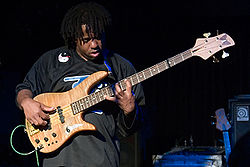
Victor Wooten soloing on the electric bass guitar

Bassline (also known as a bass line or bass part) is the term used in many styles of music, such as blues, jazz, funk, dub and electronic, traditional, and classical music, for the low-pitched instrumental part or line played (in jazz and some forms of popular music) by a rhythm section instrument such as the electric bass, double bass, cello, tuba or keyboard (piano, Hammond organ, electric organ, or synthesizer).

In unaccompanied solo performance, basslines may simply be played in the lower register of any instrument while melody and/or further accompaniment is provided in the middle or upper register. In solo music for piano and pipe organ, these instruments have an excellent lower register that can be used to play a deep bassline. On organs, the bass line is typically played using the pedal keyboard and massive 16' and 32' bass pipes.

Riffs and grooves

[edit]

Basslines in popular music often use "riffs" or "grooves", which are usually simple, appealing musical motifs or phrases that are repeated, with variation, throughout the song. "The bass differs from other voices because of the particular role it plays in supporting and defining harmonic motion. It does so at levels ranging from immediate, chord-by-chord events to the larger harmonic organization of a [sic] entire work."[1]

Bassline riffs usually (but not always) emphasize the chord tones of each chord (usually the root note, the third note, or the fifth note), which helps to define a song's key. Basslines align or syncopate with the drums. Other rhythm instruments join in to create a more interesting rhythmic variations. The type of rhythmic pulse used in basslines varies widely in different types of music. In swing jazz and jump blues, basslines are often created from a continuous sequence of quarter notes in a mostly scalar, stepwise or arpeggio-based part called a "walking bass line". In Latin, salsa music, jazz fusion, reggae, electronica, and some types of rock and metal, basslines may be very rhythmically complex and syncopated. In bluegrass and traditional country music, basslines often emphasize the root and fifth of each chord.

A German double bass section in 1952. The player to the left is using a German bow.

Though basslines may be played by many different types of instruments and in a broad musical range, they are generally played on bass instruments and in the range roughly at least an octave and a half below middle C (roughly the range of the bass clef). In classical music such as string quartets and symphonies, basslines play the same harmonic and rhythmic role; however, they are usually referred to as the "bass voice" or the "bass part".

Instruments

[edit]

Most popular musical ensembles include an instrument capable of playing bass notes. In the 1890s, a tuba was often used. From the 1920s to the 1940s, most popular music groups used the double bass as the bass instrument. Starting in the 1950s, the bass guitar began to replace the double bass in most types of popular music, such as rock and roll, blues, and folk. The bass guitar was easier to transport and, given that it uses magnetic pickups, easier to amplify to loud stage volumes without the risk of audio feedback, a common problem with the amplified double bass. By the 1970s and 1980s, the electric bass was used in most rock bands and jazz fusion groups. The double bass was still used in some types of popular music that recreated styles from the 1940s and 1950s such as jazz (especially swing and bebop), traditional 1950s blues, jump blues, country, and rockabilly.

In some popular music bands, keyboard instruments are used to play the bass line. In organ trios, for example, a Hammond organ player performs the basslines using the organ's pedal keyboard. In some types of popular music, such as hip-hop or house music, the bass lines are played using bass synthesizers, sequencers, or electro-acoustically modeled samples of basslines.

TB-303 front panel

Basslines are important in many forms of dance and electronic music, such as electro, drum and bass, dubstep, and most forms of house and trance. In these genres, basslines are almost always performed on synthesizers, either physical, such as the Minimoog and the Roland TB-303, or virtual, such as Sytrus and ZynAddSubFX. In hip-hop, producer Rick Rubin popularized the technique of creating basslines by lengthening the bass drum decay of the TR-808 drum machine and tuning it to different pitches.[2]

Chinese orchestras use the zhōng ruǎn (中阮) and dà ruǎn (大阮) for creating basslines. Other, less common bass instruments are the lā ruǎn (拉阮), dī yīn gé hú (低音革胡), and da dī hú (大低胡) developed during the 1930s.[citation needed] Russian balalaika orchestra use bass balalaika and contrabass balalaika.

Australia's indigenous music and some World music that is influenced by Australian music uses didjeridus for basslines.[citation needed]

Classical music

[edit]
The opening of Beethoven's Symphony No. 5, third movement is often used as an orchestral excerpt during bass auditions. Play

In classical music, the bassline is always written out for the performers in musical notation. In orchestral repertoire, the basslines are played by the double basses and cellos in the string section, by bassoons, contrabassoons, and bass clarinets in the woodwinds and by bass trombones, tubas and a variety of other low brass instruments. In symphonies from the Classical period, a single bassline was often written for the cellos and basses; however, since the bass is a transposing instrument, and it is notated an octave higher than it sounds, when cellos and basses play the same bassline, the line is performed in octaves, with the basses an octave below the cellos. By the end of the Classical period, with Beethoven's symphonies, cellos and double basses were often given separate parts. In general, the more complex passages and rapid note sequences are given to the cellos, while the basses play a simpler bassline. The timpani (or kettledrums) also play a role in orchestral basslines, albeit confined in 17th and early 18th century works to a few notes, often the tonic and the dominant below it. In a small number of symphonies, the pipe organ is used to play basslines.

In chamber music, the bassline is played by the cello in string quartets and the bassoon in wind chamber music. In some larger chamber music works, both a cello and a double bass are used to play the bassline. In a Baroque era (c. 1600–1750) piece accompanied by basso continuo, the accompanying musicians would include a chordal instrument (e.g., harpsichord, pipe organ or lute) and a number of bass instruments might perform the same bassline, such as the cello, viol, double bass, theorbo, serpent (an early wind instrument), and, if an organist was present, the lower manual of the organ and the low-pitched pedal keyboard. In 2000s-era performances of Baroque music, the basso continuo is typically performed by just two instruments: a chordal instrument and one bass instrument (often harpsichord and cello).

[The bass part is] the groundwork or foundation upon which all musical composition is to be erected.

[The bass part is] the base and foundation of the other parts, since one builds them upon it.

— Charles Masson 1669:31[3]

[The bass part is] the foundation of harmony.

— Gioseffo Zarlino 1561:239, 1558:179[3]

[edit]

In many genres of modern traditional music (ranging from folk rock to blues) and popular music (ranging from rock and pop to reggae to funk), the bassline is generally played by an electric bass player. In rockabilly, psychobilly, traditional blues and bluegrass music, the bassline is played by a double bass player. The bassline uses low notes that provide a rhythm while simultaneously setting out the foundation of the chord progression. The bassline bridges the gap between the rhythmic part played by the drummer and the melodic lines played by the lead guitarist and the chordal parts played by the rhythm guitarist and/or keyboard player. In most traditional and popular music styles, the bass player is expected to be able to improvise a bassline which they base in the chord progression of a song. When a bassist is playing a cover song, they may play the bassline that was originally used on the recording. A session bassist playing in a music studio is expected to be able to read a bassline written in musical notation. Bass players also perform fills in between the phrases of the vocal melody, and they may also perform bass runs or bass breaks, which are short solo sections. Rhythmic variations by the bass, such as the introduction of a syncopated figure can dramatically change the feel of a song, even for a simple groove.

"In any style, the bass's role in the groove is the same: to keep time and to outline the tonality. When developing bass lines, these two things should always be your goal"[4]

[One] may view in it [(the bass part)] all the other parts in their original essence.Thomas Campion 1967:327[3]

Walking bass

[edit]

A walking bass is a style of bass accompaniment or line, common in Baroque music (1600–1750) and 20th century jazz, blues and rockabilly, which creates a feeling of regular quarter note movement, akin to the regular alternation of feet while walking.[5][6] Walking basslines generally consist of unsyncopated notes of equal value, usually quarter notes (known in jazz as a "four feel"). Walking basslines use a mixture of scale tones, arpeggios, chromatic runs, and passing tones to outline the chord progression of a song or tune, often with a melodic shape that alternately rises and falls in pitch over several bars. To add variety to a walking bassline, bassists periodically interpolate various fills, such as playing scale or arpeggio fragments in swung eighth notes, plucking muted percussive grace notes (either one grace note or a "raked" sequence of two or three grace notes), or holding notes for two, three, or four beats. Some songs lend themselves to another type of variation: the pedal point, in which the bassist holds or repeats a single note (often the tonic or the dominant) under the chord changes.

Walking basslines are usually performed on the double bass or the electric bass, but they can also be performed using the low register of a piano, Hammond organ, tuba or other instruments. They can also be sung, as is done by some a capella vocal groups. While walking bass lines are most commonly associated with jazz and blues, they are also used in rock, rockabilly, ska, R&B, gospel, Latin, country, and many other genres.[7]

Examples

[edit]

Walking bass in the pedal keyboard part of Baroque organ music (J.S. Bach's Nun komm, der Heiden Heiland, BWV 659, from the Great Eighteen Chorale Preludes):

play

Other walking bass lines can be heard in the opening movements of Joseph Haydn's Symphony No. 22 (nicknamed "The Philosopher"), Anton Bruckner's Symphony No. 5 and Edward Elgar's Symphony No. 1.

Haydn Symphony 22 opening
Bruckner Symphony No. 5, opening
Elgar Symphony No 1 opening

Walking bass often alternates quarter notes:

\relative c' \repeat volta 2{ c g c g c g b a g d' g, d' g, d' e d}
play

giving rise to the term.

Many boogie-woogie basslines are walking bass lines:

Typical boogie woogie walking bassline

Play in G or in C

Walking bass often moves in stepwise (scalar) motion to successive chord roots, such as often in country music:

Walking bass I-IV

Play

In this example, the last two quarter notes of the second measure, D and E, "walk" up from the first quarter note in that measure, C, to the first note of the third measure, F (C and F are the roots of the chords in the first through second and third through fourth measures, respectively).

In both cases, "walking" refers both to the steady duple rhythm (one step after the other) and to the strong directional motion created;[7] in the examples above, from C to F and back in the second, and from root to seventh and back in the first.

In bebop jazz, the walking bass has a stabilising effect, offsetting and providing a foil to the complexity of the improvised melodic lines, for example in Sonny Rollins“Blue Seven”.

Bass run

[edit]

A bass run (or "bass break") is a short instrumental break or fill in which the bass instrument (such as an electric bass or a double bass) or instruments (in the case of a marching band) and the bassline are given the forefront.[8] The bass part for a bass run often differs from the usual bass accompaniment style, in terms of the register, timbre, or melodic style that is used, or the number of notes per beat which are played.

A bass run may be composed by the performer or by an arranger prior to a performance, or it may be improvised onstage by the performer using scales, arpeggios, and standard licks and riffs. In some cases, a bass run may incorporate a display of virtuoso techniques such as rapid passages or high notes. During a bass run, the main vocal or melody line usually stops, and in some cases, the percussion or drums may also stop. The technique originated in the marches of the "Sousa school", though its resemblance to call and response techniques familiar to African American musicians indicates an earlier origin.[8]

Electric bass

[edit]

In a rock song in which the bassline consists of low-pitched quarter notes played on the electric bass, a bass run may consist of a rapid sequence of sixteenth notes in a higher register, or of a melodic riff played in a higher register. In some cases, the bassist will select a "brighter"-sounding pickup or increase the treble response of the instrument for a bass run, so that it will be easier to hear.[citation needed]

In a heavy metal song where the bassist was ordinarily playing low notes without overdrive to accompany, for a solo, they may turn on a fuzz bass pedal and use a wah pedal to create a more pronounced tone (an approach used by Cliff Burton), and then play an upper register riff or scale run. Some shred guitar-style bassists may do two-handed tapping during a bass solo (e.g., Billy Sheehan).[citation needed]

In a pop song in which the bassline consists of notes plucked on the electric bass, a bass run may consist of several bars of percussive slapping and popping. Bass solos and guitar solos are rare in pop. In the rare cases that instrumental solos occur in pop, they are often played by synthesizer or, in some bands, by saxophone.[citation needed]

In a EDM, house, dubstep, grime, and related genres, synthesiser bass is used (along with kickdrums).[citation needed]

In a funk song in which the bassline already consists of percussive slapping and popping, a bass run may consist of a virtuosic display of rapid slapping and popping techniques combined with techniques such as glissando, note-bending, and harmonics.[citation needed]

Double bass

[edit]

In a jump blues tune in which the bassline consists of low-pitched quarter notes played on the double bass in a scalar walking bass style, a bass run may consist of a bar of swung eighth notes played using a percussive slap bass style, in which the right hand strikes the strings against the fingerboard.[citation needed]

In a swing tune in which the bassline consists of low-pitched quarter notes played on the double bass in a scalar walking bass style, a bass run may consist of a descending chromatic scale played in a higher register.[citation needed]

In a bluegrass tune in which the bassline consists of low-pitched quarter notes played on the double bass on the root and fifth of each chord on beats one and three (of a 4/4 tune), a bass run may consist of a walking bass line played for several bars.[citation needed]

In a psychobilly band, a bass solo will often consist of a virtuosic display of triple and quadruple slaps, creating a percussive, drum solo-like sound.[citation needed]

Wind bass

[edit]

In a marching band, a bass run may consist of a several bar unaccompanied passage composed for the tubas and sousaphones which displays either rapid passages of notes or higher-register techniques. In New Orleans jazz, the tuba may provide a walking bass line similar to that of the double bass.[citation needed]

See also

[edit]

Notes

[edit]

References

[edit]
[edit]
Revisions and contributorsEdit on WikipediaRead on Wikipedia
from Grokipedia
A bassline (also known as a bass line) is a sequence of low-pitched notes that forms the lowest part of a , typically performed on instruments such as the , , or , and serving as the primary foundation for the harmonic progression and rhythmic drive of a piece. It often emphasizes root notes of chords while incorporating melodic elements, , and variations to create groove and support other instruments. The bassline's origins trace back to Western classical music in the early , when the practice emerged during the era, featuring a continuous bass line notated with figures to indicate accompanying harmonies, which underpinned ensembles and solo works by composers like Monteverdi and Bach. This foundational role persisted through the Classical and Romantic periods, where the bass line reinforced tonal structure and in orchestral and . In the 20th century, the invention of the electric bass guitar in 1951 by transformed its application in popular genres, enabling amplified, agile lines that became central to rock, , and , as exemplified by iconic performances from musicians like and . Basslines play a versatile role across genres, providing not only harmonic support but also melodic hooks and rhythmic propulsion; in jazz, the walking bass employs steady quarter notes to propel improvisation, while in funk and electronic music, techniques like slap bass or 808 sub-bass deliver percussive energy and low-end weight. Notable examples include the driving root-fifth pattern in The Beatles' "Love Me Do," the syncopated groove in Queen's "Another One Bites the Dust," and the melodic prominence in Michael Jackson's "Billie Jean," illustrating how basslines can define a song's character and emotional impact.

Fundamentals

Definition

A bassline is the lowest-pitched part in the texture of a , serving as the foundational element that typically outlines the root notes (and often the fifths) of the underlying chords to establish progression and stability. This line provides the structural backbone, anchoring the while distinguishing itself from higher melodic or contrapuntal voices. The term "bassline" originates from the word "bass," derived from the late 14th-century bas meaning "low," which by the mid-15th century specifically denoted the lowest part of a harmonized in English usage. Unlike a static bass voice, which may sustain a single pitch, or pedal tones that hold a prolonged note against changing harmonies to create tension, a bassline implies dynamic movement through a series of pitches. Pedal points, often in the bass register, remain fixed while upper voices shift, whereas basslines progress fluidly to delineate chord changes. Structurally, basslines are typically monophonic, comprising a single melodic strand that follows scalar patterns—sequences of notes from a given scale—or arpeggiated figures that break chords into successive notes, thereby reinforcing the framework without introducing . This approach ensures rhythmic propulsion and harmonic clarity across various musical styles.

Role in Music

The bassline serves a primary role in music by reinforcing the roots of chords and outlining progressions, thereby establishing and providing foundational support for upper voices. In music theory, the motion of the bassline plays a significant in a chord's functional tendency, as the bass tone's propensities guide approach and resolution contexts. For instance, bass patterns that align with expected tonal norms enhance listeners' harmonic expectations, leading to stronger perceptions of progression completion. This reinforcement ensures stability across diverse musical contexts, from classical to contemporary forms. Rhythmically, the bassline drives the groove of a piece through elements like , ostinatos, and steady pulses, anchoring the and fostering a sense of propulsion. High-amplitude low-frequency basslines, particularly when combined with , significantly increase groove perception and the urge to move, as demonstrated in studies of where such manipulations maximized danceability ratings among listeners. This rhythmic anchoring creates a stable temporal framework, bridging percussion and melodic layers to maintain cohesion. The perceptual impact of basslines stems from their low-frequency emphasis, which imparts a of fullness and emotional depth to recordings while enhancing danceability. Low pitches enable superior compared to higher ones, explaining why bass-ranged lines effectively lay down rhythms and contribute to the music's visceral, bodily engagement. This creates an immersive quality, where bass amplifies the listener's of immersion and positive affect. Basslines interact dynamically with other elements, interlocking with to generate propulsion through synchronized patterns that lock together, often complementing and snare for tightness. These interactions foster structural tension and release, enhancing the overall musical .

Techniques

Riffs and Grooves

In the context of bass playing, a refers to a short, memorable melodic that is repeated throughout a piece to form the core or foundational motif, often defining the song's identity alongside other instruments. These bass riffs typically function as repetitive patterns that emphasize rhythmic drive over extensive exploration, serving as an anchor for the . Bass grooves, built upon these riffs, create a sense of propulsion and feel through the strategic use of , accents, and repetition, often resulting in what is known as "pocket" playing—where the bass locks tightly with the drums to produce a cohesive, body-moving . involves accenting off-beats or weak pulses, displacing the expected rhythmic emphasis to generate tension and excitement, which enhances the overall groove without overwhelming the harmonic structure. Characteristics of these riff-based grooves include an ostinato-like quality with limited pitch variation, focusing instead on , attack, and consistent rhythms such as eighth notes to maintain momentum and propulsion. This approach prioritizes rhythmic consistency and subtle variations in note placement to sustain listener engagement. When composing riffs and grooves, bassists often build patterns around the drum kit's foundational beats, aligning accents with the kick for a locked-in feel while incorporating space—pauses or rests—to allow for tension and release, preventing monotony. A useful technique is the question-and-answer (Q&A) method, where an initial idea (A) is stated, followed by a rhythmic or melodic variation (B), then a repetition of A, and concluded with a fill (C), expanding a simple motif into a fuller four- or eight-bar phrase. Common pitfalls include crafting overly busy riffs that clutter the mix and disrupt flow, rather than opting for simple, interlocking patterns that enhance the ensemble's unity; avoiding excessive note density ensures the groove remains propulsive and supportive.

Walking Bass

The walking bass technique involves playing a steady stream of quarter notes, one per beat, in 4/4 time, forming a scalar or arpeggiated line that typically ascends or descends diatonically through the chord changes to outline the underlying harmonies in real time. This creates a continuous, flowing motion that propels the music forward while providing a clear foundation. Originating in during the of the late 1920s and early 1930s, the walking bass evolved from earlier accompaniment practices where the began replacing the , enabling more subtle and sustained lines; key pioneers like Walter Page of the Blue Devils and Count Basie bands introduced chromatic elements to enhance and drive rhythmic momentum. By the 1930s, bassists such as Wellman Braud and further refined it, emphasizing every beat to support ensemble swing. In execution, bassists employ chromatic approaches, often on the fourth beat, to lead smoothly into the next chord's via half-step movements, such as inserting a single chromatic note or double chromatics for tension resolution. Passing tones drawn from scalar degrees (e.g., 1-2-3-5) or dominant fifths bridge chord tones diatonically, while enclosures surround target notes with a combination of chord tones (like -3rd-7th-5th) and chromatic or scale-based approaches from above and below, ensuring fluid transitions without abrupt leaps. These elements integrate harmonically by prioritizing chord tones on strong beats, avoiding clashes with the prevailing through careful selection of scales and chromatics that reinforce rather than contradict the progression. Variations adapt the core technique for stylistic needs, such as applying a swung —where quarter notes receive an uneven, long-short articulation typical of swing—to enhance groove and propulsion. walking, in which the line maintains quarter-note density but aligns with a slower (e.g., two beats per measure), appears in ballads or modern arrangements to create a more laid-back feel while preserving harmonic outline.

Bass Runs

Bass runs are quick sequences of notes, typically played in rapid succession, that serve as connective passages between chords or phrases in a bass line. These passages often employ diatonic or chromatic notes to smoothly transition between harmonic elements, building excitement, providing fills, or resolving tension within the musical structure. Common techniques for executing bass runs include hammer-ons, where a fretted note is struck and then another note is sounded by sharply a finger on the fretboard; pull-offs, the reverse action releasing a fretted note; and slides, gliding the finger along the string to connect pitches without plucking. These methods allow for fluid, legato phrasing in runs, which can vary in speed from eighth notes for moderate fills to thirty-second notes for heightened intensity, depending on the musical context. Harmonically, bass runs generally adhere to the prevailing key by using diatonic notes from the scale, ensuring coherence with the underlying chords, though chromatic approaches add tension through half-step movements. They frequently outline dominant-to-tonic resolutions, such as descending from the dominant seventh chord's or third to the tonic, reinforcing the harmonic progression and providing a sense of closure. Stylistically, bass runs function as brief fills inserted between bars to maintain momentum or as elaborations during chord changes, enhancing the rhythmic drive without disrupting the groove. In performance, they offer opportunities for , allowing bassists to inject personality while supporting the ensemble. Among common forms, scalar runs using stepwise diatonic motion promote smoothness and natural flow, ideal for transitional phrases, whereas chromatic runs introduce dramatic tension through non-scale tones, often resolving emphatically to heighten emotional impact.

Instruments

Acoustic Bass Instruments

The , also known as the upright bass, serves as the primary acoustic bass instrument in classical and ensembles, producing basslines through either bowed (arco) or plucked () techniques. In classical settings, arco playing allows for smooth, sustained melodic lines with expressive phrasing, while pizzicato provides rhythmic foundation with a percussive attack. basslines often favor pizzicato for its brighter tone and agility, enabling walking bass patterns that outline chord progressions, though this technique poses intonation challenges due to reduced auditory feedback compared to bowing, requiring precise finger placement to maintain pitch accuracy. Wind instruments like the and contribute to orchestral basslines with distinct timbres suited to sustained pedal tones and scalar runs. The , as the lowest , excels in providing foundational pedal tones—fundamental pitches one below the standard low register—offering a resonant, diffuse bass support that anchors harmonic progressions in large ensembles. These pedal tones demand significant control for stability, particularly in low registers where can blur if not managed carefully. The , a double-reed woodwind, reinforces basslines in the tenor-to-bass range, often doubling string parts or executing agile runs that add color and mobility to orchestral textures, though its conical bore limits extreme low-end power compared to counterparts. Historical acoustic bass instruments laid the groundwork for modern bassline practices in early ensembles. The violone, a large from the Baroque era, functioned as the basso continuo foundation in seventeenth- and eighteenth-century music, typically tuned in fourths with a range extending to low fundamentals that supported harmonic structures in chamber and orchestral settings. Similarly, the serpent, a Renaissance-era lip-reed woodwind, provided bass reinforcement in church choirs and civic bands, its serpentine wooden tube enabling a wide, buzzing tone for doubling vocal lines or simple bass patterns in pre-orchestral groups. Performance on these instruments emphasizes natural sustain and dynamic control, shaped by their acoustic properties. Bowed strings like the achieve sustain through continuous friction on the , allowing notes to decay gradually without amplification, while dynamic variation relies on bow pressure and speed for subtle crescendos and swells. Wind instruments such as the and control dynamics via breath support, enabling long-held pedal tones with controlled intensity, though breath capacity imposes limits on phrasing. High-speed runs present challenges across these instruments: the 's large scale hinders rapid finger shifts in the low register, potentially leading to intonation instability, while winds face fatigue and airflow restrictions that constrain velocity and precision in scalar passages. The typical tuning and range of acoustic bass instruments, such as the double bass's standard E1-A1-D2-G2 configuration extending to approximately G3 in practical bassline use, profoundly influences line construction by prioritizing fundamental pitches that project clearly without over-reliance on harmonics. This range encourages composers to craft basslines with stepwise motion and octave displacements to navigate the instrument's physical constraints, ensuring harmonic clarity in unamplified settings.

Electric and Electronic Bass Instruments

The electric , introduced in the post-1950s era, revolutionized bassline performance by providing amplified volume and clarity that allowed for louder and faster playing in rock and , replacing the acoustic in many ensembles. Developed by and first mass-produced as the Precision Bass in 1951, this solid-body instrument featured a fretted neck and a single split-coil pickup, enabling reliable intonation and a punchy tone suitable for rhythmic grooves. In 1960, Fender released the model, which incorporated two single-coil pickups for a brighter, more versatile sound with enhanced treble response, facilitating nuanced riffs and melodic lines in diverse genres. These innovations post-1950s supported the evolution of basslines toward more aggressive and intricate patterns, as seen in the instrument's adoption by rock bands for driving rhythms and pop acts for melodic hooks. Technical advantages of electric bass guitars include options for fretted necks, which ensure precise note placement and consistent tone for technical playing, or fretless designs that allow smooth slides and microtonal expression akin to upright bass techniques. Extended-range models, such as five-string variants tuned down to B0, expand the low-end spectrum for deeper basslines without requiring retuning, while the compact solid-body construction offers superior portability compared to larger acoustic basses. Specialized techniques like slap and pop, pioneered by in the 1960s with , utilize thumb slaps on the strings for percussive attacks and finger pops for sharp highs, creating funky, groove-oriented basslines. Tapping, adapted from guitarists like and refined by bassists such as , involves hammering both hands on the fretboard to produce rapid, polyphonic runs and chords, enabling complex basslines that mimic keyboard parts. Amplification and effects further enhance electric bass tone shaping for dynamic riffs; overdrive pedals add grit and sustain to simulate aggressive tones, compression evens out dynamics for consistent groove punch, and wah pedals provide expressive sweeps through frequency sweeps, as used in and rock contexts. In electronic music, synthesizers and technology, introduced in 1983, allow programmable basslines via sequencers and digital interfaces, supporting polyphonic textures and automated runs that extend beyond traditional stringed limitations. Devices like the Bass Station from 1993 exemplify analog modeling for warm, TB-303-inspired synth bass sounds, enabling intricate, layered basslines in dance and electronic genres.

Genre Applications

Classical and Jazz

In classical music, the bassline serves as the harmonic foundation, particularly through the practice of during the period (c. 1600–1750), where a sustained bass line is realized with improvised chords on instruments such as the or organ. This technique, often notated with —numbers indicating intervals above the bass notes—allowed performers to extemporize harmonies based on tonal rules, supporting melodies in ensembles from operas to sacred works. Johann Sebastian Bach exemplified this in his cantatas and concertos, such as the unfigured bass in the from Amore traditore (BWV 203), where the continuo blends seamlessly with obbligato parts to provide subtle dynamic support without overpowering upper voices. In the , Bach's continuo lines demonstrate inventive harmonic progression, often using the or to anchor the ensemble with restrained phrasing and varied articulations. By the Classical era, basslines evolved into more structural roles within symphonies, emphasizing foundational support through ostinatos and pedal points played by the . integrated these elements to enhance dramatic tension, as seen in Symphony No. 7, where ascending and descending chromatic bass lines in the lower strings guide transitions between sections with subtle dynamic shifts from pianissimo to fuller textures. These lines maintain a supportive subtlety, aligning with the era's emphasis on balanced rather than soloistic flair. In the Baroque-to-Classical transition, stylistic traits like controlled dynamics ensured the bass integrated harmonically, avoiding rhythmic dominance while reinforcing key centers. In jazz, basslines emphasize improvisational freedom, particularly through walking bass—a quarter-note pattern that outlines chord progressions in standards, providing forward momentum in small ensembles. During the bebop era of the 1940s, bassist adapted walking bass to complex harmonies, as in his 12-bar lines that incorporate chromatic approaches and for expressive variation. Mingus's style extended to comping—implied chordal accompaniment on bass—allowing rhythmic and harmonic flexibility in trio settings, blending bebop precision with personal inflection. Ray Brown, a key figure in post-swing trios, exemplified this in performances with , where his walking lines featured smooth arpeggios and , prioritizing improvisational interplay over rigid notation. bassists like Brown and Mingus thrived on creative liberty, varying lines nightly to respond to soloists, contrasting classical subtlety with dynamic, spontaneous expression. The evolution of basslines from Renaissance ground basses—repetitive patterns in polyphonic works like those for or organ—to 20th-century reflects a shift from modal foundations to tonal and atonal structures. grounds, such as variations over fixed bass patterns, laid groundwork for continuo, which formalized harmonic realization. By the Classical period, these became symphonic pillars, and in , composers like fragmented basslines for textural effects, as in , where ostinatos drive rhythmic complexity while retaining ensemble integration. This progression highlights the bassline's enduring role in unifying harmonic and rhythmic elements across traditions. In rock and funk music, basslines often serve as driving riffs that propel the rhythm and add melodic depth, with James Jamerson's contributions to Motown records exemplifying this approach through his syncopated, fingerstyle lines on tracks like Marvin Gaye's "What's Going On," which blended soulful grooves with innovative phrasing to influence subsequent rock and funk bass playing. Similarly, Flea of the Red Hot Chili Peppers popularized slap bass techniques in rock-funk fusion, using thumb slaps and pops for percussive energy in songs like "Higher Ground," where the bass riff locks tightly with the drums to create a high-energy, danceable foundation. Key innovators in these genres include , whose melodic basslines in elevated the instrument's role, as seen in "Come Together," where he employed octave jumps and upper-register notes to weave counter-melodies that complemented the band's harmonies and foreshadowed bass prominence in pop-rock. In funk, advanced the genre with his "space bass" style, incorporating envelope filters and wah pedals for timbral effects in Parliament-Funkadelic tracks like "Flash Light," emphasizing the downbeat for hypnotic grooves that prioritized rhythmic pocket over traditional root-note patterns. In pop and hip-hop, basslines frequently rely on sampled or programmed elements for accessibility and impact, such as the drum machine's booming sub-bass kicks, which dominate trap subgenres in artists like Travis Scott's "," providing a low-end pulse that drives the beat without complex melodic variation. exemplified synth bass in electronic pop with their filtered, Moog-derived lines in "," where the bass synth's distorted growl and sidechain compression created a pulsating foundation that bridged and influences for mainstream appeal. Contemporary developments in the 2020s have introduced auto-tuned bass vocals and AI-generated lines, particularly in , where artists like apply heavy pitch correction and shifting to low-register vocals for glitchy, surreal textures in tracks emphasizing digital over organic tone. AI tools, such as Bass Dragon, enable producers to generate customized basslines by inputting genre parameters, facilitating rapid creation of varied grooves in post-2020 electronic and pop production workflows. The cultural impact of these bass elements is evident in EDM and , where bass drops—sudden, intensified low-end entries—build tension and release energy in club settings, as in Skrillex's "," fostering communal through sub-bass vibrations that resonate physically with audiences. Dubstep's emphasis on sub-bass frequencies below 60 Hz further amplifies this, creating immersive, bass-heavy experiences that have shaped festival culture and influenced global electronic music scenes since the early .

References

Add your contribution
Related Hubs
User Avatar
No comments yet.