


Community hub
Recent from talks
Contribute something
Nothing was collected or created yet.
Yellow monitor
View on Wikipedia
| Yellow (golden) monitor lizard | |
|---|---|

| |
Scientific classification 
| |
| Kingdom: | Animalia |
| Phylum: | Chordata |
| Class: | Reptilia |
| Order: | Squamata |
| Suborder: | Anguimorpha |
| Family: | Varanidae |
| Genus: | Varanus |
| Subgenus: | Empagusia |
| Species: | V. flavescens
|
| Binomial name | |
| Varanus flavescens (Hardwicke & Gray, 1827)
| |

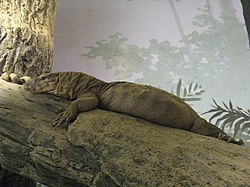
The yellow monitor (Varanus flavescens) or golden monitor is a monitor lizard native to South Asia.[1]
Description
[edit]The yellow monitor is a medium-sized monitor, measuring between 45 and 95 cm (18 and 37 in) including the tail and weighing up to 1.45 kg (3.2 lb).[2] It has subcorneal teeth, scarcely compressed. Its snout is short and convex, measuring a little less than the distance from the anterior border of the orbit to the anterior border of the ear; canthus rostralis distinct. Its nostril is an oblique slit, a little nearer to the end of the snout than to the orbit. The digits are short with the length of the fourth toe, measured from its articulation with the tarsus to the base of the claw, not exceeding the length of the femur. The tail of the yellow monitor is feebly compressed and keeled above. The head scales are small and subequal; the median series of supraocular scales slightly dilated transversely. The scales on upper surfaces are moderate, oval and keeled. Abdominal scales are smooth and in 65 to 75 transverse rows. Caudal scales are keeled; the caudal keel with a very low, doubly toothed crest. Adults are olive or yellowish brown above, with irregular darker markings which are generally confluent into broad cross bars; a blackish temporal streak; lower surfaces yellowish, with rather indistinct brown cross bars, which are most distinct on the throat. Young individuals are dark brown above, with yellow spots confluent into crossbars; lower surfaces yellow, with dark brown cross bars.[3]
Each tooth position has only a single replacement teeth in waiting at any given time.[4]
Distribution and habitat
[edit]
The yellow monitor occurs in the flood plains of the Indus, Ganges and Brahmaputra rivers in India, Pakistan, Nepal and Bangladesh.[1] It inhabits wet areas, the edges of forest and vicinity of human settlements and agricultural land. Due to its short hind toes, it is not efficient at climbing trees.[2]
Behaviour and ecology
[edit]The yellow monitors thermoregulates by moving between sunny and shady areas, similar to other diurnal lizards. There is also one report of a yellow monitor lying on a pile of hot ash left by a human-lit fire, seemingly to gain heat from it.[5]
It may be capable of play behaviour. A yellow monitor in a wetland was observed alternating between swimming in a vertical position and floating motionlessly.[6]
Threats
[edit]
The yellow monitor is threatened by hunting for its meat and skin in all range countries. Its preferred habitat is threatened due to encroachment, pollution and conversion to landfills.[1] Direct killing is the major threat to the yellow monitor in Kanchanpur District of far-western Nepal, as local people are afraid of it. It is also used as food, for medicinal purpose, and its skin has been offered for sale in wildlife markets..[7]
Conservation
[edit]International trade of the yellow monitor is regulated under CITES Appendix I; it is listed as a legally protected species in India under Schedule I of the Wild Life (Protection) Act, 1972, in Nepal under the National Parks and Wildlife Conservation Act 1973, and in Bangladesh under the Wildlife (Conservation and Security) Act 2012.[1]
References
[edit]- ^ a b c d e f Das, A.; Hasan, M.K.; Bhattarai, S.; Wangyal, J. & Mohapatra, P. (2021). "Varanus flavescens". IUCN Red List of Threatened Species. 2021 e.T22872A127899602. doi:10.2305/IUCN.UK.2021-2.RLTS.T22872A127899602.en. Retrieved 22 January 2022.
- ^ a b Ghimire, H. R.; Shah, K. B. (2014). "Status and habitat ecology of the Yellow Monitor, Varanus flavescens, in the Southeastern part of Kanchanpur District, Nepal" (PDF). Herpetological Conservation and Biology. 9 (2): 387–393.
- ^ Boulenger, G. A. 1890. Fauna of British India. Reptilia and Batrachia.
- ^ Maho, T.; Reisz, R. R. (2024). "Exceptionally rapid tooth development and ontogenetic changes in the feeding apparatus of the Komodo dragon". PLOS One. 19 (2) e0295002. doi:10.1371/journal.pone.0295002. PMC 10849390. PMID 38324523.
- ^ Al-Razi, H.; Baki, M.; Alam, S.M.I. (2014). "Varanus flavescens (yellow monitor): Thermoregulation". Herpetological Bulletin. 129: 27–28.
- ^ Khandakar, N.; Jeny, K.N.; Islam, S.; Hakim, M.A.; Pony, M. (2020). "Play behavior by a Yellow Monitor, Varanus flavescens (Hardwicke and Gray 1827)". Herpetological Bulletin. 27 (2): 257–258. doi:10.17161/randa.v27i2.14261.
- ^ Ghimire, H. R.; Phuyal, S.; Shah, K. B. (2014). "Protected species outside the protected areas: People's attitude, threats and conservation of the Yellow Monitor (Varanus flavescens) in the Far-western Lowlands of Nepal". Journal for Nature Conservation. 22 (6): 497–503. Bibcode:2014JNatC..22..497G. doi:10.1016/j.jnc.2014.08.003.
- Auffenberg W. Rahman H. Iffat F. Perveen Z. 1989. A Study of Varanus flavescens Hardwicke and Gray (Sauria varanidae). Journal of the Bombay Natural History Society 86 (3): 286–307
- Visser, G. J. (1985). "Notizen zur Brutbiologie des Gelbwarans Varanus (Empagusia) flavescens (Hardwicke & Gray 1827) im Zoo Rotterdam". Salamandra. 21 (2/3): 161–168.
- Whitaker, R. 1981 Bangladesh - Monitors and turtles Hamadryad 6 (3): 7–9
External links
[edit]
Yellow monitor
View on GrokipediaTaxonomy
Etymology and nomenclature
The yellow monitor bears the binomial scientific name Varanus flavescens, formally described by Thomas Hardwicke and John Edward Gray in their 1827 publication The Zoological Miscellany.[8] The genus Varanus, encompassing all monitor lizards, originates from the Arabic term waran or waral (ورن / ورل), a colloquial name historically applied to large lizards such as the Nile monitor, reflecting early observations of their alert, watchful demeanor akin to monitoring behavior.[9] The species epithet flavescens derives from the Latin flavus, meaning "yellow," combined with the suffix -escens, denoting a process of becoming or tending toward a quality, thus describing the lizard's characteristic yellowish or golden dorsal coloration.[10] This nomenclature highlights the animal's pale, buff-toned scales, distinguishing it from darker congeners. Common English names include yellow monitor and golden monitor, emphasizing its hue; regionally, it is known as Sun Gohoro in Nepali and Sango ih (सनगोहि) in Maithili, terms rooted in local indigenous observations of its habitat and appearance.[11] Historical synonyms encompass Monitor exanthematicus ssp. indicus proposed by Schlegel in 1844, reflecting early taxonomic confusion with African monitors before clarification of its South Asian distinctiveness.[8] The species remains valid under the International Code of Zoological Nomenclature without subsequent revisions altering its status.[10]Classification and phylogeny
The yellow monitor (Varanus flavescens) is a species of lizard in the genus Varanus, the type genus of the family Varanidae, which comprises the world's monitor lizards and is the sole family within the superfamily Varanoidea.[12] This placement positions it within the suborder Anguimorpha of the order Squamata, reflecting shared derived traits such as a forked tongue, pleurodont dentition, and specialized venom-delivering glands in the lower jaw. The species was formally described by Thomas Hardwicke and John Edward Gray in 1827, based on specimens from the Bengal region, with no recognized subspecies.[8] V. flavescens is assigned to the subgenus Empagusia (Gray, 1838), a grouping of five Asian species distinguished morphologically by features including a prominent pineal foramen, transverse scale rows on the neck, and a relatively short tail with keeled scales.[13] The other members are the Bengal monitor (V. bengalensis), Dumeril's monitor (V. dumerilii), the clouded monitor (V. nebulosus), and the grey monitor (V. griseus).[13] Phylogenetic analyses of Varanus, incorporating morphological and molecular data (e.g., mitochondrial and nuclear genes), recover Empagusia as monophyletic within the broader Indo-Asian clade of Old World monitors, which diverged from African and Australasian lineages during the Miocene.[14][15] Within Empagusia, V. flavescens clusters closely with V. bengalensis based on cranial morphology and limited genetic markers, suggesting a recent divergence likely tied to habitat specialization in riverine floodplains, though comprehensive genomic sampling for V. flavescens remains sparse.[8][14]| Taxonomic rank | Name |
|---|---|
| Kingdom | Animalia |
| Phylum | Chordata |
| Class | Reptilia |
| Order | Squamata |
| Family | Varanidae |
| Genus | Varanus |
| Subgenus | Empagusia |
| Species | V. flavescens |
Physical characteristics
Morphology and size
The yellow monitor (Varanus flavescens) possesses a robust, elongated body typical of varanid lizards, with a long neck, powerful limbs terminating in five-toed feet equipped with sharp claws adapted for digging and climbing, and a muscular tail exceeding the snout-vent length that aids in swimming and balance.[2] The head is moderately elongated, featuring a short, convex snout slightly shorter than the distance from the eye to the ear opening, subcorneal teeth that are scarcely compressed laterally, and a deeply forked tongue used for chemosensory detection.[2] Nostrils are positioned as oblique slits near the snout tip, facilitating aquatic respiration during submersion.[16] Dorsal scales are moderate in size, oval-shaped, and keeled for protection and traction, while ventral abdominal scales are smooth and arranged in 65 to 75 transverse rows; caudal scales are similarly keeled, supporting the tail's prehensile and propulsive functions.[17] Juveniles measure approximately 14.5 cm in total length at hatching, with snout-vent lengths around 6.5 cm.[17] Adults are medium-sized, attaining total lengths of 45 to 95 cm, though regional maxima in areas like Bangladesh reach 70-80 cm.[17] [2] The heaviest verified specimen weighed 1.45 kg at 95.2 cm total length, exceeding prior records, while typical adults weigh 0.5 to 1 kg, with occasional reports up to 3 kg unverified against this benchmark.[18] [19] Males and females exhibit negligible size differences.[17]Coloration and sexual dimorphism
The yellow monitor (Varanus flavescens) displays ontogenetic changes in coloration, with juveniles featuring a dark brown dorsal surface marked by yellow spots that coalesce into crossbars, complemented by yellow ventral surfaces bearing dark brown crossbars.[2] Adults exhibit an olive to yellowish-brown dorsum with irregular darker markings often forming broad crossbars and a blackish temporal streak, while the venter is yellowish with faint brown crossbars, most evident on the throat.[2] This species' coloration varies substantially even among individuals from the same locality, including diverse patterns of spots and blotches.[17] Sexual dimorphism in V. flavescens is weakly expressed externally, with no documented differences in coloration or patterning between sexes.[20] As observed across varanid lizards, dimorphism manifests chiefly through body size, wherein adult males attain larger dimensions than females due to extended growth periods post-maturity, though specific metrics for V. flavescens remain understudied.[21][22]Distribution and habitat
Geographic range
The yellow monitor (Varanus flavescens) inhabits the floodplains of the Indus River in Pakistan and the Ganges and Brahmaputra River systems extending across India, Nepal, and Bangladesh.[6] In Pakistan, populations are primarily restricted to the Indus River basin in Punjab and Sindh provinces. Indian records document occurrences in northern and eastern states such as Punjab, Uttar Pradesh, Bihar, Himachal Pradesh, Jammu and Kashmir, and Assam, often in riparian zones and agricultural wetlands adjacent to these rivers. In Nepal, the species is confined to the southern Terai lowlands, including Chitwan National Park and surrounding floodplains of the Narayani and Rapti Rivers, which connect to the Ganges system.[18][16] Bangladesh hosts populations in the extensive deltaic wetlands of the Ganges-Brahmaputra-Meghna river confluence, particularly in haor and beel ecosystems.[2] Some surveys suggest possible extension into Bhutan along the Brahmaputra tributaries, though confirmed records remain sparse and unverified in peer-reviewed assessments.[8] The species' distribution is discontinuous due to habitat fragmentation from agricultural expansion and urbanization, with no substantiated extralimital populations outside these riverine corridors. Elevational range is typically below 500 meters, aligning with subtropical and tropical lowland biomes.[23]Habitat preferences and microhabitats
The yellow monitor (Varanus flavescens) primarily inhabits lowland wetland ecosystems across its range in South Asia, favoring areas with permanent or seasonal water bodies such as rivers, canals, marshes, and flooded grasslands.[24][18] These preferences align with its semi-aquatic lifestyle, enabling efficient foraging and thermoregulation in warm, humid environments with slow-moving or standing water.[23] Observations indicate avoidance of fast-flowing rivers, with individuals concentrating in silty clay soils along water edges for burrowing and basking.[24] Within broader wetlands, the species selects microhabitats characterized by low vegetation cover and proximity to water, including canal banks, riverine floodplains, and adjacent agricultural fields.[24][18] A study in altered habitats of Bangladesh's Chalan Beel region found a strong preference for semi-aquatic microhabitats like canals and slow-moving rivers over terrestrial ones such as open fields or dense bushes, with 68% of sightings in water-adjacent sites featuring water depths under 1 meter.[24] Bushes, including invasive species like Lantana camara, are utilized primarily for cover rather than foraging, providing refuge from predators and human activity.[18] In Nepal's Kanchanpur District, surveys documented higher densities in swampy lowlands and irrigated farmlands bordering perennial rivers, where soil composition supports excavation of burrows up to 1-2 meters deep for nesting and overwintering.[23] Microhabitat selection appears driven by availability of prey in shallow waters and vegetative structure offering partial shade, with individuals rarely venturing more than 50 meters from water sources.[24] Anthropogenic modifications, such as canal irrigation, have expanded suitable microhabitats in some agricultural landscapes, though they increase vulnerability to habitat fragmentation.[18]Behavior and ecology
Foraging and diet
The yellow monitor (Varanus flavescens) exhibits a carnivorous and opportunistic diet, preying on a diverse array of invertebrates, vertebrates, eggs, and carrion.[25] Stomach content analyses from semi-aquatic populations in Bangladesh indicate that insects form the bulk of the diet by number of prey items, supplemented by crustaceans, amphibians, fish, small mammals, and bird eggs.[4] Documented prey includes frogs, toads, fish, crabs, rats, and rotten flesh, reflecting adaptability to both aquatic and terrestrial environments.[25]| Prey Category | Examples | Frequency (% of prey items by number) |
|---|---|---|
| Insects | Beetles, spiders, dragonflies, water scorpions, mole crickets, ants, crickets, grasshoppers, unidentified insects, insect larvae | Beetles: 15%; spiders: 11%; unidentified insects: 11%; others: 4–7% each[4] |
| Crustaceans | Freshwater crabs (Potamidae) | 7%[4] |
| Amphibians | Frogs (Anura) | 4%[4] |
| Fish | Small fish | 4%[4] |
| Mammals | House mouse | 4%[4] |
| Eggs | Bird eggs | 4%[4] |