Hubbry Logo
Yucca elataYucca elataMain
Open search
Yucca elata
Community hub
Yucca elata
logo
8 pages, 0 posts
0 subscribers
Be the first to start a discussion here.
Yucca elata
Yucca elata
from Wikipedia

Yucca elata
Large soaptree yucca
Scientific classification Edit this classification
Kingdom: Plantae
Clade: Tracheophytes
Clade: Angiosperms
Clade: Monocots
Order: Asparagales
Family: Asparagaceae
Subfamily: Agavoideae
Genus: Yucca
Species:
Y. elata
Binomial name
Yucca elata
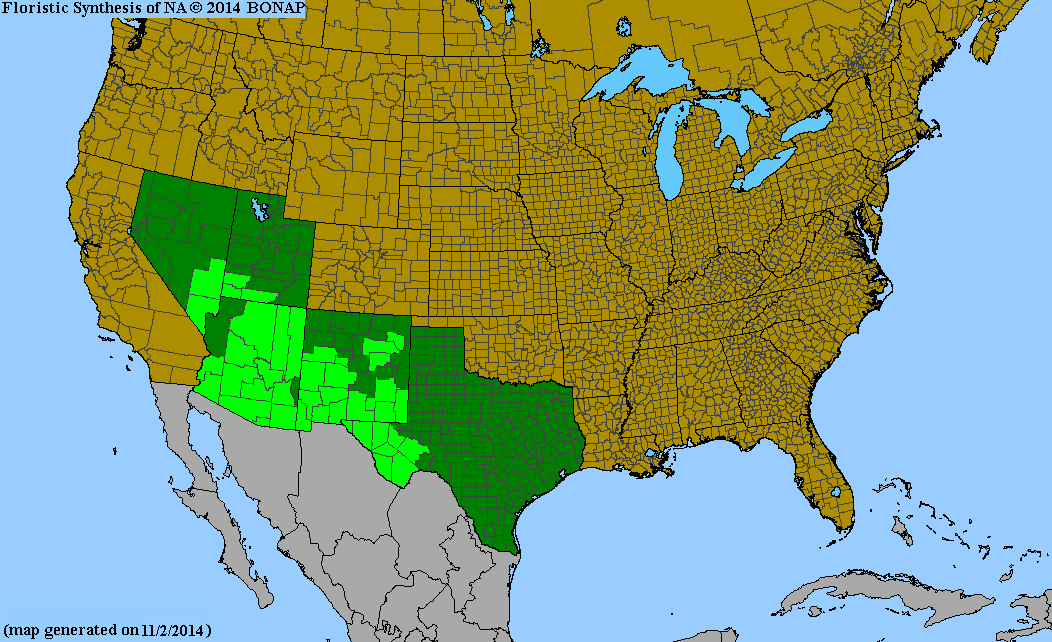
Natural range
Synonyms[2]
  • Y. angustifolia var. elata Engelm.
  • Yucca angustifolia var. radiosa Engelm.
  • Yucca radiosa (Engelm.) Trel.
  • Yucca verdiensis McKelvey

Yucca elata is a perennial plant, with common names that include soaptree, soaptree yucca, soapweed, and palmella.[3][4] It is native to southwestern North America, in the Sonoran Desert and Chihuahuan Desert in the United States (western Texas, New Mexico, Arizona), southern Nevada, southwestern Utah, and northern Mexico (Chihuahua, Coahuila, Sonora, Nuevo León).[5][6] Yucca elata is widely distributed, although its population appears to be decreasing.[1]

Description

[edit]
A dry, opened seed pod

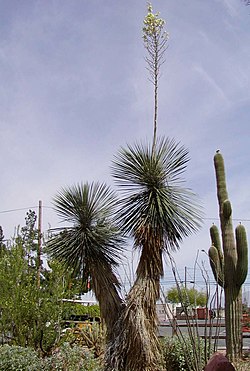
This plant grows from 1.2 to 4.5 m tall, with a sparsely branched trunk. The trunk is brown, cylindrical in shape and has a small diameter and often has holes drilled by escaping yucca moth larvae. The leaves are arranged in a dense spiral whorl at the apex of the stems, each leaf 25–95 cm long and very slender, 0.2-1.3 cm broad. The white, bell-shaped flowers grow in a dense cluster on a slender stem at the apex of the stem, each flower 32–57 mm long, creamy white, often tinged pinkish or greenish.[7][8][9]

The soaptree yucca's fruit is a capsule 4–8 cm long and 2–4 cm broad, maturing brown in summer, when it splits into three sections to release the black seeds. They do not flower every year.[6]

Ecology

[edit]

These plants fare best in dry, semi-desert conditions. They are very cold-hardy, but need much sunlight.[10]

Subspecies

[edit]

There are three subordinate taxa are sometimes recognized, although sources differ as to whether these should be considered varieties or subspecies:[6][11]

  • Yucca elata ssp. elata. Capsules large, 5–8 cm; leaves long, 30–95 cm. Throughout the species' range.
  • Yucca elata ssp. verdiensis. Capsules small, 4-4.5 cm; leaves short, 25–45 cm. Arizona only.
  • Yucca elata ssp. utahensis.

Uses

[edit]
Yucca flowers

Native Americans used the fiber of the soaptree yucca's leaves to make sandals, belts, cloth, baskets, cords, and mats, among other items; they also ate the flowers.[12] Inside the trunk and roots of the plant is a soapy substance high in saponins. In the past, this substance was commonly used as soap and shampoo, which was used to treat dandruff and hairloss. At least one tribe, the Zuni, used a mixture of soap made from yucca sap and ground aster to wash newborn babies to stimulate hair growth. The Apaches also use yucca leaf fibers to make dental floss and rope. In times of drought ranchers have used the plant as an emergency food supply for their cattle; the chopped trunk and leaves can be eaten.[12]

Symbolism

[edit]

Flowers of the genus Yucca are the state flowers of US state of New Mexico.[13] No species name is given in the statute citation,[14] however the New Mexico Centennial Blue Book from 2012 references the soaptree yucca (Yucca elata) as one of the more widespread species in New Mexico.[15]

References

[edit]
[edit]
Revisions and contributorsEdit on WikipediaRead on Wikipedia
from Grokipedia
Yucca elata, commonly known as the soaptree yucca or soapweed yucca, is a perennial, tree-like succulent in the family native to the arid regions of the and . It typically grows as a shrub or small tree with unbranched or sparsely branched, woody stems reaching 5 to 20 feet (1.5 to 6 meters) in height, often crowned by dense rosettes of rigid, linear leaves that measure 1 to 3 feet (0.3 to 1 meter) long and 0.25 to 0.5 inches (0.6 to 1.3 cm) wide, featuring gray-green to blue-green blades with distinctive white, curly margins and sharp, terminal spines; it is the official state flower of . During spring, mature plants produce tall, erect inflorescences up to 3 to 7 feet (0.9 to 2.1 meters) high, bearing large panicles of 25 to 30 pendulous, bell-shaped, creamy-white flowers, each about 2 to 3 inches (5 to 7.6 cm) long, which develop into dry, brown, woody capsules containing black seeds. These flowers are exclusively pollinated by the pronuba yucca moth (Tegeticula yuccasella), in a mutualistic relationship where the moth lays eggs in the ovaries and the larvae feed on developing seeds. The species is distributed primarily across central and southern Arizona, southern , western , and the adjacent Mexican states of Chihuahua and , with scattered peripheral populations in southeastern and southwestern . It inhabits diverse dryland environments, including desert scrub, semi-desert grasslands, mesas, rocky slopes, and pinyon-juniper woodlands, favoring coarse-textured, well-drained soils such as sandy loams, dunes, and eroded substrates at elevations ranging from 1,500 to 6,000 feet (457 to 1,829 meters). Ecologically, Yucca elata forms clumped stands in open grasslands dominated by bunchgrasses like gramas (Bouteloua spp.) and threeawns (Aristida spp.), exhibiting slow growth rates of about 1 inch (2.5 cm) per year and reproducing both clonally via deep vertical rhizomes up to 3 to 5 feet (0.9 to 1.5 meters) long and sexually through moth-pollinated seeds. The plant demonstrates high fire tolerance, resprouting from rhizomes after top-kill, and serves as important habitat, providing cover for small mammals and birds while its leaves and flowers offer browse for deer, , and livestock. Indigenous peoples have long utilized Y. elata for multiple purposes, including and fruits, leaf fibers for cordage and basketry, and roots rich in for producing soap-like suds.

Taxonomy

Classification

Yucca elata Engelm. is a in the Yucca within the , classified under the order . Its full taxonomic hierarchy is as follows: Kingdom: Plantae; Clade: Tracheophytes; Clade: Angiosperms; Clade: Monocots; Order: ; Family: ; : Yucca L.; : Y. elata Engelm. The was first described as new by American George Engelmann in 1882, based on specimens collected from western by Ferdinand Jacob Lindheimer in the 1840s. Earlier, Engelmann had treated it as a variety, Yucca angustifolia Pursh var. elata Engelm., in 1873. Synonyms include Yucca utahensis McKelvey (1947), which was later reduced to varietal status under Y. elata by Reveal in 1977, reflecting ongoing refinements in southwestern yucca driven by morphological and distributional . In traditional classifications, Y. elata is placed in Yucca subg. Yucca Engelm. (also termed subg. Euyucca), a group characterized by arborescent growth forms and obligate pollination by yucca moths of the genus Tegeticula. This subgenus contrasts with subg. Clistoyucca Engelm., which includes species with different inflorescence structures and fruit types. Recent phylogenetic studies support a clade-based system, positioning Y. elata within the monophyletic Rupicola clade, defined by dry, dehiscent capsules and shared genetic markers from nuclear and plastid DNA analyses. Y. elata is distinguished from related species like Y. filamentosa L. by its taller, distinctly arborescent habit (up to 6 m) versus the shorter, often acaulescent form of Y. filamentosa, as well as narrower leaves (0.4–1.3 cm wide) with curly marginal filaments; genetic analyses confirm their separation in distinct subclades within Rupicola. Compared to Y. baccata Torr., which belongs to the fleshy-fruited Aloifolia clade, Y. elata differs in producing dry capsules rather than berries, along with longer inflorescences (up to 2 m) and a more restricted southwestern distribution; morphological keys and DNA sequencing underscore these differences.

Etymology

The genus name Yucca derives from the Spanish "yuca," which itself originates from the of the , referring to the plant (Manihot esculenta), a root crop unrelated to the genus; early European explorers misapplied the term to these North American plants due to superficial resemblances in their edible parts or overall form. This nomenclature was formalized in the by , who adopted the name for the despite the botanical mismatch, possibly influenced by accounts of indigenous uses of inflorescences as food, akin to preparations. The specific epithet elata is derived from Latin, meaning "tall," "lofty," or "exalted," alluding to the species' distinctive upright, arborescent growth habit, which can reach heights of 6 to 9 meters in mature specimens. Common names for Yucca elata reflect both its utility and appearance: "soaptree yucca" and "soapweed" stem from the high content in its roots, which produce a soapy lather when crushed and mixed with water, a property long exploited for cleansing; "palmella" is a Spanish diminutive of "palma," evoking the plant's tall, palm-like trunk and foliage despite its lack of relation to true palms. The species was formally described and named by the German-American botanist George Engelmann in 1882, based on specimens collected during 19th-century U.S.- boundary surveys, which documented the of the southwestern border regions where Y. elata is prominent.

Description

Morphology

is an arborescent that forms a -like or small , typically reaching heights of 1.5 to 6 meters (5 to 20 feet), though occasionally up to 9 meters (30 feet) in exceptional cases. It possesses a single erect or sparsely branched trunk, which is woody and succulent, with a up to 30 cm (12 inches), often topped by a rosette of leaves; stems may arise from rhizomes, leading to clumped growth in some populations. The leaves are linear and flexible, measuring 25 to 95 cm in length and 0.2 to 1.3 cm in width, arranged in dense rosettes at the stem apex. They exhibit a gray-green to coloration, with sharply pointed tips and margins fringed by white, curly filaments that are particularly prominent near the base, measuring 2 to 5 cm long. Leaves remain green for 3 to 5 years before drying and persisting on the trunk, contributing to a characteristic "skirted" appearance. The emerges from the center of the rosette as an open, branching , typically 1 to 2 meters tall, bearing numerous pendulous, creamy-white flowers. Each flower is bell-shaped, 3 to 6 cm long, and composed of six tepals, often tinged with or . Fruits develop as erect, woody capsules, 4 to 8 cm long and 2 to 4 cm wide, initially and maturing to brown in summer; they dehisce longitudinally into three sections to release numerous black, ovoid seeds. The consists of a deep vertical or extending 1 to 1.5 meters downward, from which fibrous lateral extend up to 15 to 20 cm long; these are rich in , compounds that produce soapy lather when agitated in water.

Reproduction

Yucca elata primarily reproduces sexually through an obligate mutualism with yucca moths of the Tegeticula, particularly T. yuccasella. Female moths actively pollinate the flowers at night using specialized tentacular mouthparts to gather and deposit on the stigma before laying eggs in the developing ; the emerging larvae consume a portion of the seeds, while leaving enough viable seeds for the plant's propagation. Flowering occurs from mid-May to mid-July across its range, with fruit ripening by August to October. This is influenced by environmental cues, including adequate winter chilling periods that can delay bloom onset if unusually cold, and spring moisture that supports development. Following successful , pendulous fruits mature into dehiscent capsules, each containing approximately 150 ovoid black seeds. These capsules split open to release seeds, which are primarily dispersed by wind and gravity from September to October. Seed viability persists for up to several years, with field samples showing over 90% even after seven years of storage under natural conditions. Vegetative reproduction occurs through rhizomes and basal sprouting from the root crown, often forming clonal clusters, though it is less common than in some other yucca species and supplements seed-based recruitment. Plants grown from seed exhibit slow growth, typically reaching reproductive maturity and producing their first bloom in 5 to 6 years under favorable conditions. Seed germination is enhanced by to breach the hard coat or soaking in for 24 hours, achieving rates of 80-96% at temperatures between 28°C and 32°C in moist conditions; cold stratification is not strictly required but may mimic natural winter exposure for optimal establishment in arid environments. Seedlings establish best under nurse plant facilitation, where and shade improve survival.

Distribution and Habitat

Geographic Range

Yucca elata is native to the and , with its core distribution spanning central , southern , and western in the United States, as well as Chihuahua, , and in . Disjunct populations occur in southeast and southwest , representing peripheral extensions of the species' range. This distribution reflects adaptation to arid environments, with no documented significant introduced ranges outside its native areas. The species occupies elevations from approximately 450 to 1,830 meters (1,500 to 6,000 feet), commonly found between 1,500 and 6,000 feet in varied topographic settings such as grasslands, mesas, and hillsides. Core populations are concentrated in the Sonoran and Chihuahuan Deserts, where it thrives in semi-desert grasslands and scrub habitats, while sparse occurrences mark the fringes of the in and . Historical evidence from late pollen records indicates post-glacial migration patterns for Yucca elata within the , where the species expanded northward and upslope following the retreat of ice sheets around 11,700 years , contributing to the establishment of modern desert vegetation assemblages. This migration aligned with warming climates, allowing colonization of suitable arid habitats from southern refugia.

Ecological Associations

Yucca elata thrives in semi-arid environments characterized by sandy or gravelly soils, including dunes and sandhills, within scrub communities and semi-desert grasslands. It also tolerates alkaline and soils, often found in washes and shrublands at elevations ranging from 1,500 to 6,000 feet (450–1,830 m). These preferences support its adaptation to coarse-textured substrates that facilitate drainage in arid conditions. The species requires an arid to with annual typically between 200 and 500 mm, much of which occurs during the summer season, as exemplified by sites receiving about 215 mm annually. Mean annual temperatures around 15°C (59°F) are common, and Yucca elata demonstrates cold hardiness down to -18°C (0°F), corresponding to USDA 7. This tolerance enables persistence in regions with occasional winter freezes. Biotic interactions are central to Yucca elata's , particularly its obligate mutualism with the yucca moth (Tegeticula yuccasella), which serves as the keystone ; female moths actively pollinate flowers in exchange for oviposition sites for their larvae, ensuring reproductive success for both species. The plant's flowers also attract bees that collect and , contributing to broader pollinator networks. Additionally, Yucca elata is browsed by herbivores such as , , woodrats, and jackrabbits, with foliage comprising up to 33% of some rodents' diets and serving as winter forage for deer. Birds may utilize the flowers for , enhancing avian-insect interactions in the . Abiotic factors further define its resilience; Yucca elata exhibits strong , relying on deep roots to access in dry periods, and fire tolerance, with low-severity burns causing only about 25% mortality while promoting from the root crown. The slow of its forms a persistent protective skirt around the trunk, shielding against fire and herbivores while retaining moisture in the . In its , Yucca elata plays a vital role by stabilizing sandy soils and dunes, preventing in wind-prone , and increasing through leaf litter accumulation. As a key component of assemblages, it supports by providing structural cover for small mammals and birds, fostering complexity in semi-arid grasslands and shrublands.

Varieties

Yucca elata var. elata

Yucca elata var. elata is the nominate variety of the soaptree yucca, recognized as the tallest form within the , with capable of reaching heights of up to 9 m, though typically 3–4.5 m tall with stems 1–2.5 m in length. This variety features a robust, arborescent trunk that supports a rosette of leaves measuring 30–95 cm long and 0.4–1.3 cm wide, which are gray-green to blue-green and bear prominent white, curly filaments along the margins. The is dense and paniculate, rising 0.7–1.5 m on a peduncle 1–2 m tall, with creamy white flowers 4.5–5.7 cm long. Distributed primarily across central and southern Arizona, , western , and (Chihuahua, Coahuila, Sonora), this variety occupies desert hillsides and open grasslands at elevations of 400–1900 m. It thrives in the region, often in open grasslands dominated by grama grasses (Bouteloua spp.), threeawns (Aristida spp.), and tobosagrass (Pleuraphis mutica). Flowering occurs from spring to early summer, contributing to its role in arid ecosystems. Diagnostic traits of Yucca elata var. elata include its sturdy trunk and compact, densely branched , which distinguish it morphologically from other varieties. Genetic studies utilizing (AFLP) markers have confirmed the separation of Y. elata varieties, supporting their recognition based on combined morphological, geographical, and molecular evidence. These characteristics underscore its adaptation to lowland desert environments in the and .

Yucca elata var. verdiensis

Yucca elata var. verdiensis, known as the Verdi yucca, is a shorter-statured variety distinguished by its arborescent growth form, typically reaching 1.5–3.5 m in height with stems 1–1.5 m tall. The plant forms a compact rosette of linear leaves measuring 25–45 cm long and 0.2–0.6 cm wide, which are pale to in color, flexible, and bear margins that are curled and filiferous with threads that are less curly than those of the nominate variety. Inflorescences are paniculate and rise to 7–13 dm, bearing flowers with tepals 3.2–4.5 cm long, while fruits are capsules 4–4.5 cm in length. This variety is endemic to central , with populations concentrated along the and its tributaries, as well as in the Verde Valley, eastern , and isolated sites in the Grand Canyon region. It occurs at elevations from 300–1900 m, primarily on dry, rocky slopes, hillsides, and canyon bottoms. Diagnostic traits include its more compact rosette and adaptations suited to riparian fringes, such as tolerance for transitional moisture regimes on terrace edges. It was formally recognized as a variety of Y. elata by J. L. Reveal in 1977, based on differences in growth form and morphology from the basionym Yucca verdiensis McKelvey. Ecologically, Y. elata var. verdiensis inhabits transitional zones between Sonoran Desert scrub and higher-elevation oak woodlands, often on riparian terraces amid mesquite and riparian woodlands, where it associates with diverse shrubland communities. Flowering occurs in late spring, with reproduction primarily via pollinators shared with the species level.

Yucca utahensis

Yucca utahensis, commonly known as , is a closely related to Yucca elata and distinguished by its colonial growth habit and less arborescent form. It was formerly classified as Yucca elata var. utahensis. Plants typically reach 1.2–2.8 m in height, forming large with multiple procumbent or subcaulescent stems, often seven or more per colony, each 0.6–1.3 m long and thick. The leaves are bright yellow-green, linear-lanceolate, and measure 20–70 cm long by 0.7–2.2 cm wide, with flexible blades that are plano-convex or plano-keeled, featuring filiferous margins with whitish curling threads and a short spine at the apex; these leaves exhibit minimal filament development relative to more southern varieties. The is a paniculate structure 1–1.5 m tall, bearing pendent, campanulate creamy white flowers 4–5 cm long, leading to erect capsular fruits 5–6 cm long containing thin, dull black seeds. This taxon was first described as the distinct species Yucca utahensis by S. D. McKelvey in 1947, based on specimens from southwestern , but was subsequently reduced to varietal rank under Yucca elata by J. L. Reveal in 1977, primarily due to similarities in growth form, leaf width, and capsule characteristics. However, it is now widely accepted as a separate species in major such as the , though it retains diagnostic traits such as reduced arborescence and colonial clustering. These features help differentiate it from the more tree-like Yucca elata var. elata, which develops taller, erect trunks and broader leaves with more pronounced filaments. The distribution of Yucca utahensis is disjunct and limited, occurring in isolated populations across southeastern , southwestern , and northwestern , marking a rare northern extension from the primary range of Yucca elata in the Sonoran and Chihuahuan Deserts. It thrives on desert hillsides, canyons, and sandy soils derived from , at elevations of 700–2000 m, within the Upper Sonoran of scrub habitats. This adaptation suits it to the edges of the , where it endures higher summer heat and arid conditions, often growing in clumps amid sparse vegetation.

Uses

Traditional and Historical Uses

Native American tribes in the , including the , Mescalero Apache, , and Ancestral Pueblo peoples, have long utilized Yucca elata for its versatile properties in daily life and ceremonies. The plant's leaves, roots, flowers, and fruits provided essential materials and sustenance in arid environments, with uses documented through ethnobotanical studies and archaeological evidence from the region. These traditional applications reflect the plant's integral role in indigenous economies and cultural practices prior to European contact. The fibrous leaves of Yucca elata were stripped and processed to create strong cordage, baskets, sandals, mats, and clothing items by tribes such as the and Pueblo peoples. groups, including the and , wove the tough leaf fibers into carrying nets, ropes, and ceremonial headdresses, while Ancestral Pueblo communities used them for woven goods that facilitated trade across the Southwest. These items were essential for transportation, shelter, and exchange, highlighting the plant's economic importance. Roots of Yucca elata were pounded and soaked to extract , producing a natural lather used as and for personal and ceremonial cleansing among Native American groups like the and tribes. This practice, noted in 19th-century ethnobotanical records, extended to treating skin conditions and was a staple in daily and ritual washing. The sudsy solution was particularly valued in water-scarce regions for its cleansing efficacy without additional resources. Food derived from Yucca elata included its , buds, and immature fruits, which were roasted, boiled, or eaten raw by tribes such as the and . Flowers served as fresh in soups or greens, while buds and young fruits provided a nutritious supplement during lean seasons. The inner trunk was also processed into meal, offering an emergency food source. Additional applications encompassed the trunk, which was burned as or mixed with for smoking among groups, and the plant's role in Mescalero Apache fertility and religious ceremonies, where it symbolized purification and vitality. In the mid-20th century, commercial extraction of Yucca elata emerged in the U.S. Southwest, with facilities in processing leaves for ropes, brushes, and industrial cordage, building on indigenous techniques documented in agricultural reports.

Cultivation and Ornamental Value

Yucca elata thrives in full sun and requires well-drained sandy or rocky soils with a range of 6 to 8, tolerating high content. It is highly drought-tolerant once established, relying primarily on natural rainfall, and is hardy in USDA zones 7 to 10, withstanding temperatures down to -18°C (0°F). Propagation is achieved through seeds or offsets from rhizomes. Seeds germinate best at 60-70°F (15-21°C) after and cold stratification, such as overwintering in moist or a sealed in the . Offsets can be separated from mature plants and replanted directly. Growth is slow, typically about 2.5 cm (1 inch) per year, though supplemental irrigation can slightly accelerate it initially. In , Yucca elata serves as an accent plant in xeriscapes and rock gardens, valued for its striking architectural form and creamy white, fragrant flowers that attract and other pollinators. Its winter appearance features a distinctive of dried, fibrous leaves clinging to the trunk, adding textural interest. Care is minimal, with watering needed only about once per month during the first summer after planting; established plants require no supplemental in suitable climates. Pruning involves removing to maintain appearance, and the plant is generally pest-resistant, though yucca weevils (Scyphophorus spp.) can occasionally infest stems and require monitoring or systemic insecticides if detected. Commercially, Yucca elata has been propagated in nurseries since the early and remains popular in southwestern U.S. gardens for its low-maintenance, drought-resistant qualities. In modern applications, saponins extracted from its are used in commercial soaps, shampoos, and as foaming agents in and beverages.

Conservation Status

Global and Regional Assessments

Yucca elata is assessed as globally secure (G5) by NatureServe, reflecting its extensive range and apparently stable populations across the and . At the international level, the species is considered Least Concern by the , owing to its wide distribution and lack of significant threats to overall viability, as of 2020. In the United States, Yucca elata is not listed under the federal Act, though certain varieties receive monitoring attention due to localized distributions. At the state level, the species is salvage-restricted in under the Native Plant Law, prohibiting unauthorized collection or removal of var. elata and var. verdiensis without permits, to protect regional populations. In and , it is ranked as secure (effectively G5 at subnational scales via NatureServe's framework), indicating abundant and stable occurrences. Among varieties, var. utahensis faces potential vulnerability from its disjunct distribution limited to southeastern , southwestern , and northwestern , where it is also salvage-restricted in . Var. verdiensis, endemic to central , warrants regional concern due to its narrower habitat range, though it shares the species' overall secure global status. Population trends for Yucca elata remain stable, distributed across its native habitats.

Threats and Protection

Subnational ranks vary, with the species unranked (SNR) in , , and . Primary threats to Yucca elata include illegal for ornamental , driven by demand for drought-tolerant in arid regions. In , poachers uproot mature plants from public and private lands, shipping them to markets in and , which disrupts local populations and hinders regeneration since plants require over a decade to produce viable seed. Frequent wildfires pose another risk, causing up to 25% mortality in affected stands by top-killing aboveground stems, particularly in semidesert grasslands where fire return intervals have shortened due to invasive grasses. impacts by consuming flowers and developing stalks, reducing seed set in grazed areas. exacerbates these issues through altered , such as anomalous early blooming that desynchronizes with yucca moths, potentially lowering production in variable patterns. Protection efforts focus on regulatory measures under state native plant laws. In Arizona, Yucca elata is classified as salvage restricted, prohibiting removal, transport, or sale without a permit during to prevent incidental destruction. Permits require salvage assessments and often mandate replanting or compensation to preserve populations. In , the variety Yucca elata var. utahensis (now often recognized as Yucca utahensis) receives similar salvage restrictions, limiting collection from public lands. The species occurs in protected areas like and , where indirectly safeguards it from development and . No federal protections apply under the U.S. Endangered Species Act.

References

Add your contribution
Related Hubs
User Avatar
No comments yet.