Hubbry Logo
Yucca flaccidaYucca flaccidaMain
Open search
Yucca flaccida
Community hub
Yucca flaccida
logo
8 pages, 0 posts
0 subscribers
Be the first to start a discussion here.
Yucca flaccida
Yucca flaccida
from Wikipedia

Yucca flaccida
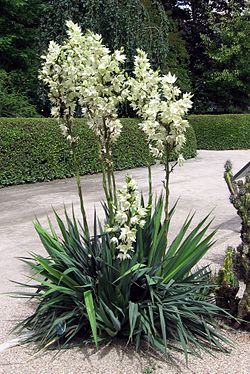
Royal Botanic Garden, Madrid
Scientific classification Edit this classification
Kingdom: Plantae
Clade: Tracheophytes
Clade: Angiosperms
Clade: Monocots
Order: Asparagales
Family: Asparagaceae
Subfamily: Agavoideae
Genus: Yucca
Species:
Y. flaccida
Binomial name
Yucca flaccida
Synonyms[3]
  • Yucca filamentosa var. flaccida (Haw.) Engelm.
  • Yucca concava Haw.
  • Yucca exigua Baker
  • Yucca glaucescens Haw.
  • Yucca puberula Haw.
  • Yucca orchioides Carrière
  • Yucca louisianensis Trel.
  • Yucca smalliana Fern.
  • Yucca freemanii Shinners

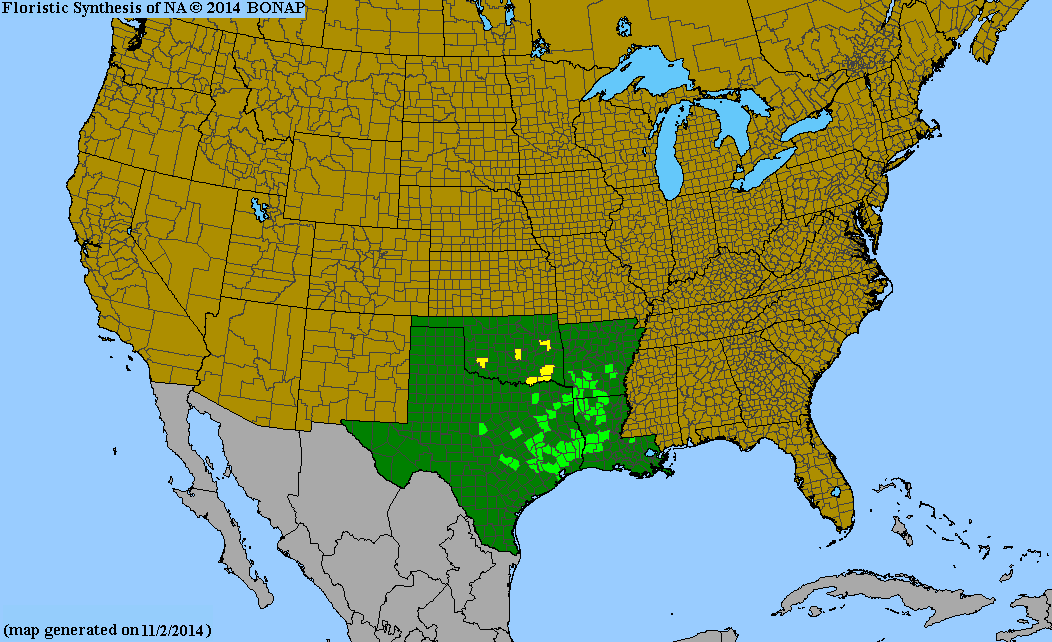
Yucca flaccida, commonly called Adam's needle[4] or weak-leaf yucca,[5] is a species of flowering plant in the asparagus family (Asparagaceae). It is native to south-central and southeastern North America, from the lower Great Plains eastward to the Atlantic seaboard in Virginia, south through Florida and the Gulf states.[6] Its natural habitat is in sandy open woodlands and fields.[4] It is not considered to be threatened by the IUCN.[1]

Description

[edit]

It is a stemless evergreen shrub growing to 55 cm (22 in) tall by 150 cm (59 in) broad. It has a basal rosette of sharply pointed, swordlike leaves up to 55 cm (22 in) long. In summer, 150 cm (59 in) long panicles of bell-shaped creamy white flowers are held above the foliage.[7]

The Latin specific epithet flaccida means "weak", "feeble", referring to the leaves which often fold under their own weight (the inner leaves may remain erect as they are supported by the outer ones).[8]

Taxonomy

[edit]

Some authorities regard Y. flaccida as a variety or form of Y. filamentosa, rather than as a separate species.[4]

Populations in the South Central Region of the United States with unusually narrow leaves have been segregated as Y. louisianensis by some authorities.[9][10] This entity is found in the states of Arkansas, Louisiana, Oklahoma, and Texas.[11]

Ecology

[edit]

A number of yucca moths lay their eggs upon Y. flaccida as a host plant, an example being Tegeticula intermedia.[12]

Cultivation

[edit]

It is cultivated and valued as an architectural plant.[7] Numerous cultivars are available, some with variegated leaves, of which 'Golden Sword'[13] and 'Ivory'[14] have gained the Royal Horticultural Society's Award of Garden Merit.[15]

References

[edit]
Revisions and contributorsEdit on WikipediaRead on Wikipedia
from Grokipedia
Yucca flaccida, commonly known as Adam's needle or flaccid-leaf yucca, is a stemless evergreen shrub in the family native to the interior regions of eastern . It forms dense basal rosettes of slender, lanceolate leaves that measure 40-80 cm long and 10-40 mm wide, with flexible, recurved blades featuring distinctive thread-like filaments along the margins. In summer, the plant produces erect flower stalks rising 1-2.5 meters tall, bearing panicles of nodding, creamy white, bell-shaped flowers less than 2.5 cm in diameter. These are followed by erect, cylindrical seed capsules 2.5-7.5 cm long containing black seeds. The species is distributed from and southward to and , occurring in prairies, open woodlands, forest edges, and sandy or rocky soils at elevations up to 1,500 meters. It thrives in full sun and well-drained, dry conditions, demonstrating strong and adaptability to poor soils, which contributes to its hardiness across USDA zones 4-10. Yucca flaccida often suckers to form small colonies and is frequently confused with the similar Yucca filamentosa, though it is distinguished by its more flexible leaves and less coastal affinity. Ecologically, Y. flaccida relies on a mutualistic relationship with yucca moths (Tegeticula spp.) for pollination, where female moths actively deposit eggs and pollen into the flowers, ensuring seed production in exchange for larval food. The plant also attracts bees and hummingbirds to its blooms. Human uses include harvesting edible flowers, fruits, and young stems, as well as employing leaf fibers for cordage and roots for soap or medicinal purposes due to their saponin content, though the latter can be toxic if ingested improperly. Widely cultivated since the 16th century for ornamental value in landscapes, it propagates easily via offsets, seeds, or cuttings and features cultivars like 'Golden Sword' with variegated foliage.

Description

Morphology

Yucca flaccida is an acaulescent or rarely short-caulescent that forms compact basal rosettes and cespitose colonies through offsets, typically reaching heights of 40–80 cm for the foliage and widths up to 1.5 m as it spreads. The exhibits a slow growth rate and an erect to spreading , with rosettes that die back after flowering but are replaced by new growth from subterranean stems. This morphology distinguishes it from more rigidly upright yuccas, as its overall form is low and clumping rather than forming tall trunks. Plants are typically 1–3 m tall including the ; rosettes are usually small. The leaves are lanceolate and sword-like, measuring 40–80 cm in length and 1–4 cm in width, with the broadest point near the middle; they are gray-green, glabrous, and thin with a flexible, limp texture that causes them to bend or fold under their own weight, especially the proximal ones which reflex at the middle with age. Margins are entire but bear fine, white, thread-like filaments (filiferous), and the apex is sharply spinose. This flaccid quality sets Y. flaccida apart from related species like , which has thicker, more rigid leaves with coarser, often curled filaments. The consists of a scapelike peduncle 50–280 cm long and 0.5–4 cm in diameter at the base, bearing a narrowly ovoid 40–150 cm long, with mostly pubescent branches and erect bracts (proximal up to 25 cm, distal 2–3 cm). It bears pendent, bell-shaped flowers in loose clusters, each with white to creamy or light greenish-white tepals that are lanceolate to elliptic, 3–5 cm long and 1–3 cm wide, with obtuse apices and pubescent surfaces; flowering occurs in summer. The fruits are erect, dehiscent capsules that are oblong to obpyriform or conical, 3.5–4 cm long and 1.5–2 cm wide, opening septicidally to release dull black, thin seeds measuring 6–8 mm long and 5–6 mm wide.

Growth and Reproduction

Yucca flaccida is a slow-growing that forms dense clumps through the production of offsets emerging from its basal rhizomes. These offsets allow the to expand gradually, creating colonies over time as the parent rosette develops new shoots from . In optimal conditions, such as well-drained sandy or rocky soils in full sun, the produces flowers upon maturation. Mature individuals flower annually during the summer months, typically from to early July depending on the region, with each rosette bearing a single central . This tall, unbranched rises 1-2.5 meters above the foliage, supporting numerous pendulous, creamy-white, bell-shaped flowers. Following , the develops into a fruit capsule containing black seeds. The species reproduces both sexually and asexually. occurs through , which are primarily dispersed by wind from the dehiscent capsules, though animal dispersal may also contribute in natural habitats. Asexual happens via rhizomatous offsets, enabling clonal spread without reliance on seed production. Individual rosettes are monocarpic, dying after flowering, but the offsets persist and continue the colony's growth. For seed , of the hard-coated seeds enhances viability, followed by in a well-drained medium; typically occurs within 1-2 months at temperatures of 15-21°C.

Taxonomy and Etymology

Taxonomic History

Yucca flaccida is classified within the genus L. (Asparagaceae Juss., subfamily ), though it was historically placed in the segregated family Dumort. prior to revisions based on that integrated it into the broader . The genus comprises approximately 40–50 of succulent perennials native primarily to the , with Y. flaccida belonging to a characterized by dry, dehiscent capsules, though its phylogenetic position shows affinities to fleshy-fruited relatives. The species was first described by Adrian Hardy Haworth in 1819, based on cultivated material likely originating from the , in his Supplementum Plantarum Succulentarum. Haworth's description emphasized the plant's flexible, recurved leaves, distinguishing it from more rigid congeners. Subsequent taxonomic treatments have recognized several synonyms, including Yucca filamentosa L. var. flaccida (Haw.) Engelm., Yucca concava Haw., and Yucca smalliana Fernald, reflecting early uncertainties in delimitation. The taxonomic status of Y. flaccida has long been debated, particularly regarding its distinction from the closely related Yucca filamentosa L., with some authorities treating it as a variety (Y. filamentosa var. flaccida) due to overlapping morphological traits such as and filamentation, while others uphold it as a separate based on subtler differences in width, flower size, and peduncle pubescence. Later analyses, including those in the Flora of North America (2002), maintain their separation pending further resolution. Additionally, some southern populations, particularly narrow-leaved forms in , , , and , have been reclassified as the distinct species Yucca louisianensis Trel. (described in 1902), which exhibits genetic and morphological divergence from typical Y. flaccida. Phylogenetically, Y. flaccida is closely allied with Y. filamentosa and Y. aloifolia L. within the informal "filamentosa group" of eastern North American yuccas, a lineage defined by caulescent or acaulescent habits and dry s, though nuclear DNA studies place Y. flaccida genetically distant from Y. filamentosa and nearer to the fleshy-fruited Y. aloifolia than expected based on morphology alone. This positioning highlights ongoing evolutionary transitions in fruit type within the , as evidenced by parsimony analyses of ITS and morphological data.

Etymology

The genus name Yucca derives from the Spanish "yuca," a term originally applied to the plant (Manihot esculenta) and borrowed from the of the indigenous peoples, where it referred to the edible root crop; this name was misapplied by early European botanists to the unrelated plants due to superficial similarities in root structure. The specific flaccida comes from the Latin flaccidus, meaning limp, flabby, or pendulous, alluding to the plant's flexible leaves that bend or droop under their own weight. Common names for Yucca flaccida include Adam's needle, which evokes the sharp, needle-like tips of its leaves in a manner reminiscent of biblical imagery associated with the , and weak-leaf yucca, directly reflecting the lax texture of the foliage as indicated by the scientific . The species was first described by British botanist Adrian Hardy Haworth in 1819, based on specimens cultivated from Georgia seeds in his Chelsea garden; his account highlighted the distinction from the more rigid-leaved through the notably bent-back leaf tips and straighter marginal filaments of Y. flaccida.

Distribution and Habitat

Native Distribution

Yucca flaccida is native to the interior of eastern , ranging from in and in the United States eastward to , and southward to , , , and . Its distribution spans multiple states, including , , , Georgia, , , , , , , , , , , Ohio, Oklahoma, , South Carolina, Tennessee, , Virginia, and , with as the sole Canadian province. Populations are generally scattered in open woodlands and fields across its range, occurring more continuously in the , such as the . The species is common in , , and , while rarer at its northern limits, including , where occurrences may partly result from escaped cultivation. Outside its native range, Yucca flaccida has been introduced or has escaped cultivation in parts of , though it is not considered invasive in these regions. The historical range has shown stability, with no major contractions documented prior to the .

Habitat Preferences

Yucca flaccida thrives in environments characterized by sandy, well-drained s within open woodlands, fields, roadsides, and prairies, reflecting its adaptation to semi-open, upland settings across eastern . It occurs at elevations up to 1,500 meters (5,000 feet). While it favors poor, dry, sandy loam or substrates, the plant exhibits notable tolerance for a range of types, including compacted, clay, or nutritionally deficient conditions, as long as drainage remains adequate to avert prolonged saturation. Optimal growth occurs in full sun to partial shade, where the plant's —supported by its deep —allows it to persist with minimal once established, suiting regions with low to moderate annual rainfall. It performs poorly in consistently moist or humid climates but can endure occasional wetness if soils drain quickly. Preferred is neutral to slightly acidic (6.0-7.5), though broader adaptability from acidic to alkaline levels is observed in natural occurrences. This species demonstrates robust climatic resilience, suitable for USDA hardiness zones 4 to 10, withstanding winter lows to -30°C and summer highs up to 40°C. It frequently colonizes sites influenced by mild disturbances, such as light or periodic histories typical of and edge ecosystems, enhancing its prevalence in transitional landscapes.

Ecology

Pollination

Yucca flaccida maintains an obligate mutualistic relationship with the yucca moth Tegeticula yuccasella, in which female moths act as the exclusive pollinators while laying eggs that ensure larval development. This is essential for the plant's reproduction, as Y. flaccida flowers lack adaptations for or generalist pollinators. The process unfolds nocturnally during the 's summer flowering period, typically May to June, synchronizing emergence with floral availability to maximize . Using specialized tentacle-like maxillary appendages, the female collects sticky from the anthers of one flower, compressing it into a compact ball held beneath her head. She then flies to a different flower—often on another —to deliberately place the pollen mass onto the three-lobed stigma, ensuring cross-. Immediately after, she pierces the flower's wall with her to deposit one or more eggs directly into the locules. This active contrasts with passive mechanisms in most and underscores the coevolved precision of the interaction. Hatching within days, the moth larvae burrow into the developing seeds, feeding exclusively on them as they mature into fruit over several weeks. Each larva typically consumes 20–30% of the seeds in a fruit, leaving the majority intact to support the plant's while providing sufficient nutrition for the moth's single generation. The plant often aborts fruits with excessive egg loads to regulate this cost, maintaining the mutualism's balance. Although rare instances of wind-assisted pollen transfer have been noted, it remains ineffective for Y. flaccida, as the pendulous, enclosed flowers and heavy, cohesive are poorly suited to anemophily. In fragmented habitats, such as urban edges or isolated remnants of native range, declining T. yuccasella populations—driven by habitat loss and isolation—severely impair Y. flaccida's seed production, often resulting in near-total reproductive failure without manual intervention. This vulnerability emphasizes the fragility of specialized dependencies amid .

Wildlife Interactions

Yucca flaccida serves as a larval host plant for several species of insects, notably the giant yucca skipper butterfly (Megathymus yuccae), whose caterpillars feed on the leaves and stems. Other lepidopterans, including yucca moths, also utilize the plant for larval development, contributing to the intricate trophic dynamics within its ecosystem. The tender flower petals of Yucca flaccida are occasionally consumed by herbivores such as deer, though the plant's sharp tips generally deter of the foliage and provide a degree of resistance to heavier herbivory. This partial palatability allows the plant to persist in areas with moderate pressure without suffering complete defoliation. The seeds are dispersed primarily by wind from the dehiscent capsules. For instance, various species may feed on the ripe capsules, potentially aiding in propagation across habitats. The plant's flowers provide that attracts secondary visitors like bees and hummingbirds, supplementing the primary by yucca moths. In fire-prone ecosystems, Yucca flaccida demonstrates resilience by resprouting from its basal crown following burns, which helps maintain plant cover and promotes by creating opportunities for associated in post-fire succession. As a native component of these communities, it exhibits no major invasive tendencies and instead bolsters the stability of indigenous grassland assemblages.

Cultivation and Uses

Horticultural Cultivation

Yucca flaccida is well-suited for due to its and low maintenance requirements once established. It thrives in full sun with at least six hours of direct sunlight daily and prefers well-drained, poor, sandy, or rocky with a ranging from acidic to alkaline; it adapts to a variety of soil types as long as drainage is adequate to prevent . Plant in spring or fall, spacing clumps 90-120 cm (3-4 feet) apart to allow for mature spread of 1-1.5 meters. Propagation is straightforward through division of offsets or . Divide suckers or offsets in spring, replanting them immediately in well-drained soil; this method is preferred for maintaining traits. can be sown in spring using a sterile, sandy medium at 13-20°C (55-68°F), with aided by or a 24-hour soak; however, seed-grown may not come true to type. Maintenance is minimal, aligning with its native preference for dry, open habitats. Water sparingly during the first to establish roots, then reduce to occasional deep watering only during prolonged droughts; overwatering should be avoided. Prune dead or damaged leaves at the base as needed to maintain tidiness, and remove spent flower stalks after blooming. In USDA 4, apply a 5-8 cm (2-3 inch) layer of organic around the base in late fall to protect roots from freeze-thaw cycles, though the plant is hardy to -34°C (-30°F) without protection in milder microclimates. Pests and diseases are rare in suitable conditions, though the yucca plant bug (Halticotoma valida) may cause leaf distortion, and the yucca weevil (Scyphophorus yuccae) can bore into crowns in warmer regions—monitor and remove affected parts promptly. The plant exhibits strong deer resistance due to its tough, fibrous leaves, making it ideal for landscapes with browsing pressure. Several cultivars of Yucca flaccida, such as 'Golden Sword' and 'Ivory', have earned the Royal Horticultural Society's Award of Garden Merit for their reliability, ornamental value, and performance in temperate gardens.

Traditional and Modern Uses

Native Americans in the southeastern United States utilized the leaves of Yucca flaccida to extract strong fibers for crafting cordage, baskets, and sandals. These fibers, derived from the plant's tough, linear leaves, were twisted into durable threads suitable for weaving and binding materials. Additionally, the roots contain saponins, which were employed as a soap substitute for cleaning textiles and personal use. The flowers and young fruits of Y. flaccida served as edible components in traditional diets, often consumed raw, boiled, or cooked as a source. The emerging flowering stems could be prepared like , providing a nutritious option during lean periods. While the fruits form dry capsules, they were harvested young for palatability when tender. In modern applications, Y. flaccida is planted on slopes and in dryland areas to prevent , thanks to its extensive that stabilizes loose substrates. It also functions as a in arid landscapes, reducing and protecting surrounding . Medicinal claims for Y. flaccida include the use of extracts for effects, though these remain unverified by clinical studies. Although no large-scale commercial production of its fibers occurs today, the plant holds potential for sustainable crafts, such as handmade ropes and mats, in contemporary artisanal practices.

Varieties and Cultivars

Natural Variations

Yucca flaccida exhibits morphological variations across its native range in the , particularly in leaf form and dimensions, which are influenced by local habitats. Northern populations, often occurring in mountainous or inland sites with partial shade, display broader and more flexible leaves that facilitate greater compared to coastal forms. These leaves are typically lanceolate, measuring 40–80 cm long and 1–4 cm wide, with thin, limp texture and filiferous margins that fray into threads. Southern forms, such as those in drier, sandier coastal plains, tend to have narrower leaves adapted to open, arid conditions; for example, populations in southern show leaves up to 90 cm long but only 2 cm wide. Color variations occur occasionally, with leaves taking on a tinge in nutrient-poor soils, though green or forms predominate. Size differences are evident in rosette formation, with smaller, more compact rosettes in or nutrient-limited habitats contrasting larger clumps in open fields and prairies, where plants can reach 1–3 m in height including the . Genetic diversity within Y. flaccida is higher in the core southeastern U.S. range, where diverse habitats support greater variation among individuals, while marginal populations show reduced diversity; DNA analyses confirm distinct genetic clustering separate from close relatives like Y. filamentosa.

Selected Cultivars

Selected cultivars of Yucca flaccida have been developed primarily for their ornamental appeal in , emphasizing distinctive foliage coloration, compact growth forms, and enhanced flowering characteristics. These varieties are selected from garden origins or imported stocks and are propagated to maintain their unique traits, making them popular for xeriscapes, borders, and plantings. One prominent cultivar is 'Golden Sword', featuring variegated leaves with a bright yellow central stripe and dark green margins, forming compact rosettes that reach 2-3 feet tall and 3-4 feet wide. This shrub produces cream-white flowers in summer and is noted for its and architectural form, suitable for full sun and well-drained soils. '' is a small, stemless with rosettes of dark green, sword-shaped leaves that droop at the tips, growing to about 2 feet tall and wide. It bears erect panicles up to 1.2 meters high with bell-shaped, creamy-white flowers, and has received the Royal Horticultural Society's for its reliable performance and ornamental value. 'Color Guard' originated from Japanese stock introduced to the by hosta breeder Paul Aden, displaying bright yellow-striped foliage with green margins and curly white threads along the edges. This clump-forming variety grows to 20 inches tall and 3 feet wide, topped by 6-foot stalks of white flowers in spring that attract hummingbirds, and it exhibits strong deer resistance. 'Bright Edge' features sword-shaped leaves with green centers and golden yellow margins, forming low-growing clumps 2 feet tall and wide. It is particularly heat-tolerant, thriving in full sun and poor soils while maintaining its variegated appeal through seasons. Breeding and selection of these cultivars prioritize traits such as vibrant foliage color for visual interest, reduced size for landscape versatility, and improved resistance to diseases like , ensuring adaptability to diverse garden conditions. Propagation is commonly achieved through techniques for Yucca species, allowing for the production of uniform, disease-free from explants.

References

Add your contribution
Related Hubs
User Avatar
No comments yet.