Hubbry Logo
Yucca filamentosaYucca filamentosaMain
Open search
Yucca filamentosa
Community hub
Yucca filamentosa
logo
8 pages, 0 posts
0 subscribers
Be the first to start a discussion here.
Yucca filamentosa
Yucca filamentosa
from Wikipedia

Yucca filamentosa

Secure  (NatureServe)
Scientific classification Edit this classification
Kingdom: Plantae
Clade: Tracheophytes
Clade: Angiosperms
Clade: Monocots
Order: Asparagales
Family: Asparagaceae
Subfamily: Agavoideae
Genus: Yucca
Species:
Y. filamentosa
Binomial name
Yucca filamentosa

Yucca filamentosa,[2] Adam's needle and thread,[3] is a species of flowering plant in the family Asparagaceae[4] native to the southeastern United States. Growing to 3 metres (10 feet) tall, it is an evergreen shrub valued in horticulture.

Description

[edit]

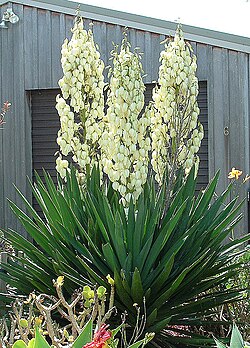
Usually trunkless, it is multisuckering with heads of 75 centimetres (30 inches) long, filamentous, blue-green, strappy leaves. Y. filamentosa is readily distinguished from other yucca species by white, thready filaments along the leaf margins.[5] Flower stems up to 3 metres (10 feet) tall bear masses of pendulous cream flowers in early summer.[6]

Taxonomy

[edit]

Y. filamentosa is closely related to Y. flaccida and it is possible they should be classified as a single species.[6]

Names

[edit]

Its common names include Adam's needle, common yucca, Spanish bayonet,[7] bear-grass, needle-palm, silk-grass, and spoon-leaf yucca.[8]

Distribution and habitat

[edit]

Yucca filamentosa is native from coastal Virginia south to Florida, and as far west as south and southeast Texas.[6] It has become naturalized along the Atlantic coastal plain north to Long Island Sound, and into areas of the lower Midwest. It is reportedly also naturalized in France, Germany, Italy and Turkey.[9]

In its native environment, Yucca filamentosa is most commonly found in sunny open areas in sandy soils, especially in beach scrub and sand dunes, but also in fields, barrens, and rocky slopes, though it grows well also in silt or clay soils. Normally Yucca filamentosa will spread horizontally across open sunny and dry areas, creating a dense thicket of sword like foliage. Yucca filamentosa is hardy to USDA zone 5 to 12.

Ecology

[edit]

The plants are pollinated by the yucca moth Tegeticula yuccasella.[10][11] Other moth species, such as Tegeticula intermedia, also use this yucca as a host plant to lay their eggs.[12]

Cultivation

[edit]

Y. filamentosa is widely cultivated in mild temperate and subtropical climates. A fairly compact species, it nevertheless presents a striking appearance with its sword-like leaves and dramatic flowerheads. It is naturally a focal point in the landscape, also providing a tropical touch in temperate gardens. It needs full sun and a well-drained soil, preferring an acid or slightly alkaline pH range of 5.5 to 7.5. It develops a large, fleshy, white taproot with deep lateral roots. Once planted and established, it is difficult to remove, as the roots keep sending up new shoots for many years. It is normally hardy down to −29 °C (−20 °F), or U.S. Department of Agriculture (USDA) hardiness zones of 5 to 9: UK H7).

Cultivars

[edit]

'Bright Edge', a dwarf cultivar with yellow-margined foliage and creamy flowers tinged with green, has gained the Royal Horticultural Society's Award of Garden Merit.[13][14] 'Color Guard', with broad yellow stripes all year plus red stripes in the winter, has also won the award.[15]

Other cultivars include:

  • 'Golden Sword' - with yellow centered leaves and green margins.[16]
  • 'Ivory Tower' - with larger, branched inflorescence.[17]

Uses

[edit]

Once the seeds have been removed, the fruits can be cooked and eaten. The large flower petals can also be eaten in salads.[18]

The leaves, stems and roots of this plant can be used to stun fish.[19] The Cherokee used it for this purpose.[20]

References

[edit]
[edit]
Revisions and contributorsEdit on WikipediaRead on Wikipedia
from Grokipedia
Yucca filamentosa, commonly known as Adam's needle, is a broadleaf shrub in the family, native to the . It forms dense basal rosettes of rigid, sword-shaped leaves that are grayish-green, up to 30 inches (76 cm) long and 3 inches (7.6 cm) wide, with sharp tips, marginal teeth, and distinctive curly white threads along the edges. In early to midsummer, mature plants produce tall, upright flower spikes reaching 4 to 8 feet high (occasionally up to 12 feet), bearing pendulous, bell-shaped creamy white flowers that are 2 to 3 inches long and attract and hummingbirds. The flowers give way to capsular fruits containing black seeds, and the plant spreads slowly via underground rhizomes or offsets. Native to sandy, rocky, or coastal habitats such as dunes, bluffs, open woodlands, and fields in hot, dry regions, Y. filamentosa thrives in well-drained, acidic to neutral soils and is highly tolerant of , , salt spray, and poor conditions. It is hardy in USDA zones 5 to 10 and prefers full sun, though it can adapt to , making it suitable for on slopes, borders, and seaside gardens. The plant's sharp leaves also provide resistance to deer and rabbits, enhancing its value in urban or wildlife-pressured landscapes. Historically, Native American tribes utilized Y. filamentosa for various purposes, including extracting strong fibers from the leaves to make cordage, baskets, and nets, while served as a source of for soap and medicinal salves, and the flowers were eaten or used in corsages. Today, it is widely cultivated as an ornamental for its striking architectural form and low-maintenance qualities, with achieved through seeds, root cuttings, or division of offsets; the spent flower stalks should be removed after blooming to maintain tidiness. The species is primarily pollinated by yucca moths, underscoring its ecological role in native ecosystems.

Botanical Characteristics

Description

Yucca filamentosa is an , acaulescent that forms dense basal rosettes of rigid leaves, typically reaching 0.5 to 1 meter in both height and width for the foliage clump. It spreads slowly via underground rhizomes, developing into small colonies through a multisuckering where offsets emerge from the . This trunkless maintains its foliage year-round, contributing to its structured, architectural appearance in natural settings. The leaves are sword-shaped, stiff, and linear, measuring 30 to 75 cm in length and 2 to 4 cm in width, with a blue-green to gray-green coloration. Each leaf features curly white filaments curling along the margins, a trait that distinguishes it from closely related species, along with fine marginal teeth and a sharp terminal spine. These adaptations enhance the plant's resilience in exposed environments. In summer, from to , the produces a tall, erect on a leafless stalk rising 1 to 3 meters above the rosette, bearing pendulous, bell-shaped flowers that are creamy white and 2.5 to 7.6 cm long. The flowers cluster in a loose , attracting pollinators with their nocturnal fragrance. Following , green capsules form, maturing to brown and containing numerous small black seeds dispersed by . Once established, Yucca filamentosa exhibits a multisuckering growth pattern that allows it to form expansive clumps over time, demonstrating high drought tolerance through its deep root system and succulent leaf tissues. As a long-lived perennial, it can persist for decades in suitable conditions.

Taxonomy

Yucca filamentosa is classified within the kingdom Plantae, phylum Tracheophyta, class Liliopsida, order Asparagales, family Asparagaceae, genus Yucca, and species filamentosa. This placement reflects its position among monocotyledonous flowering plants, specifically within the asparagus family, which encompasses various succulent and ornamental species. The species has several synonyms, including Yucca smalliana Fern. and Yucca filamentosa var. smalliana (Fern.) Ahles, which refer to variants distinguished by minor morphological differences but are now often subsumed under the typical form. Additionally, there is ongoing taxonomic debate regarding its distinction from , with some authorities proposing a merger into a single polymorphic species due to overlapping traits, while others, based on type locality examinations, maintain them as separate taxa. The genus name Yucca derives from the Spanish "yucca," itself borrowed from the word "yuca" for (Manihot esculenta), which Linnaeus misapplied to this unrelated genus due to superficial root similarities. The specific epithet filamentosa comes from the Latin "filamentum," meaning thread, alluding to the curly, thread-like appendages along the margins of its leaves. Common names for Yucca filamentosa include Adam's needle, Spanish bayonet, spoon-leaf yucca, and needle palm, with regional variants such as silk-grass or bear-grass reflecting its fibrous leaves historically used for cordage. Phylogenetically, Yucca filamentosa belongs to the Yucca within the and is closely related to species like and , as evidenced by chloroplast genome analyses showing shared evolutionary lineages in the subfamily. This positioning highlights its role in the broader diversification of yuccas, which exhibit complex hybridizations and host-specific mutualisms.

Geographic Range and Habitat

Native Distribution

Yucca filamentosa, commonly known as Adam's needle, is native to the (from and southeastern south to , west to and eastern , including and ) and parts of . This distribution primarily encompasses the and regions, where the plant forms part of the natural in open, disturbed areas. Populations are documented as stable, with no significant historical range contraction observed in botanical records; the species is assessed as Least Concern by the IUCN and Secure (G5) by NatureServe. Within its native range, Yucca filamentosa occurs in specific ecoregions such as sandhills, , and oak savannas, typically at elevations from to about 300 meters. These habitats reflect the species' adaptation to well-drained, sandy substrates in fire-prone landscapes. The species was first described by in 1753. Beyond its native distribution, Yucca filamentosa has been introduced and naturalized in parts of , including , , , and the , primarily through ornamental plantings dating back to the 17th and 18th centuries.

Habitat Requirements

Yucca filamentosa thrives in environments characterized by well-drained, nutrient-poor soils, particularly sandy or rocky substrates found in coastal and inland open areas. It prefers soils with an acidic to neutral range of 5.5 to 7.5 and avoids heavy clay or waterlogged conditions that can lead to root rot. This adaptation allows it to persist in thin, infertile soils such as those on bluffs, old fields, and dunes. The species is suited to warm temperate to subtropical climates prevalent in its native range, corresponding to USDA hardiness zones 5 to 10. It tolerates extreme temperatures from -29°C in winter to 40°C in summer, with full sun exposure being essential for optimal growth and flowering. Low humidity and minimal frost damage further define its climatic tolerances, enabling survival in both continental and coastal settings. Water requirements are minimal, as Yucca filamentosa exhibits high due to its thick rhizomatous that store water and nutrients. It flourishes in dry to mesic conditions and is fire-adapted in certain habitats, where periodic burns promote regeneration in sandy ecosystems. This resilience supports its presence in low-precipitation areas with infrequent watering needs once established. In natural settings, Yucca filamentosa often associates with open woodlands dominated by Pinus palustris or Quercus species, as well as scrub-pine forests and coastal dunes. It co-occurs with salt-tolerant vegetation in maritime environments, tolerating salt spray that limits competition from less hardy plants. These associations enhance its role in stabilizing sandy substrates and maintaining in fire-prone, disturbed landscapes.

Ecological Role

Pollination and Reproduction

Yucca filamentosa exhibits a specialized mutualism for with the yucca moth Tegeticula yuccasella, where female moths actively collect from the anthers of one flower using specialized maxillary tentacles, form it into a pollen ball, and deliberately deposit it onto the stigma of another flower while laying eggs in the . This ensures cross-, as the plant is self-compatible but selectively aborts fruits with high self- loads or excessive egg numbers to favor viable offspring. The larvae of T. yuccasella subsequently hatch and feed on a portion of the developing seeds, typically consuming 20-40% while leaving 60-80% intact and viable, thus sustaining both species in this co-evolved relationship. Flowering in Yucca filamentosa occurs primarily at night during late spring to summer, with synchronized to the nocturnal activity of T. yuccasella; the pendulous, cream-white flowers emit a mild fragrance to attract the s but produce no , as adult s do not feed and survive only briefly on stored energy. A secondary interaction involves the non-pollinating "cheater" Tegeticula intermedia, which oviposits into developing fruits without contributing to , potentially reducing seed set in infested capsules by competing for resources with T. yuccasella larvae. Despite occasional self-pollen deposition by pollinators, genetic analyses reveal predominantly outcrossed progeny due to the plant's post- selection mechanisms. Reproduction in Yucca filamentosa proceeds through both sexual and asexual means, with production yielding dehiscent capsules approximately 5-7 cm long that split open to release numerous small, black dispersed primarily by wind. These remain viable for 1-2 years and germinate within 1-2 months under warm (around 20-30°C), moist conditions following or soaking to soften the hard coat. Vegetatively, the plant spreads via rhizomatous roots that produce suckers and offshoots, forming dense clumps up to 1.5 m wide and enabling local colonization without reliance on pollinators.

Wildlife Interactions

Yucca filamentosa experiences herbivory primarily from deer and rabbits, which browse on its buds and tender leaves, though the plant's sharp, thread-like leaf margins deter most larger mammals from extensive feeding. These structural defenses reduce overall damage, making it relatively resistant to heavy browsing in natural settings. Rare insect pests include the yucca snout weevil (Scyphophorus yuccae), which bores into crowns and roots, and scale that suck from leaves, potentially weakening the plant under stress. The species provides valuable habitat structure in its native ecosystems, offering dense foliage cover for small mammals such as rabbits and rodents, as well as ground-nesting birds seeking protection from predators. While primarily pollinated by yucca moths, its flowers are occasionally visited by bees for pollen. Yucca filamentosa has low flammability due to its succulent leaves, reducing ignition risk in fire-prone habitats such as coastal pine savannas. Classified as Least Concern by the IUCN in , Yucca filamentosa maintains stable populations across its southeastern U.S. range, with no major widespread threats identified. However, localized habitat loss from coastal development poses risks in urbanizing areas, prompting recommendations for its use in restoring native grasslands and dunes to enhance . Knowledge gaps persist regarding potential impacts of , such as altered or range shifts, and ongoing studies assess its invasiveness in non-native regions where it may escape cultivation.

Cultivation Practices

Growing Conditions

Yucca filamentosa thrives in full sun, receiving at least six hours of direct daily, though it tolerates partial shade with sufficient air circulation to prevent stretching. It prefers well-drained that mimic its native sandy habitats, such as sandy loams or even rocky substrates, with a neutral range of 6.0 to 8.0, and it adapts to a variety of types including clay or alkaline conditions as long as drainage is excellent. This plant is well-suited for due to its exceptional once established, making it ideal for low-water landscapes. In terms of climate suitability, Yucca filamentosa is hardy in USDA zones 4 to 10, enduring , , and poor soils with minimal intervention. To aid initial establishment, apply a layer of around the base to retain , but avoid overwatering, as excess moisture can lead to in its succulent roots. For successful establishment, Yucca filamentosa in spring or fall to allow development before extreme temperatures, spacing rosettes 1 to 2 meters (3 to 6 feet) apart to accommodate their clumping growth habit. Provide weekly watering during the first until roots are established, then reduce to minimal supplemental , relying on natural rainfall. It is resilient to zone 4 winters when protected with mulching, and its low-growing form and make it suitable for urban green roofs in challenging environments.

Propagation and Care

Yucca filamentosa can be propagated primarily through division of offsets, which is the most reliable method for home gardeners. In spring, carefully separate the basal offsets or pups from the parent plant using a sharp , ensuring each division has roots attached, and replant immediately in well-drained ; this approach yields healthy clones true to the parent with minimal risk of transmission. Propagation from is also possible but slower, involving collection in autumn just before capsules open, followed by through soaking in warm water overnight to soften the hard seed coat, and optional cold stratification for 30 days at around 4°C to improve rates, which can reach 1-2 weeks at 28-32°C under moist conditions. Root cuttings taken in winter can be used rarely as an alternative, placed under intermittent mist for 10-14 weeks until rooting occurs, though success depends on maintaining consistent moisture levels around 70-90% relative humidity. Ongoing maintenance for cultivated plants involves minimal intervention to preserve their natural form and vigor. Annually prune away dead or damaged leaves at the base in late winter or early spring to prevent rot and improve air circulation, while removing spent flower stalks immediately after blooming to redirect energy to the rosette. Fertilize sparingly in spring with a low-nitrogen, balanced diluted to half strength, applied once every two years for established plants, as excessive nutrients can promote weak growth susceptible to pests. For pest management, scales and on foliage or stalks can be controlled effectively with applications of , sprayed weekly until infestation clears, avoiding chemical pesticides to protect pollinators. This plant's , derived from its native sandy, dry habitats, allows it to thrive with reduced watering after the first year. Common issues in cultivation often stem from environmental mismatches, such as overwatering, which leads to root and crown rot from soil-borne fungi like , manifesting as yellowing leaves and mushy bases—mitigate by ensuring excellent drainage and watering only when the top 5 cm of is dry. In exposed sites during extreme winters, leaf tips may brown; mulching young plants can provide protection. To prevent , divide clumps every 5-7 years in spring, replanting sections to maintain spacing and vitality. Once established after the second year, Yucca filamentosa requires low-maintenance care and tolerates neglect well, needing no routine watering or feeding in suitable conditions, though occasional thinning of offsets benefits airflow and prevents central die-back in dense clusters.

Cultivars

Yucca filamentosa has been the subject of extensive horticultural selection, resulting in numerous cultivars bred primarily for enhanced foliage coloration, compact growth habits, and improved hardiness in ornamental landscapes. These selections emphasize patterns, leaf texture, and overall size to suit various designs, available commercially from specialized nurseries. One prominent cultivar is 'Bright Edge', featuring sword-shaped leaves with distinctive bright yellow margins on a green base, forming compact, stemless clumps reaching approximately 0.6 m in height. This variety earned the Royal Horticultural Society's in 2002 for its reliable performance and ornamental appeal. 'Color Guard' stands out with its central creamy-yellow stripe contrasting against green leaf margins, growing to about 0.8 m tall and exhibiting strong resistance to pests and diseases. Introduced in the , it maintains vibrant coloration through seasons, with rose tints appearing in cooler months. The 'Golden Sword' displays bold with bright yellow centers that gradually fade to green edges on its linear leaves, attaining a of around 0.7 m while tolerating full sun without loss of striping. It also holds the Royal Horticultural Society's for its durability in dry conditions. Among more recent selections, offers blue-green leaves edged with curly white filaments for added texture, selected in the 2020s for its tidy, rounded habit and enhanced ornamental interest. Similarly, 'Ivory Tower' is noted for its tall inflorescences rising above rosettes of sword-like, blue-green foliage, providing dramatic vertical accent in mature plantings.

Human Uses

Ornamental Applications

Yucca filamentosa, commonly known as Adam's needle, serves as a striking accent plant in xeriscapes, borders, and rock gardens due to its bold, architectural form and drought tolerance. Its rosette of rigid, sword-like leaves provides a strong structural contrast against softer perennials, such as lavender or coreopsis, enhancing visual interest in low-water landscapes. This evergreen shrub's upright habit makes it ideal for creating focal points in sunny, well-drained sites, where its creamy white flower spikes add vertical drama in summer. In garden design, planting in masses emphasizes its fibrous leaf texture, while grouping it with ornamental grasses or succulents fosters a cohesive, drought-resistant composition suitable for modern minimalist or desert-themed gardens. It excels as a specimen in dry meadows or coastal plantings, where its resilience to poor soils and salt spray supports naturalistic arrangements. Designers recommend positioning it away from pathways to avoid contact with its sharp leaf tips, ensuring safe integration into broader schemes. Since 2020, Yucca filamentosa has gained popularity in sustainable landscaping for its low-maintenance qualities and role in water-conserving designs, as highlighted in recent guides. It is increasingly incorporated into gardens, supporting native yucca moths despite their specialized , and contributing to in eco-friendly yards. The species and cultivars like 'Bright Edge' and 'Color Guard' have received the Royal Horticultural Society's for their ornamental reliability and .

Traditional and Medicinal Uses

Native American tribes in the , including the , Catawba, Nanticoke, and , have historically utilized Yucca filamentosa for practical and healing purposes, as documented in ethnobotanical records from the . The plant's flowers and buds were consumed as food by indigenous groups, with petals eaten raw or cooked for their mild flavor, while immature fruits were boiled as a and seeds roasted or ground into . Southeastern tribes, such as the , also prepared flower stalks by harvesting them fully grown but before buds opened, incorporating them into diets as a seasonal resource. Medicinally, the roots, rich in saponins, were boiled or pounded to create a soapy lather used as shampoo or to wash fabrics, with the compounds providing cleansing and potential anti-fungal properties for skin care. Cherokee healers applied root decoctions externally to treat skin diseases, sores, and swellings, or used pounded roots as poultices for wounds and sprains; an infusion of the plant was employed to alleviate arthritis symptoms and as a sedative to induce sleep. The Catawba rubbed root preparations on the body for dermatological ailments, while the Nanticoke used it as an orthopedic aid. For crafts, the leaves' tough, curly filaments—derived from their fibrous structure—were stripped, twisted, or plied into durable cordage, serving as a historical substitute for among southeastern tribes like the and to make baskets, fishing nets, binding materials, and clothing. Additionally, communities incorporated the plant in ceremonial medicine and hunting practices, such as using root extracts to stun in . These applications, recorded in 19th- and early 20th-century ethnobotanical studies, reflect without modern pharmacological validation.

Industrial and Other Uses

The leaves of Yucca filamentosa contain strong, sisal-like fibers that can be extracted through processes such as or mechanical separation, yielding threads suitable for , , and cordage production. These fibers have been explored for limited commercial applications in the United States, primarily in small-scale or specialty manufacturing rather than large industrial operations. Additionally, the fibers can be pulped to produce , particularly for artisanal or specialty products like filter papers, due to their content and durability. Roots of Y. filamentosa are rich in steroidal saponins, which serve as natural surfactants and foaming agents in commercial extracts. These compounds have been incorporated into natural detergents and emulsifiers, leveraging their ability to reduce surface tension without synthetic additives, though commercial production focuses more on related species like Yucca schidigera with Y. filamentosa contributing to niche formulations. In environmental applications, Y. filamentosa is promoted for erosion control in sandy or dry soils, where its deep root system stabilizes slopes and prevents sediment runoff in xeriscaping and restoration projects. Y. filamentosa has a high air pollution tolerance index (APTI), making it suitable for planting in urban or industrial settings exposed to vehicular emissions. Historically, root saponins were used to stun fish in traditional fishing, but this practice is now obsolete due to ecological concerns. Economically, Y. filamentosa plays a minor role in the native industry, where it is propagated for ecological restoration and sustainable , supporting markets for erosion-control plantings and enhancement in sandy ecosystems.

References

Add your contribution
Related Hubs
User Avatar
No comments yet.