Hubbry Logo
ZerdavaZerdavaMain
Open search
Zerdava
Community hub
Zerdava
logo
8 pages, 0 posts
0 subscribers
Be the first to start a discussion here.
Zerdava
Zerdava
from Wikipedia
Zerdava
Other namesBlack Sea Spitz, Kapi Kopegi, Laz Kopegi, Gürcu Kopegi, Turkish Laika, Mekverna
Common nicknamesThe Gate Dog
OriginTurkey, Georgia
Traits
Weight Males 17 kg
Females 11–13 kg
Coat Double
Colour Solid liver, liver and white, liver roan
Litter size 5
Kennel club standards
Dog (domestic dog)

The Zerdava (Georgian: მეკვერნე) is an aboriginal laika dog breed native to the Black Sea region of Turkey and Georgia.[1][2] Zerdava are traditionally used as guard and hunting dogs and are especially prized for boar hunting.[3][2] The name “Zerdava” is Slavic for mustelid, possibly in reference to their Marten-brown color or their treeing behavior when hunting martens.[3]

History

[edit]

There exists very little written evidence on the origin of the Zerdava in Turkey and Georgia.[3][4] The most probable explanation is that hunting laika were acquired by trade from Russia, as Baltic and Black Sea ports were the primary routes of Russian Fur trade into Europe and parts of Asia though the early Middle Ages.[3] Zerdava have been documented in the Eastern Black Sea region for at least a hundred years, especially in the Trabzon and Giresun provinces of Turkey.[2]

Characteristics

[edit]
Native region of Zerdava dogs

Appearance

[edit]

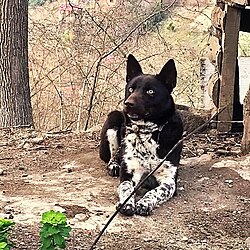
Zerdava are a spitz breed with a compact, athletic body, triangular, upright ears, and a curved tail.[3][5] They have a double coat that is always either solid liver brown or a combination of liver and white, such as liver and white-ticked, piebald, ticked, or liver roan.[3][5] The brown is described as marten-like in color. At birth, they are often nearly black in color and their white sections are without ticking. Zerdava have brown noses and yellow-brown eyes.[3] Their sickle shaped tails are usually white tipped and any brown spots will be the same shade of brown as the rest of their body.[2]

Two Zerdava in Turkey

Behavior

[edit]

As is typical with laikas, zerdava are hardy and versatile hunters, capable of hunting game of a variety of sizes; they are known to tree small game, stalk large prey silently until cornered, and work in teams to corner jackals, bear, and boar.[3][2] They are especially prized for their ability to avoid injury while hunting boar, a major pest to corn farmers.[3] Zerdava have had considerable success as search and rescue dogs.[2]

They are devoted to their humans and distrust strangers, earning them the nickname “the Gate Dog” for their excellent capabilities as a watchdog.[4][2] Puppies need considerable socialization with people to avoid overly shy or aggressive behavior. Zerdava often struggle with being rehomed and will try to escape and find their original owner.[3]

Zerdava in Trabzon, Turkey

Starting in 2016, Turkish Armed Force has been training Zerdava for a variety of military uses including bomb and narcotic detection, search and rescue, and personnel detention.[6]

Health

[edit]

Zerdava are prized for their excellent health in harsh conditions with minimal care. Like other laika, it is more common for the females to go into estrus only once a year.[3]

The population in Georgia is critically endangered due to frequent inbreeding. There are estimated to only be 15–20 purebred dogs left, with experts agreeing that the only way to stabilize the population is by importing dogs from Turkey.[1]

References

[edit]
Revisions and contributorsEdit on WikipediaRead on Wikipedia
from Grokipedia
The Zerdava is a rare aboriginal dog breed native to the Black Sea region of and Georgia, particularly around in Turkey, and is classified as a laika-type with ancient roots possibly linked to northern Eurasian dogs. Known as მეკვერნე in Georgia, it is traditionally employed by local shepherds for boar, foxes, and —where it exhibits treeing behavior and acts as a barking pointer—as well as guarding and properties against predators, the breed is prized for its agility, loyalty, and strong protective instincts. Physically, Zerdava dogs are medium-sized, with males typically weighing around 16 kg and standing 48 cm at the , featuring a compact athletic build, triangular upright ears, a curled , and a double coat in shades of often accented with markings. Genetically distinct from other Turkish , they show low phenotypic variation and derive primarily from two maternal lineages, supporting their status as a unique local genetic resource at risk of without conservation efforts. Since 2013, organizations such as the Zerdava Dog Association have advocated for official recognition and protection to preserve this culturally significant , which matures around and remains aloof toward strangers while affectionate with .

History and Origins

Geographical Origins

The Zerdava is native to the coastal regions, primarily the provinces of Trabzon and , as well as , , and , in northeastern , where it has been raised for generations in local communities. These areas form part of the Eastern Black Sea Region, encompassing rugged terrains that extend to adjacent zones in Georgia along the international border. The environmental context of these origins features mountainous and forested landscapes with steep, rocky s, supporting dense vegetation and diverse wildlife. The climate is mild yet damp overall, marked by harsh winters with snowfall in higher elevations and warm, humid summers along the coast, conditions that have shaped the breed's foundational adaptations to the local ecosystem. Historical trade routes along Black Sea ports, including as a key harbor, facilitated the introduction of Laika-type ancestors from through networks like the Fur Road during the Byzantine, Seljuk, and Ottoman periods.

Historical Development

The dog breed likely traces its ancestry to Northern Laika dogs introduced through trade routes connecting and the Black Sea region during the , including the Byzantine and Seljuk periods, when exchanges along the "Fur Road" facilitated the movement of dogs from and northern into . These influences contributed to the breed's spitz-type morphology and behavioral traits adapted for and guarding. Historical records indicate that Zerdava dogs have been utilized in and Georgia for at least 100 years, in roles such as hunting and protecting livestock in the Eastern provinces such as and . Trade continued into the Ottoman era and persisted until the mid-20th century, when geopolitical changes like the disrupted these exchanges, allowing local populations to evolve independently. The Zerdava emerged as a distinct aboriginal through and geographic isolation in the mountainous Black Sea region, where environmental pressures and limited interbreeding preserved recessive traits like coat patterns while differentiating it from formalized modern programs. This development, separate from initiatives elsewhere, underscores its status as a population shaped by centuries of adaptation to local hunting needs.

Description

Physical Appearance

The Zerdava is a medium-sized, spitz-type characterized by a compact, athletic build that reflects its adaptation to rugged, mountainous terrain around the Black Sea region. It exhibits square , with body length slightly exceeding height at the , typically measuring about 48 cm on average, and a deep, wide chest that provides stability and endurance. The breed's agile limbs and firm musculature support its historical roles in and guarding, contributing to an overall balanced and sturdy frame without excess bulk. Distinct traits are prominent in the Zerdava's head and tail. The head is triangular with upright, erect ears that are small and nearly equilateral in shape, enhancing alertness and hearing in varied environments. The tail is sickle-shaped and curls inward over the back, often with longer, thicker hairs on the underside, adding to the breed's expressive . The muzzle is moderately tapered. The Zerdava possesses a dense double suited for weather resistance, consisting of a thick undercoat and longer, stiff guard hairs that form a ruff around the neck and shoulders. Coat colors are predominantly liver , ranging from light to dark , often combined with markings such as ticking, patterns, or spots on the legs and tail tip. Males average around 17 kg, while females weigh 11-13 kg, underscoring the breed's moderate size and proportional athleticism.

Temperament and Behavior

The Zerdava possesses a brave, loyal, and independent , marked by fearlessness, protectiveness, and a stubborn streak that can manifest as petulance. These dogs are highly alert and exhibit strong territorial instincts, making them exceptional guard dogs that remain devoted to their families while remaining aloof and distrustful toward strangers. Their affectionate nature toward owners is tempered by a potential for if not properly socialized, underscoring the need for early to mitigate or overprotectiveness. As versatile hunters, Zerdavas excel at pursuing boar and small game such as and foxes, as well as deterring bears, often working in small packs to track and corner prey with silent efficiency before engaging through barking or biting. They display classic behavior when pursuing arboreal animals like martens or squirrels, cornering them in trees until the hunter arrives, and demonstrate impressive endurance in rugged, harsh terrains of the Black Sea region. This hunting prowess stems from their agile, athletic build, which enables them to evade injuries during confrontations with large, dangerous game like . In contemporary roles, Zerdavas contribute to search-and-rescue operations and have been reported in use by the , as of 2020, for various military tasks due to their intelligence and adaptability to demanding environments. Highly trainable for specialized work, they nonetheless demand experienced handlers to manage their independent and occasionally willful disposition, ensuring effective performance without behavioral challenges.

Reproduction and Health

Breeding and Reproduction

The Zerdava, an aboriginal native to the Black Sea region, exhibits a reproductive cycle adapted to its seasonal environment, with females typically experiencing estrus once per year, in contrast to the biannual cycles common in most canine breeds. This pattern aligns with the breed's historical role in and guarding within forested, temperate habitats of Turkey and Georgia. Historically, Zerdava breeding has been largely unmanaged by local communities, relying on natural pairings that have preserved genetic purity, as evidenced by the stable recessive liver-brown coat color and low phenotypic variation. However, this approach has contributed to challenges from the breed's low population numbers, including that reduces conception rates and increases stillbirths. The average litter size is five puppies, with most females producing one litter annually. To sustain the breed's distinctive traits, such as its medium size and variations, experts recommend controlled breeding programs that select non-related individuals based on morphological standards and pedigrees, while strictly avoiding crossbreeding with other types to prevent dilution of aboriginal characteristics. Such practices, including keeping estrus females with selected males for several days during , help mitigate genetic bottlenecks.

Health Concerns

The Zerdava is generally regarded as a robust and hardy breed, well-adapted to extreme weather conditions in its native Black Sea region, with few breed-specific diseases reported owing to its aboriginal purity and minimal interference. Veterinary sources indicate no tightly associated genetic conditions, attributing this resilience to the breed's primitive lineage and in harsh mountainous environments. Routine veterinary care focuses on preventive measures rather than chronic , including vaccinations, parasite control, and dental to support overall vitality. The primary health concern for the Zerdava stems from due to its critically small population, which heightens risks of reduced fertility, weakened immune function, and subtle hereditary vulnerabilities. This endangerment arises from limited gene pools and historical isolation, potentially exacerbating issues like lower litter viability despite the breed's otherwise strong reproductive health, including an annual estrus cycle in females. Responsible breeding practices, such as genetic screening and where feasible, are recommended to mitigate these effects and preserve the breed's . Essential routine maintenance includes regular coat brushing to manage their double-layered fur and prevent matting, particularly during seasonal shedding, as well as daily exercise to maintain and avoid in this active working . Owners should monitor for minor issues like cracking or dryness in arid or extreme climates, treatable with moisturizers and protocols.

Conservation

Population Status

The Zerdava faces critical endangerment in Georgia, where frequent within isolated populations has resulted in very few individuals remaining. This low number heightens risks of genetic bottlenecks and associated health issues, such as reduced vitality and increased susceptibility to diseases. In Turkey's Black Sea provinces, particularly and , Zerdava populations are larger relative to Georgia but remain rare and localized, confined primarily to rural, traditional communities without formal breeding programs. There is no official global registry for the breed, reflecting its status as an underdocumented . The breed's overall decline stems from urbanization eroding rural habitats, the diminishing need for traditional guardian and hunting roles amid modern livestock practices, and absence of recognition by major international kennel clubs like the Fédération Cynologique Internationale. These factors have led to ad hoc breeding, crossbreeding with imported varieties, and high mortality rates from environmental threats and diseases.

Preservation Efforts

In , the Trabzon Zerdava Köpeği Derneği, established in 2013 under the leadership of Serdar Ergün, has led efforts to register the Zerdava as an official breed and promote breeding of pure lines to prevent extinction. As of 2017, the association maintained a stock of approximately 30 breeding dogs and collaborated with for DNA analyses, which in 2016 confirmed the breed's genetic distinctiveness and purity. Calls for official protection intensified in 2017, with petitions urging Turkish authorities to grant the Zerdava endangered status and include it in national standards to safeguard its future. These initiatives highlight the breed's vulnerability due to declining traditional uses and crossbreeding, emphasizing the need for standardized registration to ensure controlled reproduction. Since 2016, the have contributed to preservation through a and program at the Dog Production and Training Battalion in , adapting Zerdavas for military roles such as mine detection, narcotics operations. This program sources dogs primarily from , producing litters for deployment and thereby supporting population maintenance via structured breeding. Internationally, primitive dog societies have shown interest in the Zerdava, recognizing it as a spitz-type akin to northern Laikas and advocating for its conservation through genetic studies and natural breeding practices to retain ancestral traits. The Primitive and Aboriginal Dogs Society, for instance, has documented the breed's biocultural value and recommended measures like interbreeding controls to mitigate .
Add your contribution
Related Hubs
User Avatar
No comments yet.