Hubbry Logo
Adherens junctionAdherens junctionMain
Open search
Adherens junction
Community hub
Adherens junction
logo
8 pages, 0 posts
0 subscribers
Be the first to start a discussion here.
Adherens junction
Adherens junction
from Wikipedia
Adherens junction
Details
Identifiers
Latinjunctio adhaesionis
MeSHD022005
THH1.00.01.1.02002
FMA67400
Anatomical terminology
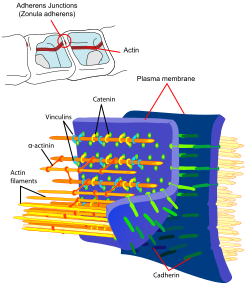
Principal interactions of structural proteins at cadherin-based adherens junction. Actin filaments are associated with adherens junctions in addition to several other actin-binding proteins such as vinculin. The head domain of vinculin associates to E-cadherin via α-, β - and γ -catenins. The tail domain of vinculin binds to membrane lipids and to actin filaments.

In cell biology, adherens junctions (or zonula adherens, intermediate junction, or "belt desmosome"[1]) are protein complexes that occur at cell–cell junctions and cell–matrix junctions in epithelial and endothelial tissues,[2] usually more basal than tight junctions. An adherens junction is defined as a cell junction whose cytoplasmic face is linked to the actin cytoskeleton. They can appear as bands encircling the cell (zonula adherens) or as spots of attachment to the extracellular matrix (focal adhesion).

Adherens junctions uniquely disassemble in uterine epithelial cells to allow the blastocyst to penetrate between epithelial cells.[3]

A similar cell junction in non-epithelial, non-endothelial cells is the fascia adherens. It is structurally the same, but appears in ribbonlike patterns that do not completely encircle the cells. One example is in cardiomyocytes.

Proteins

[edit]

Adherens junctions are composed of the following proteins:[4]

  • cadherins. The cadherins are a family of transmembrane proteins that form homodimers in a calcium-dependent manner with other cadherin molecules on adjacent cells.
  • p120 (sometimes called delta catenin) binds the juxtamembrane region of the cadherin.
  • γ-catenin or gamma-catenin (plakoglobin) binds the catenin-binding region of the cadherin.
  • α-catenin or alpha-catenin binds the cadherin indirectly via β-catenin or plakoglobin and links the actin cytoskeleton with cadherin. Significant protein dynamics are thought to be involved.[5]

Models

[edit]

Adherens junctions were, for many years, thought to share the characteristic of anchor cells through their cytoplasmic actin filaments.[citation needed]

Adherens junctions may serve as a regulatory module to maintain the actin contractile ring with which it is associated in microscopic studies.[citation needed]

See also

[edit]

References

[edit]
[edit]
Revisions and contributorsEdit on WikipediaRead on Wikipedia
from Grokipedia
Adherens junctions are specialized multiprotein complexes that mediate calcium-dependent cell-cell adhesion in epithelial and other tissues, linking the actin cytoskeletons of adjacent cells to maintain tissue integrity, regulate morphogenesis, and coordinate intracellular signaling. These junctions form belt-like structures, known as the zonula adherens in epithelial cells, positioned just below tight junctions to provide mechanical stability and polarity to tissues. Composed primarily of classical cadherins such as E-cadherin, adherens junctions enable homophilic interactions between extracellular domains of cadherins on neighboring cells, while their intracellular tails associate with catenins to anchor the complex to the actin cytoskeleton. Adherens junctions were first identified in the 1960s through electron microscopy studies of epithelial tissues, revealing them as distinct belt-like adhesions below tight junctions; their molecular components, including cadherins and catenins, were elucidated in the late , with key discoveries in the and 1990s linking them to and signaling pathways. The core molecular architecture revolves around the cadherin-catenin complex, enabling adhesive and cytoskeletal connections, with additional components like nectins contributing to assembly. Beyond structural roles, adherens junctions serve as dynamic hubs for signaling and regulation, integrating mechanical cues with pathways like Wnt (via β-catenin) to control cell behavior; recent research as of 2025 has further illuminated mechano-transduction mechanisms and novel regulators enhancing junction stability under tension. Disruptions in adherens junctions, often due to loss or catenin dysregulation, are implicated in epithelial-to-mesenchymal transition and diseases like cancer, underscoring their critical role in tissue homeostasis.

Introduction

Definition and Characteristics

Adherens junctions (AJs) are specialized cell-cell adhesion structures that link the cytoskeletons of adjacent cells through cadherin-mediated contacts, forming multi-protein complexes essential for tissue . These junctions mediate homotypic adhesion between cells of the same type, enabling the mechanical coupling required for coordinated cellular behavior across diverse tissues. Key characteristics of AJs include their variable distributions, appearing as continuous belt-like (zonula adherens) formations encircling epithelial cells or as discrete spot-like (puncta adherens) structures in other cell types, such as neurons or mesenchymal cells. Adhesion at AJs is calcium-dependent, as extracellular calcium ions stabilize the homophilic interactions between molecules on opposing cell surfaces, promoting junctional integrity. These features allow AJs to play a critical role in maintaining tissue architecture by transmitting mechanical forces and supporting . In the epithelial junctional complex, are positioned subapically, immediately below tight junctions, where they contribute to mechanical strength by anchoring the cytoskeleton, while desmosomes, located more basally, provide additional reinforcement through intermediate filaments. This stratification ensures a of and barrier functions, with AJs offering dynamic tensile strength superior to desmosomes in response to cytoskeletal tension but inferior to the sealing properties of tight junctions. AJs exhibit evolutionary conservation across metazoans, with the core cadherin-catenin adhesome present from sponges to vertebrates, underscoring their ancient role in multicellularity and tissue formation.

Historical Discovery

The adherens junction was initially observed in the mid-20th century through pioneering electron microscopy studies of epithelial tissues. In the , early ultrastructural analyses by researchers such as Keith R. Porter and others revealed specialized regions of cell-cell contact in epithelia, including belt-like adhesions associated with cytoplasmic filaments. By the early , Marilyn G. Farquhar and George E. Palade provided a detailed description of the zonula adherens (now known as the adherens junction) as the intermediate component of the tripartite epithelial junctional complex, positioned between the (zonula occludens) and the (macula adherens or spot desmosome). Their work, based on thin-section electron microscopy of and intestinal epithelia, highlighted its morphology as a continuous band of membrane apposition linked to a dense undercoat of filaments. During the 1970s, the adherens junction received formal naming and classification within the broader framework of intercellular junctions. L. Andrew Staehelin, in a comprehensive 1974 review, categorized adherens junctions (referred to as belt desmosomes) as actin-linked adhesions distinct from intermediate filament-anchored spot desmosomes and the sealing tight junctions, emphasizing their role in maintaining epithelial cohesion as part of the junctional complex. This classification built on earlier ultrastructural data and integrated functional insights from freeze-fracture techniques, which revealed intramembranous particle arrangements at these sites. Staehelin and collaborators, including Barbara E. Hull, further popularized the term in accessible syntheses, such as their 1978 article, solidifying adherens junctions as a key element of multicellular organization. Early experimental evidence for the functional properties of adherens junctions emerged in the 1970s through studies demonstrating their calcium dependence. Masatoshi Takeichi's 1977 experiments with dissociated lung cells (V79 line) showed that cell aggregation is disrupted in calcium-free or EDTA-containing media but rapidly restored upon calcium readdition, indicating a specific calcium-dependent mechanism distinct from other divalent cation-dependent processes. These findings, using quantitative aggregation assays, established adherens junctions as mediators of this reversible , with surface protein involvement inferred from sensitivity and metabolic labeling. A pivotal milestone occurred in the 1980s with the identification of as the molecular basis of adherens junctions. Building on his earlier adhesion work, Takeichi's group identified a 124-kDa from teratocarcinoma cells in 1982, which was later recognized as E-cadherin (also known as uvomorulin and cell-CAM 120/80) and shown to drive calcium-dependent homophilic binding essential for junction formation. By the mid-1980s, biochemical purification and functional reconstitution experiments confirmed ' transmembrane role in linking extracellular adhesion to intracellular via catenins, transforming adherens junctions from ultrastructural observations to molecular entities. Takeichi coined the term "cadherin" in 1987 to unify this growing family of adhesion molecules.

Molecular Structure

Transmembrane Components

The primary transmembrane components of adherens junctions are classical , which serve as calcium-dependent receptors mediating homophilic interactions between adjacent cells. These proteins consist of an extracellular region with five cadherin (EC) repeats (EC1–EC5), a single that anchors the molecule in the plasma membrane, and a conserved cytoplasmic tail. The extracellular domains facilitate cell-cell through trans interactions, where the N-terminal EC1 domain of one cadherin engages in strand-swapped dimerization with the EC1 domain of an opposing cadherin on a neighboring cell, primarily involving a conserved residue (Trp2) that inserts into a hydrophobic pocket on the partner molecule. Among classical cadherins, E-cadherin (also known as ) is predominantly expressed in epithelial tissues, where it forms the core of adherens junctions to maintain tissue integrity, while N-cadherin (cadherin-2) is mainly found in neurons, mesenchymal cells, and , supporting in these non-epithelial contexts. These cadherins exhibit distinct homophilic binding affinities, with N-cadherin forming dimers of higher affinity (K_d ≈ 22.6 μM at 37°C) compared to E-cadherin (K_d ≈ 160 μM at 37°C), influencing the strength and specificity of cell-cell contacts in different tissues. The cytoplasmic tail of cadherins briefly links to intracellular partners like catenins for further anchoring. Adhesion by cadherins is strictly calcium-dependent, as Ca²⁺ ions bind to specific sites between the EC domains (particularly between EC1 and EC2), rigidifying the flexible extracellular "arms" and enabling proper alignment for homophilic binding; in the absence of Ca²⁺, the domains adopt a floppy conformation that disrupts adhesion. This calcium modulation is essential for the dynamic assembly of adherens junctions, with removal of Ca²⁺ leading to rapid disassembly (e.g., half-time of ~0.6 s for N-cadherin). To form stable junctions, s undergo lateral cis-interactions within the same , where EC domains (notably EC1–EC3) associate in a zipper-like manner to cluster hundreds of molecules into organized arrays, enhancing the of trans adhesions and promoting junction maturation. These cis clusters create a lattice that resists mechanical forces and supports tissue cohesion.

Cytoplasmic and Cytoskeletal Components

The cytoplasmic components of adherens junctions primarily consist of catenins, which serve as intracellular linkers connecting transmembrane cadherins to the . Beta-catenin, an repeat protein, directly binds to the cytoplasmic tail of classical cadherins via its domain, stabilizing the adhesion complex and facilitating intracellular signaling. Alpha-catenin, in turn, associates with the C-terminal region of beta-catenin and interacts with F- filaments, thereby anchoring the junction to the cortical and enabling mechanical force transmission.01175-X) P120-catenin, another family member, binds to the juxtamembrane domain of cadherins, promoting their stabilization at the plasma membrane and preventing their endocytosis.00608-4) Actin-binding proteins further reinforce this linkage by recruiting and organizing cytoskeletal elements at the junction. , an -crosslinking protein, binds to alpha-catenin in a force-dependent manner, adopting an open conformation that enhances its affinity for F-actin and contributes to junction reinforcement under tension. Alpha-actinin, a bundling protein, associates with alpha-catenin to crosslink actin filaments, supporting the structural integrity of the perijunctional actin belt.00974-8) Afadin, particularly in nectin-afadin complexes that colocalize with cadherin-based adhesions, binds actin via its C-terminal domain and aids in cytoskeletal anchorage, often in coordination with other junctional proteins. Armadillo family proteins, including beta-catenin and p120-catenin, play a central role in force transmission by forming dynamic complexes that respond to mechanical stress. Beta-catenin can directly interact with through a specific in its N-terminal region, providing an alternative pathway for force propagation to the when alpha-catenin levels are low, as demonstrated in epithelial cells where this interaction restores junctional tension. This mechanism ensures robust mechanotransduction, with single-molecule studies showing the beta-catenin-vinculin complex capable of withstanding forces up to 16 pN. Recent proximity proteomics studies have identified novel interactors in afadin-associated complexes, expanding our understanding of cytoplasmic . For instance, bioID-based mapping in junctional environments revealed PAK4 as a key afadin-proximal protein, alongside nectins and ZO-1, forming a subcompartment that supports organization independently of classical cadherin-catenin linkages. These findings, corroborated in 2025 analyses of multivalent afadin interactions, highlight intrinsically disordered regions in afadin that promote condensate formation with cytoskeletal partners, enhancing junctional stability.

Assembly and Regulation

Formation Processes

The formation of adherens junctions begins with the initial contact between adjacent cells, mediated by the extracellular domains of classical cadherins, such as E-cadherin, which engage in calcium-dependent homophilic interactions primarily through their EC1 domains. These interactions form weak, transient adhesions at sites of cell-cell contact, often initiated by protrusions like lamellipodia or that bring opposing membranes into proximity, allowing cadherins to recognize and bind partner molecules on neighboring cells. This step establishes the foundational adhesive bonds without immediate cytoskeletal involvement, relying on the strand-swapping mechanism for trans-dimer formation with a around 100 µM. Following initial contact, lateral clustering of cadherins occurs through cis-interactions between their extracellular domains, promoting the of intracellular partners like p120-catenin and β-catenin to the cadherin cytoplasmic tails. β-Catenin bridges cadherins to α-catenin, which in turn connects to the , often via intermediary proteins such as EPLIN, thereby stabilizing the nascent junction and initiating to the contact site. This phase transforms scattered molecules into organized clusters, enhancing strength and preparing the junction for further reinforcement. Junction maturation involves polymerization to form a circumferential actin belt and II-mediated contraction, which compacts and strengthens the structure. filaments polymerize at the junctional site, driven by nucleation, while non-muscle II generates contractile forces that align and tension the network, leading to a mature, belt-like adherens junction capable of withstanding mechanical stress. This process integrates the transmembrane cadherins with the cortical cytoskeleton, completing the assembly into a robust intercellular anchor. Two prominent models explain cadherin clustering during assembly: the cadherin zipper model and the diffusion-trap hypothesis. In the zipper model, initial trans-adhesive bonds propagate laterally like a , with sequential cis- and trans-interactions forming linear arrays of that expand the junctional contact. The diffusion-trap hypothesis posits that freely diffusing are captured and immobilized at the contact site by initial adhesions and linkages, gradually accumulating into stable clusters without requiring ordered propagation. These models highlight the cooperative roles of adhesive and cytoskeletal dynamics in adherens junction formation.

Dynamic Regulation

Adherens junctions () exhibit dynamic behavior essential for maintaining tissue plasticity, with their stability and remodeling governed by post-formation modifications and environmental cues. These processes involve phosphorylation-mediated disassembly, endocytic turnover, cytoskeletal rearrangements, and responses to extracellular ions, allowing to adapt to cellular needs such as migration and tissue morphogenesis. Tyrosine phosphorylation of β-catenin by Src family kinases represents a primary mechanism for AJ disassembly. Src kinases phosphorylate β-catenin at specific residues, such as Y654, which disrupts its binding to E-cadherin and α-catenin, thereby weakening the linkage between cadherins and the actin cytoskeleton. This event, often triggered by growth factors like EGF or HGF, promotes the dissociation of β-catenin from the AJ complex and facilitates its translocation to the cytoplasm or nucleus, leading to reduced cell-cell adhesion. In endothelial cells, Src-mediated of VE- at Y658 similarly uncouples p120-catenin, initiating junction breakdown. Seminal studies have established that such modifications are critical for pathological processes like epithelial-mesenchymal transition, where increased Src activity correlates with AJ disruption. Endocytosis and intracellular trafficking further regulate AJ turnover by controlling cadherin levels at the plasma membrane. Clathrin-mediated of , such as E-cadherin and , is primarily modulated by p120-catenin, which binds the juxtamembrane domain of to mask endocytic signals and inhibit internalization. In the absence of p120-catenin, undergoes rapid clathrin-dependent , leading to lysosomal degradation and AJ destabilization; experiments using IL-2R- chimeras demonstrated a threefold increase in internalization rates without p120 binding. This allows for dynamic recycling of , with p120-catenin acting as a retention signal to stabilize surface pools and maintain junction integrity during steady-state conditions. Rho , particularly RhoA and Rac1, orchestrate dynamics to strengthen or remodel . RhoA activation promotes actomyosin contractility and formation, which anchors to the and enhances junctional tension for stability. Conversely, Rac1 drives at junctions via effectors like formin-like 2 (FMNL2), facilitating the assembly of cortical bundles that support AJ reinforcement during . p120-catenin modulates these by sequestering them in the when unbound to s, reducing RhoA activity by up to 45% and increasing Rac1 by approximately twofold, thereby balancing disassembly and strengthening; engagement shifts this equilibrium to favor junctional reinforcement. Environmental factors like extracellular calcium and profoundly influence AJ integrity. Calcium ions (>1 mM) stabilize by promoting trans-dimerization of cadherins, enhancing homotypic E-cadherin binding affinity by over tenfold and supporting actin linkage for robust adhesion. Low calcium levels (<0.1 mM) induce cis-dimer formation and junction disassembly, mimicking conditions during epithelial remodeling. Acidic extracellular (e.g., 6.6) disrupts AJs by activating Src kinases, leading to phosphorylation of E-cadherin and p120-catenin, subsequent ubiquitination via Hakai, and proteasomal/lysosomal degradation, resulting in discontinuous E-cadherin staining at cell contacts. These ionic cues thus serve as rapid modulators of AJ dynamics in response to physiological or pathological environments.

Functions

Cell Adhesion and Tissue Integrity

Adherens junctions function as primary mechanical anchors in epithelial tissues, enabling the transmission and distribution of tensile forces between adjacent cells. By linking the extracellular -mediated adhesions to the intracellular actin cytoskeleton via adaptor proteins such as α-catenin and β-catenin, these junctions allow forces generated by actomyosin contractility to propagate across multicellular sheets, thereby maintaining structural cohesion under physiological stresses. This force transmission is essential for coordinating cellular behaviors in epithelia, where intercellular tensions can reach forces on the order of piconewtons per bond, as measured in model systems like . In addition to force distribution, adherens junctions play a critical role in preserving epithelial barrier integrity, particularly during dynamic processes like . They stabilize cell-cell contacts to prevent gaps in the epithelial monolayer, ensuring the sheet remains impermeable to external agents while accommodating shape changes in developing tissues. For instance, in epithelial remodeling events, adherens junctions dynamically reorganize to support tissue folding and extension without compromising . This maintenance is vital for processes such as wound closure, where junctional integrity resists shear forces and sustains collective . Adherens junctions also exhibit adaptive responses to mechanical stress through reinforcement mechanisms involving actomyosin contractility. When subjected to external loads, such as tensile forces from neighboring cells or substrates, myosin II activation increases cortical tension, recruiting additional filaments and stabilizing proteins to the junctional complex, thereby enhancing its resistance to deformation. This feedback loop, observed in epithelial monolayers under , scales junctional strength proportionally to applied forces, preventing rupture and promoting tissue resilience. Tissue-specific adaptations in adherens junctions include variations in their density and prominence across epithelial types, reflecting functional demands. In simple epithelia, such as those lining the intestines, adherens junctions are densely distributed and provide the dominant adhesive force due to fewer desmosomes, ensuring robust in dynamic environments. Conversely, in stratified epithelia like the , adherens junctions are more evenly layered but less dense per cell layer, complementing abundant desmosomes to balance flexibility and strength in mechanically stressed, multilayered tissues. These differences allow epithelia to tailor junctional architecture to specific mechanical contexts, such as high-friction surfaces in the skin.

Intracellular Signaling

Adherens junctions (AJs) integrate with the canonical primarily through β-catenin, which serves dual roles in and . In the absence of Wnt ligands, β-catenin binds to the cytoplasmic tail of cadherins at AJs, linking them to the actin cytoskeleton while remaining susceptible to phosphorylation by the destruction complex (comprising Axin, , GSK3β, and CK1), leading to its ubiquitination and proteasomal degradation. Upon Wnt ligand binding to and LRP5/6 receptors, the destruction complex is disassembled, stabilizing β-catenin and allowing its release from AJs. The stabilized β-catenin then accumulates in the and translocates to the nucleus, where it interacts with TCF/LEF transcription factors to activate target genes such as c-Myc, , and MMP7, thereby promoting , differentiation, and survival. AJs also coordinate with planar cell polarity (PCP) signaling to establish tissue-level polarity, mediated by interactions with core PCP proteins. The atypical Celsr1, a key PCP component, localizes to AJs via association with in endothelial cells, where it regulates the dynamics of adherens junctions to facilitate directed cell rearrangements. Specifically, Celsr1 inhibits stabilization and junction maturation, enabling dynamic extension and 90-degree cell reorientation during processes like lymphatic valve . Similarly, the PCP effector Vangl2 modulates E- trafficking and stability, ensuring asymmetric distribution of polarity cues across the tissue plane. These interactions allow PCP signaling to influence cytoskeletal organization and collective without disrupting basal adhesion. Engagement of E-cadherin at AJs exhibits crosstalk with growth factor receptors, notably inhibiting (EGFR) signaling to maintain epithelial . Homophilic E-cadherin ligation sequesters EGFR at cell-cell contacts, reducing its lateral mobility and ligand-binding capacity, which in turn suppresses EGFR autophosphorylation and downstream activation of the MAPK/ERK pathway. This inhibition occurs independently of β-catenin and involves direct physical association between E-cadherin and EGFR, as well as decreased receptor , thereby limiting proliferative signals in confluent epithelia. Loss of E-cadherin function, as seen in early epithelial-mesenchymal transitions, relieves this restraint, enhancing EGFR-driven proliferation. Beyond β-catenin, other AJ proteins exhibit nuclear translocation to modulate , with recent studies highlighting dynamic shuttling mechanisms. Stabilized β-catenin enters the nucleus via importin-11 (IPO11)-mediated transport in certain contexts, such as APC-mutated cells, where it not only drives Wnt targets but also interacts with additional factors like to fine-tune transcriptional outputs. Afadin, a nectin-binding scaffold at AJs, has been observed in the nucleus, though its functions there remain less defined; it may contribute to gene regulation by associating with Rap1 and influencing polarity-related transcription. These nuclear roles, particularly for β-catenin, underscore AJs as signaling hubs that extend beyond the plasma membrane to impact cellular fate decisions.

Pathological and Developmental Roles

Involvement in Diseases

Dysfunction of adherens junctions, particularly through the loss or downregulation of E-cadherin, plays a central role in cancer progression by facilitating epithelial-mesenchymal transition (EMT), a process that enhances tumor cell motility and invasiveness, thereby promoting . In , reduced E-cadherin expression is a hallmark of EMT, correlating with increased metastatic potential as tumor cells dissociate from primary sites and acquire migratory properties. Similarly, in , diminished E-cadherin levels serve as a prognostic , with low expression associated with advanced stages, lymph node involvement, and distant metastasis, underscoring its role in disrupting cell-cell adhesion and enabling tumor dissemination. In (IBD), adherens junction disruption contributes to intestinal barrier dysfunction, leading to increased permeability and leakage of luminal contents into the mucosa, which exacerbates chronic inflammation. Cytokine-driven remodeling of adherens junctions, including altered localization of E-cadherin and associated proteins, compromises epithelial integrity in conditions like and , allowing bacterial translocation and immune activation. This barrier leakage is further evidenced by studies showing that pro-inflammatory signals directly impair adherens junction assembly, perpetuating the cycle of tissue damage in IBD. Germline mutations in the CDH1 gene, which encodes E-cadherin, are the primary cause of hereditary diffuse gastric cancer (HDGC), an aggressive familial syndrome characterized by early-onset diffuse-type gastric due to impaired and tumor suppression. These inactivating mutations disrupt adherens junction formation, leading to loss of and increased susceptibility to , with recent estimates of lifetime risk for advanced gastric cancer around 10% (95% CI 6-24%) for men and 7% (95% CI 4-15%) for women carrying pathogenic variants (as of 2024), though earlier studies reported higher figures of up to 70% and 56%. CDH1 alterations account for 30-40% of cases in families meeting clinical criteria for HDGC across ethnic groups, highlighting the critical role of adherens junctions in preventing hereditary gastric malignancies. Recent studies have linked adherens junction proteins to metabolic dysregulation, particularly in pancreatic β-cells where E-cadherin-mediated junctions regulate insulin secretory vesicle trafficking and release. Disruption of these junctions, often through stress in models, leads to mislocalization of E-cadherin and impaired insulin secretion, contributing to . From 2018 onward, research has demonstrated that adherens junctions retain a releasable pool of insulin vesicles near the plasma membrane, and their dysregulation in diabetic conditions hinders glucose-stimulated insulin secretion. In neurological disorders, N-cadherin, a key adherens junction component in neural tissues, is implicated in neurodevelopmental and degenerative pathologies through defects in and signaling. De novo pathogenic variants in CDH2 (encoding N-cadherin) cause a syndromic featuring , seizures, and structural brain anomalies due to disrupted adherens junctions in neural progenitors.30344-1) Additionally, N-cadherin dysfunction contributes to ependymal denudation and in congenital disorders, as adherens junction breakdown leads to of ventricular lining cells and impaired dynamics.

Roles in Development and Homeostasis

Adherens junctions play a pivotal role in during embryonic development, particularly in processes like and neural tube closure, where dynamic adhesion enables coordinated tissue movements. In , such as in embryos, adherens junctions shift from subapical to apical positions in ventral cells, facilitating apical constriction and invagination through E-cadherin relocation and actomyosin assembly regulated by factors like and the JAK/Stat pathway. This dynamic remodeling supports convergent extension movements, as seen in where integrin β1 signaling modulates C-cadherin activity at adherens junctions to promote cell polarization and intercalation without altering total cadherin levels. Similarly, in neural tube closure, adherens junctions undergo planar-polarized contraction driven by actomyosin networks enriched along the mediolateral axis, with planar cell polarity (PCP) proteins like Celsr1 concentrating in these junctions to activate Rho and enable apical constriction and tissue elongation. Defects in this process, such as Celsr1 disruption, impair junctional contractility and lead to failure in bending. In tissue , adherens junctions are essential for maintaining niches and facilitating epithelial renewal. Within the bulge niche, stable adherens junctions, reinforced by and α-catenin, enforce mechanical contact inhibition on bulge s, sequestering YAP1 at junctions to preserve quiescence and regulate cycling for long-term tissue regeneration. In the germline niche, adherens junctions mediate direct hub-GSC contacts, localizing BMP receptor activation (via Tkv and ligands like Dpp) to repress differentiation genes like bam and sustain stemness; exocyst and Rab11-dependent trafficking ensures signal confinement to junctional sites. For epithelial renewal, adherens junctions achieve through a balance of spontaneous recruitment (diffusion-trap mechanism, ~2-minute half-time), catenin-dependent clustering for stability, and ATP-dependent release, preventing accumulation and supporting continuous turnover in tissues like the . Adherens junctions exhibit remarkable evolutionary conservation in orchestrating tissue organization across metazoans, from to , underscoring their fundamental role in multicellularity. Core components like cadherins and catenins form multi-protein complexes mediating homotypic in diverse epithelia, with mechanisms like aPKCζ/λ localization at apical adherens junctions regulating polarity and junction assembly preserved in , C. elegans, and vertebrate neural progenitors. This conservation extends to force transmission and cytoskeletal linkage, enabling uniform tissue integrity from fly to mammalian . Adherens junctions integrate with s during development to establish epithelial barriers, with adherens junction formation preceding and influencing assembly through modulation of composition. In epithelial cells, E-cadherin engagement at adherens junctions increases levels in the plasma membrane, promoting ZO-1 recruitment and polymerization essential for maturation and paracellular barrier function. This coordination ensures sequential barrier development, as adherens junctions provide the mechanical scaffold for positioning in processes like gut epithelialization.

References

Add your contribution
Related Hubs
User Avatar
No comments yet.