
.jpg/250px-1968_Alfa_Romeo_33_Stradale,_front_right_(Miller).jpg)


.jpg/2000px-1968_Alfa_Romeo_33_Stradale,_front_right_(Miller).jpg)
Community hub
Recent from talks
Contribute something
Nothing was collected or created yet.
Alfa Romeo 33 Stradale
View on Wikipedia
| Alfa Romeo 33 Stradale | |
|---|---|
.jpg) | |
| Overview | |
| Manufacturer | Alfa Romeo |
| Production | November 1967 – March 1969 18 produced |
| Assembly | Milan, Italy (Carrozzeria Marazzi) |
| Designer | Franco Scaglione[1] |
| Body and chassis | |
| Class | Sports car (S) |
| Body style | 2-door coupé |
| Layout | Rear mid-engine, rear-wheel drive |
| Doors | Butterfly |
| Related | Alfa Romeo Tipo 33 |
| Powertrain | |
| Engine | 2.0 L V8 |
| Transmission | 6-speed Colotti manual |
| Dimensions | |
| Wheelbase | 2,350 mm (92.5 in) |
| Length | 3,970 mm (156.3 in) |
| Width | 1,710 mm (67.3 in) |
| Height | 991 mm (39.0 in) |
| Curb weight | 700 kg (1,543 lb) |
| Chronology | |
| Successor | Alfa Romeo 33 Stradale (2023) (spiritual) |
The Alfa Romeo 33 Stradale is a mid-engine sports car built by Italian automobile manufacturer Alfa Romeo. It was the fastest commercially available car for the standing kilometer upon its introduction.[2][3][4] 18 examples were produced between 1967 and 1969. "Stradale" (Italian for "road-going") is a term often used by Italian car manufacturers to indicate a street-legal version of a racing car; indeed the 33 Stradale was derived from the Tipo 33 sports prototype. Built in an attempt by Alfa Romeo to make some of its racing technology available to the public, it was also the most expensive automobile for sale to the public in 1968 at US$17,000 (equivalent to $153,700 in 2024).[5]
History
[edit]The 33 Stradale was based on the Autodelta Alfa Romeo Tipo 33 racing car. The car, designed by Franco Scaglione,[6] and built by Carrozzeria Marazzi, made its debut at the Paris Salon de L'Auto on 5 October 1967.[7]
The first prototype (chassis no. 10533.01) was built at Autodelta's workshop in Settimo Milanese, side by side with the Tipo 33 "Periscopica" race car in 1967. The body was built by Franco Scaglione and his team from Carrozzeria Marazzi, while Autodelta worked on the technical aspects of the car. Work to manufacture another magnesium bodied prototype (chassis no. 10533.12) (intended for street racing) was started by Scaglione. However, Marazzi did not finish this until 1968. The two prototypes are the only ones to have the dual headlight arrangement. This was redesigned by Scaglione on the production cars due to regulations on minimum headlight distance from the ground.
The two prototypes carry the project's original serial numbers, 105.33.xx. However, the Tipo 33 racing and production cars got 750.33.0xx (racing) and 750.33.1xx (Stradale) chassis numbers. Marazzi claims to have built 18 chassis. 5 of them were used for 6 concept cars (one chassis was used twice) by Pininfarina, Bertone and Giugiaro/Italdesign and 8 were used for production cars. The rest of the chassis numbers are not confirmed due to a lack of available information as the exact number (allegedly 18) of actual Stradale-chassis (with a 10 cm longer wheelbase than the race cars) doesn't quite match the range of chassis numbers.[citation needed]
The production version of the 33 Stradale was introduced at the Sport Car Show in Monza, Italy in September 1967.[8] The prototype (chassis No. 105.33.01) was sold to the Gallery Abarth in Japan.[3] The second magnesium bodied Stradale prototype (chassis No. 105.33.12) and the five concept cars are now part of the Alfa Romeo Museum.
Specifications
[edit]Body and chassis
[edit]The 33 Stradale is one of the first production vehicles to feature forward- and upward-opening butterfly doors, hinged both at the base and on top of the windshield-frame,[9] allowing the 33 Stradale to also feature side windows which seamlessly curve upward into the roof/canopy of its body. Most cars feature an aluminium body on an aluminium tubular chassis. As a result of being built by hand, each model differs from the others in some details. For example, the position of the windscreen wiper, and some of the later cars having vents added behind both the front and rear wheels to allow hot air from the brakes to escape is a differentiating factor.[10] The car has 13 inches (33 cm) Campagnolo magnesium-alloy wheels – the front and the rear wheels are 8 and 9 inches (20 and 23 cm) wide respectively; the brakes used are disc brakes manufactured by Girling,[8] the rear ones are inboard. The suspension system of the car is directly derived from the Tipo 33 race car, with upper and lower control arms in the front and double trailing arms in the rear, along with substantial anti-roll bars.
| Type | 90° DOHC V8 |
|---|---|
| Displacement | 1,995 cc (2.0 L; 121.7 cu in) |
| Bore x stroke | 78mm x 52.2mm |
| Power | 230 PS (227 hp; 169 kW) at 8,800 rpm |
| Torque | 206 N⋅m (152 lb⋅ft) at 7,000 rpm |
| Top speed | 260 km/h (162 mph) |
| 0–100 km/h (62 mph) | less than 6 seconds (untested) |
Engine and transmission
[edit]The race-bred engine bore no resemblance to the mass-produced units in Alfa Romeo's more mainstream vehicles. The engine is closely related to the V8 of the Montreal, albeit with a smaller displacement and a higher power output. The engines, despite being derived from the Tipo 33 racer cars, differed in many details. For example, the 33 Stradale's engines had chain driven camshafts as opposed to the racers' gear driven ones, but the Stradale kept the racing engine's flat plane crankshaft, whereas the Montreal engine had a crossplane crank. Race engineer Carlo Chiti had designed an oversquare bore x stroke of 78 mm × 52.2 mm (3.07 in × 2.06 in) while the all-aluminum 1,995 cc (2.0 L) V8 engine was dry-sump lubricated featuring SPICA fuel injection[11] with four ignition coils and twin spark plugs per cylinder. The engine used four chain-driven camshafts to operate the 2 valves per cylinder valvetrain featuring dual overhead camshafts and had a rev-limit of 10,000 rpm with a compression ratio of 10.5:1 [12] The engine has a maximum power output of 230 PS (227 hp; 169 kW) at 8,800 rpm and 206 N⋅m (152 lb⋅ft) at 7,000 rpm of torque in road trim and 270 PS (266 hp; 199 kW) in race trim.[3] Due to the hand-built nature of the drivetrain, the power output levels can vary by each car produced, for example the first production Stradale (No. 750.33.101) has a factory datasheet that states a power output of 243 PS (240 hp; 179 kW) at 9,400 rpm with a "street" exhaust and 254 PS (251 hp; 187 kW) with open exhaust.[13] The transmission is a 6-speed unit similar to the Tipo 33 race car, designed by Colotti Trasmissioni.[14]
Although the Stradale is a road legal car, it has some limitations which may make the everyday use slightly hard, for example missing locks and limited ground clearance.[8]
Performance
[edit]The car takes less than six seconds to attain 100 km/h (62 mph) from a standing start and has a claimed top speed of 260 km/h (160 mph). In 1968, the German Auto, Motor und Sport magazine measured a top speed of 252 km/h (156.6 mph) and 24.0 seconds for the standing kilometer which made it the fastest commercially available car for this distance at the time. It achieved this using an engine less than half the displacement of those in high-performance contemporary sports cars such as the Lamborghini Miura, Ferrari Daytona, and Maserati Ghibli.[3][4]
Gallery
[edit]
(Alfa Romeo Museum replica)


(Alfa Romeo museum replica).


.jpg)

Concept cars
[edit]Six concept cars were built on 33 Stradale chassis with bodies designed by various Italian coachbuilders.[15]
| Name | Designer | Debut | Dimensions | Chassis no. |
|---|---|---|---|---|
| Alfa Romeo Carabo | Marcello Gandini at Bertone | 1968 Paris Motor Show | 750.33.109[16] | |
| Alfa Romeo P33 Roadster[a] | Paolo Martin at Pininfarina | 1968 Turin Auto Show | 750.33.108[17] | |
| Alfa Romeo Iguana | Giorgetto Giugiaro at Italdesign | 1969 Turin Auto Show | 750.33.116[18] | |
| Alfa Romeo 33/2 Coupé Speciale | Leonardo Fioravanti[19] at Pininfarina | 1969 Paris Motor Show | wheelbase: 2,350 mm (92.5 in) | 750.33.115[20] |
| length x width: 4,000 mm × 1,800 mm (157.5 in × 70.9 in) | ||||
| height: n/a | ||||
| weight: 720 kg (1,587 lb) | ||||
| Alfa Romeo P33 Cuneo | Paolo Martin[21] at Pininfarina | 1971 Brussels Motor Show | 750.33.108[22] | |
| Alfa Romeo 33 Navajo | Marcello Gandini at Bertone | 1976 Geneva Motor Show | wheelbase: 2,430 mm (95.7 in)[23] | 750.33.117[24] |
| length x width: 3,800 mm × 1,860 mm (149.6 in × 73.2 in)[23] | ||||
| height: 1,050 mm (41.3 in)[23] | ||||
| weight: 870 kg (1,918 lb)[23] |
Bertone
[edit]
Alfa Romeo Carabo
[edit]The Carabo is a wedge-shaped coupé with scissor doors and was unveiled in 1968 at the Paris Motor Show. It was designed by Marcello Gandini working under Bertone, who had already built his reputation by designing the Lamborghini Miura.[25]

Alfa Romeo Navajo
[edit]The Alfa Romeo Navajo concept car was unveiled at the 1976 Geneva Motor Show held in March of that year. It was given a full fibreglass coupé body with a wedge design, typical of the 1970s, and features such as active front and rear spoilers, as well as headlights which extend horizontally from the fenders.[26] The car is equipped with the 2-litre fuel injected (SPICA) V8 engine producing around 230 PS (169 kW; 227 hp) at 8,800 rpm.[23]
Pininfarina
[edit]Between 1968 and 1971, Italian design house Pininfarina designed a total of three vehicles on 33 Stradale chassis:
Alfa Romeo P33 Roadster
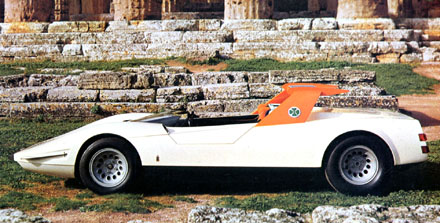
[edit]The Alfa Romeo P33 Roadster was presented to the public at the Turin Motor Show in November 1968. It was an open-top vehicle with a lower windscreen and a roll bar at rear painted in the colour of the body of the car.[27] The chassis was re-bodied two years later to produce the Cuneo.[28]

Alfa Romeo 33/2 Coupé Speciale
[edit]The Alfa Romeo 33/2 Coupé Speciale, also known as Alfa Romeo 33.2, was first presented to the public at the Paris Motor Show in 1969. This 2-door coupé was designed by Leonardo Fioravanti, then working at Pininfarina. It bears a striking yellow paint scheme and featured hydraulically operated butterfly doors and pop-up headlights.[29] The design was influenced by the Ferrari 250 P5 concept shown a year earlier at Geneva.[30]

Alfa Romeo P33 Cuneo
[edit]The Alfa Romeo Cuneo, originally called 33 Spider at Pininfarina, was by designed by Paolo Martin. It is an open-top, wedge-shaped concept and was presented at the Brussels Motor Show in January 1971.[28]
Italdesign
[edit]
Alfa Romeo Iguana
[edit]The Alfa Romeo Iguana, designed by Italdesign Giugiaro, was presented at the Turin Motor Show in November 1969. It is a two-seater sports coupé built on chassis No. 750.33.116. The design showed some new elements that Giugiaro introduced later in production vehicle designs. The body of the Iguana was painted a metal-flake grey, while the roof frame and cabin pillars were finished in brushed metal, a treatment Giugiaro later applied to the DMC DeLorean. The front end of the Iguana inspired the designs for the Maserati Bora and Merak, and the rear of the car with its high-mounted tail lights formed the basis of the design of the Alfa Romeo Alfasud Sprint. Allegedly, a small series production of the Iguana was planned, but it never materialized.[18]
In popular culture
[edit]A 33 Stradale can be seen in the 1969 Italian movie Un bellissimo novembre.[31][32]
See also
[edit]Notes
[edit]- ^ later rebodied by Pininfarina into the Cuneo
References
[edit]- ^ "1967 ALFA ROMEO TIPO 33 STRADALE PROTOTIPO". archivioprototipi.it (in Italian). Retrieved 17 December 2019.
- ^ Alfa Romeo 33 Stradale turns 50, is still the most beautiful car ever...: Alfa Romeo 33 Stradale turns 50, is still the most beautiful car ever... Archived 20 February 2020 at the Wayback Machine, accessdate: 19. June 2019
- ^ a b c d Bruno von Rotz (2011). "Alfa Romeo 33 Stradale - Schönheit und Geschwindigkeit in Perfektion". zwischengas.com (in German). Retrieved 30 May 2012.
- ^ a b Patrick Lang. "50 JAHRE ALFA ROMEO T33/2 STRADALE". auto-motor-und-sport.de (in German). Archived from the original on 17 June 2018. Retrieved 16 June 2018.
- ^ "News". italiaspeed.com. Archived from the original on 4 May 2007. Retrieved 26 April 2007.
- ^ "Most Sensuous Car Shapes Ever Designed". 8 October 2010.
- ^ The Revs Institute: The Revs Institute - The Revs Institute, accessdate: 6. June 2019
- ^ a b c "Spotlight: The Exquisite Alfa-Romeo Tipo 33 Stradale". autoinjected.com. Archived from the original on 13 November 2013. Retrieved 30 May 2012.
- ^ "Dalla 6C 2500 alla 4C Concept, la storia delle sportive Alfa Romeo". panorama-auto.it (in Italian). Archived from the original on 6 June 2012. Retrieved 19 November 2012.
- ^ "Alfa Romeo 33 Stradale". ultimatecarpage.com. Retrieved 30 May 2012.
- ^ "Alfa Romeo 33 Sport Prototipo". geocities.com/mundoalfa (in Spanish). Archived from the original on 27 October 2009. Retrieved 9 May 2007.
- ^ "Alfa Romeo 33 Part 1: 33 Stradale". qv500.com. Archived from the original on 17 December 2007. Retrieved 22 December 2007.
- ^ "1968 Alfa Romeo T33 Serial Number 75033.101". ferraris-online.com. Archived from the original on 22 February 2014. Retrieved 30 May 2012.
- ^ "Alfa Romeo 33 Stradale turns 50, is still the most beautiful car ever made". drivemag.com. Retrieved 4 November 2024.
- ^ "THE 33 " STRADALE" AND HER " PROTOTYPE " SISTERS". www.afra.it. Archived from the original on 14 August 2018.
- ^ "Alfa Romeo 33 Part 2: 33 Stradale Bertone 'Carabo'". qv500.com. Archived from the original on 21 December 2008.
- ^ "Alfa Romeo 33 Part 3: 33 Stradale Pininfarina 'P33 Roadster'". qv500.com. Archived from the original on 21 December 2008.
- ^ a b "Alfa Romeo 33 Part 5: 33 Stradale Ital Design 'Iguana'". qv500.com. Archived from the original on 21 December 2008.
- ^ "1969 PININFARINA ALFA ROMEO 33/2 COUPE' SPECIALE". archivioprototipi.it (in Italian). Retrieved 17 December 2019.
- ^ "Alfa Romeo 33 Part 4: 33 Stradale Pininfarina 'P33 Coupe'". qv500.com. Archived from the original on 21 December 2008.
- ^ "1971 PININFARINA ALFA ROMEO P33 CUNEO". archivioprototipi.it (in Italian). Retrieved 17 December 2019.
- ^ "Alfa Romeo 33 Part 6: 33 Stradale Pininfarina 'Cuneo'". qv500.com. Archived from the original on 21 December 2008. Retrieved 25 April 2007.
- ^ "Images of the Bertone Carabo". carbodydesign.com. 2 July 2009. Retrieved 7 March 2012.
- ^ "Alfa Romeo Navajo". bertone.it/. Archived from the original on 16 December 2007. Retrieved 30 September 2008.
- ^ "Image of Sport Roadster". Retrieved 7 March 2012.
- ^ a b "33 Spider "Cuneo" - 1971". museoalfaromeo.com. Retrieved 17 December 2019.
- ^ Sparrow, David; John Tipler (1996). Alfa Romeo Legends. ISBN 1-85532-646-9.
- ^ "Présentation Alfa Romeo 33.2 Pininfarina". motorlegend.com (in French). Archived from the original on 7 May 2007. Retrieved 26 April 2007.
- ^ "1968 Alfa Romeo 33 Stradale in Un bellissimo novembre". imcdb.org. Retrieved 29 June 2012.
- ^ "Alfa Romeo Tipo 33 Stradale on". Youtube.com. 2 April 2009. Archived from the original on 14 December 2021. Retrieved 7 March 2012.
External links
[edit]
- German article of Stradale with chassis numbers
- Brief story and original pictures about the 33 Stradale and five of the derived concepts

Alfa Romeo 33 Stradale
View on GrokipediaDevelopment and History
Origins in Racing
The Alfa Romeo Tipo 33 racing program was initiated by the company's Autodelta racing division in the mid-1960s as a means to re-enter international prototype sports car competition following a period of focus on smaller displacement models like the Giulia TZ.[6] Launched in 1967, the project marked Alfa Romeo's return to the World Sportscar Championship with a purpose-built mid-engine prototype, featuring a lightweight tubular spaceframe chassis constructed from riveted aluminum and magnesium alloys to optimize weight and rigidity.[7] The initial Tipo 33 prototype was equipped with a 1.6-liter four-cylinder engine derived from the Giulia TZ2, producing around 170 horsepower, though the V8 was under development and would be introduced later, addressing early reliability issues.[7] The Tipo 33 series quickly demonstrated its potential in competition, making its competition debut at the Fléron hillclimb on March 12, 1967, where it showed promise despite early reliability issues that highlighted the innovative mid-engine layout prioritizing balance and handling.[7] In 1968, the refined Tipo 33/2 variant, nicknamed "Daytona" or "Periscopica" due to its distinctive air intake, achieved significant success with a detuned 2.0-liter V8 to comply with prototype class regulations; it secured a 1-2-3 class victory at the 24 Hours of Daytona and class wins at the 1000 km races of Monza, Targa Florio, and Nürburgring, highlighting the car's aerodynamic efficiency and lightweight construction under 600 kilograms.[8] These accomplishments underscored the engineering prowess of the platform, with its central drivetrain and minimal bodywork influencing future developments in high-performance vehicles.[9] In late 1967, amid the Tipo 33's racing momentum, Alfa Romeo decided to develop a road-legal variant, the 33 Stradale, primarily to homologate the design for Group 4 sports car racing under FIA rules requiring at least 50 production units, while also serving as a prestige showcase for the brand's advanced technology to attract road car buyers.[10] Initial concept sketches were penned by Franco Scaglione, who had recently left Bertone and was working as a freelance designer for Alfa Romeo, adapting the racer's proportions into a more civilized coupe form while retaining the mid-engine configuration.[11] Engineering adaptations for road use included detuning the V8 engine from the racer's approximately 270 horsepower to a more compliant 230 horsepower with added exhaust silencing, incorporating full glass enclosures, leather-trimmed seats, and suspension refinements for everyday drivability, all without compromising the core lightweight ethos derived from the Tipo 33.[12]Design and Production
The Alfa Romeo 33 Stradale's design was penned by Franco Scaglione, transforming the mid-engine racing platform of the Tipo 33 into a sleek, low-slung coupe that emphasized aerodynamic efficiency and visual elegance.[13] Drawing inspiration from Scaglione's earlier work on the Alfa Romeo Disco Volante, the Stradale featured flowing, sculptural lines with a height under one meter, contributing to its exceptional road presence.[5] The body utilized lightweight aluminum panels hand-formed over a tubular steel chassis, optimizing weight distribution while achieving a coefficient of drag that reflected Scaglione's innovative use of woolen threads and photographic analysis for airflow studies in the absence of advanced wind tunnels.[13] Distinctive butterfly doors, which opened upward and outward while integrating into the roofline, addressed the car's low profile and enhanced accessibility, marking a pioneering application in production vehicles.[13] These doors, combined with the aerodynamic shaping, created a cohesive form that balanced functionality with aesthetic purity, often described as a timeless evolution of Italian gran turismo styling.[14] Production of the 33 Stradale occurred from late 1967 to 1969 at Carrozzeria Marazzi in Milan, where each example was hand-assembled to exacting standards, reflecting Alfa Romeo's commitment to bespoke craftsmanship during a period of limited-series manufacturing.[15] Despite plans for at least 50 units to achieve FIA Group 4 homologation, only 18 units were completed due to the high price of nearly 17 million lire, resulting in limited demand with just 13 customer cars sold, underscoring its status as an ultra-exclusive road car derived from racing heritage.[10][16] Configurations catered to international markets, with several built as right-hand-drive specifications to suit export regions like the UK.[12] The interior showcased a driver-focused cabin trimmed in supple leather, providing a luxurious contrast to the car's performance-oriented exterior while maintaining simplicity in line with 1960s grand tourer ideals.[12] Instruments from Veglia, including a straightforward dashboard layout with essential gauges, ensured clear visibility and intuitive operation, complemented by Veglia-Borletti switches for controls.[12] Removable roof panels enabled targa-like open-air operation, enhancing versatility for leisurely drives without compromising structural integrity.[12] Among variants, the one-off 33 Sport Prototipo served as the initial development mule, featuring experimental refinements to the body and chassis before full production.[17] Minor evolutions during the build run included varied color options such as Giallo Paglierino (straw yellow) and Arancio Michelangiolo (Michelangelo orange), allowing personalization while adhering to Alfa Romeo's palette of vibrant hues.[18] Wheel designs centered on 13-inch Campagnolo magnesium-alloy rims—eight inches wide at the front and nine inches at the rear—chosen for their lightweight properties and ability to dissipate brake heat effectively.[19]Post-Production Legacy
The Alfa Romeo 33 Stradale's post-production legacy is defined by its extreme rarity, with only 18 examples produced between 1967 and 1969, all of which are believed to survive today in museums and private collections.[16][20] These vehicles command extraordinary values on the collector market, where pristine examples rarely appear at public auction; a 1968 model was estimated at $9.5 million in a private sale, reflecting the car's status as a pinnacle of Italian automotive artistry.[21] Restoration efforts present significant challenges due to the hand-formed aluminum body panels, which can suffer from galvanic corrosion between the aluminum body and steel chassis if protective coatings fail, often requiring specialized expertise to preserve structural integrity without compromising the original design.[22] The model's enduring appeal has led to prominent exhibitions highlighting its historical significance. In 2017, Alfa Romeo marked the 50th anniversary with a dedicated display at the Museo Storico Alfa Romeo in Arese, Italy, showcasing the original prototype alongside related Tipo 33 racing variants to celebrate its blend of motorsport heritage and road-going elegance.[4][23] Original Stradales have also appeared at prestigious events like the Pebble Beach Concours d'Elegance, including chassis 75033.104 after its restoration and the planned 2020 debut of the rare blue example, underscoring its recognition among global collectors.[24][25] Regarded as one of the earliest true supercars, the 33 Stradale pioneered the mid-engine, low-volume formula that blended racing technology with exquisite styling, influencing Alfa Romeo's later design philosophy through experimental concepts that explored aerodynamic forms and lightweight construction.[26][27] Its legacy extends to vehicles like the 1989 SZ, which echoed the brand's commitment to bold, performance-oriented aesthetics, though adapted to a more angular, Zagato-penned silhouette.[28] Notable ownership histories include examples in esteemed institutions such as the Louwman Museum in the Netherlands, which houses a production Stradale acquired from prior collections, and private holdings like the restored blue prototype kept out of public view for decades.[29]Technical Specifications
Chassis and Body
The Alfa Romeo 33 Stradale featured a tubular steel spaceframe chassis derived directly from the Tipo 33 racing prototype, adapted for road use with an asymmetrical "H"-shaped structure consisting of large-diameter steel tubes in the central section for enhanced rigidity, supplemented by magnesium castings at the front and rear. This design incorporated aluminum elements from the racer where possible, but prioritized steel reinforcements to accommodate the mid-engine layout and daily drivability while maintaining structural integrity under varied conditions. The resulting chassis provided exceptional torsional stiffness relative to its compact proportions, forming the foundation for the car's legendary handling characteristics.[12] Complementing the chassis, the body was constructed entirely from hand-formed aluminum panels, crafted by Carrozzeria Marazzi to Franco Scaglione's design, which minimized weight and allowed for a curb weight of approximately 700 kg.[30] Key dimensions included a wheelbase of 2,350 mm, overall length of 3,970 mm, width of 1,710 mm, and height of 991 mm, creating a low-slung silhouette that emphasized aerodynamic efficiency and visual drama. The suspension system employed independent double wishbones with coil springs front and rear, paired with Girling disc brakes at all four wheels, delivering precise control and stopping power suited to the car's sporting intent. Aerodynamic considerations were integral to the design, with features such as the truncated Kammback tail and smoothly integrated, covered headlights optimizing airflow and reducing turbulence. These elements aided high-speed stability without reliance on protrusions or spoilers.Engine and Drivetrain
The Alfa Romeo 33 Stradale was powered by a mid-mounted, 2.0-liter all-aluminum V8 engine designated as the Tipo 33 V8, featuring dry-sump lubrication and twin overhead cams per bank for high-revving performance. This compact powerplant displaced 1,995 cc with a 90-degree V angle and produced 230 PS (169 kW) at 8,800 rpm, alongside 206 N⋅m of torque at 7,000 rpm in its standard road configuration, with a compression ratio of 10:1 and a redline of 10,000 rpm.[1] The engine employed a mechanical SPICA fuel injection system as standard, which contributed to its efficiency and power delivery. In racing-tuned variants derived from the Tipo 33 prototype, output could reach up to 260 PS through modifications like higher compression ratios and enhanced breathing. These adaptations maintained the engine's lightweight aluminum construction while optimizing for competition demands. Power was transmitted via a rear-wheel-drive layout, with a 6-speed Colotti manual transmission—derived from ZF components—mounted in a transaxle configuration to aid balance. A limited-slip differential ensured effective torque distribution to the rear wheels, enhancing traction in dynamic conditions.[31] For thermal management, the setup included twin front radiators to cool the mid-engine efficiently, while the exhaust system featured side-exit pipes positioned for aerodynamic balance and reduced weight. This integration with the tubular spaceframe chassis optimized overall weight distribution, approaching a near-perfect 40/60 front/rear bias.[1]Performance Metrics
The Alfa Romeo 33 Stradale's 2.0-liter V8 engine, producing 230 horsepower, propelled the car to a top speed of 260 km/h (162 mph) during period evaluations.[30] Acceleration was equally impressive, with 0 to 100 km/h achieved in 5.5 seconds, showcasing the lightweight 700 kg curb weight's contribution to brisk performance.[32] In 1968, the model established a world record for the fastest standing kilometer among production cars, completing the distance in 24 seconds at an average speed of 150 km/h.[33] Fuel consumption reflected the high-revving nature of the V8, averaging approximately 30 L/100 km in combined cycle testing, though real-world figures varied with driving style.[34] Braking capabilities were strong for the era, with estimated stopping distances from 100 to 0 km/h under 40 meters, aided by ventilated disc brakes on all wheels.[35] Handling benefited from a near-neutral balance, stemming from a front/rear weight distribution of roughly 40/60, which promoted predictable cornering and stability. Grip was provided by period-specific tires, including Dunlop 4.75/10.0-13 at the front and 6.0/12.0-13 at the rear, enhancing roadholding without modern compounds.[30] In comparison to contemporaries like the Lamborghini Miura, the 33 Stradale excelled in sprint performance, outpacing the Miura's 6.7-second 0-100 km/h time and faster standing kilometer run, though the Miura held a higher top speed of around 280 km/h due to its larger 3.9-liter V12.[36]Related Concept Vehicles
Bertone Designs
Bertone, under the direction of Marcello Gandini, utilized the Alfa Romeo 33 Stradale chassis to create innovative one-off concept cars that pushed the boundaries of automotive styling toward angular, futuristic forms. These designs retained the Stradale's mid-engine layout and 2.0-liter V8 engine while emphasizing experimental aesthetics that contrasted sharply with the original's organic curves.[37][38] The Alfa Romeo Carabo, unveiled at the 1968 Paris Motor Show, exemplified Gandini's wedge-shaped philosophy with its low-slung profile, vertically opening scissor doors, and retractable headlights integrated into a streamlined fiberglass body. Built directly on the 33 Stradale's mechanical underpinnings, including its central-rear 90-degree V8 producing 230 horsepower, the Carabo achieved a lightweight 700 kg curb weight and a top speed of 250 km/h, prioritizing aerodynamic efficiency through its sharp lines and luminescent green finish. This radical design influenced subsequent supercars, notably the Lamborghini Countach, by introducing the era's bold, geometric motifs.[37][38][39] Evolving Gandini's vision nearly a decade later, the Alfa Romeo Navajo debuted at the 1976 Geneva Motor Show as a targa-top variant with pop-up headlights and active aerodynamic elements like an electric front spoiler and rear wing. Constructed on an extended version of the 33 Stradale chassis (number 750.33.117), it incorporated the same 2.0-liter V8 engine producing 230 horsepower, housed in a fiberglass body that evoked spaceship-like futurism with flat surfaces and orange accents. As the final Bertone concept in the series, the Navajo highlighted the firm's commitment to avant-garde experimentation on the Stradale platform.[40][41][42]Pininfarina Prototypes
Pininfarina, renowned for its elegant Italian styling, developed several prototypes based on the Alfa Romeo 33 Stradale chassis in the late 1960s and early 1970s, emphasizing refined road-going aesthetics over the more radical experimentation seen in Bertone's designs. These concepts retained the core mechanical layout of the Stradale while showcasing Pininfarina's signature flowing lines and attention to grand touring usability.[43][44] The Alfa Romeo P33 Roadster, completed in 1968, was an open-top prototype that debuted at the Turin Motor Show. Designed by Paolo Martin, it featured a low-slung body with a soft white wedge profile incorporating flat surfaces and complex curves, offering smoother and more fluid lines than the production Stradale's angular forms. Without a fixed roof, it relied on an optional fabric top for open-air motoring, and its mid-mounted V8 engine provided the familiar powertrain dynamics.[43][45] In 1969, Pininfarina unveiled the Alfa Romeo 33/2 Coupé Speciale at the Paris Motor Show, a fixed-head coupe that prioritized grand touring comfort. Penned by Leonardo Fioravanti, it boasted an elongated nose with retractable headlight pods on each fender and a removable access hatch bearing the Alfa Romeo shield, creating a more production-oriented silhouette. The interior emphasized luxury with a left-hand-drive cockpit, full-width Alcantara dashboard, brown leather bolsters, green tartan velour seats, and pale green carpet, all powered by the same 1,995 cc 90° V8 engine tuned to 230 bhp at 8,800 rpm via SPICA fuel injection.[46] The Alfa Romeo P33 Cuneo, introduced in 1971 at the Brussels Motor Show, represented a shift toward aerodynamic exploration with its dramatic wedge-shaped profile. Also designed by Paolo Martin, this open-top spider featured taut lines, a curved windscreen, no conventional doors, flat-sided flanks for improved airflow, and a truncated tail paired with a massive basket-handle spoiler inherited from the earlier Roadster. It explored forward-thinking aerodynamics through its arrow-like form and included visual elements like an orange stripe and the Pininfarina crest, while retaining the 1,995 cc V8 engine delivering 230 hp at 8,800 rpm.[47][44] Across these prototypes, Pininfarina maintained the Stradale's 1,995 cc all-alloy V8 engine with its dry-sumped lubrication and dual overhead camshafts per bank, ensuring consistent performance potential of around 230 bhp. Styling hallmarks included sweeping curves for visual harmony—contrasting the era's emerging angular trends—and subtle chrome accents on grilles and trim, underscoring a sophisticated, road-focused elegance.[46][47]Italdesign Projects
The Alfa Romeo Iguana, designed by Giorgetto Giugiaro at Italdesign and unveiled at the 1969 Turin Motor Show, was a 2+2 grand tourer concept derived from the 33 Stradale chassis to emphasize everyday usability over pure racing pedigree. Featuring a lengthened wheelbase of approximately 2450 mm—extended by 100 mm from the Stradale's standard dimension—the Iguana provided additional rear seating space, making it suitable for family-oriented grand touring while retaining the mid-engine layout for balanced handling. Its brushed aluminum bodywork, finished in metallic flake gray with exposed stainless steel elements on the roof frame and pillars, highlighted Italdesign's innovative approach to blending futuristic aesthetics with structural visibility.[48][49][50] Mechanically, the Iguana preserved the 33 Stradale's 1995 cc aluminum V8 engine producing 230 hp at 8800 rpm via Spica fuel injection, paired with a Colotti 6-speed manual transmission and rear-wheel drive. Suspension upgrades, including double wishbones with coil springs and anti-roll bars, contributed to an improved ride quality focused on comfort for longer journeys, distinguishing it from the sportier prototypes by Pininfarina. Design highlights included retractable pop-up headlights integrated into a full-width nose and expansive wraparound glass areas—encompassing an extended windshield and large rear glazing—for enhanced driver visibility and interior brightness, elements that foreshadowed Giugiaro's angular styling language.[51][52][49] Only a single prototype was constructed on chassis number 750.33.116, which after salon appearances and photo sessions was retired from public display. Today, the Iguana resides in the Alfa Romeo Historical Museum in Arese, Italy, where it stands as a pivotal link between the 33's racing origins and Alfa Romeo's evolution toward practical production grand tourers like the Alfetta GT, whose rear design echoed the concept's high tail and glass integration.[53][54][52]Modern Homage (2023–Present)
Development and Announcement
The Alfa Romeo 33 Stradale was announced on August 30, 2023, during Monterey Car Week, marking the brand's return to custom-built "fuoriserie" vehicles since 1969. This limited-edition project revives the legendary nameplate as a tribute to the original 1967 model's iconic status, with production capped at just 33 units worldwide, each fully customizable to the owner's specifications.[55][56] Development of the modern 33 Stradale began in 2022 under the Stellantis umbrella, with initial concepts presented at that year's Monza Grand Prix and collaborative input from select customers through Alfa Romeo's "Bottega" team. The design, led by the Alfa Romeo Centro Stile, faithfully reinterprets Franco Scaglione's original 1967 shape while incorporating contemporary elements such as advanced LED lighting and extensive carbon fiber construction for enhanced aerodynamics and lightness. All units were sold out within weeks of the announcement, underscoring the project's immediate appeal among collectors.[1][1] First customer deliveries commenced in late 2024, with the North American debut occurring at the 2025 Monterey Car Week across multiple events. Pricing starts at approximately €1.5 million (around $1.65 million), though final costs vary based on extensive personalization options available through the Centro Stile, ensuring no two examples are identical.[57][58][59]Specifications and Features
The Alfa Romeo 33 Stradale offers two powertrain options in its 2023 model, both employing a mid-engine, rear-wheel-drive layout that pays homage to the original 1967 model's V8 configuration.[1] The internal combustion engine (ICE) variant features a 3.0-liter twin-turbocharged V6 derived from the Maserati Nettuno, producing over 620 horsepower and 538 lb-ft (729 Nm) of torque.[60][61] This engine pairs with an eight-speed dual-clutch automatic transmission (DCT8) from ZF, enabling rear-wheel drive with torque vectoring for enhanced handling.[60] The battery electric vehicle (BEV) option utilizes an 800-volt architecture with three permanent magnet synchronous motors delivering over 750 horsepower total, supported by a 102 kWh battery (90 kWh usable) for an estimated WLTP range of approximately 450 km.[60][62] The chassis employs a carbon fiber monocoque tub, paired with aluminum subframes front and rear, contributing to a lightweight structure with a curb weight under 1,500 kg for the ICE version and under 2,100 kg for the BEV.[60][63] This construction, developed in collaboration with Dallara, features double-wishbone suspension with a virtual steering axle and anti-roll bars at both ends for precise dynamics.[63] Braking is handled by Brembo carbon-ceramic discs—390 mm front with six-piston calipers and 360 mm rear with four-piston calipers—achieving a 100-0 km/h stopping distance under 33 meters.[60] Active aerodynamics, including adjustable elements like a truncated rear tail and side air intakes, optimize downforce and efficiency, with a drag coefficient (Cx) of 0.375.[60][64] Dimensions reflect proportions inspired by the marque's racing heritage, measuring approximately 4,637 mm in length, 1,966 mm in width (2,171 mm with mirrors), 1,226 mm in height, and a 2,700 mm wheelbase, with front and rear tracks of 1,680 mm and 1,668 mm, respectively.[60] The 20-inch wheels are fitted with 245/35 front and 305/30 rear tires for balanced grip.[60] Inside, the cabin emphasizes driver focus with bespoke leather and Alcantara upholstery, an aluminum center console featuring aeronautics-inspired toggles, and ribbed "cannelloni" detailing on seats and panels for tactile refinement.[64] A retractable central touchscreen integrates connectivity features including Apple CarPlay, while the "Cannocchiale" instrument cluster blends analog and digital displays, adjustable between "Strada" road and "Pista" track modes.[64][65] The steering wheel lacks onboard controls to minimize distraction, underscoring the car's purist ethos.[64]| Specification | ICE Variant | BEV Variant |
|---|---|---|
| Powertrain | 3.0L twin-turbo V6 | Three electric motors, 102 kWh battery |
| Power/Torque | >620 hp / 538 lb-ft | >750 hp / N/A (instant torque delivery) |
| Transmission/Drive | 8-speed DCT, RWD | Electric, RWD |
| Curb Weight | <1,500 kg | <2,100 kg |
| Top Speed | 333 km/h | >310 km/h |
| 0-100 km/h | <3.0 s | <3.0 s |