Hubbry Logo
801 Grand801 GrandMain
Open search
801 Grand
Community hub
801 Grand
logo
8 pages, 0 posts
0 subscribers
Be the first to start a discussion here.
801 Grand
801 Grand
from Wikipedia

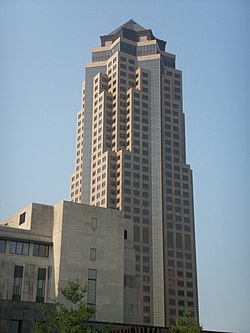
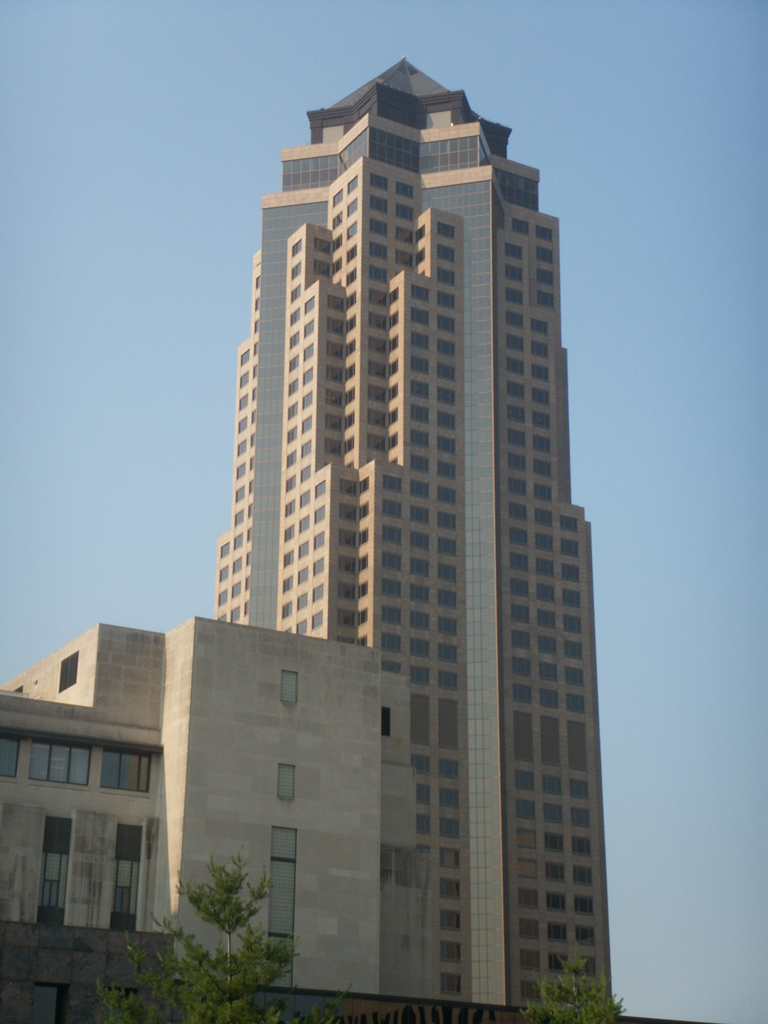
801 Grand High Rise Building (referred to as the 801 Grand Building and previously known as The Principal Building) is an office skyscraper in Des Moines, Iowa, United States, operated and managed by JLL Americas and owned by Principal Financial Group (Principal Real Estate). The building was constructed from 1989 to 1991; and at a height of 630 feet (190 m) and 45 stories, it is the tallest building in both Des Moines and the state of Iowa. It is part of a larger downtown campus run by Principal Financial Group and features a skywalk and an eight-sided copper pyramid at its top.

Key Information

History

[edit]

Construction of the 801 Grand Building began in 1989, with Principal Financial Group serving as the developers and owners.[4][5] In February 1989, the foundation, consisting of 38,860 cubic yards (29,710 m3) of concrete, was poured, and 139 caissons were drilled.[6] The building was designed by Hellmuth Obata and Kassabaum.[7] During the design phase of the building, the tower was designed to house office spaces and blend with the architecture of the local area.[8] The tower cost $70 million to construct, with an additional $19 million parking lot being constructed and financed by the city of Des Moines. The building featured 705,000 square feet (65,500 m2) of office space, with 62 percent having been leased prior to completion of the building.[5] In 1990, Democratic gubernatorial candidate Donald Avenson toured the nearly completed building, specifically visiting the 40th and 41st floors. In total, the project involved approximately 500 workers representing a dozen separate labor unions.[9]

The 45-story 801 Grand Building was completed and opened in 1991.[7][8] The company JLL Americas serves as the buildings' manager.[10] Upon completion, the 630-foot (190 m) building overtook the Ruan Center as the tallest building in Iowa;[11][7] and also surpassed both One Kansas City Place and the Metropolitan Square in St. Louis, making it the tallest building in the Midwest between Chicago and Denver.[5] This record was broken by Omaha's First National Bank Tower in 2002.[12][13]

In 2014, Principal Financial Group refitted their entire downtown campus with diode lights. Originally, the campus featured white lights but these were changed to LEDs due to issues with the white lights attracting and killing corn borer moths. This project was part of a $284 million renovation.[14]

Design

[edit]

The 801 Grand Building follows a postmodern design. The tower's exterior is built out of granite with the upper levels featuring terraces and setbacks.[7] This was designed to minimize the building's impact on the city's skyline.[8] In total, the building's walls required a total of 3,000,000 pounds (1,400,000 kg) of granite.[9] The granite used in the 801 Grand's exterior is specifically Venetian gold granite, which is known for its distinctive golden color. The stone used for the 801 was originally mined in Brazil, processed in Italy, and imported to Des Moines. Conversely, the windows are framed with a darker variant of granite.[6]

The top of the building is an eight-sided pyramid covered in copper. Originally, the designers intended the copper to turn to a verdigris color via oxidation. Furthermore, the original 1987 designs indicate a light green cap that was designed to blend the building's profile in with the rest of Des Moines's skyline. This was never achieved due to the relatively low levels of sulfur pollution in the atmosphere, which led to the copper pyramid oxidizing to a deep brown color.[15]

The bottom three floors of the 801 Grand are designated for retail stores and restaurants, with the upper levels designated for office space.[7] The third floor connects to a skywalk system and the top two floors serve as a private restaurant.[8][4] The build was named one of the 50 most significant Iowa Buildings of the 20th Century by the Iowan chapter of the American Institute of Architects.[7]

Notable tenants

[edit]

In 1993, the 801 Chophouse was established on the second floor of the 801 Grand. In 2022, the Des Moines Register listed the 801 Chophouse among the 12 best steakhouses in Des Moines. This restaurant serves as the chain's flagship and features a gallery of cattle-themed artwork.[16][17][18] The steakhouse has been used as a de facto clubhouse during the Iowa caucuses, and it is commonly visited by politicians and news personnel.[19]

In 2010, the First Church of Christ, Scientist relocated from their Des Moines building to the 801 Grand.[20] In 2020, insurance company F&G moved their headquarters to the 801 Grand Building. This move involved a $9.4 million renovation of 83,000 square feet (7,700 m2) of office space.[21]

[edit]

See also

[edit]

References

[edit]
[edit]
Revisions and contributorsEdit on WikipediaRead on Wikipedia
from Grokipedia
801 Grand is a prominent 44-story situated at 801 Grand Avenue in , serving as the tallest building in the state. Completed in 1991 after construction began in 1989, the structure rises to a height of 630 feet (192 meters), surpassing previous landmarks like the Ruan Center to claim its record status. Designed by the architectural firm Hellmuth, Obata + Kassabaum, Inc. of , , 801 Grand exemplifies through its incorporation of historical references at the base, combined with modern materials such as gold- and brown-toned from and , and cream- and black-colored from and . The building encompasses approximately 920,000 gross square feet, featuring 1,142 windows, 18 passenger elevators, and extensive use of 200,000 square feet of stone, 83,700 tons of , and 5,559 tons of in its construction. Owned by , whose headquarters occupy significant space within the tower, 801 Grand also hosts a diverse array of tenants including , high-end dining options, cozy cafés, and retail outlets across its podium levels and upper floors. Managed by Jones Lang LaSalle (JLL), the property remains a key economic and architectural landmark in Des Moines, contributing to the vitality of the city's downtown skyline.

Location and Context

Site and Surroundings

801 Grand is located at 801 Grand Avenue, Des Moines, Iowa 50309, within the central business district of downtown Des Moines. This positioning places the building at the intersection of Grand Avenue and key urban corridors, integrating it into the city's historic street grid that dates back to the 19th century. The surrounding area features proximity to the Des Moines River, which forms the western boundary of downtown and supports recreational and commercial activity along its banks. The building lies near the financial district, home to major institutions including its primary owner, Principal Financial Group, and is within walking distance of government buildings such as Des Moines City Hall at 400 Robert D. Ray Drive. Public spaces in the vicinity include the Simon Estes Riverfront Amphitheater in the adjacent East Village, connected via pedestrian bridges over the river, enhancing accessibility for cultural events and urban mobility. The site connects to the Des Moines Skywalk system, a 4.2-mile (6.8 km) network of elevated walkways connecting approximately 55 buildings and over 40 blocks of downtown offices, retail, and amenities. The original plot for 801 Grand was developed in the late as part of broader downtown revitalization initiatives in Des Moines, building on momentum from earlier projects like the 1973 Financial Center that spurred high-rise construction after decades of stagnation. This effort aimed to reinforce the area's role as Iowa's economic and civic hub, with the site's selection aligning Principal Financial Group's campus expansion near existing infrastructure.

Urban Significance

801 Grand stands as the tallest structure in , measuring 630 feet (192 meters) in height and comprising 44 stories. Completed in , it surpassed the previous record held by the Ruan Center, which stands at 460 feet (140 m) and 36 stories, establishing a new benchmark for vertical development in the state. This achievement solidified the building's prominence in Des Moines' , serving as a visual anchor for the city's . Economically, 801 Grand functions as a cornerstone of Des Moines' business district, housing headquarters for , a company, and offering over 920,000 square feet of Class A that supports high demand in the region's financial and sectors. As of 2024, its assessed value is $81.2 million, positioning it among the most valuable office towers in the city and contributing to elevated property values in the surrounding area through sustained occupancy and redevelopment incentives. The building's presence has bolstered the influx of daytime workers to , exceeding 50,000 upon its initial occupancy and fostering broader economic vitality in Iowa's capital. Culturally, 801 Grand symbolizes the expansion of Iowa's financial sector during the late , embodying the state's transition toward a modern economic hub with its postmodern design featuring Venetian gold granite cladding and an eight-sided copper pyramid atop. Frequently highlighted in city promotional materials and media depictions of Des Moines' , it represents architectural and urban ambition, drawing attention to the city's role as a regional center between larger metros like and Omaha.

Historical Development

Planning and Construction

The development of 801 Grand was initiated by in the late as an expansion of its corporate headquarters in downtown , to accommodate the company's growth and consolidate operations in a . The project represented a significant in the city's skyline, positioning Principal as a key driver of urban development in the Midwest. Construction began in 1989 under the direction of the architectural firm Hellmuth, Obata & Kassabaum, Inc. (HOK) of , , with serving as the lead designer; the firm was selected for its expertise in postmodern high-rise architecture, which aligned with the vision for a structure that blended historical references with modern functionality. The general contractor, M.A. Mortenson Company of , , oversaw the two-year build process, coordinating the erection of the 44-story tower that would reach a height of 630 feet upon completion. The structural system employed a core for stability paired with framing to support the building's height and accommodate the region's wind loads, utilizing 83,700 tons of concrete, 5,559 tons of , and 3,100 tons of reinforcing . Exterior cladding incorporated 200,000 square feet of stone, including Brazilian gold for the primary facade, accented by brown-toned , Italian cream , and black marble, which contributed to the postmodern aesthetic featuring an eight-pointed copper star motif at the crown and base. These materials and methods were chosen to ensure durability in the Midwest climate while integrating with local requirements for high-rise development, resulting in the tower's completion in 1991.

Completion and Early Operations

The 801 Grand building was dedicated in 1991 following its completion, with opening ceremonies attended by local leaders and covered by regional media outlets. As the primary tenant and developer, initiated occupancy, relocating key operations to the new 44-story tower that served as its . In the building's early years during the , it hosted corporate events for and offered public tours to highlight its role as a landmark amid the sector's economic expansion. The tower adapted to this growth period by supporting increased staffing and activities for the industry, aligning with Principal's rising assets from $14.9 billion in to further expansions by decade's end. Operational setup from the outset included comprehensive lobby services for visitor reception, robust protocols to manage high-traffic corporate use, and an advanced vertical transportation system featuring 18 high-speed passenger elevators serving all 44 floors. These elements ensured efficient daily operations for the primary tenant and initial lessees, facilitating smooth integration into Des Moines' urban core.

Architectural Features

Exterior Design

801 Grand exemplifies through its design by the firm Hellmuth, Obata, and Kassabaum (HOK), with as the lead designer. The building's exterior employs a classical tripartite composition—base, shaft, and capital—incorporating historical references to create a dialogue with traditional forms while embracing modern high-rise aesthetics. At the base, a sheltering arcade along Grand Avenue nods to local architectural precedents, providing pedestrian scale and enclosure with brown cladding. This lower portion transitions upward to the shaft, where the facade shifts to a bronze-tinted curtain wall system framed in dark aluminum, featuring vertical fins and panels for visual rhythm and light modulation. The tower rises to 630 feet (192 meters) over 44 stories, with its massing articulated by a series of terraces and setbacks in the upper half to mitigate wind loads and enhance the building's sculptural presence against the Des Moines skyline. Over 200,000 square feet of —primarily Venetian gold and brown varieties mined in and finished in —clads significant portions of the exterior, complemented by cream marble from and black marble from for textural contrast and durability. The 1,142 windows integrated into the curtain wall allow for expansive views while maintaining a cohesive that balances solidity and transparency. Crowning the structure is an eight-sided sheathed in , which serves as a distinctive capstone echoing the building's postmodern historicism and providing an illuminated focal point at night. This element, along with the overall color palette of warm earth tones in the stone and the subtle hue of the glazing, fosters visual with the surrounding urban context. The design's stepped profile and material transitions not only address functional needs like wind resistance but also contribute to a dynamic silhouette that has earned the building recognition as one of Iowa's most significant 20th-century structures.

Interior and Structural Elements

The structural system of 801 Grand employs a central core to provide stability, surrounded by perimeter columns that support the tower's height and loads. This configuration utilizes approximately 83,700 tons of , 5,559 tons of , and 3,100 tons of reinforcing , enabling the building to withstand the demands of its 630-foot elevation while accommodating Iowa's variable soil conditions through piled footings in the foundation. The floor layout features podium levels on floors 1 through 3 dedicated to retail spaces, lobbies, and facilities, while floors 4 through 44 primarily consist of open-plan configurations designed for flexibility and efficiency. Mechanical floors house HVAC and electrical systems, supporting the building's operational needs with 18 passenger elevators for vertical circulation. Interior features include an atrium lobby finished with marble and granite elements, contributing to a professional aesthetic from the original design. The structure integrates energy-efficient lighting and climate control systems, optimized for the office environment across its 920,000 square feet.

Tenancy and Usage

Major Corporate Occupants

The Principal Financial Group has served as the of 801 Grand since the building's completion in , occupying over 375,000 square feet across multiple floors for corporate operations following a completed in early 2017, including an executive conference center on the 16th floor. As the property owner, Principal played a key role in the building's development and naming, originally known as the Principal Building, and has influenced its management through ongoing renovations and adaptations, such as converting portions for fitness and amenity spaces. In April 2025, Principal placed the top five floors in vacant mode to optimize space utilization. Jones Lang LaSalle (JLL) provides on-site property management for 801 Grand, maintaining an office within the building to oversee operations, leasing, and tenant services. Other prominent occupants include financial services firms such as in Suite 3100 and Fidelity & Guaranty Life (F&G) in Suite 2600, alongside legal practices like on the 33rd floor, LLP in Suite 4100, and Bradshaw, Fowler, Proctor & Fairgrave in Suite 3700. Post-2000s, various financial and legal firms expanded their presence, exemplified by Ahlers & Cooney, P.C., which leased Suite 3200 around 2010 before relocating. The building features approximately 705,000 square feet of leasable office space overall. Occupancy at 801 Grand faced challenges during the 2008 recession, mirroring broader downtown Des Moines trends with elevated vacancy rates exceeding 15% in the . Recovery strengthened in the , driven by influxes from providers like and technology companies such as Q2 in Suite 3500, boosting utilization to near 90% by the early 2020s.

Retail and Public Amenities

The lower levels of 801 Grand feature a diverse array of public-facing retail and dining spaces designed to serve both visitors and local foot in downtown Des Moines. The ground and levels host establishments such as the 801 Chophouse, an upscale opened in 1993 offering prime USDA steaks, innovative sides, and an extensive selection of bourbons, scotches, and wines. Complementing this are casual cafés like Main Street Café & , which provides breakfast options, sandwiches, soups, and bakery items, and Big Acai , specializing in acai bowls, smoothies, toasts, and coffee beverages. These venues form a compact retail directory emphasizing convenient, high-quality dining and services accessible via the building's skywalk connections. Public access to these retail and dining areas operates during the building's standard hours: weekdays from 5:00 AM to 11:00 PM, Saturdays from 6:00 AM to 11:00 PM, and Sundays from 6:00 AM to 10:00 PM, allowing broad availability for commuters and tourists. Supporting visitor experiences, amenities include a connected public parking garage at Ninth and Grand Avenue, charging $1 per hour and linked directly to the building via skywalk for seamless access. Additional facilities encompass a recently completed fitness center on the 19th floor, equipped for tenant and guest use, and conference spaces such as a 50-seat conference center with an adjacent pre-function hospitality room and catering kitchen. The lobby integrates subtle public art elements, including displays around the elevators, enhancing the welcoming atmosphere of the space. In the , efforts to bolster foot traffic led to expansions in dining variety, notably the opening of Big Acai Bowl on the level to introduce healthier, quick-service options amid post-pandemic recovery. Venues like 801 Chophouse further engage patrons through regular promotions from Tuesday to Friday, 4:00 PM to 6:00 PM, featuring discounted drinks and appetizers.

Contemporary Aspects

Sustainability Initiatives

From its in , 801 Grand has supported efficient operation in the variable Midwestern weather. These features supported efficient operation in the building's early years by reducing demands for heating and cooling in the variable Midwestern weather. In the , the building participated in comprehensive and audits conducted by Grumman/Butkus Associates (GBA), which informed targeted improvements to reduce the operational . This included LED lighting retrofits for exterior floodlights, replacing high-pressure sodium fixtures with LEDs that cut total wattage by 62,120 watts and extended maintenance intervals from 6.8 to 28.9 years, yielding significant savings. GBA's Level 3 audit also identified HVAC optimizations, such as schedule adjustments and turning off unoccupied bathroom exhaust fans, contributing to annual savings of approximately $225,000 across low- and no-cost measures, with total verified savings of $424,000 including capital investments. These efforts supported aspirations by focusing on measurable reductions in use intensity. The building achieved EB: O+M under v4.1 for Existing Buildings in 2025, with recertification emphasizing ongoing performance in energy, water, and materials management. This highlights initiatives like through low-flow fixtures, which help lower overall consumption in line with USGBC standards. programs are integrated into tenant policies, promoting and minimization to reduce contributions, further aligning with the City of Des Moines' broader goals, including its own for Climate Resiliency . These programs collectively enhance indoor and support Des Moines' efforts to lower community-wide emissions.

Recent Renovations and Ownership

The 801 Grand building has been owned by the Principal Financial Group since its development and opening in 1991. In the 2020s, responsibilities shifted to JLL Americas, which now handles operations and leasing for the owner. As of recent assessments, the building's total assessed value stands at $81.2 million. Recent modernization efforts at 801 Grand have focused on enhancing tenant amenities and operational efficiency. Between 2011 and 2016, Principal undertook a multi-phase of approximately 375,000 square feet across 17 floors, involving interior rebuilds of spaces, areas, and client centers, along with major updates to systems. In 2023, the 19th floor was converted into a 14,000-square-foot fitness center and private tenant lounge to support employee wellness and retention. Looking ahead, the building faces evolving demands from remote work trends, with Principal placing the top five floors in "vacant mode" in early 2025 to adapt space usage. Occupancy remained strong at 89% as of 2023, reflecting sustained demand for its Class A office space in downtown Des Moines.

References

Add your contribution
Related Hubs
User Avatar
No comments yet.