Hubbry Logo
Crash (computing)Crash (computing)Main
Open search
Crash (computing)
Community hub
Crash (computing)
logo
8 pages, 0 posts
0 subscribers
Be the first to start a discussion here.
Crash (computing)
Crash (computing)
from Wikipedia

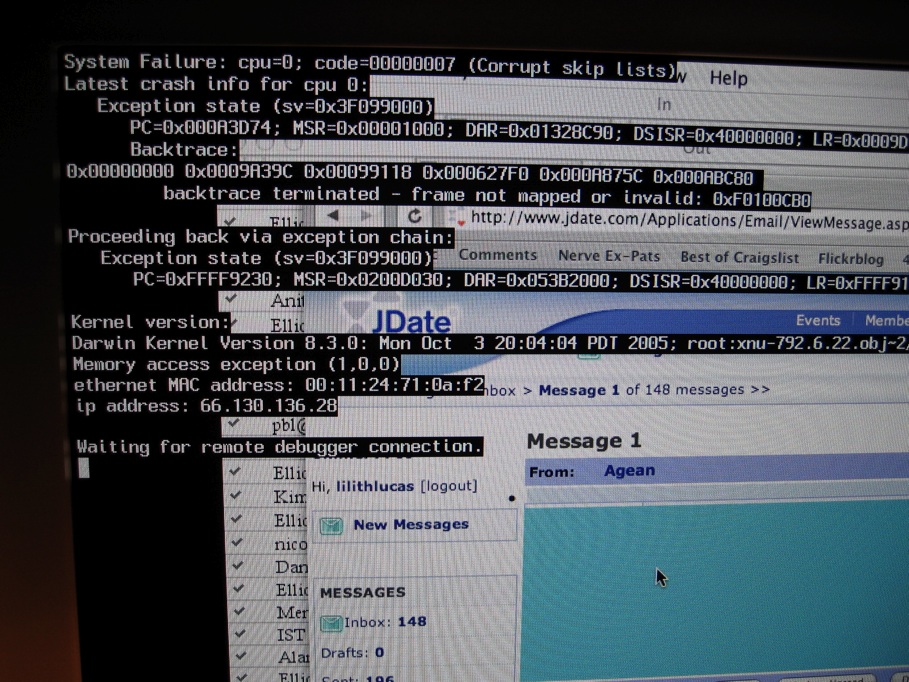
A kernel panic displayed on an iMac. This is the most common form of an operating system failure in Unix-like systems.

In computing, a crash, or system crash, occurs when a computer program such as a software application or an operating system stops functioning properly and exits. On some operating systems or individual applications, a crash reporting service will report the crash and any details relating to it (or give the user the option to do so), usually to the developer(s) of the application. If the program is a critical part of the operating system, the entire system may crash or hang, often resulting in a kernel panic or fatal system error.

Most crashes are the result of a software bug. Typical causes include accessing invalid memory addresses,[a] incorrect address values in the program counter, buffer overflow, overwriting a portion of the affected program code due to an earlier bug, executing invalid machine instructions (an illegal or unauthorized opcode), or triggering an unhandled exception. The original software bug that started this chain of events is typically considered to be the cause of the crash, which is discovered through the process of debugging. The original bug can be far removed from the code that actually triggered the crash.

In early personal computers, attempting to write data to hardware addresses outside the system's main memory could cause hardware damage. Some crashes are exploitable and let a malicious program or hacker execute arbitrary code, allowing the replication of viruses or the acquisition of data which would normally be inaccessible.

Application crashes

[edit]
A display at Frankfurt Airport running a program under Windows 2000 that has crashed due to a memory read access violation

An application typically crashes when it performs an operation that is not allowed by the operating system. The operating system then triggers an exception or signal in the application. Unix applications traditionally responded to the signal by dumping core. Most Windows and Unix GUI applications respond by displaying a dialogue box (such as the one shown in the accompanying image on the right) with the option to attach a debugger if one is installed. Some applications attempt to recover from the error and continue running instead of exiting.

An application can also contain code to crash[b] after detecting a severe error.

Typical errors that result in application crashes include:

  • attempting to read or write memory that is not allocated for reading or writing by that application (e.g., segmentation fault, x86-specific general protection fault)
  • attempting to execute privileged or invalid instructions
  • attempting to perform I/O operations on hardware devices to which it does not have permission to access
  • passing invalid arguments to system calls
  • attempting to access other system resources to which the application does not have permission to access
  • attempting to execute machine instructions with bad arguments (depending on CPU architecture): divide by zero, operations on denormal number or NaN (not a number) values, memory access to unaligned addresses, etc.

Crash to desktop

[edit]

A "crash to desktop" (CTD) is said to occur when a program (commonly a video game) unexpectedly quits, abruptly taking the user back to the desktop. Usually, the term is applied only to crashes where no error is displayed, hence all the user sees as a result of the crash is the desktop. Many times there is no apparent action that causes a crash to desktop. During normal function, the program may freeze for a shorter period of time, and then close by itself. Also during normal function, the program may become a black screen and repeatedly play the last few seconds of sound (depending on the size of the audio buffer) that was being played before it crashes to desktop. Other times it may appear to be triggered by a certain action, such as loading an area.

CTD bugs are considered particularly problematic for users. Since they frequently display no error message, it can be very difficult to track down the source of the problem, especially if the times they occur and the actions taking place right before the crash do not appear to have any pattern or common ground. One way to track down the source of the problem for games is to run them in windowed-mode. Certain operating system versions may feature one or more tools to help track down causes of CTD problems.

Some computer programs such as StepMania and BBC's Bamzooki also crash to desktop if in full-screen, but display the error in a separate window when the user has returned to the desktop.

Web server crashes

[edit]

The software running the web server behind a website may crash, rendering it inaccessible entirely or providing only an error message instead of normal content.

For example, if a site is using an SQL database (such as MySQL) for a script (such as PHP) and that SQL database server crashes, then PHP will display a connection error.

Operating system crashes

[edit]
A Blue screen of death as displayed in Windows XP, Vista, and 7
A kernel panic as displayed in OS X Mountain Lion

An operating system crash commonly occurs when a hardware exception occurs that cannot be handled. Operating system crashes can also occur when internal sanity-checking logic within the operating system detects that the operating system has lost its internal self-consistency.

Modern multi-tasking operating systems, such as Linux, and macOS, usually remain unharmed when an application program crashes.

Some operating systems, e.g., z/OS, have facilities for Reliability, availability and serviceability (RAS) and the OS can recover from the crash of a critical component, whether due to hardware failure, e.g., uncorrectable ECC error, or to software failure, e.g., a reference to an unassigned page.

Abnormal end

[edit]

An Abnormal end or ABEND is an abnormal termination of software, or a program crash. Errors or crashes on the Novell NetWare network operating system are usually called ABENDs. Communities of NetWare administrators sprang up around the Internet, such as abend.org.

This usage derives from the ABEND macro on IBM OS/360, ..., z/OS operating systems. Usually capitalized, but may appear as "abend". Some common ABEND codes are System ABEND 0C7 (data exception) and System ABEND 0CB (division by zero).[1][2][3] Abends can be "soft" (allowing automatic recovery) or "hard" (terminating the activity).[4] The term is jocularly claimed to be derived from the German word "Abend" meaning "evening".[5]

Security and privacy implications of crashes

[edit]

Depending on the application, the crash may contain the user's sensitive and private information.[6] Moreover, many software bugs which cause crashes are also exploitable for arbitrary code execution and other types of privilege escalation.[7][8] For example, a stack buffer overflow can overwrite the return address of a subroutine with an invalid value, which will cause, e.g., a segmentation fault, when the subroutine returns. However, if an exploit overwrites the return address with a valid value, the code in that address will be executed.

Crash reproduction

[edit]

When crashes are collected in the field using a crash reporter, the next step for developers is to be able to reproduce them locally. For this, several techniques exist: STAR uses symbolic execution,[9] EvoCrash performs evolutionary search.[10]

See also

[edit]

Notes

[edit]

References

[edit]
[edit]
Revisions and contributorsEdit on WikipediaRead on Wikipedia
from Grokipedia
In computing, a crash refers to the sudden and unexpected failure of a software program or system component, resulting in its termination and inability to continue normal operation. This phenomenon typically arises when the program encounters an unhandled error that compromises its stability, such as invalid memory access or resource exhaustion. Crashes are distinct from hangs, where a program becomes unresponsive but does not terminate; instead, they force an abrupt shutdown to prevent further issues like data corruption. Crashes are broadly categorized into application crashes, which affect individual software programs without necessarily impacting the entire system, and system crashes, which involve critical operating system components like the kernel and halt all operations. Application crashes often manifest as error dialogs or forced closures, while system crashes may display diagnostic screens, such as the (BSOD) in Windows, accompanied by stop codes indicating the fault. Common causes include software bugs (e.g., segmentation faults or dereferences), faulty hardware (e.g., failing or drives), driver conflicts, , or even environmental factors like overheating. In severe cases, crashes can lead to unsaved , system instability, or security vulnerabilities if exploited. Recovery from crashes typically involves restarting the affected program or rebooting the , often with automated to aid via tools like or crash dump analysis. Prevention strategies emphasize robust error handling, regular updates to software and drivers, and design paradigms like , where programs are engineered to recover quickly from failures by treating crashes as a normal stop mechanism. Despite advances in reliability, crashes remain a fundamental challenge in computing, influencing everything from to architecture.

Definition and Fundamentals

Definition of a Crash

In computing, a crash refers to the unexpected and abrupt termination of a computer program, application, or operating system due to an unhandled error, such as an invalid operation or resource exhaustion, rendering the affected component unable to continue normal execution. This failure typically results from the program's inability to recover from the error state, leading to an abnormal exit that may leave the system in an inconsistent condition. Crashes are distinct from planned terminations, as they occur without user intent or graceful shutdown procedures. Crashes commonly manifest through low-level mechanisms like exceptions or operating system signals that detect and respond to erroneous conditions. For instance, in systems, attempting to access invalid memory—such as dereferencing a or writing to a read-only segment—triggers a , which generates the SIGSEGV signal as defined in the standard. This signal indicates an invalid memory reference, with subtypes like SEGV_MAPERR for unmapped addresses or SEGV_ACCERR for permission violations, and the default action is abnormal process termination if no handler is provided. The program's state becomes inconsistent at this point, often requiring external intervention like restarting to restore functionality. error handling further standardizes such responses, ensuring signals like SIGSEGV provide diagnostic information, such as the faulting address via siginfo_t structures. Historically, the mechanics of crashes trace back to the with mainframes like the , where failures were diagnosed using "core dumps"—complete snapshots of the contents upon halt, a term derived from the era's core-based RAM technology. These dumps allowed engineers to analyze the machine's state post-crash, evolving from manual hardware inspections to automated debugging aids. Over time, this practice influenced modern standards, including POSIX's signal framework for error detection and reporting in Unix-derived systems. Crashes must be differentiated from related failures like hangs and freezes to clarify their impact. A hang involves the program entering an , deadlock, or resource wait without terminating, allowing it to continue running but rendering it unresponsive to inputs. In contrast, a freeze typically describes a broader -level unresponsiveness, such as when the operating system or multiple processes stall without explicit exit, often requiring a . Unlike these persistent states, a crash enforces termination, potentially enabling recovery through restarts but risking from the inconsistent state.

Indicators and Symptoms

A crash in computing often manifests through distinct visual indicators that alert users to a system or application failure. In Microsoft Windows, the (BSOD) displays a blue error screen with a stop code, such as 0x0000007B indicating an INACCESSIBLE_BOOT_DEVICE error, which halts the system to prevent further damage. On macOS, a presents a black screen with white text detailing the panic reason, often accompanied by a restart prompt, signaling a critical kernel-level issue. In systems, an "Oops" message may appear on the console or in logs, describing a kernel exception like a , typically with a for initial diagnosis. Behavioral symptoms provide immediate cues of instability without always involving visual screens. These include sudden closure of applications, where the program terminates abruptly without saving progress, leading to loss of unsaved data input. Systems may also issue automatic prompts or enter unresponsive states, freezing user interactions across the interface. In older hardware setups, audio cues such as (Power-On Self-Test) beep codes— for instance, continuous short beeps signaling a failure—indicate boot-time crashes before visual output. Diagnostic outputs enable deeper analysis post-crash. Core dumps capture a snapshot of the program's memory state at the time of failure, allowing developers to inspect variables, stack traces, and execution flow in tools like debuggers for root cause identification. Log entries further aid troubleshooting; in Windows, the Event Viewer records crash details under System logs, including event IDs like 1001 for BugCheck events with minidump paths. On Linux, /var/log/syslog or kern.log files log crash entries, such as kernel panics or segmentation faults, with timestamps and error descriptions for forensic review. As of 2025, mobile platforms exhibit tailored indicators reflecting their ecosystems. Android displays an "App has stopped" dialog for unhandled exceptions, prompting users to force close or report the issue while logging the stack trace in logcat for developers. alerts users via on-screen notifications or crash reports in Settings > Privacy & Security > Analytics & Improvements, including symbolicated stack traces that trace the exception back to specific code lines.

Causes of Crashes

Software Bugs and Errors

Software bugs and errors represent a primary internal cause of crashes in systems, stemming from flaws in , , or configuration that lead to unexpected program termination or . These issues often arise during development and can manifest as segmentation faults, access violations, or abrupt exits, disrupting normal execution without external intervention. According to the (CWE), many such bugs fall under categories like improper input validation. Synchronization failures represent another prevalent category. Among the most common bugs, null pointer dereferences occur when a program attempts to access memory through a pointer that has not been initialized or has been set to null, typically resulting in a crash due to invalid memory access. For instance, in languages without automatic null checks, this can trigger hardware exceptions like segmentation faults on systems or access violations on Windows. The CWE-476 highlights that such dereferences often lead to process failure unless robust is implemented. Similarly, buffer overflows happen when data exceeds the allocated memory bounds, corrupting adjacent memory regions and potentially causing crashes; a classic example is stack smashing, where an attacker or erroneous input overwrites the return address on the call stack, leading to hijacking or immediate termination. The Foundation notes that buffer overflows, classified under CWE-119, are a leading cause of exploitable crashes in C-based applications due to lack of bounds checking. Race conditions in multithreaded code emerge when multiple threads access shared resources concurrently without proper , resulting in inconsistent states or crashes from . For example, if two threads modify a shared variable simultaneously—one reading while the other writes—the outcome can be indeterminate, often culminating in memory corruption or assertion violations that halt execution. The CWE-362 entry from describes race conditions as a concurrency weakness that frequently causes and system crashes in parallel programming environments. Unhandled exceptions further contribute to crashes, particularly in object-oriented languages; in , for instance, an uncaught RuntimeException propagating up the call stack terminates the thread or application, as the JVM lacks a default handler for such errors beyond . Oracle documentation confirms that unhandled exceptions in terminate the application if uncaught. Programming language specifics influence how memory management errors precipitate crashes. In low-level languages like C and C++, dangling pointers—references to freed or deallocated memory—can cause crashes upon dereference, as the pointer retains an invalid address leading to undefined behavior or access violations. GeeksforGeeks outlines that raw pointers in C++ exacerbate risks like dangling references due to manual memory management, often resulting in segmentation faults without runtime safeguards. In contrast, managed languages like Python mitigate some low-level errors but still crash on unhandled exceptions; an IndexError, raised when accessing a list or array beyond its bounds, terminates the program if not caught, as Python's interpreter propagates it upward until exhaustion. Real Python documentation explains that built-in exceptions like IndexError are designed to signal errors but cause immediate exits in unhandled scenarios, emphasizing the need for try-except blocks to prevent crashes. Configuration errors, often overlooked, also trigger crashes through flawed setup or misuse. Infinite recursion from poorly designed loops or recursive functions exhausts the call stack, invoking a StackOverflowError or equivalent crash when the stack limit is reached. This occurs in scenarios like bidirectional object relationships in without termination conditions, leading to unbounded calls. Assertion failures, triggered by API misuse such as passing invalid parameters to library functions, explicitly halt execution to flag programmer errors; for example, violating preconditions in a public can cause the program to abort via assert statements, which are typically enabled only in debug builds but can be configured for release. Assertions serve as defensive measures against misuse, ensuring crashes highlight configuration flaws early. As of 2025, recent trends in software crashes increasingly involve AI and model integration, where tensor overflows in frameworks like cause runtime failures. These overflows happen when tensor operations exceed integer limits during resizing or computation, triggering CHECK failures and process crashes due to unchecked arithmetic. A GitLab security advisory on vulnerabilities (CVE-2021-41199, with ongoing relevance in updated versions) details how large input sizes in functions like tf.image.resize lead to overflows, underscoring the need for input validation in ML pipelines to avert such integration-induced crashes.

Hardware Failures and External Factors

Hardware failures represent a significant category of physical malfunctions that can precipitate system crashes by disrupting normal operation at the component level. Overheating, often resulting from inadequate cooling or prolonged high-load usage, can cause the (CPU) to throttle performance or halt entirely to prevent damage, leading to abrupt system instability and crashes. Faulty (RAM) modules may induce parity errors, where during read/write operations triggers kernel panics or application terminations as the system detects uncorrectable inconsistencies. Similarly, disk drive failures, such as those in hard disk drives (HDDs) or solid-state drives (SSDs), can generate (I/O) exceptions when sectors become unreadable, causing the operating system to crash in an attempt to handle the error. External environmental factors further exacerbate hardware vulnerabilities, often acting as unpredictable triggers for crashes. Power surges, typically from unstable electrical supplies or strikes, can overload voltage regulators and corrupt states, resulting in immediate system shutdowns or reboots. Electromagnetic interference (), arising from nearby high-power devices or sources, may induce bit flips in or signal disruptions on circuit boards, leading to erratic behavior and crashes in sensitive electronics. In distributed computing environments, network timeouts—caused by latency spikes or —can propagate cascading failures across nodes, where one system's unresponsiveness overloads others, culminating in cluster-wide crashes. Peripheral hardware issues often stem from integration challenges or user modifications, introducing instability at the interface level. Driver incompatibilities with universal serial bus (USB) devices, for instance, can arise when firmware mismatches cause resource conflicts, prompting blue screen errors or kernel dumps upon device connection. Overclocking, the practice of exceeding manufacturer-specified clock speeds on CPUs or graphics processing units (GPUs), frequently leads to instability through insufficient power delivery or heat dissipation, manifesting as random crashes during intensive tasks. In contemporary contexts as of 2025, introduce novel hardware failure modes. Hybrid quantum-classical systems experience crashes due to noise in quantum bits (qubits), where decoherence errors propagate to classical control logic, disrupting computations and forcing system resets. Likewise, (IoT) edge devices suffer from sensor malfunctions, such as environmental degradation in accelerometers or temperature probes, which trigger false data inputs and subsequent crashes in resource-constrained environments. These hardware-induced crashes can sometimes be amplified by underlying software bugs, though the primary trigger remains the physical fault.

Types of Crashes by System Level

Application-Level Crashes

Application-level crashes occur when a software is confined to a single user-space process, typically resulting from application-specific errors such as mishandling invalid user input or uncaught exceptions during data parsing. These failures do not propagate to the kernel or other processes unless explicitly escalated, allowing the operating to terminate the affected application while maintaining overall stability. Common examples include "crash to desktop" (CTD) incidents in video games, where the application abruptly exits due to issues like incompatible graphics drivers or resource overflows, returning control to the operating system's . In mobile environments, such as Android, app crashes manifest as force closes, where the system terminates the process and displays an dialog to the user, often triggered by runtime exceptions or memory violations. Modern operating systems employ isolation mechanisms like sandboxing to contain these crashes and prevent broader impact. For instance, in enforces mandatory access controls through per-application profiles, restricting file access, network capabilities, and system calls to minimize the risk of a single app's failure compromising the host system. Historically, application crashes in the , such as frequent General Protection Faults (GPF) in due to its hybrid 16/32-bit architecture, often required manual intervention like restarting the application or system, as isolation was rudimentary and errors could cascade. By 2025, cross-platform frameworks like have introduced new crash patterns in desktop apps, such as renderer process failures from issues or incompatible page sizes, though improved sandboxing in underlying engines has enhanced containment.

Operating System-Level Crashes

Operating system-level crashes occur when errors in the kernel or core system components render the entire OS unstable, often requiring a forced to restore functionality. These failures contrast with application-level issues by affecting all processes and hardware interactions, stemming from unrecoverable conditions like invalid access or hardware interrupts mishandled in privileged mode. In Unix-like systems such as Linux, kernel panics represent unrecoverable errors where the kernel detects a fatal issue, such as a divide-by-zero operation or null pointer dereference in kernel code, prompting an immediate system halt to prevent data corruption or further instability. This leads to a diagnostic message on screen and a reboot, with examples including the "Kernel panic - not syncing: Attempted to kill init!" triggered by critical boot failures. A related but less severe event is a kernel oops, which logs a non-fatal error like an invalid page fault but allows continued operation unless configured to escalate to panic via the oops=panic parameter. Windows operating systems manifest similar kernel-level crashes through the (BSOD), where the NT kernel encounters irrecoverable errors, displaying a stop code and halting the system. For instance, the IRQL_NOT_LESS_OR_EQUAL error (bug check 0xA) arises when a kernel-mode or system service accesses pageable memory at an elevated Level (IRQL), often due to improper address handling or coding flaws like failing to release a . This forces a , with the screen providing details on the faulty module for . The term abnormal end (ABEND) originates from mainframe environments like IBM , denoting an unexpected OS or program termination due to errors such as storage violations or invalid operations. In these cases, the logs the abend code (e.g., 0Cx for VTAM network issues) and dumps diagnostic data for analysis, often requiring operator intervention or automated recovery. As of 2025, modern operating systems incorporate advanced mechanisms to handle and mitigate kernel crashes. Windows 11 introduces Proactive Memory Diagnostics, which automatically prompts users to scan RAM for corruption following a BSOD, activating after reboot to identify hardware faults like faulty modules that could precipitate future kernel errors. Kernel panics in macOS Sequoia are primarily caused by incompatible software or hardware, with tools like restarts and Apple Diagnostics enabling targeted troubleshooting without full reinstalls. For systems, supports kernel live patching, allowing critical security and bug fixes to be applied to a running kernel without rebooting, thus averting potential crashes from known vulnerabilities. Comparisons across operating systems highlight architectural differences in kernel stability and error management. kernels, being monolithic, rely on signal handling (e.g., SIGSEGV for segmentation faults) primarily for user-space processes, escalating to panics for kernel-mode failures, which contributes to their reputation for robustness in server environments due to modular design and extensive auditing. In contrast, the hybrid kernel isolates drivers in user mode where possible but exposes more kernel-mode interactions for hardware compatibility, leading to BSODs from driver IRQL mismatches; however, recent NT iterations have improved stability through better and verifier tools, narrowing the gap with systems in desktop reliability.

Server and Infrastructure Crashes

Server crashes in networked and distributed environments often stem from resource exhaustion, configuration errors, or external pressures that disrupt high-availability systems designed for continuous operation. Unlike isolated application failures, these incidents can cascade across multiple nodes, leading to widespread service disruptions in web and cloud infrastructures. For instance, web servers like and frequently encounter crashes due to overload from traffic spikes or script errors, manifesting as HTTP 500 Internal Server Errors that halt request processing. In , common crash triggers include memory-mapping issues where deleted or truncated files cause segmentation faults, particularly on multiprocessor systems, and improper sendfile configurations that fail on platforms with buggy network implementations like early support. Additionally, infinite internal redirects from misconfigured modules can exhaust recursion limits, resulting in server termination, while abnormal child process exits holding pthread mutexes may deadlock the entire server, necessitating manual restarts on most systems. failures often arise from PHP-FPM integration problems, such as upstream timeouts or socket overflows during high-load scenarios, where unhandled PHP script errors propagate as 500 responses; DDoS attacks exacerbate this by overwhelming worker processes, causing and process crashes. Infrastructure-level crashes extend to backend components like databases, where encounters deadlocks when multiple transactions hold locks needed by others, preventing progress and triggering error 1213 with automatic of one transaction to resolve the . Broader crashes in can result from corrupted data files confusing the storage engine or undetected bugs in data handling, leading to abrupt server panics and shutdowns. In cloud environments, AWS EC2 instances may terminate unexpectedly due to underlying host failures or configuration drifts, as seen in the October 20, 2025, US-EAST-1 outage caused by a malfunction in the network load balancer health monitoring subsystem, which prevented new instance launches and degraded existing ones for over 11 hours. Scalability challenges in distributed systems amplify crash risks, particularly with load balancers in architectures, where failures in routing logic or health checks can isolate services and cause cascading unavailability if not redundantly configured. In , pod crashes commonly occur from out-of-memory (OOM) kills when containers exceed resource limits, liveness probe failures that signal unhealthy states prompting restarts, or invalid startup commands leading to immediate exits and CrashLoopBackOff status. As of 2025, introduces unique crash vectors, such as functions timing out during cold starts when initialization exceeds the configured limit (default 3 seconds, up to 15 minutes), often due to heavy dependencies or runtime environment setup delays affecting less than 1% of invocations but introducing latency spikes. Edge computing in content delivery networks (CDNs) faces failures from compute service disruptions, exemplified by Fastly's November 3, 2025, incident where elevated errors in new Compute activations halted deployments and impacted .

Implications and Consequences

Security and Privacy Vulnerabilities

Crashes in computing systems can serve as critical exploit vectors, particularly through memory corruption vulnerabilities that allow attackers to inject malicious code. A seminal example is the of 1988, which exploited a in the fingerd daemon on Unix systems, overwriting stack memory to execute arbitrary code and propagate itself, ultimately infecting approximately 6,000 machines and causing widespread system slowdowns and crashes due to resource exhaustion. Similarly, use-after-free vulnerabilities, where freed memory is accessed post-deallocation, frequently occur in web browsers and can trigger crashes while enabling remote code execution; for instance, such flaws in Google Chrome's have been documented to allow memory corruption via manipulated object lifetimes during URL processing. Beyond direct , crashes pose significant risks by generating dumps that inadvertently expose sensitive information. Core dumps and minidumps created during crashes often capture uninitialized or residual containing passwords, session tokens, personally identifiable information (PII), and ; analyses of browser crash reports have revealed leaks of up to 20,000 session tokens and hundreds of passwords due to stack overflows or improper handling. In one notable case, a crash dump exposed an key that enabled unauthorized access to executive accounts, highlighting how such artifacts can lead to broader data breaches if not secured. In contemporary threats as of 2025, has amplified the danger by enabling advanced techniques to deliberately induce crashes and uncover zero-day exploits. Google's AI agent, combining large language models with , identified a previously unknown stack buffer underflow in —a used in billions of devices—by generating inputs that caused crashes and facilitated root-cause analysis for potential exploitation. compromises exacerbate this, as seen in variants of the vulnerability (CVE-2021-44228) in Apache Log4j, where exploited dependencies in third-party libraries can trigger remote code execution leading to application crashes and systemic instability in affected Java-based infrastructures. Mitigation strategies have evolved to counter these crash-related vulnerabilities, beginning with (ASLR), introduced in the early 2000s to randomize memory addresses and thwart exploits by increasing the entropy needed for successful attacks. While ASLR provides partial protection—reducing exploit success rates but remaining vulnerable to brute-force derandomization on 32-bit systems—more advanced approaches by 2025 include enclaves, such as Intel SGX or AMD SEV, which isolate sensitive data in hardware-protected environments during processing, preventing exposure even if a crash occurs outside the enclave. These enclaves ensure that memory contents remain encrypted and inaccessible to the host system or attackers, addressing privacy leaks from dumps while supporting secure crash analysis.

Reliability and User Impact

Software crashes significantly undermine system reliability, as measured by metrics such as (MTBF), which quantifies the average operational time between consecutive failures. Frequent crashes reduce MTBF, leading to lower overall dependability and increased vulnerability to in mission-critical applications. Crashes profoundly affect , often resulting in , halted , and eroded trust, particularly in essential applications. For instance, unexpected app failures can lead to unsaved work being lost, causing immediate frustration and reduced user engagement, as users may abandon sessions or switch to alternatives. In , such incidents exacerbate trust erosion, with crashes during transactions potentially resulting in financial discrepancies and diminished customer confidence in the platform's stability. Studies indicate that IT disruptions, including software crashes, contribute to substantial losses, with global businesses forfeiting an average of 470,000 hours annually per organization due to these issues. The economic ramifications of crashes extend beyond immediate losses, encompassing expenses and elevated support costs. The , lasting approximately six hours due to a configuration change triggering widespread service failures, resulted in an estimated $65 million in lost advertising revenue alone. Such events also amplify operational overhead, as companies must allocate resources for and recovery efforts, further straining budgets in high-stakes environments. As computing evolves into immersive and automated domains by 2025, crash impacts have grown more nuanced, particularly in virtual reality (VR) and augmented reality (AR) applications, where failures can induce motion sickness through disrupted sensorimotor feedback and latency spikes.

Detection, Analysis, and Reproduction

Crash Reporting Mechanisms

Crash reporting mechanisms are essential components in computing systems that automatically capture and transmit diagnostic data following a software or hardware failure, enabling developers and system administrators to analyze and address issues efficiently. These tools operate by detecting crashes—such as segmentation faults, unhandled exceptions, or kernel panics—and generating reports that include critical diagnostic information without requiring manual intervention from users. Built-in operating system reporters form the foundation of crash reporting on major platforms. (WER) is an event-based feedback infrastructure integrated into Windows that collects data on application faults and system errors, allowing users to notify for troubleshooting and updates; it supports both local storage and optional transmission to for aggregated analysis. On macOS, the ReportCrash process, part of the crash reporting system, generates detailed logs stored in the Console app under Crash Reports, capturing information from app terminations to aid developers in diagnosing issues via the .ips files it produces. For Linux distributions, the Automatic Bug Reporting Tool (ABRT) detects crashes in user-space applications and the kernel, automatically gathering problem data and facilitating reports to bug trackers like , with support for both automatic and manual submission workflows. Third-party tools extend these capabilities for cross-platform and specialized needs. Google Breakpad provides a lightweight, open-source for generating minidump files—compact crash snapshots—that can be sent to custom servers for symbolication and analysis, widely used in projects like for its efficiency in handling stripped binaries without requiring full debug symbols at runtime. Sentry, a developer-first tracking platform, offers real-time crash analytics by integrating SDKs that intercept exceptions and signals, processing them into structured events with breadcrumbs for context, and supporting native, mobile, and web environments through its cloud-based ingestion pipeline. The data collected by these mechanisms typically includes stack traces to trace the call sequence leading to the crash, heap snapshots for memory state analysis, and environment variables such as OS version, hardware specs, and running processes to contextualize the failure. considerations are paramount, as reports may inadvertently include sensitive information like file paths or user data; mechanisms employ anonymization techniques, such as hashing identifiers and stripping personal details before transmission, with user consent controls in tools like WER to prevent unauthorized sharing.) As of 2025, advances in crash reporting incorporate for automated , enhancing efficiency in large-scale environments. Microsoft's Azure Monitor uses AI-driven issue detection to analyze telemetry from crashes, grouping related incidents and suggesting root causes to accelerate mitigation in cloud applications. Similarly, updates to open-source integrations like Firebase leverage AI for root cause identification in dashboards, providing actionable insights and best-practice recommendations based on crash patterns, while maintaining privacy through controlled data processing.

Techniques for Reproducing Crashes

Reproducing software crashes deterministically is essential for , allowing developers to isolate and analyze failure conditions reliably. One foundational approach involves using debuggers such as the GNU Debugger (GDB), which enables stepping through code execution line by line to identify the exact point of failure under controlled conditions. GDB supports breakpoints, variable inspection, and backtraces, making it particularly effective for reproducing crashes in compiled binaries by running the program in a controlled environment. Complementing this, delta debugging automates the isolation of minimal failure-inducing inputs by systematically simplifying test cases or code changes until only the essential elements causing the crash remain. This technique, introduced in seminal work on failure localization, reduces complex inputs to their core components, facilitating targeted analysis. Advanced methods leverage automated input generation to explore program behaviors beyond manual testing. Fuzzing tools like AFL++ generate mutated inputs to trigger crashes, instrumenting the code to track coverage and prioritize paths likely to reveal vulnerabilities, thereby reproducing rare failures through extensive trial-and-error. Symbolic execution, as implemented in tools like KLEE, models program paths symbolically to generate precise inputs that reach crash sites without exhaustive enumeration, achieving high coverage in complex systems. Evolutionary algorithms, such as those in EvoCrash, apply guided genetic optimization to evolve test cases from crash stack traces, focusing mutations on relevant code elements to reproduce real-world failures efficiently; empirical evaluations on open-source projects demonstrated reproduction of 82% of crashes, with 89% yielding useful debugging information. Non-deterministic crashes, often arising from timing dependencies, concurrency, or external factors like network variability, pose significant challenges to , as identical inputs may not yield the same outcome across runs. Record-and-replay tools address this by capturing execution traces—including system calls, memory states, and scheduling events—during the initial failure, then replaying them deterministically for analysis; the rr tool for , for instance, enables low-overhead recording and precise reversal, transforming intermittent issues into repeatable ones. As of 2025, AI-enhanced techniques are emerging to predict and guide crash reproduction in large codebases, using models to analyze stack traces and code patterns for generating targeted test sequences. (LLM) agents, for example, have shown promise in end-to-end reproduction by interpreting bug reports and autonomously scripting executions in environments like , reducing manual effort in complex scenarios.

Prevention and Recovery Strategies

Methods to Prevent Crashes

Preventing crashes in computing systems involves proactive measures embedded in software design, development, and architecture to mitigate common failure points such as invalid inputs, resource overflows, and unexpected errors. These methods emphasize robustness from the outset, reducing the likelihood of runtime failures across application, operating system, and infrastructure levels. By integrating defensive techniques, rigorous testing, redundant designs, and modern tools, developers can significantly enhance system stability without relying on post-failure interventions. Defensive programming forms the foundation of crash prevention by assuming that errors are inevitable and building safeguards accordingly. Input validation ensures that all external data, such as user entries or network payloads, conforms to expected formats, types, and ranges before processing, thereby averting crashes from malformed data like SQL injection or format string vulnerabilities. Bounds checking complements this by verifying array indices and buffer limits during operations, preventing overflows that could lead to segmentation faults or memory corruption, as recommended in secure coding standards for languages like C. Exception handling mechanisms, such as try-catch blocks in languages like C#, allow programs to gracefully intercept and manage runtime errors, logging issues or providing fallbacks instead of terminating abruptly. Testing strategies play a crucial role in identifying potential crash triggers early in the development cycle. Unit testing frameworks like enable developers to isolate and verify individual components, ensuring they handle edge cases without failing, which has been shown to improve code reliability in Java-based systems. Static analysis tools, such as , scan for defects like dereferences or race conditions before compilation, analyzing billions of lines across projects to detect issues that could cause crashes. For infrastructure-level resilience, introduces controlled failures in production environments, as exemplified by Netflix's Chaos Monkey, which randomly terminates instances to validate system recovery and prevent widespread outages from single points of failure. Architectural approaches incorporate redundancy and fault isolation to avoid crash propagation. Redundant Arrays of Inexpensive Disks (RAID) provide data redundancy through striping and parity across multiple drives, ensuring continued operation despite disk failures by reconstructing lost data on-the-fly. In microservices environments, circuit breakers like those implemented in Netflix's Hystrix library monitor service calls and halt requests to failing dependencies after a threshold of errors, preventing cascading crashes across distributed systems. As of 2025, contemporary practices leverage advanced languages and AI to further minimize crashes. Zero-trust coding principles, which treat all inputs as untrusted regardless of origin, align with techniques in , where tools based on the RustBelt framework mathematically prove and absence of data races, eliminating entire classes of crashes common in unsafe languages. AI-assisted code s, such as GitHub Copilot's feature, analyze pull requests for vulnerabilities and bugs in real-time, demonstrating effectiveness in detecting flaws that could lead to crashes, with studies showing improved code quality in developer workflows.

Recovery and Mitigation Approaches

Recovery from computing crashes often relies on restart mechanisms that automatically detect failures and reinitialize processes or systems to minimize downtime. In environments, provides robust process respawning capabilities, where services can be configured to restart automatically upon exit with a non-zero or signal termination, ensuring continuous operation without manual intervention. Similarly, the design paradigm, introduced in research from the early 2000s, advocates for systems that exclusively use restarts for both shutdown and startup, simplifying recovery by eliminating complex shutdown procedures and focusing on rapid from a clean state. Backup and rollback techniques further enhance recovery by preserving system states for restoration after a crash. In database systems like , (WAL) records all changes before they are applied to the database, enabling automatic replay of committed transactions and of incomplete ones during recovery to maintain data integrity. For applications, version control systems such as facilitate to previous stable versions, allowing developers to revert code or configurations post-crash, while built-in checkpointing in frameworks like SQL Server's Accelerated Database Recovery versions modifications to speed up undo operations during restarts. At the user level, mitigations focus on preserving work in progress to reduce data loss from crashes. Text editors like implement auto-save and hot exit features, which periodically back up unsaved files and restore them upon relaunch after a crash, leveraging local storage for quick recovery. In web applications, graceful degradation ensures partial functionality persists during failures; for instance, if a dynamic feature crashes, the app falls back to static content delivery, maintaining basic user access without total outage. As of 2025, innovations in cloud and decentralized systems have advanced recovery approaches. Serverless platforms like inherently support auto-scaling recovery by distributing function executions across multiple availability zones and automatically reprovisioning environments after failures, achieving high resilience without explicit configuration. In decentralized systems, protocols such as Ethereum's account abstraction enable state recovery through social recovery mechanisms, where trusted guardians assist in reconstructing wallet states lost due to crashes or key compromises, preserving asset integrity across nodes.

References

Add your contribution
Related Hubs
User Avatar
No comments yet.