Hubbry Logo
18601860Main
Open search
1860
Community hub
1860
logo
8 pages, 0 posts
0 subscribers
Be the first to start a discussion here.
1860
1860
from Wikipedia
Not found
Revisions and contributorsEdit on WikipediaRead on Wikipedia
from Grokipedia

1860 was a pivotal year in modern history, marked by 's , which began with a landing in on May 11 and rapidly led to the conquest of the Kingdom of the Two Sicilies, significantly advancing the under the . In the United States, the presidential election on November 6 resulted in the victory of , the Republican candidate who opposed the expansion of , prompting South Carolina's from the Union on December 20 and initiating the sectional crisis that erupted into the Civil War. These events underscored deepening divides over sovereignty, governance, and economic systems, reshaping national boundaries and precipitating widespread conflict.
Technological innovations also defined the year, including the inaugural run of the on April 3, which established a rapid mail relay across the American West from St. Joseph, Missouri, to , reducing transcontinental communication time to about ten days until the completion of the transatlantic telegraph. In Britain, the launch of HMS Warrior represented a revolution in as the world's first seagoing , rendering wooden fleets obsolete and influencing maritime strategy for decades. Such developments highlighted the accelerating pace of industrialization and connectivity amid political turmoil. The year's turbulence extended globally, with ongoing upheavals like the in claiming millions of lives, though Western attention focused on European realignments and American fissures; these shifts, driven by ideological clashes rather than mere contingencies, laid causal foundations for 19th-century nation-state formations and the erosion of traditional empires.

Overview and Context

Global Political and Economic Climate

In 1860, the global political landscape featured a tenuous under the , with Britain, France under , the , , and as dominant actors, though nationalist movements increasingly strained post-Napoleonic arrangements. The grappled with profound sectional conflict over slavery's expansion, intensified by Abraham Lincoln's election on November 6, which Southern states interpreted as a threat to their institutions, leading to South Carolina's ordinance on December 20. In , the contended with the , a massive civil conflict initiated in 1850 that by 1860 had already inflicted 20 to 30 million deaths through warfare, famine, and disease, severely undermining central authority and economic stability. The Second Opium War concluded that year with the on October 24, compelling to cede to Britain and legalize the , further exposing imperial vulnerabilities to Western coercion. Economically, Britain upheld its position as the preeminent industrial and trading power, its underpinning a vast network of commerce reliant on raw materials like American , which constituted 66 percent of global production and fueled Lancashire's mills. The Anglo-French Commercial Treaty, signed , 1860, epitomized a pivot toward by slashing tariffs—France reducing duties to 20 percent ad valorem on most goods—and incorporating a most-favored-nation clause, which spurred growth and influenced subsequent European pacts, fostering interdependence amid rivalries. Advancements in steamships and railroads progressively diminished costs, amplifying global exchanges, though dependencies rendered systems fragile; for instance, disruptions in U.S. supplies loomed as threatened transatlantic flows. In , the Taiping upheaval decimated agricultural output and centers, exerting lasting negative effects on while inadvertently spurring localized industrialization in recovery phases.

Key Themes and Preceding Factors

In the United States, preceding factors to 1860 centered on deepening sectional divisions over 's expansion, exacerbated by the Kansas-Nebraska Act of 1854, which organized territories via and sparked "" violence between pro- and anti-slavery settlers from 1854 to 1859. The ruling on March 6, 1857, declared African Americans non-citizens ineligible for citizenship and invalidated restrictions on in territories, fueling Northern fears of a "slave power" conspiracy while emboldening Southern defenses of the institution. John Brown's October 1859 raid on the , aimed at arming a slave uprising, ended in his execution but radicalized discourse, with Southern states viewing it as evidence of Northern aggression and passing laws to suppress abolitionist materials. Economic disparities compounded these tensions: the South's cotton-based agrarian economy, reliant on enslaved labor producing 75% of the world's supply by 1860, clashed with the North's industrial growth and opposition to 's extension into western territories gained via the 1846-1848 Mexican-American War. European nationalism, subdued after the 1848 revolutions, resurfaced as a key theme, particularly in Italy's Risorgimento. The Second Italian War of Independence (April-June 1859) saw , under Camillo Cavour and allied with , defeat Austrian forces at battles like and , resulting in Lombardy’s annexation to and plebiscites incorporating , , and by mid-1860. These victories weakened Austrian influence in the and encouraged revolutionary fervor against the Kingdom of the Two Sicilies and , setting conditions for volunteer-led unification efforts. In , Alexander II's preparations for serf emancipation, influenced by the 1853-1856 defeat exposing military backwardness, reflected broader autocratic reforms amid serf unrest, though formal abolition came in 1861. Globally, imperial rivalries and internal rebellions underscored tensions between traditional empires and modernizing forces. The , erupting in 1850 under Hong Xiuquan's messianic leadership claiming Christian divine mandate, had by 1860 devastated southern China, killing over 20 million and eroding Qing authority through millenarian ideology blended with anti-Manchu sentiment. Concurrently, the Second Opium War (1856-1860) arose from disputes over and , with British and French forces capturing in 1860, compelling the Qing to legalize imports and cede , highlighting Europe's against Asian sovereignty. These dynamics intertwined with technological diffusion, as steam-powered navies and telegraphs enabled rapid colonial assertions, contrasting with agrarian economies vulnerable to disruption.

Events

January

In the United States, political divisions over deepened as the adopted a resolution on January 1, 1860, directing its delegates to the upcoming in Charleston to insist upon a federal slave code protecting in the territories, a stance that foreshadowed the party's fracture and contributed to the election of later that year. On January 20, Dutch colonial forces under Major J.B. van Goor captured the stronghold of Watampone in the Celebes (modern , ), defeating local resistance and consolidating Dutch control over the region amid ongoing pacification campaigns. Britain formally transferred sovereignty of the , including the Bay Islands, back to on January 28, fulfilling terms of the 1850 Clayton-Bulwer Treaty and resolving a long-standing that had involved claims over the area since the early . The in was established on January 29 by , providing seminary training for American Catholic priests and marking a step in the institutionalization of U.S. presence in the Vatican amid growing Irish-American influence in the American Church. Russian writer Anton Pavlovich Chekhov was born on January 29 in , , later becoming renowned for his short stories and plays that critiqued social conventions through subtle realism.

February

On February 1, Morris J. Raphall, a from , became the first Jewish clergyman to deliver the opening prayer in the United States , marking a milestone in religious diversity in American legislative proceedings. On February 7, British naval forces intercepted the slave ship Orion off the coast of , liberating 1,023 enslaved Africans bound for illegal sale in the Americas and underscoring ongoing international efforts to suppress the Atlantic slave trade despite its persistence in defiance of treaties like the 1817 Anglo-Spanish agreement. In the Netherlands, the liberal cabinet led by Jan Jacob Rochussen and Pieter van Bosse resigned on February 16 amid internal divisions and fiscal policy disputes, paving the way for a conservative government under Floris Adriaan van Hall and leading to elections that reflected shifting parliamentary balances. The most consequential event occurred on February 27, when Abraham Lincoln addressed an audience at the Cooper Institute (now Cooper Union) in New York City. In this meticulously researched speech, Lincoln contended that a majority of the framers of the U.S. Constitution—specifically 21 of 39 signers—opposed the expansion of slavery into federal territories, framing Republican opposition not as radical innovation but as fidelity to the founders' original intent to contain and ultimately extinguish the institution. He refuted Democratic claims of Republican extremism by emphasizing legal precedents and historical evidence, declaring, "Let us, to the contrary of those who would place you first in the wrong, resolve to be just to ourselves, to be true to ourselves." The address, attended by over 1,500 people and widely reprinted in newspapers, elevated Lincoln's stature among Eastern Republicans, who had previously viewed him as a frontier politician, and contributed decisively to his nomination as the party's presidential candidate three months later.

March

On March 5, 1860, plebiscites were held in the central Italian states of Tuscany, Parma, Modena, and Romagna, with overwhelming majorities voting for annexation to the Kingdom of Sardinia as part of the Risorgimento movement toward Italian unification. In Tuscany, approximately 366,571 voted in favor and only 1,999 against; similar lopsided results occurred in the other territories, reflecting strong public support for Sardinian leadership under King Victor Emmanuel II amid recent upheavals following the Second Italian War of Independence. These referendums, organized by provisional governments aligned with Sardinia, effectively dissolved the short-lived United Provinces of Central Italy and advanced Piedmont-Sardinia's territorial consolidation, though critics noted the votes' foregone conclusions given the political context and suppression of pro-Austrian or papal factions. The Treaty of Turin, signed on March 24, 1860, between and the Kingdom of Sardinia, formalized the cession of the and the to in exchange for French diplomatic and military backing during the unification process. Negotiated by Prime Minister , and French Foreign Minister Édouard Thouvenel, the agreement fulfilled secret protocols from the 1858 , where had pledged support against in return for these territories; plebiscites in and later confirmed the transfer with reported majorities exceeding 99%, though allegations of French influence and voter irregularities persisted. This diplomatic maneuver strengthened Sardinia's position for further expansion while compensating for its role in the 1859 war, which had expelled Austrian forces from . In the United States, amid escalating sectional tensions over leading to the 1860 , the clubs emerged as a paramilitary-style Republican youth organization on March 3, 1860, in . Formed by local clerks to escort abolitionist Cassius Clay safely through Democratic crowds, the group—characterized by black oilcloth capes, torches, and drills—rapidly expanded to over 500,000 members across northern states, mobilizing voters for by emphasizing vigilance against perceived southern threats to the Union. These clubs, while non-violent in intent, adopted martial imagery that heightened partisan fervor and foreshadowed the militarization of politics. On March 11, 1860, , then a leading Republican candidate, visited the Five Points Mission in , addressing children at a in one of America's most notorious slums and pledging support for urban reform efforts. This appearance underscored Lincoln's appeal to working-class and immigrant voters, contrasting with elite perceptions of his frontier background, and highlighted growing northern concerns over social inequalities intertwined with slavery debates. Earlier in the month, the rejected a proposal for a southern convention to coordinate resistance to perceived northern aggression on , signaling divisions even among slaveholding states that would delay until after Lincoln's November election. Elsewhere, preliminary planning for Giuseppe Garibaldi's gained momentum when Sicilian exile Rosolino Pilo urged the general in March to lead volunteers against the Kingdom of the Two Sicilies, setting the stage for the May departure from that would topple Bourbon rule in . In Vietnam, French and Spanish forces initiated the Siege of Saigon around early March, capturing the city by February 1861 after prolonged resistance, marking an early phase of French colonial expansion in Indochina.

April

The Pony Express, a horseback relay mail service designed to expedite communication between the and , initiated its first westbound run on from St. Joseph, , to Sacramento, covering approximately 1,900 miles in relay stages of 10-15 miles per rider. Organized by the firm of Russell, Majors, and Waddell, the service charged $5 per ounce for letters and employed around 200 riders, primarily young men, on durable horses to achieve delivery times of about 10 days, significantly faster than stagecoach or steamer routes. Despite its brief 18-month operation until supplanted by the transcontinental telegraph, the symbolized frontier ingenuity and the demand for rapid transcontinental linkage amid growing sectional tensions. The Democratic Party's national convention convened on April 23 in , to nominate a presidential candidate for the upcoming election, but profound divisions over slavery's expansion into western territories quickly emerged. Northern delegates, favoring Stephen A. Douglas's doctrine—which allowed territories to decide on slavery via local vote—clashed with southern "" insisting on federal protection for slaveholders' property rights in all territories, as affirmed by the decision. On April 30, approximately 50 southern delegates, primarily from the , stormed out of Institute Hall in protest after the convention adopted a platform insufficiently protective of slavery, deepening the party's fracture and paving the way for separate nominations that fragmented the anti-Republican vote. This schism, rooted in irreconcilable economic and ideological commitments to slavery, critically weakened Democratic chances and contributed to Abraham Lincoln's victory. In the Kingdom of the Two Sicilies, unrest intensified in early April amid widespread discontent with Bourbon rule, setting the stage for Giuseppe Garibaldi's subsequent intervention, though his departed only on May 5. Meanwhile, on April 30, Navajo warriors attacked Fort Defiance in the , highlighting ongoing frontier conflicts over land and resources in the American Southwest.

May

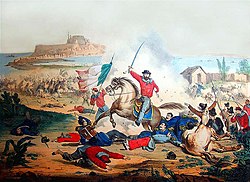
On May 5, 1860, Giuseppe Garibaldi departed from Quarto near Genoa with approximately 1,000 volunteers, known as the Expedition of the Thousand, aboard two steamships to support the unification of Italy by overthrowing Bourbon rule in Sicily and Naples. The force landed at Marsala on the western coast of Sicily on May 11, evading initial Bourbon naval interception despite numerical disadvantages. Two days later, on May 13, local Sicilian insurgents joined Garibaldi, swelling his ranks before engaging Bourbon forces. The expedition's first major clash occurred on May 15 at the , where Garibaldi's roughly 1,100 men, including volunteers and locals, defeated about 3,000 Bourbon troops under Francesco Landi, despite being outnumbered; the victory, achieved through bold uphill charges, boosted morale and encouraged widespread defections and uprisings across . This battle marked a turning point, demonstrating the volunteers' resolve and tactical superiority, paving the way for advances toward . In the United States, political tensions over intensified amid presidential nominations. On May 9, the Constitutional Union Party convened in , nominating John Bell of for president and of for vice president on a platform emphasizing adherence to the Constitution and Union preservation without addressing directly. The met in from May 16 to 18; after multiple ballots, delegates nominated of for president on May 18 and of for vice president, reflecting the party's anti- expansion stance and sectional Northern support. These nominations underscored deepening divisions, with Southern states viewing Lincoln's candidacy as a threat to 's extension.

June

On June 18, the reconvened in , following the deadlock at its earlier session in Charleston; Northern delegates nominated Senator of for president on the second ballot, endorsing a platform that affirmed on in the territories while rejecting a federal slave code. Southern delegates, dissatisfied with the platform's avoidance of a slave code demanded by pro-slavery interests, walked out on June 22 and formed a separate convention, nominating Vice President of on June 23 to represent Southern Democratic positions favoring stronger federal protections for . This schism formalized the Democratic Party's fracture along sectional lines, contributing to a fragmented presidential field that enabled Republican Abraham Lincoln's victory later in the year without Southern electoral votes. In , Giuseppe Garibaldi's , after capturing on May 27 amid urban fighting that killed around 500 Neapolitan troops and civilians, continued consolidating control over western Sicily in June; Neapolitan forces under General Ferdinando Lanza retreated from surrounding positions by June 6, concluding an that allowed Bourbon troops to evacuate Palermo while Garibaldi recruited additional volunteers and suppressed local unrest. By mid-June, Garibaldi's irregular forces, bolstered by Sicilian insurgents, numbered over 10,000 and advanced eastward, skirmishing with Bourbon garrisons and laying the groundwork for further conquests toward , though major battles like lay ahead in July. Sectarian violence escalated in the Ottoman province of on June 19–20, when militias launched coordinated attacks on Maronite Christian villages, massacring between 400 and 1,000 civilians in events tied to longstanding land and tax disputes exacerbated by weak Ottoman governance; these killings prompted European diplomatic pressure on the Porte and foreshadowed French military intervention in August. In , Alexander II established the State Bank of the on June 12 (Old Style), centralizing credit and discounting operations previously handled by the State Commercial Bank to support industrial development amid post-Crimean War reforms, though its immediate impact on the economy remained limited by serf emancipation burdens. The U.S. Congress passed an act on June 23 creating the Government Printing Office to centralize federal document production, standardizing operations that had previously relied on scattered contracts and addressing inefficiencies in disseminating laws and reports; the office began operations in 1861 under Superintendent John D. Defrees. On June 16, Congress authorized subsidies for a transcontinental telegraph line from the Missouri River to the Pacific Coast, a measure championed by Senator William P. Fessenden to connect California and accelerate communication, ultimately rendering the recently launched Pony Express obsolete within two years.

July

Sectarian violence escalated in the Ottoman province of Syria during early July 1860, as conflicts between Druze and Maronite Christians from Mount Lebanon spilled into Damascus. On July 9, riots broke out in the city, where Druze and Muslim mobs attacked Christian neighborhoods, leading to widespread destruction and an estimated 5,000 to 6,000 Christian deaths over several days. Ottoman authorities, including the governor Ahmed Pasha, were accused of complicity or inaction, exacerbating the massacres that also involved looting and forced conversions. The events prompted European powers, particularly France, to demand intervention, resulting in the dispatch of Ottoman forces under Fuad Pasha to restore order and punish perpetrators by late July. In the United States, extreme heatwaves struck the Midwest on July 9, with temperatures reaching 115°F (46°C) in , and 112°F (44°C) in Topeka, contributing to agricultural stress amid growing sectional tensions over . Concurrently, infrastructural expansion continued as the first railroad line reached on , facilitating settlement and commerce in the territory recently organized under the Kansas-Nebraska Act. These developments underscored the economic disparities between free and slave states, heightening political divisions in the prelude to the . A total solar eclipse occurred on July 18, visible across the from to , marking the first such event observable in the region since 1806 and drawing scientific interest despite limited instrumentation. In , Giuseppe Garibaldi's volunteer army advanced against Bourbon forces during the . The Battle of commenced on July 15, when approximately 4,000 Garibaldini assaulted the fortified port town held by 12,000 Neapolitan troops under General Bosco. After five days of grueling combat, including bayonet charges and naval support, the Bourbon garrison surrendered on July 20, yielding eastern to the revolutionaries and enabling Garibaldi's push toward . This tactical victory, achieved through superior morale and terrain exploitation despite numerical inferiority, bolstered the Risorgimento movement toward Italian unification under Piedmontese leadership.

August

On August 3, the Second Māori War commenced in , marking an escalation in conflicts between tribes and British colonial forces over land disputes in the region. This phase followed earlier skirmishes and involved significant engagements that highlighted ongoing tensions from the . August 5 saw Charles XV, also known as Carl IV in Norway, crowned King of Norway in Trondheim, solidifying the personal union between Sweden and Norway under his rule. The ceremony underscored the dual monarchy's stability amid European nationalist movements. On August 8, the USS Mohican captured the slave ship Erie off the coast of the Congo River, liberating approximately 900 enslaved Africans who were subsequently transported to Monrovia, Liberia, for resettlement. This action exemplified ongoing U.S. naval efforts to suppress the Atlantic slave trade under international agreements. August 11 marked the operation of the first successful silver mill in , processing ore from the and initiating a major silver boom that fueled western economic expansion. A pivotal moment in Italian unification occurred on August 19, when Giuseppe Garibaldi's crossed the Straits of Messina and landed at Melito di Porto Salvo in , extending the revolutionary campaign from to the mainland . This landing, involving around 3,000 volunteers by then, bypassed Neapolitan defenses and rapidly advanced northward, contributing to the collapse of Bourbon rule. The Victoria Bridge over the in officially opened on August 25, inaugurated by the Prince of Wales (future ), representing the longest bridge in the world at three kilometers and a triumph of tubular wrought-iron engineering. The structure facilitated vital rail links between and the , enhancing trade connectivity. On August 30, Europe's first street tramway began operations in , , running horse-drawn cars from Woodside Ferry to over 1.5 miles of track, innovating urban passenger transport. This system, promoted by American entrepreneur , preceded similar developments in and influenced subsequent European tram networks.

September

On September 7, , leading the in support of Italian unification, entered unopposed after King Francis II of the Two Sicilies fled the city the previous day, marking a pivotal collapse of Bourbon rule in . This triumphal arrival, greeted by massive crowds, accelerated the integration of the Kingdom of the Two Sicilies into the emerging under , with Garibaldi's forces having already secured and much of the mainland through prior victories. On September 8, the Lady Elgin, carrying passengers from a political rally in back to , sank in after a collision with the Augusta amid gale-force winds and high seas approximately nine miles off , resulting in an estimated 297 to 300 deaths and constituting the deadliest maritime disaster on the up to that time. The Lady Elgin broke apart rapidly, with survivors clinging to debris in rough waters; the incident prompted subsequent maritime safety reforms, including enhanced regulations on vessel lighting and collision protocols. On September 20, Albert Edward, Prince of Wales (later King Edward VII), arrived in the United States as the first British royal to visit the country, landing in Halifax, Nova Scotia, before proceeding to various North American sites, an event organized to strengthen Anglo-American relations amid post-Crimean War diplomacy. On September 21, during the Second Opium War, Anglo-French allied forces decisively defeated Qing dynasty troops at the Battle of Palikao (Baliqao) near Beijing, clearing the path for the capture of the imperial capital and contributing to the eventual signing of the Convention of Peking, which expanded foreign concessions in China.

October

On October 1, Giuseppe Garibaldi's volunteer army defeated a larger Neapolitan force at the Battle of Volturno near , securing control over much of amid the campaign for unification. This engagement involved approximately 20,000 Italian irregulars under Garibaldi facing 40,000 royal troops, with Garibaldi's forces leveraging terrain and morale to repel attacks despite being outnumbered. In the Second Opium War, Anglo-French expeditionary forces looted the outside on October 6, following their advance from the captured Dagu forts. British and French troops entered on October 13–15, prompting Qing Emperor Xianfeng to flee the capital. In retaliation for the torture and execution of British envoy Harry Parkes and others, British forces under Lord Elgin burned the on October 18–19, destroying much of the imperial retreat's treasures and pavilions as a punitive measure against the Qing court. The , concluding the Second Opium War, was signed on October 24 between the Qing Empire and Britain, with France following shortly after; it legalized the opium trade, ceded the to Britain, opened additional including , and indemnified the allies for war costs totaling 8 million taels. These terms expanded Western extraterritorial rights and missionary access in , marking a significant erosion of Qing . Plebiscites held on October 21 in the former overwhelmingly favored annexation to the , with recording 1,302,064 votes in favor and 10,312 against, and showing similar lopsided results of 432,053 to 667. On October 26, King met Garibaldi at , symbolically assuming command of southern forces and advancing the unification process under Piedmontese leadership. In the United States, the Prince of Wales (future ) visited George Washington's estate on October 5 during his North American tour, the first such royal visit, where he planted chestnut trees and toured the grounds amid heightened pre-election tensions. A massive Republican "Wide-Awake" torchlight parade occurred in on October 5, involving thousands of uniformed marchers supporting Abraham Lincoln's presidential bid and highlighting sectional divisions over . On October 8, the first telegraph line connecting and became operational, spanning 500 miles and facilitating rapid communication across . Samuel A. B. Abbott took the first successful aerial photograph of from a on October 13.

November

On November 6, 1860, Abraham Lincoln of the Republican Party was elected the 16th President of the United States, securing 180 electoral votes against 123 for opponents split among Northern Democrat Stephen A. Douglas (12 votes), Southern Democrat John C. Breckinridge (72 votes), and Constitutional Union candidate John Bell (39 votes). Lincoln received 1,865,593 popular votes, or approximately 39.8% of the total, with turnout reaching 81.2% of eligible voters amid intense sectional divisions over slavery expansion. The victory, achieved without carrying a single Southern state, intensified Southern fears of federal interference with slavery, prompting immediate calls for secession conventions in states like South Carolina, where the legislature resolved on November 10 to convene a convention on December 17 to consider leaving the Union. The election outcome reflected deep partisan fractures, with Republicans opposing slavery's extension into territories while demanded its protection, including a proposed that failed to gain traction. Lincoln's win marked the first Republican presidential success, built on Northern industrial and free-soil interests, but it excluded slave states from his popular vote base, fueling perceptions of Northern dominance. In the following days, Southern accelerated disunion rhetoric, and President James Buchanan's cabinet grew unstable as Southern members resigned, while Lincoln began consultations in , including a November 12 meeting with vice president-elect to plan cabinet selections. Elsewhere, the Siege of Gaeta commenced around November 6, 1860, as forces under General Enrico Cialdini blockaded the Bourbon stronghold in the Kingdom of the Two Sicilies, pressuring King Francis II to surrender amid Giuseppe Garibaldi's earlier conquests in and . This operation, part of the Risorgimento's push for Italian unification under , involved over 30,000 Piedmontese troops encircling the fortress, which held out until February 1861 despite naval bombardments and supply shortages. The siege underscored the collapse of Neapolitan resistance following plebiscites in that favored annexation to Sardinia, advancing the consolidation of southern territories into a nascent Italian state.

December

On December 20, 1860, South Carolina's secession convention unanimously adopted an ordinance declaring the state seceded from the , marking the first formal dissolution of ties with the Union following Abraham Lincoln's election the previous month. The convention, convened earlier in the month, cited as primary cause the non-slaveholding states' "increasing hostility on the part of the non-slaveholding States to the institution of " and their failure to suppress alleged violations of the Fugitive Slave Act, viewing Lincoln's Republican victory as a culmination of Northern aggression against Southern interests in preserving . The ordinance passed without dissent, reflecting the state's long-standing commitment to and , with delegates ratifying it 169-0 after debates emphasizing constitutional grievances over federal overreach. The secession declaration, issued immediately after the ordinance, articulated specific grievances including the election of a president hostile to slavery without Southern electoral support and the non-slave states' refusal to extradite fugitive slaves or cease agitation against the institution. , who assumed office on the same day, endorsed the action and urged other Southern states to follow, framing it as a defense of against perceived Northern tyranny. This event precipitated a cascade of secessions, as South Carolina's move emboldened states fearing abolitionist policies under the incoming administration. On December 30, state militiamen seized the federal arsenal in Charleston, securing arms and ammunition while leaving as the primary remaining Union-held property in the state, escalating tensions toward potential conflict. This action, part of a broader pattern of appropriating federal installations, underscored South Carolina's determination to establish independent defenses amid the secession crisis.

Date Unknown

In 1860, assumed the governorship of , advancing centralist reforms that undermined the federal under President Santiago Derqui. These actions, amid ongoing disputes over constitutional authority and provincial autonomy, represented a pivotal shift toward ' dominance in national politics. Mitre's policies emphasized and military preparedness, setting the stage for the decisive Battle of Pavón in September 1861.

Births

January–March

January 17 (d. 1949), Irish Gaelic scholar, writer, and first from 1938 to 1945. January 25 (d. 1936), American politician who served as the 31st of the under from 1929 to 1933, and the first person with documented Native American ancestry to reach that office. January 25 – Takaaki Katō (d. 1926), Japanese diplomat and politician who served as the 24th from 1924 to 1926. February 10 (; 29 January Julian) – Anton Pavlovich Chekhov (d. 1904), Russian playwright, short-story , and physician, considered one of the greatest short-story writers in the history of . February 21 – William Goscombe John (d. 1952), Welsh sculptor and medallist known for works including war memorials and portrait busts. March 19 (d. 1925), American politician, orator, and three-time Democratic nominee for (1896, 1900, 1908), also serving as under from 1913 to 1915.

April–June

On April 3, the initiated its relay mail service, with the inaugural rider departing St. Joseph, Missouri, at approximately 5:00 p.m., carrying mail destined for , via a route spanning over 1,900 miles serviced by 190 stations and 80 riders who changed horses every 10-15 miles to achieve delivery times as short as 10 days. The convened in , on April 23 but dissolved without nominating a presidential candidate by early May due to irreconcilable sectional divisions over , particularly the party's platform plank on territorial expansion, prompting around 50 southern delegates to walk out on and leading to separate northern and southern tickets later in the year. In Europe, launched the on May 5, departing from near with roughly 1,000 volunteer fighters aboard two steamships, aiming to liberate from Bourbon rule as part of the broader Risorgimento movement for Italian unification under the . The force landed unopposed at on May 11 despite Neapolitan naval presence, then advanced inland to secure a pivotal victory at the on May 15, where Garibaldi's 1,200 men routed approximately 3,000 royal troops through determined bayonet charges, boosting recruitment among Sicilian insurgents and paving the way for the capture of by late May. In the United States, the assembled in from May 16 to 18, nominating as its presidential candidate on the third ballot amid intense competition from rivals like , with the platform emphasizing opposition to slavery's expansion into territories while avoiding direct calls for abolition to maintain broad northern support. This selection reflected the party's strategic pivot toward a midwestern figure perceived as less polarizing than eastern frontrunners, setting the stage for Lincoln's general election victory despite his absence from ballots in most southern states.

July–September

In July 1860, Giuseppe Garibaldi's volunteer army continued its campaign against the Kingdom of the Two Sicilies in , culminating in the Battle of from to 24. Garibaldi's forces, numbering approximately 4,000 men including Sicilian recruits, assaulted the fortified town held by a Neapolitan of similar strength under General Bosco. After intense fighting, including , the Garibaldini captured the citadel on July 20, compelling the Bourbon troops to surrender five days later; this victory secured northeastern and facilitated the subsequent investment of . During August, following the consolidation of Sicilian gains, Garibaldi orchestrated the invasion of the Italian mainland. On August 18–19, roughly 4,000 troops crossed the in small boats under cover of night, landing unopposed at Melito di Porto Salvo in despite Neapolitan expectations of attack elsewhere. Local populations rose in support, swelling ranks and enabling swift advances with little organized resistance from Bourbon forces, as Garibaldi's column marched northward through toward . September saw the rapid collapse of Bourbon authority in southern Italy. Garibaldi's army entered Basilicata on September 2, then pressed to ; King Francis II evacuated the city on September 6 amid popular unrest, allowing Garibaldi to enter triumphantly on September 7 amid massive crowds acclaiming him as liberator. Plebiscites held in (early September) and (early October, but prepared in September) overwhelmingly favored annexation to the Kingdom of , advancing Italian unification under . Elsewhere, the Lady Elgin sank in on September 8 after colliding with the Augusta during a , resulting in approximately 300 deaths—the deadliest Great Lakes maritime disaster at the time. The vessel, carrying passengers from to , broke apart rapidly off the Illinois shore, with survivors clinging to wreckage amid high winds.

October–December

On October 1, Giuseppe Garibaldi's army of approximately 20,000 volunteers defeated a larger Neapolitan force of 40,000 under General Giorgio Carafa at the Battle of Volturno, securing control over much of and paving the way for the Kingdom of Italy's formation. This victory, part of the Expedition of the Thousand's broader campaign, demonstrated the effectiveness of irregular volunteer tactics against conventional Bourbon troops, though it relied on subsequent Piedmontese regular army support to consolidate gains. In the Second Opium War, Anglo-French forces captured on October 12, prompting Emperor Xianfeng to flee and leading to the looting of the ; this pressure resulted in the on October 24, which legalized the opium trade, opened additional ports, and ceded to Britain, effectively ending the conflict on terms favorable to the Western powers. On November 6, won the U.S. with 39.8% of the popular vote and 180 electoral votes, primarily from Northern and border states, as the Democratic Party split between Northern and Southern candidates fragmented opposition. Lincoln's platform opposed the expansion of into territories but did not call for immediate abolition in existing states, yet Southern leaders interpreted the result as a direct threat to their economic and social order dependent on , accelerating secessionist movements. Voter turnout reached 81.2%, reflecting intense sectional polarization. Tensions escalated in December when South Carolina's secession convention unanimously adopted an on December 20, declaring the state independent from the Union due to perceived federal threats to slavery and . Governor , a proponent of Southern interests, oversaw the seizure of federal arsenals, including Charleston on December 30, leaving as the primary Union-held outpost amid rising hostilities. This act, justified by South Carolinians as a response to Lincoln's election and long-standing grievances over tariffs and fugitive slave laws, marked the first formal break and inspired similar conventions in other states. Concurrently, the siege of , a Bourbon stronghold, began on November 5 and intensified through December, with Piedmontese forces bombarding the fortress, contributing to the collapse of Neapolitan resistance by early 1861.

Deaths

January–June

In January 1860, tensions over intensified in the United States as , particularly from , adopted resolutions demanding federal protection for in the territories, foreshadowing divisions at upcoming party conventions. On April 3, the initiated its first transcontinental mail delivery service, with riders departing simultaneously from St. Joseph, Missouri, and , covering the 1,900-mile route in relay using 190 stations and 400 horses, operating until October 1861 when the transcontinental telegraph rendered it obsolete. The convened in , on April 23 but fractured over slavery platforms; after 57 ballots failing to nominate a candidate, Southern delegates walked out on May 1, leading to the party's split, with Northern Democrats reconvening in on June 18 to nominate , while Southerners nominated separately. The met in from May 16 to 18, nominating as presidential candidate on the third ballot after initial support for rivals like waned due to his perceived radicalism; the platform opposed slavery's expansion in territories but avoided abolition in states. In , launched the on May 5, departing near with approximately 1,000 volunteers aboard the steamships Lombardo and Washington to support uprisings against the Kingdom of the Two Sicilies, landing unopposed at , , on May 11 despite Bourbon naval presence. Garibaldi's forces secured an early victory at the Battle of Calatafimi on May 15 against Bourbon troops, bolstering recruitment among Sicilian locals opposed to King Francis II's rule, and advanced to besiege Palermo from May 27 to 30, where urban insurgents aided in forcing a Bourbon withdrawal after street fighting. By June, Garibaldi controlled much of western Sicily, with plebiscites planned to annex it to the Kingdom of Sardinia, marking a pivotal advance in Italian unification under Piedmontese leadership. The Constitutional Union Party, comprising former Whigs and others seeking compromise, nominated John Bell for president at its May 9 convention in , advocating preservation of the Union and existing laws without addressing directly.

July–December

In July 1860, Giuseppe Garibaldi's continued its campaign against the Kingdom of the Two Sicilies, culminating in the Battle of Milazzo on July 20, where his approximately 4,000 volunteers defeated a larger Bourbon force of over 12,000 troops, securing control over northeastern and paving the way for the invasion of the Italian mainland. On September 7, Garibaldi entered unopposed after the Bourbon king Francis II fled, prompting widespread plebiscites in and that October favoring annexation to the Kingdom of Sardinia, with reported votes of 99% approval in both regions despite questions over the process's integrity. Forces under Garibaldi clashed with Neapolitan troops at the on October 1, where roughly 20,000 Garibaldini repelled 30,000 Bourbon soldiers, marking the largest battle of the campaign; by October 26, Garibaldi met King at and subordinated his army to royal command, effectively ending his independent operations and facilitating the unification of . The , signed on October 18, concluded the Second Opium War, with China ceding to Britain, opening additional ports to foreign trade, and paying indemnities to Britain and France, reflecting European imperial expansion in Asia amid weaknesses. In the United States, the presidential election on November 6 saw Republican secure victory with 180 electoral votes and 39.8% of the popular vote (1,865,908 ballots), triumphing over a fractured opposition including Northern Democrat (29.5%), Southern Democrat (18.1%), and Constitutional Unionist John Bell (12.6%), as Lincoln's platform opposing slavery expansion garnered no Southern electoral support and heightened sectional tensions. In response, South Carolina's secession convention unanimously adopted an on December 20, declaring the union dissolved due to perceived Northern encroachments on slavery and , citing federal failures to enforce fugitive slave laws and the election of a president hostile to Southern institutions; this action, led by Governor , initiated the cascade of Southern secessions and federal property seizures in Charleston.

Date Unknown

In 1860, assumed the governorship of , advancing centralist reforms that undermined the federal under President Santiago Derqui. These actions, amid ongoing disputes over constitutional authority and provincial autonomy, represented a pivotal shift toward ' dominance in national politics. Mitre's policies emphasized and military preparedness, setting the stage for the decisive Battle of Pavón in September 1861.

Historical Significance and Interpretations

Role in Prelude to the

The year 1860 marked the culmination of escalating sectional tensions over slavery, as the failure of compromise efforts and the fracturing of national parties exposed irreconcilable differences between Northern and Southern interests. The in , from April 23 to May 3, adjourned without nominating a candidate after 57 ballots, primarily due to disputes over a platform plank demanding federal protection for slavery in the territories; Northern delegates, led by , favored , allowing territorial residents to decide on slavery, while Southern delegates insisted on stronger safeguards. The party reconvened in on June 18, splitting into Northern Democrats nominating Douglas and on a platform, and nominating and , endorsing slavery's protection in all territories. This division weakened Democratic unity, reflecting deeper rifts where Southerners viewed territorial restrictions as existential threats to their slave-based economy and social order. In response, the Republican Party convened in from May 16 to 18, nominating , a former Illinois congressman known for his 1858 Senate debates against Douglas, on a platform explicitly opposing the expansion of into federal territories while pledging non-interference with it in existing Southern states. A third faction, the Constitutional Union Party, nominated John Bell and , advocating preservation of the Union without addressing directly, appealing to border state moderates. The November 6 election saw Lincoln secure 1,865,908 popular votes (39.8 percent) and 180 electoral votes, winning every free state except while carrying zero Southern states, underscoring the North's growing political dominance and the South's electoral irrelevance in a Republican victory. Southern leaders interpreted this as a rejection of their demands for 's perpetual security, fearing federal policies would encircle and ultimately dismantle the institution, despite Lincoln's inaugural assurances to the contrary. The election's aftermath ignited the secession crisis within 1860, with South Carolina's legislature calling a convention that unanimously adopted an on December 20, declaring the Union dissolved over the "increasing hostility on the part of the non-slaveholding States to the institution of " and the election of a sectional president. This act, justified in declarations citing to protect from perceived Northern aggression, prompted immediate calls for secession conventions in other Deep South states, though only South Carolina acted before year's end; six more followed by February 1, 1861, forming the . Failed attempts at reconciliation, such as the proposed in December, which sought constitutional amendments to protect south of the 36°30' parallel, collapsed amid Republican opposition to any expansion guarantees. Thus, 1860's not only elected a president committed to containing but catalyzed the Southern bid for , transforming prelude into open rupture.

Contributions to Italian Unification

In 1860, Giuseppe Garibaldi's Expedition of the Thousand marked a pivotal military contribution to Italian unification by liberating Sicily and Naples from Bourbon rule, facilitating their annexation to the Kingdom of Sardinia. Comprising approximately 1,000 volunteers, primarily from northern Italy, the force departed Genoa on May 6 aboard the steamships Lombardo and Washington, evading Neapolitan warships to land at Marsala, Sicily, on May 11. This landing capitalized on a Sicilian uprising against Bourbon King Francis II that had erupted on April 4, providing immediate local support despite the expedition's modest initial numbers. Garibaldi's campaign progressed rapidly through guerrilla tactics and decisive battles, swelling ranks with local recruits to over 20,000 by mid-campaign. On May 15, his forces defeated 2,000 Neapolitan troops at Calatafimi, a victory that demoralized Bourbon defenders and secured western . Palermo fell after street fighting on June 27, followed by the Siege of Milazzo from July 15 to 20, where Redshirts overcame entrenched positions to control northeastern . Crossing the on August 19-20 despite naval opposition, Garibaldi advanced northward, entering unopposed on September 7 after King Francis II fled to . These conquests dismantled Bourbon authority in the Kingdom of the Two Sicilies without direct Piedmontese intervention, though Camillo Cavour covertly facilitated while publicly distancing the to avoid European backlash. Plebiscites held on October 21 formalized annexation: in , 432,053 voted in favor of union with against 667 opposed, while continental provinces including showed similarly lopsided results exceeding 99% approval among participants. King met Garibaldi at on October 26, assuming command and entering on November 7; royal decree annexed the territories on December 17. Cavour's subsequent dispatch of Piedmontese troops to conquer and the Marches in September, defeating papal forces, secured , complementing Garibaldi's southern gains. By year's end, these actions unified the peninsula from the to of under rule, excluding , , and minor enclaves, paving the way for the Kingdom of Italy's proclamation in 1861. Garibaldi's deference to Victor Emmanuel, despite his republican ideals, ensured monarchical consolidation rather than republican upheaval, aligning popular fervor with Cavour's diplomatic strategy of incremental expansion through plebiscites and alliances. This synergy overcame internal divisions—Mazzinian radicals versus monarchists—and external threats, as European powers acquiesced to faits accomplis without major intervention. The 1860 campaigns thus transformed unification from northern-centric diplomacy post-1859 into a near-complete national framework, driven by Garibaldi's audacious volunteerism and Cavour's pragmatic statecraft.

Broader Global Impacts

The launch of HMS Warrior on December 29, 1860, marked the advent of iron-hulled, armor-plated warships, displacing traditional wooden vessels and compelling naval powers worldwide to modernize their fleets. Measuring 420 feet in length with a speed of 14.5 knots, Warrior demonstrated the superiority of steam propulsion combined with iron armor, influencing designs in the United States during its Civil War and accelerating an arms race among European navies that reshaped colonial projection and maritime dominance. Garibaldi's , commencing May 11, 1860, facilitated the rapid conquest of by July 20 and by September 7, propelling the unification of under the and inspiring nationalist movements across Europe by exemplifying popular insurgency against fragmented monarchies. This shift weakened Austrian hegemony in the , redistributed territorial influence—evident in France's acquisition of and via the Treaty of Turin on March 24—and contributed to the ideological fervor that underpinned later German unification under . The , ratified on October 24, 1860, after Anglo-French forces occupied in October, extracted concessions from the including the cession of to Britain, legalization of the opium trade, opening of 11 additional , and indemnities totaling 16 million taels of silver shared between Britain and . These terms entrenched extraterritorial rights for foreigners, lowered import tariffs to 5 percent, and enabled permanent legations in the capital, fostering deeper economic penetration that drained Chinese silver reserves, intensified social decay from opium addiction affecting millions, and eroded Qing sovereignty, setting precedents for further imperialist encroachments in . Abraham Lincoln's victory in the U.S. presidential election on November 6, 1860, with 39.8 percent of the popular vote but 180 electoral votes, triggered the of on December 20 and subsequent Southern states, signaling to European powers the imminent fracture of the and potential opportunities for intervention amid dependencies on American exports that supplied 80 percent of Britain's raw material needs. British and French observers, anticipating disruptions, debated neutrality policies that would later evolve into considerations of Confederate recognition, while the crisis underscored the global interdependence of slavery-driven economies and influenced abolitionist discourses in .

Historiographical Debates and Controversies

Historians have long debated the underlying causes of Southern secession following Abraham Lincoln's election on November 6, 1860, with interpretations ranging from an inevitable clash over 's expansion to broader conflicts over and economic interests. Early 20th-century scholars, influenced by the , emphasized constitutional disputes and Reconstruction-era resentments, often minimizing 's centrality in favor of narratives portraying the South as defending federalism against Northern aggression. Post-World War II shifted toward viewing as the primary driver, supported by secession ordinances explicitly citing the institution's protection—such as South Carolina's declaration on December 20, 1860, which blamed Northern hostility to for dissolving the Union—alongside quantitative evidence of deepening sectional divergences in labor systems and ideology by 1860. Revisionist critiques persist, arguing that academic consensus overemphasizes moral antislavery rhetoric at the expense of tariffs, territorial ambitions, or cultural incompatibilities, potentially reflecting modern ideological biases in that privilege racial justice narratives over multifaceted causal analysis. In Italian unification historiography, the led by in May 1860 is contested between romantic portrayals of grassroots nationalism and revisionist accounts framing it as a Piedmontese-orchestrated that imposed monarchical centralism on disparate regions. Traditional Risorgimento narratives, dominant until the mid-20th century, celebrated Garibaldi's of and as a triumphant popular revolt against Bourbon tyranny, culminating in the Kingdom of Italy's proclamation on March 17, 1861, and attributing success to charismatic volunteerism evidenced by the rapid surrender of 25,000 Neapolitan troops at Volturno on October 1, 1860. Denis Mack Smith's analyses, however, highlight elite manipulations by Camillo Cavour, portraying the events as incomplete and coercive, with limited Southern buy-in—Sicily's literacy rate lagged at under 10% compared to Piedmont's 30%—foreshadowing the "Southern Question" of economic underdevelopment and revolts exceeding 100,000 insurgents by 1861. Contemporary debates, amplified by cultural critiques, question Garibaldi's heroism through lenses of or , yet these often rely on selective reinterpretations unsubstantiated by primary military records, underscoring tensions between empirical event reconstruction and ideologically driven revisions. Cross-regional comparisons of 1860 reveal controversies over whether these events signaled a liberal democratic surge or authoritarian consolidations masked as progress. In the American context, debates question the election's decisiveness—Lincoln garnered 39.8% of the popular vote yet swept Northern states—versus contingent factors like the Democratic split, with some scholars arguing war was avoidable absent panic-driven secessions totaling seven states by February 1861. Italian scholars counter that unification's 1860 pivot succeeded due to pragmatic alliances, not inevitability, but engendered long-term instabilities, as plebiscites in (October 21, 1860) yielded 432,000 yes votes amid coerced participation. These interpretations highlight a meta-issue in global : institutional biases in post-1960s academia, particularly left-leaning emphases on anti-elite , may undervalue and empirical metrics like troop mobilizations or economic data in favor of egalitarian reframings, necessitating scrutiny of source motivations in causal attributions.
Previous yearNext year

References

Add your contribution
Related Hubs
User Avatar
No comments yet.