Hubbry Logo
Active laser mediumActive laser mediumMain
Open search
Active laser medium
Community hub
Active laser medium
logo
8 pages, 0 posts
0 subscribers
Be the first to start a discussion here.
Active laser medium
Active laser medium
from Wikipedia
Laser rods (from left to right): Ruby, alexandrite, Er:YAG, Nd:YAG

The active laser medium (also called a gain medium or lasing medium) is the source of optical gain within a laser. The gain results from the stimulated emission of photons through electronic or molecular transitions to a lower energy state from a higher energy state previously populated by a pump source.

Examples of active laser media include:

In order to fire a laser, the active gain medium must be changed into a state in which population inversion occurs. The preparation of this state requires an external energy source and is known as laser pumping. Pumping may be achieved with electrical currents (e.g. semiconductors, or gases via high-voltage discharges) or with light, generated by discharge lamps or by other lasers (semiconductor lasers). More exotic gain media can be pumped by chemical reactions, nuclear fission,[7] or with high-energy electron beams.[8]

Example of a model of gain medium

[edit]
Simplified scheme of levels in a gain medium

The simplest model of optical gain in real systems includes just two, energetically well separated, groups of sub-levels. Within each sub-level group, fast transitions ensure that thermal equilibrium is reached quickly. Stimulated emissions between upper and lower groups, essential for gain, require the upper levels to be more populated than the corresponding lower ones. This situation is called population-inversion. It is more readily achieved if unstimulated transition rates between the two groups are slow, i.e. the upper levels are metastable. Population inversions are more easily produced when only the lowest sublevels are occupied, requiring either low temperatures or well energetically split groups.

In the case of amplification of optical signals, the lasing frequency is called signal frequency. If the externally provided energy required for the signal's amplification is optical, it would necessarily be at the same or higher pump frequency.

Cross-sections

[edit]

The simple medium can be characterized with effective cross-sections of absorption and emission at frequencies and .

  • Have be concentration of active centers in the solid-state lasers.
  • Have be concentration of active centers in the ground state.
  • Have be concentration of excited centers.
  • Have .

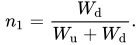
The relative concentrations can be defined as and .
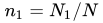
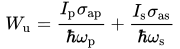
The rate of transitions of an active center from the ground state to the excited state can be expressed like this: .
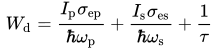
While the rate of transitions back to the ground state can be expressed like: , where and are effective cross-sections of absorption at the frequencies of the signal and the pump, and are the same for stimulated emission, and is rate of the spontaneous decay of the upper level.
Then, the kinetic equation for relative populations can be written as follows:

,
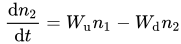
However, these equations keep .
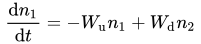
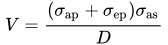
The absorption at the pump frequency and the gain at the signal frequency can be written as follows:

and .

Steady-state solution

[edit]

In many cases the gain medium works in a continuous-wave or quasi-continuous regime, causing the time derivatives of populations to be negligible.

The steady-state solution can be written:

,
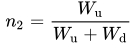
The dynamic saturation intensities can be defined:

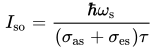
, .
The absorption at strong signal: .
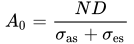
The gain at strong pump: , where is determinant of cross-section.
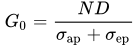

Gain never exceeds value , and absorption never exceeds value .

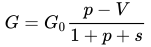
At given intensities , of pump and signal, the gain and absorption can be expressed as follows:

, ,
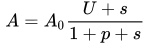
where , , , .

Identities

[edit]

The following identities[9] take place: ,

The state of gain medium can be characterized with a single parameter, such as population of the upper level, gain or absorption.

Efficiency of the gain medium

[edit]

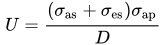
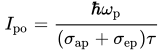
The efficiency of a gain medium can be defined as .

Within the same model, the efficiency can be expressed as follows: .
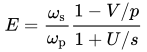
For efficient operation, both intensities—pump and signal—should exceed their saturation intensities: , and .

The estimates above are valid for a medium uniformly filled with pump and signal light. Spatial hole burning may slightly reduce the efficiency because some regions are pumped well, but the pump is not efficiently withdrawn by the signal in the nodes of the interference of counter-propagating waves.

See also

[edit]

References and notes

[edit]
[edit]
Revisions and contributorsEdit on WikipediaRead on Wikipedia
from Grokipedia
The active laser medium, also known as the gain medium, is the core component of a laser system responsible for amplifying light through , where excited atoms or molecules release photons in phase with incoming light to produce coherent, . This amplification occurs after achieving via external pumping, typically optical or electrical, which excites the medium's atoms or molecules from lower to higher energy states, enabling net gain that overcomes optical losses in the laser resonator. Active laser media are classified by their physical state and composition, including solids such as ion-doped crystals (e.g., Nd:YAG) and glasses, which offer high efficiency and compactness for continuous-wave operation; liquids like organic dyes (e.g., rhodamine 6G) that provide broad tunability across visible wavelengths; gases such as helium-neon mixtures for low-power visible s or for high-power infrared output; and semiconductors like for compact, electrically pumped devices. Key properties influencing performance include the gain bandwidth, which determines wavelength tunability; emission cross-section, affecting amplification efficiency; thermal conductivity for heat management in high-power applications; and quantum defect, representing energy loss during emission. These media enable diverse applications from precision cutting and medical procedures to scientific research, with selection depending on desired wavelength, power, and beam quality.

Fundamentals

Definition and role

The active laser medium, also known as the gain medium, is the physical material within a laser that enables optical amplification through stimulated emission of radiation. It typically consists of atoms, ions, molecules, or electrons that can be excited to higher states, where they store before releasing it as coherent light photons. The primary role of the active medium is to achieve and maintain , a non-equilibrium condition in which more particles occupy a higher than a lower one, allowing the rate of to exceed absorption and produce net optical gain for coherent light output. This distinguishes it from passive laser components, such as mirrors or the source, which do not participate in the amplification process but support and excitation. By providing this gain, the medium ensures the laser's ability to generate intense, monochromatic beams suitable for applications in science, industry, and . The basic process begins with excitation of the medium by an external energy source, such as electrical discharge or , which populates the higher energy levels and establishes . When photons from interact with the inverted medium, they trigger , amplifying the intensity as additional photons are emitted in phase with the incident ones. This amplification occurs within an , where feedback sustains the process until a portion of the escapes as the beam. For efficient lasing, the active medium must possess suitable discrete energy levels that enable the desired transitions, a long upper-state lifetime—often on the order of microseconds to milliseconds—to allow accumulation of the inverted , and low internal losses to minimize energy dissipation and maximize gain. These properties ensure that the medium can sustain inversion against relaxation processes and achieve threshold conditions for laser oscillation with minimal input power.

Historical context

The concept of , essential for laser action in active media, was first introduced by in 1917 as part of his quantum theory of radiation, where he proposed it as the counterpart to and absorption to explain the Planck blackbody spectrum. This theoretical foundation remained largely unexplored until the mid-20th century, when microwave amplification by of radiation () experiments revived interest in coherent light generation. Following World War II, Charles H. Townes and colleagues at Columbia University developed the first maser in 1954 using ammonia gas as the active medium, demonstrating population inversion for microwave amplification. Extending these principles to optical frequencies, Townes collaborated with Arthur L. Schawlow at Bell Laboratories to publish a seminal paper in 1958 outlining the design of an "optical maser," or laser, emphasizing the need for a suitable active medium to achieve stimulated emission at visible wavelengths. The first practical realization came in 1960 when Theodore H. Maiman at Hughes Research Laboratories constructed the inaugural laser using a synthetic ruby crystal (chromium-doped aluminum oxide) as the solid-state active medium, pumped by a flashlamp to produce pulsed red light at 694 nm. Subsequent milestones rapidly diversified active media types. In late 1960, Ali Javan, William R. Bennett Jr., and Donald R. Herriott at Bell Laboratories demonstrated the first gas laser using a helium-neon mixture, operating continuously at 1.15 μm infrared, which was also the first continuous-wave laser. The first continuous-wave operation at the visible 632.8 nm wavelength was achieved in 1962 with an improved He-Ne design, enabling stable output for applications requiring steady beams. In 1966, Peter P. Sorokin and John R. Lankard at IBM reported the first dye laser, employing organic dye solutions like chloroaluminum phthalocyanine in ethanol as the liquid active medium, pumped by a ruby laser for tunable visible emission. Continuous-wave dye laser operation was achieved in 1970 by O. G. Peterson, S. A. Tuccio, and B. B. Snavely at Eastman Kodak using rhodamine 6G in a detergent solution. Semiconductor lasers emerged concurrently, with the first demonstration in 1962 by independent teams including Robert N. Hall at and M. I. Nathan at , using forward-biased gallium arsenide p-n junctions cooled to cryogenic temperatures for pulsed output. Practical room-temperature CW operation was realized in 1970 by Izuo Hayashi and Morton B. Panish at Bell Laboratories through double-heterostructure GaAs-AlGaAs designs, dramatically improving efficiency and enabling compact, electrically pumped devices. These developments were propelled by deepening insights from into atomic and molecular transitions, coupled with advances in that facilitated the transition from bulky gaseous and crystalline media to more compact, tunable and for broader technological integration.

Classification of media

Gaseous media

Gaseous laser media utilize ionized or excited gases as the active medium, enabling lasing through atomic, molecular, or transitions, with primary pumping via electrical discharge or electron-beam excitation to achieve primarily through collisional energy transfer. These media offer advantages such as high optical purity, scalability to large volumes, and tunability via broadening, making them suitable for both continuous-wave and pulsed operations. Atomic gaseous media, exemplified by the helium-neon (He-Ne) laser, employ a mixture of where serves as the lasing species. The typical gas composition is approximately 10:1 to at low pressures (around 1 ), excited by an electrical discharge that transfers energy from helium metastable states to neon via collisions. This results in continuous-wave operation at a primary wavelength of 632.8 nm in the visible red spectrum, with overall efficiency around 0.1%. He-Ne lasers are valued for their stability and coherence in applications like alignment and . Molecular gaseous media, such as those in carbon dioxide (CO₂) lasers, rely on vibrational-rotational transitions in triatomic molecules mixed with buffer gases. A common composition is CO₂:N₂:He in ratios like 1:1:6 at total pressures of about 20 Torr, where nitrogen enhances energy transfer to CO₂'s upper lasing levels via resonant collisions, and helium aids in depopulating the lower level. Electrical discharge pumping enables high-power continuous-wave output at 10.6 μm in the mid-infrared, with efficiencies of 10-20% and powers scalable to kilowatts for industrial cutting and welding. Excimer gaseous media involve rare-gas halide molecules, such as fluoride (ArF) or fluoride (KrF), which lase via bound-free transitions from electronically excited dimer states to repulsive ground states, emitting in the . These operate in mixtures like Ar:F₂:Ne or Kr:F₂:He at pressures up to several atmospheres, pumped by high-energy electron beams or fast electrical discharges to form the transiently. Typical wavelengths are 193 nm for ArF and 248 nm for KrF, with pulsed operation yielding energies of hundreds of millijoules per pulse (up to joules in high-power systems) and repetition rates of tens to hundreds of Hz, ideal for semiconductor lithography.

Liquid and dye media

Liquid and dye media consist of organic dyes dissolved in liquid solvents, serving as versatile active media for lasers due to their molecular properties that enable broad spectral coverage. Common dyes include rhodamine 6G and derivatives, which are typically dissolved in polar solvents such as or to form solutions with concentrations optimized for . These dyes exhibit broad absorption and emission bands, spanning tens to hundreds of nanometers, arising from vibronic transitions involving molecular vibrations and solvent interactions that introduce inhomogeneous broadening. Operation of dye lasers relies on optical pumping using flashlamps or other lasers, such as nitrogen or argon-ion lasers, to excite the dye molecules from the to higher singlet states, followed by rapid relaxation to the lowest excited where occurs. The output is highly tunable across the to near-infrared spectrum (approximately 300–1000 nm) by selecting appropriate s or employing intracavity elements like prisms or gratings for selection, allowing continuous tuning over the gain bandwidth of individual dyes. For instance, rhodamine 6G provides efficient lasing around 570–650 nm, while dyes extend coverage into the blue-green region. Key characteristics of these media include high quantum yields, often ranging from 0.5 to 1, with rhodamine 6G achieving approximately 0.95 in , enabling efficient conversion of pump energy to output. The upper has a short lifetime, typically on the order of a few nanoseconds, necessitating fast pumping rates to maintain and avoid significant losses from . However, —irreversible chemical degradation of dye molecules under intense illumination—limits operational lifetime, with quantum yields for bleaching as low as 10^{-6} for rhodamine 6G in aqueous solutions, requiring careful management of pump intensity and exposure time. The first demonstration of a occurred in 1966, when Fritz P. Schäfer and colleagues achieved using a dye solution pumped by a mercury lamp, marking the advent of tunable lasers. These systems have since become essential in , particularly for generating pulses via mode-locking techniques, enabling time-resolved studies of ultrafast processes such as . Some dyes exhibit peak efficiencies around 70%, as observed in optimized systems, contributing to their utility in high-resolution applications. Advantages of liquid dye media include their exceptionally broad gain bandwidths, facilitating passive mode-locking for generation down to femtoseconds and wide tunability for applications like . However, the susceptibility to necessitates circulating flow systems to refresh the dye solution, preventing buildup of degraded molecules and extending operational duty cycles, though this adds complexity to the setup.

Solid-state and crystalline media

Solid-state and crystalline active laser media consist of ions incorporated into a host lattice, such as crystals or glasses, which provide structural stability and enable efficient energy storage for lasing action. Common dopants include trivalent (Nd³⁺), (Cr³⁺), and (Ti³⁺) ions, embedded in hosts like yttrium aluminum (YAG, Y₃Al₅O₁₂) for Nd³⁺, (Al₂O₃) for Cr³⁺ or Ti³⁺, and glasses for broader emission spectra due to their amorphous structure allowing inhomogeneous broadening. These media are prized for their mechanical ruggedness and ability to handle high pump energies without degradation, unlike fluid-based alternatives. Operation typically involves with flashlamps or lasers to achieve , often in a four-level scheme that facilitates efficient lasing by minimizing the lower-level population. For instance, the Nd:YAG laser operates at 1064 nm via this scheme, where the upper laser level is populated from broad absorption bands around 808 nm. The , using Cr³⁺:Al₂O₃, was the first demonstrated in 1960, emitting at 694 nm under flashlamp pumping. Similarly, Ti³⁺: enables tunable operation from 650 to 1100 nm, pumped optically for ultrafast applications. Commercial Nd:YAG systems emerged in the 1960s, with flashlamp-pumped efficiencies typically around 2-3%, though pumping later improved this to over 5%. Key characteristics include long upper-state lifetimes, ranging from 230 μs in Nd:YAG to 3 ms in , which allow substantial before dominates. Crystalline hosts like YAG exhibit high thermal conductivity, approximately 13 W/m·K at , aiding heat dissipation during high-power operation. techniques, enabled by these long lifetimes, produce pulses with peak powers reaching gigawatts in solid-state systems, ideal for applications requiring intense bursts. These media offer advantages such as compactness and durability, making them suitable for rugged environments, but suffer from thermal lensing due to pump-induced heating, which distorts the beam and limits continuous-wave power output.

Semiconductor and fiber media

active media utilize direct bandgap materials such as (GaAs) and (InP), which are fabricated into p-n junction diodes to enable lasing action. Electrical injection pumping drives by injecting carriers across the junction, exciting electrons from the valence band to the conduction band, where they can recombine radiatively to produce photons. This process leverages the semiconductor's band structure for efficient , with gain occurring primarily through transitions between these bands. The first semiconductor laser was demonstrated in 1962 using GaAs by Robert N. Hall at , marking the initial realization of laser action in a solid-state electronic medium. Operation involves spontaneous that is amplified by within the optical cavity formed by the diode facets. These lasers emit across a broad wavelength range, from near 400 nm using (GaN) to mid-infrared beyond 3 μm with indium antimonide (InSb)-based structures. Continuous-wave room-temperature operation was achieved in 1970 through double-heterostructure designs in GaAs/AlGaAs by teams including Izuo Hayashi, Morton Panish, and , enabling practical applications. Distributed feedback (DFB) lasers, introduced in the 1970s, incorporate periodic gratings for single-frequency output, improving spectral purity for and sensing. Semiconductor lasers exhibit high wall-plug efficiencies approaching 50%, converting electrical input to optical output effectively, and support modulation speeds exceeding 1 GHz due to their compact size and fast carrier dynamics. These characteristics make them ideal for integration in compact devices like transceivers and scanners. active media, such as rare-earth-doped optical fibers, provide a waveguide-based platform for lasing and amplification, with ions (Er³⁺) doped into silica glass enabling emissions at 1550 nm for . These fibers are typically pumped by lasers at 980 nm or 1480 nm, achieving in the rare-earth energy levels through absorption and subsequent energy transfer, yielding distributed gain along fiber lengths up to several kilometers. Erbium-doped fiber amplifiers (EDFAs), developed in the late , revolutionized optical by enabling low-loss signal boosting over transoceanic distances without electronic regeneration. Fiber media offer advantages including single-mode beam output for minimal and the ability to function as amplifiers without discrete resonators, leveraging the fiber's inherent waveguiding for high gain . Wall-plug efficiencies can reach ~50% in optimized systems, supporting high-power, continuous-wave operation in compact, alignment-free configurations.

Physical mechanisms

Population inversion

Population inversion is a non-equilibrium condition in the active laser medium where the number of atoms or molecules in the upper (denoted as level 2, with population N2N_2) exceeds that in the lower (level 1, with population N1N_1), such that N2>N1N_2 > N_1. This state violates the typical of , in which lower energy levels are more heavily populated. It is a prerequisite for net optical amplification because, under inversion, the rate of surpasses absorption, enabling the medium to amplify light rather than attenuate it. Achieving requires external input, known as pumping, to selectively populate the upper level. Common methods include , where absorption of photons from a source (such as a flashlamp or another ) excites atoms to higher states, followed by relaxation to the lasing upper level. Electrical discharge pumping relies on collisions between energetic electrons and atoms or molecules in a gas medium, transferring to create the inversion, as seen in many gas lasers. Chemical pumping occurs through exothermic reactions that directly produce species in the , for example in gasdynamic lasers where high-speed flow and reaction kinetics maintain the non-equilibrium. In a simple two-level system, population inversion is theoretically unattainable in practice because the pumping rate to the upper level is balanced by the equal probability of stimulated absorption from it, preventing N2N_2 from exceeding N1N_1. Multi-level schemes address this limitation: three-level systems, such as the ruby laser, involve pumping from the ground state to a higher "pump" level, with rapid non-radiative decay to the upper laser level; inversion requires exciting more than half the total population to achieve N2>N1N_2 > N_1, leading to higher pump thresholds. Four-level systems are more efficient, as the lower laser level empties quickly via fast relaxation to the ground state, allowing inversion with a small fraction of the population in the upper level and thus lower thresholds. These schemes are illustrated in qualitative energy level diagrams, where arrows depict pumping, stimulated emission between levels 1 and 2, and decay pathways (e.g., in a four-level diagram, a broad pump band leads to level 4, fast decay to level 3 (upper), lasing to level 2 (lower), and rapid decay to level 1 (ground)). The threshold for establishing occurs when the pumping rate surpasses the combined decay rates from the upper level, ensuring sustained N2>N1N_2 > N_1. The lifetime of this inversion is inherently limited by , governed by the Einstein coefficient A21A_{21}, which quantifies the probability per unit time of an atom in level 2 decaying to level 1 via emission; higher A21A_{21} values shorten the viable inversion duration, necessitating continuous pumping. This condition of is essential across all types of media to enable the dominance of .

Stimulated emission and gain

is the fundamental process enabling optical amplification in an active laser medium, where an incident triggers an excited atom or in the upper to transition to a lower level, releasing a second that is identical in phase, direction, polarization, and to the first. This coherent emission contrasts with , which produces photons randomly, and requires a —where more atoms occupy the upper state than the lower—as a prerequisite for net gain. The rate of stimulated emission is proportional to the density and the population difference between the upper (N₂) and lower (N₁) states, ensuring that under inversion (N₂ > N₁), emission dominates over absorption. The Einstein coefficient B₂₁ quantifies this process, relating the stimulated emission rate to the radiation at ν, such that the transition probability per unit time is B₂₁ ρ(ν), where ρ(ν) is the per unit . In laser media, this leads to the gain coefficient g(ν), defined as g(ν) = σ(ν)(N₂ - N₁), where σ(ν) is the stimulated emission cross-section at ν; this small-signal gain applies at low intensities where the inversion remains largely unaffected. Line broadening influences the shape of the gain profile across frequencies. Homogeneous broadening, arising from lifetime-limited processes like or collisions, affects all atoms equally, resulting in a Lorentzian lineshape. In contrast, inhomogeneous broadening, such as due to thermal motion in gaseous media, varies among atoms, producing a Gaussian profile that can support multimode operation. At higher intensities, gain saturation occurs as stimulated emission depletes the population inversion faster than it can be replenished, reducing the effective gain and imposing limits on output power. This nonlinear effect is described by the saturation intensity I_sat, beyond which the gain drops, often halving at I = I_sat for homogeneous media. Typical gain lengths in laser media range from centimeters in crystalline solids to meters in fiber amplifiers, balancing amplification with practical cavity design.

Absorption and cross-sections

In active laser media, absorption occurs when ground-state atoms or molecules absorb pump photons, transitioning to excited upper energy levels that enable . This process is fundamental for in , where the absorption probability is quantified by the absorption cross-section σ_a(λ), which represents the effective area per atom or for capture at λ. The cross-section σ_e(λ) similarly characterizes the likelihood of on the lasing transition, determining the medium's gain potential. The net gain coefficient for the laser transition is given by g(λ) = [σ_e(λ) N_2 - σ_a(λ) N_1], where N_2 and N_1 are the population densities in the upper and lower lasing levels, respectively; the total single-pass gain is then exp(g L), with L as the medium length. Typical cross-sections in laser media range from 10^{-20} to 10^{-18} cm², varying by material and transition. Cross-sections are measured via using broadband sources to obtain spectral profiles, requiring knowledge of the active ion density, or through gain measurements in oscillators by analyzing threshold conditions and saturation fluxes. In molecular media like dyes, dependence arises from Franck-Condon factors, which govern vibronic overlap and shape the absorption and emission bands. Temperature and pressure influence cross-sections through spectral broadening mechanisms; for instance, in gaseous media, due to thermal motion reduces the peak σ_a while widening the line, with the effect scaling as √T/m (T temperature, m atomic mass). For the solid-state medium Nd:YAG, the stimulated emission cross-section at 1064 nm is approximately 2.8 × 10^{-19} cm², exemplifying high-gain transitions in crystals.

Theoretical models

Rate equations

The rate equations describe the of the densities in the levels of the active medium and the density within the cavity, providing the foundation for modeling the dynamic processes leading to lasing. These equations are derived from for the atomic system and for the field, under a semiclassical approximation where quantum effects in the field are neglected but included for the matter. They account for pumping, , , absorption, and cavity losses, enabling analysis of transients such as buildup and relaxation oscillations in pulsed operation. For a basic two-level system, consisting of a ground state (level 1) and an excited state (level 2), the population rate equations are: dN2dt=RN2τσeIhν(N2N1)\frac{dN_2}{dt} = R - \frac{N_2}{\tau} - \frac{\sigma_e I}{h\nu} (N_2 - N_1) dN1dt=dN2dt\frac{dN_1}{dt} = -\frac{dN_2}{dt} where N1N_1 and N2N_2 are the population densities in levels 1 and 2, respectively (with total density N=N1+N2N = N_1 + N_2); RR is the pumping rate from level 1 to 2 (often due to optical or electrical absorption); τ\tau is the upper-level lifetime (inverse of the total decay rate); σe\sigma_e is the stimulated emission cross-section; II is the intracavity intensity at frequency ν\nu; hh is Planck's constant. The term involving σeI/hν\sigma_e I / h\nu represents net stimulated transitions (emission minus absorption), assuming equal cross-sections for emission and absorption in a simple two-level model. However, such systems cannot sustain population inversion (N2>N1N_2 > N_1) under continuous pumping due to equal stimulated rates in both directions, limiting their practical use for lasing without additional mechanisms. In real lasers, multi-level systems are employed to achieve and maintain inversion more efficiently. For a three-level system, typical of the , pumping occurs from the (level 1) to a higher pump band (level 3), followed by rapid non-radiative decay to the upper lasing level (level 2), with the lower lasing level being the . The extended rate equations are: dN3dt=R13N1N3τ32R31N3\frac{dN_3}{dt} = R_{13} N_1 - \frac{N_3}{\tau_{32}} - R_{31} N_3 dN2dt=N3τ32N2τ21σeIhν(N2N1)\frac{dN_2}{dt} = \frac{N_3}{\tau_{32}} - \frac{N_2}{\tau_{21}} - \frac{\sigma_e I}{h\nu} (N_2 - N_1) dN1dt=dN3dtdN2dt\frac{dN_1}{dt} = - \frac{dN_3}{dt} - \frac{dN_2}{dt} Here, R13R_{13} is the absorption pumping rate from level 1 to 3 (proportional to pump intensity and absorption cross-section); τ32\tau_{32} is the short lifetime from level 3 to 2 (enabling rapid repopulation of level 2); and τ21\tau_{21} is the longer lifetime of the lasing transition. Inversion requires pumping more than half the ground-state population to level 2, as level 1 remains the lower lasing state. For four-level systems, common in Nd:YAG lasers, an additional fast decay from the lower lasing level (level 3) to the ground state ensures N30N_3 \approx 0, simplifying inversion since only a small fraction of atoms needs excitation to level 2 (the upper lasing level). The equations extend similarly, with an extra term for dN3/dtdN_3/dt including rapid emptying (τ31τ21\tau_{31} \ll \tau_{21}). The pumping rate RR in these models arises from absorption processes, often R=σaIpNg/hνpR = \sigma_a I_p N_g / h\nu_p, where σa\sigma_a is the absorption cross-section, IpI_p the pump intensity, and NgN_g the ground-state density. The dynamics are governed by a coupled for the intracavity ϕ\phi (or intensity I=hνϕc/nI = h\nu \phi c / n, with c/nc/n the speed in the medium): dϕdt=Γσehν(N2N1)ϕϕτc+βN2τ21\frac{d\phi}{dt} = \Gamma \frac{\sigma_e}{h\nu} (N_2 - N_1) \phi - \frac{\phi}{\tau_c} + \beta \frac{N_2}{\tau_{21}} where Γ\Gamma is the confinement factor (fraction of mode overlapping the active medium); τc\tau_c is the cavity lifetime (determined by mirror reflectivities and losses); and β\beta (typically 105\sim 10^{-5} to 10210^{-2}) accounts for into the lasing mode. The first term represents net gain from stimulated processes, the second cavity losses, and the third noise from , which initiates lasing. These equations are fully coupled, with ϕ\phi or II feeding back into the population rates. The standard rate equations assume homogeneous broadening (uniform interaction across the ensemble), no spatial variations (uniform pumping and fields, valid for small gain media), and a semiclassical treatment ignoring field quantization and coherent effects like Rabi flopping. The upper-level lifetime τ\tau (e.g., τ21\tau_{21}) is a key parameter, typically 10310^{-3} to 10910^{-9} s depending on the medium, influencing gain and pulse dynamics. In practice, these nonlinear differential equations are solved numerically (e.g., via Runge-Kutta methods) to simulate transients, such as the buildup time to lasing or relaxation oscillations in pulsed regimes, where populations and photons evolve on timescales from nanoseconds to microseconds.

Steady-state analysis

The steady-state analysis of an active laser medium is derived by setting the time derivatives of the population densities in the rate equations to zero, assuming continuous-wave (CW) operation where transients have decayed and conditions remain constant over timescales longer than the upper-level lifetime τ. This approach applies to equilibrium lasing, predicting population distributions, gain, and power output under balanced pumping, , and losses. For a general multi-level system, the steady-state upper-level population N₂ satisfies dN₂/dt = 0, leading to N₂ = R τ / [1 + I / I_sat], where R is the rate, τ is the lifetime, I is the intracavity photon flux intensity, hν is the transition , and I_sat = hν / (σ_e τ) is the saturation intensity with σ_e the cross-section. For pump saturation, the effective rate is R = R_0 / [1 + I_p / I_{p,sat}], where I_p is the intensity and I_{p,sat} the saturation intensity. The ΔN = N₂ - N₁ follows from the balance of rates as ΔN = R / (σ_e I / hν + 1/τ), where the denominator captures both spontaneous decay and depletion. occurs when the small-signal gain g₀ = σ_e ΔN equals the total losses α (internal plus output coupling), requiring ΔN_th = α / σ_e; below threshold, no net gain exists, and above it, the inversion clamps near ΔN_th to maintain g₀ ≈ α. For a four-level laser, where the lower level is rapidly depopulated (N₁ ≈ 0), the threshold rate simplifies to R_th ≈ α / (σ_e τ), highlighting the role of cross-section and lifetime in minimizing requirements. In steady-state operation, the small-signal gain provides a baseline measure of amplification potential as g₀ = σ_e ΔN, which saturates with increasing I to g = g₀ / (1 + I / I_sat). The output power is approximated as P_out ≈ η (g₀ - α) I_pump, where η is the quantum efficiency and I_pump is the intensity, reflecting how excess gain above losses converts to output efficiently in well-designed cavities. This analysis enables prediction of threshold pump power and optimization for CW lasers, such as Nd:YAG systems where low thresholds arise from large σ_e and long τ.

Efficiency and identities

The efficiency of an active laser medium is quantified through several key metrics that describe the conversion of input energy to output laser power. Slope efficiency, denoted as ηs\eta_s, represents the incremental increase in output power per unit increase in pump power above threshold and is defined as ηs=dPoutdPpump\eta_s = \frac{dP_\text{out}}{dP_\text{pump}}. For optically pumped , this is fundamentally limited by the quantum efficiency ηq\eta_q, which accounts for the fraction of absorbed pump photons that produce lasing photons, and the ratio: ηs=ηq(λpλl)\eta_s = \eta_q \left( \frac{\lambda_p}{\lambda_l} \right), where λp\lambda_p is the pump and λl\lambda_l is the laser . This relation arises because each absorbed photon at shorter λp\lambda_p can produce at most one photon at longer λl\lambda_l, introducing a Stokes shift loss. Optimized solid-state can achieve ηs>50%\eta_s > 50\% relative to incident pump power, though values below 30% are common in less efficient systems. Wall-plug efficiency, ηwp\eta_{wp}, measures the overall as the of optical output power to total electrical input power: ηwp=PoutPelectrical\eta_{wp} = \frac{P_\text{out}}{P_\text{electrical}}. This metric encompasses losses in the power supply, driver electronics, and cooling s, with dissipation being a primary contributor due to non-radiative recombination and heat generation in the gain medium. Typical values for many laser types range from 40% to 50%, though diode-pumped solid-state lasers often achieve around 25% and high-power fiber lasers up to 50%. Direct electrical pumping in lasers can exceed these limits, but remains critical to prevent roll-off at high powers. Mathematical identities derived from detailed balance principles link the spectroscopic properties of the active medium, enabling prediction of emission behavior from absorption data. A key reciprocity relation connects the absorption cross-section σa\sigma_a and stimulated emission cross-section σe\sigma_e for the same transition: σa(ν)/σe(ν)gupper/glower\sigma_a(\nu) / \sigma_e(\nu) \approx g_\mathrm{upper} / g_\mathrm{lower}, where g(ν)g(\nu) represents the normalized lineshape function of the spectral transition and degeneracies are included. This identity stems from the principle of in , incorporating level degeneracies, and is particularly useful for solid-state gain media with Stark-split levels. The McCumber theory extends this to quasi-three-level systems, providing a framework to compute emission cross-sections from measured absorption spectra via σem(ν)=σabs(ν)exp[(hνE)/kT]\sigma_\mathrm{em}(\nu) = \sigma_\mathrm{abs}(\nu) \exp[(h\nu - E)/kT], where E is the McCumber , with high accuracy in laser crystals. Fundamental limits on efficiency are imposed by and . The maximum theoretical efficiency is η=ElEp\eta = \frac{E_l}{E_p} for pump photon energy Ep>ElE_p > E_l, reflecting the unavoidable Stokes loss in systems where the pump photon energy exceeds the transition energy. In multi-level gain media, additional losses occur due to non-radiative relaxation pathways, reducing the internal quantum efficiency ηq<1\eta_q < 1 and further limiting the overall conversion. For instance, in four-level lasers, rapid depopulation of the lower minimizes , allowing efficiencies closer to the Stokes limit, whereas three-level systems require near-complete inversion, exacerbating losses. Specific media exhibit characteristic efficiencies tied to their mechanisms. Semiconductor lasers, benefiting from direct electrical pumping and minimal thermal losses, achieve wall-plug efficiencies up to 73% at 70 W output power and 25°C in passively cooled 940 nm bars, approaching the practical limit for high-power operation. In contrast, dye lasers typically operate at around 10% efficiency due to significant non-radiative decay, primarily from triplet-state trapping that competes with radiative emission and requires mitigation strategies like flowing solvents. These examples highlight how material-specific processes, such as non-radiative paths in organic dyes versus efficient carrier recombination in semiconductors, dictate performance bounds.

Advanced topics

Nonlinear effects

In active laser media subjected to high optical intensities, nonlinear effects arise when the response of the material deviates from linear behavior, primarily due to intensity-dependent interactions that alter gain, absorption, and . These phenomena become prominent in high-power or ultrafast systems, limiting output power, pulse quality, and efficiency by introducing distortions such as spectral broadening or beam instability. Unlike linear regimes where gain and loss are intensity-independent, nonlinearities stem from processes like population depletion or electronic/hyperpolarizability responses, necessitating careful design to mitigate their impact in applications ranging from amplifiers to mode-locked oscillators. Gain saturation occurs when intense signal light depletes the in the active medium, reducing the small-signal gain coefficient as intensity increases. This effect is described by the intensity-dependent gain g(I)=g01+I/Isat,g(I) = \frac{g_0}{1 + I / I_\mathrm{sat}}, where g0g_0 is the unsaturated gain, II is the intracavity intensity, and IsatI_\mathrm{sat} is the saturation intensity, typically on the order of 1–10 kW/cm² for solid-state media. At intensities approaching IsatI_\mathrm{sat}, the gain drops to half its unsaturated value, constraining power scaling in continuous-wave lasers by clamping the output to avoid excessive inversion depletion. In amplifiers, gain saturation also leads to spectral hole burning in inhomogeneously broadened media, further complicating high-power operation. Nonlinear absorption manifests in doped laser media through processes like (TPA), where simultaneous absorption of two s excites electrons to higher states, or upconversion in rare-earth-doped hosts, both of which increase loss at high pump intensities. In materials such as - or ion-doped polymers, TPA cross-sections on the order of 10⁻⁵⁰ cm⁴ s/ reduce by shunting away from the desired lasing transition, particularly under pumping where peak powers exceed 10¹² W/cm². For instance, in Cu-phthalocyanine-doped PMMA films, nonlinear absorption dominates in the near-infrared, enabling applications in optical limiting but degrading performance at elevated powers. Upconversion in Yb³⁺-doped fibers similarly competes with , limiting slope to below 70% at high pump densities. Self-phase modulation (SPM), driven by the , induces a intensity-dependent change n=n0+n2In = n_0 + n_2 I, where n2n_2 is the nonlinear index (typically 10⁻¹⁶ cm²/W for silica s), causing temporal phase shifts that broaden the during propagation. In lasers, this chirping effect is critical for ultrafast , as it generates new components via Δϕ=(2π/λ)n2LeffI(t)\Delta \phi = (2\pi / \lambda) n_2 L_\mathrm{eff} I(t), with LeffL_\mathrm{eff} the effective , leading to up to 10-fold spectral expansion for 100-fs s at peak powers above 1 kW. SPM limits the achievable in erbium-doped amplifiers by promoting unwanted nonlinear mixing, though it enables supercontinuum when balanced with dispersion. Thermal nonlinearities arise from heat-induced refractive index variations, characterized by the thermo-optic coefficient dn/dTdn/dT (e.g., 10⁻⁵ K⁻¹ for Nd:YAG), which creates a and equivalent thermal lens under high pump absorption. In end-pumped solid-state lasers, this lensing alters and can induce or mode hopping, with focal lengths as short as 10 cm at 100 W pump powers, degrading beam quality factor M2M^2 beyond 1.5. Nonlinear refraction from combined and electronic effects exacerbates this in thin-disk geometries, where radial temperature profiles up to 100 K lead to wavefront aberrations. These effects are particularly evident in Ti:sapphire lasers generating pulses, where SPM and gain saturation broaden spectra by factors of 2–5 and limit pulse energies to below 10 nJ without compensation, as observed in chirped-pulse amplification systems. strategies, such as cladding-pumped designs, reduce intensity in the core by distributing pump light over a larger area, suppressing SPM and thermal lensing to enable kW-level outputs with nonlinear phase shifts below π.

Recent developments

In the realm of nanostructured active laser media, quantum dots and have emerged as key materials for tunable lasers since the 2010s, offering enhanced quantum yields and facile synthesis for emission. quantum dots, in particular, enable low-threshold lasing due to their defect-tolerant structures and high carrier mobilities, with applications in integrated . The first demonstration of a occurred in 2014, using organometallic halide perovskites in a microcavity to achieve at room temperature. Subsequent advancements in colloidal quantum dots have pushed efficiencies toward practical levels, with solution-processed devices exhibiting lasing thresholds below 10 μJ/cm². For applications, GaN-based nanostructures have seen efficiency improvements up to over 50% in the 2020s, with reports reaching 52.4% for blue edge-emitting lasers through optimized epitaxial growth and designs, enabling high-power operation at wavelengths around 405 nm without significant thermal degradation. Hybrid active media integrating two-dimensional (2D) materials like with traditional gain media have revolutionized mode-locking in , leveraging the broadband of these layers to generate ultrashort pulses. , with its ultrafast recovery time on the order of picoseconds, serves as an efficient saturable absorber when embedded in - or thulium-doped fibers, facilitating passive mode-locking at wavelengths from 1.5 to 2 μm. For instance, multilayer integrated into a Tm-doped has produced 654 fs pulses at 1940 nm, demonstrating stability over extended operation. Emerging 2D materials beyond , such as dichalcogenides, further enhance these hybrid systems by providing tunable absorption edges, enabling dual-wavelength mode-locking with pulse energies up to nJ levels. High-power fiber lasers based on ytterbium-doped photonic crystal fibers (PCFs) have achieved kilowatt-level continuous-wave (CW) output since the mid-2010s, mitigating thermal lensing through large-mode-area designs and air-clad structures. Commercial systems utilizing Yb-doped PCFs deliver over 1 kW of single-mode power at 1070 nm with slope efficiencies above 70%, free from nonlinear distortions at high intensities. These fibers, often with core diameters exceeding 50 μm, support beam quality factors (M²) near 1.1, making them suitable for industrial applications like materials processing. Exotic active media, including plasma-based systems, have advanced (EUV) lasing for and , where laser-produced tin plasmas generate coherent 13.5 nm radiation. Driven by CO₂ lasers at repetition rates up to 50 kHz, these plasmas achieve conversion efficiencies of several percent into EUV, powering high-volume . Complementing this, filamentation in air has enabled transient gain media, with laser-induced filaments creating nitrogen (N₂⁺) populations that support lasing at 391 nm, as demonstrated in 2018 experiments achieving gain lengths over 1 m without external cavities. Room-temperature polariton lasers, utilizing microcavities to couple s and photons, have realized thresholdless operation since around 2020, bypassing traditional for coherent emission. In perovskite microcavities, strong light-matter coupling yields condensates with thresholds as low as ~0.5 W/cm² under continuous-wave pumping, enabling efficient blue-green lasing as of 2025. These devices leverage organic or perovskites for robust binding energies, promising scalable, low-power sources for quantum technologies.

References

Add your contribution
Related Hubs
User Avatar
No comments yet.