



Community hub
Recent from talks
Contribute something
Nothing was collected or created yet.
AdaBoost
View on Wikipedia| Part of a series on |
| Machine learning and data mining |
|---|
AdaBoost (short for Adaptive Boosting) is a statistical classification meta-algorithm formulated by Yoav Freund and Robert Schapire in 1995, who won the 2003 Gödel Prize for their work. It can be used in conjunction with many types of learning algorithm to improve performance. The output of multiple weak learners is combined into a weighted sum that represents the final output of the boosted classifier. Usually, AdaBoost is presented for binary classification, although it can be generalized to multiple classes or bounded intervals of real values.[1][2]
AdaBoost is adaptive in the sense that subsequent weak learners (models) are adjusted in favor of instances misclassified by previous models. In some problems, it can be less susceptible to overfitting than other learning algorithms. The individual learners can be weak, but as long as the performance of each one is slightly better than random guessing, the final model can be proven to converge to a strong learner.
Although AdaBoost is typically used to combine weak base learners (such as decision stumps), it has been shown to also effectively combine strong base learners (such as deeper decision trees), producing an even more accurate model.[3]
Every learning algorithm tends to suit some problem types better than others, and typically has many different parameters and configurations to adjust before it achieves optimal performance on a dataset. AdaBoost (with decision trees as the weak learners) is often referred to as the best out-of-the-box classifier.[4][5] When used with decision tree learning, information gathered at each stage of the AdaBoost algorithm about the relative 'hardness' of each training sample is fed into the tree-growing algorithm such that later trees tend to focus on harder-to-classify examples.
Training
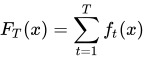
[edit]AdaBoost refers to a particular method of training a boosted classifier. A boosted classifier is a classifier of the form where each is a weak learner that takes an object as input and returns a value indicating the class of the object. For example, in the two-class problem, the sign of the weak learner's output identifies the predicted object class and the absolute value gives the confidence in that classification.


Each weak learner produces an output hypothesis which fixes a prediction for each sample in the training set. At each iteration , a weak learner is selected and assigned a coefficient such that the total training error of the resulting -stage boosted classifier is minimized.


![{\displaystyle E_{t}=\sum _{i}E[F_{t-1}(x_{i})+\alpha _{t}h(x_{i})]}](https://wikimedia.org/api/rest_v1/media/math/render/svg/3ad2646753bae9d7170c88485eec7db956feecc1)
Here is the boosted classifier that has been built up to the previous stage of training and is the weak learner that is being considered for addition to the final classifier.


Weighting
[edit]At each iteration of the training process, a weight is assigned to each sample in the training set equal to the current error on that sample. These weights can be used in the training of the weak learner. For instance, decision trees can be grown which favor the splitting of sets of samples with large weights.


Derivation
[edit]This derivation follows Rojas (2009):[6]
Suppose we have a data set where each item has an associated class , and a set of weak classifiers each of which outputs a classification for each item. After the -th iteration our boosted classifier is a linear combination of the weak classifiers of the form: where the class will be the sign of . At the -th iteration we want to extend this to a better boosted classifier by adding another weak classifier , with another weight :









So it remains to determine which weak classifier is the best choice for , and what its weight should be. We define the total error of as the sum of its exponential loss on each data point, given as follows:



Letting and for , we have:


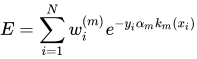
We can split this summation between those data points that are correctly classified by (so ) and those that are misclassified (so ):
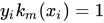

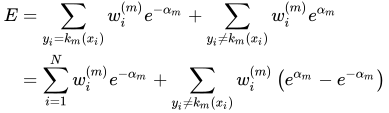
Since the only part of the right-hand side of this equation that depends on is , we see that the that minimizes is the one in the set that minimizes [assuming that ], i.e. the weak classifier with the lowest weighted error (with weights ).
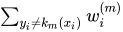

To determine the desired weight that minimizes with the that we just determined, we differentiate:

Luckily the minimum occurs when setting this to zero, then solving for yields:
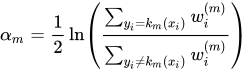
because does not depend on





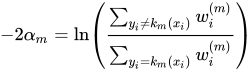
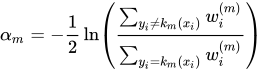
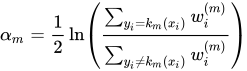
We calculate the weighted error rate of the weak classifier to be , so it follows that: which is the negative logit function multiplied by 0.5. Due to the convexity of as a function of , this new expression for gives the global minimum of the loss function.
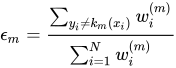
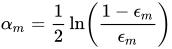
Note: This derivation only applies when , though it can be a good starting guess in other cases, such as when the weak learner is biased (), has multiple leaves () or is some other function .




Thus we have derived the AdaBoost algorithm: At each iteration, choose the classifier , which minimizes the total weighted error , use this to calculate the error rate , use this to calculate the weight , and finally use this to improve the boosted classifier to .


Statistical understanding of boosting
[edit] | This section needs additional citations for verification. (May 2016) |
Boosting is a form of linear regression in which the features of each sample are the outputs of some weak learner applied to .
While regression tries to fit to as precisely as possible without loss of generalization, typically using least square error , whereas the AdaBoost error function takes into account the fact that only the sign of the final result is used, thus can be far larger than 1 without increasing error. However, the exponential increase in the error for sample as increases, resulting in excessive weights being assigned to outliers.



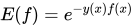


One feature of the choice of exponential error function is that the error of the final additive model is the product of the error of each stage, that is, . Thus it can be seen that the weight update in the AdaBoost algorithm is equivalent to recalculating the error on after each stage.
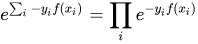

There is a lot of flexibility allowed in the choice of loss function. As long as the loss function is monotonic and continuously differentiable, the classifier is always driven toward purer solutions.[7] Zhang (2004) provides a loss function based on least squares, a modified Huber loss function:

This function is more well-behaved than LogitBoost for close to 1 or -1, does not penalise ‘overconfident’ predictions (), unlike unmodified least squares, and only penalises samples misclassified with confidence greater than 1 linearly, as opposed to quadratically or exponentially, and is thus less susceptible to the effects of outliers.


Boosting as gradient descent
[edit]Boosting can be seen as minimization of a convex loss function over a convex set of functions.[8] Specifically, the loss being minimized by AdaBoost is the exponential loss whereas LogitBoost performs logistic regression, minimizing
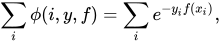

In the gradient descent analogy, the output of the classifier for each training point is considered a point in n-dimensional space, where each axis corresponds to a training sample, each weak learner corresponds to a vector of fixed orientation and length, and the goal is to reach the target point (or any region where the value of loss function is less than the value at that point), in the fewest steps. Thus AdaBoost algorithms perform either Cauchy (find with the steepest gradient, choose to minimize test error) or Newton (choose some target point, find that brings closest to that point) optimization of training error.






Example algorithm (Discrete AdaBoost)
[edit]With:
- Samples
- Desired outputs
- Initial weights set to
- Error function
- Weak learners






For in :

- Choose :
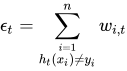
- Find weak learner that minimizes , the weighted sum error for misclassified points
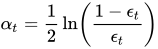
- Choose
- Add to ensemble:
- Update weights:
- for in
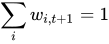
- Renormalize such that
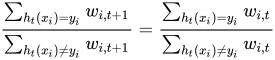
- (Note: It can be shown that at every step, which can simplify the calculation of the new weights.)






Variants
[edit]Real AdaBoost
[edit]The output of decision trees is a class probability estimate , the probability that is in the positive class.[7] Friedman, Hastie and Tibshirani derive an analytical minimizer for for some fixed (typically chosen using weighted least squares error):



- .

Thus, rather than multiplying the output of the entire tree by some fixed value, each leaf node is changed to output half the logit transform of its previous value.
LogitBoost
[edit]LogitBoost represents an application of established logistic regression techniques to the AdaBoost method. Rather than minimizing error with respect to y, weak learners are chosen to minimize the (weighted least-squares) error of with respect to where


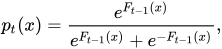


That is is the Newton–Raphson approximation of the minimizer of the log-likelihood error at stage , and the weak learner is chosen as the learner that best approximates by weighted least squares.

As p approaches either 1 or 0, the value of becomes very small and the z term, which is large for misclassified samples, can become numerically unstable, due to machine precision rounding errors. This can be overcome by enforcing some limit on the absolute value of z and the minimum value of w

Gentle AdaBoost
[edit]While previous boosting algorithms choose greedily, minimizing the overall test error as much as possible at each step, GentleBoost features a bounded step size. is chosen to minimize , and no further coefficient is applied. Thus, in the case where a weak learner exhibits perfect classification performance, GentleBoost chooses exactly equal to , while steepest descent algorithms try to set . Empirical observations about the good performance of GentleBoost appear to back up Schapire and Singer's remark that allowing excessively large values of can lead to poor generalization performance.[9][10]



Early termination
[edit]A technique for speeding up processing of boosted classifiers, early termination refers to only testing each potential object with as many layers of the final classifier necessary to meet some confidence threshold, speeding up computation for cases where the class of the object can easily be determined. One such scheme is the object detection framework introduced by Viola and Jones:[11] in an application with significantly more negative samples than positive, a cascade of separate boost classifiers is trained, the output of each stage biased such that some acceptably small fraction of positive samples is mislabeled as negative, and all samples marked as negative after each stage are discarded. If 50% of negative samples are filtered out by each stage, only a very small number of objects would pass through the entire classifier, reducing computation effort. This method has since been generalized, with a formula provided for choosing optimal thresholds at each stage to achieve some desired false positive and false negative rate.[12]
In the field of statistics, where AdaBoost is more commonly applied to problems of moderate dimensionality, early stopping is used as a strategy to reduce overfitting.[13] A validation set of samples is separated from the training set, performance of the classifier on the samples used for training is compared to performance on the validation samples, and training is terminated if performance on the validation sample is seen to decrease even as performance on the training set continues to improve.
Totally corrective algorithms
[edit]For steepest descent versions of AdaBoost, where is chosen at each layer t to minimize test error, the next layer added is said to be maximally independent of layer t:[14] it is unlikely to choose a weak learner t+1 that is similar to learner t. However, there remains the possibility that t+1 produces similar information to some other earlier layer. Totally corrective algorithms, such as LPBoost, optimize the value of every coefficient after each step, such that new layers added are always maximally independent of every previous layer. This can be accomplished by backfitting, linear programming or some other method.
Pruning
[edit]Pruning is the process of removing poorly performing weak classifiers to improve memory and execution-time cost of the boosted classifier. The simplest methods, which can be particularly effective in conjunction with totally corrective training, are weight- or margin-trimming: when the coefficient, or the contribution to the total test error, of some weak classifier falls below a certain threshold, that classifier is dropped. Margineantu & Dietterich[15] suggested an alternative criterion for trimming: weak classifiers should be selected such that the diversity of the ensemble is maximized. If two weak learners produce very similar outputs, efficiency can be improved by removing one of them and increasing the coefficient of the remaining weak learner.[16]
See also
[edit]References
[edit]- ^ Freund, Yoav; Schapire, Robert E. (1995), A desicion-theoretic [sic] generalization of on-line learning and an application to boosting, Lecture Notes in Computer Science, Berlin, Heidelberg: Springer Berlin Heidelberg, pp. 23–37, doi:10.1007/3-540-59119-2_166, ISBN 978-3-540-59119-1, retrieved 2022-06-24
- ^ Hastie, Trevor; Rosset, Saharon; Zhu, Ji; Zou, Hui (2009). "Multi-class AdaBoost". Statistics and Its Interface. 2 (3): 349–360. doi:10.4310/sii.2009.v2.n3.a8. ISSN 1938-7989.
- ^ Wyner, Abraham J.; Olson, Matthew; Bleich, Justin; Mease, David (2017). "Explaining the Success of AdaBoost and Random Forests as Interpolating Classifiers". Journal of Machine Learning Research. 18 (48): 1–33. Retrieved 17 March 2022.
- ^ Kégl, Balázs (20 December 2013). "The return of AdaBoost.MH: multi-class Hamming trees". arXiv:1312.6086 [cs.LG].
- ^ Joglekar, Sachin (6 March 2016). "adaboost – Sachin Joglekar's blog". codesachin.wordpress.com. Retrieved 3 August 2016.
- ^ Rojas, Raúl (2009). "AdaBoost and the super bowl of classifiers a tutorial introduction to adaptive boosting" (Tech. Rep.). Freie University, Berlin.
- ^ a b Friedman, Jerome; Hastie, Trevor; Tibshirani, Robert (1998). "Additive Logistic Regression: A Statistical View of Boosting". Annals of Statistics. 28: 2000. CiteSeerX 10.1.1.51.9525.
- ^ Zhang, T. (2004). "Statistical behavior and consistency of classification methods based on convex risk minimization". Annals of Statistics. 32 (1): 56–85. doi:10.1214/aos/1079120130. JSTOR 3448494.
- ^ Schapire, Robert; Singer, Yoram (1999). "Improved Boosting Algorithms Using Confidence-rated Predictions": 80–91. CiteSeerX 10.1.1.33.4002.
{{cite journal}}: Cite journal requires|journal=(help) - ^ Freund; Schapire (1999). "A Short Introduction to Boosting" (PDF):
- ^ Viola, Paul; Jones, Robert (2001). "Rapid Object Detection Using a Boosted Cascade of Simple Features". CiteSeerX 10.1.1.10.6807.
{{cite journal}}: Cite journal requires|journal=(help) - ^ McCane, Brendan; Novins, Kevin; Albert, Michael (2005). "Optimizing cascade classifiers".
{{cite journal}}: Cite journal requires|journal=(help) - ^ Trevor Hastie; Robert Tibshirani; Jerome Friedman (2009). The Elements of Statistical Learning: Data Mining, Inference, and Prediction (2nd ed.). New York: Springer. ISBN 978-0-387-84858-7. Archived from the original on 2015-03-13. Retrieved 2014-03-13.
- ^ Šochman, Jan; Matas, Jiří (2004). Adaboost with Totally Corrective Updates for Fast Face Detection. IEEE Computer Society. ISBN 978-0-7695-2122-0.
- ^ Margineantu, Dragos; Dietterich, Thomas (1997). "Pruning Adaptive Boosting". CiteSeerX 10.1.1.38.7017.
{{cite journal}}: Cite journal requires|journal=(help) - ^ Tamon, Christino; Xiang, Jie (2000). "On the Boosting Pruning Problem".
{{cite journal}}: Cite journal requires|journal=(help)
Further reading
[edit]- Freund, Yoav; Schapire, Robert E (1997). "A decision-theoretic generalization of on-line learning and an application to boosting". Journal of Computer and System Sciences. 55: 119–139. CiteSeerX 10.1.1.32.8918. doi:10.1006/jcss.1997.1504: original paper of Yoav Freund and Robert E.Schapire where AdaBoost is first introduced.
- Zhou, Zhihua (2008). "On the margin explanation of boosting algorithm" (PDF). In: Proceedings of the 21st Annual Conference on Learning Theory (COLT'08): 479–490. On the margin explanation of boosting algorithm.
- Zhou, Zhihua (2013). "On the doubt about margin explanation of boosting" (PDF). Artificial Intelligence. 203 (2013): 1–18. arXiv:1009.3613. Bibcode:2010arXiv1009.3613G. doi:10.1016/j.artint.2013.07.002. S2CID 2828847. On the doubt about margin explanation of boosting.
AdaBoost
View on GrokipediaOverview and Background
Definition and Purpose
AdaBoost, or Adaptive Boosting, is a meta-algorithm in machine learning that constructs a strong classifier from an ensemble of weak classifiers by sequentially training them and adaptively adjusting the weights of the training examples based on prior performance.[4] It operates within the framework of ensemble learning, where multiple models are combined to achieve better predictive performance than any individual model.[4] Typically, weak classifiers in AdaBoost are simple models such as decision stumps—single-split decision trees that make binary decisions based on one feature—chosen for their computational efficiency and ability to slightly outperform random guessing.[5] The purpose of AdaBoost is to enhance classification accuracy in supervised learning settings, particularly for binary classification tasks where data points are assigned labels of +1 or -1 to denote the two classes.[4] By iteratively emphasizing examples that were misclassified in previous rounds, the algorithm focuses computational effort on difficult cases, leading to an exponential reduction in training error as more weak classifiers are added, assuming each weak learner achieves accuracy marginally better than 50%.[4] This adaptive mechanism ensures that the ensemble progressively refines its decision boundary, resulting in a robust strong classifier suitable for real-world applications like pattern recognition and anomaly detection. At a high level, AdaBoost begins by assigning equal weights to all training examples. In each iteration, a weak learner is trained on the current weighted distribution of examples, its weighted classification error is calculated, and a confidence weight is assigned to the learner based on how well it performs relative to random. The weights of the training examples are then updated—increasing for misclassified instances and decreasing for correctly classified ones—to shift focus toward harder examples. The final strong classifier combines all weak learners through a weighted majority vote, where each contributes according to its assigned confidence.[4]Historical Development
AdaBoost was initially introduced in 1995 by Yoav Freund and Robert E. Schapire through a technical report that outlined a novel adaptive boosting algorithm aimed at enhancing the performance of weak learners.[2] This work built upon earlier boosting concepts, such as those explored in Robert E. Schapire's 1990 analysis of weak learnability, which demonstrated that a weak learning algorithm could be strengthened through repeated calls, and addressed limitations in non-adaptive methods by incorporating example reweighting to focus on misclassified instances.[6] The algorithm was formally presented and experimentally validated in their 1996 paper at the International Conference on Machine Learning (ICML), titled "Experiments with a New Boosting Algorithm," where it was shown to outperform existing methods on benchmark datasets.[7] The foundational contributions of AdaBoost gained significant recognition in 2003 when Freund and Schapire received the Gödel Prize from the Association for Computing Machinery (ACM) Special Interest Group on Algorithms and Computation Theory (SIGACT) and the European Association for Theoretical Computer Science (EATCS) for their 1997 paper, "A Decision-Theoretic Generalization of On-Line Learning and an Application to Boosting," which provided a theoretical framework linking boosting to online learning and decision theory.[8] This award highlighted AdaBoost's impact on machine learning theory, particularly its ability to convert weak hypotheses into strong ones with high probability. By the 2010s, AdaBoost maintained relevance through integrations with emerging techniques, such as hybrid models combining it with deep learning for computer vision tasks like object detection, where it served as a residual corrector alongside convolutional neural networks to refine predictions.[9] Into the 2020s, no major paradigm shifts have supplanted AdaBoost, but it continues to be incorporated into hybrid ensembles, such as with bidirectional long short-term memory networks for precision analysis in agricultural spectroscopy, underscoring its enduring utility in boosting weak models within modern applications.[10]Core Algorithm
Training Procedure
AdaBoost begins with a training dataset consisting of examples , where each is a feature vector and is the corresponding binary label, along with a hypothesis class of weak learners capable of achieving accuracy slightly better than random guessing.[1] The algorithm outputs a strong classifier , which combines weak hypotheses weighted by coefficients .[1] The training procedure initializes equal weights for all training examples to ensure uniform importance at the start.[1] It then proceeds iteratively for a predefined number of rounds : in each round , a weak learner is trained on the current weighted distribution of the data to produce hypothesis ; the weighted training error of is evaluated; the weight for is computed based on this error; the sample weights are updated to increase the emphasis on misclassified examples and decrease it on correctly classified ones; and the process repeats.[1] After iterations, the final ensemble classifier is formed as the sign of the weighted vote across all .[1] This iterative process embodies the adaptive nature of AdaBoost, where each successive weak learner focuses more on the examples that previous learners have mishandled, thereby progressively refining the ensemble's performance on difficult cases.[1] Weak learners, such as simple decision stumps that split data based on a single feature threshold, are commonly employed due to their computational efficiency and ability to serve as effective base models.[11] For multiclass classification problems with labels, AdaBoost can be extended using a one-versus-all strategy, where multiple binary AdaBoost classifiers are trained and combined, though details of such variants like AdaBoost.MH are beyond the scope of the core binary procedure. The overall computational complexity of AdaBoost is , where is the cost of training and evaluating a single weak learner per iteration, making it scalable when paired with inexpensive base learners.[11]Weighting and Iteration
In AdaBoost, sample weights are initialized uniformly across the training set as for each of the examples, ensuring equal importance at the start of training.[12] After selecting a weak hypothesis in iteration , these weights are updated multiplicatively to emphasize misclassified examples: where , is the coefficient assigned to , and is a normalization factor computed as the sum of the unnormalized weights to ensure they sum to 1.[12] This adaptation mechanism increases the relative weight of harder examples exponentially while decreasing that of easier ones, directing future weak learners toward persistent errors.[12] The weak hypothesis is selected in each iteration by identifying the classifier from a base learner family that minimizes the weighted training error with the constraint that for effective boosting.[12] The corresponding coefficient is then set as in the binary classification setting, assigning greater influence to more accurate weak hypotheses.[12] Lower yields larger , reinforcing the focus on reliable contributors in the final ensemble. The boosting process iterates over these steps for a predefined number of rounds, typically ranging from 100 to 1000 depending on dataset complexity and convergence behavior, as longer runs allow the algorithm to refine margins without significant overfitting in practice. Early stopping may be applied if the weighted error stabilizes, halting iterations to balance bias and variance.[13] In implementation, the normalization maintains the weights as a valid distribution, facilitating probabilistic interpretation and consistent error computation across iterations.[12] To mitigate numerical issues like overflow from cumulative exponentiations, weights are often maintained in logarithmic scale or periodically rescaled, preserving stability over many iterations.[13]Mathematical Foundations
Derivation of Update Rules
AdaBoost can be interpreted as a stage-wise additive modeling procedure that minimizes the exponential loss function defined as , where are the binary class labels, are the input features, and is the additive model composed of weak classifiers weighted by coefficients .[14] This loss function penalizes incorrect classifications exponentially, emphasizing misclassified examples more heavily than alternatives like squared error.[14] In the stage-wise approach, the model is built iteratively: at iteration , the previous model is fixed, and a new term is added to minimize the updated loss .[14] Assuming the weights are normalized such that the current distribution is , the loss simplifies to finding and that minimize .[14] To derive the optimal , consider the inner minimization over for a fixed weak classifier . The relevant loss term is . Taking the partial derivative with respect to and setting it to zero yields: This equation separates into contributions from correctly classified () and incorrectly classified () examples. Let be the weighted error rate of . Solving the derivative equation leads to , or equivalently, This choice ensures when , giving more weight to better-performing weak classifiers.[14] The weight update follows directly from reweighting the examples after adding the new term. The updated weights before normalization are , which simplifies to multiplication by for correct classifications and for errors, thereby increasing emphasis on misclassified points. The normalization factor is then Substituting the expression for simplifies to , ensuring the updated distribution sums to 1. In unnormalized form, this corresponds to , or equivalently after the update.[14] This derivation assumes binary labels and weak classifiers , as in the original AdaBoost formulation. Extensions to probability outputs or {0,1} labels can be achieved by rescaling, such as mapping 0/1 to ±1 via , though the core updates remain analogous.[14][15]Error Bounds and Convergence
AdaBoost exhibits strong theoretical guarantees on its training error, which decreases exponentially under mild conditions on the weak learners. Specifically, if the -th weak hypothesis achieves a weighted training error , the training error of the final boosted classifier after iterations satisfies with each term and strictly less than 1 when . This product bound can be further tightened using the inequality , yielding Thus, the training error approaches zero exponentially fast in , as long as the weak learners maintain a consistent advantage over random guessing ().[15] The convergence rate of AdaBoost depends on the weak learning assumption, where each weak hypothesis has an edge . Assuming a uniform edge across iterations, the number of iterations required to achieve training error at most is . This quadratic dependence on highlights that even a small advantage suffices for rapid convergence, but the algorithm relies on the availability of weak learners outperforming random classifiers by at least . However, AdaBoost is sensitive to label noise, as misclassified noisy examples receive exponentially increasing weights, potentially leading to poor performance if noise exceeds a certain threshold.[15] For generalization, early analyses bound the test error using the VC dimension of the hypothesis class. If the weak learner's hypothesis space has VC dimension , the VC dimension of the boosted ensemble grows linearly with , leading to a generalization bound of the form , where is the training sample size, with high probability. More refined margin-based bounds connect the test error to the distribution of margins on the training set: the generalization error is at most the fraction of training examples with margin below plus , emphasizing AdaBoost's tendency to maximize margins for improved generalization.[15][17] Recent empirical studies from the 2020s have investigated AdaBoost's behavior in high-dimensional regimes, revealing that it resists overfitting when the data is linearly separable. In overparameterized settings (where the number of features satisfies ), AdaBoost converges to a minimum -norm interpolating classifier, achieving generalization errors that approach constants determined by the signal-to-noise ratio and overparameterization level, rather than diverging due to overfitting. These findings underscore AdaBoost's robustness in modern high-dimensional applications, such as genomics or imaging, provided the weak learners can exploit separability.[18]Theoretical Perspectives
Statistical Interpretation
In the population setting, AdaBoost can be interpreted as an empirical risk minimization procedure using exponential loss, where the algorithm iteratively reweights the underlying data distribution to emphasize examples that are misclassified by the current ensemble. Specifically, at iteration , the weights are defined as , with denoting the accumulated classifier up to the previous iteration; this reweighting shifts focus toward observations with large negative margins , effectively upweighting errors to guide subsequent weak learners toward harder instances.[19] The normalization constant in this framework is , where is the weighted population error of the weak hypothesis , and is the stage weight. This factor links to the Kullback-Leibler (KL) divergence between the current distribution and the updated distribution , as quantifies the divergence induced by the reweighting, measuring how the algorithm adapts the emphasis on misclassified points relative to the prior distribution.[19][20] As the number of iterations , AdaBoost minimizes the population exponential loss , and under the assumption that weak learners can achieve error slightly better than 1/2, the procedure converges to the minimizer of this loss, which approximates the log-odds and approaches the Bayes error rate in the population limit.[19][21] This statistical view frames AdaBoost as a forward stage-wise additive modeling algorithm for non-parametric regression, building an ensemble that fits an additive expansion to minimize the exponential criterion. This reweighting mechanism can be understood as maximizing the margins of the classifier, with theoretical analyses showing that AdaBoost's performance relates to the distribution of margins achieved by the ensemble, providing bounds on generalization error.[22][19] The exponential loss emphasizes large-margin corrections by upweighting examples with small margins. However, this mechanism can make AdaBoost sensitive to outliers and noisy data in practice, potentially leading to overfitting.[23] Analyses from the 2010s further elucidate the bias-variance dynamics, showing that AdaBoost primarily reduces bias via its additive structure while leveraging weak learners to control variance, though early stopping may be needed to balance the tradeoff in finite samples.[24][25]Gradient Descent Formulation
AdaBoost can be reformulated as a form of functional gradient descent aimed at minimizing the exponential loss function , where is the additive model and is the true label.[14] This perspective, introduced in the late 1990s and early 2000s, reveals AdaBoost's iterative process as an optimization procedure in function space, where each weak learner contributes to descending the loss landscape. The negative functional gradient of the exponential loss with respect to at a point is .[14] In practice, for the training samples, this corresponds to the residuals at iteration , where is the current model. The weak hypothesis is then selected from a base learner class to best correlate with these residuals, typically by minimizing the weighted classification error under weights proportional to .[14] The coefficient is computed as , where is the weighted error of , effectively scaling the step size along the direction .[14] This procedure approximates the ideal gradient step because AdaBoost does not perform a full line search or least-squares fit to the residuals; instead, the discrete nature of the weak learners () and the specific choice of provide a computationally efficient proxy that aligns with the gradient direction in an inner-product space defined by the base learners. Breiman (1998) and subsequent analyses, including Friedman et al. (2000), demonstrate that the update effectively fits a linear term to the log-odds residuals, as the exponential loss minimization equates to optimizing the log-odds in the population limit.[26][14] This gradient descent interpretation bridges AdaBoost to broader gradient boosting frameworks, enabling adaptations to alternative loss functions beyond the exponential, such as squared error or logistic loss, by replacing the residual computation and fitting mechanism accordingly.[14] It underscores AdaBoost's strength in iteratively refining predictions through gradient-like updates, though the approximation nature limits exact convergence guarantees compared to full optimization methods.Implementation Details
Discrete AdaBoost Pseudocode
The discrete AdaBoost algorithm, introduced by Freund and Schapire, combines multiple weak classifiers into a strong classifier through iterative weighted training, focusing on binary classification problems where labels and predictions are in .[1] It initializes equal weights for all training examples and, in each iteration, trains a weak learner to minimize weighted error, adjusts example weights to emphasize misclassified instances, and computes a confidence weight for the weak hypothesis based on its performance. The final classifier aggregates these weighted hypotheses via a sign function on their linear combination. The following pseudocode outlines the standard discrete AdaBoost procedure, assuming access to a weak learning algorithm that produces hypotheses given a distribution over the training data.[Algorithm](/page/The_Algorithm) Discrete AdaBoost
Input: Training set $(x_1, y_1), \dots, (x_N, y_N)$ where $x_i \in \mathcal{X}$, $y_i \in \{-1, +1\}$;
Number of iterations $T$;
Weak learner [algorithm](/page/Algorithm) `WeakLearn`.
Output: Final classifier $H: \mathcal{X} \to \{-1, +1\}$.
1. Initialize weights: $w_i = \frac{1}{N}$ for $i = 1, \dots, N$.
2. For $t = 1$ to $T$:
a. Train weak hypothesis: $h_t = $ `WeakLearn`$( \{(x_i, y_i)\}_{i=1}^N, \{w_i\}_{i=1}^N )$, where $h_t: \mathcal{X} \to \{-1, +1\}$.
b. Compute weighted error: $\epsilon_t = \sum_{i=1}^N w_i \cdot \mathbb{I}(h_t(x_i) \neq y_i)$, where $\mathbb{I}(\cdot)$ is the indicator function.
c. If $\epsilon_t > 0.5$, abort (weak learning assumption violated).
d. Compute hypothesis weight: $\alpha_t = \frac{1}{2} \ln \left( \frac{1 - \epsilon_t}{\epsilon_t} \right)$.
e. Update weights: For each $i = 1, \dots, N$,
$$
w_i \leftarrow w_i \cdot \exp(-\alpha_t y_i h_t(x_i))
$$
Then normalize: $w_i \leftarrow \frac{w_i}{\sum_{j=1}^N w_j}$.
3. Output the final classifier:
$$
H(x) = \operatorname{sign} \left( \sum_{t=1}^T \alpha_t h_t(x) \right).
$$
[Algorithm](/page/The_Algorithm) Discrete AdaBoost

Input: Training set $(x_1, y_1), \dots, (x_N, y_N)$ where $x_i \in \mathcal{X}$, $y_i \in \{-1, +1\}$;
       Number of iterations $T$;
       Weak learner [algorithm](/page/Algorithm) `WeakLearn`.

Output: Final classifier $H: \mathcal{X} \to \{-1, +1\}$.

1. Initialize weights: $w_i = \frac{1}{N}$ for $i = 1, \dots, N$.
2. For $t = 1$ to $T$:
   a. Train weak hypothesis: $h_t = $ `WeakLearn`$( \{(x_i, y_i)\}_{i=1}^N, \{w_i\}_{i=1}^N )$, where $h_t: \mathcal{X} \to \{-1, +1\}$.
   b. Compute weighted error: $\epsilon_t = \sum_{i=1}^N w_i \cdot \mathbb{I}(h_t(x_i) \neq y_i)$, where $\mathbb{I}(\cdot)$ is the indicator function.
   c. If $\epsilon_t > 0.5$, abort (weak learning assumption violated).
   d. Compute hypothesis weight: $\alpha_t = \frac{1}{2} \ln \left( \frac{1 - \epsilon_t}{\epsilon_t} \right)$.
   e. Update weights: For each $i = 1, \dots, N$,
      $$
      w_i \leftarrow w_i \cdot \exp(-\alpha_t y_i h_t(x_i))
      $$
      Then normalize: $w_i \leftarrow \frac{w_i}{\sum_{j=1}^N w_j}$.
3. Output the final classifier:
   $$
   H(x) = \operatorname{sign} \left( \sum_{t=1}^T \alpha_t h_t(x) \right).
   $$
Illustrative Example
To illustrate the Discrete AdaBoost algorithm, consider a toy dataset with five training examples, each characterized by a single feature value and a binary label : the points are , , , , and . The initial weights are set uniformly to for each example. In the first iteration, a weak learner selects the best decision stump with threshold at , predicting for and for . This stump incurs a weighted training error of . The corresponding weight is . The weights are then updated by multiplying the weights of correctly classified examples by and those of misclassified examples by , followed by normalization to sum to 1; this increases emphasis on the two misclassified points at and . In the second iteration, using the updated weights, the weak learner selects a new stump with threshold at , predicting for and for , yielding a weighted error of . The weight is . Weights are updated again, further boosting the influence of the now-misclassified examples (primarily shifting focus to previously underemphasized outliers like the point at ). In the third iteration, with the revised weights, the weak learner chooses a stump with threshold at , predicting for and for , resulting in and . The final update to weights would prepare for additional iterations if continued, but here the process stops at . The final classifier is the sign of the weighted sum of the stumps: , where each is the prediction from the -th stump (taking values in ). For this dataset, the combined classifier achieves a training error of 0.2, correctly classifying three of the five points while the alternating labels highlight the challenge of outliers. The decision boundary evolves from a simple threshold at 1.5 in the first iteration (separating the leftmost point imperfectly) to incorporating adjustments at 3.5 and 2.5, gradually refining the separation to better accommodate the non-monotonic label pattern; initially broad, it narrows focus around the middle points (x=2 and x=3) in later steps. This example demonstrates how AdaBoost shifts emphasis to harder-to-classify examples (outliers like the inconsistent labels at x=2 and x=4) through iterative reweighting, improving overall performance without requiring complex weak learners.| Iteration | Threshold | Prediction Rule | Error | Misclassified Points | |
|---|---|---|---|---|---|
| 1 | 1.5 | +1 if , -1 otherwise | 0.4 | ≈0.20 | x=0, x=3 |
| 2 | 3.5 | -1 if , +1 otherwise | 0.3 | ≈0.42 | x=2, x=4 |
| 3 | 2.5 | +1 if , -1 otherwise | 0.4 | ≈0.20 | x=1, x=4 |
Variants and Improvements
Real and LogitBoost
Real AdaBoost, introduced by Friedman, Hastie, and Tibshirani in 2000 as a generalization of the original AdaBoost, allows weak learners to produce real-valued predictions in the form of class probability estimates, making it suitable for binary classification tasks. In this variant, the weak learner at iteration returns , the weighted probability estimate under the current distribution . The contribution to the additive model is then , which represents the log-odds. The sample weights are updated as , where is the normalization factor, and the final predictor is , with the class determined by the sign of . This procedure approximates stagewise optimization of the exponential loss .[27] LogitBoost, developed by Friedman, Hastie, and Tibshirani in 2000 as an alternative boosting procedure, directly minimizes the binomial logistic loss to produce probabilistic outputs, addressing limitations in AdaBoost's exponential loss for probability estimation tasks. At each iteration, it fits the weak learner to the working residuals via weighted least squares, approximating the Newton-Raphson update for the log-odds. Specifically, the update is , where are the working responses and are the weights, with current probabilities . The additive model is then , where is a shrinkage parameter, and the final probability estimate is . This formulation optimizes the logistic deviance stagewise. While Real AdaBoost uses continuous-valued predictions from probability estimates to fit the exponential loss for binary classification, LogitBoost targets binomial outcomes by fitting the logistic loss, enabling direct probability calibration. Both variants mitigate the sensitivity of standard AdaBoost by using more stable loss approximations, with LogitBoost offering greater numerical stability for probability outputs, particularly in multi-class settings via extensions.Gentle AdaBoost and Early Stopping
Gentle AdaBoost, proposed by Friedman, Hastie, and Tibshirani in 2000, modifies the standard AdaBoost algorithm by fitting each weak learner using weighted least squares rather than exactly minimizing the exponential loss. This approach fits the product to the residuals via weighted least squares, where is the current additive model, yielding . The weights are updated proportionally to , similar to AdaBoost, but the fitting step corresponds to an adaptive Newton-Raphson update for the exponential loss, promoting smoother and more stable progress.[19] This least-squares fitting makes Gentle AdaBoost more robust to noisy or suboptimal weak learners, as it avoids the exponential weighting's sensitivity to outliers in the loss. Empirical evaluations on benchmark datasets, such as those from the UCI repository, show that Gentle AdaBoost often achieves faster convergence and lower test error compared to Discrete or Real AdaBoost, particularly in scenarios with data noise or complex boundaries. For instance, on simulated datasets with added noise, it reduced variance in predictions while maintaining competitive accuracy.[19] In terms of implementation, the core change from standard AdaBoost pseudocode involves replacing the minimization of the weighted classification error with the weighted least-squares fit described above; the subsequent weight update and normalization remain unchanged. This variant aligns with a gradient descent perspective on additive modeling, where each step approximates the negative gradient of the loss.[19] To address overfitting, early stopping techniques are commonly integrated into Gentle AdaBoost by monitoring performance on an out-of-bag or held-out validation set. Training halts if the validation error fails to decrease for a predefined number of consecutive iterations, say , thereby selecting the number of boosting stages that maximizes generalization. Alternatively, shrinkage regularizes the updates by scaling each by a learning rate , which slows learning and typically requires more iterations but improves robustness, as evidenced in gradient boosting frameworks. Recent advancements in the 2020s incorporate adaptive early stopping based on learning curves, where the training and validation error trajectories are analyzed to dynamically predict the optimal stopping point, reducing computational overhead in large-scale applications. For example, in gradient boosting reinforcement learning contexts, learning curves guide early termination by detecting plateaus in improvement, enhancing efficiency without manual tuning of patience parameters.Corrective and Pruning Methods
Totally corrective boosting algorithms represent an advancement over the stage-wise nature of standard AdaBoost by re-optimizing the weights of all previously selected weak learners after introducing a new one, aiming to minimize the exponential loss more globally.[28] Introduced in 2006, these methods formulate the problem as a convex quadratic program (QP) that exactly solves for the optimal coefficients at each iteration , ensuring the ensemble maximizes the margin while converging faster to the minimum of the convex loss function.[28] For instance, Coordinate Descent Boosting (CDBoost), a specific implementation, iteratively adjusts the coefficients using coordinate descent on the QP, achieving better empirical performance on benchmark datasets compared to AdaBoost, though at higher computational cost due to the complexity for iterations.[28] Pruning methods in AdaBoost focus on reducing the ensemble size post-training or during training to enhance efficiency and mitigate overfitting, particularly when using decision stumps or trees as weak learners.[29] A seminal approach, developed in 1997, involves post-training removal of weak hypotheses with low values or those that do not significantly contribute to the weighted vote, using techniques like reduced-error pruning where classifiers are sequentially eliminated if their removal does not increase validation error.[29] During training, pruning can discard hypotheses if falls below a predefined threshold, often preserving over 90% of the original accuracy while reducing model size by 50% or more on datasets like UCI benchmarks.[29] More recent variants, such as those using minimax concave penalty (MCP) functions, apply sparsity-inducing regularization to the coefficients, further simplifying the ensemble for deployment in resource-constrained environments.[30] Other corrective variants include BrownBoost, proposed in 1999, which adapts boosting for imbalanced or noisy data by solving differential equations that de-emphasize outliers through a running average of weights, leading to improved robustness on datasets with class imbalance ratios exceeding 10:1.[31] Similarly, margin-maximizing extensions like those in Modest AdaBoost introduce soft margins via regularization terms in the loss, balancing aggressive weight updates to prevent overfitting while pursuing larger margins, as demonstrated on synthetic and real-world classification tasks.[32] In the 2020s, sparse boosting techniques have emerged for large-scale data, incorporating pruning-like sparsity into AdaBoost by using oblique decision trees or L1 regularization to select only a subset of features and hypotheses, reducing training time by up to 70% on high-dimensional datasets while maintaining competitive accuracy.[33] These methods address scalability issues in modern applications, such as spatial autoregressive models with thousands of covariates.[34] Corrective algorithms like totally corrective boosting offer superior optimality by globally re-optimizing parameters but incur quadratic computational overhead relative to AdaBoost's linear scaling, making them suitable for offline training on moderate datasets.[28] Pruning and sparse variants, conversely, prioritize deployment efficiency, trading minimal accuracy for substantial reductions in memory and inference time, with empirical studies showing less than 2% performance degradation on average across standard benchmarks.[29][33]References
- https://arxiv.org/abs/1309.6818